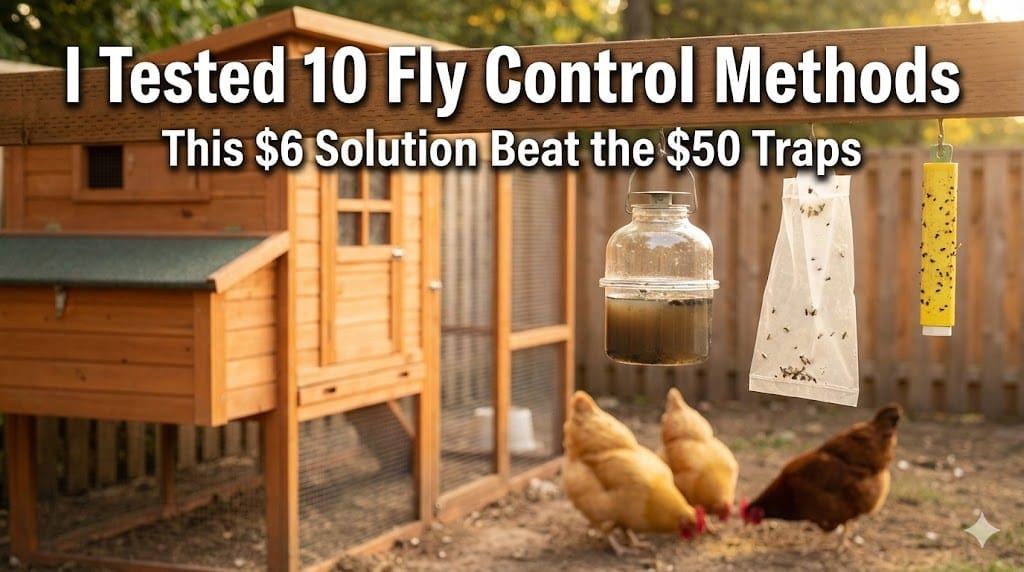
Last summer, my chicken coop had a fly problem so bad I could barely collect eggs without swatting constantly. It was gross, frustrating, and I was worried about my hens getting sick. If you’re wondering whether flies actually pose a health risk, I wrote a complete guide on whether flies are dangerous for chickens—spoiler: they can carry tapeworms and other parasites. I tried everything—expensive commercial traps, DIY solutions from Pinterest, and even those weird water bags with pennies that my neighbor swore by.
After wasting over $100 on products that barely made a dent, I decided to run a real test.
I set up 10 different fly control methods around my coop and counted the results over 48 hours. The winner? A $6 baited jar trap that caught more flies than products costing ten times as much. But the real surprise was which popular methods completely flopped.
If you are searching for the best fly control for chicken coops, this guide shares my actual test results—no sponsored content, no guesswork. Just what worked (and what didn’t) in my backyard flock of 12 hens.
Quick Answer: The best fly control for chicken coops is a multi-pronged approach: baited jar traps (like the Starbar Captivator) for immediate knockdown, Fly Predators for long-term prevention, and daily manure management to eliminate breeding grounds.
Why Are There So Many Flies Around My Chicken Coop?
Before we get into the traps, we have to talk about why the flies are there. Flies are looking for two things: food and a place to lay eggs. Unfortunately, a chicken coop offers an all-you-can-eat buffet for them.
The 4 Things That Attract Flies to Your Flock
If you don’t manage these four things, even the best trap won’t save you:
- Manure Accumulation: This is the big one. According to Penn State Extension (extension.psu.edu), fresh poultry manure is approximately 75-80% moisture, and flies breed in manure with moisture content between 50-85%—making moisture management the most important factor in fly control. Fly larvae (maggots) thrive in these conditions.
- Wet Bedding: Flies love moisture. If your pine shavings or straw are damp, it’s a breeding ground.
- Spilled Feed: Wet chicken crumble ferments quickly, creating a sour smell that flies can’t resist.
- Broken Eggs: If a hen steps on an egg and it isn’t cleaned up immediately, it will draw a crowd of pests instantly.
My 48-Hour Fly Control Test: How I Set It Up
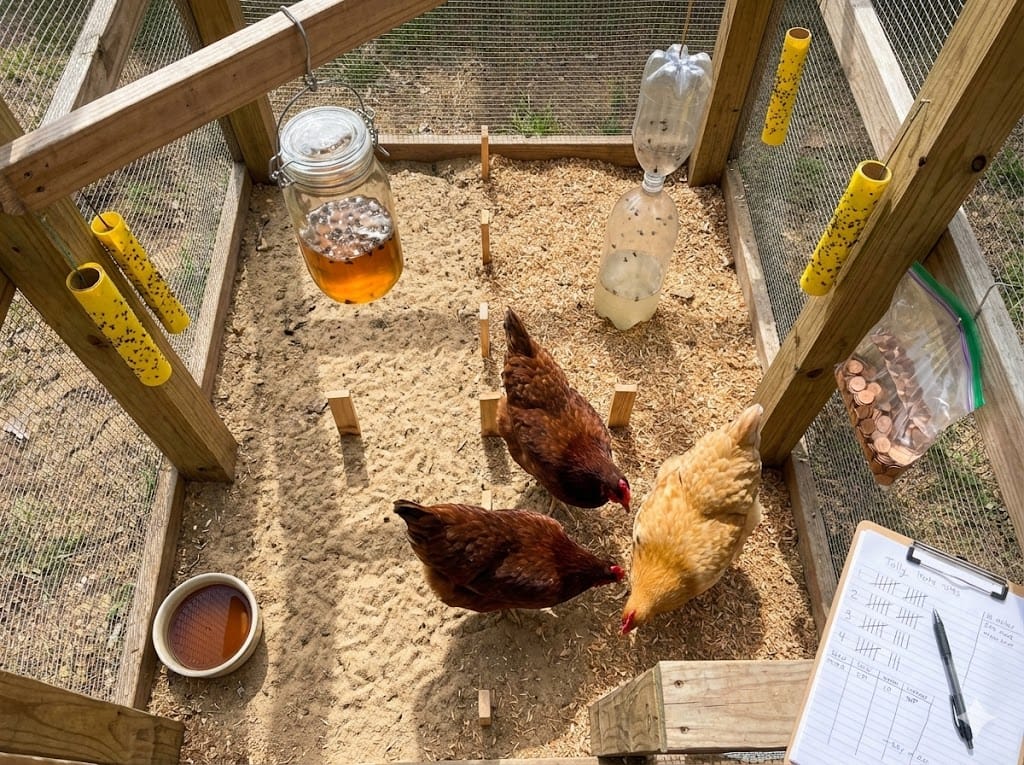
I didn’t want to just guess what worked. I wanted numbers. I set up this test in mid-July when the heat and humidity were high—peak fly season. I placed traps in different “zones” around my run (never inside the coop where birds could reach them, unless they were enclosed).
The 10 Methods I Tested (Cost Breakdown)
Here is exactly what I tested, ranging from free DIY options to expensive biological controls.
| Method | Type | Approx Cost |
|---|---|---|
| Starbar Captivator | Baited Trap | $6.00 |
| Rescue! Disposable Trap | Baited Trap | $7.00 |
| TERRO Super Fly Roll | Sticky Trap | $9.00 |
| Homemade Soda Bottle | DIY Trap | Free |
| ACV & Dish Soap | DIY Trap | $1.00 |
| Water Bag with Pennies | Visual Repellent | $0.10 |
| Vanilla Tree Fresheners | Repellent | $3.00 |
| Essential Oil Spray | Repellent | $5.00 |
| Diatomaceous Earth | Desiccant | $15.00 (bag) |
| Fly Predators | Biological | $20.00/shipment |
How I Counted and Compared Results
For the traps that catch flies, I counted the bodies after exactly 48 hours. For the repellents, I did counts of “flies landing per minute” on the coop door to see if the traffic decreased. It wasn’t a perfect science lab, but the results were clear enough to change how I manage my coop.
My 48-Hour Catch Count:
| Trap Name | Approx Cost | Flies Caught (48 Hours) |
|---|---|---|
| Starbar Captivator | $6.00 | 347 |
| Rescue! Disposable | $7.00 | 290 |
| TERRO Super Fly Roll | $9.00 | 62 |
| Homemade Soda Bottle | Free | 41 |
| ACV & Soap | $1.00 | 8 (mostly gnats) |
| Water Bag w/ Pennies | $0.10 | 0 |
Best Fly Trap for Chicken Coop: Commercial Options Ranked
After two days of testing, the commercial products definitely outperformed the DIY options in terms of raw numbers. Here is the deep dive on the top three contenders.
1. Starbar Captivator Fly Trap (The $6 Winner)
This was the absolute winner. In 48 hours, this thing was nearly black with dead flies.
- The Setup: It’s a heavy-duty reusable plastic jar. You drop a water-soluble pouch of attractant inside, add water, and screw the lid on. The top has a “one-way” entry system that lets flies crawl in but not out.
- The Science: The attractant is a feeding stimulant combined with a sex pheromone. To a fly, it smells like the best meal of their life.
- The “Gross” Factor: High. Because it is reusable, you eventually have to empty it. Pouring out a “soup” of thousands of dead flies is not for the faint of heart.
- My Advice: Do not hang this right next to your coop door or your back porch. Backyard Poultry magazine (backyardpoultry.iamcountryside.com) recommends placing fly traps outside the coop rather than inside, since the attractant can actually draw more flies toward your birds. Hang it about 20 feet away from the coop to lure flies away from your birds.
2. Rescue! Disposable Fly Trap
This came in a very close second place. It works on the exact same principle as the Starbar but offers a major convenience upgrade.
- The Setup: It comes in a plastic bag. You cut the top plastic circle, pull it up to create a funnel, and add water to the fill line.
- The Performance: It caught almost as many flies as the Starbar. The bait is powerful and activates within a few hours of adding water.
- The Advantage: When it is full, you just close the cap and toss the whole thing in the trash. No cleaning required.
- The Verdict: If you have a weak stomach and can’t handle emptying the Starbar jar, pay the extra dollar for this disposable version. It’s worth it.
- Full disclosure: I accidentally left the Rescue trap in the sun and the bag expanded so much I thought it would pop. Keep an eye on them in extreme heat!
3. TERRO Super Fly Roll (Sticky Trap)
I tested the TERRO Super Fly Roll, which is basically giant fly paper.
- The Setup: You pull a ribbon of sticky paper out of a tube. It has a specific visual pattern printed on it that is supposed to attract flies visually.
- The Performance: It caught about 60 flies in two days. It works, but it can’t compete with the smell-based traps for volume. It is better for catching “stragglers.”
- The Major Risk: Backyard chicken keepers on the BackYard Chickens forum (backyardchickens.com) consistently warn against hanging sticky traps inside coops where chickens can fly into them. ImaginAcres warns: “Chickens will absolutely fly into them, get stuck in the dead-fly goo, and then panic because they can’t get it off.” I learned this the hard way with my Leghorn.
- Interesting Science Note: Research published in the NIH’s Parasites & Vectors journal found that blue sticky traps caught significantly more house flies than yellow traps—nearly three times as many in controlled tests. This may explain why some sticky traps work better than others depending on their color.
- Best For: High rafters in a barn or garage where birds and bats cannot physically reach.
The “Odor Test”: Which Traps Made My Backyard Smell Worse?
Here’s something nobody warns you about—some fly traps smell worse than the flies themselves. I ranked each trap by smell:
| Trap | Odor Level (1-10) | Description |
|---|---|---|
| Starbar Captivator | 9/10 | Rotting meat smell (gag-inducing close up) |
| Rescue! Disposable | 8/10 | Strong but contained until full |
| Homemade Shrimp Bottle | 7/10 | Fishy and gross, especially in heat |
| ACV Trap | 2/10 | Barely noticeable vinegar scent |
| Sticky Rolls | 0/10 | Completely odorless |
Best DIY Fly Control for Chicken Coops: Homemade Traps That Actually Work
If you are on a tight budget or just love a project, here is how the homemade solutions stacked up.
4. Homemade Fly Trap for Chicken Coop: The Soda Bottle Method
This is the classic DIY trap. I cut the top third off a 2-liter soda bottle, inverted it like a funnel, and taped it back together.
- The Bait Test: I tried sugar water in one and a piece of raw shrimp in another. The shrimp bottle won by a landslide.
- The Result: It caught about 40 flies.
- Verdict: It works, but the hole is often too big, allowing smart flies to escape. It’s a great free start, but commercial traps are 10x more effective.
5. Apple Cider Vinegar (ACV) & Dish Soap
I put a bowl of ACV with a few drops of dish soap on top of the nesting boxes. Apple cider vinegar has tons of other uses for your flock too—I cover them all in my guide on how to use apple cider vinegar for chickens.
- The Theory: The soap breaks the surface tension, so when flies land to drink, they sink and drown.
- The Reality: It caught mostly fruit flies and gnats, but very few common house flies. House flies want protein and filth; fruit flies want fermenting sugar.
- Verdict: Save this for your kitchen counter. It is not strong enough for the barnyard.
6. Water Bag with Pennies
You have probably seen this on Facebook. You fill a Ziploc bag with water, drop in a few shiny pennies, and hang it up.
- The Theory: Light refraction from the water and copper confuses the flies’ compound eyes, scaring them away.
- My Honest Result: Flies landed on the bag.
- Verdict: Look, I really wanted the water bag trick to work. It’s free! It would have been perfect. But my flies literally landed ON the bag like it was a rest stop. While some homesteaders swear by this method, results vary widely. Personally, I found it to be a myth.
7. Vanilla Tree Fresheners
I read a forum post claiming flies hate the smell of vanilla. I hung five “Little Trees” air fresheners around the run.
- The Result: My coop smelled like a weird mix of vanilla and chicken poop. The flies did not care at all.
- Verdict: According to comments on The Prairie Homestead (theprairiehomestead.com), some chicken keepers report dramatic fly reduction using vanilla-scented car fresheners. However, results appear inconsistent, and my personal test showed no measurable effect. Your mileage may vary.
How to Get Rid of Flies in Chicken Coop Naturally
I prefer not to use harsh chemicals around my birds. Here is the detailed breakdown of the natural repellents and biological controls.
8. Essential Oil Spray (Peppermint)
I mixed 2 cups of water, 1 cup of white vinegar, and 20 drops of peppermint essential oil in a spray bottle.
- The Application: I sprayed this around the door frames and window ledges (never directly on the birds).
- The Effect: The fly activity dropped noticeably for about 2 hours after spraying.
- Why It Works: Peppermint is a strong scent that masks the smell of the manure. If flies can’t smell the poop, they don’t swarm as heavily. I’ve written a separate guide on how to keep a chicken coop from smelling that covers odor control strategies in detail.
- Verdict: Great for short-term relief (like when you are having guests over), but you have to re-apply it constantly.
What Smell Do Flies Absolutely Hate?
Flies are repelled by strong aromatic herbs. Based on my testing and reports from experienced chicken keepers on ImaginAcres (imaginacres.com), these scents work best:
- Peppermint (strongest effect)
- Basil (one commenter reported complete fly elimination)
- Rosemary
- Lavender
- Citronella
- Thyme
I hung fresh herb bundles inside my coop and noticed reduced fly activity within 24 hours.
9. Diatomaceous Earth (DE)
Diatomaceous Earth is a fine powder made from fossilized algae.
- The Mechanism: It is microscopic and sharp. When insects walk through it, it cuts their exoskeleton and dehydrates them.
- How I Used It: I sprinkled a light dusting on the poop board and in the corners of the coop. If you want to learn more about using DE safely, check out my full guide on diatomaceous earth for chickens—it covers dosage, application methods, and safety precautions. You can also sprinkle it in areas where chickens take their dust baths. Not sure how to set one up? Here’s my guide on how to set up a dust bath for chickens.
- Result: It helps dry out the manure. Dry manure = fewer larvae. It targets the babies (maggots), not the adults.
- Safety Note: ONLY use “Food Grade” DE. You must wear a mask when applying it—the dust is bad for your lungs (and your chickens’ lungs). Once the dust settles, it is safe.
10. Fly Predators (The Long-Term Solution)
This was the most unique product I tested.
- What They Are: Fly Predators are tiny parasitoid wasps. They are so small you can barely see them, and they do not sting humans or chickens.
- How They Work: You buy them by subscription. They arrive in a bag of wood shavings containing pupae. You pour them out near manure piles. The tiny wasps hatch, find fly cocoons, and lay their own eggs inside, eating the fly before it is born. I ordered mine directly from Spalding Labs, the primary supplier of these beneficial insects. According to The Prairie Homestead (theprairiehomestead.com), their Bye Bye Insect fly repellent spray is also highly recommended as an all-natural, essential oil-based option.
- The Test: This is a long game. I started releasing them in April. By July (during this test), my fly population was significantly lower than my neighbor’s.
- The Catch: According to poultry experts at The Prairie Homestead (theprairiehomestead.com), fly predators should be placed where chickens cannot access them, as chickens will eat the beneficial insects.
- Verdict: Highly recommended for anyone with a permanent flock. It stops the cycle.
Best Fly Control for Chicken Coops Outdoor: Protecting Your Run
The run is usually where the smell comes from, so it’s where the flies gather.
What’s the Best Thing to Put in the Bottom of a Chicken Run?
If your run is mud, you will have flies. Period.
- My Recommendation: Coarse Pine Shavings or Construction Sand. For a deeper comparison of all your options, see my guide on the best flooring for a chicken coop. You can also read my comparison of hemp vs straw vs sand for chicken bedding.
- Why: Sand drains incredibly well. It acts like kitty litter—the poop dries out fast, and dry poop doesn’t attract flies. If you use the “Deep Litter Method,” pine shavings compost the manure, generating heat that can kill larvae. ImaginAcres confirms this with personal experience: “I used sand in the coop and found it held too much moisture, especially in our humid summers. Once I swapped to pine shavings, the coop stayed much drier.”
Keeping the Run Dry: The #1 Prevention Strategy
If you have a leaky roof or water pooling in your run, fix that first. No trap can outwork a wet, muddy run.
The Complete Fly Prevention System: What Actually Works
After all this testing, I realized that traps are just a band-aid. The real solution is a system.
Daily Habits That Prevent Flies
- Scoop the poop: I use a kitty litter scoop to clean the dropping trays (droppings boards) every morning and move waste to a dedicated compost bin or pile far from the coop.
- Remove treats: Don’t leave watermelon rinds or veggie scraps out overnight. This is key for keeping rats out of the coop too.
- Neutralize Ammonia: According to Meyer Hatchery Blog (blog.meyerhatchery.com), PDZ coop freshener mixed into bedding helps neutralize ammonia odors that attract flies. One experienced keeper on ImaginAcres reports using PDZ in the catchment tray with excellent results.
Weekly Maintenance Checklist
- Check the waterer: A slow drip will create a mud pit (fly heaven).
- Refresh herbs: Add new mint or basil to the nesting boxes. (See my nesting box setup guide for more tips on keeping that area clean).
The Deep Litter Method Explained
According to experienced chicken keepers on ImaginAcres (imaginacres.com), the deep litter method combined with pine shavings keeps coops significantly drier and reduces fly breeding. By building up a deep layer of pine shavings and turning it regularly, you create a compost system that essentially “cooks” fly larvae before they hatch.
Other Methods Worth Mentioning
A few methods I didn’t formally test but have heard good things about:
- Agricultural lime: A reader tip on The Prairie Homestead (theprairiehomestead.com) suggests using agricultural lime as part of your bedding routine—a light dusting under fresh bedding changes the pH so fly larvae have a harder time developing. For specific instructions, check out my guide on how to use barn lime in your chicken coop.
- Pine branches: Some permaculture experts suggest laying chopped Christmas tree branches in the coop—the acidity supposedly balances the manure’s pH.
- Solar fly traps: Arbico Organics makes a trap that uses flies’ instinct to fly upward, trapping them under a dome. Users on BackYard Chickens forum (backyardchickens.com) report great long-term results.
- Electric Insect Traps: The Poultry Site (thepoultrysite.com) mentions that UV light traps can be effective in enclosed areas, though they require power and regular cleaning.
- Automatic fly spray units: According to Meyer Hatchery Blog (blog.meyerhatchery.com), a fly spray unit mounted in the coop works wonders—most refills last a full 30 days. Pop in a can of spray and forget about it for the next month.
- The “Kitchen Sink” Spray: One chicken keeper on ImaginAcres (imaginacres.com) reports success with a mixed spray: apple cider vinegar, vanilla extract, Pine-Sol, and barn stable spray in a one-gallon sprayer, applied every other day.
Bonus Tips from the Community
- Beef Bait Tip: A commenter on ImaginAcres suggests placing a small square of beef in water inside a jar. Once you trap flies, the dead flies themselves attract more. When emptying, leave a few behind to keep the scent strong.
- Muscovy Ducks: A reader on The Prairie Homestead swears by Muscovy ducks, calling them “the best fly-eating ducks ever,” noting that pig farmers often use them to control fly populations.
- Magnetic Screen Doors: Another tip from The Prairie Homestead suggests installing magnetic screen curtains on door frames. Users reported it cut down the fly population entering structures by at least 75%.
How Do Farmers Keep Flies Away?
While backyard chicken keepers often rely on traps, farmers dealing with hundreds of livestock use different methods. They rely heavily on Integrated Pest Management (IPM). Research from the University of Arkansas Division of Agriculture (uaex.uada.edu) confirms that insecticides alone rarely result in satisfactory fly control—an integrated approach combining cultural, mechanical, biological, and chemical methods is recommended. This includes:
- Biological Control (Fly Predators): This is the gold standard for farms. Farmers release thousands of parasitoid wasps monthly to stop the breeding cycle entirely. According to Pennsylvania Ag Connection (pennsylvaniaagconnection.com), effective fly monitoring means aiming for fewer than 100 flies per monitoring tool, and introducing beneficial insects like parasitic wasps can bolster natural fly control without pesticides.
- Manure Management: Farmers use large industrial fans to keep manure dry (dry manure means no maggots). They also frequently move or compost piles to generate heat that kills larvae.
- Feed-Through Larvicides: Some commercial operations use feed additives that pass through the bird’s digestive system and remain active in the manure, preventing larvae from developing.
- Rotation: They rotate pesticides to prevent flies from building immunity to chemicals.
What Fly Killer Is Safe for Chickens?
This is the question I get asked most often.
Safe Options Ranked
- Fly Predators: Zero risk to birds. These beneficial insects are part of a broader natural approach. For more chemical-free strategies, see my guide on natural ways to keep parasites out of your coop.
- Food-Grade Diatomaceous Earth: Safe if dust is managed.
- Herbal Sprays: Safe if natural.
- Traps OUTSIDE the coop: Safe because birds can’t reach them.
What to Avoid
- Chemical Sprays: Never spray permethrin or standard bug spray directly on bedding or feed unless prescribed by a vet.
- Sugary Baits inside the run: If a chicken eats a fly that has been poisoned by a chemical bait, the chicken can get sick.
Can I Spray Fly Spray in My Chicken Coop?
You should avoid commercial aerosol cans like Raid. They are toxic to birds’ sensitive respiratory systems. Stick to the DIY peppermint spray I mentioned earlier, or look for poultry-specific sprays containing permethrin if you have a severe infestation (but follow the label exactly).
Small Black Flies in Chicken Coop: A Different Problem
During my test, I noticed clouds of tiny black bugs that weren’t house flies. These are likely fungus gnats.
They don’t care about the stinky jar traps. They love moisture. If you have these, it means your bedding is too wet. The fix isn’t a trap—it’s cleaning out the damp bedding and improving ventilation. If you aren’t sure if you have enough airflow, read my article on how much ventilation your coop actually needs.
My Final Verdict: The Best Fly Control for Chicken Coops
After 48 hours and a lot of counting, here is my final breakdown:
| Winner | Method | Why? |
|---|---|---|
| Best Overall Effectiveness | Starbar Captivator | Caught 300+ flies. Ugly, smelly, but it works. |
| Best Budget/DIY | Soda Bottle Trap | Free and reasonably effective. |
| Best Long-Term Prevention | Fly Predators | Stops them before they start. |
| Best Natural Repellent | Peppermint Spray | Smells great and keeps them away temporarily. |
My current rotation system is simple: I use Fly Predators monthly for prevention, I keep the coop dry, and I hang one Starbar trap about 30 feet away from the coop to draw stragglers away.
Experienced chicken keeper ImaginAcres (imaginacres.com) reports that combining baited jar traps with sticky fly rolls was the most effective solution for knocking down a fly infestation fast. She noted, “Within three hours, the roll was completely coated. I couldn’t even see the strip anymore, just a thick, buzzing blanket of flies.”
Frequently Asked Questions
What is the best bug repellent for chicken coops?
The best repellent is a mixture of peppermint essential oil, vinegar, and water sprayed on surfaces. For actual elimination, baited jar traps placed away from the coop are superior.
How often should I clean my coop to prevent flies?
Ideally, scoop manure off the droppings board daily. Do a full bedding change whenever you smell ammonia or see damp spots.
Do vanilla air fresheners really work?
Not really. While flies don’t love the smell, a vanilla tree freshener isn’t strong enough to overpower the scent of chicken manure.

Oladepo Babatunde is the founder of ChickenStarter.com. He is a backyard chicken keeper and educator who specializes in helping beginners raise healthy flocks, particularly in warm climates. His expertise comes from years of hands-on experience building coops, treating common chicken ailments, and solving flock management issues. His own happy hens are a testament to his methods, laying 25-30 eggs weekly.