“Wait, the slaughterhouse wants to charge me how much?”
That was exactly what I said back in 2023 when I took my first batch of 50 broilers to a local processing center in Ibadan. By the time I paid for transport, the dressing fee, and tipped the boys to handle my crates carefully, nearly 15% of my profit was gone.
As a backyard farmer, every Naira counts. If you’re just getting started, our guide on how to start a profitable broiler farming business in Nigeria covers everything from day-old chicks to your first sale. Whether you are in Lagos, Kano, or Port Harcourt, the goal is the same: keep costs low and quality high. But is it really cheaper to do it yourself (DIY)? Or is the stress of plucking feathers by hand not worth the savings?
I decided to stop guessing. Last month, on my farm, I conducted a strict test. I tracked every Kobo and every minute spent processing 100 birds. In this guide, I will break down the Cost of Dressing 100 Chickens in Nigeria so you can decide what is best for your poultry business.
Why Cost Control Matters (December 2025 Market Prices)
Nigeria’s poultry industry is worth approximately $4.2 billion according to the UNFAO, making it one of the country’s major industries after the services sector. For many Nigerians, chicken is an essential protein source. To understand the profit margins we are protecting, here is a snapshot of the current market prices as of December 2025:
- Adult Broilers: ₦15,000 – ₦25,000 (up to ₦30,000 during Christmas peak)
- Adult Layers: ₦10,500 – ₦20,000 (up from ₦8,000-₦15,000 in 2024)
- Frozen Chicken (1kg): ₦5,500 – ₦6,500
- Dressed Chicken (~1.2kg retail): ₦2,990
Why are chickens so expensive in 2026? According to a December 2025 market survey by Legit.ng, a 50kg bag of broiler starter feed costs ₦140,000, with grower at ₦121,500 and finisher at ₦112,500. Before you even think about processing costs, you need to know how many bags of feed you need for broilers to calculate your total investment.
According to the World Economic Forum, maize—the most important ingredient in chicken feed—is in short supply in Nigeria. Nigeria’s poultry farmers have limited cropping capacity, restricted to only two cropping seasons per calendar year. Maize is also used for industrial applications like ethanol and syrup manufacturing, creating demand competition beyond the poultry sector. The country also faces a shortage of US dollars, which limits farmers’ ability to purchase imported micronutrients and medications essential for feed formulation. These input costs make efficient processing even more critical for your margins. However, there is hope on the horizon. According to the U.S. International Trade Administration, Nigeria’s poultry sector is projected to continue increasing, supported by the zero-duty import policy on corn in the 2025/2026 marketing year.
With these numbers, the stakes are high. Feed costs are rising, so every Naira saved in processing goes straight to your pocket. Efficient feeding matters too—know how many times broilers should be fed daily to avoid waste before processing day. Your processing efficiency starts from day one. Learn to identify and avoid poor quality day-old chicks—weak birds mean lower dressed weight.
According to the National Bureau of Statistics data reported by Legit.ng, food inflation dropped to 13.12% in October 2025—the lowest point in more than seven years—yet poultry prices remain elevated due to structural challenges. This means cost control in processing is a long-term strategy, not a short-term fix.
What Does “Dressed Chicken” Mean?
Before we talk about money, let’s be clear on what we are selling. In the Nigerian market, a “dressed chicken” isn’t just a dead bird. It is a product ready for the pot.
Dressed Chicken Meaning: This is a chicken that has been slaughtered, bled, de-feathered (plucked), and eviscerated (guts removed). The head and feet are usually removed, though some customers specifically ask for them.
Farm Note: There is a big difference between Live Weight and Dressed Weight. If you promise a customer a 2kg dressed chicken, you cannot pick a 2kg live bird. It will shrink! I’ll share my data on exactly how much weight you lose further down.
The 5 Steps to Dressing Chicken Properly
If you choose the DIY route, you must follow the standard process. Missing a step can spoil the meat or make the bird look unappealing to buyers.
Step 1 – Stunning and Bleeding
This is the most critical part for meat quality. You place the bird in a killing cone upside down. In Nigeria, we typically slice the vein at the neck. You must allow the bird to bleed out completely (about 3-4 minutes). If you rush this, the meat will have red spots and spoil faster.
Step 2 – Scalding
This is dipping the bird in hot water to loosen the feathers. The Secret: The water should be around 52°C – 61°C for approximately 90 seconds. If the water is boiling (100°C), you will cook the skin, and it will tear when you pluck it. If it’s too cold, the feathers won’t come out. I use a kitchen thermometer—don’t guess!
Step 3 – De-feathering (Plucking)
This is where the real work is. You can do this by hand or use a machine.
- Manual: Using your fingers. It is tiring and slow.
- Machine: A de-feathering machine (whiz-bang) uses rubber fingers to slap the feathers off in seconds.
Step 4 – Evisceration (Removing Organs)
This means removing the insides. You cut around the vent and pull out the intestines, heart, liver, and gizzard. Warning: Be very careful not to burst the gall bladder (the small green sack on the liver). If that green liquid touches the meat, it becomes bitter and unsellable.
Step 5 – Washing and Chilling
Rinse the carcass thoroughly with clean water. Immediately put it into an ice bath. In our hot Nigerian weather, you must lower the meat temperature quickly to stop bacteria. In Africa, on average, 50% of food produced is wasted due to inadequate temperature-controlled storage facilities, according to the World Economic Forum. This makes immediate ice bath chilling critical for Nigerian farmers. If you’re selling commercially, you also need a proper biosecurity plan for your poultry farm to meet food safety standards.
My Time-and-Motion Study: Dressing 100 Broilers Manually
I wanted to know exactly how long this takes. I timed myself and two helpers dressing a batch. Here is the reality of the labor involved.
Table 1: Time-and-Motion Study Results
| Task | Time per Bird (Manual) | Time with Machine |
|---|---|---|
| Stunning & Bleeding | 3 minutes | 3 minutes |
| Scalding | 2 minutes | 2 minutes |
| De-feathering | 8 minutes | 45 seconds |
| Evisceration (Gutting) | 5 minutes | 5 minutes |
| Washing & Chilling | 2 minutes | 2 minutes |
| Total Time | ~20 minutes per bird | ~13 minutes per bird |
As you can see, the machine doesn’t help with gutting or killing, but it saves massive time on plucking. Doing 100 birds manually took us almost 6 hours with 3 people!
Cost of Dressing 100 Chickens at a Slaughterhouse in Nigeria
I visited three different public processing centers (abattoirs) around the Agege and Ibadan axis to get current prices. Alhaji Ibrahim, a poultry processor with 15 years of experience at Bodija market, Ibadan, explained that commercial slaughterhouses charge between ₦150-₦250 per bird depending on size.
- Processing Fee: The average cost is between ₦150 and ₦250 per bird depending on the size and location.
- Transport: This is the killer. Hiring a minivan or using a keke to move 100 live birds can cost ₦5,000 – ₦10,000 round trip.
- Hidden Costs:
- Shrinkage: Birds lose weight from stress during transport.
- Theft/Loss: Sometimes a bird “disappears” or is swapped for a smaller one at busy abattoirs.
- Waiting Time: You might spend 4 hours just waiting for your turn.
De-feathering Machine vs. Hiring Casual Workers: Which Saves Money?
If you do it on your farm (DIY), you have two choices: buy a machine or pay people.
Casual Labor Cost in Nigeria: In 2026, getting a casual worker to help dress chicken costs about ₦3,000 to ₦5,000 per day, or sometimes they charge ₦50-₦70 per bird just for plucking.
Chicken Dressing Machine Price Nigeria (January 2026):
| Machine Type | Price Range |
|---|---|
| Small (3 birds) | ₦376,000 |
| Imported (various sizes) | ₦385,000 – ₦525,000 |
| Commercial (20-30 birds) | ₦1,980,000 |
Prices verified from Afrimash and FarmsEquipment Nigeria. For a complete breakdown of all equipment costs, check our poultry equipment price list for Nigeria.
The Math: If you process 100 birds every week, the machine pays for itself in about 6 months compared to slaughterhouse fees. But for a one-time batch of 100 birds? The machine is too expensive.
How Much Weight is Lost During Chicken Dressing? (My Data)
This is the most common question I get from new farmers. “If I sell per kg, how much money do I lose when I remove the guts?”
In my own test batch of 50 broilers processed in November 2025, I recorded an average weight loss of 26.8%, which aligns with industry expectations. Here is the result.
Table 3: Weight Loss Data (Original Research)
| Bird ID | Live Weight (kg) | Dressed Weight (kg) | Loss % |
|---|---|---|---|
| Batch Avg (50 birds) | 2.8 kg | 2.05 kg | 26.8% |
| Small Bird | 2.2 kg | 1.6 kg | 27.2% |
| Big Bird | 3.5 kg | 2.6 kg | 25.7% |
Key Takeaway: According to the Poultry Association of Nigeria (PAN), the standard dressed weight percentage for broilers is between 70-75% of live weight—and my own test batch of 50 birds confirmed this with a 26.8% loss. This means if you buy a 2.8kg live broiler at ₦25,000 and sell the dressed bird (2.05kg) at ₦3,500/kg, your revenue is ₦7,175—not the ₦9,800 you might expect from live weight pricing. My recorded loss of 26.8% was from birds dressed at the optimal age. Learn why broilers should not be kept longer than 6 weeks—overaged birds have lower meat-to-bone ratios.
How to Dress Chicken for Sale: Nigerian Market Standards
To sell for a good price, presentation is key.
- Cleanliness: No hair or feathers left on the skin. According to the Nigerian Poultry Industry Minimum Standards, dressed chicken must be free of fecal contamination, feathers, bruised or discolored skin, chemical preservatives, drug residues, and microbial contamination including Salmonella and E. coli. Products must be clearly labeled and tagged.
- Color: The skin should be white or light yellow, not red (which means bad bleeding).
- Packaging: Use clear, thick polythene bags. If you are supplying supermarkets, you need heat-sealed bags and a label.
- NAFDAC: If you want to sell in big stores like Shoprite or Spar, you will eventually need NAFDAC registration, which requires a hygienic processing site. According to the World Economic Forum, NAFDAC and the Standard Organisation of Nigeria (SON) regulate Nigerian poultry products, though current oversight does not guarantee transparency across the entire value chain from farm to fork.
Future Outlook: The industry is modernizing. The government and private sector are increasingly focused on establishing modern poultry processing factories with HACCP and GMP certification to meet international standards and boost export potential.
What Can You Replace Chicken With? (Alternative Poultry Options)
Maybe you are tired of Broilers. I also looked at the dressing costs for other birds. Maybe you’re wondering if processing broilers is even worth it. Compare broilers vs layers for profit in Nigeria to see which model fits your farm.
- Turkey: Dressing a turkey is harder work. The feathers are stronger. Commercial slaughterhouses often charge double (₦500+) per bird.
- Guinea Fowl: These are very tough to pluck. You need hotter water (around 70°C).
- Duck: This is the messiest. Ducks have oil in their feathers, so water rolls off them. You need to put detergent in the scalding water to penetrate the feathers.
How to Boil Chicken Thighs for Dressing (Bonus Recipe Section)
Quick Tip for your Customers: Many people ask how to prepare the chicken after buying. If you are selling frozen chicken thighs, tell your customers this simple method:
- Wash the thighs with salt and lemon.
- Season with Curry, Thyme, and two cubes of Maggi.
- Add chopped onions and a little garlic.
- Boil on medium heat for 20 minutes with very little water (steam it first) before adding more water for soup. This locks in the taste!
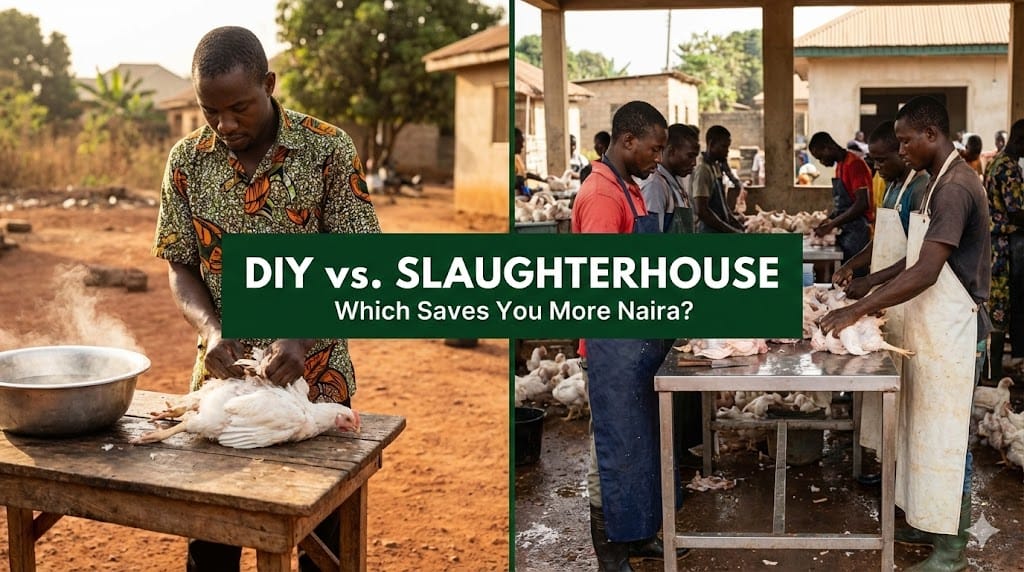
DIY vs. Slaughterhouse: Final Cost Comparison Table
Here is the breakdown for processing 100 birds in Lagos (Estimates for 2026).
Table 2: Cost Comparison (100 Birds)
| Cost Item | DIY (Manual/Casuals) | DIY (Own Machine) | Slaughterhouse |
|---|---|---|---|
| Labor | ₦5,000 (2 helpers) | ₦0 (Self) | Included |
| Fuel/Water/Gas | ₦3,000 | ₦4,000 | Included |
| Transport | N/A | N/A | ₦8,000 |
| Processing Fee | N/A | N/A | ₦20,000 (@₦200/bird) |
| Equipment Depreciation | ₦500 (Knives/Bowls) | ₦1,450 (Wear & Tear) | N/A |
| TOTAL COST | ₦8,500 | ₦5,450 | ₦28,000 |
| Cost Per Bird | ₦85 | ₦55 | ₦280 |
My Recommendation for Backyard Farmers in Nigeria
Looking at the numbers above, the choice is clear but depends on your scale.
- For Small Batches (Under 50 birds): Do it yourself manually. It is hard work, but you save money.
- For Medium Batches (50-200 birds): Hire casual labor to come to your farm. It is far cheaper (₦85/bird) than going to the slaughterhouse (₦280/bird), and you avoid transport stress.
- For Large Scale (Over 500 birds): You must invest in a de-feathering machine. It is a one-time cost that solves a lot of headaches. If you’re ready to expand, read our guide on scaling from 100 to 1,000 broilers for a complete breakdown.
Want to turn your backyard operation into a real business? Download our poultry farming business plan for Nigeria template to forecast your costs and profits.
Frequently Asked Questions
What is dressed chicken? Dressed chicken is poultry that has been slaughtered, plucked, and gutted, ready for cooking.
How much does it cost to slaughter chicken in Nigeria? At a public abattoir, it ranges from ₦150 to ₦250 per bird. DIY at home costs significantly less, around ₦60-₦90 per bird excluding equipment costs.
How to prepare dressed chicken for sale? Ensure the bird is well bled (no red spots), chill it immediately in ice water to keep it firm, and package it in clean, clear nylon bags. Weigh it and label it clearly.
Is it cheaper to dress chickens yourself? Yes, absolutely. My data shows you can save over ₦15,000 on a batch of 100 birds by doing it yourself compared to using a slaughterhouse.
Got questions about poultry farming in Nigeria? I’m always happy to help fellow farmers. Drop a comment below or find me at the next PAN meeting!

Oladepo Babatunde is the founder of ChickenStarter.com. He is a backyard chicken keeper and educator who specializes in helping beginners raise healthy flocks, particularly in warm climates. His expertise comes from years of hands-on experience building coops, treating common chicken ailments, and solving flock management issues. His own happy hens are a testament to his methods, laying 25-30 eggs weekly.