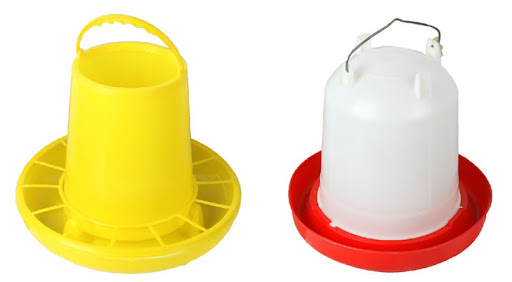
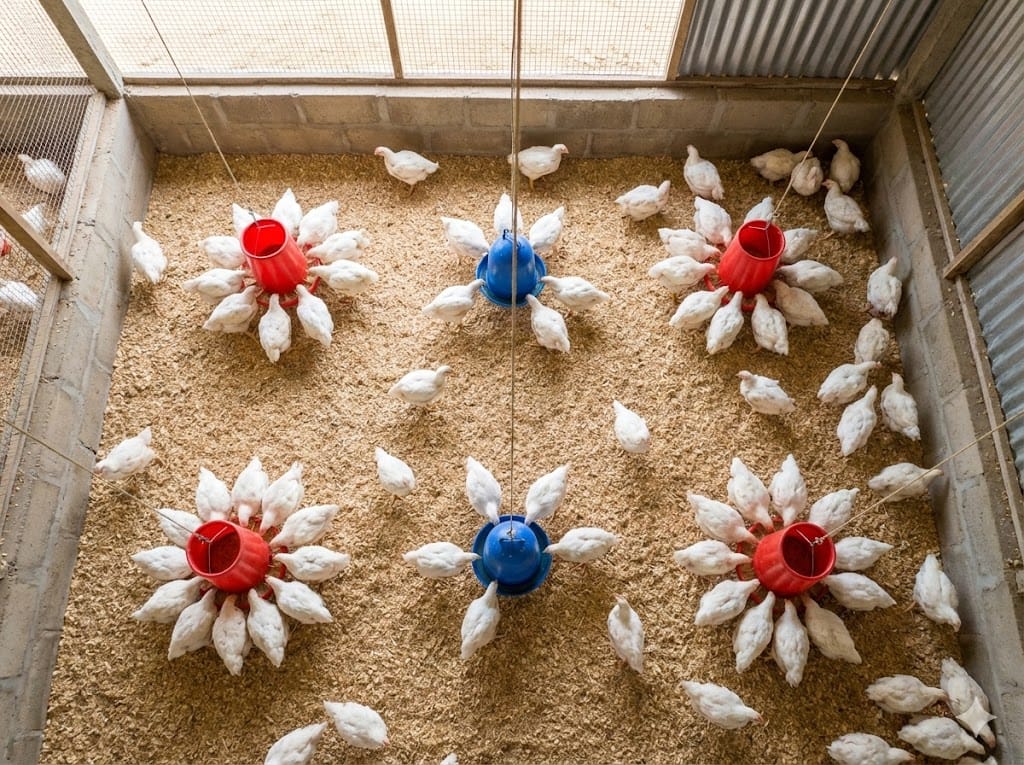
For 100 broilers at 6+ weeks, you need 4 hanging tube feeders and either 10-17 nipple drinkers or 2 large bell drinkers. This provides the required 3 inches of feeder space per bird according to Hubbard Homestead guidelines. At week 6, your 100 broilers will consume approximately 12.8 kg of feed and 22-26 litres of water daily, with consumption increasing significantly in Nigerian heat conditions.
Getting the right number of feeders and drinkers is one of the most critical steps for ensuring healthy, uniform growth in your Nigerian broiler operation.
Quick Reference: Feeders and Drinkers for 100 Broilers
| Equipment Type | Quantity Needed | Key Specification |
|---|---|---|
| Hanging tube feeders | 4 feeders | 3 inches per bird at 6+ weeks |
| Nipple drinkers | 10-17 nipples | 1 nipple per 6-10 birds (finisher) |
| Bell drinkers | 2 drinkers | 1 per 60 birds at finisher stage |
| Daily feed (Week 6) | 12.8 kg | Increases weekly as birds grow |
| Daily water (Week 6) | 22-26 litres | Increases 40-50% in Nigerian heat |
This guide covers small and medium-scale flock owners raising 10 to 500 broilers in Nigeria. Whether you’re using a deep litter or battery cage system, these recommendations will help you set your flock up for maximum profitability.
The number of feeders and drinkers you need also depends on your specific housing system and local climate conditions.
Here’s where many Nigerian farmers get this wrong: they underestimate equipment needs during the critical final weeks when broilers eat and drink the most.
Why Proper Feeder and Drinker Setup Matters in Nigeria
Nigerian poultry farmers face unique challenges that make proper equipment setup even more critical.
Heat stress is a constant concern: Temperatures regularly exceed 35°C in many parts of Nigeria, especially during the dry season. Water consumption in broilers increases approximately 7% for each degree Fahrenheit increase in temperature. This means Nigerian temperatures could increase water needs by 40-50% above baseline.
Feed costs dominate your budget: According to industry data, feed accounts for 60-70% of total production costs in Nigerian broiler operations. Every kilogram of wasted feed cuts directly into your profit margin.
Electricity is unreliable: Many farms experience power outages that can disable automated watering systems. Having backup manual systems is not optional in Nigeria.
Most beginners make this mistake: they buy equipment for the number of day-old chicks they start with, not the full-grown broilers they’ll have at harvest.
How Many Feeders Are Needed for 100 Broilers?
For 100 broilers aged 6 weeks or older, you need four hanging tube feeders.
The goal is to provide enough linear space for birds to eat without competing. According to Hubbard Homestead broiler management guidelines, broilers need 3 inches (7.6 cm) of feeder space per bird at 6+ weeks.
For 100 birds, that’s 300 total inches of feeder edge.
A standard hanging tube feeder comfortably serves about 25 birds at this spacing. Therefore, four feeders prevent crowding and ensure timid birds get enough to eat.
For aggressive breeds like Ross 308, consider providing 4 inches per bird, which would require 5 feeders for extra margin.
Feeder Space Requirements by Age
| Age | Linear Space Per Bird | Total for 100 Birds |
|---|---|---|
| 0-1 weeks | 1 inch (2.5 cm) | 100 inches |
| 2-6 weeks | 2 inches (5 cm) | 200 inches |
| 6+ weeks | 3 inches (7.6 cm) | 300 inches |
Note: Mature birds over 20 weeks need 3-4 inches per bird.
The feeder space requirement increases significantly at 6 weeks, which is a critical point in broiler management. Learn more about why broilers should not be kept longer than 6-8 weeks for maximum profitability.
What About Trough Feeders?
If you use long trough feeders common in Nigerian markets, the same calculation applies.
You would need a total of 300 inches (7.6 metres) of trough length. Since birds can eat from both sides, a 3.8-metre-long trough provides the required space.
However, hanging tube feeders are often preferred because they protect feed from contamination and are easier to adjust for height.
According to the Hubbard Broiler Management Guide, chain feeders should provide 25 metres per 1,000 broilers at the finisher stage.
How Many Drinkers Are Needed for 100 Broilers?
For 100 broilers at finisher stage (6+ weeks), you need 10-17 nipple drinkers or 2 large bell drinkers.
Water is even more critical than feed for fast-growing broilers, especially in Nigeria’s hot climate.
Nipple Drinker Calculations
According to the Hubbard Broiler Management Guide, the nipple drinker ratio changes as birds grow:
| Stage | Nipple Ratio | Nipples for 100 Birds |
|---|---|---|
| Starter (0-2 weeks) | 1 per 10-15 birds | 7-10 nipples |
| Finisher (6+ weeks) | 1 per 6-10 birds | 10-17 nipples |
For 100 finishing broilers, plan for 10-17 nipples to ensure adequate water access.
Nipple Flow Rate Formula
Adequate nipple flow rates can be estimated using this formula:
Flow rate (ml/minute) = (7 × age in weeks) + 20
For 6-week-old broilers: 7 × 6 + 20 = 62 ml/minute
Test by pressing the nipple pin for 15 seconds and collecting the water. Multiply by 4 to get the per-minute rate.
Bell Drinker Calculations
According to the Hubbard Broiler Management Guide, bell drinker ratios also change by stage:
| Stage | Bell Drinker Ratio |
|---|---|
| Starter | 1 per 100 broilers |
| Finisher | 1 per 60 broilers |
For 100 finishing broilers, you need 2 bell drinkers (100 ÷ 60 = 1.67, round up to 2).
Using two is highly recommended for small flocks anyway. This ensures constant access and provides a crucial backup if one gets dirty or fails.
Drinking Trough Space Standard
For drinking troughs, the Hubbard Broiler Management Guide recommends 3 cm (1.2 inches) per bird at the finisher stage. In hot Nigerian weather, double this requirement.
The Critical Importance of Redundancy
Never rely on a single water source in Nigeria.
If one bell drinker gets clogged or a nipple line fails during a power outage, a second unit ensures your flock is never without water.
Dehydration can happen in just a few hours during harmattan or dry season. Birds can lose significant weight and even die within 24-48 hours without water access.
Having at least two drinkers is simple insurance against disaster.
Breed-Specific Adjustments: Ross 308 vs. Cobb 500
The two most popular broiler breeds in Nigeria, the Ross 308 and Cobb 500, have slightly different needs.
Ross 308 Recommendations
This breed is known for incredible feed conversion and rapid weight gain.
Feeder Focus: Ross 308s can be aggressive eaters. Provide 4 inches of feeder space (rather than the minimum 3 inches) and spread feeders out to prevent dominant birds from hoarding resources.
Water Management: They have a high metabolic rate, making them sensitive to water restrictions. Ensure water is always cool and readily available, especially during Nigerian dry season.
Cobb 500 Recommendations
Known for excellent health, uniformity, and strong legs, the Cobb 500 is often considered more robust and forgiving.
Feeder Focus: Slightly less aggressive at the feeder than Ross 308. Standard 3-inch feeder space works well, but pay close attention to feeder height to minimize waste.
Water Management: Their hardiness makes them resilient, but optimal water intake is key to their good health. They respond well to nipple drinkers.
Starting with healthy chicks is essential for success. Learn how to identify and avoid poor-quality day-old chicks before you bring them home.
Daily Feed and Water Consumption for 100 Broilers
The number of physical feeders and drinkers you need does not change daily. But their consumption of feed and water increases weekly as birds grow.
Daily Feed Consumption by Week
According to Nigerian poultry industry standards, a broiler needs approximately 5 kg of feed from day old to table size of about 2.5 kg, consisting of about 2 kg starter and 3 kg finisher feed.
| Week | Daily Feed per 100 Birds (kg) | Cumulative Feed (kg) |
|---|---|---|
| 1 | 1.5 kg | 10.5 kg |
| 2 | 3.2 kg | 33 kg |
| 3 | 5.4 kg | 71 kg |
| 4 | 7.4 kg | 123 kg |
| 5 | 10.2 kg | 194 kg |
| 6 | 12.8 kg | 284 kg |
| 7 | 14.8 kg | 388 kg |
| 8 | 15.6 kg | 497 kg |
These numbers help you calculate how many bags of feed you need for your broiler operation.
Daily Water Consumption by Week
Water consumption can be calculated using the formula: 5.28 ml per bird per day of age.
For Day 42 (Week 6): 5.28 × 42 = 221.76 ml per bird = 22.2 litres per 100 birds at baseline temperature.
| Week | Baseline Water (Litres) | Nigerian Heat Adjusted (Litres) |
|---|---|---|
| 1 | 4 L | 5-6 L |
| 2 | 8 L | 11-12 L |
| 3 | 12 L | 17-18 L |
| 4 | 16 L | 22-24 L |
| 5 | 19 L | 27-29 L |
| 6 | 22 L | 31-33 L |
| 7 | 26 L | 36-39 L |
| 8 | 29 L | 41-44 L |
Important for Nigerian farmers: Baseline numbers assume moderate temperatures around 21°C. Water consumption increases 7% for each degree Fahrenheit increase in temperature. In typical Nigerian conditions of 30-35°C, expect 40-50% higher consumption.
Special Considerations for the Brooding Stage
The first week of a chick’s life is the most critical, and equipment needs differ from older birds.
Chick Feed Trays (Days 1-7)
For the first few days, many Nigerian farmers use simple cardboard or plastic trays, or paper spread on the floor, sprinkled with starter crumble.
According to Hubbard guidelines, 15-25 grams of crumb or mini-pellet feed per chick on paper is recommended in 40-50% of the brooding area.
You’ll need about one square foot of tray space per 50 chicks.
A brooder guard 6-10 feet across (12-15 inches high) is sufficient for 100 chicks. Remove the guard at day 6-8.
Chick Water Founts (Days 1-7)
Small, gravity-fed waterers are ideal for chicks.
According to Hubbard Feeds starting guidelines, you need 1 quart of water for each 25 chicks. For 100 chicks, that’s 4 quarts (approximately 4 litres) of waterer capacity.
Placing clean pebbles in the water trough can prevent accidental drowning.
After 5-7 days, begin introducing larger hanging feeders and nipple or bell drinkers. Leave chick equipment in place for a day or two to ensure smooth transition.
Equipment Checklist for Starting 100 Chicks
According to Hubbard Feeds, equipment needed to start 100 baby chicks includes:
- Feeder space: 180 inches total
- Waterers: 1 quart per 25 chicks (4 quarts total)
- Two heat lamps minimum (one per 75 birds)
- Litter/shavings (not super fine): 2-4 inches deep
- Brooder guard: 12-15 inches high, removed at day 6-8
Brooding Environment Targets
| Parameter | Recommendation |
|---|---|
| Brooding temperature | 32°C (reduce 2-3°C weekly) |
| Mature bird temperature | 24°C optimal |
| Litter depth | 2-4 inches (5-10 cm) |
| Day 7 weight target | 180g benchmark |
| Ammonia threshold | Should not exceed 10-20 ppm |
Broiler Vaccination and Medication Schedule (Nigeria)
Proper vaccination is critical for bird survival to harvest. According to Artib Farm, this schedule has helped Nigerian farmers reduce mortality to below 5%.
Complete Broiler Vaccination Schedule
| Day | Treatment | Type | Route |
|---|---|---|---|
| Day 1 | Marek’s vaccine | Vaccine | Injection at hatchery |
| Day 1 | Glucose or multivitamin | Supplement | Drinking water (for transport stress) |
| Day 2-4 | Multivitamins (AM) + antibiotics (PM) | Medication | Drinking water |
| Day 5-7 | Anti-coccidiosis (AM) + multivitamins (PM) | Medication | Drinking water |
| Day 8 | 1st Gumboro (IBD) | Vaccine | Drinking water |
| Day 9 | Multivitamins | Supplement | Drinking water |
| Day 10-12 | Anti-coccidiosis + vitamins | Medication | Drinking water |
| Day 13 | 1st Lasota (Newcastle) | Vaccine | Drinking water with milk |
| Day 14-19 | Multivitamins | Supplement | Drinking water |
| Day 20 | 2nd Gumboro (IBD) | Vaccine | Drinking water |
| Day 21-23 | Multivitamins | Supplement | Drinking water |
| Day 24-26 | Anti-coccidiosis | Medication | Drinking water |
| Day 27 | 2nd Lasota (Newcastle) | Vaccine | Drinking water |
| Day 28-30 | Multivitamins | Supplement | Drinking water |
| Day 31-41 | Clean drinking water only | Withdrawal period | — |
| Day 42 | Dewormer | Medication | Oral |
Key Vaccination Guidelines for Nigerian Farmers
Marek’s vaccine timing: According to the 2026 Chicken Vaccination Schedule, Marek’s vaccination must be given within 24 hours of hatching. If you fail to vaccinate with Marek’s, birds may experience paralysis or blindness.
Lasota vaccine mixing: Mix Lasota vaccine with milk: one tablespoon of Cowbell or any other powder milk in 5 litres of drinking water. The milk helps protect the vaccine.
Water withdrawal: Deny birds water for 2 hours before vaccination so they drink the medicated water quickly and completely.
Timing: Vaccinate early morning or late evening when temperatures are cooler. Vaccines are very sensitive to heat.
Post-vaccination: Provide multivitamins after vaccination to reduce stress. Do not give antibiotics on vaccination day as this can neutralise the vaccine.
Gumboro affects chicks only, not mature chickens, so ensure you don’t miss the Day 8 and Day 20 doses.
Withdrawal period: Any day beyond six weeks (42 days), give clean drinking water only until birds are sold or slaughtered. This complies with the withdrawal method on drug labels. Electrolytes can be given if you notice heat stress.
Scaling Your Equipment: 10 to 500 Broilers
How Many Feeders for 50 Chickens?
You need 2 hanging tube feeders for 50 broilers.
At 3 inches of space per bird, 50 broilers require 150 inches of total feeder edge. Two feeders provide adequate space and reduce competition.
Place them in different areas of the pen to encourage movement and prevent dominant birds from guarding resources.
How Many Feeders for 500 Chickens?
For 500 broilers, you need approximately 20 hanging tube feeders.
At 3 inches per bird, 500 broilers require 1,500 inches of feeder space. At 25 birds per tube feeder, you need 20 feeders.
For water, you would need 50-84 nipples or 8-9 large bell drinkers.
At this scale, consider automated feeding and watering lines to ensure consistency and reduce labour. Check the current poultry equipment price list in Nigeria to budget for your setup.
Complete Scaling Chart
| Birds | Feeder Space (3″) | Tube Feeders | Nipple Drinkers | Bell Drinkers |
|---|---|---|---|---|
| 10 | 30 inches | 1 | 2 (minimum) | 1 |
| 50 | 150 inches | 2 | 5-8 | 1 |
| 100 | 300 inches | 4 | 10-17 | 2 |
| 200 | 600 inches | 8 | 20-34 | 3-4 |
| 500 | 1,500 inches | 20 | 50-84 | 8-9 |
Managing Hot Weather in Nigeria
Heat is the biggest challenge for Nigerian broiler farmers. This is what usually kills birds faster than any disease.
Increase Water Access by 40-60%
In hot or harmattan conditions, a broiler’s water consumption can nearly double.
Add extra temporary water stations and check them frequently.
Keep Water Cool
Chickens are less likely to drink warm water.
Keep water reservoirs in shade. On dangerously hot days, add blocks of ice to waterers to keep temperature down.
Many Nigerian farmers keep jerry cans of water in a cooler or buried in sand to maintain lower temperatures.
Use Fans and Ventilation
Fans that create airflow at bird level are effective for cooling birds in Nigerian humidity.
Position fans to move air across the birds without creating direct drafts on young chicks.
Encourage Feed Intake During Cooler Hours
Birds naturally eat less in heat.
Ensure feeders are full in early morning (before 8 AM) and late evening (after 5 PM) when temperatures are lower.
Learn specific strategies for feeding chickens during heatwaves.
Managing Harmattan Season
The harmattan season brings unique challenges for Nigerian poultry farmers.
Dust Control
Harmattan dust can clog nipple drinkers and contaminate bell drinkers.
Clean filters daily and check nipples for proper flow.
Cover water storage tanks to prevent dust accumulation.
Temperature Swings
Harmattan nights can be surprisingly cold while days remain warm.
Monitor birds for huddling (too cold) or panting (too hot) and adjust ventilation accordingly.
Humidity Management
Low humidity during harmattan can cause respiratory stress.
Lightly misting the floor (not the birds) can help maintain adequate humidity levels.
For comprehensive seasonal guidance, read our guide on how to manage poultry during harmattan.
Where to Put Chicken Feeder and Water
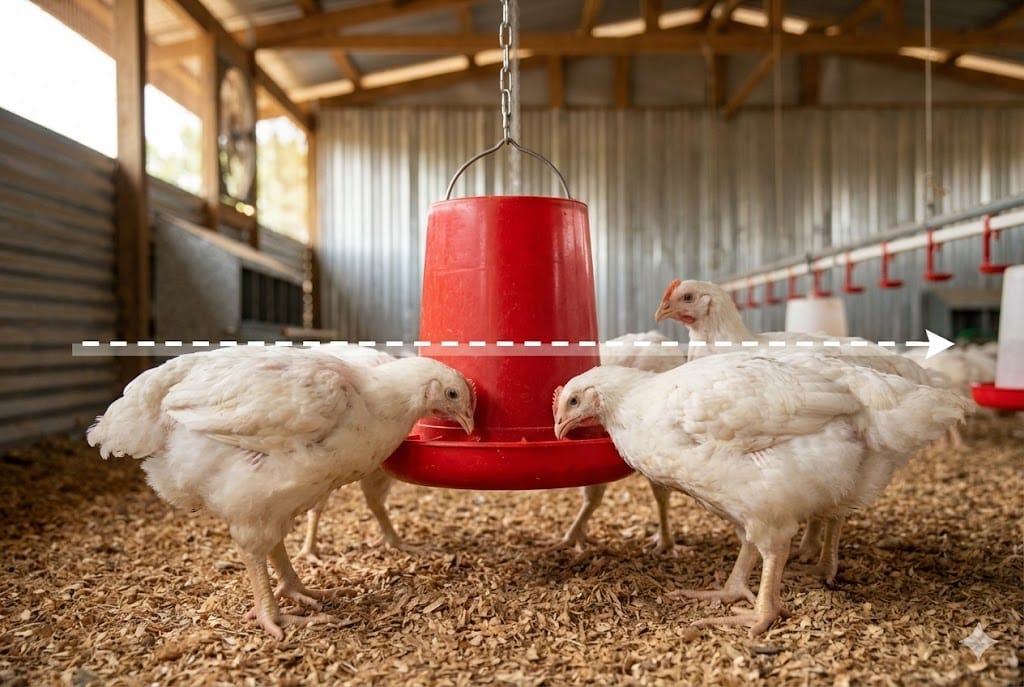
Placement matters as much as quantity.
Adjust Equipment to the Right Height
The correct height: lip of the feeder and tip of the water nipple level with the birds’ backs.
As chickens grow, raise the equipment weekly.
If equipment is too low, birds scratch feed out and kick bedding into water.
If equipment is too high, birds can’t reach comfortably, reducing intake.
Implement Daily Feeder Emptying
According to Hubbard guidelines, once chicks can reach the bottom of the feeder (normally from 10-14 days of age), regular feeder emptying should be implemented.
Birds should be allowed to eat almost all the feed before fresh feed is distributed. This reduces fine particles accumulating in the pans.
After 2 weeks, chickens should be allowed to clean out the feeding pans once per day, but not left empty for more than 1 hour.
The Importance of Separation
Keep feeders and waterers at least 1-2 metres apart.
Chickens are messy drinkers and will splash water. If water gets into the feeder, it creates wet mash that quickly grows mould.
Keeping equipment clean and litter dry is part of a larger poultry farm biosecurity plan.
Even Distribution for Equal Access
Spread feeders and drinkers evenly throughout the pen.
Chickens have a pecking order, and dominant birds may try to guard resources.
Distributing stations ensures timid birds always have a safe place to eat and drink.
If you notice dominant birds guarding resources, you may have pecking order problems that need addressing.
Best Types of Feeders for Nigerian Broiler Farms
Hanging Tube Feeders
Most popular choice for Nigerian broiler operations.
Pros: Keeps feed clean, highly adjustable, large capacity, protects from rain during outdoor operations.
Cons: Can be difficult to fill if hung very high; feed can sometimes bridge and stop flowing.
Cost in Nigeria: ₦3,000-₦8,000 depending on size and quality.
Pan Feeders
According to Hubbard guidelines, pan feeders serve 40-50 birds each at the finisher stage, or 60-70 birds at the starter stage.
Pros: Easy access for birds, simple design.
Cons: More prone to feed wastage if not properly adjusted.
Trough Feeders
Long metal or plastic troughs common in Nigerian markets.
Pros: Easy for many birds to access at once, affordable, locally available.
Cons: Feed can be scratched out and wasted; more prone to contamination from bedding.
Cost in Nigeria: ₦2,000-₦5,000 for standard sizes.
Automatic Pan Feeders
For larger flocks (200+ birds), automated systems improve efficiency.
Pros: Reduces daily labour, provides consistent feed access, minimizes waste.
Cons: Higher initial investment, requires electricity, needs regular maintenance.
Check FRD poultry farming equipment prices and reviews for current Nigerian market rates.
Modern Automation Trends in Nigerian Poultry
Nigerian farms adopting H-type cage systems with smart feeders report 10-18% feed savings and 50% labour reduction. IoT sensors can reduce heat-stress mortality by 20% through automated climate alerts.
However, for small-to-medium scale farmers, traditional deep litter systems with proper manual management remain the most cost-effective option in Nigeria.
Best Types of Drinkers for Nigerian Conditions
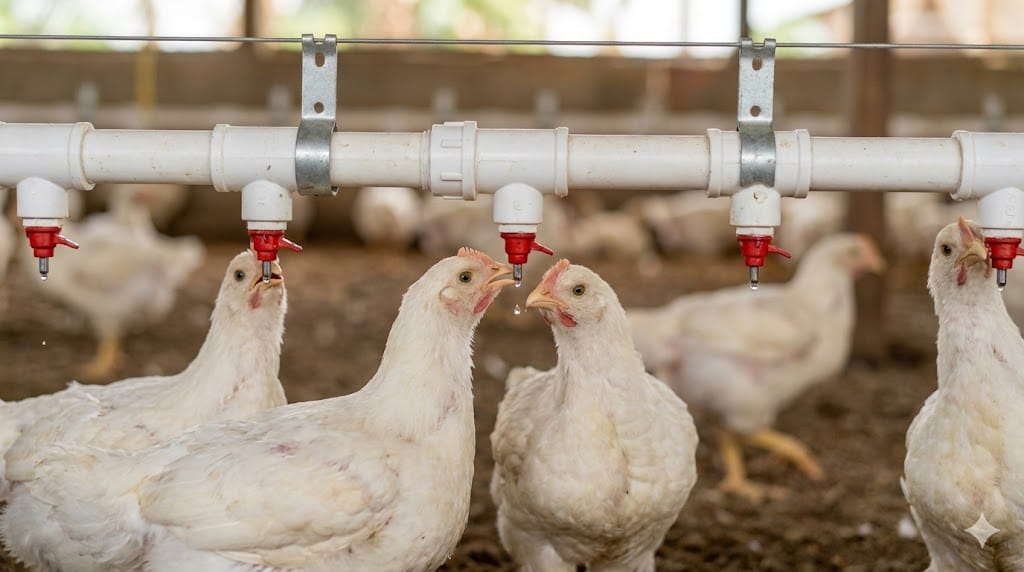
Nipple Drinkers
These systems use small valves that release water when a chicken pecks the metal pin.
Pros: Keeps water exceptionally clean, minimizes waste, helps keep litter dry.
Cons: Higher initial cost, lines can fail during power outages if pressurized systems are used.
Flow Rate Guidelines by Age:
| Age | Target Flow Rate | Formula Check |
|---|---|---|
| Week 1 | 27 ml/minute | (7×1)+20 = 27 |
| Week 3 | 41 ml/minute | (7×3)+20 = 41 |
| Week 6 | 62 ml/minute | (7×6)+20 = 62 |
| Week 8 | 76 ml/minute | (7×8)+20 = 76 |
Test by pressing the nipple pin for 15 seconds and collecting the water. Multiply by 4 to get the per-minute flow rate.
Bell Drinkers (Plasson-Type)
Gravity-fed, bell-shaped drinkers that automatically refill.
Pros: Can serve many birds, relatively inexpensive, reliable without electricity.
Cons: Need frequent cleaning as birds can get bedding in the open trough.
Cost in Nigeria: ₦4,000-₦12,000 depending on size.
For Nigerian farms with unreliable power, bell drinkers connected to an elevated water tank provide the most reliable solution.
Reducing Feed Waste to Under 5%
Feed is your single largest cost. Reducing waste is like putting money directly back in your pocket.
Problem: Incorrect Feeder Height
If a feeder is too low, birds scratch feed out with their feet.
Solution: Adjust the feeder so the lip is level with the birds’ backs. Raise it every few days as they grow.
Problem: Overfilling Feeders
When feeders are too full, birds rake through feed looking for preferred bits, spilling much onto the floor.
Solution: Never fill feeders more than one-third to one-half full.
Problem: Pests
Rodents and wild birds can consume and contaminate significant amounts of feed.
Solution: Store all feed in sealed, rodent-proof containers. In Nigeria, metal drums with tight-fitting lids work well.
Problem: Poor Quality Feed
Nigerian farmers sometimes encounter adulterated or poorly stored feed.
Solution: Buy from reputable suppliers like CHI, Vital, or Top Feeds. Check for mould, clumping, or off odours before using.
Emergency Water Systems for Power Outages
Power outages are common across Nigeria. A backup plan is essential for flock safety.
Option 1: Gravity-Fed Barrel System
This is the best non-electric backup.
Place a large 100-200 litre food-grade barrel on a platform of cement blocks to elevate it above drinker lines.
Connect with simple hose fittings. The height provides gravity-fed pressure needed to run nipple or bell lines for several days.
Option 2: Manual Founts
The simplest backup: have several large gravity-fed water founts stored.
In an emergency, fill these from stored water and place throughout the coop.
Labour-intensive but effective as a last resort.
Option 3: Generator Backup
A small generator can keep your well pump and any pressure regulators operating.
This requires having fuel on hand and regular generator maintenance.
For Nigerian farms, a combination of gravity-fed backup with generator availability provides the most reliable solution.
Troubleshooting Common Problems
Problem: Wet Litter Around Drinkers
Check drinker height: Is the nipple or bell trough lip level with the birds’ backs?
Check for leaks: Are there drips from connections or cracks?
Check flow rate: Is the rate too high for the birds’ age? Use the formula (7 × weeks) + 20 to verify.
If litter is wet everywhere: This is likely a ventilation issue, not equipment problem. Increase air exchange.
Problem: Low Water Consumption
Check water temperature: Is it cool and clean? Have drinkers been scrubbed this week?
Check equipment height: Can the smallest birds comfortably reach water?
Observe the birds: Do they appear lethargic or huddled? This may indicate illness requiring veterinary attention.
Problem: Feed Wastage on Floor
Check feeder height: Is the lip level with birds’ backs?
Check fill level: Are you filling feeders more than half full?
Consider feeder design: A deeper pan or feed-saving lip reduces waste.
Cost Analysis and ROI for Nigerian Farmers
Investing in proper equipment directly impacts your profitability.
Equipment Cost (100-Broiler Flock)
| Item | Cost (₦) |
|---|---|
| 4 tube feeders | ₦16,000-₦32,000 |
| 2 bell drinkers | ₦8,000-₦24,000 |
| OR nipple line kit (17 nipples) | ₦20,000-₦40,000 |
| Total Initial Cost | ₦24,000-₦72,000 |
If this equipment is used for 10 flocks, the amortized cost drops to just ₦2,400-₦7,200 per flock.
Feed Savings from Proper Management
Let’s calculate for a 100-broiler flock:
Total feed consumed: Approximately 5 kg/bird × 100 birds = 500 kg
Feed cost: Assume ₦450/kg. Total potential feed cost = ₦225,000
Poor management (15% waste): 75 kg wasted = ₦33,750 lost
Good management (5% waste): 25 kg wasted = ₦11,250 lost
Savings: ₦22,500 per flock just from proper feeder management.
For complete cost planning, read our guide on how many bags of feed for broilers and the current cost of poultry feed in Nigeria.
Frequently Asked Questions on How Many Feeders and Drinkers for 100 Broilers?
Can I use the same feeders and drinkers for broilers and layers?
While the equipment is physically the same, keeping separate sets is better if you raise both.
Broilers grow much faster and require weekly height adjustments. Layers’ equipment height stays more consistent once they are adults.
Keeping them separate also helps prevent disease transmission between flocks.
How often should I clean feeders and drinkers?
Drinkers should be scrubbed at least once a week. In hot Nigerian weather, clean them every 2-3 days.
Feeders should be completely emptied and cleaned between each flock. Check daily and remove any soiled or mouldy feed immediately.
What happens if I don’t provide enough feeder space?
Insufficient feeder space leads to intense competition.
Dominant birds eat their fill while timid birds get pushed out. This results in non-uniform flock size, poor overall growth rates, and increased stress.
Non-uniform birds at harvest mean lower prices from off-takers.
My feed consumption is higher than expected. Why?
Several factors can increase consumption:
Colder harmattan nights (birds eat more to stay warm)
Feed wastage from incorrect feeder height
Specific genetics of your broiler breed
Poor feed quality requiring birds to eat more for same nutrition
If birds are healthy and growing well, slight variations from averages are normal.
Can chickens go all night without water?
Chickens naturally sleep and do not drink when dark. So technically yes.
However, never intentionally restrict water access. Their metabolism is fast, and they need to rehydrate immediately upon waking.
As soon as lights come on, they need water available.
What vaccines do broilers need in Nigeria?
According to Artib Farm, Nigerian broilers need Marek’s (Day 1 at hatchery), Gumboro/IBD (Day 8 and Day 20), Lasota/Newcastle (Day 13 and Day 27), and deworming (Day 42). Follow proper vaccine handling and timing for best results.
Conclusion: Setting Your Nigerian Flock Up for Success
Calculating the correct number of feeders and drinkers is one of the most impactful decisions for your broiler operation’s profitability.
Remember these key principles:
- 4 tube feeders for 100 broilers at 6+ weeks (3 inches per bird)
- 10-17 nipple drinkers or 2 bell drinkers for water
- Always have backup water systems for Nigerian power conditions
- Adjust height weekly as birds grow
- Never fill feeders more than half full to reduce waste
- Empty feeders daily from 20 days of age to reduce fines accumulation
- Follow vaccination schedule strictly to reduce mortality below 5%
Proper equipment setup reduces competition, ensures uniform growth, and minimizes stress.
By applying these guidelines based on Hubbard management standards, you create an environment where every bird can thrive, leading to a successful and profitable flock.
Getting your feeder and drinker setup right is foundational. For a complete overview of starting and scaling your operation, read our guide on how to start a profitable broiler farming business in Nigeria.

Oladepo Babatunde is the founder of ChickenStarter.com. He is a backyard chicken keeper and educator who specializes in helping beginners raise healthy flocks, particularly in warm climates. His expertise comes from years of hands-on experience building coops, treating common chicken ailments, and solving flock management issues. His own happy hens are a testament to his methods, laying 25-30 eggs weekly.