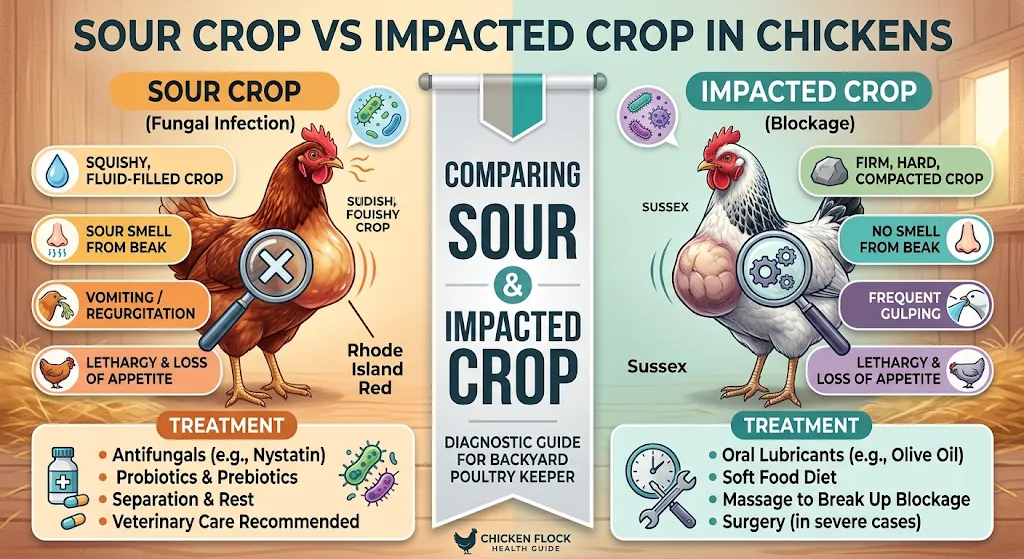
Sour crop vs impacted crop in chickens is a comparison worth understanding because both conditions can stop the crop from emptying normally, but they do not have the same underlying cause. A swollen crop alone does not tell you what is wrong. If the crop is still enlarged before the bird has eaten in the morning, or the chicken is regurgitating, eating less or becoming weak, investigate promptly.
Two conditions often confused by backyard keepers are impacted crop and sour crop. An impacted crop contains material that is not moving through normally. “Sour crop” is a common keeper’s term usually associated with crop stasis and candidiasis (a yeast infection), although a sour smell by itself does not prove that Candida is responsible.
The distinction matters because an obstruction, delayed crop emptying and a fungal infection do not have the same treatment. This comparison explains what the signs may mean, what you can safely observe at home, and when a poultry or avian veterinarian should examine the bird.
Key takeaways
- Impacted crop usually means feed or foreign material is retained and the crop is not emptying normally.
- Sour crop is a non-specific term commonly used for a fluid-filled, foul-smelling crop; candidiasis may be involved, but other causes of crop stasis are possible.
- A healthy chicken’s crop should be substantially empty before the first meal in the morning.
- A hard crop, fluid-filled crop or sour smell can provide clues, but none confirms a diagnosis on its own.
- Impaction and secondary microbial overgrowth can occur together. Pendulous crop and other digestive diseases can look similar.
- Do not turn a chicken upside down, force it to regurgitate, pour oil or liquids into its beak, or aggressively massage a swollen crop.
- Persistent crop fullness, regurgitation, loss of appetite, reduced droppings or weakness warrants veterinary advice. Breathing difficulty or collapse is urgent.
How a chicken’s crop normally works
The crop is an expandable pouch in the oesophagus, at the base of the neck and upper chest. It temporarily stores swallowed feed before the feed moves into the proventriculus and then the muscular gizzard. It is a storage area, not the organ that grinds food.
After a day of eating, a healthy crop can feel full. During the night, its contents normally pass onwards, so the crop should be substantially empty by morning before the bird eats again. This makes a pre-feeding morning check more informative than feeling the crop just after a meal.
The University of Maryland Extension explains that a persistently full crop in the morning can indicate an abnormality, but also warns keepers not to overdiagnose crop problems from one examination. See its guide, Common Crop Issues in Backyard Chickens.
Sour crop vs impacted crop in chickens: the main differences
The key distinction is whether the main problem is retained material, abnormal crop emptying, infection, or a combination. The terms are sometimes used loosely in backyard poultry discussions, so the table describes typical clues rather than a home diagnosis.
| What you notice | Impacted crop | Sour crop / crop stasis |
|---|---|---|
| Main issue | Feed or foreign material is retained and may form a firm mass. | The crop is not emptying normally; fermentation and microbial overgrowth may occur. |
| Crop feel | May feel firm, doughy or packed. | May feel soft or fluid-filled, but texture varies. |
| Smell | May become unpleasant if contents remain for a long time. | A sour or fermented smell may be present, but it is not diagnostic. |
| Morning check | Often remains full before feeding. | May also remain enlarged before feeding. |
| Other signs | Reduced appetite, fewer droppings, lethargy or weight loss. | Regurgitation, poor appetite, lethargy, weight loss or abnormal material in the crop. |
| What confirms it? | Veterinary examination to assess retained contents and possible obstruction. | Veterinary assessment; crop-fluid examination or other tests may be needed to identify yeast, bacteria or another cause. |
Important: The signs overlap. A crop that feels hard is not automatically impacted, and a sour smell does not establish candidiasis. A chicken can have an impaction and develop secondary crop infection or stasis.
What is sour crop in chickens?
“Sour crop” is a familiar backyard term for a crop that is abnormally full and may contain sour-smelling fluid. It is often associated with crop stasis (delayed or absent movement of crop contents) and candidiasis, an opportunistic fungal infection caused by Candida species, most commonly Candida albicans.
These terms are related but not interchangeable. Crop stasis describes a failure of normal emptying; candidiasis describes a fungal disease. Candida can be present in the digestive tract without causing disease. It may overgrow when the normal microbial balance is disrupted or when a bird is already unwell.
The MSD Veterinary Manual’s poultry candidiasis reference describes candidiasis as an opportunistic disease of the digestive tract. Clinical findings can include thickened crop lining, raised whitish pseudomembranes, poor appetite, crop stasis, regurgitation and weight loss. A veterinarian may need to examine crop material or lesions to support the diagnosis.
Possible signs associated with sour crop
- A crop that remains enlarged or contains fluid before morning feeding.
- A sour or unpleasant smell from the beak or regurgitated material.
- Regurgitation or fluid coming back up.
- Reduced appetite, lethargy or gradual weight loss.
- In some cases, whitish raised lesions in the mouth or crop lining, which require veterinary assessment.
Not every affected chicken shows every sign. A smell, by itself, cannot identify the organism or tell you which treatment is appropriate.
What is impacted crop in chickens?
An impacted crop occurs when material accumulates and does not pass through the crop normally. The retained contents may feel firm or doughy. Long, tough grass and swallowed foreign material such as string or plastic can contribute, although underlying problems with digestive movement may also be involved.
Possible signs of impacted crop
- The crop remains full before the chicken has eaten in the morning.
- The crop feels unusually firm, packed or doughy.
- The bird eats less or stops eating.
- Droppings become smaller or less frequent.
- The chicken becomes quiet, loses weight or appears unwell.
- Regurgitation may occur, particularly when the crop is severely distended.
A veterinarian needs to determine whether the crop contains an obstruction and whether another condition is slowing digestion. Do not assume that every firm crop is an impaction or attempt to break up a suspected blockage yourself.
Other conditions that can look similar
Not every enlarged crop is sour crop or an impaction. Two important possibilities are pendulous crop and crop stasis caused by another illness.
Pendulous crop
A pendulous crop hangs lower than normal and may lose its ability to empty efficiently. The crop can remain enlarged, and retained contents may create conditions for secondary problems. The cause and outlook vary, so a veterinarian should assess a bird with a persistently sagging or poorly emptying crop.
Crop stasis caused by another problem
Crop stasis is a sign, not a single diagnosis. Infection, obstruction, systemic illness, foreign-body ingestion and disorders affecting digestive movement can all interfere with emptying. Treating only the smell or swelling may miss the underlying cause.
How to check your chicken’s crop safely
A simple observation routine can help you describe the problem to a veterinarian. It cannot replace an examination.
- Check before breakfast. Observe the bird early in the morning, before it has access to feed. A crop that is still clearly enlarged deserves attention.
- Look at the whole bird. Note appetite, drinking, activity, posture, droppings, breathing and whether the bird is losing condition.
- Observe without forcing anything. If you are confident handling the chicken, use only a gentle touch to notice whether the crop seems unusually firm or fluid-filled. Do not squeeze, knead or try to empty it.
- Record the timeline. Write down when the swelling began, whether it changes overnight, recent feed or forage changes, medication history and any other symptoms.
- Contact a veterinarian. Share these observations, especially if the crop remains full or the chicken is unwell.
If the bird is regurgitating, has a fluid-distended crop, is weak or is not swallowing normally, do not delay veterinary advice. Forceful handling can cause crop contents to enter the airway.
How are sour crop and impacted crop treated?
Treatment depends on the cause found during veterinary assessment. There is no single remedy that safely treats every swollen crop.
Veterinary treatment for suspected sour crop
The veterinarian may examine the bird and assess crop contents. Depending on the findings, testing may include microscopic examination of a crop sample, culture or additional investigation for an underlying digestive problem.
If candidiasis is diagnosed, a veterinarian may prescribe an appropriate antifungal. If bacteria or another disease is responsible, management will be different. Supportive care may also be needed for dehydration, poor intake or the condition that caused crop stasis.
Do not use leftover antibiotics or antifungal medicines. Antibiotics do not treat a fungal infection, and unnecessary antibiotic use can disrupt normal microbial populations and contribute to antimicrobial resistance.
Veterinary treatment for suspected impacted crop
The veterinarian will assess whether material is physically obstructing the crop, whether the digestive tract is moving normally and whether an underlying disease is involved. Depending on severity, treatment may involve veterinary-directed supportive care, management of the obstruction or a procedure to remove foreign material. Severe or persistent cases may require surgery.
Do not try to push, crush or flush out a suspected obstruction at home. The safest approach depends on what is trapped, the bird’s condition and the risk of aspiration or injury.
Home remedies to avoid
- Do not turn the chicken upside down or force it to regurgitate. This can cause fluid or feed to enter the respiratory tract.
- Do not pour oil, vinegar or water into the beak. A bird that cannot swallow normally can aspirate liquids.
- Do not aggressively massage the crop. This can worsen discomfort and may increase aspiration risk, especially when the crop contains fluid.
- Do not assume apple cider vinegar cures sour crop. It is not a proven substitute for diagnosing and treating candidiasis or an obstruction.
- Do not choose medication by smell alone. Antifungals, antibiotics and obstruction management address different problems.
Keep the chicken calm and seek veterinary instructions about food, water and transport. Do not impose prolonged fasting or withhold water unless a veterinarian specifically directs you to do so for that bird.
What a veterinarian may check
A veterinary examination helps distinguish a physical obstruction from crop stasis, infection or another digestive condition. Be ready to explain when you first noticed the swelling, whether it was still present before breakfast, whether the bird has regurgitated, and whether appetite or droppings have changed.
The veterinarian may assess the chicken’s hydration, body condition, mouth, crop size and crop contents. When infection is suspected, a sample of crop material may be examined under a microscope or sent for additional testing to look for yeast or abnormal bacteria. If a foreign body or another internal problem is suspected, the veterinarian may recommend imaging or other tests.
Bring the feed label or a list of recent feed changes, details of any medicines given (including dates), and notes about access to long grass, bedding or foreign objects. These details can help identify a trigger. Not every chicken needs every test; the examination findings guide the next step. For more on how crop infections are investigated in birds, see VCA’s veterinary overview of crop infections.
When does a swollen crop need urgent veterinary attention?
Contact a poultry or avian veterinarian promptly if the crop repeatedly remains full in the morning, feels persistently firm, or is accompanied by reduced appetite, fewer droppings, regurgitation, weight loss or lethargy.
Seek urgent veterinary care if the chicken has difficulty breathing, is collapsing, cannot swallow, is severely weak or has a markedly distended crop with repeated regurgitation. Do not wait to see whether a home remedy works.
For other signs that a bird may be unwell, see our guide to how to tell if a chicken is sick.
How to reduce the risk of crop problems
- Keep the run free of foreign material. Remove string, plastic, packaging and other items a chicken might swallow.
- Manage long grass. Keep foraging areas maintained and avoid allowing birds to consume large quantities of long, tough grass.
- Store feed correctly. Use clean, dry, pest-resistant containers and discard feed that is mouldy, damp, spoiled or contaminated.
- Clean drinkers and feeders. Remove slime and organic build-up, and provide fresh drinking water.
- Feed a balanced ration. Provide a complete feed suitable for the bird’s age and purpose; treats should not displace the main ration.
- Use medicines responsibly. Give antibiotics only when indicated by a veterinarian, and follow the prescribed course.
- Monitor the flock. Notice changes in appetite, droppings, body condition and morning crop emptying, particularly after illness or medication.
Frequently asked questions
How can I tell whether my chicken has sour crop or impacted crop?
A firm or doughy crop that stays full overnight can raise concern about impaction. A fluid-filled crop and sour smell may occur with sour crop or crop stasis. These clues overlap and cannot confirm the cause; a veterinarian may need to examine the crop and test a sample.
Can an impacted crop lead to sour crop?
It can. When crop contents are retained, normal emptying is disrupted and secondary microbial overgrowth may develop. The two problems can therefore occur together.
Should a chicken’s crop be empty every morning?
It should normally be substantially empty before the bird eats again. A crop that remains enlarged on repeated morning checks should be assessed, particularly if the chicken has other symptoms.
Does a sour smell prove that a chicken has a yeast infection?
No. A sour or unpleasant smell is a clue, not a diagnosis. Candidiasis is one possible cause, but other infections and digestive problems can cause crop stasis or regurgitation. Veterinary examination and, when appropriate, testing help identify the cause.
Can chickens recover from an impacted crop?
Recovery depends on what is causing the impaction, how severe it is and how quickly the bird receives appropriate care. Some cases can be managed without surgery, while a persistent obstruction or foreign body may require a veterinary procedure.
Is sour crop contagious to other chickens?
Candidiasis is generally an opportunistic infection rather than a typical contagious flock disease. More than one bird may be affected when birds share risk factors such as poor drinker hygiene, contaminated feed, illness or unnecessary antibiotic exposure.
When should I call a veterinarian?
Call promptly if the crop remains full before morning feeding, or if the bird has regurgitation, reduced appetite, fewer droppings, weight loss or lethargy. Breathing difficulty, collapse or inability to swallow requires urgent care.
Final thoughts
Sour crop and impacted crop can look similar because both interfere with normal crop emptying. Impaction involves retained material or an obstruction; “sour crop” is a commonly used term associated with crop stasis and may involve candidiasis, but the smell alone cannot confirm a yeast infection.
Check the crop before morning feeding, observe the chicken’s overall condition and record what changes. If the crop remains enlarged or the bird is unwell, seek veterinary assessment rather than experimenting with home remedies. Finding the underlying cause is the safest route to appropriate treatment.
Veterinary disclaimer: This article provides general poultry-health information and is not a substitute for examination, diagnosis or treatment by a qualified poultry or avian veterinarian. Medication and treatment decisions should be made with veterinary guidance.

Oladepo Babatunde is the founder of ChickenStarter.com. He is a backyard chicken keeper and educator who specializes in helping beginners raise healthy flocks, particularly in warm climates. His expertise comes from years of hands-on experience building coops, treating common chicken ailments, and solving flock management issues. His own happy hens are a testament to his methods, laying 25-30 eggs weekly.