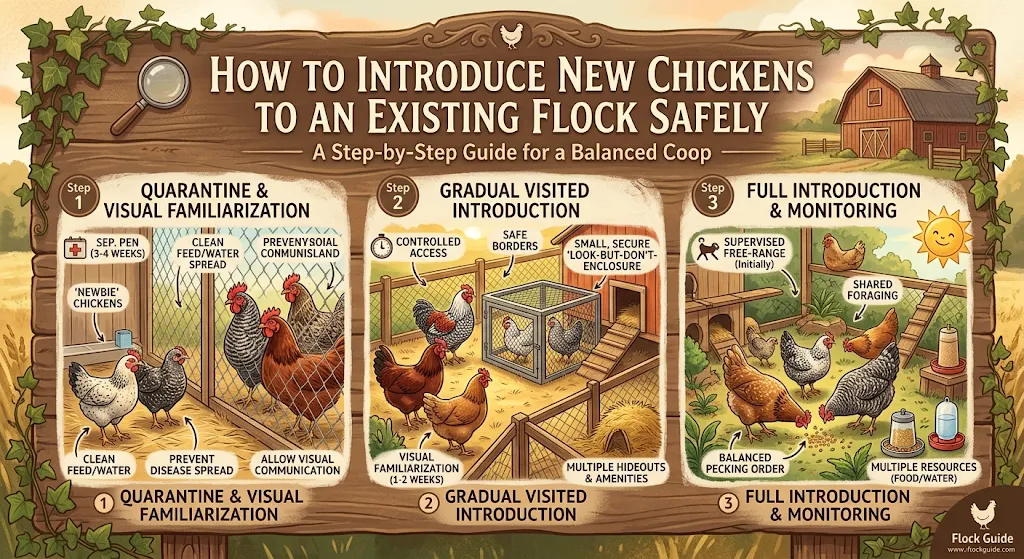
Adding chickens to an established flock takes more than opening the run and letting the birds sort things out. New arrivals can introduce disease or parasites, while unfamiliar birds may compete over food, water, roosts and space as the flock’s social order changes.
The safest process has two distinct parts: biosecure quarantine first, then gradual social integration. Keep the newcomers physically separate while you monitor their health. Only after quarantine and any necessary veterinary checks should you let the groups see one another through a secure barrier and begin supervised contact.
Key takeaways
- Keep newly acquired poultry separate for at least 30 days before introducing them to your existing flock, following CDC guidance.
- Use separate housing, feeders, drinkers, footwear and cleaning equipment during quarantine; prevent direct contact and reduce shared contamination.
- After quarantine, let the groups see one another through a secure barrier before attempting supervised, shared-space sessions.
- Provide more than one feeding and drinking station, enough room, and escape routes so subordinate birds are not trapped or excluded.
- Brief displays of dominance can occur, but repeated attacks, injuries or blocked access to food and water require intervention.
- There is no fixed number of days for social integration. Progress according to the birds’ behaviour, not a calendar deadline.
Why introducing new chickens can go wrong
Chickens form social relationships within a flock. When unfamiliar birds arrive, those relationships are disrupted and the birds establish a new pecking order. Some chasing, warning pecks and posturing may occur, but crowding and competition can make conflict worse.
There is also a separate disease risk. Birds can look healthy while carrying infectious organisms or external parasites. Mixing them immediately can expose the established flock before you have had a chance to observe the newcomers.
For that reason, quarantine and social introduction must not be treated as the same step. A wire partition can help birds become familiar with one another, but it is not a substitute for disease separation.
Step 1: Quarantine new chickens for at least 30 days
The CDC’s backyard poultry guidance recommends keeping new poultry separated from existing birds for at least 30 days before introduction. Penn State Extension similarly advises a minimum four-week quarantine for new birds. Follow any stricter local animal-health requirements or veterinary instructions.
Quarantine means more than putting the newcomers in a small pen beside the old flock. Use a separate enclosure with no direct bird-to-bird contact. Ideally, keep it well away from the established flock and avoid shared airspace where practical, especially if disease is suspected. Do not share feeders, drinkers, transport crates, litter tools or other equipment between groups.
During the quarantine period:
- Attend to the established flock first and the quarantined birds afterwards.
- Use dedicated footwear and clothing or protective outerwear for the quarantine area.
- Wash hands after handling birds or equipment, and clean and disinfect equipment appropriately.
- Keep feed dry and water clean; prevent wild birds and rodents from accessing feed and water.
- Observe the newcomers every day and record any changes in appetite, droppings, breathing, activity or appearance.
The CDC also recommends cleaning hands, shoes, clothing and equipment when moving between poultry groups. Read its backyard poultry and biosecurity advice for additional precautions.
Important: Thirty days is a minimum observation period, not a guarantee that every infection will be detected. Some diseases have longer incubation periods or birds may carry infections without obvious signs. If a bird becomes unwell, do not introduce it when the calendar period ends. Contact a poultry veterinarian or the relevant local animal-health authority; the quarantine period may need to be extended or restarted.
Step 2: Check the newcomers’ health during quarantine
Do not use quarantine as a passive waiting period. Watch for changes that could indicate illness or parasites. Look for:
- Reduced appetite, unusual thirst or a sudden drop in activity.
- Sneezing, coughing, noisy breathing or discharge from the eyes or nostrils.
- Swelling around the eyes or face.
- Diarrhoea, unusual droppings or a persistent change in droppings.
- Visible mites or lice, feather damage, pale combs or unexplained weight loss.
- Lameness, weakness, poor balance or other unusual behaviour.
These signs do not identify a particular disease by themselves. Avoid diagnosing or medicating the birds based only on a symptom list. Seek veterinary advice if you notice illness, unexplained deaths or a suspected reportable poultry disease. Ask the seller for the birds’ age, vaccination and treatment history, and any available flock-health information.
Ask a poultry veterinarian whether a fecal examination, parasite assessment or other testing is appropriate for the birds’ source and your region. Do not give antibiotics, dewormers or mite treatments “just in case”; the correct product and whether treatment is needed depend on the suspected problem, bird age and egg or meat status. If there is an active disease alert or movement restriction in your area, follow the relevant animal-health authority’s instructions before buying, moving or mixing birds.
If you are unsure what to look for, use our guides to recognising signs of illness in chickens and checking chickens for mites and lice as observation aids, not as substitutes for veterinary diagnosis.
Step 3: Prepare the coop and run before integration
Before the groups meet, check whether your housing can comfortably support the larger flock. Adding birds without adding usable space or resources can intensify competition. Check the actual floor and run space, ventilation, roosting provision and the number and placement of feeders and drinkers. Our chicken coop size guide can help you review the available space, but use the birds’ size, breed, housing design and local welfare guidance when assessing your own setup.
Set up the shared area so a bird can move away from another bird without being cornered. Useful features include:
- At least two feeding locations and more than one drinking point, spaced apart rather than placed side by side.
- Clear routes between the coop, run, feeders and waterers.
- Visual barriers or structures that break long sightlines without creating traps or dead ends.
- Enough roosting space for the whole flock, with more than one access route where possible.
- A separate, secure pen ready in case a bird needs to be removed for safety.
Do not rely on a single feeder simply because it holds enough feed for every chicken. A dominant bird can guard the access point and keep quieter birds away. Penn State Extension notes that birds lower in the pecking order may be prevented from eating or drinking when access is inadequate. Its guidance on space, feeder and water access explains why resources need to be distributed around the enclosure.
Step 4: Let the groups see each other through a secure barrier
Once quarantine is complete and the birds appear healthy, begin the social introduction with a secure divider. A partitioned run or adjoining pen allows the groups to see and hear one another without being able to peck or grab through the barrier. Check that the mesh openings are small enough to prevent heads, feet and combs from being injured.
Penn State Extension recommends splitting the pen with a wire wall for at least a week so the birds can become familiar with one another. This is a useful starting point, not a deadline that every flock will meet. Some groups need longer. Keep observing behaviour, and do not move to direct contact if birds remain highly agitated or repeatedly attack the barrier.
Make sure both groups can eat, drink, rest and move away from the divider. Do not place the only feeder or waterer directly beside the barrier, where one bird could guard it.
Step 5: Start short, supervised introductions
When the birds are calmer around the divider, arrange a first meeting in a spacious area with more than one route away from the other birds. Stay present and keep the session short enough that you can intervene. Gradually increase the time together only when interactions remain manageable.
Watch the whole flock, not just the loudest birds. A newcomer that stands apart may be avoiding conflict, but it may also be unable to reach food or water. Check that every bird can move away, eat and drink.
Some brief pecking, chasing or posturing can be part of establishing social relationships. However, separate birds if an attack is sustained, a bird is pinned or cornered, blood or an injury appears, or one chicken is repeatedly prevented from accessing essential resources. Do not leave them together to “work it out” when a bird is at risk.
Penn State Extension advises supervising new introductions and intervening if pecking becomes excessive or birds are being hurt. Read its guidance on poultry cannibalism, prevention and treatment for signs that pecking has become dangerous.
Step 6: Take extra care when introducing young chickens to adults
Do not put small chicks directly into an adult flock. A large size and strength difference can leave young birds unable to escape pecking or compete for feed. Age alone is not a reliable readiness test: consider body size, feathering, health, weather, housing and whether the younger birds can reach all resources.
Use the same quarantine and barrier stages, and wait until the younger birds are robust enough to move around the shared space and avoid unwanted contact. Provide feeders and drinkers that they can comfortably reach. Supervise closely and have a secure separation area ready.
Your existing article on moving chicks from the brooder to the coop covers the separate question of when chicks are ready to leave the brooder. Moving into an adult flock requires additional integration precautions.
Step 7: Monitor the flock after they share space
Integration is not finished the moment the birds spend time in the same run. Continue checking them closely, especially around feeding, drinking and roosting times. Confirm that:
- Every bird is eating and drinking.
- No bird is repeatedly chased away from the feeder, waterer or coop.
- There are no fresh wounds, damaged eyes or persistent feather-pulling.
- Newcomers can reach a safe resting place at night.
- All birds remain active and maintain their usual body condition.
If one bird repeatedly targets another, separate them before an injury occurs and reassess the space and resource layout. A short separation may help in some situations, but it does not guarantee that the birds will accept one another later. If aggression persists, ask an experienced poultry veterinarian or extension adviser for help. Keeping separate groups may be safer than forcing an unstable flock together.
How long does it take to introduce new chickens?
There is no universal integration timetable. The quarantine period is the clear minimum: at least 30 days under CDC guidance. The social introduction period depends on the birds’ behaviour, size, temperament, space and flock composition.
| Stage | Practical guide | Move on when… |
|---|---|---|
| Quarantine | At least 30 days, separately housed | The period is complete, birds remain healthy, and any veterinary concerns have been addressed |
| Barrier introduction | Start with about a week as a guide; extend if needed | Birds can see one another without persistent barrier attacks or extreme distress |
| Supervised contact | Begin with short sessions and increase gradually | Interactions remain manageable and all birds can retreat and access resources |
| Shared housing | Only when safe behaviour is consistent | No sustained attacks, injuries or exclusion from food, water or roosts |
| Ongoing monitoring | Continue after integration | Keep checking health, access to resources and flock behaviour |
Do not shorten quarantine because the birds seem friendly through a fence. Disease control and social acceptance are different issues.
Common mistakes when adding chickens to a flock
Skipping quarantine because the birds look healthy
Some infected birds show few or no visible signs. Keep the separate quarantine period and biosecurity routine even when the newcomers appear active and healthy.
Putting the new birds straight into the coop
Immediate mixing gives the birds no gradual introduction and leaves you little opportunity to prevent an attack. Use a secure barrier and supervised contact after quarantine.
Providing only one feeder and waterer
One dominant bird can control a single access point. Distribute multiple stations around the enclosure and check that quieter birds actually use them.
Ignoring injuries or repeated targeting
Persistent attacks are not something to leave unattended. Separate birds when necessary, assess injuries and change the setup before trying another meeting.
Assuming nighttime placement solves integration
Putting newcomers on the roost after dark does not replace quarantine, barrier familiarisation or supervised contact. Birds still have to interact when they wake up, and you may miss early signs of aggression if you rely on this method.
Mixing birds of very different sizes too soon
Small pullets or chicks may be unable to escape adult birds or compete for resources. Wait until they are physically ready and provide equipment they can reach.
Frequently asked questions
How long should I quarantine new chickens?
The CDC recommends keeping new poultry separate from existing birds for at least 30 days before introduction. Use separate equipment and footwear, practise hand hygiene and monitor the newcomers throughout the period. If a bird becomes ill, seek veterinary advice rather than introducing it when the 30 days end.
Can I introduce just one new chicken?
Yes, but a single newcomer may have difficulty settling into an established group. Use a gradual barrier introduction, provide several resource stations and supervise contact closely. The individual bird’s temperament and the existing flock’s behaviour matter more than a fixed group-size rule.
Should I put new chickens in the coop at night?
Nighttime placement is sometimes suggested, but it is not a substitute for quarantine or gradual introduction. It can also make it harder to observe the first interactions. A supervised introduction in daylight gives you a better opportunity to identify and interrupt unsafe behaviour.
How long should chickens stay separated by a wire barrier?
Penn State Extension suggests at least a week as a practical starting point. Some flocks need longer. Move to supervised contact only when the birds are calmer around one another and the enclosure is ready for safe interaction.
Why are my existing chickens chasing the new ones?
Chasing and brief pecking can occur while the flock’s social order changes. Repeated attacks, injuries, cornering or preventing a bird from eating and drinking are warning signs. Increase separation, check resource access and supervise any further contact.
Can chicks live with adult chickens?
They can sometimes be integrated when they are sufficiently developed and physically able to avoid adult birds, but small chicks should not be placed directly into an adult flock. Use separate housing, a secure barrier and supervised introductions, with feeders and drinkers the younger birds can reach.
What should I do if one hen keeps attacking the newcomers?
Separate the birds if the behaviour is sustained or risks injury. Check for crowding and resource guarding, add or reposition feeders and waterers, and provide escape routes. If the attacks continue, seek poultry-specific advice and consider keeping the birds in separate groups.
Final thoughts
Introducing new chickens safely means protecting the flock’s health before managing its social relationships. Keep newcomers quarantined for at least 30 days, monitor them carefully, and use separate equipment and good hygiene. After quarantine, let the birds become familiar through a secure barrier before beginning supervised contact.
There is no prize for completing integration quickly. Move at the pace the birds can handle, make sure every chicken can reach food, water and shelter, and separate birds when aggression becomes dangerous. A successful integration is one in which all birds can feed, rest and move around safely.
Biosecurity note: This article provides general flock-management information. Follow local animal-health requirements and seek advice from a poultry veterinarian or animal-health authority if illness is suspected.
Sources and further reading
- CDC: Backyard Poultry – introducing poultry and biosecurity
- Penn State Extension: Poultry Cannibalism – Prevention and Treatment
- University of Arizona Cooperative Extension: New Chicks and Old Flocks
- Agriculture Victoria: Quarantine Advice When Introducing New Birds
- Penn State Extension: Space Should Increase as Birds Grow

Oladepo Babatunde is the founder of ChickenStarter.com. He is a backyard chicken keeper and educator who specializes in helping beginners raise healthy flocks, particularly in warm climates. His expertise comes from years of hands-on experience building coops, treating common chicken ailments, and solving flock management issues. His own happy hens are a testament to his methods, laying 25-30 eggs weekly.