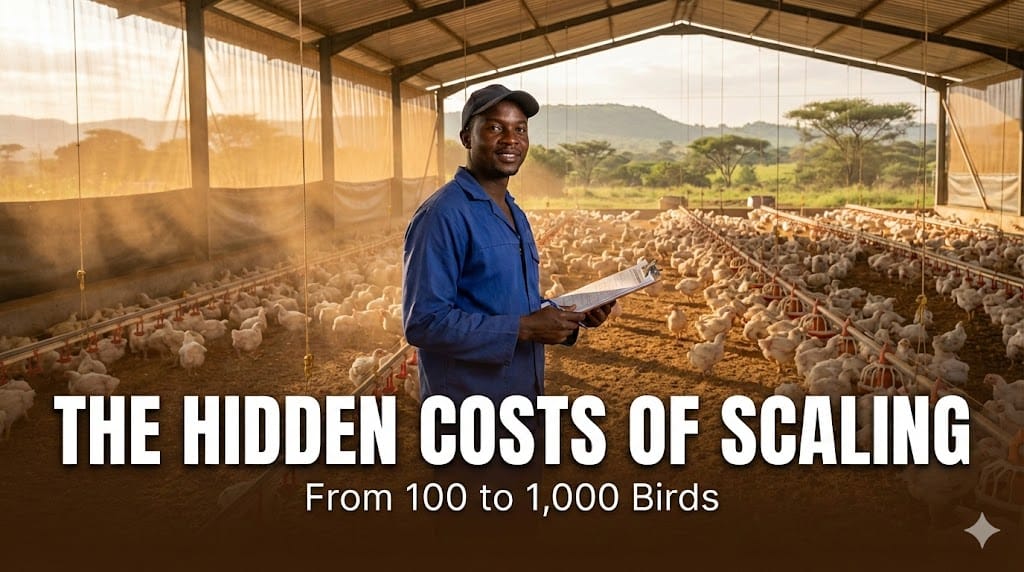
The day I ordered my first batch of 500 day-old chicks, I thought I had calculated everything. I had my pen ready, my sawdust spread, and my calculator out. I was wrong by ₦340,000.
Scaling from 100 to 1000 broilers in Nigeria taught me lessons no PDF guide ever mentioned. When you are raising 50 birds in your backyard, you can carry a bag of feed on your head. When you have 1,000 birds, you are managing logistics, battling heat stress, and negotiating with suppliers.
If you are thinking about making the jump from a backyard hobby to a commercial business, this guide is for you. I’m going to share the hidden costs, the mistakes that almost bankrupted me, and the exact math you need to make a 1000 chicken farm profit per month.
Why I Decided to Scale Beyond 100 Birds
I started like many of us do—with a small wooden cage at the back of my house in Lagos. I had 100 birds. It was fun. I fed them kitchen scraps and some starter mash, and when I sold them during Christmas, I made a nice little profit.
But 100 birds is just pocket money. I wanted a real business. I wanted to start profitable broiler farming in Nigeria, pay school fees, and rent from my poultry farm.
I looked at the market. Chicken is the most consumed meat in Nigeria. Eateries, hotels, and frozen food shops are always looking for meat. The demand was there. I told myself, “If I can make ₦50,000 from 100 birds, surely I can make ₦500,000 from 1,000 birds, right?”
That was my first mistake. Scaling isn’t just multiplication; it’s a totally different game.
The True Cost of Scaling from 100 to 1000 Broilers in Nigeria
This is the part where most people get stuck. You might have the money for the chicks, but do you have the money for the feed when they are 6 weeks old and eating like dragons?
Where My ₦340,000 Went Wrong

Before I give you the general market list, let me break down my specific failure so you don’t repeat it. I mentioned being wrong by ₦340,000. Here is where that money went:
- Underestimated Feed Cost (₦180,000): Maize prices jumped mid-cycle, increasing feed price by ₦1,500 per bag. I wasn’t prepared for inflation.
- Emergency Borehole Drilling (₦120,000): My well ran dry in Week 3. 1,000 birds need a lot of water. I had to drill deeper urgently.
- Generator Repairs (₦40,000): My small generator couldn’t cope with the workload and burned its coil.
Here is the breakdown of scaling from 100 to 1000 broilers cost. Please note, these prices fluctuate with the Naira, so use them as a guide. For the latest pricing, check our complete poultry equipment prices in Nigeria guide.
Capital Expenditure Breakdown (One-Time Costs)
These are the things you buy once (or rarely).
| Item | For 100 Birds | For 1,000 Birds | Notes |
|---|---|---|---|
| Housing/Pen Construction | ₦150,000 | ₦1.5M – ₦2.5M | Needs solid blocks and good roofing. |
| Feeders | ₦5,000 | ₦60,000 | You need roughly 30-35 feeders. |
| Drinkers | ₦4,000 | ₦85,000 | How many nipple drinkers for 1000 chickens? About 100-120 nipples. |
| Brooding Equipment | ₦10,000 | ₦50,000 | Coal pots, stoves, or gas brooders. |
| Generator/Power | Optional | ₦150,000+ | Essential for pumping water. |
| Borehole/Tank | Shared | ₦300,000+ | 1,000 birds drink a lot of water. |
My Experience: I underestimated the water. 1,000 birds can drink over 250 liters a day in hot weather. I spent a fortune buying water from “Mai Ruwa” before I finally dug a borehole. Don’t start 1,000 birds without a reliable water source.
Operating Costs Per Production Cycle

This is the money you spend every 8 weeks. Use our chicken feed calculator to estimate your exact costs before starting.
| Expense Category | Details |
|---|---|
| Day-Old Chicks (DOC) | High-quality chicks (e.g., Chi Farms, Zartech, Amo). Price varies weekly. |
| Feed Costs | The biggest expense. Wondering how many bags of feed broilers need? According to PAN, feed accounts for approx. 70% of production costs. |
| Medications/Vaccines | Lasota, Gumboro. Always ensure medications are NAFDAC-approved before administering. |
| Labor Costs | You cannot do it alone. You need at least one farm attendant. |
| Litter/Bedding | Wood shavings (sawdust). You need about 100 bags. |
| Heating/Fuel | Charcoal for brooding, petrol for the generator. |
Hidden Costs Nobody Tells You About
These are the “silent killers” of profit:
- Transport & Logistics: Moving 150 bags of feed costs money. If you don’t have a truck, you are paying drivers and loaders every week.
- Mortality Buffer: You will lose birds. It’s a sad fact. If you start with 1,000, plan to sell 940.
- Theft: Sadly, you need security. Chickens have a way of “disappearing” if the pen isn’t secure.
- Price Fluctuation: The price of maize and soya changes every week in the market.
How Much Space Do You Need for 100 to 1,000 Broilers?
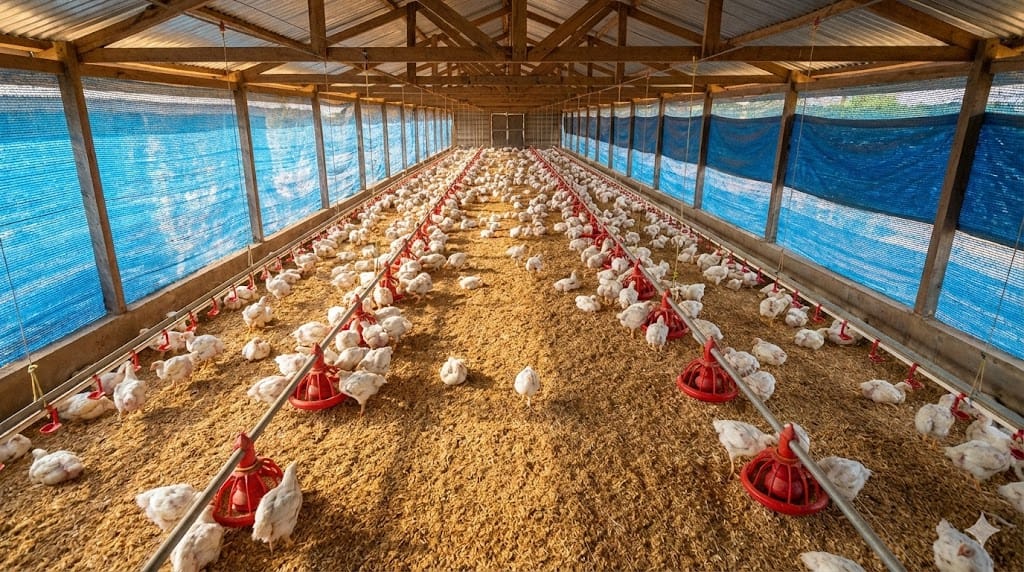
A common question I get is: “How much space for 100 broilers?”
If you pack them too tight, they won’t grow, and disease will spread fast. If you give them too much space, you are wasting money on building materials.
The Industry Standard: According to the FAO Poultry Production Guidelines, the recommended stocking density is 10 to 12 birds per square meter for optimal growth. If you want a deeper breakdown, read our guide on how much space chickens really need.
Space Calculation Formula:
Number of Birds ÷ 10 = Minimum Square Meters Needed
- For 100 Birds: 100 ÷ 10 = 10 Square Meters
- For 1,000 Birds: 1,000 ÷ 10 = 100 Square Meters
My Advice for Nigeria: Research from Nigerian agricultural universities like FUNAAB suggests increasing ventilation space in tropical climates. Because of our heat, I recommend giving them more space—aim for 110 to 120 square meters for 1,000 birds to prevent heat stress. Also, consider researching deep litter vs battery cage systems to see which fits your land better.
Feed Conversion Ratio (FCR): The Number That Determines Your Profit
If you take nothing else from this article, please learn this. FCR is the difference between a wealthy farmer and a broke one.
What Is Feed Conversion Ratio and Why Does It Matter?
FCR stands for Feed Conversion Ratio. It simply answers the question: “How much food did my chicken eat to give me 1kg of meat?”
You want this number to be low. A low number means your chicken is efficient.
How to Calculate Feed Conversion Ratio for Broilers
Here is the formula you need:
FCR = Total Feed Consumed (kg) ÷ Total Weight Gained (kg)
Example from my farm: In my last batch, my 1,000 birds ate 3,600 kg of feed (that’s 144 bags of 25kg). When I sold them, the total weight of all chickens combined was 2,000 kg.
Calculation: 3,600 ÷ 2,000 = 1.8
What Is a Good Feed Conversion Ratio?
- 1.5 – 1.6: Excellent (World class standard per Cobb Broiler Management Guides)
- 1.7 – 1.8: Good (Standard for successful Nigerian farms)
- 1.9 – 2.0: Average (You are making small profit)
- Above 2.2: Poor (You are likely losing money)
How to Calculate Feed for Broilers
To plan your budget, you need to know how to calculate feed for broilers before you even buy the chicks.
- Starter (Weeks 1-2): Approx 0.5 kg per bird
- Grower (Weeks 3-4): Approx 1.2 kg per bird
- Finisher (Weeks 5-8): Approx 2.3 kg per bird
- Total: Roughly 4 kg to 4.5 kg per bird to reach market weight.
For 1,000 birds, you need to budget for 4,000 kg to 4,500 kg of feed. That is roughly 160 to 180 bags (25kg size). Feeding frequency matters—here’s how many times broilers should be fed daily. Some farmers even prefer to formulate your own feed to cut costs, though this requires expertise.
How to Get Better Feed Conversion on Broiler Chickens
Here are 5 things I changed to improve my FCR:
- Buy Quality Feed: Brands like Top Feeds, Animal Care, or Hybrid usually give better results than mixing your own without expert knowledge.
- Clean Water: If the water is dirty, they won’t drink. If they don’t drink, they don’t eat.
- Temperature Control: If the birds are too hot, they pant and burn energy. If they are too cold, they huddle and burn energy.
- No Feed Wastage: Adjust your feeders! If you see feed on the floor mixed with poop, you are throwing money away.
- Harvest Early: The older the bird gets, the worse their FCR becomes. Selling at 6-7 weeks is often more profitable than keeping them to 9 weeks.
Equipment Checklist: What You Need for 1,000 Broilers
When people ask “how many nipple drinkers for 1000 chickens,” they are often trying to save money. But having too few equipment leads to fighting and uneven growth. If you are starting smaller, see our guide on feeders and drinkers for 100 broilers.
| Equipment | Quantity for 1,000 Birds | Calculation Basis |
|---|---|---|
| Nipple Drinkers | 100-125 nipples | 8-10 birds per nipple |
| Bell Drinkers | 20-25 units | 40-50 birds per drinker |
| Tube Feeders | 30-35 units | 30-35 birds per feeder |
| Brooder Stoves | 4-6 large stoves | Depends on weather/season |
| Thermometers | 3 units | Put them at bird height! |
Personal Insight: Switch to nipple drinkers if you can. The litter stays drier, and the birds get sick less often. It costs more upfront but saves money on medicine later. If you’re shopping for equipment, check our FRD poultry equipment reviews.
Monthly Profit Analysis: Is 1,000 Chicken Farm Profitable in Nigeria?
Let’s look at the 1000 chicken farm profit per month. For more strategies on running a profitable poultry business in Nigeria, see our detailed guide.
Note: These figures are based on market prices as of late 2025/early 2026. Feed costs and chicken prices in Nigeria fluctuate significantly. Always check current prices at your local market before budgeting.
Revenue Calculation
- We start with 1,000 birds.
- Assume 5% mortality (50 birds die). We have 950 birds left.
- Target weight: 2.2 kg per bird.
- Selling Price: Let’s assume ₦1,500 per kg (live weight).
Total Revenue: 950 birds × 2.2 kg × ₦1,500 = ₦3,135,000
Profit Margin Calculation
- Gross Revenue: ₦3,135,000
- Estimated Cost of Production: (Feed, DOC, Meds, Labor) ≈ ₦2,400,000
- Net Profit: ₦3,135,000 – ₦2,400,000 = ₦735,000
This looks like a lot of money, right? But remember, this is for a 2-month cycle. So, your monthly profit is roughly ₦367,500. Not sure if broilers are right for you? Compare broilers vs layers profitability first.
Factors That Affect Profitability
- Festive Periods: Prices skyrocket during Christmas and Easter.
- Feed Cost: If maize prices go up, your profit goes down.
- Market Access: Selling to a frozen food bulk buyer is easier but pays less. Selling directly to consumers pays more but is harder work.
Common Mistakes I Made (And How to Avoid Them)
Many of these overlap with the mistakes first-time chicken keepers make.
- Running Out of Cash: I spent all my money on the pen and chicks. By week 4, I had no money for feed. I had to borrow at high interest. Lesson: Keep 50% of your capital for feed.
- Bad Biosecurity: I let a friend visit my pen after he visited another farm. Two days later, my birds were coughing. Lesson: No visitors inside the pen. Learn how to create a proper biosecurity plan to prevent disease outbreaks.
- Ignoring Runts: I kept the sick, small birds hoping they would grow. They just ate feed and spread disease. Lesson: Cull (remove) sick birds early.
Step-by-Step Scaling Timeline
If you are ready to scale, don’t do it overnight.
- Month 1-3 (Planning): Secure your land, dig your borehole, and save your capital. Before you start, know where to buy quality day-old chicks in Nigeria. Also, learn to identify poor-quality day-old chicks before you waste money.
- Month 4-5 (Infrastructure): Build the pen. Don’t rush the cement work. Let it dry properly.
- Month 6-7 (The Test): Do a batch of 500 birds first. Test your equipment. Test your market. Timing matters—read about the best season to raise broilers in Nigeria.
- Month 8 (Full Scale): If the 500 batch went well, go for the full 1,000.
Free Resources: Broiler Management Checklist
Stop guessing and start tracking. I’ve prepared a Broiler Management PDF Checklist which you can find in the attached files. If you prefer to copy it into your notebook right now, here is the essential data you need to track:
1. Weekly Weight Targets
If your birds are not hitting these numbers, something is wrong with feed or health.
| Week | Target Weight |
|---|---|
| Week 1 | 180g |
| Week 2 | 450g |
| Week 3 | 900g |
| Week 4 | 1.4kg |
| Week 6 | 2.2kg (Market Ready) |
2. Vaccination Schedule
Newcastle disease remains one of the most significant threats according to the World Organisation for Animal Health (WOAH). Always confirm with your vet, but this is the standard schedule for successful farms.
| Age | Vaccine | Notes |
|---|---|---|
| Day 1 | Multivitamins | Stress relief |
| Day 5-7 | Gumboro (IBD) | First dose |
| Day 10-12 | Lasota (Newcastle) | First dose |
| Day 14 | Gumboro (IBD) | Second dose |
| Day 28 | Lasota (Newcastle) | Booster |
More Resources for Nigerian Poultry Farmers
- Funding: Learn how to get a loan for poultry farming or check for poultry farming grants in Nigeria.
- Extra Income: Discover how to make money from chicken manure.
- Seasonal Care: Tips for managing poultry during harmattan.
- Harvest: Understand why broilers shouldn’t be kept past 6 weeks.
Frequently Asked Questions
How do you calculate feed conversion ratio?
I used to think FCR was just math for big companies until I lost money. Now, I write it on my pen wall. I take the total bags of feed used (say, 144 bags x 25kg = 3,600kg) and divide it by the total weight of chicken sold (e.g., 2,000kg). If the number is above 1.8, I know I need to fix something in the next batch.
What is the best FCR in poultry for broilers?
Textbooks say 1.5 is the goal, but in the Nigerian heat, that’s really hard. I aim for 1.7 to 1.8. If I hit 1.7, I celebrate because it means my management was tight. Anything above 2.0 means I’m just working for the feed seller.
How many nipple drinkers for 1000 chickens?
I started with bell drinkers but switched to nipples to stop the mess. For 1,000 birds, I installed about 120 nipple points (that’s roughly 10 birds sharing one). It stopped the fighting and kept my litter much drier, which saved me money on sawdust.
How much space is needed for 100 broilers?
Don’t squeeze them! I learned the hard way that overcrowding brings disease. For 100 birds, give them at least 10 to 12 square meters. If you are building for 1,000 like I did, aim for 120 square meters to account for our hot weather.
How to speed up broiler growth?
Following research recommendations from Aviagen’s Ross Broiler Handbook, I switched from 12 hours of light to 23 hours light with 1 hour darkness and saw my birds reach 2kg about 4 days earlier. I also started adding ice blocks to their water tanks during afternoon heat in Lagos—this kept them drinking and eating instead of panting.
What is a realistic profit from 1000 broilers in Nigeria?
It varies wildly, but let’s be real. In a good cycle with low mortality (under 5%) and decent market prices, I target about ₦500 to ₦700 profit per bird. So for 1,000 birds, clearing ₦600,000 is a solid win. But one disease outbreak or a hike in maize prices can wipe that out fast.

Oladepo Babatunde is the founder of ChickenStarter.com. He is a backyard chicken keeper and educator who specializes in helping beginners raise healthy flocks, particularly in warm climates. His expertise comes from years of hands-on experience building coops, treating common chicken ailments, and solving flock management issues. His own happy hens are a testament to his methods, laying 25-30 eggs weekly.