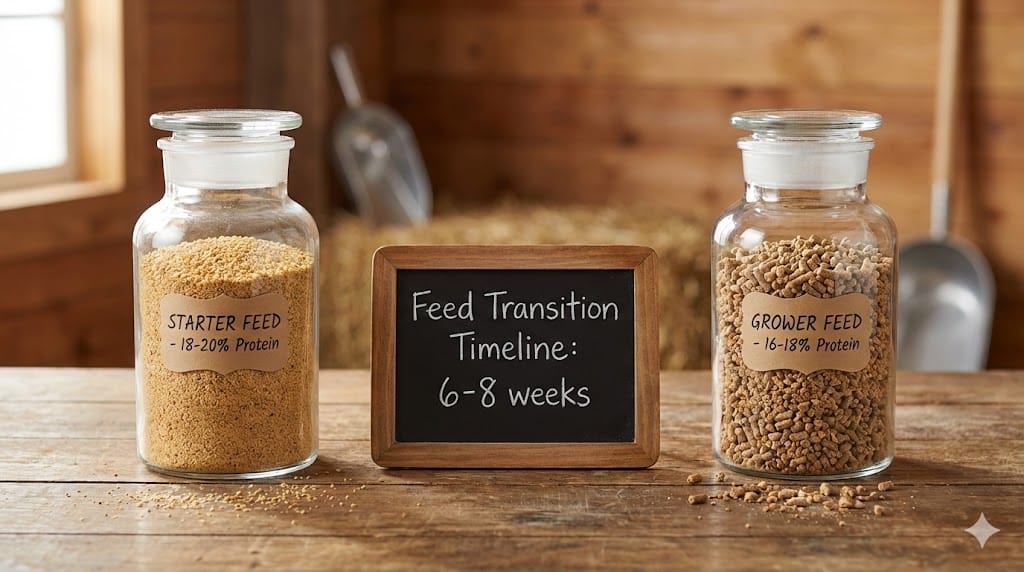
Most backyard chicken owners should switch from starter to grower feed between 6 to 8 weeks of age, once birds are fully feathered and weigh roughly 1.5-2 pounds. This transition timeline is supported by agricultural experts at the University of Georgia Extension and Purina Mills, marking a critical nutritional shift as your chicks’ protein needs decrease from 18-20% to 16-18%.
Making this switch correctly supports skeletal growth without stressing the kidneys, while also reducing your feed costs. To ensure you have everything else needed for this stage, check out our guide on essential supplies for raising healthy chicks. This guide covers exactly how to execute this transition for healthy, productive chickens.
Understanding Chicken Feed Types: The Foundation
Before we dive into the timeline, it is crucial to understand exactly what is in the bag. Many new chicken keepers get confused by the colorful bags at the feed store. Why does protein percentage matter so much? Why can’t you just feed one type of food forever?
What is Starter Feed?
Starter feed is the high-octane fuel your chicks need for their first few weeks of life. When a chick hatches, it needs to do a massive amount of growing very quickly.
- Protein Content: Starter feed provides 18-20% protein to support the rapid growth chicks need during their first few weeks, according to Penn State Extension’s poultry nutrition guidelines.
- Texture: Usually a “crumble.” This looks like coarse sand or granola, making it easy for tiny beaks to pick up and swallow.
- Purpose: The high protein supports rapid muscle growth and the development of internal organs.
- Medicated vs. Non-Medicated: You will often see “medicated” starter. This contains Amprolium, a thiamine analog that prevents coccidiosis. According to Purdue University Extension’s poultry management resources, it is not an antibiotic and is approved for safe use in preventing this common parasite.
What is Grower Feed?
Grower feed for chickens is designed for the “teenage” stage. Once the initial growth spurt slows down, chicks need a diet that supports steady development without pushing them too hard.
- Protein Content: 16-18%, slightly lower than starter. This level is optimal for steady development during weeks 6-18, as recommended by the LSU AgCenter.
- Texture: You might find this as a larger crumble or small pellets.
- Purpose: It builds strong bones and adult feathers. If you keep feeding high-protein starter too long, birds can grow too fast, leading to leg problems or kidney issues.
- Best grower feed for chickens includes premium options from Purina, Nutrena, Blue Seal Feeds, and Manna Pro. These established brands invest heavily in poultry nutrition research and formulate feeds meeting or exceeding National Research Council guidelines for growing poultry. For a deeper dive, you can compare top organic and non-GMO chicken feed options to find the best fit for your flock.
Grower Feed vs Layer Feed
This is the most dangerous confusion point for new owners.
- Layer Feed (16% protein) has a massive amount of calcium (3.5-4.5%) added to it. This calcium is vital for hens making eggshells, as noted in feeding guides by Tractor Supply. For more on why this mineral is critical later in life, read our guide to understanding calcium requirements for healthy egg production.
- The Danger: You must never feed layer feed to chickens younger than 16-18 weeks (or before they lay their first egg). University of Georgia Extension warns that feeding layer diets to young pullets can result in kidney failure or bone problems due to calcium toxicity. Grower feed has low calcium (around 1%), which is safe for growing bodies.
Week-by-Week Development Timeline
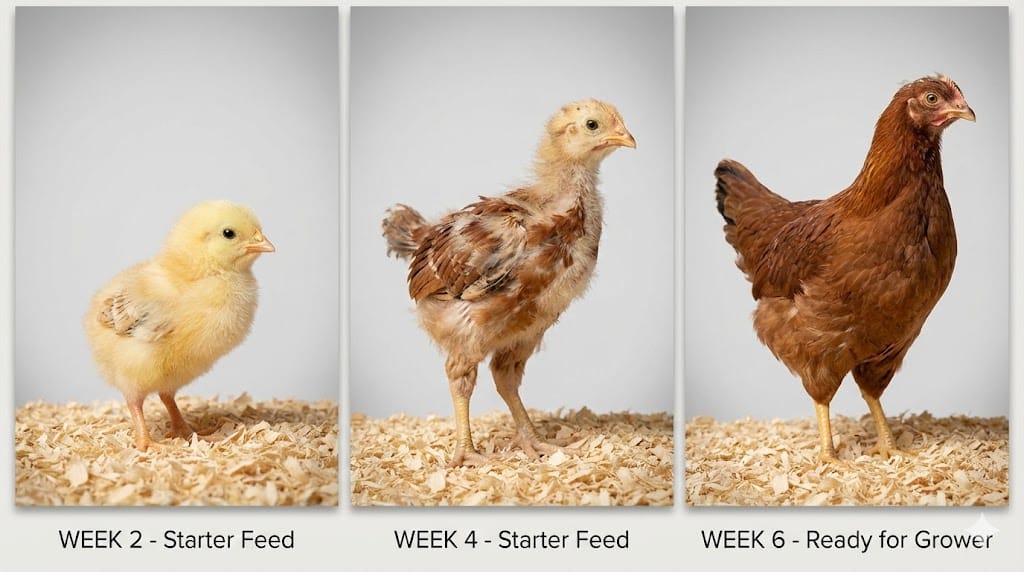
Knowing what to feed chickens by age chart standards is helpful, but watching your specific birds is better. Here is what is happening inside your chicks and what they need from you.
Week 1-6: The High-Growth Starter Phase
Feed: 18-20% Starter Feed (Crumble)
During these first six weeks, your chicks are basically eating machines.
- Physical Markers: They will triple their hatch weight in the first week. By week 4, they look awkward and dinosaur-like as they lose fluff and grow teeny feathers.
- Consumption: They eat small amounts frequently. LSU AgCenter guidelines note that you should expect to use at least 4 lbs of starter feed per bird during this period.
- Nutritional Needs: They need maximum amino acids (the building blocks of protein) to build tissue. Protein needs are highest right after hatching.
- Observation: If you see “pasting up” (poop sticking to their vent), clean it immediately. Learn how to treat pasty butt in chicks quickly to prevent health issues. This is common in week 1-2 but should stop by week 3.
Week 6-8: The Transition Window
This is the specific window when to change from chick starter to grower.
- The Sign: Look at your chicks. Do they look like miniature chickens? Are they fully feathered, with almost no baby fuzz left on their heads or bodies?
- Weight: For standard dual-purpose breeds (like Rhode Island Reds or Plymouth Rocks), they should weigh roughly 1.5 to 2 pounds, a benchmark often cited by hatchery standards.
- Behavior: They are now hardy enough to go outside for short trips (weather permitting).
- Decision Time: If they are fully feathered and active, it is time to buy your first bag of grower feed.
Week 6-16: The Grower Feed Phase
Feed: 16-18% Grower Feed (Crumble or Pellet)
After transitioning at 6-8 weeks, your birds will stay on grower feed until weeks 16-20, or when the first egg appears. During this 10-14 week period:
- Growth Rate: Growth slows down. They are filling out, getting taller, and their combs (the red thing on top of their head) might start turning pink.
- Nutrition: They need “maintenance” energy. They are burning more calories moving around and exploring. The slightly lower protein in grower feed vs layer feed is perfect for this steady pace.
- Consumption: Their appetite increases significantly. According to Auburn University Extension, properly managing feed intake is critical as birds approach laying age to ensure they have the body reserves for egg production.
Week 16-20+: Pre-Layer Transition
Feed: Switch from Grower to Layer Feed
- The Final Switch: Around 16-20 weeks, or when the first egg appears (whichever comes first), you switch to layer feed.
- Why wait? Remember, calcium is toxic to young kidneys. Only once their bodies start the hormonal process of making eggs do they need that extra calcium.
Visual Development Tracker: What to Feed Chickens by Age Chart
To help you judge if your birds are ready without a scale, use this visual progression guide.
- Week 2 (Starter Feed):
- Look for: Chick loses fluff on wings; first “pinfeathers” (spiky new feathers) become visible.
- Action: Keep heat lamp on; ensure high protein intake.
- Week 4 (Starter Feed):
- Look for: Body feathering is about 50% complete. They look “moth-eaten” or awkward. Active flying attempts and roosting on low bars.
- Action: Start introducing a small perch; maintain starter feed.
- Week 6 (Transition Time):
- Look for: Fully feathered bodies; head might still have some fuzz. Wattles (skin under beak) might turn slightly pink.
- Action: Start the switch. If they look like miniature hens rather than fuzzy balls, they are physically ready for grower feed.
When to Skip Grower and Go Straight to Layer (Not Recommended)
A common search query we see is: “When to switch from chick starter to layer feed?”—implying skipping the grower phase entirely.
The Short Answer: Never.
Unless you are using a combined “Starter/Grower” feed (which is formulated for this exact purpose), you should never jump straight from high-protein starter to high-calcium layer feed.
- The Myth: Some owners think, “They are big enough, let’s just get the cheaper layer pellets.”
- The Reality: Layer feed contains 4x the calcium of grower feed. If fed to a 6-week-old bird, this calcium overload cannot be processed. The excess calcium can accumulate in the kidneys, potentially causing urolithiasis (kidney stones) and visceral gout. Research published in PLOS ONE shows that laying hens exposed to nutritional stress experience increased oxidative damage and renal fibrosis, confirming that inappropriate calcium levels during development can cause permanent kidney damage.
- The Result: You might save $5 on a bag of feed now, but you will lose hens to kidney failure at 6-12 months of age, just as they enter their prime laying months.
The Only Exception: If you cannot find “Grower” feed, buy a bag of “All-Flock” or “Flock Raiser.” This has the right protein (18-20%) but safe low calcium levels. You can feed this from hatch until egg-laying safely. However, once hens begin laying, they’ll need supplemental oyster shell offered free-choice to meet calcium needs, as All-Flock doesn’t contain the 3.5-4.5% calcium found in layer feed.
How to Switch Feeds Properly: The Mixing Method
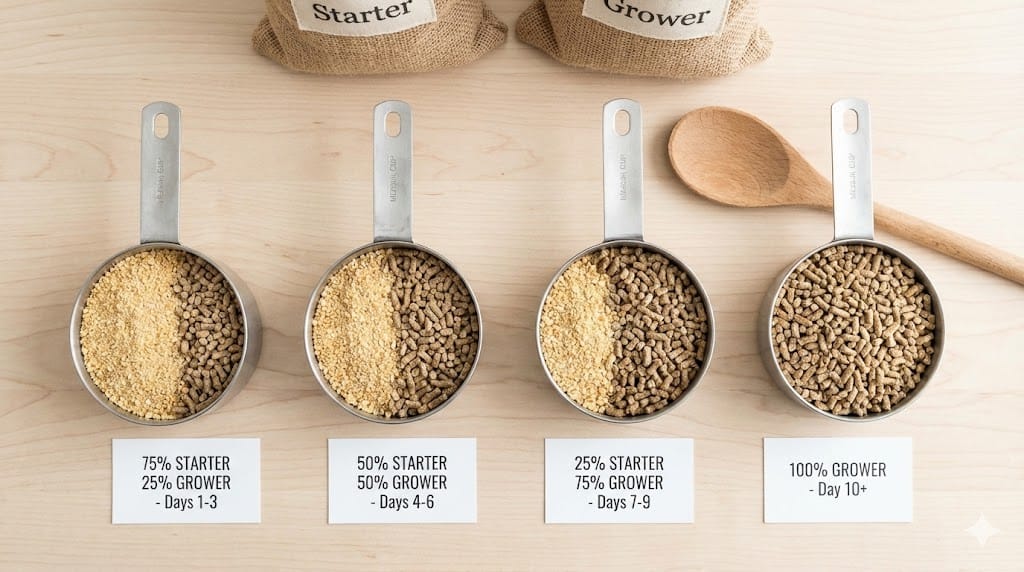
One of the most common questions is, “Can I mix starter and grower feed together?”
Yes, you absolutely must.
Chickens have sensitive digestive systems. If you switch their food abruptly (“cold turkey”), they can suffer from diarrhea, stop eating, or get stressed. This stress can invite illness.
Why Mix? Chickens have a crop (a storage pouch in their throat) and specific bacteria in their gut that digest food. These bacteria need time to adapt to new ingredients or textures.
The 10-Day Mixing Schedule: I have used this method with my own flocks for years, and it works every time. This gradual approach also aligns with Scratch and Peck’s transition guidelines.
- Days 1-3: Fill the feeder with 75% Starter Feed and 25% Grower Feed. Mix it up with your hand so they can’t just pick out the pieces they like.
- Days 4-6: Fill the feeder with 50% Starter and 50% Grower. This is a 50/50 mix.
- Days 7-9: Fill the feeder with 25% Starter and 75% Grower. They are now mostly eating the new food.
- Day 10: 100% Grower Feed. The transition is complete!
Pro Tip: Use a large bucket or storage bin to pre-mix each day’s ration. This ensures even distribution and prevents picky eaters from sorting through to find only their preferred feed. Delaware State University’s CAST program recommends storing feed in cool, dry places to prevent mold, so keep your mixing bin in a safe area.
Personal Experience: In my flock of 12 Rhode Island Reds, I once tried to switch feed in just 3 days because I ran out of starter. It was a mistake. Two of my birds developed loose, watery droppings, and the flock was unusually quiet. When I raised my next batch of Barred Rocks, I used the 10-day mix above. Their droppings remained firm and healthy, and their energy levels never dipped.
Specific Scenarios Requiring Different Timing
The 6-8 week rule is a general guideline. Here is how to adjust for your specific situation.
Meat Birds (Broilers like Cornish Cross)
Meat birds are bred to grow unnaturally fast.
- The Difference: They need high protein for longer.
- Protocol: Many keepers keep meat birds on a high-protein (20-22%) “Meat Bird Grower” or “Finisher” from start to finish. If you switch them to a 16% grower too early, you might reduce their final harvest weight.
- Timing: If you do switch, wait until 3-4 weeks, but ensure the protein stays high (18%+).
Heritage Breeds vs. Production Hybrids
- Production Reds / Leghorns: These mature fast. You can switch them safely at 6 weeks.
- Heritage Breeds (Brahmas, Cochins, Orpingtons): These are big birds that grow slowly. They need to build massive skeletons. It is often smart to keep them on starter feed until 8 to 10 weeks. The extra protein helps build strong bones to support their heavy bodies later.
Seasonal Considerations
- Winter Chicks: If you are raising fall or winter babies in a cold climate (like Michigan or New York), they burn massive calories just staying warm. Keep them on the higher-energy starter feed for an extra 2 weeks (until week 8 or 9). We have complete winter feeding strategies for cold-weather flocks to help you manage this season.
- Summer Chicks: Warm-weather chicks can transition right at 6 weeks as they don’t need the extra energy for heat. However, be sure to review feeding strategies for extreme heat conditions if you are raising birds during mid-summer.
When You Run Out of Starter Early
If you completely run out of starter feed before your chicks reach 6 weeks, you have two safe options:
- Best Option: Buy another bag of starter and continue the original schedule. A partial bag can be stored in an airtight container for future use or shared with other chicken keepers.
- Acceptable Alternative: If chicks are 4-5 weeks old and well-feathered, you can begin an extended 14-day transition to grower feed, using even more gradual mixing ratios. Monitor closely for any digestive issues.
Never skip straight to layer feed in an emergency—the kidney damage risk is too severe.
Special Feeding Situations
The 90-10 Rule Explained
As your chicks enter the “grower” phase, you might want to give them treats. Maybe some scratch grains, mealworms, or kitchen scraps (lettuce, watermelon).
- The Rule: The 90-10 rule, widely adopted by poultry nutritionists and agricultural extension services, ensures your chickens receive complete balanced nutrition. This standard is highlighted in Nutrena’s guidelines.
- Why It Matters: Commercial feeds are formulated with precise amino acid profiles, vitamin ratios, and mineral balances. When treats exceed 10% of total diet, you risk creating nutritional imbalances—particularly protein dilution during the critical grower phase when skeletal development is occurring. Learn more about safe kitchen scraps and treats for chickens to keep your flock healthy.
- Practical Limit: For every 9 cups of feed, give no more than 1 cup of treats.
Organic Grower Feed Options
Many owners want organic eggs. To get organic eggs, you must feed organic feed. However, you need to budget accordingly.
As of December 2025, organic grower feed pricing is approximately 4x higher than conventional options:
- Scratch and Peck Organic Grower: $42-48 per 25 lbs ($1.68-1.92/lb)
- New Country Organics: $38-44 per 25 lbs ($1.52-1.76/lb)
- Conventional Grower Feed: $18-22 per 50 lbs ($0.36-0.44/lb)
If you are considering premium feeds, read our detailed Nutrena NatureWise feed review and feeding results. International readers can also find UK-specific poultry feed brand recommendations and Australian poultry feed brands and availability relevant to their region.
If you choose organic, you should budget roughly $24-28 per bird for the grower phase alone, compared to about $6.00 for conventional feed. For those interested in maximizing nutrition naturally, consider the advanced feeding technique: fermenting feed for enhanced nutrition.
Can Chickens Eat Too Much Grower Feed?
Not usually, but it depends.
Unlike dogs, most chickens are good at self-regulating their intake to match their energy needs. However, the idea that they cannot overeat is a misconception.
- Boredom & Confinement: If birds are kept in small runs with nothing to do, they may eat out of boredom.
- Palatability: They are more likely to overeat fatty treats or scratch grains than standard grower pellets.
- The Exception: Meat birds (Cornish Cross) lack the genetic “off switch” for hunger and will eat themselves to death if allowed. For standard laying breeds, obesity is less common but can happen. Feel the keel bone (breastbone); if you can’t feel it through the fat, cut back on treats.
Common Mistakes to Avoid
Even experienced owners make these slips.
Mistake #1: The “Cold Turkey” Switch
- Problem: Switching straight from starter to grower one morning.
- Result: Diarrhea, stress, and refusal to eat. Make sure to perform regular health checks on your growing flock to catch any digestive issues early.
- Solution: Plan ahead. When you have about 1/4 bag of starter left, buy the grower feed and start mixing.
Mistake #2: Rushing to Layer Feed
- Problem: Feeding layer pellets at 12 or 14 weeks because “it’s cheaper” or “all the same.”
- Result: Kidney damage. The excess calcium forms crystals in their kidneys (Visceral Gout). This can kill your hens months later, often right when they should start laying.
- Solution: Patience. Wait for the first egg.
Mistake #3: Mixing Medicated and Non-Medicated
- Problem: Your starter was medicated (Amprolium), but your grower is organic (non-medicated).
- Result: If you switch abruptly, their immunity to Coccidiosis might drop just as they go outside and encounter the parasite in the soil.
- Solution: If switching from medicated to non-medicated, watch them closely for lethargy or bloody poop. The gradual mixing method also helps their immune system adjust.
Cost Analysis: What This Transition Means for Your Budget
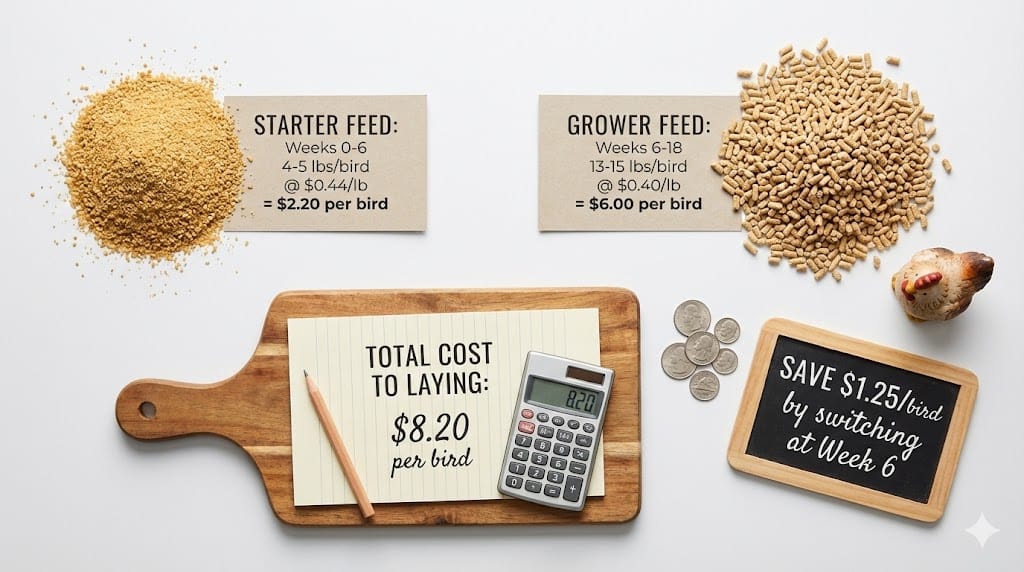
Let’s talk money. Raising chickens can get expensive, and understanding feed costs helps you budget. You can calculate exact feed costs for your flock size to plan even more accurately.
Based on current 2025 prices at Tractor Supply and Rural King, raising one pullet from hatch to point-of-lay costs approximately $8.20 in feed:
- Starter Phase (0-6 weeks): 4-5 lbs @ $0.44/lb = $2.20
- Grower Phase (6-18 weeks): 13-15 lbs @ $0.40/lb = $6.00
The Savings: By switching to grower feed at Week 6 instead of keeping birds on expensive starter until Week 12, you save approximately $1.25 per bird.
- For a standard 25-bird flock, that is $31.25 in savings—enough to buy quality oyster shell supplements for the entire first laying year.
- This calculation assumes standard feed prices; savings are even higher if you use premium or organic brands.
Visual Guide to Chicken Feeds
Use these tables when you are planning your flock’s nutrition or standing in the aisle at Tractor Supply.
Feed Composition Guide
| Feed Type | Protein % | Calcium % | Ideal Age Range | Primary Purpose | Texture |
|---|---|---|---|---|---|
| Starter | 18-20% | ~1.0% | 0-6 or 8 weeks | Rapid muscle & organ growth | Fine Crumble |
| Grower | 16-18% | ~1.0% | 6-16 weeks | Steady skeletal development | Crumble or Pellet |
| Layer | 16% | 3.5-4.5% | 16-20+ weeks | Eggshell production | Pellet or Mash |
| All-Flock | 18-20% | ~1.5% | Any Age | Mixed flock maintenance | Pellet or Crumble |
Transition Timeline by Scenario
| Scenario | Recommended Transition Age | Key Consideration |
|---|---|---|
| Standard layers (Leghorns, RIR) | 6-7 weeks | Fast maturation rate |
| Heritage breeds (Brahmas, Cochins) | 8-10 weeks | Slower skeletal development |
| Meat birds (Cornish Cross) | 3-4 weeks to high-protein grower | Rapid growth needs |
| Winter chicks | 8-9 weeks | Extra calories for warmth |
| Summer chicks | 6 weeks | Standard development |
Note: “All-Flock” or “Flock Raiser” feeds are a high-protein option that can be used as a grower feed, but you usually pay a premium for the higher protein.
FAQ: Common Questions About Feed Transition
Q: What age do I stop feeding chick starter?
A: Most chicken keepers stop chick starter between 6 and 8 weeks of age. Layer breeds typically transition at 6-7 weeks, while dual-purpose breeds may benefit from starter until 8 weeks. The key indicator is body weight: chicks should reach approximately 1.5-2 pounds before switching.
Q: How many weeks can chickens eat grower feed?
A: Chickens should eat grower feed from 6-8 weeks until 16-20 weeks of age. This means they will be on this diet for about 10 to 14 weeks. You will switch from grower to layer feed when birds begin laying eggs or reach 16-20 weeks, whichever comes first.
Q: Can I mix starter and grower feed together?
A: Yes! Mixing is the best way to switch. Start with mostly starter feed and add a little grower. Over the course of a week, add more grower and less starter until you are only feeding grower. This prevents stomach aches for your birds.
Q: How do I know if I’m doing this right?
A: Trust your observations. Healthy pullets during the grower phase should be:
Active and alert, with bright eyes
Producing firm, well-formed droppings (not watery or bloody)
Showing steady weight gain week to week
Developing full, glossy feathers
Exhibiting normal flock behaviors (pecking, scratching, dust bathing)
If you see these signs, you’re doing great. Any sudden changes in behavior, appetite, or droppings warrant a check with a poultry veterinarian.
Q: When to switch from chick starter to grower Reddit opinions?
A: If you check the chicken-keeping subreddits, experienced keepers almost universally recommend the 6-week mark for production breeds. However, Reddit threads often emphasize flexibility: if your birds look small or are recovering from an illness (like Coccidiosis), keep them on starter longer.
Q: What happens if I accidentally feed grower to baby chicks?
A: If it happens once, don’t panic. But long-term, grower feed does not have enough protein (16%) to support the explosive growth a 2-week old chick needs. They may develop slowly, have poor feathering, or have weak immune systems. Switch back to starter immediately.
Q: Can I skip grower feed and just use “All-Flock” feed?
A: Yes, you can. “All-Flock” or “Flock Raiser” feeds usually have 20% protein and can be fed to chicks, ducks, and turkeys of all ages. However, this is often more expensive than grower feed. If you have a mixed flock of ducks and chickens, All-Flock is actually the best option because it simplifies your life. For more details on feeding different age groups, consult our comprehensive chicken feeding guide covering all life stages.
Q: My store doesn’t sell “Grower,” only “Starter/Grower.” What do I do?
A: Many brands now sell a combined “Starter/Grower” feed (usually 18%). University of Georgia Extension’s management guide confirms that combined rations are formulated for this use. If you are using one, you don’t need to switch anything until you see the first egg.
Conclusion
Transitioning your flock from starter to grower feed is one of your first big management decisions. It feels complicated, but it is actually simple if you follow the bird’s lead.
The Summary Checklist:
- Wait until 6-8 weeks of age.
- Check that birds are fully feathered and active.
- Buy a 16-18% protein Grower feed.
- Mix the old and new feed gradually over 7-10 days.
- Watch for healthy droppings and energy.
- Switch to Layer feed only after the first egg or around 16-20 weeks.
By following this guide, you ensure your chickens grow at a healthy pace, saving you money on feed costs while protecting their long-term health. Happy chickens mean healthy eggs later! Once you’ve mastered the transition, your next step is to establish a consistent daily feeding schedule for your chickens to keep egg production steady.
Disclaimer: This guide provides educational information based on current poultry nutrition research and established feeding practices. Individual bird requirements may vary by breed, climate, and health status. For specific health concerns, consult a licensed poultry veterinarian or contact your local agricultural extension service. Feed manufacturers’ guidelines on packaging should be followed for products you purchase. The author is not a licensed veterinarian and cannot diagnose or treat poultry diseases.

Oladepo Babatunde is the founder of ChickenStarter.com. He is a backyard chicken keeper and educator who specializes in helping beginners raise healthy flocks, particularly in warm climates. His expertise comes from years of hands-on experience building coops, treating common chicken ailments, and solving flock management issues. His own happy hens are a testament to his methods, laying 25-30 eggs weekly.