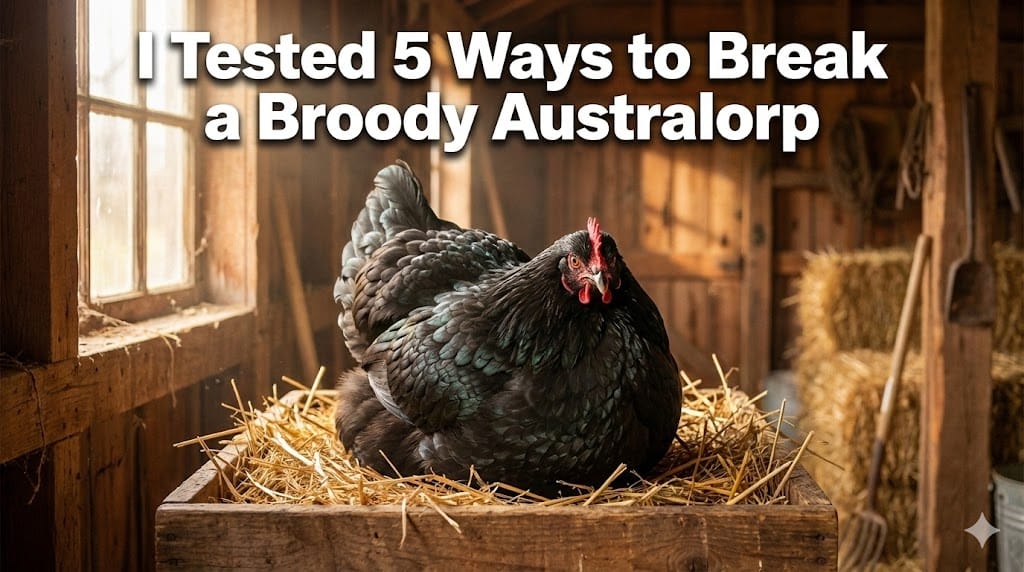
I stood in my coop, staring at Midnight, my favorite Black Australorp hen. She was flattened out like a pancake in the nesting box, growling at me like a velociraptor.
I reached under her to check for eggs. Peck! She nailed my hand.
Midnight had gone broody. Again.
If you raise Australorps, you know they are wonderful layers and friendly pets. But when their hormones flip a switch, they become determined mothers—even if she is guarding a phantom clutch of eggs.
Breaking a broody Australorp requires patience and the right strategy. Over the last three weeks, I lost approximately 23 eggs because Midnight refused to lay during her brooding spell. I decided to turn this frustration into an experiment. While I have written a general guide to breaking broody hens, I wanted to see what specifically works for this breed. I tested 5 different methods, ranging from gentle persuasion to the famous “broody jail.”
Here is my honest, day-by-day account of what actually works for breaking a stubborn Australorp hen.
Black Australorps Go Broody: Understanding Why This Breed Sets
Yes, Australorps are known to go broody. (For a deep dive into the breed’s temperament, check out our complete Australorp guide).
It helps to know where they fall on the “Broody Scale”:
| Breed | Broodiness Level | Typical Behavior |
|---|---|---|
| Silkie | Extreme (★★★★★) | Will try to hatch golf balls or rocks. |
| Buff Orpington | High (★★★★☆) | Very persistent; famously fluffy mothers. |
| Australorp | Moderate/High (★★★★☆) | Determined nesting instinct, but breakable. |
| Leghorn | Low (★☆☆☆☆) | Rarely sets. Bred strictly for production. |
Because Australorps are a “heritage breed,” they retain a strong nesting instinct. The Livestock Conservancy notes that Australorps are “generally considered good sitters and mothers,” which explains their tendency toward broodiness.
Unlike production birds that have had the maternal instinct bred out of them, Australorps are dual-purpose birds. Oklahoma State University’s Department of Animal Science describes them as “one of the best dual-purpose fowls,” meaning they are heavy enough for meat but prolific enough for eggs. This balance makes them excellent, if sometimes stubborn, mothers.
My Personal Observation: In my flock of six, only my Australorps go broody consistently. It usually happens in early spring, right when you are busy starting your vegetable garden seeds or prepping planting beds. The increasing daylight that triggers egg laying also triggers the hormonal broody switch, unfortunately coinciding with the busiest time of year for homesteaders.
Midnight went broody twice this season alone. It’s part of owning this breed, but it can be frustrating if you want eggs, not chicks.
Broody Hen Symptoms: How to Tell if Your Australorp is Broody
You might think your chicken is sick, but she is likely just hormonal. It’s always smart to perform a quick chicken health check to be sure, but here are the specific broody hen symptoms I tracked with Midnight:
- The “Pancake” Posture (Setting Behavior): She flattened her body out to cover as much surface area as possible. This distinctive setting behavior is designed to cover a full clutch of eggs.
- The “Broody Trance”: When I picked her up, she didn’t flap. She stayed frozen in that seated position, legs tucked up, staring into space.
- The Growl: When I approached the nest, she made a low, ticking growl.
- Feather Fluffing: She puffed her feathers up to look twice her size.
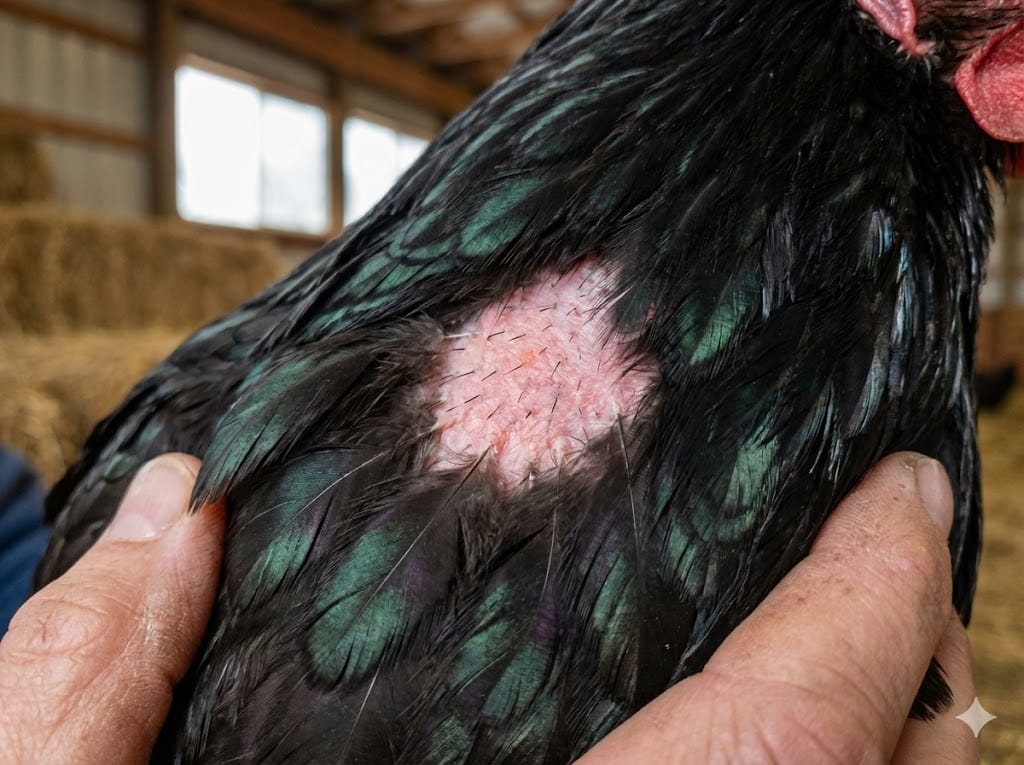
- Bald Chest (The Broody Patch): On day 3, I noticed she had plucked a 2-inch bare patch on her chest. She does this to put her warm skin (which runs hot at ~105°F+) directly against the eggs.
- Stopped Laying: This is the big one. Egg production dropped to zero immediately. When a hen stops laying eggs, you know something is up.
- The “Broody Poop”: She would leave the nest once a day for a massive, foul-smelling dropping. It is unmistakably huge compared to normal droppings.
Breaking a Broody Hen: Is It Necessary? (The Real Cost)
You might ask, “Why not just let her sit?”
I asked myself this, too. But after doing the math and checking her health, I realized I had to intervene to interrupt her natural hormonal cycle.
1. The Health Risks: How Long Can a Hen Safely Be Broody?
A broody hen neglects her own health. Midnight was barely eating. The natural incubation cycle is 21 days. The Association of Avian Veterinarians recommends allowing broody hens to sit for the “normal 21-day period” if hatching is intended, after which they typically break naturally.
However, if you have a broody hen with no eggs, this cycle doesn’t end naturally, leading to serious risks:
- Safe Limit: A healthy hen can usually handle 21 days of sitting.
- The Danger Zone: If she sits longer than 21 days (which she will if the eggs don’t hatch), she enters a danger zone of starvation.
- Weight Loss: Hens can lose a lot of body mass quickly.
- Dehydration: They don’t drink enough water.
- Mite Infestations: This is a hidden danger. Because she isn’t dust bathing or moving, mite infestations can swarm a broody hen. I found a cluster of mites near her vent on Day 5 because she hadn’t moved to preen.
- Heat Stroke: A broody hen’s body temperature rises. In the summer heat, sitting in a hot nesting box can be fatal. See our guide on heat management for Australorps for more details.
2. The Financial Cost
I tracked the numbers. An Australorp lays about 4-5 eggs a week.
- Days Broody: 18 days (during my testing)
- Recovery Time: 14 days (before she laid again)
- Total Eggs Lost: ~23 eggs
- Value: At local organic prices ($0.50/egg), I lost over $11.00 from just one hen.
When NOT to break them: The only time I let them sit is if I actually want chicks. If you are wondering what to do with a broody hen no rooster present, you generally have two choices: break her broodiness immediately or purchase fertile eggs (or use an incubator for hatching). Since I don’t have a rooster right now, allowing Midnight to sit would have been pointless.
Breaking a Broody Australorp: 5 Methods I Tested
I ran this experiment over three weeks. I started with the easiest, nicest methods and worked my way up to the “tough love” options. (Note: I am currently working on a video demonstration of the entire process, specifically the Broody Jail setup—stay tuned for that update!)
Method 1: The “Football Carry” (Manual Eviction)
I started with the most common advice: just take her off the nest. The idea is that if you annoy her enough, she’ll eventually give up.
My Routine: I set a strict alarm on my phone to go out to the coop every 2 hours (8 AM, 10 AM, 12 PM, 2 PM, 4 PM). Every time I found her in the box, I picked her up using a “football hold” (tucking her wings so she couldn’t flap) and carried her 50 feet away to the farthest corner of the run. I’d then drop some scratch grains or mealworms in front of her to trigger her foraging instinct.
The Reality Check: The “boomerang effect” is real, and it is exhausting. Midnight treated this like a game. I would carry her out, put her down, and turn my back to latch the gate. By the time I turned around, she had already sprinted back to the coop and was settling onto the nest. I did this for 4 days. It cost me nothing but sweat, but it was a total failure.
Verdict: ❌ Failed. She was more stubborn than I was.
Method 2: Frozen Water Bottles (The Ice Trick)
Since broody hens have elevated body temperatures, the theory is that cooling their underside makes the nest uncomfortable and signals their body that incubation is impossible.
What I Tried: I grabbed two hard plastic “lunchbox” ice packs from my freezer. (Tip: Don’t use the soft gel ones; chickens will peck through the plastic and eat the toxic gel). I waited until she stood up to rotate her phantom eggs and slid the frozen packs right into the center of the nest.
How She Reacted: I expected her to jump out the moment her warm skin hit the ice. Instead, she shimmied around until she got comfortable on top of the ice packs. She actually tucked them under her wings like they were giant, cold eggs. When I checked on her an hour later, the ice packs were warm. Her body heat is incredibly powerful.
Verdict: ❌ Failed. She seemed to appreciate the air conditioning.
Method 3: The Day-Long Lockout
If she can’t get to the nesting box, she can’t brood, right? That was the logic behind Method 3.
The Chaos: I waited until 10:30 AM (so my other hens could finish laying) and then chased everyone out of the coop. I closed the pop-door and the human door, locking the entire flock in the run until dusk. I made sure they had plenty of food and water outside.
The Unintended Consequence: This method caused absolute chaos. My non-broody hens who needed to lay a late egg were pacing and screaming at the door. But Midnight? She didn’t snap out of it. She simply walked under the raised coop, found a dark depression in the dirt, and went broody on the ground. She sat there all day, puffed up and growling at the air.
Verdict: ⚠️ Partially effective. It kept her out of the box, but didn’t break the hormonal trance.
Method 4: The Cold Water Dunk (Proceed with Caution)
This is an old-school farm remedy: a sudden, drastic drop in body temperature to break the “fever” of broodiness instantly.
Safety First: I only attempted this because it was a sunny, 80°F (26°C) day. Never do this if it’s cold, windy, or late in the evening. The bird needs time to dry off completely before roosting.
The Process: I filled a galvanized tub with cool garden hose water. I held her wings tight to her body and lowered her in up to her neck, keeping her there for about 3 minutes. She didn’t struggle; she just floated there looking betrayed. Afterwards, I set her in the grass to air dry (no towel rubbing, as that creates heat).
The Aftermath: It worked… for about two hours. While she was wet and miserable, she preened and ate. But the moment she was fluffy and dry, the hormones kicked back in and she marched right back to the nest.
Verdict: ⚠️ Helpful as a supplement, but not a standalone cure.
Method 5: Broody Jail for Chickens (The Wire Crate)
After wasting nearly two weeks on the methods above, I went for the “nuclear option.” This method uses continuous airflow to cool the bird’s underside (brood patch) for several days.
My Winning Setup:
- The Crate: I borrowed a 36-inch wire dog crate. Popular models like the MidWest iCrate or Petmate Precision work perfectly because they have removable plastic trays—you must remove the tray.
- Elevation: I propped the crate up on four cinder blocks inside the chicken run. This allows cool air to flow under her belly. If the crate is on the ground, the earth keeps her warm.
- Interior: I added a clip-on water cup and a heavy bowl for food. Crucially, I added ZERO bedding. No cardboard, no towel, no straw. She had to stand or sit on the wire grid.
The Mental Battle: Putting her in was easy; keeping her there was hard. The first night, I went out to check on her and she was pacing and clucking softly. I felt like a mean warden. I desperately wanted to put a towel in there for her feet, but I knew that would ruin the “cooling” effect.
I kept her in there for 3 full days and nights.
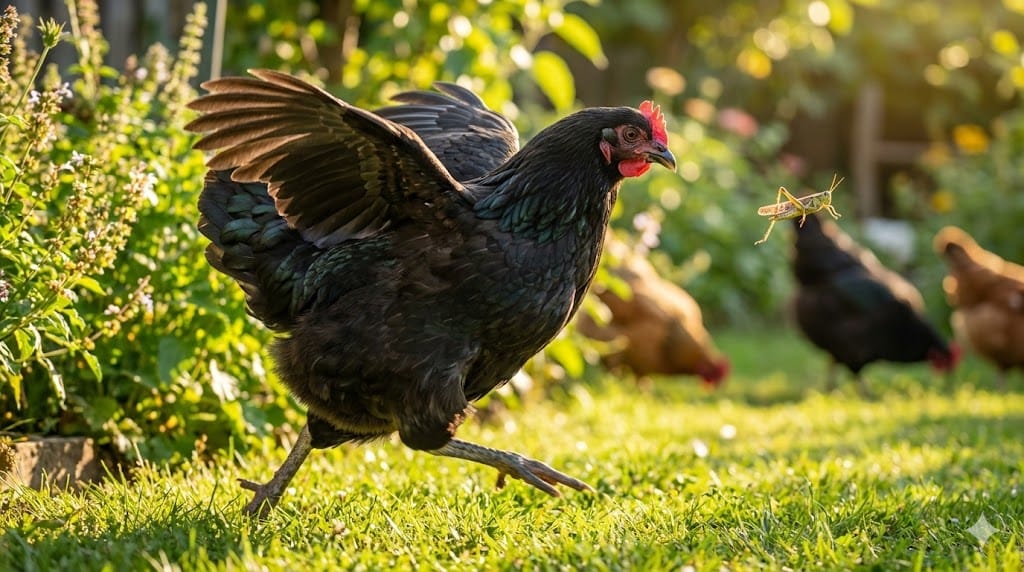
Verdict: ✅ Complete Success. When I released her on the morning of Day 4, she ignored the nest completely and ran to chase a grasshopper.
Breaking a Broody Hen in Winter: Special Safety Rules
Breaking a broody hen in freezing temperatures requires extra care to prevent illness. Never use water methods or leave her in an exposed outdoor wire crate where her toes could freeze. Instead, move the broody jail crate into a draft-free garage or basement that is cool (around 50°F) but safe from frostbite—check our guide on winterizing your coop for draft-proofing tips. You can also try the “high-traffic” method by placing her crate in a busy hallway or mudroom; the constant activity and artificial light can help break the trance without the risk of hypothermia.
Multiple Hens Go Broody: Handling the Chain Reaction
Australorps are social birds, and broodiness can be contagious. One broody hen can trigger others.
If you have two or three hens go broody at once (which happened to me last year):
- Do not stack them: Do not put multiple hens in one small crate; they will overheat each other.
- Use a larger crate: A Great Dane-sized wire crate can hold two hens if necessary, but only if there is enough space for them not to touch.
- Separate them if possible: Ideally, use separate crates. If they sit snugly together, they keep each other warm, defeating the purpose of the “cooling” jail.
How Long Does It Take to Break a Broody Hen?
Based on my testing, the length of the brooding period depends entirely on the method you use.
- Gentle methods (Ice/Removal): Could take weeks (or never work).
- Broody Jail: 2 to 6 days.
My Australorp’s timeline looked like this:
- Day 1-4: Wasted time with gentle methods.
- Day 5-7: Broody Jail.
- Day 8: Released. Behavior back to normal.
- Day 22: She laid her first egg after the break.
Post-Broody Recovery: Getting Her to Lay Again
Breaking the broodiness is only half the battle. Your hen is now depleted. Here is the recovery protocol I used to get Midnight laying again:
- Protein Boost: For the first week, I gave her high-value treats like scrambled eggs and mealworms every morning. She needed to rebuild muscle mass.
- Electrolytes: I added a Sav-A-Chick electrolyte packet to the flock’s water for 2 days to help with rehydration.
- Pecking Order Watch: Since she had been “crazy” for weeks, the other hens bullied her slightly upon return. I monitored them, but they sorted it out in about 24 hours. If bullying persists, check our guide on pecking order problems.
What Actually Works for Stubborn Australorps: My Final Verdict
If you have a determined Black Australorp, save yourself the time. Skip the ice packs and the water baths.
My Ranking of Methods:
- Broody Jail for Chickens (Wire Crate): ★★★★★ (The Gold Standard)
- Cold Water Bath + Lockout: ★★★☆☆ (Messy, weather-dependent)
- Lockout Only: ★★☆☆☆ (She just nests elsewhere)
- Ice Packs: ★☆☆☆☆ (Useless)
- Nest Removal: ★☆☆☆☆ (Useless)
For the fastest results with the least amount of stress on the bird’s health, use the wire crate method immediately. It resets their body temperature and hormones faster than anything else.
Broody Hen FAQs: Frequently Asked Questions
How long should I let a broody hen sit?
If you aren’t hatching eggs, do not let her sit at all. Start breaking her the moment you notice the symptoms. The maximum safe limit is 21 days, but breaking her within the first 3 days is ideal.
Why do chickens scream after laying eggs?
That loud “Bawk-bawk-bawk-GAAAAWK” sound is the “Egg Song.” It is an announcement that they laid an egg. It is totally normal.
Can a broody hen die from broodiness?
Yes. While rare in the short term, a hen that sits for months without proper food and water intake can die from dehydration, starvation, or mite infestations.

Oladepo Babatunde is the founder of ChickenStarter.com. He is a backyard chicken keeper and educator who specializes in helping beginners raise healthy flocks, particularly in warm climates. His expertise comes from years of hands-on experience building coops, treating common chicken ailments, and solving flock management issues. His own happy hens are a testament to his methods, laying 25-30 eggs weekly.