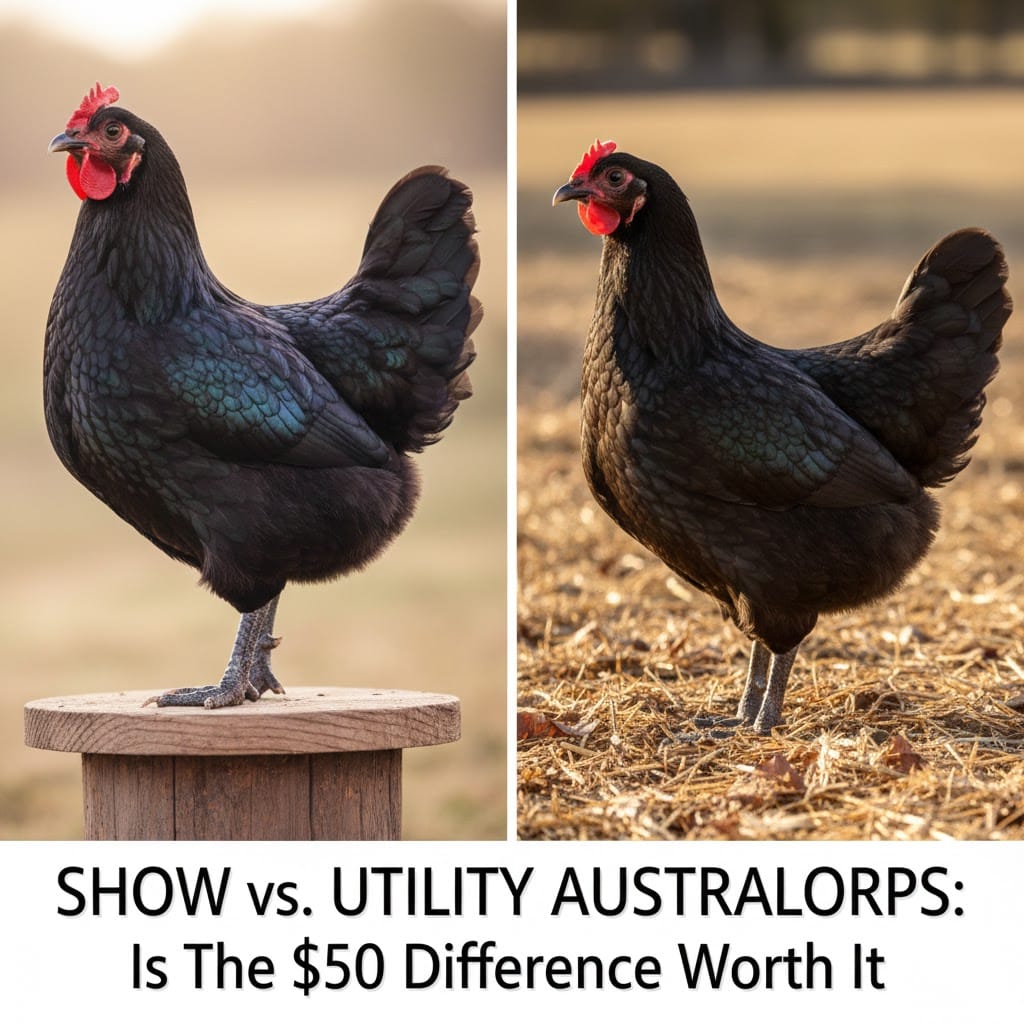
When comparing show quality vs. utility Australorps, the price gap is dramatic. I paid $62.50 for a show quality Australorp pullet from a breeder near Ballarat, Victoria, and just $8 for a hatchery bird from my local farm supply store on the same day. I honestly thought the expensive bird would be “better” in every way. Twelve months later, my egg production spreadsheet tells a much more complicated story—and the answer isn’t what most breed guides will tell you.
If you are standing in the feed store or looking at a breeder’s website wondering where to put your money, you aren’t alone. This guide breaks down the real differences between show quality vs. utility Australorps—covering egg production, temperament, lifespan, and whether that premium price makes sense for backyard keepers in Australia, the US, and beyond. If you want a deeper dive into the breed itself, check out our complete Australorp breed guide first.
What Are the Different Types of Australorps?
Before we get into the numbers, we have to clear up some confusion. Many new keepers think an Australorp is just an Australorp. However, the Livestock Conservancy lists the Australorp as a dual-purpose heritage breed, meaning they were originally developed to provide both meat and eggs.
(Note: If you’re considering Australorps for meat as well as eggs, note that the black feathers can make plucking more difficult compared to lighter-feathered breeds. Dark pin feathers are more visible on the dressed carcass, which is a common observation among heritage breeders.)
The Australorp was developed in Australia during the early 1900s from Black Orpingtons imported from England (originally developed by William Cook). Australian breeders focused on improving egg production while maintaining the calm temperament that Orpingtons were known for.
Over time, a massive divide formed between production strains (utility) and exhibition strains (show).
- Utility/Production Strain: These are the birds you usually get from big hatcheries (like Murray McMurray in the US or commercial suppliers in Australia). They are bred for one thing: laying lots of eggs.
- Show/Exhibition Strain: As a heritage breed, these are bred by private breeders to match the breed standard (Standard of Perfection). They care about body shape, feather quality, and that classic beetle-green sheen.
Defining the Pure Breed Black Australorp
When we talk about the Pure Breed Black Australorp, we are referring to the original standard. This is the bird that took the world by storm in the 1920s.
While you will see Blue, White, and Splash varieties—Wikipedia notes these are recognized in Australia—the Pure Breed Black Australorp is the only variety recognized by the APA in the US, offering the most consistent poultry genetics for both show and utility purposes.
Where Do Australorps Fit in Chicken Classification?
According to the American Poultry Association‘s official breed registry, Australorps belong to the English class, despite being developed in Australia. Why? Because they originated from the Black Orpington, a breed developed by William Cook in England.
Cook’s Orpingtons were imported to Australia, where breeders refined them into the egg-laying machines we know today. Other English class breeds related to them include Cornish, Dorkings, and Sussex.
Black Australorp vs. Blue Australorp: Appearance and Performance
A lot of people ask me about color. Does it change how many eggs you get? In my flock, I’ve raised both.
The Black Australorp is the classic. The Open Poultry Standards Australia describes the ideal Australorp as having “lustrous black with green sheen” plumage. This beetle-green sheen should shine brilliantly in the sunlight.
The Blue Australorp is a bit different. They have slate blue-grey feathers, usually with darker lacing (a dark rim around the feather). They are beautiful, but genetically, they are a bit more complicated.
Here is what I’ve noticed comparing them:
| Characteristic | Black Australorp | Blue Australorp |
|---|---|---|
| Plumage Color | Solid black with beetle-green sheen | Slate blue-grey with darker lacing |
| Egg Production | Excellent (Reliable layers) | Very Good (Slightly variable) |
| Show Recognition | APA & Australian Standards recognized | APA recognized (but harder to perfect) |
| Availability | Very Common | Less common, often higher priced |
Show Quality vs. Utility Australorps: The Core Differences
This is where my wallet really felt the difference. I bought “Lady,” my show bird, from a breeder near Ballarat, Victoria. I bought “Henrietta,” my utility bird, from a local farm supply store bin.
Physical Conformation Differences
The first thing you notice is the size. The utility bird, Henrietta, looks like a sportier version—leaner, taller, and more active. Lady, the show bird, is built like a tank. Both types share white skin (not yellow), dark brown or black eyes, and a single comb with up to seven points.
According to the Open Poultry Standards, a show-quality Australorp must have a very specific “silhouette.” Here is how my birds compared to the technical standard:
| Feature | Standard Description (Show Quality) | My Utility Bird (Henrietta) |
|---|---|---|
| Back | “Rather long, broad its entire length, slightly sloping downward from shoulders… rising in a gradually increasing concave sweep to tail.” | Short, flat back with a sharp, abrupt tail transition. |
| Body | “Moderately long and rather deep; carried nearly horizontal.” | Leaner body, carried at an upward angle rather than horizontal. |
| Tail Angle | “Carried at an angle of forty degrees above the horizontal.” | High, vertical tail (almost 90 degrees), common in production strains. |
| Fluff | “Minimal, only sufficient to cover the thighs.” | Very little fluff; feathers are thin and strictly functional. |
The South African standard further notes that the ideal bird should be “compact… giving the impression of depth, width, and fair length.” Lady has this symmetry perfectly. In show birds, excessive fluff and loose feathering should be eliminated, as they indicate Orpington blood that hasn’t been properly refined for the Australorp standard.
My Side-by-Side Comparison ($8 Hatchery Hen vs. $60 Show Hen)
Here is what surprised me after 12 months:
- Feed Consumption: The show bird eats about 15% more feed. She is a bigger bird (weighing in at roughly 7.5 lbs vs. the utility hen at 5.5 lbs), so she needs more fuel just to exist. The utility bird has a better feed conversion ratio, making for better Australorp feed efficiency.
- Temperament: This is where the extra money might be worth it. My show bird is incredibly calm. I can walk up and pick her up without a chase. The utility hen is skittish and acts more like a typical farm chicken.
- Molt: The show bird looked absolutely ragged during her chicken molting season because she has so many more feathers to lose. It took her longer to grow them back, too.
Feed and Equipment Costs Breakdown
Beyond the purchase price, specific equipment and ongoing costs differ. Here’s what each bird cost me over 12 months:
| Expense | Show Bird | Utility Bird |
|---|---|---|
| Layer feed (per year) | ~$85 AUD | ~$70 AUD |
| Veterinary check (one visit) | $65 AUD | $65 AUD |
| Additional coop space | Needed larger roost | Standard sizing |
If you’re building a new coop using quality building materials, budget approximately 4 square feet of floor space per bird for utility Australorps, and closer to 5 square feet for the larger show types (see our coop sizing guide). This extra space on your rural property helps prevent health issues and reduces the need for emergency veterinary care. You can calculate your specific expenses with our chicken feed cost calculator.
Note: For high-value birds, many owners in the US and Australia are now looking into specialized poultry insurance (similar to pet insurance) to cover unexpected medical costs. If you plan to breed show birds, factor in the cost of quality incubators and brooders, as show hens often go broody but having control over the hatch is better for preservation.
Egg Production Reality: My 12-Month Data
This is the part that answers the commercial intent for most of you. If you want eggs, pay attention to this chart. According to the Livestock Conservancy, backyard Australorps lay 250+ tinted to light brown eggs per year, with eggs averaging 26-27 ounces per dozen. My data from the utility strain certainly backs this up.
I tracked egg numbers from the point of lay pullet stage (when they started laying around 22-24 weeks old) for exactly one year.
| Month | Show Quality Hen (Eggs) | Hatchery/Utility Hen (Eggs) |
|---|---|---|
| Spring (Peak Production) | 20 per month | 26 per month |
| Summer Heat | 16 per month | 24 per month |
| Autumn/Fall | 12 per month | 20 per month |
| Winter | 4 per month (stopped early) | 15 per month |
| Annual Total | ~180 Eggs | ~260 Eggs |
Commercial vs. Backyard Expectations
Poultry Hub Australia makes an important distinction for your expectations: while the Australorp can average over 300 eggs per hen per year in a high-intensity commercial setting, backyard poultry producers should not expect more than 250 eggs a year. My utility hen’s result of 260 eggs is actually an exceptional performance for a home environment.
Why Show Birds Actually Lay Fewer Eggs
The honest answer is biology. A chicken only has so much energy.
A utility Australorp puts almost all her energy into making eggs, maintaining a steady laying cycle throughout the year. As you can see in the table, the utility hen continued laying through winter (15 eggs vs. 4), proving the breed’s reputation for cold-weather laying—provided you have the right strain. Many sources explicitly praise utility Australorps for their winter production, making them one of the best choices for year-round eggs.
A show quality Australorp puts a lot of energy into body maintenance. Also, breeders select show birds for their looks, not necessarily for how many eggs they lay. Over generations, the “broodiness” (the desire to sit on eggs) often stays stronger in show lines. My show hen went broody twice this year, interrupting her laying cycle and meaning zero eggs for about 6 weeks total. If you’re dealing with this, here’s how to break a broody Australorp.
Do Australorps Lay Pink Eggs?
I see this question frequently, and the answer is no—Australorps do not lay pink eggs. They lay light to medium brown eggs. However, according to Somerzby, the eggs can sometimes appear to have a very slight pink coloring due to the natural bloom coating hens produce when the egg is laid. If you’re consistently getting distinctly pink eggs from a bird sold as an Australorp, you likely have a crossbreed.
What Are the Disadvantages of Australorp Chickens?
I love this breed, but I want to be real with you. They aren’t perfect.
- The Heat: Black feathers absorb heat. In the Australian summer or the US South, these girls get hot. You need to provide deep shade and cool water. Learn more about managing heat stress in Australorps. Many owners install specialized heating/cooling equipment like ventilation fans or misting systems (standard hardware items) to help these heavy black birds cope with the midday sun.
- Broodiness: Especially with the heritage/show types, they love to be moms. If you don’t want chicks, breaking a broody hen is a hassle.
- Size & Management: They are big birds. This impacts coop space requirements—you cannot cram them in. If you are unsure about capacity, check how much space do chickens really need. Also, according to the Livestock Conservancy, if Australorps are kept only in confinement, they may get fat. Free ranging or allowing foraging opportunities keeps them active and productive while helping prevent obesity. Their heavy bodies make them a bit slower, so robust predator protection—such as high-quality fencing and automatic coop doors—is vital.
How to Tell If Your Australorp Is a Rooster
I’ve had this happen. You buy “sexed pullets,” and 8 weeks later, one is looking suspicious.
Early Signs (4-8 Weeks)
- Comb Color: The boys usually get a pink/red comb much earlier than the girls.
- Leg Thickness: Take a look at the legs. The males often have thicker, sturdier legs even at a young age.
Definitive Signs (8-16 Weeks)
- Saddle Feathers: This is the smoking gun. Look at the feathers on the back, right before the tail. Pointy, cascading feathers mean it’s a boy. Rounded feathers mean it’s a girl.
- Crowing: Obviously!
- Spurs: You might see little bumps starting to grow on the inside of the leg.
I once had a utility pullet I was sure was a rooster because she was so bossy, but she laid an egg at week 21. Sometimes personality tricks you!
Australorp Lifespan: What to Expect
One benefit of the show/heritage types is that they often live longer. High-production birds burn out faster because laying eggs is hard on the body.
| Bird Type | Average Lifespan | Productive Laying Years |
|---|---|---|
| Show Quality | 6-10 years | 3-4 years |
| Utility/Hatchery | 5-8 years | 2-3 years |
| Australorp Hybrid | 4-6 years | 2 years |
For more on how long chickens typically live across all breeds, see our detailed guide. If you are looking for a pet that sticks around, the lifespan of an Australorp from a breeder is usually better.
Is the Australorp Really the “King of All Poultry”?
You might have read about the 364-egg world record. While that is the headline number everyone remembers, the records actually progressed significantly over time as Australian breeders perfected the dual-purpose heritage breed.
According to the Livestock Conservancy, the “King” title was earned through a series of increasingly impressive competitions:
- Geelong, Victoria: A pen of six Australorp hens set a world record by laying 1,857 eggs in 365 days—an average of 309.5 eggs each.
- Grafton Contest (1923-24): A single Australorp hen laid 347 eggs in 365 days.
- Burns Bloodline: Shortly after, a hen from the famous Burns bloodline broke the record again, laying 354 eggs in twelve months.
- The Final Record: This all culminated in the famous world-record holder who produced 364 eggs in 365 days at the Hawkesbury Agricultural College.
These records made the breed famous worldwide. However, do not expect 364 eggs from your backyard flock. Those were results of freak nature and extreme selective breeding. Modern utility birds are great—my 260 eggs from Henrietta is an excellent number—but they aren’t machines.
Which Should You Buy? Decision Framework
So, which one should you actually buy?
| If You Want… | Choose… | Why? |
|---|---|---|
| Maximum Eggs | Utility/Hatchery | Bred strictly for production. You get more eggs for less feed. |
| Poultry Shows | Show Quality | Matches the breed standard. Utility birds will be disqualified or score low. |
| Breeding Program | Show Quality | Essential to maintain the breed integrity and heritage traits. |
| Friendly Pets | Show Quality | Usually handled more and bred for calmer temperaments. |
| Budget Flock | Utility/Hatchery | $8 vs $60 is a huge difference for a starting flock. |
Where to Buy Quality Australorps
For Australian Readers
Check with the Australorp Club of Australia. They can point you to reputable breeders in Victoria, New South Wales, and Queensland. Avoid buying from “backyard mixes” on Gumtree if you want pure genetics. Check our guide on where to buy chickens in Australia and make sure you understand backyard chicken laws in Australia before purchasing.
For US Readers
If you want utility birds, big hatcheries like Murray McMurray or Meyer Hatchery are reliable. If you want show quality, look for breeders who are NPIP certified (National Poultry Improvement Plan). Be sure to check your local chicken laws by state before buying.
A Note on Health
Regardless of where you buy, practice strict biosecurity. Quarantine new birds for 30 days before adding them to your flock to prevent the spread of disease.
Conclusion
So after 12 months, would I pay that premium again?
For me, yes, but only for one or two birds. I love having “Lady” in the flock. She is beautiful to look at, calm around my kids, and keeps the heritage genetics alive. But for the rest of the flock? I’ll stick to the utility girls. They pay the rent with their eggs.
If you just want breakfast, save your money and get the hatchery chicks (see our guide on chicks vs adult hens for beginners). If you want a stunning “lawn ornament” that lays decent eggs and acts like a puppy, splash out on the show bird.
Have you raised both types? Did your show birds lay better than mine? Let me know in the comments below!

Oladepo Babatunde is the founder of ChickenStarter.com. He is a backyard chicken keeper and educator who specializes in helping beginners raise healthy flocks, particularly in warm climates. His expertise comes from years of hands-on experience building coops, treating common chicken ailments, and solving flock management issues. His own happy hens are a testament to his methods, laying 25-30 eggs weekly.