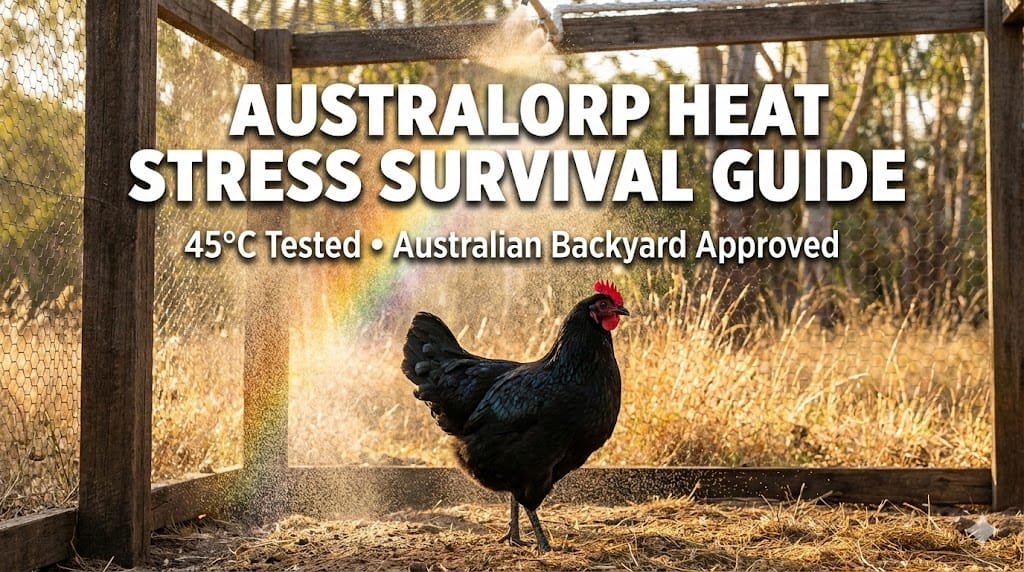
When my weather app showed 45°C (113°F) for three consecutive days last summer, I knew my black Australorps were in serious danger. Australorp heat stress management became my obsession after I sadly lost a hen to heat stroke during my very first year of chicken keeping. It was a hard lesson to learn, but it changed how I care for my birds. This complete guide covers black Australorp heat stress management, including how to keep chickens cool in 100 degree weather and what temperature is too hot for chickens in Celsius.
As a backyard chicken owner in Victoria, Australia, I’ve spent four years learning exactly what keeps these beautiful birds alive in extreme heat (and during bushfire season). If you want to understand the full Black Australorp breed characteristics, I’ve written a complete guide—but today we’re focusing specifically on heat survival and keeping chickens cool in Australian summers.
Australorp summer care is critical because, although they were developed in Australia from Black Orpingtons giving them some natural adaptation, 45°C is extreme for any animal.
If you are worried about your flock, you are in the right place. Here is exactly how I manage the heat and keep my girls safe when the sun tries its best to bake the backyard.
Heat stress in chickens occurs when ambient temperatures exceed 27°C (80°F) and the bird’s core body temperature rises beyond its ability to self-regulate through panting and behavioural changes. Without intervention, internal temperatures can reach fatal levels of 45-46°C.
Quick-Reference Temperature Guide
| Temperature | Risk Level | Action Required |
|---|---|---|
| 15-24°C (60-75°F) | Safe | Normal care |
| 24-29°C (75-85°F) | Caution | Monitor, ensure water access |
| 29-35°C (85-95°F) | Moderate stress | Active cooling measures |
| 35-40°C (95-104°F) | High risk | Misters, shade, multiple water sources |
| 40°C+ (104°F+) | Emergency | All interventions, consider bringing indoors |
Why Black Australorps Need Extra Help in Extreme Heat
A common question I get is, “Can Australorps handle heat?” The short answer is yes—they are rated as moderately heat tolerant—but they require more management in extreme heat compared to lighter breeds like Leghorns. Heat stress in chickens affects heavy breeds like Australorps more severely due to their body mass and feather color.
First, Australorps are a heavy dual-purpose breed. Australorp hens weigh 6.5-8 lbs (3-4 kg) and roosters 8.5-10 lbs, giving them a large body mass that retains heat. General poultry guidelines highlight that heavy breeds need extra care compared to lighter birds.
Second, and more importantly, is their colour. Black Australorp heat stress is a specific issue because black feathers absorb significantly more solar radiation than white or buff feathers. For more on how sun affects your flock, read my sun and heat safety guide.
I once took a thermal temperature gun into my run on a 38°C day. My white Leghorn’s back measured about 40°C. My black Australorp’s back measured nearly 55°C in direct sun. That dense feathering, which is amazing for keeping them warm in winter, acts like a down jacket that traps heat in the summer.
Who Is At Highest Risk?
It’s not just the breed. Be extra vigilant with:
- Older or Overweight Hens: Fatty deposits make cooling harder.
- Broody Hens: They will stubbornly sit in stagnant nesting boxes where airflow is poor. Kick them out during heatwaves!
- Chicks: Young birds cannot regulate their body temperature efficiently yet.
- Overcrowded Flocks: Each chicken generates body heat of approximately 40°C (104°F). In an overcrowded space, this multiplies dangerously. During heatwaves, I ensure at least 0.75 square metres (8 square feet) per bird in the run.
A Note on Australorp Varieties
While black Australorps are the most common (and the only variety recognized by the American Poultry Association), blue and white Australorps exist and may be worth considering for extremely hot climates. Their lighter feathers absorb less solar radiation. However, they are harder to source and typically lay slightly fewer eggs (250+ versus the impressive 280-300+ of the blacks) as selective breeding for color took priority over production.
Why Evening Heat Can Kill (The Humidity Factor Most People Miss)
Most chicken keepers relax once the sun goes down. But here’s what almost caught me off guard: most heat-related chicken deaths happen in the evening, not midday.
Why? Humidity rises as temperatures drop. A 30°C evening with 70% humidity feels like 38°C to your birds. Their panting becomes less effective because the air is already saturated with moisture.
Understanding Chicken Heat Temperature (Internal vs. Ambient)
It helps to understand that a chicken’s normal internal body temperature is already high—approximately 40-42°C (104-107°F), as noted by The Poultry Site. They don’t have much room to move before hitting lethal internal temperatures of 45-46°C. When ambient humidity is high, they can’t shed that internal heat.
The Heat Index Rule
According to St David’s Poultry Team, you should calculate the danger zone: Temperature (°F) + Humidity (%)
- Under 140 = Safe
- 140-160 = Caution
- Over 160 = Danger zone
For reference, the University of Minnesota Extension notes that at 29°C (85°F) with humidity above 50%, birds enter the danger zone. At 32°C (90°F) with 50% humidity, conditions become extreme.
My lesson learned: I now check humidity forecasts, not just temperature. On humid evenings, I run fans in the coop even after dark.
What Temperature Is Too Hot? (The Humidity Factor)
You might be wondering, “What temperature is too hot for chickens Celsius?” But temperature is only half the story. Humidity is the silent killer.
According to The Poultry Site and the University of Minnesota Extension, the “thermoneutral zone” for poultry is generally between 15-24°C (60-75°F). Heat stress becomes apparent once temperatures climb above 29°C (85°F).
Will My Chickens Be OK in 100 Degree Weather?
A frequent question I see in forums is, “Will my chickens be ok in 100 degree weather?” (38°C). The honest answer is: Only with intervention. At 100°F, a chicken’s body temperature is dangerously close to its limit. If you have Australorps, they cannot be left to “figure it out” at this temperature; they need shade, cool water, and preferably misters to survive.
How Do I Tell If My Chickens Are Too Hot? (8 Warning Signs)
Heat Stress in Chickens
You need to know the specific chicken heat stroke symptoms. Chickens are stoic, so by the time they look sick, they are usually in trouble. Here is what I look for in my flock.
Early Warning Signs
- Panting with open beak: Chickens don’t sweat. They pant to release moisture and heat from their lungs.
- Wings held away from body: This allows air to reach the unfeathered skin under their wings (their “armpits”).
- Reduced activity: My girls stop scratching and stand still in the shade.
- Decreased feed consumption: Digestion creates internal body heat, so they instinctively eat less.
Severe Heat Stress Signs (Emergency)
If you see these, you need to act immediately (see my treatment section below).
- Pale comb and wattles: According to the University of Arizona Cooperative Extension, a hen in danger of heat exhaustion will have pale wattles and comb as blood flow diverts to internal organs.
- Watery diarrhea: This happens because they are drinking excessive amounts of water, causing an electrolyte imbalance.
- Complete egg production stop: Their body is prioritising survival over laying eggs. (Read more on reasons egg production stops).
- Lethargy or limpness: If a chicken is lying down and won’t get up when you approach, this is a life-threatening emergency. Lethargy can have many causes, but on a hot day, assume heat stroke first. Without immediate cooling, this leads to chicken heat stroke death.
How to Keep Chickens Cool in Extreme Heat (My 5 Survival Hacks)
Over the years, I have tested dozens of methods. Here are the five that actually work for black australorp heat stress management in Australia and the US.
1. The $30 DIY Misting System (With a Warning)
I used to just spray the run with a hose, but it dried up in 10 minutes. I went to the local hardware store and bought a simple misting kit that attaches to a standard garden tap.
- What I did: I ran the misting line along the top of their covered run, focusing on the shady side.
- The Result: Research suggests misters can drop ambient temps by 11-17°C (20-30°F). My thermometer confirmed the air inside the misted zone was 12 degrees cooler than the rest of the yard. If you want step-by-step instructions, check out my detailed DIY misting system guide for Australian coops.
- CRITICAL CAUTION: Do not mist on high humidity days. As noted above, if the air is already saturated, the water won’t evaporate. It will just coat your chickens in warm water, creating a sauna effect.
2. Strategic Water Station Placement (The Multiple Source Method)
Chickens are surprisingly lazy when it’s hot. If the water is 10 metres away in the sun, they won’t walk to it.
- What I did: I use waterers designed for Australian heat and placed four different sources around the shaded parts of the run. I also add large blocks of ice (frozen margarine tubs work great) to the water in the morning.
- Why it works: Cooperative extension services note that cool water helps lower core body temperature internally.
- My rule: If the water feels warm to my touch, I change it. I also use shallow terracotta saucers so they can stand in the water to cool their feet.
3. Coop Ventilation Modifications That Saved Lives
Standard coops, especially the prefabricated wooden ones, can turn into ovens. Penn State Extension highlights the critical importance of proper ventilation facilities to manage air quality and temperature. I’ve documented 17 ventilation mistakes that overheat flocks—make sure you’re not making any of them.
- What I did: I used a drill and a jigsaw to cut new ventilation windows near the roofline of my coop. I covered them with heavy-gauge hardware cloth (to keep foxes out). If you are building from scratch, check how much ventilation a chicken coop needs.
- The Result: This created a “chimney effect.” Hot air rises and escapes the top vents, while cooler air is drawn in from the bottom. The coop temperature dropped significantly at night.
- Lower Your Perches: Hot air rises, so lowering perch heights relative to the coop ceiling helps birds stay cooler at night. I moved my roosts from 1.2m to 0.6m during summer and noticed my girls were less stressed in the mornings.
- Clean the Litter: Decomposing bedding generates heat (just like a compost pile). I do a full clean-out before any predicted heatwave and use minimal bedding in summer to ensure the floor stays cool and doesn’t radiate heat upward.
- Grass Cover Around Coop: Penn State Extension recommends maintaining grass cover to reduce heat reflection. Keep grass around the coop low-cut but present—bare ground reflects heat into the coop, while tall grass blocks airflow. Low grass absorbs heat without restricting ventilation.
- Add a Fan: I also add a secured fan at dusk to circulate air before roosting. Make sure it’s stable and out of reach of curious beaks.
- Frozen Bottles near Nesting Boxes: A simple, low-cost hack is to place frozen water bottles (2L milk jugs work best) inside or near the nesting boxes. This creates a localized cool zone for any hen that needs to lay during the heat of the day.
- Important: Warm nights are dangerous. If the coop stays hot at night, the birds can’t recover from the day’s heat stress.
4. Diet & Supplements: Timing is Everything
I used to rely only on electrolytes, but I learned that when and what you feed matters just as much as hydration. For a deep dive, check what to feed chickens during a heatwave.
- Feed Timing Strategy: I feed in the coolest part of the day (early morning or late evening). Digestion produces internal body heat (thermogenesis).
- Avoid “Hot” Foods: Avoid high energy foods like cracked corn, scratch mix, and bread when the weather is hot. These are “winter foods” that generate extra heat during digestion.
- Limit Treats (The 10% Guideline): Even when they are eating less, a general guideline is to limit treats to no more than 10% of their daily diet, ensuring the rest is formulated layer feed. It’s tempting to spoil them with watermelon, but they need the balanced nutrients in their feed to fight stress.
- Supplements & The Vitamin Debate:
- Electrolytes vs. Vitamins: There is a debate in the poultry community. Some experts argue that electrolytes can drive excessive thirst, which can be counterproductive in a heatwave. They suggest prioritising vitamins (especially C, A, and E) to help the bird’s body manage stress rather than just replacing salts.
- My Approach: I offer plain, cool water as the primary source so they are never forced to drink additives. I offer a vitamin/electrolyte mix in a secondary drinker.
- Vitamin A + Zinc: Combined, these are powerful for stress management.
- Fennel Seed: I mix 10-20g per kilo into feed to aid digestion.
5. Emergency Ground Cooling Technique
This is the fastest way to cool a whole flock without touching them.
- What I did: I flood a shaded patch of dirt or sand with the hose until it is mud. You can also improve this area by installing the best shade cloth for your chicken run.
- Why it works: Chickens lose heat through their feet and wattles. When they dust bathe in cool, damp mud, the conduction draws heat right out of their bodies.
- Caution: Don’t leave puddles for days as it can encourage bacteria, but for a single hot afternoon, it is a lifesaver.
Emergency Heat Stroke Treatment (The Correct Method)
Before summer hits, I recommend setting up a chicken first aid kit so you’re prepared for emergencies.
Step 1: Move immediately to a cool indoor space—bathroom, laundry, anywhere with air conditioning or a fan.
Step 2: Submerge to the neck. According to the University of Arizona Cooperative Extension, submerge the chicken’s body up to her neck (not her head) in a bucket of cool—not icy—water. Some sources recommend focusing only on the underparts (feet, legs, belly, under wings) to avoid wetting feathers that trap moisture. In my experience, the full-body method works faster for severely affected birds.
Step 3: Soak for 5+ minutes. Keep the bird calm and monitor breathing.
Step 4: Fan dry gently. Place in front of a fan (not blasting directly at face) to encourage evaporative cooling.
Step 5: Hydrate with electrolytes. If the bird won’t drink, use a syringe or eyedropper to place drops on the side of the beak.
Step 6: Monitor for 3-4 days. Birds are prone to digestive problems in the days following heat stress. Offer probiotics and watch for secondary symptoms.
Post-Heat Stress Recovery Guide
Even after the temperature drops, your flock isn’t out of the woods. Here is what to expect in the weeks following a heat event:
- Egg Quality Issues: Don’t be alarmed if you find thin-shelled, soft, or weirdly shaped eggs for 1-2 weeks after severe heat stress. Your hen’s calcium reserves were depleted trying to maintain basic bodily functions.
- Calcium Boost: To help them bounce back, ensure they have unlimited access to crushed oyster shells or eggshells. This helps restore the calcium needed for strong shells.
- Recovery Diet: Avoid heavy grains like corn immediately after heat stress. Instead, offer low-carb, high-fat recovery foods to boost energy without creating extra digestive heat. Good options include:
- Scrambled eggs (ironically, one of the best foods for chickens).
- Mealworms (high protein and fat).
- Wet mash (their regular pellets soaked in water/probiotics).
Can Australorps Handle Australian Summers? (Honest Assessment)
After four years, here is my honest verdict. Can Australorps handle heat?
Yes, but not without help.
If you live in Queensland or Texas where it is constantly 35°C+, Australorps are harder work than lighter breeds. Their black feathers are a genuine disadvantage. However, they are robust, healthy birds that can live 7-10 years and lay an incredible 250-300 eggs per year (one famous Australorp even set a world record of 364 eggs in 365 days!).
If you provide shade, water, and the cooling hacks I mentioned above, they will thrive. It is worth the effort for such a productive and friendly bird.
A Note on Winter: While we are focusing on heat, it’s worth noting that the large combs and wattles that help them release heat in summer can be prone to frostbite in freezing winters. They are truly a bird that needs season-specific care.
Common Australorp Questions (FAQ)
Can Australorps fly well?
No, Australorps do not fly well. Because they are a heavy, dual-purpose breed, they struggle to get much lift. This is actually a benefit for backyard owners—they are easily contained by a standard 1.2m or 1.5m fence and rarely escape. However, it also means they cannot fly up high to escape predators, so a secure coop is essential.
When Can Black Australorps Go Outside in Hot Weather?
Timing is everything. I strictly control their free-range time in summer.
Morning: They are out as soon as the sun is up, usually until about 9:00 AM.
Mid-day: From 10:00 AM to 5:00 PM, they are in their covered, ventilated run with the misters on.
Evening: Once the sun dips low (usually after 6:00 PM), I let them back out to forage.
Do Australorps stop laying eggs in hot weather?
Yes, and you shouldn’t try to force them. Egg production generates significant internal body heat. When temperatures hit 35°C+ (95°F), a hen’s body naturally hits “pause” to focus energy on survival. You might see smaller eggs or shell-less eggs first, then a complete stop. Production usually resumes a few days after the heatwave breaks.
Can I give my chickens ice water?
There is a common myth that ice water is dangerous for chickens. In my experience (and according to poultry science), cool water is essential, and adding ice cubes floating in the waterer is safe and effective. It keeps the water temperature down longer, which encourages drinking. Just don’t force-feed ice or submerge a bird in freezing water, as that causes shock.
Should I bring my chickens inside in a heatwave?
If you have a bird showing severe signs (limpness, pale comb), yes—bring her in immediately. For the whole flock, I only bring them into the garage or laundry if the temperature exceeds 42°C (108°F) and my outdoor cooling methods aren’t keeping up. It is a messy “last resort,” but it has saved lives during record-breaking Australian summers.
Heat-Tolerant Breed Alternatives (If You’re Starting Fresh)
If you haven’t bought your chickens yet and you are terrified of the heat, here is a quick comparison. If you want a breed specifically selected for Australian conditions, see my list of the 10 best heat-tolerant chicken breeds for Australia.
| Breed | Heat Tolerance | Comb Type | Feather Density | Best For |
|---|---|---|---|---|
| Leghorn | Excellent | Large single | Light, tight | Hot/dry climates |
| Rhode Island Red | Good | Medium single | Moderate | Variable climates |
| Australorp | Moderate | Single, medium | Dense, heavy | Cooler climates with summer management |
| Orpington | Poor | Small | Very dense, fluffy | Cool climates only |
| Light Sussex | Moderate | Medium | Dense but lighter colour | Variable with management |
You can also explore more breeds that handle heat better if you are still deciding.
Managing Australorp heat stress is part of the deal when you own this amazing breed. They are the Australian national breed for a reason—they are tough. But even the toughest Aussie needs a cold drink and some shade when it hits 45 degrees.
Disclaimer: I am an experienced chicken keeper, not a vet. If your bird is unresponsive, please consult a poultry veterinarian immediately.

Oladepo Babatunde is the founder of ChickenStarter.com. He is a backyard chicken keeper and educator who specializes in helping beginners raise healthy flocks, particularly in warm climates. His expertise comes from years of hands-on experience building coops, treating common chicken ailments, and solving flock management issues. His own happy hens are a testament to his methods, laying 25-30 eggs weekly.