It’s 6:00 AM. The wind is howling, it’s 10 degrees outside, and you’re trudging through the snow in your bathrobe carrying a kettle of boiling water. Why? Because the chicken waterer is frozen solid. Again.
If you keep chickens in the USDA hardiness zones where winter hits hard (looking at you, Midwest and New England), you know this struggle. Finding reliable Winter Water Solutions isn’t just about convenience; it’s about keeping your flock alive. Before the first freeze hits, you’ll want to focus on winterizing your chicken coop and setting up cold weather chicken coops properly.
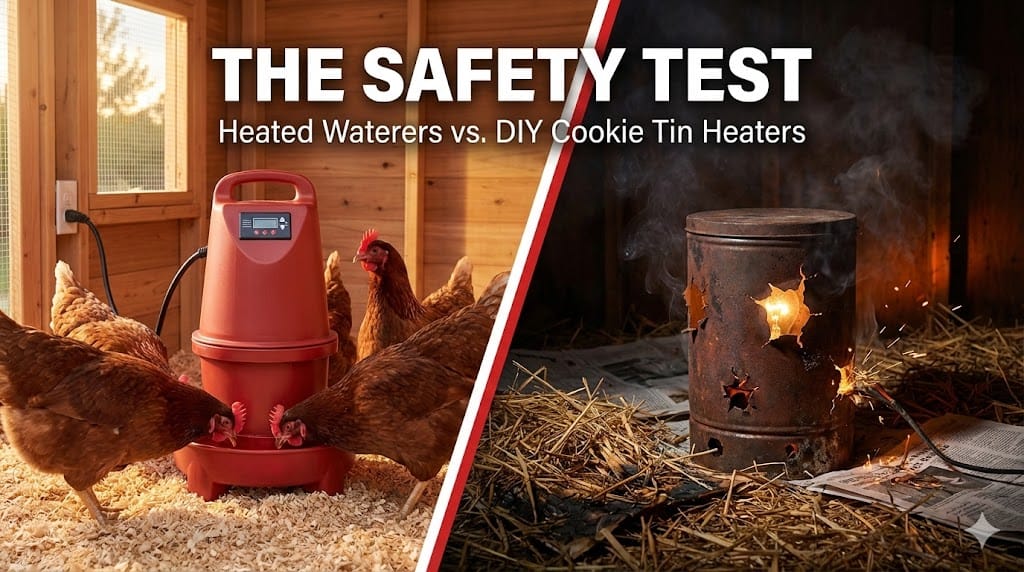
A lot of chicken keepers ask, “Is a heated waterer safe for chickens?” or “Should I just build a cheap DIY heater?” I’ve been there. I’ve tried the hacks, and I’ve used the pro gear. In this guide, we are going to look at the hard truth about DIY cookie tin heaters versus commercial heated poultry waterers. We’ll cover safety, cost, and which one might burn your coop down. (Yes, we need to talk about that).
Why Winter Water Solutions Matter for Your Backyard Flock
You might think chickens can just eat snow. Please don’t rely on that. We’ve covered whether chickens can safely eat snow—spoiler: it’s not a reliable water source. Hydration is actually the secret sauce to keeping your hens laying eggs during the dark months.
Water drives the chicken’s metabolism. If they don’t drink enough, they don’t eat enough. If they don’t eat enough, they can’t stay warm, and egg production stops cold. According to poultry research conducted by Penn State Extension, chickens need plenty of fresh water to digest feed and regulate body heat.
Extension poultry experts at the University of Arkansas System Division of Agriculture confirm that as temperatures fall below 35 degrees Fahrenheit, supplemental heating is needed for backyard flocks to maintain health. Additionally, the USDA APHIS provides extensive resources on defending your flock against disease during these stressful winter months.
The Connection Between Hydration and Egg Production
Did you know an egg is mostly water? If a hen gets dehydrated for just a few hours, she might stop laying for weeks. It’s that sensitive. While water intake might drop slightly in winter compared to the heat of summer, the need for liquid water remains. Proper hydration pairs with what to feed chickens in winter to keep production steady through the cold months.
At What Temperature Does Chicken Water Freeze?
Water starts freezing at 32°F (0°C). However, in a coop with a draft, the wind chill can freeze a nipple waterer much faster than a standard bowl.
This leads to the big question: What temperature is too cold for an unheated chicken coop? Chickens are tough. They wear down jackets, basically. Cold-hardy breeds like Buff Orpingtons and Wyandottes can handle temps well below freezing. But while they can handle the cold, their water cannot. For winter care for young chicks and chickens, water management is even more critical. If your coop drops below 32°F inside, you need a plan.
Understanding DIY Cookie Tin Heaters — How They Work and Why They’re Popular
If you scroll through Pinterest or backyard farming forums, you’ll see the DIY heated chicken waterer. It’s the classic “macgyver” solution.
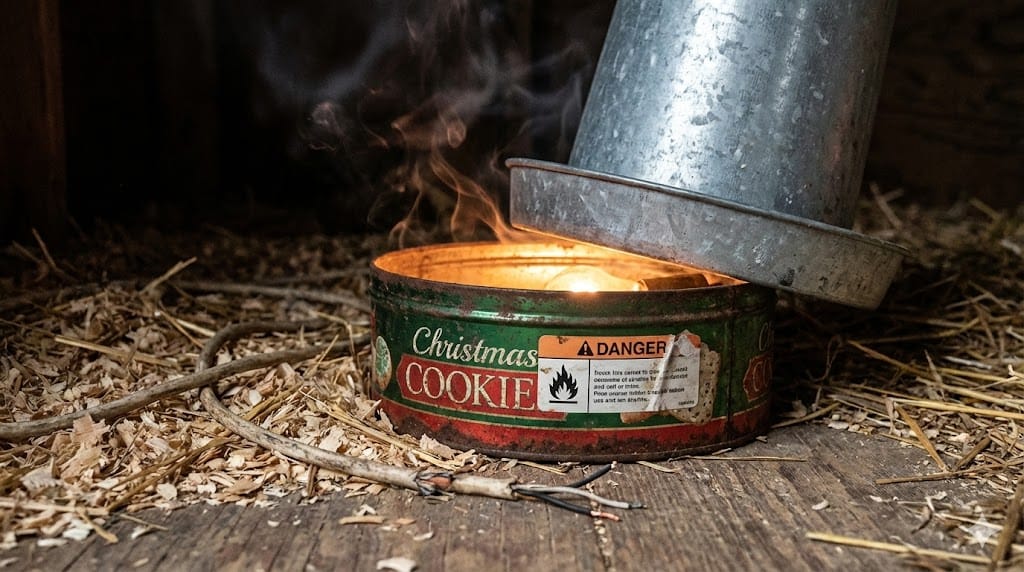
The idea is simple: You take an old metal holiday cookie tin, drill a hole in the side, stick a lightbulb socket inside, and screw in a 40-watt or 60-watt incandescent bulb. You plug it in, put the lid on, and set your galvanized steel waterer on top. The heat from the bulb warms the tin, which keeps the water liquid.
Step-by-Step: How Cookie Tin Heaters Are Constructed
Usually, people use:
- A metal tin (from Christmas cookies).
- A lamp kit from a hardware store.
- An incandescent bulb.
- Sand (sometimes added inside to hold heat).
It seems genius, right? It costs maybe $15 to make if you buy the parts, or free if you have junk lying around. This is why they are so popular. But popularity doesn’t equal safety.
The Real Cost of DIY Heated Chicken Waterers
Sure, the parts are cheap. But there are hidden costs. First, finding incandescent bulbs is getting harder as the world switches to LED (which don’t produce enough heat for this). Second, what are common problems with DIY waterers? You usually have to replace the bulb frequently because the vibration from chickens jumping on the waterer kills the filament.
But the biggest cost might be your coop itself.
A Slightly Safer DIY Alternative: The Cinder Block Method
If you are determined to go the DIY route, there is a method safer than the tin can—but it has strict limits. Some keepers use a light bulb clamped inside a cinder block, covered with a stepping stone, with the waterer on top. The rough surface prevents slipping, and the mass of the stone holds heat well.
However, this should ONLY be used outside in the run on hard, frozen ground—never inside the coop where bedding creates a fire hazard. Inside the coop, the cinder block setup still poses a risk if a spark lands in dry straw.
The Safety Test — Critical Problems with DIY Cookie Tin Heaters
Here is where I have to be the buzzkill. After looking at safety data and how these things are built, I have serious concerns. If you are asking “What is the safest heater to leave unattended?”, a homemade cookie tin is not the answer.
Fire Hazard Analysis: Why Extension Cords and Heat Don’t Mix
Barn fires are a tragedy you never want to experience. The National Fire Protection Association (NFPA) warns that heat lamps must be properly secured and kept away from anything that can burn.
With a DIY tin, you are putting a hot lightbulb inside a closed metal box, sitting on pine shavings or straw (which are highly flammable), usually connected by a cheap extension cord. Fire safety experts at the NFPA provide specific guidelines for mitigating electrical and fire risks in backyard chicken coops, explicitly warning against makeshift heating solutions.
If you’re unsure about choosing the right chicken bedding, this is another reason to reconsider—some bedding materials are more fire-resistant than others. This is one of the common first-time chicken keeper mistakes that can have serious consequences.
If that bulb shatters, or the socket shorts out because of moisture, you have a fire starter. It is not UL-listed. There is no safety testing. It’s just a bulb in a box.
Inconsistent Temperature Control Without Thermostats
A cookie tin heater is “dumb.” It doesn’t know if it’s 0°F or 50°F outside. It just pumps out heat.
- Too Hot: If the day warms up, the water can get tepid and grow bacteria.
- Too Cold: If the temperature drops to -10°F, a 40-watt bulb might not be strong enough to stop the freeze.
Material Degradation and Long-Term Reliability Issues
Cookie tins are made to hold snickerdoodles, not to support 3 gallons of water (approx 25 lbs) in a damp coop. They rust. Quickly. Once the metal rusts through, moisture gets to the electrical socket. Water plus electricity equals a tripped breaker at best, and a shocked chicken at worst.
Commercial Heated Poultry Waterers — What Makes Them Safer?
So, what is the safest heater for a chicken coop? It’s almost always going to be a unit designed for the job. The best heated chicken waterer options on the market solve the problems the cookie tin creates.
Built-In Safety Features You Can’t Replicate at Home
Commercial units from established brands like Premier 1 Supplies, Farm Innovators, K&H Pet Products, Little Giant, and Brower usually feature:
- Thermostats: They only turn on when the temp drops near freezing. This saves electricity.
- Sealed Electronics: The heating elements are encased in plastic or metal designed to be wet.
- Ground Fault Protection: Many are designed to work safely with GFCI outlets.
Is a Heated Waterer Safe for Chickens? Examining the Evidence
Yes, provided you install them right. A purpose-built heated waterer eliminates exposed hot bulbs. The heat is gentle—usually just enough to keep water at 40-50°F. The cords usually have anti-peck coils so your curious hens don’t zap themselves.
Temperature Ratings: What to Expect in Extreme Cold
Not all heaters are created equal. Based on testing over four winters by Meyer Hatchery and other keepers, here is how different styles hold up when the mercury drops:
- Heated 2.25 Gallon Nipple Waterers: These are the heavy hitters, functioning down to -20°F (blog.meyerhatchery.com).
- Chicken Waterer De-icers: Submersible units generally work in temperatures below zero.
- Three Gallon Heated Poultry Founts: These traditional style founts typically work down to 0°F with thermostat control.
- Electric Heater Bases: These are best for milder winters or insulated coops; they keep water defrosted down to approximately 10°F.
Best Heated Chicken Waterers — Complete Product Comparison
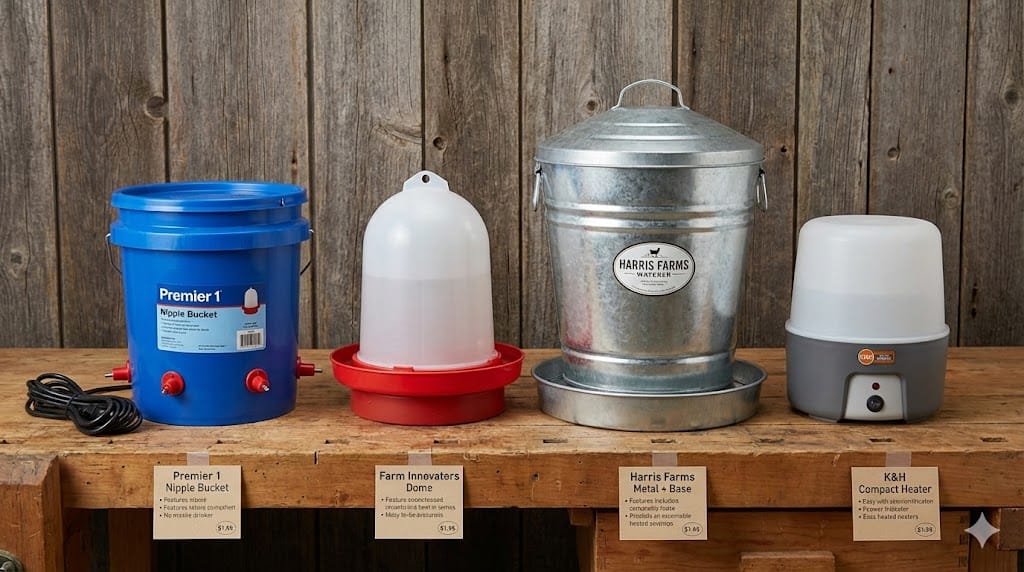
Let’s look at the top contenders. We are looking for the best heated chicken waterer, specifically comparing the big names.
Premier 1 Heated Poultry Waterer — Detailed Review
The Premier 1 Heated Poultry Waterer is often called the “Cadillac” of waterers. It usually uses a nipple system.
- Specs: It features a built-in thermostat that turns on at 40°F and turns off at 60°F to save energy. It uses a 100-watt heater and comes with a detachable 16 ft. grounded cord (thefarmerscupboard.com), which is a huge plus if your outlet isn’t right next to the coop.
- Pros: Nipple drinkers keep water cleaner (no poop in the bowl). The heater is integrated perfectly.
- Seasonal Bonus: Because the cord is detachable, you can simply unplug and remove it during spring and summer. This eliminates the risk of chickens pecking at a dormant cord and turns the unit into a standard year-round waterer.
- Cons: It takes time for chickens to learn nipples if they aren’t used to them. It’s pricier.
- Verdict: Excellent for preventing frostbite on wattles since chickens don’t dunk their faces. Speaking of frostbite, check out our guide on preventing and treating frostbite on chicken combs for complete cold-weather protection.
Farm Innovators Heated 2-Gallon Nipple Waterer — Detailed Review
Dimensions: 12 x 12 x 11 inches | Capacity: 2.25 gallons | Power: 60 watts
This nipple-style waterer has been tested through multiple New England winters by real chicken keepers. The heating element is enclosed inside the base, heating the water from the bottom, and users report never having problems with the top of the water freezing (camrynrabideau.com).
- Pros:
- Nipples stay unfrozen even on the coldest days
- Minimizes water waste and contamination (no poop in the bowl)
- Metal handle for hanging keeps it off frozen ground
- Power cord is several feet long for flexible placement
- Reasonably priced compared to Premier 1
- Cons:
- Learning curve if your birds have never used nipples before
- Chickens may try to perch on top
- 2.25 gallons serves approximately 15 birds; larger flocks need multiple units
- Verdict: If you solely have chickens (not ducks), this is an excellent choice. Nipple systems keep water dramatically cleaner than open-dish designs.
Farm Innovators 2-Gallon Heated Bucket — Best for Ducks
Dimensions: 12 x 12 x 11 inches | Capacity: 2 gallons | Power: 60 watts
If you have ducks or a mixed flock, nipple waterers won’t work because ducks need to submerge their heads to clean their nares (nostrils) and eyes. This simple heated bucket solves that problem (camrynrabideau.com).
- Pros:
- Deep enough for ducks to clean nares and eyes
- Hard for ducks to climb into and splash around
- Chew-resistant power cord protects against geese gnawing
- Metal handle for hanging
- Available in several sizes
- Cons:
- Needs topping off daily as water level drops
- No flat back for wall mounting
5 Gallon Heated Chicken Waterer for Large Flocks — Harris Farms Review
Similar to Farm Innovators, Harris Farms makes a 5 gallon heated chicken waterer that is great for larger flocks so you aren’t filling it up every single day.
- Pros: Large capacity.
- Cons: Heavy to carry when full.
K&H Thermo-Poultry Waterer — Detailed Review
K&H Pet Products makes a really nice unit that looks like a standard waterer but has the heating element hidden in the bottom cap.
| Feature | Premier 1 Nipple | Farm Innovators Nipple | Farm Innovators Bucket | Harris Farms Metal | K&H Thermo |
|---|---|---|---|---|---|
| Capacity | 3 Gallons | 2.25 Gallons | 2 Gallons | 5 Gallons | 2.5 Gallons |
| Wattage | 100 W | 60 W | 60 W | ~150 W | 60 W |
| Thermostat | Yes (40°F on/60°F off) | Yes | Yes | Yes | Yes |
| Temp Rating | -20°F | Sub-freezing | Sub-freezing | Sub-freezing | Sub-freezing |
| Birds Served | Up to 35 | Up to 15 | Small flocks | Large flocks | Small-medium |
| Style | Nipple | Nipple | Open bucket | Traditional | Traditional |
| Cord Length | 16 ft detachable | Several feet | Several feet | Standard | Standard |
| Price Range | $$$ | $$ | $$ | $$ | $$ |
| Best For | Cleanest water | Chickens only | Ducks/mixed flocks | Large flocks | Energy savings |
Heated Pet Bowls — A Popular Alternative
Many backyard chicken keepers skip the “poultry” aisle entirely and use heated pet bowls (designed for dogs) instead. According to social media feedback collected by Meyer Hatchery, “many people love using heated pet bowls” as their go-to winter solution (blog.meyerhatchery.com). One experienced chicken keeper reports using the same heated dog water bowl for over five years, calling it their “preferred method” for providing fresh unfrozen water all winter long.
These are simple, thermostatically controlled bowls that only heat when needed, making them energy efficient.
- Pros:
- Super easy to clean (just dump and scrub).
- Work well for small flocks.
- Great for ducks and geese since they can get their bills in.
- Widely available at standard pet stores.
- Cons:
- Open design means more debris (dust and poop) gets in the water.
- Chickens may stand on the edges and contaminate the water.
- Need to be elevated to the back-height of your shortest bird to minimize the mess.
Verdict: A solid, low-cost choice if you are willing to clean the water daily.
Known Problems with Commercial Heated Waterers — It’s Not All Sunshine
I want to be 100% honest with you. While commercial units are safer than a DIY fire hazard, they aren’t perfect. Real chicken keepers (including me) have faced some frustrating mornings with even the “best” gear. Here is what you need to watch out for.
The Frozen Nipple Problem
Nipple waterers are great for keeping water clean, but they have a weak spot: the metal nipple itself. Since it hangs outside the heated water, it is exposed to the wind.
One reader on the Meyer Hatchery Blog shared a warning: “Despite living in a ‘mild’ winter area… My heated water reservoir did not keep the nipples from freezing solid shut! My pitiful hens suffered until I realized that!” Even if the water in the bucket is liquid, a frozen nipple means no water for the flock.
The Fix: If it is extremely cold or windy, you might need to wrap the bucket in insulation or check the nipples frequently to break any ice seal.
Design Flaws in 3-Gallon Founts (The “Soaked Pants” Issue)
The standard 3-gallon plastic heated founts (like the Farm Innovators model) are bottom-fill. This means you have to fill the heavy bucket, flip the base upside down, screw it on perfectly tight, and then flip the whole heavy, wet mess back over.
Users often complain about this design. One keeper noted, “I absolutely hate the design… I have been soaked too many times to count from the bottom coming undone while I was carrying it back down to the coop” (blog.meyerhatchery.com). Another user in Minnesota pointed out that if you overfill it, the water at the top can freeze because it’s too far from the heating element at the bottom.
Heated Base Limitations
Heated bases are great, but they have limits. They heat from the bottom up. If you use a giant waterer (like 5+ gallons) on a really cold day, the heat might not reach the top.
A chicken keeper testing a K&H deicer with a large 6.5-gallon waterer reported: “The deicer was able to keep the bottom few inches of water from freezing, but above that, it would turn to solid ice” (camrynrabideau.com).
The Takeaway: Don’t rely on a small heater for a massive tank in sub-zero weather. Match the heater wattage to your water volume.
The Algae Battle in Plastic Waterers
There is one downside to plastic waterers that metal ones don’t have: Algae. Because the plastic is often translucent to let you see the water level, it also lets sunlight in. Warm water + sunlight = algae bloom.
The Fix: Scrub your plastic waterers weekly with a stiff brush and a little apple cider vinegar. If possible, place the waterer in a shaded part of the coop or run to minimize direct sun exposure.
Heated Chicken Waterer Without Electricity — Off-Grid Alternatives
What if you don’t have power at your coop? We’ve written a complete guide on keeping chicken water from freezing without electricity that covers even more methods. You might also consider adding solar power to your chicken coop as a long-term solution.
Solar Chicken Water Heater Options — Do They Actually Work?
I’ll be honest with you: Solar is tough in winter. Why? Shorter days and clouds. To run a heating element all night when it’s coldest, you need a massive battery bank. Most cheap “solar lights” won’t touch a block of ice. Unless you have a full solar setup (panels + deep cycle batteries), this is rarely a reliable solution for hard freezes.
The Saltwater Bottle Trick
According to Grubbly Farms, you can use science to fight the freeze. Saltwater freezes at a much lower temperature than fresh water.
- Recipe: Bring 3 cups of water to a boil, add 1/3 cup of salt, and dissolve it completely. Let it cool, pour it into a sturdy plastic bottle, and seal it tight.
- How it works: Place the sealed bottle into your flock’s water bowl. The saltwater stays liquid longer, and the bobbing bottle helps delay ice formation (grubblyfarms.com).
- CRITICAL WARNING: You do NOT add salt to your flock’s drinking water! Drinking saltwater will kill your chickens (grubblyfarms.com). This is for the sealed bottle only.
The Window Greenhouse Method
If you have some old storm windows lying around, put them to work. Meyer Hatchery suggests “Taking a couple of old windows and making a tent around your waterer will also act like a sunroom keeping your waterer warmer” (blog.meyerhatchery.com). This blocks the wind and traps solar heat, buying you extra time on sunny days.
The Ping Pong Ball Method (Expanded)
If you have a bowl or bucket-style waterer, drop a few ping pong balls on the surface. As they bob around in the wind or when chickens drink, “they’ll help to keep the water moving, which may delay freezing” (camrynrabideau.com).
The Apple Cider Vinegar Trick
Adding a few capfuls of apple cider vinegar to your flock’s water can lower the freezing point by about 4°F (from 32°F to 28°F). This won’t help in extreme cold, but it buys you extra time on borderline days—and it’s good for their gut health too.
Insulated Waterers: Rubber Tubs and Tires
- Rubber Tubs: The first and easiest switch is swapping your traditional galvanized fount for a wide, deep black rubber tub. Metal waterers freeze quickly because the metal conducts cold and the water is spread thin in the trough. Conversely, black rubber absorbs solar heat to keep the water warmer for longer. Plus, if it does freeze, the rubber is flexible—you can just kick it to break the ice without cracking the tub.
- Dark Gravel Trick: Setting your waterer on top of a patch of dark gravel can help soak up residual heat from the sun. It also provides excellent drainage to keep your chickens’ feet dry and frostbite-free.
- The Tire Trick: Pack an old tire with straw and place the water bucket inside to insulate it from the frozen ground.
A Realistic Caveat for Off-Grid Keepers
I have to be honest here. “Keep in mind that their effectiveness of these methods will vary depending on your climate, and they’ll work best in areas with mild winters where the temperature only dips below freezing occasionally. If you live somewhere with prolonged periods of cold or sub-zero temperatures, these strategies won’t keep water from freezing for long” (camrynrabideau.com).
Water Rotation Strategy for Extreme Cold
Sometimes, technology just can’t beat nature. For readers in extremely cold climates, sometimes the old-fashioned way is the only way. An experienced chicken keeper shares this practical advice for when the mercury hits rock bottom:
“When the temps get down into single digits and below zero, I have a different strategy. I still use the same type of waterer but twice a day while I am feeding other animals, I rotate water to the chicken pens during the daytime. This method works for extreme cold when water freezes in a matter of minutes” (dontclipmywings.com).
Michigan State University Extension validates this approach, suggesting that owners invest in two sets of waterers to capitalize on the rotation method, ensuring a stand-by waterer is always available to switch out.
It’s labor-intensive, but it guarantees your flock gets hydration when electric heaters can’t keep up.
Pro Tip: Save your clean 1-gallon milk or juice jugs for this. They are much lighter to carry through snow than 5-gallon buckets, and the screw-top lids prevent water from sloshing onto your boots (or freezing into an ice slick) while you walk to the coop.
Heated Waterer Bases vs. All-in-One Units
If you already own a standard galvanized metal fount from brands like Little Giant, Brower, or Harris Farms, you don’t necessarily need a whole new plastic unit. You can buy just a heated base. These are metal discs you plug in.
- Warning: Only use these with metal waterers. They can melt plastic ones.
- Benefit: Cheaper than buying a whole new system.
- Durability Reality Check: Heated bases have mixed durability reviews. Some keepers report they only last one or two seasons, while others (like Meyer Hatchery) report using the same base for four winters. Quality varies by brand.
What Is the Best Heat Source for a Chicken Coop?
Since we are talking about heat, people often pivot to heating the whole coop. Which is better, a ceramic or fan heater? We’ve done a complete comparison of safe chicken coop heaters for winter—radiant vs bulb compared with 5 fire-safe options. But here’s what most experts say.
Ceramic Heaters vs. Fan Heaters for Chicken Coops
If you must heat the coop (and usually you don’t need to), a flat-panel radiant heater (like the cozy coop style) is safer than a space heater.
- Fan Heaters: Dangerous. Dust clogs them, and they get hot enough to ignite straw.
- Ceramic Bulbs: Better, but still a spot-source of high heat.
Why Most Experts Recommend Against Heating Chicken Coops
The American Veterinary Medical Association (AVMA) and most university extensions agree: Don’t heat the coop unless it is dangerously cold (like -20°F). Industry leaders like Purina Animal Nutrition emphasize that there is no need for expensive heat lamps or chicken coop heaters, as birds cannot regulate body temperature if there is a large gap between coop and outdoor temperatures. Good coop ventilation matters more than heating in most cases.
If you do supplement, the CDC confirms that poultry can be kept warm outdoors in winter in a draft-free shelter or by using a safe heating source.
It is also vital to manage moisture. University of Maryland Extension notes that damp air feels much colder than dry air, making moisture management critical for preventing frostbite.
The Difference Between Heating Water and Heating the Coop
Focus your electricity on the water. A chicken water heater for winter is essential; a coop heater is a luxury that carries risk.
Chicken Water Heater for Winter — Installation Best Practices
Even the safest Premier 1 heated poultry waterer can be dangerous if you plug it in wrong.
Electrical Safety Requirements for Coop Installations
- GFCI is Non-Negotiable: Always connect coop electricity to a Ground Fault Circuit Interrupter outlet. If moisture gets in, it cuts the power before a fire starts.
- Wire Management: According to poultry specialists at the University of Minnesota Extension, chicken owners should keep all wires away from poultry, water, and flammable litter to prevent damage, shocks, or fires.
- Extension Cord Reality Check:Grubbly Farms explicitly warns: “Do not use extension cords at the chicken coop.” They advise keeping all connections out of reach to prevent chickens from tripping or pulling them out (grubblyfarms.com).
- Revised Recommendation: Ideally, have an electrician install a dedicated GFCI outlet in or near your coop. If you absolutely must use an extension cord, use a heavy-duty outdoor-rated cord designed for the wattage load, and inspect it regularly for damage. However, poultry experts recommend avoiding extension cords entirely when possible.
- Downloadable Safety Checklist: For a complete guide, download the NFPA Backyard Chicken Coop Safety Tip Sheet.
Placement Strategies to Prevent Spills and Contamination
Put the waterer up on cinder blocks or a stand. This prevents chickens from scratching bedding into the water (which creates a gross bacteria soup) and keeps the unit level so the heater works properly. The best flooring for a chicken coop also affects moisture levels around your electrical equipment.
Making Your Decision — Which Winter Water Solution Is Right for You?
Still undecided? Consider how big your chicken coop should be when choosing your waterer capacity. For those just starting out, here are the easiest chicken breeds for beginners. Here is my quick cheat sheet.
Best Choice for Small Flocks (1-6 Chickens)
Go with the K&H Thermo-Poultry Waterer (2.5 gal) or a heated base with your existing metal fount. It uses low watts and handles small crowds well.
Best Choice for Medium Flocks (7-15 Chickens)
The Farm Innovators 3-gallon or Premier 1 Nipple Waterer is ideal here. You need enough capacity so you aren’t refilling twice a day in the snow. Trusted retailers like Meyer Hatchery often stock replacement parts for these models, which is a huge plus.
Best Choice for Large Flocks (15+ Chickens)
You need the Harris Farms 5 gallon heated chicken waterer. Or, buy two smaller units to prevent bullying at the water cooler.
Frequently Asked Questions About Heated Chicken Waterers
What is the safest heater for a chicken coop?
The safest heat source is a sealed, UL-listed radiant flat-panel heater specifically designed for coops (like the Cozy Coop). For water, a fully integrated plastic heated waterer is safer than a separate base or bulb.
Is a heated waterer safe for chickens?
Yes, commercial heated waterers are safe when used with a GFCI outlet. They are designed to operate at low temperatures that won’t burn the chickens or melt the plastic.
What temperature is too cold for an unheated chicken coop?
Most cold-hardy breeds (like Rhode Island Reds or Orpingtons) do fine down to roughly -10°F or even -20°F without supplemental heat, provided the coop is draft-free and dry. However, water freezes at 32°F, so the water always needs help before the birds do.
What is the safest heater to leave unattended?
Thermostatically controlled heated waterers from reputable brands like Premier 1 or K&H are generally safe to leave unattended because they cycle off when not needed. Never leave a DIY bulb or space heater unattended in a coop.
Can I use a DIY cookie tin heater safely?
It is risky. If you do it, you must use a ceramic socket, a very secure electrical connection, and ensure the tin cannot tip over or contact bedding. However, fire experts strongly advise against makeshift electrical devices in barns.
How many watts does a heated chicken waterer use?
Most units use between 40 and 150 watts. A 100-watt waterer running 24 hours costs about the same as leaving a single old-school lightbulb on.
Will a heated waterer raise my electric bill significantly?
It depends on your electricity rates, but generally, it adds $5 to $15 per month during the coldest weather. That’s a small price to pay for not hauling buckets of boiling water at dawn!
How long can chickens go without water in the winter?
Your flock should always have access to clean water, but there’s no need to panic if, for example, their water freezes overnight and you don’t notice until later in the day. Chickens will be fine without water for several hours. Many chicken keepers lock their birds in the coop without water overnight, often for 8+ hours in the winter, without issues (camrynrabideau.com).
Can I use a metal or galvanized waterer on a heated base?
Yes, but there’s a trade-off. Heated water bases work with both plastic and metal waterers, but galvanized or metal water systems will rust faster when exposed to constant heat and moisture. Using plastic water systems on top of heated bases is recommended for longevity (grubblyfarms.com).
What if I don’t have water access near my coop?
Save old juice or milk containers—they work great for transporting water to your birds in winter (blog.meyerhatchery.com). Consider installing rain barrels with PVC pipe directing water to nipples in each pen for a nearly maintenance-free system when temps are above 32°F, though this isn’t a winter solution (dontclipmywings.com).
Conclusion
Winter is tough on chicken keepers, but it doesn’t have to be dangerous. We have completed the safety test heated poultry waterers vs DIY cookie tin heaters, and the results are clear. While the DIY heated chicken waterer made from a cookie tin is a clever, cheap hack, the fire risks just aren’t worth the savings.
Investing in a quality heated poultry waterer from brands like Premier 1 or Farm Innovators gives you peace of mind. Investing in safety is key. When calculating your first-year chicken raising costs, factor in a reliable heated waterer—it’s worth every penny.
Check your extension cords, set up your GFCI, and get your winter water solutions in place before the first hard freeze hits. Perform regular chicken health checks to ensure your flock stays hydrated and healthy all season long. Your flock will thank you with breakfast.

Oladepo Babatunde is the founder of ChickenStarter.com. He is a backyard chicken keeper and educator who specializes in helping beginners raise healthy flocks, particularly in warm climates. His expertise comes from years of hands-on experience building coops, treating common chicken ailments, and solving flock management issues. His own happy hens are a testament to his methods, laying 25-30 eggs weekly.