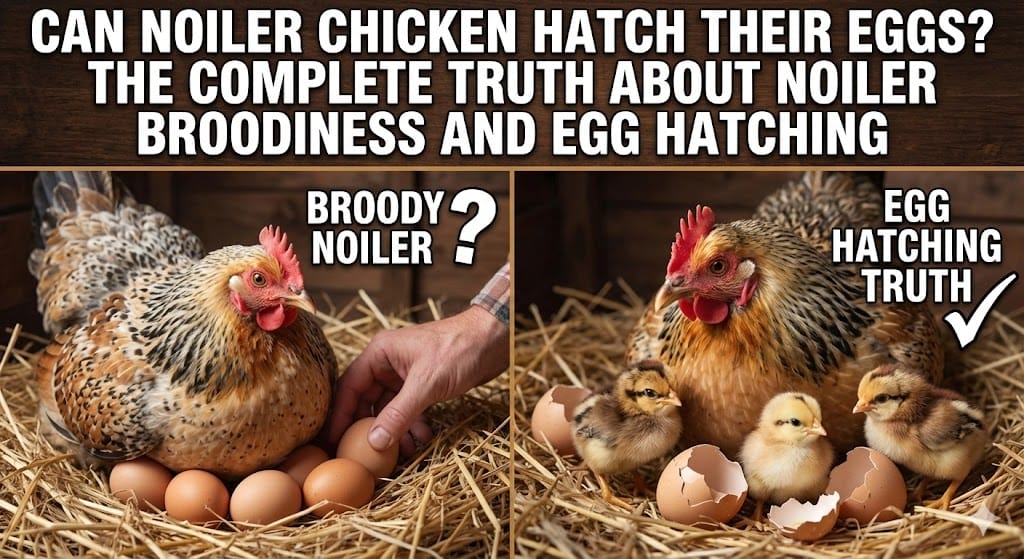
If you have ever wondered can Noiler chicken hatch their eggs, you are not alone. This is one of the most frequently asked questions I receive from Noiler farmers across Nigeria, South Africa, and other parts of the world where these hybrid chickens have gained popularity. The answer is more nuanced than a simple yes or no, and understanding the reality will save you time, money, and frustration.
I made the mistake of assuming my first batch of Noiler hens would eventually go broody and hatch their own eggs. After watching them lay consistently for three months without a single hen showing any interest in sitting on a nest, I realized I had misunderstood the fundamental nature of this hybrid breed. That experience taught me something valuable that I want to share with every Noiler farmer who faces this same question.
The short answer is that original, pure Noiler chickens very rarely sit on and hatch their own eggs. According to experienced Noiler farmers and breeders, approximately 9 out of 10 Noiler hens will simply lay eggs and walk away, showing no maternal instinct to incubate them. However, there are rare exceptions and workarounds that can help you multiply your Noiler flock naturally.
This guide will explore everything you need to know about Noiler egg hatching, including why most Noilers do not go broody, how to identify the rare exceptions, and practical methods to hatch Noiler eggs successfully.
Understanding Why Most Noiler Chickens Do Not Hatch Their Eggs
To understand why Noilers rarely hatch their eggs, you need to understand what a Noiler actually is. Noilers are hybrid chickens developed by Amo Farm Sieberer Hatchery in Nigeria by crossing broiler genetics with local Nigerian breeds (often referred to as “cockerel” or indigenous fowl). According to Noiler.net, the official breed resource, Noiler was developed over several years through a pedigree breeding and selection program, with the first commercial stock launched to the market in 2014.
The problem is that broodiness (the instinct to sit on eggs and hatch them) has been deliberately bred out of commercial poultry breeds for decades. Commercial operations do not want hens wasting time sitting on nests when they could be laying more eggs. Since Noilers inherit significant genetics from broiler lines, they also inherit this reduced broody instinct.
As Abraham Adeyemi, a Nigerian backyard farmer who has extensively documented his Noiler experiences on The Adeyemis YouTube channel, explains in his December 2022 video: “Original Noiler chickens do not sit on their eggs. They just lay eggs and move on. If you see a Noiler chicken sitting and hatching eggs, you need to confirm if that Noiler chicken is original or if it is mixed.”
This observation aligns with my own experience raising Noilers over the past several years. I have had multiple batches of Noiler hens, and the vast majority show zero interest in incubating eggs. They lay reliably, sometimes daily when well-fed, but they treat their eggs as if they are disposable rather than precious.
According to research documented by Philips (2015), “Noiler females are free from broodiness,” a characteristic that distinguishes them from indigenous Nigerian chickens that frequently go broody. This trait was intentionally preserved during the breeding program to maximize egg production.
The Genetic Explanation Behind Noiler Non-Broodiness
Broodiness is controlled by genetics and hormones. In broody breeds, hormonal changes trigger the hen to stop laying, develop a “broody patch” (a featherless area on the breast for better heat transfer), and commit to sitting on eggs for approximately 21 days.
Commercial breeding programs have selected against this trait because:
- Broody hens stop laying eggs for weeks
- They consume feed without producing
- They occupy nesting space other hens could use
- Commercial operations use incubators for hatching anyway
Since Noilers inherit broiler genetics, they carry these anti-broody traits. The local chicken genetics in Noilers do carry broodiness genes, but they are often suppressed or diluted by the commercial genetics.
For a deeper understanding of Noiler characteristics and how they compare to other production birds, our comprehensive guide on choosing between layers, broilers, and noilers explains the genetic differences in detail.
The Rare Exceptions: When Noilers DO Hatch Eggs
Here is where things get interesting. While the general rule is that Noilers do not go broody, rare exceptions exist. I have personally witnessed one Noiler hen out of a group of eight show genuine broody behavior, and other farmers report similar experiences.
Abraham Adeyemi documented this phenomenon after initially stating that Noilers cannot hatch eggs. In a follow-up correction video from July 2023, he admitted: “I was wrong. One of my Noiler chickens sat on the eggs and hatched them. Out of 10 Noiler chickens that I have, only 1 of them is sitting on the eggs while the rest will just lay eggs and leave.”
This roughly 1 in 10 occurrence rate matches what I have observed and what other farmers report. However, several factors influence whether you might see broody behavior in your Noilers:
Genetic variation: Not all Noilers are identical. Some inherit stronger broody genes from their local chicken parentage. If your Noiler has more local genetics than broiler genetics, broodiness becomes more likely.
Purity of the breed: According to multiple experienced farmers, Noilers that show broody behavior are often not “pure” Noilers but mixed with local breeds. One farmer on the Nairaland agriculture forum noted: “Neither broilers nor Noilers can go broody, but in rare occasions, Noilers do. You just have to look for a laying local hen and pass the eggs to it for incubation.”
Environmental triggers: Even in breeds with low broodiness, certain conditions can trigger the instinct: lengthening daylight hours, accumulation of eggs in a nest-like setting, hormonal changes, and a secure, dark nesting area.
Seasonal factors: Research on Nigerian indigenous chickens found that broodiness rates varied by season, with more hens becoming broody during the early dry season (December in Nigeria). If the rare Noiler that carries broody genes is going to express this behavior, it may be more likely during certain seasons. However, further research is needed to confirm whether this applies to Noilers specifically.
Age and experience: Older hens that have been laying for extended periods sometimes develop broody tendencies that younger hens do not show. According to experienced poultry keepers, some hens do not go broody until they are at least 2 years old. If your Noilers are young pullets in their first laying season, do not expect broodiness. The instinct, if present at all, may only emerge after they mature.
If you are fortunate enough to have a Noiler hen that goes broody, she can absolutely hatch eggs successfully. The incubation period is standard, approximately 20 to 21 days of consistent sitting.
Can Noiler Lay Eggs Without Mating?
This is another common question that confuses many new Noiler keepers. The answer is yes, female Noiler chickens will lay eggs without mating. This is true for all chicken breeds, not just Noilers.
Egg laying is controlled by the hen’s reproductive cycle and is independent of whether a rooster is present. A healthy, mature Noiler hen receiving adequate nutrition and lighting will lay eggs regardless of whether she has ever encountered a male.
The difference is fertility:
- Eggs laid without mating are infertile and will never hatch, no matter how long they are incubated
- Eggs laid after mating with a rooster may be fertile and can develop into chicks if incubated properly
I have kept small flocks of Noiler hens without roosters specifically for egg production. They laid consistently, and those eggs were perfectly fine for eating. However, if you want to hatch Noiler chicks, you absolutely need a rooster to fertilize the eggs.
According to discussions on Nairaland’s agriculture forum, one farmer asked whether local males crossing Noiler females would produce fertile eggs. The response confirmed: “Yes, the eggs will be fertilized, but the female offspring will never go broody, and the male, though will grow faster than the average local, will not grow as big as the Noilers.”
This highlights an important point: you can breed Noilers with other chickens, but the offspring will have different characteristics than pure Noilers. For more information about rooster requirements and egg production, our guide on do I need a rooster to get eggs addresses this topic thoroughly.
How Many Eggs Does Noiler Lay Per Day?
Understanding Noiler egg production helps you plan for hatching. A healthy, mature Noiler hen typically lays 4 to 6 eggs per week under optimal conditions, which translates to roughly one egg every 1 to 2 days. This is lower than commercial layer breeds but significantly higher than most local chicken varieties.
According to Noiler.net, the official breed resource, “Noiler birds lay 4 times more eggs compared to other local African breeds,” making them significantly more productive than indigenous fowl while maintaining hardiness. This productivity advantage is one of the key reasons Noilers have become popular among smallholder farmers.
Research published by the CGIAR consortium comparing tropically adapted chicken breeds found that Noilers came into lay at 17 weeks of age, among the earliest of the breeds tested. The study noted average first egg weights between 39 and 55 grams across the improved breeds.
One farmer documented his experience: “There are 5 females, and I have been picking at least 4 eggs daily for some time now.” This indicates that well-managed Noiler hens can approach near-daily laying.
Several factors affect laying frequency:
Nutrition: Noilers need adequate protein (16 to 18 percent for laying hens) and calcium for consistent egg production. Switching to layer feed when they begin laying supports both shell quality and frequency.
Lighting: Chickens need approximately 14 to 16 hours of light daily for optimal laying. In tropical regions, natural daylight usually suffices, but shorter winter days in temperate climates may reduce laying.
Age: Noilers begin laying at approximately 17 to 20 weeks of age, though some may start earlier or later depending on nutrition and genetics.
Stress levels: Overcrowding, predator threats, extreme temperatures, and other stressors reduce laying frequency.
According to research on rural women poultry farmers, Noilers lay between 150 to 200 eggs per year, while indigenous Nigerian chickens lay just 30 to 40 eggs per year. This dramatic difference is largely because indigenous hens frequently go broody, stopping egg production for weeks at a time, while Noilers continue laying consistently.
For detailed feeding strategies to optimize egg production, our guide on how to make Noiler grow faster covers nutrition principles that also support laying performance.
How Many Months Does It Take for Noiler to Mature?
Noilers reach laying maturity at approximately 4 to 5 months (17 to 20 weeks). This is significantly faster than local chickens, which may take 6 to 8 months to begin laying, but slower than commercial layers that can start at 16 to 18 weeks.
For meat production, Noilers reach marketable weight of 2 to 3 kilograms in approximately 12 to 20 weeks, depending on feeding program and management. This dual-purpose maturity timeline is one of the key advantages that makes Noilers attractive to smallholder farmers.
If you are planning to hatch Noiler eggs, your hens need to be fully mature and laying consistently before you begin collecting eggs for incubation. Eggs from pullets (young hens) that have just started laying tend to be smaller and may have lower fertility and hatch rates than eggs from mature hens.
Practical Methods to Hatch Noiler Eggs
Since most Noilers will not hatch their own eggs, you need alternative strategies. Here are the proven methods used by successful Noiler farmers:
Method 1: Using Local Chickens as Surrogate Mothers
This is the most common and cost-effective method in Nigeria and other African countries. The strategy is simple: collect your Noiler eggs and place them under a broody local hen.
How to do it:
- Identify a local hen that has gone broody (sitting persistently on a nest, puffing up and clucking when disturbed)
- Wait until evening when the hen is calm and settled
- Gently remove any eggs she is sitting on
- Replace them with your fertile Noiler eggs
- Place no more than 8 to 12 eggs under a standard-sized hen
- Allow the local hen to incubate for 21 days
- Ensure the broody hen has access to food and water near her nest
What to expect from a broody surrogate: Research on Nigerian indigenous hens found that broody hens spend approximately 88 to 92 percent of their time sitting on eggs. They typically leave the nest once daily, usually between 10:00 AM and 6:00 PM, for a brief period to feed, drink, and defecate. This consistent behavior ensures proper incubation temperature. Do not be alarmed when you see her off the nest during this window; it is normal and necessary.
What happens after hatching: A broody hen will generally begin to distance herself from her brood and re-commence roosting at approximately 6 weeks after hatching. However, the complete weaning process is gradual: she begins actively driving the chicks away at 10 to 12 weeks, and weaning is typically complete by 16 to 18 weeks. During the early weeks, she will fiercely protect the chicks, teach them to forage, and brood them at night.
The local hen does not know the difference between her eggs and Noiler eggs. She will incubate them with the same dedication and will raise the chicks as her own once they hatch.
One farmer shared his success: “Another good option is to look for a local fowl that is laying and just add those Noiler eggs you think are fertile. It will definitely hatch. I have tried it.”
Economic note: A broody hen consumes approximately 80% less feed than usual during the 21-day incubation period, so the cost of maintaining a surrogate is minimal. This makes the surrogate method extremely economical compared to running an incubator.
The advantage of this method is that it costs nothing beyond the eggs themselves. The broody hen provides natural incubation at perfect temperature and humidity, and she will teach the chicks to eat, drink, and avoid dangers.
What happens after hatching: A broody hen will generally begin to distance herself from her brood approximately 5 to 6 weeks after hatching. She can begin egg-laying any time thereafter. During those initial weeks, she will fiercely protect the chicks, teach them to forage, and keep them warm at night. Once she begins distancing, the chicks are typically self-sufficient enough to manage on their own.
Method 2: Using an Incubator
If you do not have access to broody local hens, or if you want to hatch larger quantities of eggs, an incubator is your best option. Modern egg incubators maintain consistent temperature and humidity, turning eggs automatically to ensure proper development.
Key incubation parameters for Noiler eggs:
- Temperature: 37.5°C (99.5°F)
- Humidity: 50 to 55% for days 1 to 18, increasing to 65 to 70% for days 19 to 21
- Turning: 3 to 5 times daily (automatic turners handle this)
- Duration: 21 days
Incubators range from small tabletop units holding 7 to 12 eggs to larger cabinet-style incubators holding hundreds of eggs. For small-scale farmers, a reliable incubator with automatic turning and digital temperature control is worth the investment.
Our detailed review of best chicken egg incubators for beginners covers specific models and what features to prioritize.
Method 3: Community Hatching Arrangements
In some communities, farmers share broody hens or incubator access. If you have Noiler eggs but no way to hatch them, networking with other poultry keepers in your area may provide solutions. Someone with a broody local hen might be willing to hatch your eggs in exchange for some of the chicks or a small fee.
What Would Cause Chicken Eggs Not to Hatch?
Whether you use a surrogate hen or an incubator, not all eggs will hatch successfully. Understanding why eggs fail to hatch helps you improve your success rate.
Infertile eggs: If there is no rooster, or if the rooster is not successfully mating with your hens, eggs will be infertile. You can check fertility by candling eggs, looking for visible blood vessels and embryo development.
Temperature problems: Even brief temperature excursions can kill developing embryos. Too hot (above 39°C) or too cold (below 36°C) for extended periods is fatal. This is why incubators with accurate thermostats are essential.
Humidity issues: Incorrect humidity causes either too much or too little moisture loss from the egg during incubation. The air cell should grow appropriately. Too dry, and the chick cannot properly position for hatching. Too wet, and the chick may drown internally.
Improper turning: Eggs must be turned regularly during the first 18 days to prevent the embryo from sticking to the shell membrane. Failure to turn causes the embryo to die.
Old or damaged eggs: Eggs older than 10 days have significantly reduced hatch rates. Eggs with hairline cracks, dirty shells (especially if washed improperly), or that were stored at incorrect temperatures may not develop properly.
Bacterial contamination: Dirty eggs or unsanitary incubation conditions allow bacteria to penetrate the shell and kill the developing embryo.
Genetic problems: Some embryos have genetic defects that prevent them from developing fully or hatching successfully.
Candling Protocol: How to Monitor Egg Development
Candling allows you to monitor embryo development and remove non-viable eggs. Follow this schedule for best results:
Day 7 (first candle): Shine a bright light through the egg in a dark room. Fertile, developing eggs will show visible blood vessels radiating from a dark central spot (the embryo). Infertile eggs appear clear with only the yolk shadow visible. Remove clear eggs.
Day 10 (second candle): Confirm continued development. The embryo should be larger, with more extensive blood vessel networks. The air cell at the blunt end should be clearly defined.
Day 17 (final candle): If you must candle again, this is the absolute latest. The embryo should fill most of the egg, appearing dark. The air cell should be noticeably larger than at day 10.
After day 18: Do not handle or candle eggs. The embryo assumes hatching position during this time and should not be disturbed. Moving eggs after day 18 can disorient the chick and prevent successful hatching.
For related information about egg issues and quality, our guide on why did my chicken lay an egg without a shell discusses egg formation problems that can affect hatchability.
Does a Chicken Know If an Egg Is Fertilized?
This is a fascinating question that many chicken keepers wonder about. The short answer is no, chickens cannot distinguish between fertile and infertile eggs.
A broody hen will sit on any eggs placed under her, whether fertile, infertile, or even fake decoy eggs. Her instinct is triggered by the presence of eggs in a nest-like setting, not by any ability to detect fertility.
This is actually advantageous for farmers using surrogate hens. You can place Noiler eggs under a broody local hen, and she will incubate them just as devotedly as she would her own fertile eggs.
The only way for humans to determine if an egg is fertile is through candling, which involves shining a bright light through the egg in a dark room to observe internal development. By day 7 of incubation, fertile eggs show visible blood vessels and a dark spot (the developing embryo), while infertile eggs appear clear with only the yolk shadow visible.
What Chickens Will Hatch Their Own Eggs?
If hatching ability is important to you, certain chicken breeds are known for strong broody instincts. These breeds will reliably sit on eggs and raise chicks without intervention:
Highly broody breeds:
- Silkies (famous for going broody and making excellent mothers)
- Cochins (large, gentle, very broody)
- Orpingtons (moderate to high broodiness)
- Brahmas (good mothers, moderate broodiness)
- Sussex (moderate broodiness)
- Local/indigenous chickens (most tropical local breeds retain strong broody instincts)
Breeds that rarely go broody:
- Leghorns (bred for maximum egg production)
- Commercial layers (ISA Brown, Lohmann, etc.)
- Broilers (no broody instinct)
- Noilers (rare broodiness, as discussed)
If self-sustaining flock reproduction is your goal, keeping a few broody breed hens alongside your Noilers provides a natural hatching solution. Our Buff Orpington chicken guide and Brahma chicken guide cover breeds with strong maternal instincts.
Breeding Noilers: What Happens When You Cross Them?
An important consideration is what happens if you do successfully hatch Noiler eggs. Since Noilers are hybrids (F1 crosses), their offspring will not be identical to the parents.
When you breed Noiler with Noiler, the resulting chicks (F2 generation) will show more variation than their parents. Some may grow faster, some slower. Some may inherit more broody tendencies from the local chicken genetics, while others may be even less broody. This genetic unpredictability is typical of hybrid breeding.
If you cross a Noiler with a local rooster (or vice versa), the offspring will be different again. One experienced farmer explained: “If a local male is crossing a female Noiler, the eggs will be fertilized. The female offspring will never go broody, and the male, though will grow faster than the average local, will not grow as big as Noilers.”
Another farmer added important context about genetics: “Broody strain is always in them and can be triggered by a cross with any broody breed. For the best results, the rooster should be from the broody strain. The size of your rooster also influences the size of your chicks.”
This means that if you want to maintain Noiler performance characteristics, you need to either:
- Continue buying day-old Noiler chicks from hatcheries
- Accept that home-bred offspring will vary in performance
- Selectively breed, keeping only the birds that best match your goals
For more information about the differences between Noilers and other production birds, our comparison guide on broilers vs Noilers for Nigerian farmers explains the genetic and performance differences.
My Personal Experience with Noiler Egg Hatching
I want to share my own journey with Noiler egg hatching because I think it illustrates the challenges and solutions that many farmers face.
When I first started keeping Noilers about four years ago, I assumed I could simply let nature take its course. I had a rooster running with my hens, they were laying eggs consistently, and I expected at least some of them to eventually go broody. Weeks turned into months, and not a single hen showed any interest in sitting.
I collected dozens of fertile eggs during this time (I confirmed fertility by cracking a few and checking for the characteristic “bullseye” pattern indicating fertilization). But without a broody hen or incubator, those eggs just became breakfast.
Eventually, I borrowed a small incubator from a neighbor who raised commercial layers. My first incubation attempt was a disaster. I did not monitor humidity properly, and the eggs were too dry. Out of 12 eggs, only 2 hatched, and one of those chicks was weak and died within days.
My second attempt, after learning proper incubation technique including the candling protocol at days 7, 10, and 17, yielded much better results: 8 healthy chicks from 12 eggs. Those chicks grew into a mix of birds, some resembling Noilers closely, others showing more variation. The females, as expected, showed no broody behavior when they matured.
The lesson I learned is that you cannot rely on Noilers to reproduce naturally. If you want to multiply your Noiler flock, you need a plan that involves either surrogate broody hens or incubation equipment. Accepting this reality upfront saves a lot of frustration.
Step-by-Step Guide: Collecting and Storing Eggs for Hatching
If you plan to hatch Noiler eggs using any method, proper egg collection and storage dramatically affects your success rate.
Step 1: Ensure Fertility
Make sure you have an active, healthy rooster running with your hens. One rooster can adequately service 8 to 12 hens. After introducing a rooster, wait at least 2 weeks before collecting eggs for hatching to ensure the hens have been mated and the sperm has reached the eggs.
Step 2: Collect Eggs Frequently
Gather eggs at least twice daily. Eggs left in nests get dirty, may be damaged by other hens, and experience temperature fluctuations that reduce viability.
Step 3: Select the Best Eggs
Choose eggs that are:
- Medium to large size (avoid very small or very large eggs)
- Clean (do not wash hatching eggs; light dry brushing is acceptable)
- Free from cracks or shell abnormalities
- Of normal shape (avoid extremely pointed or rounded eggs)
Step 4: Store Properly
Store hatching eggs:
- Point-end down in an egg carton or tray
- At 12 to 15°C (54 to 59°F) if possible; room temperature is acceptable for short periods
- At 70 to 80% humidity (a damp cloth nearby helps)
- For no more than 7 to 10 days (fertility decreases significantly after this)
- Tilted slightly from side to side once daily to prevent the yolk from sticking
Step 5: Prepare for Incubation
Before placing eggs under a broody hen or in an incubator, allow them to come to room temperature for several hours. Placing cold eggs into a warm incubator causes condensation that can introduce bacteria.
For comprehensive guidance on egg handling, our resource on 6 ways to preserve eggs and reduce spoilage provides additional storage principles.
Frequently Asked Questions About Noiler Egg Hatching
Can female Noiler lay eggs?
Yes, female Noilers lay eggs naturally once they reach maturity at approximately 17 to 20 weeks of age. They do not need a rooster to lay eggs. However, those eggs will only be fertile (capable of hatching) if a rooster has mated with the hen. According to Noiler.net, Noiler birds lay 4 times more eggs compared to other local African breeds.
Is there a chicken that can lay eggs without mating?
All female chickens lay eggs without mating. This is a normal part of their reproductive cycle. The eggs are simply unfertilized and will not develop into chicks. This applies to Noilers, layers, local chickens, and all other breeds.
Will female quail lay eggs without a male?
Yes, like chickens, female quail lay eggs regardless of male presence. Quail eggs without a male present will be unfertilized. This biological principle applies to most poultry species.
How did my bird lay eggs without mating?
Egg laying is controlled by the bird’s reproductive hormones and light exposure, not by mating. When a hen reaches maturity and experiences appropriate day length (approximately 14+ hours of light), her body produces eggs on a regular cycle. Mating only determines whether those eggs are fertilized, not whether they are produced.
Can I hatch Noiler eggs using other chicken breeds?
Yes, any broody chicken can hatch Noiler eggs. The species of the surrogate mother does not affect the genetics of the chicks. A Silkie, Cochin, or local hen sitting on Noiler eggs will hatch Noiler chicks (not crosses).
How long do Noiler eggs take to hatch?
Like all chicken eggs, Noiler eggs take approximately 21 days to hatch when incubated at the correct temperature (37.5°C or 99.5°F). There may be slight variation of plus or minus one day depending on incubation conditions.
What is the hatch rate I should expect from Noiler eggs?
With good fertility, proper storage, and correct incubation, you can expect 60 to 80% hatch rates. Factors that reduce hatch rates include old eggs, incorrect incubation temperature or humidity, eggs from very young or very old hens, and poor rooster fertility.
Can I make my Noiler hen go broody?
You cannot force broodiness, but you can encourage it by leaving eggs to accumulate in a dark, private nest area. However, even with encouragement, most Noilers will not go broody due to their genetics. The instinct simply is not strong enough in this hybrid. Remember that some hens do not go broody until they are at least 2 years old, so young Noilers are especially unlikely to show this behavior.
Research has shown that extending daylight hours to 16 hours while providing eggs in nest boxes can induce broodiness in some breeds, achieving 46.7% success rates in Silkies and Wyandottes. However, this technique has not been tested on Noilers and is unlikely to overcome their strong anti-broody genetics.
Should I buy day-old Noiler chicks instead of hatching my own?
For many farmers, buying day-old chicks from reputable hatcheries is more practical than hatching your own. Hatchery chicks are from controlled breeding programs and will have more consistent Noiler characteristics than home-bred offspring. However, if you want to reduce costs or enjoy the hatching process, home hatching using surrogate hens or incubators is viable.
For guidance on selecting quality chicks, our resource on how to identify and avoid poor quality day-old chicks helps you make better purchasing decisions.
The Economics of Hatching vs. Buying Noiler Chicks
Before investing in incubation equipment or managing broody hens, consider whether hatching your own Noilers makes economic sense for your situation.
Advantages of hatching your own:
- Lower cost per chick after initial equipment investment
- Independence from hatchery supply and pricing
- Ability to select breeding stock for desired traits
- Satisfaction of self-sufficiency
- Potential to sell surplus chicks
Disadvantages of hatching your own:
- Initial cost of incubator and accessories
- Time and attention required for incubation
- Lower consistency in offspring performance (F2 generation issues)
- Need to maintain roosters (feed cost, noise, possible aggression)
- Learning curve with potential losses during early attempts
Surrogate hen economics: Using a broody local hen is extremely cost-effective. Since a broody hen consumes approximately 80% less feed than usual during incubation, the 21-day period costs very little. You essentially get free incubation with the added benefit of natural mothering afterward.
For small-scale keepers with just a few birds, buying day-old chicks when needed is often more practical. For larger operations or those committed to self-sufficiency, investing in hatching capability pays off over time.
Understanding Noiler Limitations and Realistic Expectations
After years of working with Noilers, I want to set realistic expectations for anyone exploring this breed:
Noilers are excellent dual-purpose birds for smallholder farmers. They grow faster than local chickens, are hardier than commercial broilers, and provide reasonable egg production. However, they are not designed to be self-reproducing.
Accept that natural reproduction is not a Noiler strength. If multiplying your flock without purchasing new chicks is essential to you, either keep broody breeds alongside your Noilers or invest in incubation equipment.
Hybrid vigor works one generation. When you breed Noiler to Noiler, you get F2 offspring with more variation. This is not necessarily bad, but it means home-bred birds will not match the consistent performance of hatchery Noilers.
The rare broody Noiler is a bonus, not an expectation. If one of your Noilers goes broody, consider yourself fortunate. Use her to hatch as many eggs as she can handle. But do not plan your flock management around expecting this to happen.
For a thorough understanding of what challenges to expect, our detailed guide on disadvantages of Noiler chicken covers the full picture of Noiler limitations.
Practical Recommendations Based on Your Situation
Let me offer specific recommendations based on different farmer situations:
If you are a small backyard keeper with 5 to 10 Noilers: Keep a few local or Silkie hens alongside your Noilers specifically for hatching duty. When you want chicks, collect your Noiler eggs and place them under a broody local hen. This costs nothing extra and works reliably.
If you are scaling up to 50 to 100 Noilers: Invest in a good quality incubator (30 to 50 egg capacity). The initial cost pays for itself within one or two hatching cycles compared to buying day-old chicks. Learn proper incubation technique through online resources and practice.
If you are running a commercial Noiler operation: Continue buying day-old chicks from established hatcheries. The consistency of hatchery stock, combined with the time savings from not managing incubation, makes this the most practical approach for commercial production.
If you are in a remote area with limited hatchery access: Develop relationships with neighbors who keep local breeds. Community hatching arrangements where broody hens are shared or traded can provide hatching services without cash cost. Alternatively, invest in a small incubator that can run on generator or solar power.
The question of can Noiler chicken hatch their eggs ultimately has a practical answer: they rarely will on their own, but with simple workarounds using surrogate hens or incubators, you can successfully hatch Noiler eggs and grow your flock.
Whether you use a broody local hen, a modern incubator, or community resources, the key is accepting Noiler biology for what it is and planning accordingly. The breed offers many advantages for smallholder poultry keeping, and their one significant limitation, the lack of broody instinct, is easily overcome with the right approach.

Oladepo Babatunde is the founder of ChickenStarter.com. He is a backyard chicken keeper and educator who specializes in helping beginners raise healthy flocks, particularly in warm climates. His expertise comes from years of hands-on experience building coops, treating common chicken ailments, and solving flock management issues. His own happy hens are a testament to his methods, laying 25-30 eggs weekly.