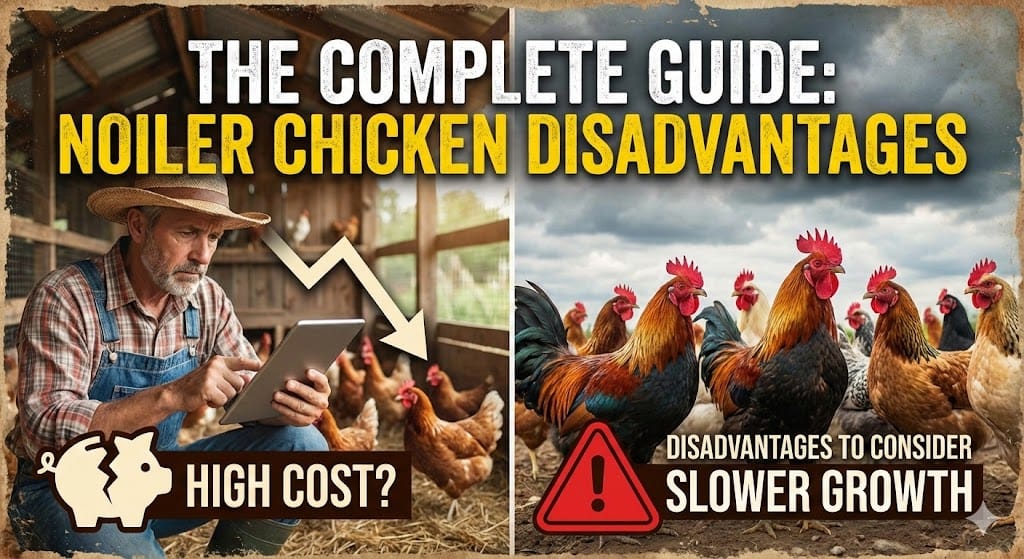
The disadvantages of Noiler chicken can make or break your farming venture if you are not prepared for them. When I first heard about Noiler chickens back in 2019, they sounded like the perfect solution to every poultry farmer’s problems. A bird that could scavenge for food, resist diseases, grow reasonably fast, and still lay eggs? It seemed too good to be true.
And in some ways, it was.
After raising multiple batches of Noilers alongside broilers and local breeds over the past six years, I have learned that while Noilers have genuine advantages, the hidden disadvantages of Noiler chicken farming require careful consideration before you invest your hard-earned money. This is especially true for farmers in Nigeria, where Noilers originated, but also for those in South Africa, other African nations, and even backyard chicken keepers in the USA, UK, Canada, and Australia who are curious about this hybrid breed.
I am Oladepo Babatunde, founder of ChickenStarter, and I have personally raised over 50 chickens across multiple breeds in tropical climates. I have made costly mistakes, lost birds to preventable causes, and learned lessons that no promotional material ever taught me. This guide will give you the honest, experience-based breakdown of Noiler chicken disadvantages that most promotional materials conveniently leave out.
Whether you are a commercial poultry farmer calculating profit margins or a backyard chicken enthusiast exploring dual-purpose breeds, understanding these Noiler chicken management issues will help you make an informed decision about Noiler farming profitability for your specific situation.
What Exactly Is a Noiler Chicken?
Before diving into the disadvantages, let me clarify what we are dealing with. Noiler chickens are a hybrid breed developed by Amo Farm Sieberer Hatchery Limited in Nigeria. According to industry documentation from poultry research sources, Noilers were created by crossing a male broiler with an exotic pullet to produce a bird that combines commercial growth potential with indigenous hardiness.
The name “Noiler” comes from combining “Nigerian” with “broiler,” reflecting the bird’s dual heritage. These chickens were specifically designed for smallholder farmers who could not afford the intensive management requirements of pure commercial broilers. According to research documented by BNetHub, Noilers come in different colors including brown, black and white, pure white, and pure black, which makes them visually appealing compared to uniform commercial breeds.
On paper, Noilers offer an attractive package: they reach market weight of approximately 2.3 to 3.2 kilograms in 10 to 16 weeks depending on management, can scavenge for a portion of their feed, show better disease resistance than broilers, and females can lay eggs after reaching maturity. They have a feed conversion ratio ranging from approximately 2.2 to 2.8 kilograms of feed per kilogram of weight gain, which varies based on management quality and is less efficient than broilers but reasonable for a dual-purpose bird.
According to a Harvard Social Innovation Review profile on Noiler development, the breed “is a genetically optimized dual-purpose chicken breed which is similar in looks and taste to the native chicken, but is resistant to diseases, produces four times more eggs and three times more meat.”
However, these features come with significant trade-offs that every prospective Noiler farmer must understand before committing resources to this venture.
The 14 Major Disadvantages of Noiler Chicken
1. Significantly Slower Growth Rate Compared to Broilers
This is perhaps the most impactful disadvantage for commercial farmers focused on meat production. While broilers reach market weight in 6 to 8 weeks, Noilers require 10 to 16 weeks to achieve similar or smaller weights depending on feeding and management quality.
According to experienced farmers interviewed on Nigerian poultry forums, Noilers take “up to 6 months” to reach a “very good weight” even with good feeding patterns. This timeline discrepancy has serious financial implications that many new farmers underestimate.
I learned this the hard way during my first Noiler batch in 2020. I had calculated my feed costs and expected returns based on the promotional materials that emphasized Noiler’s “rapid growth.” What I did not fully appreciate was that “rapid” was relative to local chickens, not to commercial broilers.
One experienced farmer put it bluntly in a video comparison: “No matter what you do, the broiler always grows faster. These two birds, they are growing the same day, the same water, the same food, the same condition, but no matter what you do, the broiler always grows faster.” This observation from side-by-side trials confirms what the numbers suggest.
The math is straightforward but brutal for commercial operations:
| Factor | Broilers | Noilers | Impact |
|---|---|---|---|
| Time to market weight | 6-8 weeks | 10-22 weeks | 50-100% longer production cycle |
| Batches per year | 5-6 batches | 2-3 batches | 50% fewer production cycles |
| Labor costs | Lower (shorter period) | Higher (longer period) | Increased operational expenses |
| Facility turnover | Faster | Slower | Reduced annual capacity |
| Salary payments | 2 months | 6-7 months | 3x higher labor costs per batch |
For farmers who have limited space or need to maximize production volume, this slower growth rate represents a serious constraint. If you are choosing between layers, broilers, and noilers, this timeline difference should heavily influence your decision.
2. Lower Feed Conversion Efficiency
Feed typically represents 60 to 70 percent of poultry production costs. Noilers have a feed conversion ratio ranging from 2.2:1 to 2.8:1 or even higher depending on management quality. This means they require about 2.2 to 2.8 kilograms of feed to gain 1 kilogram of body weight. Compare this to modern broiler strains that achieve FCR ratios of 1.6:1 to 1.8:1, and the economic implications become clear.
Here is the hidden disadvantage of Noiler that catches many farmers off guard: the FCR varies significantly based on your specific conditions. Well-managed free-range Noilers with good scavenging opportunities might achieve the lower end of that range, while confined Noilers on purchased feed only will hit the higher end or worse.
Let me break down what this means in practical terms. To produce a 3-kilogram Noiler at the higher FCR end, you need approximately 8.4 kilograms of feed. A broiler of the same weight requires only about 5.4 kilograms of feed. That difference of 3 kilograms of feed per bird multiplies dramatically across a flock.
For a batch of 500 birds:
| Metric | Broilers | Noilers (High FCR) | Difference |
|---|---|---|---|
| Feed per bird to 3kg | 5.4 kg | 8.4 kg | +3.0 kg |
| Total feed for batch | 2,700 kg | 4,200 kg | +1,500 kg |
| Additional cost (at ₦500/kg) | – | ₦750,000 | Significant margin erosion |
Yes, Noilers can scavenge and reduce this feed requirement, but scavenging has limitations. In my experience, free-ranging Noilers in a well-vegetated area might reduce feed requirements by 20 to 30 percent at best. They still need supplemental feeding to achieve reasonable growth rates and meat quality.
As one experienced farmer noted, Noilers “almost eat the same food” as broilers when kept together, but “upon what they eat, they will still grow bigger than the Noiler.” The genetics simply do not support the same efficient conversion regardless of feed quality.
For detailed calculations on feed requirements, our guide on how many bags of feed for broilers provides a useful comparison framework.
3. Smaller Final Market Size
Noilers typically reach a market weight of 2.3 to 3.2 kilograms (approximately 5 to 7 pounds), while commercial broilers can achieve 3.5 to 4.5 kilograms (8 to 10 pounds) or more. This size difference affects both revenue per bird and market positioning.
In markets where consumers prefer larger birds for family gatherings, celebrations, or commercial food service, Noilers may fetch lower prices or face reduced demand. I have had customers specifically request “bigger chickens” and had to explain that Noilers, despite their excellent meat quality, simply do not reach the same size as pure broilers.
This creates a marketing challenge. You are essentially asking customers to pay similar or slightly lower prices for a smaller bird, which requires effective communication about the quality advantages (leaner meat, better flavor) to justify the purchase.
One farmer’s observation captures this reality: “When you sell the Noiler, the amount of money you sell them is not as high” compared to broilers, even though production costs may be similar or higher due to the extended growing period.
4. Flock Variability and Uneven Growth Rates
Here is a disadvantage that becomes apparent only after you have raised a few batches: Noilers do not all grow at the same speed or end up the same size. Because Noilers are a genetic mix of different chicken types, they lack the uniform genetics of commercial broiler chickens bred to be nearly identical.
In any given batch, you will likely see significant size variation. Some birds will be noticeably larger, while others remain smaller than average even with identical feeding and management. This Noiler flock variability creates real problems at market time.
A farmer in Rivers State described this challenge to me during a visit: “When it is time to sell, I have to sort them into groups. Some are big, some are small. The small ones sell for less money, or I have to keep feeding them longer. It is not like broilers where they are all pretty much the same size when they are ready.”
Quantifying the Impact
This variability typically means:
- Sorting birds into 2 to 3 size groups at sale time
- Selling the smallest 10 to 20 percent of your flock for 15 to 25 percent less per bird
- Either accepting lower prices on small birds or extending feeding periods
- Increased labor for sorting and separate marketing
- Potential buyers cherry-picking the largest birds and leaving you with harder-to-sell smaller ones
For a 200-bird batch where 20 percent are undersized:
| Scenario | Standard Birds (160) | Undersized Birds (40) | Impact |
|---|---|---|---|
| Expected price | ₦4,000 each | ₦3,000 each (25% less) | – |
| Expected revenue | ₦640,000 | ₦120,000 | ₦760,000 total |
| If all uniform | ₦4,000 × 200 | – | ₦800,000 total |
| Revenue loss | – | – | ₦40,000 per batch |
Solutions for Flock Variability
Grade chicks on arrival: Upon receiving day-old chicks, quickly sort them into 2 to 3 groups based on size and apparent vigor. Keep these groups separate throughout the growing period. This allows stronger chicks to grow without competition while giving smaller chicks extra care.
Ensure adequate feeder space: Provide 2 to 3 inches (5 to 8 cm) of feeder space per adult bird. Use enough feeders so roughly half your flock can eat simultaneously without crowding. Watch birds during feeding; if they fight for spots, add more feeders or reduce stocking density.
Cull underperformers early: If certain birds consistently lag behind despite good management, consider culling them for home use rather than investing additional feed in birds unlikely to reach market weight.
Understanding how many feeders and drinkers for 100 broilers can help you ensure adequate equipment for Noilers as well, which helps reduce competition-related growth disparities.
5. Inconsistent Performance Under Intensive Systems
Here is something that surprised me and that you will not find in most Noiler promotional materials: these birds were designed for semi-intensive and extensive systems, not for the intensive confinement systems used in large-scale commercial broiler production.
When you try to raise Noilers in high-density, fully confined systems similar to commercial broiler operations, their performance suffers. Their natural foraging instincts become frustrated, stress levels increase, and you lose many of the advantages that make Noilers attractive in the first place.
According to experienced farmers, “Noilers do very well with less quality feeds on a free range than in an enclosed or deep litter system.” This means that confining them and feeding commercial feed only eliminates their key competitive advantage while exposing their lower efficiency compared to broilers.
When asked about raising Noilers in battery cages, one farmer responded: “Yes, they can be reared in battery cages, but in my personal opinion, raising Noiler using a deep litter system with a well-ventilated poultry house, well spacious and ammonia-free litter will be more suitable, or using the free-range system. But if you already have the facilities and you are considering space utilization, then a battery cage will be a good option. For optimal result, deep litter and free-range is the best for Noilers.”
Interestingly, the intensive confinement that harms Noiler performance is also associated with leg problems in broilers. According to research published in the journal Annals of Animal and Veterinary Sciences, modern commercially grown broilers are prone to lameness, footpad dermatitis, and hock-burn due to rapid growth and high-density housing. Noilers’ slower growth and preference for movement may actually protect them from these skeletal issues, though this advantage is lost if they are confined intensively.
The bottom line: if your business model depends on intensive confinement, Noilers are the wrong choice.
6. Limited Egg Production Compared to Layers
While Noilers are marketed as dual-purpose birds, their egg production is modest at best. Under optimal management conditions with proper feeding and lighting, Noiler hens can produce 150 to 200 eggs per year. However, many farmers report actual production of 80 to 150 eggs annually in real-world conditions with typical management practices.
Compare this to commercial layer breeds that produce 280 to 320 eggs annually, and you can see the limitation. As one industry source noted, “Layers are genetically bred to lay more eggs. Although Noilers lay eggs too, in my opinion, I don’t think they can replace the traditional commercial layers.”
The same source clarified that Noilers “can provide enough eggs for you and your family, and you can sell the extra eggs to friends, neighbors, etc.” This positions Noiler eggs as supplementary income or household use rather than a primary business focus.
If your primary goal is egg production, Noilers are not the answer. They are meat birds first, egg producers second. The eggs they do lay are a supplementary benefit, not a primary income stream.
During one production cycle, I tracked my Noiler hens’ laying performance over six months. The best performers gave me about 3 eggs per week, while the average was closer to 2 eggs per week. That is nowhere near the daily egg production you would expect from dedicated layer breeds.
For farmers focused on egg production, understanding how many crates of eggs 1000 layers can produce highlights why layers remain the better choice for egg-focused operations.
7. The Broodiness Problem
Broodiness is when a hen stops laying eggs and insists on sitting on a nest to hatch chicks. While useful if you want natural hatching, Noiler broodiness is a significant disadvantage if you are focused on getting eggs to sell or if you need consistent production.
Noilers retain stronger broody instincts than commercial layer breeds that have been selectively bred to minimize this behavior. During a broody period lasting 2 to 3 weeks or longer, the affected hen produces zero eggs while consuming feed and occupying nesting space.
A farmer in Enugu shared her frustration during a phone conversation: “Just when they start laying well, some decide to go broody. I have to find them and move them away from the nests, and they stop laying for weeks. It messes up my egg collection and I lose sales.”
The problem compounds when multiple hens go broody simultaneously, which can happen especially during certain seasons. If 3 or 4 of your 10 laying hens go broody at once, your egg production drops by 30 to 40 percent for several weeks.
Interestingly, there is conflicting information about whether Noilers can successfully hatch their own eggs. Some farmers report success: “Many thought that Noiler hen cannot hatch her eggs. This is far from being true. My Noiler hen hatched 3 out of the 7 eggs it sat on.” Others doubt this ability, with one experienced farmer stating, “I have never tried it, but some people claim they can hatch their eggs by themselves, which I seriously doubt. The best is to have your fertilized Noiler eggs hatched by an incubator.”
Breaking Broody Hens
If broodiness disrupts your production, you can break the cycle using a simple broody-breaking setup:
- Build or designate a small wire-floored cage or coop
- The cage should be large enough for the hen to stand and turn but not spacious enough to feel like a nesting area
- Ensure good airflow underneath and around the cage
- The cooler temperature and uncomfortable surface help break the hormonal cycle
- Provide food and water inside the cage
- Most hens return to normal within 3 to 5 days
Identify broody hens early by watching for these signs: flattened posture when sitting in the nest, aggressive pecking when disturbed, puffed-up feathers, and refusal to leave the nesting box even when you approach. The sooner you move them to the broody-breaking setup, the faster they return to laying.
Our guide on how to break a broody hen provides detailed techniques that work for Noilers and other breeds.
8. Disease Resistance Is Not Immunity
One of the most dangerous misconceptions about Noilers is treating their “disease resistance” as “disease immunity.” They are not the same thing, and this misunderstanding has cost many farmers their entire flocks.
Yes, Noilers inherited improved disease resistance from their indigenous Nigerian parent stock. They handle common poultry diseases better than pure commercial broilers, which are notoriously fragile. However, Noilers absolutely can and do contract diseases when exposed to pathogens or when management practices are poor.
One farmer’s forum post captures this reality starkly: “Please my Noilers are dying, help?” The responses indicated an outbreak of fowl pox, “which happened to be generally common with Noilers.”
According to experienced farmers, Noilers require the same vaccination schedule as other poultry birds. One farmer emphasized: “Before visiting the farm, I used to believe that Noilers don’t require strict vaccination schedules like other poultry birds such as broilers, layers, or turkey. Since they are very hardy and have disease resistance, but I was informed that for you to succeed, you have to follow a strict vaccination schedule for your birds. Because they are still exposed to viruses that cause diseases such as Newcastle, bronchitis, fowlpox, etc.”
Essential Vaccinations for Noilers
The recommended vaccination protocol includes:
| Age | Vaccine | Disease Protected |
|---|---|---|
| Day 1-3 | Lasota (first dose) | Newcastle disease |
| Week 2 | Gumboro (IBD) | Infectious Bursal Disease |
| Week 3 | Lasota (second dose) | Newcastle disease booster |
| Week 4-6 | Fowl Pox | Fowl Pox (especially important in rainy season) |
One farmer specifically noted: “It’s rainy season now. It’s important you vaccinate them against fowl pox as early as 4 to 6 weeks.”
Warning Signs Requiring Immediate Attention
The signs of illness in Noilers that require immediate action include:
- Lethargy and dullness: Healthy Noilers are naturally active and curious. If your birds are sitting motionless or reluctant to move, something is wrong.
- Changes in droppings: Normal Noiler droppings should be brownish with white uric acid caps. Green, yellow, bloody, or watery droppings indicate health problems. One farmer noted observing “whitish milky poo” before deaths.
- Reduced feed and water intake: A sudden drop in consumption signals illness before other symptoms appear.
- Respiratory symptoms: Sneezing, wheezing, or nasal discharge require immediate investigation.
- Swelling: Any swelling on the head, eyes, joints, or feet indicates infection or injury.
I lost 23 birds in a single batch because I assumed my Noilers’ “superior immunity” would protect them without proper vaccination and biosecurity. It did not. Implementing a proper poultry farm biosecurity plan is non-negotiable, regardless of what breed you raise.
9. Coccidiosis Susceptibility
While Noilers show improved resistance to many diseases compared to broilers, they appear to be more susceptible to coccidiosis specifically. This parasitic disease affects the intestinal tract and can cause significant mortality, especially in young birds or during wet conditions.
Several factors increase coccidiosis risk in Noiler production:
- Longer growing period: More time means more exposure opportunities
- Free-range systems: Ground contact increases parasite exposure
- Wet litter conditions: Moisture promotes oocyst sporulation
- Mixed-age flocks: Older birds can shed parasites to younger ones
Coccidiosis Prevention Protocol for Noilers
- Maintain dry litter: Wet bedding dramatically increases coccidiosis risk. Check moisture levels daily, especially during rainy season.
- Use coccidiostats in feed: For the first 8 weeks especially, medicated starter feeds containing coccidiostats provide protection during the vulnerable period.
- Rotate pasture areas: If using free-range systems, rotate grazing areas to break the parasite lifecycle. Avoid using the same ground continuously.
- Watch for early signs: Bloody droppings, hunched posture, and reduced feed intake are early coccidiosis indicators. Treatment with amprolium or toltrazuril should begin immediately upon detection.
- Clean water sources: Contaminated water spreads coccidiosis rapidly. Use nipple drinkers or elevate open drinkers to prevent fecal contamination.
For more information on managing parasites, our guide on treating internal parasites and worms in chickens provides detailed prevention and treatment protocols.
10. Geographic Availability Limitations
Noilers were developed in Nigeria and remain most readily available in West Africa. If you are a farmer in South Africa, the USA, UK, Canada, or Australia, obtaining authentic Noiler stock presents significant challenges.
The breed is not widely distributed through international hatcheries, and importing live birds or hatching eggs involves complex regulations, quarantine requirements, and substantial costs. Many international farmers interested in Noilers simply cannot access them through legitimate channels.
Within Nigeria, availability has improved, with farmers reporting they can order day-old chicks from hatcheries in Ibadan and other locations. Current prices fluctuate but typically range from ₦15,500 to ₦16,500 per carton (approximately 100 chicks) depending on location and season.
However, even within Nigeria, transportation challenges exist. One farmer described receiving “100 Noilers that I ordered from Ibadan to Bauchi,” highlighting the long-distance shipping that may be required depending on your location.
For farmers outside West Africa, similar dual-purpose, hardy breeds may be more practical alternatives. In Australia, heat-tolerant chicken breeds adapted to hot climates are more accessible. In the UK and USA, heritage dual-purpose breeds like Australorps, Plymouth Rocks, or Sussex offer similar characteristics with better local availability.
11. Hybrid Breeding Limitations
Noilers are F1 hybrids, meaning you cannot simply breed your Noilers together to produce more Noilers with the same characteristics. If you breed Noiler to Noiler, the offspring (F2 generation) will show significant variation and lose the consistent performance traits that make Noilers valuable.
This creates confusion among farmers. One asked: “I have Noiler laying eggs, but I am confused if they can hatch by themselves or I should take their eggs to incubator.” The response clarified: “You can introduce a male cockerel or rooster to have fertilized eggs if you want to incubate and hatch your own Noilers. But introducing another rooster that is not Noiler will not give you the exact Noiler breed you initially have.”
This means you must purchase new day-old chicks from hatcheries for each production cycle. You cannot become self-sufficient in Noiler production the way you could with pure breeds that breed true.
According to Amo Farm Sieberer Hatchery, the company that developed Noiler, the breed was created “with a focus on addressing food security and economic challenges in rural Africa” through continuous breeding programs designed to enhance genetic traits for growth, egg production, and disease resistance.
The dependency on hatchery supply creates several risks:
- Price vulnerability: Hatcheries can increase prices without alternatives
- Supply disruptions: Hatchery problems affect your production schedule
- Quality variations: “A lot of farms are producing their own Noilers these days, so your source is a key success factor”
- Geographic limitations: Only certain hatcheries produce authentic Noilers
For farmers interested in maintaining flock quality, understanding how to identify and avoid poor quality day-old chicks becomes essential when you are entirely dependent on external sources.
12. Market Recognition and Pricing Challenges
Outside Nigeria and a few neighboring countries, most consumers have never heard of Noiler chickens. This lack of market recognition creates sales challenges, particularly for farmers trying to command premium prices based on Noiler’s quality characteristics.
When I tried marketing Noilers to new customers, I consistently faced the same questions: “What is a Noiler? Why is it smaller than regular chicken? Why should I pay this price for a smaller bird?” Each sale required education and explanation that pure broilers or recognized heritage breeds did not.
The pricing reality compounds this challenge. According to farmers, “a 5 months old Noiler” sells for “between 2k to 3.5k” (₦2,000 to ₦3,500), which represents a relatively modest return after 5 months of care and feeding.
In established markets, consumers have expectations shaped by familiar products. Introducing an unfamiliar breed requires marketing investment and patience that many small-scale farmers cannot afford.
13. Longer Return on Investment Timeline
The combination of slower growth, longer production cycles, and lower efficiency means your capital remains tied up longer with Noilers compared to broilers.
One experienced farmer explained the financial reality clearly: “Noiler takes long to grow, up to 6 months, that’s when you get a very good weight. Broilers within 5 weeks, 6 weeks, 8 weeks, they’re off. So when you deduct the amount of time you spend, as you’re paying somebody salary, it’s only two months salary you pay the person. But Noiler, you pay somebody money for complete 6 to 7 months before you sell it.”
| Investment Recovery | Broilers | Noilers |
|---|---|---|
| Initial investment recovered | 8-10 weeks | 20-28 weeks |
| Cash flow positive | After first batch sale | Often after second batch |
| Annual ROI potential | Higher (5-6 batches) | Lower (2-3 batches) |
| Labor cost per batch | 2 months | 6-7 months |
The farmer continued: “When you sell the Noiler, the amount of money you sell them is not as high, but they almost eat the same food.” This creates a situation where costs are similar or higher while revenue per bird is lower.
For farmers operating with limited capital or those who need quick returns, this extended timeline creates cash flow pressure. You are feeding birds, paying for utilities, and managing labor costs for 200 to 300 percent longer before seeing any revenue.
For a realistic assessment of poultry profitability, our guide on starting a profitable poultry business in Nigeria provides comprehensive financial projections.
14. Space Requirements for Optimal Performance
Because Noilers are designed for semi-intensive systems with access to outdoor foraging areas, they require more space per bird than confined broilers to perform optimally.
According to experienced farmers, Noilers “do very well under a deep litter system” but perform even better with free-range access. The recommendation to allow them to “free-range” and “move around from one part of the farm to another” implies space requirements that many urban or peri-urban farmers cannot meet.
Recommended space allocations:
| System Type | Broilers | Noilers | Notes |
|---|---|---|---|
| Indoor only | 0.09-0.1 m² per bird | 0.15-0.2 m² per bird | Noilers need more space |
| With outdoor access | Not typical | 0.5-1.0 m² per bird outdoors | Required for optimal performance |
For farmers with limited land, this space requirement is a significant constraint. You simply cannot stock Noilers at the same density as broilers and expect good results.
Our comprehensive guide on how much space do chickens really need provides detailed recommendations for various housing systems.
Disadvantages of Noiler Chicken in Nigeria: Specific Considerations
Nigerian farmers face particular challenges with Noilers that deserve special attention given the breed’s origin and primary market.
Market Saturation in Some Regions
In areas where Noiler adoption has been high, particularly around Lagos, Ogun, and other southwestern states, market saturation has emerged. Too many farmers producing Noilers in the same areas has driven prices down, eroding profit margins.
I spoke with a farmer in Abeokuta who started Noiler production in 2021 expecting strong prices based on 2019 data. By the time he brought his first batch to market, prices had dropped 25 percent due to increased local supply. His carefully calculated profit margins evaporated.
Feed Cost Inflation Impact
Nigeria has experienced significant feed cost inflation, with prices increasing substantially over recent years. Because Noilers require longer feeding periods than broilers, they are more exposed to feed price increases during their production cycle.
As one farmer noted regarding feed formulation: “The cost of feed is on the high side now.” This economic reality makes the longer Noiler growing period even more financially challenging.
If feed prices rise sharply while your Noilers are growing, your projected costs become invalid, and your margins shrink or disappear entirely. A farmer who started a batch expecting to pay ₦400 per kilogram for feed might finish paying ₦550 per kilogram, completely erasing projected profits.
For current pricing information, our guide on how much is a bag of poultry feed in Nigeria provides updated market data.
Competition with Imported Frozen Chicken
Despite government efforts to reduce poultry imports, smuggled frozen chicken remains a market factor in Nigeria. These imports, often of questionable safety and quality, compete on price with locally raised birds including Noilers.
Farmers cannot control this competition but must factor it into their market analysis and pricing strategy. When consumers can buy imported frozen chicken cheaply, convincing them to pay more for locally raised Noilers requires effective marketing of quality and freshness advantages.
Infrastructure and Input Challenges
Unreliable electricity, inconsistent feed quality, and limited veterinary services affect all Nigerian poultry farmers, but the longer production cycle of Noilers increases exposure to these challenges. A power outage that affects broilers at week 5 is devastating; the same disruption affecting Noilers at week 10 represents even greater lost investment.
One farmer described ordering chicks from Ibadan to Bauchi, highlighting the logistics challenges. The long journey exposes day-old chicks to stress that can affect their later performance.
Quality Control at Source
Multiple farmers have reported variability in Noiler quality depending on the source hatchery. One farmer observed that “a lot of farms are producing their own Noilers these days,” which means quality control varies significantly.
Another farmer specifically mentioned that “source of your birds (parent stock)” is a major factor in growth performance. If you receive birds from a hatchery with poor parent stock genetics, your results will suffer regardless of your management quality.
Stunted Growth Issues
Several farmers have reported stunted growth problems with Noilers. One frustrated farmer noted: “My birds, despite given them the processed bagged feeds, they grow slower and mine is twice smaller compared with someone I know whose own is about the same age in weeks.”
The response identified multiple potential causes: “Source of your birds, efficiency of the brooding period, feed quality and quantity, ventilation, stocking density all play a vital role in the growth, weight gain, and the overall success of your poultry venture.”
This variability in outcomes makes business planning challenging. Two farmers with seemingly identical operations can achieve dramatically different results.
According to BusinessDay reporting on Amo Farm’s NatnuPreneur Programme, the Noiler breed “resembles and tastes like native chicken, but is resistant to diseases, and produces four times more eggs and three times more meat” compared to indigenous breeds. While this sounds promising, the practical disadvantages discussed above often reduce these theoretical advantages in real-world farming conditions.
Advantages and Disadvantages of Noiler Chicken: A Balanced Assessment
To make an informed decision, you need to weigh both sides. Here is an honest comparison based on documented farmer experiences:
| Advantages | Disadvantages |
|---|---|
| Better disease resistance than broilers | Slower growth rate (10-22 weeks vs 6-8 weeks) |
| Can scavenge to reduce feed costs | Lower FCR (2.2-2.8:1 vs 1.7:1) |
| Hardier in harsh climates | Smaller final size (2.3-3.2 kg vs 3.5-4.5 kg) |
| Dual-purpose (meat and eggs) | Limited egg production (80-200 eggs/year vs 280-320) |
| Leaner, more flavorful meat | Not suited for intensive confinement |
| Lower mortality rates | Limited geographic availability |
| Better adapted to free-range systems | Hybrid breeding limitations |
| Lower initial management intensity | Longer ROI timeline (6-7 months vs 2 months) |
| Higher heat tolerance | Market recognition challenges |
| More active foraging behavior | Space requirements higher |
| Beautiful variety of colors | Flock variability and uneven sizes |
| Friendly temperament | Broodiness disrupts egg production |
| Can be kept with less quality feed | Higher coccidiosis susceptibility |
| Good for smallholder farmers | Dependent on hatchery supply |
The right choice depends entirely on your specific situation, goals, resources, and market conditions. There is no universally “best” poultry breed, only the best fit for your circumstances.
Noiler vs Kuroiler: How Do They Compare?
Many farmers researching Noiler disadvantages are also considering Kuroiler chickens, another dual-purpose hybrid developed for similar conditions. Understanding how these breeds compare helps inform your decision.
| Factor | Noiler | Kuroiler |
|---|---|---|
| Origin | Nigeria (Amo Farm) | India (Kegg Farms) |
| Availability in Nigeria | High | Lower |
| Disease resistance | Good | Reportedly slightly better |
| Coccidiosis resistance | Moderate | Reportedly better |
| Age at first egg | 5-6 months | 4-5 months |
| Egg production | 150-200 eggs/year | 150-200 eggs/year |
| Growth rate | 10-22 weeks to market | Similar |
| Climate adaptation | Excellent for Nigeria | Excellent for tropical climates |
| Local support/knowledge | High in Nigeria | Limited in Nigeria |
Kuroilers may offer slight advantages in disease resistance and earlier egg production, but their limited availability in Nigeria makes Noilers the more practical choice for most Nigerian farmers. The established Noiler supply chain and local knowledge base provide support that Kuroiler farmers would lack.
Who Should Avoid Noiler Chickens?
Based on my experience and the documented disadvantages, certain farmers should probably choose alternatives:
- Large-scale commercial meat producers: If you are operating at commercial scale with established broiler buyers, switching to Noilers rarely makes economic sense. As one farmer stated: “Professionally, it is not good” when you calculate all the management expenses over the extended period. The volume reduction and longer cycles will impact your business significantly.
- Farmers with limited space: If you cannot provide outdoor access or adequate space, Noilers will not perform to their potential. You would be better served by breeds optimized for confinement.
- Egg-focused operations: If eggs are your primary product, dedicated layer breeds will dramatically outperform Noilers. Noilers “can provide enough eggs for you and your family” but cannot “replace the traditional commercial layers.”
- Farmers needing quick returns: If your financial situation requires rapid capital recovery, the longer Noiler cycle creates unacceptable cash flow pressure. Remember: “6 to 7 months” versus “2 months” for broilers.
- Record-keeping challenged farmers: As one experienced farmer emphasized, “Some people will tell you that Noiler gives them more money, but professionally it is not good. Most of the people you see, they don’t calculate the cost of managing those birds for the period of time. They don’t calculate it. They only put the number. Some don’t even keep accurate records.”
- International farmers without reliable supply: If you cannot access quality Noiler stock consistently, building a production system around them is risky.
Who Might Benefit from Noiler Chickens Despite the Disadvantages?
Conversely, certain farmers may find Noilers worthwhile:
- Smallholder farmers with access to land: If you have space for free-ranging and want to reduce feed costs through scavenging, Noilers can work well. “They can scavenge and browse for their food” which reduces feed costs when properly managed.
- Farmers in hot climates with disease pressure: Where commercial broilers struggle with heat and disease, Noilers’ hardiness provides real advantages. They are “very hardy and are more resistant to the normal poultry diseases.”
- Dual-purpose small-scale operations: If you want both meat and some eggs from a single flock for household consumption or local sales, Noilers offer flexibility. They “serve a dual purpose, i.e., can be used to produce meat and egg.”
- Farmers targeting premium local markets: Where consumers value local, naturally-raised chicken and will pay accordingly, Noilers’ quality characteristics justify the production economics.
- Backyard chicken keepers: For hobbyist keepers who prioritize hardy, active birds over maximum production efficiency, Noilers can be rewarding to raise. One farmer noted: “Noilers are friendly. If my friend wants to feed them, all he needs to do is to make a funny sound, and you see them coming towards him from all directions within the farm.”
- Farmers who cannot commit to intensive management: If you cannot provide the constant attention broilers require, Noilers’ hardiness provides a buffer. However, “Noiler farming requires all the seriousness you can give other poultry birds.”
Making Your Decision: Key Questions to Ask
Before investing in Noilers, honestly answer these questions:
- What is my primary goal? Maximum meat production favors broilers. Eggs favor layers. Flexibility with lower management intensity may favor Noilers.
- What space do I have available? Confined space suits broilers. Extensive land with foraging opportunities suits Noilers.
- What is my cash flow situation? Tight cash flow needs faster-returning broilers. More financial cushion can accommodate Noilers’ longer cycle.
- What does my market want? Research local demand. Do customers want big birds or quality birds? Price-sensitive or quality-seeking?
- Can I access quality stock consistently? Reliable Noiler supply makes production planning possible. Inconsistent supply creates operational chaos.
- What is my management capacity? Noilers are lower intensity but over longer periods. Consider total management burden, not just daily requirements.
- Do I keep accurate records? If you cannot track all costs including labor, utilities, and time, you may fool yourself about Noiler profitability.
Practical Recommendations for Those Who Choose Noilers
If, after considering the disadvantages, you decide Noilers fit your situation, here are recommendations to maximize success based on experienced farmer advice:
Start Small
Begin with 50 to 100 birds maximum for your first batch. Learn the breed’s characteristics, test your local market, and refine your systems before scaling up. The financial risk of learning with 100 birds is manageable; learning with 1,000 birds can be catastrophic.
Prioritize the Brooding Period
According to experienced farmers, “Brooding of day-old chicks is the first step towards success. From what my friend told me, they need the same care you would give your day-old chicks, either broilers or layers. At least the first four weeks of their life, they need a special kind of warmth and care.”
Critical brooding requirements:
- Keep temperature at 35°C for the first few days
- Cover the pen to avoid draft air
- Use a thermometer to monitor temperature
- Watch chick behavior: clustered chicks need more heat, scattered chicks indicate too much heat
- Provide 24-hour light for the first 3 days
- Gradually increase darkness hours from week 4 onward
Our guide on bringing chicks home: 15 must-haves provides a comprehensive checklist.
Invest in Quality Starter Feed
“Giving them a starter feed will be highly beneficial to them because of the richness of the feed. It has high protein content. It will help them have a good start in life.”
Farmers recommend quality commercial starter feed for at least the first 6 to 8 weeks. One farmer advised: “Before you start mixing their feed with anything, endeavor to give them manufactured feed between 4 to 8 weeks.”
After 8 weeks, you can transition to grower mash or begin incorporating formulated feeds with supplements. Understanding when to switch from starter to grower feed helps optimize nutrition and costs.
Do Not Skip Vaccinations
“Vaccination is very important to your Noiler birds, e.g., Lasota, Gumboro, and fowl pox. The most endemic viral diseases in your area should be given utmost priority. By vaccinating your birds, you are rest assured of not losing your birds to the major viral poultry diseases.”
Create and follow a strict vaccination schedule. Do not assume hardiness equals immunity.
Maximize Scavenging Potential
If you are raising Noilers, take advantage of their foraging ability. “Open their pen when it is 10 am so that they can scavenge and browse for their food. This method of rearing is known as free-range. They move around from one part of the farm to another and then come back in the evening to their pen.”
This is where Noilers can offset their lower feed efficiency. Confining them eliminates their key advantage.
Calculate True Costs
Do not rely on promotional materials for your financial projections. Track every cost meticulously during your first batches: feed, medications, labor, mortality, processing, and marketing. “Ordinary pure water you give somebody in your farm, it’s part of the business. Anything you spend from that farm is from the business.”
Use these real numbers to evaluate whether Noiler production makes economic sense in your specific situation.
Keep Detailed Records
Track growth rates, feed consumption, mortality, and financial performance for every batch. This data allows you to identify problems early and make informed decisions about continuing or adjusting your Noiler operation.
Frequently Asked Questions About Noiler Chicken Disadvantages
Are Noiler chickens worth raising for profit?
Noilers can be profitable under the right conditions: low land costs, access to scavenging areas, markets that value quality over size, and farmers who can manage the longer production cycle. However, according to experienced farmers, “Broiler gives more money” when you properly calculate all management expenses over time. For pure profit maximization in commercial meat production, broilers typically outperform Noilers on return on investment.
Why do Noilers grow slower than broilers?
Noilers were bred by crossing commercial broiler genetics with indigenous Nigerian chickens. The indigenous genetics provide disease resistance and hardiness but also slower growth characteristics. As one farmer observed after side-by-side trials: “No matter what you do, the broiler always grows faster. These two birds, they are growing the same day, the same water, the same food, the same condition, but the broiler will still grow bigger than the Noiler because of their genetic pattern.”
Can I breed Noilers to produce more Noilers?
No, not with consistent results. Noilers are F1 hybrids, and breeding them produces F2 offspring with inconsistent characteristics. As one farmer explained: “Introducing another rooster that is not Noiler will not give you the exact Noiler breed you initially have.” You must purchase new day-old chicks from hatcheries for each production cycle. This is a significant disadvantage for farmers who want breeding independence.
How many eggs do Noiler chickens lay?
Under optimal conditions with proper feeding and management, Noiler hens can produce 150 to 200 eggs per year. However, many farmers report actual production of 80 to 150 eggs annually in real-world conditions. This is far below the 280 to 320 eggs produced by dedicated layer breeds. As one source noted, Noilers “can provide enough eggs for you and your family, and you can sell the extra eggs to friends, neighbors,” but they cannot replace commercial layers for egg-focused operations.
Do Noilers need vaccination?
Yes, absolutely. Despite their improved disease resistance compared to broilers, Noilers require proper vaccination against common poultry diseases. Farmers emphasize: “For you to succeed, you have to follow a strict vaccination schedule for your birds. Because they are still exposed to viruses that cause diseases such as Newcastle, bronchitis, fowlpox, etc.” Skipping vaccination based on assumed immunity is a recipe for flock losses.
How do Noilers compare to Kuroiler chickens?
Both Noilers and Kuroilers are dual-purpose hybrid chickens developed for challenging conditions, but they have different origins and characteristics. Kuroilers were developed in India while Noilers originated in Nigeria. Kuroilers may be slightly hardier and less susceptible to coccidiosis than Noilers. Kuroilers also may start laying eggs slightly earlier, at approximately 4 to 5 months compared to Noilers at 5 to 6 months. However, Kuroilers are less available in Nigeria and may not be as well-adapted to specific local conditions.
What climate do Noilers perform best in?
Noilers were developed for Nigerian conditions and perform well in hot, tropical climates. They handle heat better than commercial broilers. Their performance in cold climates is less documented, and farmers in temperate or cold regions should research carefully before committing.
How much space do Noilers need?
For optimal performance, Noilers need more space than confined broilers. Indoor stocking should be approximately 0.15 to 0.2 square meters per bird minimum, with outdoor access of 0.5 to 1.0 square meters per bird for scavenging. High-density confinement undermines their performance advantages. One farmer noted that Noilers “do very well with less quality feeds on a free range than in an enclosed or deep litter system.”
What are the main diseases that affect Noilers?
While more resistant than broilers, Noilers remain susceptible to Newcastle disease, Infectious Bursal Disease (Gumboro), coccidiosis, fowl pox (which is “generally common with Noilers”), and various bacterial infections. According to farmer experiences documented on forums, proper vaccination and biosecurity protocols are essential for Noiler health management. One farmer specifically noted losing birds to a pox outbreak despite the breed’s reputation for hardiness.
Can Noilers be raised in battery cages?
Technically possible but not recommended for optimal results. According to experienced farmers: “Yes, they can be reared in battery cages. But in my personal opinion, raising Noiler using a deep litter system with a well-ventilated poultry house, well spacious and ammonia-free litter will be more suitable, or using the free-range system.” If you plan to use intensive confinement, commercial broilers or layers are more appropriate choices.
How long before Noilers start laying eggs?
Noiler hens typically begin laying eggs at around 5 to 6 months of age. One farmer asked about “5 months old” Noilers that had not started laying and was advised: “In the absence of disease, poor feed in terms of quantity and quality, you need more patience. They will start to lay very soon.” Once they start laying, they should be transitioned to layer mash containing calcium and other nutrients needed for egg production.
What bedding is best for Noilers?
Farmers recommend wood shavings over sawdust, particularly for young chicks. According to experienced Noiler farmers: “Sawdust is smaller in particles. It can easily impact their digestive system, especially when they are small, the first 1 week of their life. What we do is to spread wood shavings on the floor, then place newspaper or old calendar on the wood shavings. After 4 to 7 days, by then they are more active and stronger to differentiate between food and the wood shavings.”
Final Thoughts on Noiler Farming Profitability
The disadvantages of Noiler chicken are real and significant. Slower growth, lower feed efficiency, smaller size, flock variability, broodiness, disease susceptibility, limited availability, and other constraints make Noilers unsuitable for many farming situations.
However, dismissing Noilers entirely would also be a mistake. For the right farmer in the right situation, their hardiness, disease resistance, foraging ability, and dual-purpose nature offer genuine value. As one farmer summarized: “Noiler farming is a serious business. There is no substitute for hard work. You have to face their upkeep headlong. It is a 24-hour job.”
The key is honest assessment. Do not believe marketing materials that present Noilers as the solution to all poultry farming challenges. Do not dismiss them based on comparisons that ignore their intended use case. Instead, evaluate how Noilers fit your specific goals, resources, market, and management capacity.
For those continuing to explore poultry options, understanding the detailed comparison between broilers and noilers for Nigerian farmers provides additional context for this important decision.
Whatever breed you choose, success in poultry farming comes from realistic planning, diligent management, and continuous learning. Noilers can be part of that success story, but only when their limitations are fully understood and accounted for.
The information in this guide reflects farmer experiences and research data compiled in early 2026. Poultry genetics, market conditions, and production practices continue to evolve. Always verify specific claims with current sources and consult local agricultural extension services for region-specific recommendations.

Oladepo Babatunde is the founder of ChickenStarter.com. He is a backyard chicken keeper and educator who specializes in helping beginners raise healthy flocks, particularly in warm climates. His expertise comes from years of hands-on experience building coops, treating common chicken ailments, and solving flock management issues. His own happy hens are a testament to his methods, laying 25-30 eggs weekly.