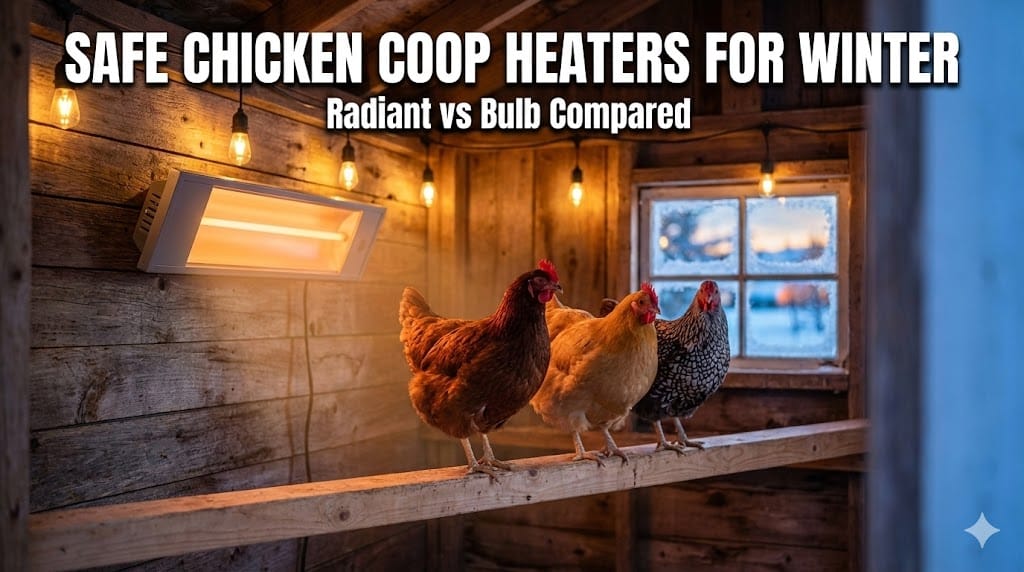
Let’s be real here: waking up to a coop fire is every chicken keeper’s worst nightmare. Yet, every winter, we see the same tragic stories on the news about barns and coops burning down because of a cheap heat lamp.
As the temperature drops, you want your flock to be comfortable. But you also want to sleep soundly knowing your property is safe. The good news is that heating technology has changed. You no longer have to rely on dangerous bulbs that can shatter or ignite pine shavings.
Before you invest in any heater, make sure you have addressed the basics. Our complete guide to winterizing your chicken coop covers insulation, draft-proofing, and preparation steps that can reduce or eliminate the need for supplemental heat entirely. If you are still in the building phase, consider our designs for cold weather chicken coops to ensure maximum heat retention naturally.
In this guide, we are going to look at the safe chicken coop heater for winter (Radiant vs Bulb) options available today. We will cover why radiant heat is the gold standard, which products actually prevent fires, and how to keep your hens warm without risking it all.
Do Chickens Actually Need Heat in Winter?
Before we rush out to buy equipment, we need to answer a big question: do your birds even need it?
Here is the thing—chickens are much tougher than we give them credit for. They wear a natural down coat that is incredibly efficient at trapping body heat.
Many poultry experts recommend providing supplemental heat when coop temperatures fall below 35°F—this is why popular thermostat devices like the Thermo Cube are designed to activate at this threshold.
Many chicken keepers use thermostat devices that automatically activate heaters at this 35°F threshold and shut off when they rise to 45°F. While The Farmers Cupboard suggests using frozen water as your guide, complying with these general guidelines ensures you stay well within the safe zone for your flock. Most poultry experts agree that healthy adult chickens of cold-hardy breeds—like Rhode Island Reds, Wyandottes, or Orpingtons—can handle temperatures far lower than that without any heat at all. In fact, many beginner-friendly chicken breeds are selected specifically for their ability to thrive in cold climates.
Birds naturally acclimate to the cold as fall turns to winter. If you suddenly blast them with heat, they lose that natural ability to regulate their body temperature.
When Supplemental Heat Is Actually Necessary
There are specific times when a heater isn’t just a luxury, but a lifesaver:
- Extreme Arctic Climates: If you live in an area where winter lows consistently dip below -20°F. Tool Junkie’s testing suggests that if a heater can keep a flock frostbite-free at these temperatures, it is worth the investment.
- Sick or Injured Birds: A sick chicken cannot regulate its body heat well. Performing regular health checks ensures you spot these issues early. USDA APHIS emphasizes that maintaining a stable environment is critical for flock health and disease recovery.
- Young Birds: Chicks that aren’t fully feathered need help. See our dedicated guide on winter care for young chicks for specific temperature requirements.
- Delicate Breeds: Breeds like Silkies or Bantams don’t have the body mass or feather type to withstand deep freezes.
What Temperature Do Chickens Need in Winter?
The Farmers Cupboard offers practical guidance: “You will know if your chickens are warm enough if the water in your chicken waterer is not frozen. If your water is not frozen, you do not need to add a coop heater.”
This simple test cuts through the confusion. Your goal isn’t to make the coop comfortable for humans—chickens don’t need that. Chickens regulate their body temperature differently than humans—their comfort zone is much colder than ours.
Most healthy adult chickens of cold-hardy breeds can handle temperatures well below freezing. However, Tool Junkie’s testing focused on the -20°F threshold, noting that “if a heater can keep a flock frostbite free at minus 20°F, it’s worth a spot in any coop.”
Why Not Use Heat Lamp in Coop During Winter?
You might be wondering, “Why can’t I just use a $10 heat lamp from the hardware store?”
Please don’t. Heat lamps are the number one cause of coop fires. One of the mistakes every first-time chicken keeper makes is assuming these cheap bulbs are a safe “standard” solution.
Fire safety experts consistently warn that heat lamps are dangerous because the lamp assemblies can be easily knocked over by birds. Kalmbach Feeds warns: “Adding heat may seem helpful, but it can introduce serious safety risks. Space heaters and heat lamps can cause fires if knocked over or if dust accumulates.”
The Hidden Toxic Gas Danger: There is a hidden danger most people don’t know about: toxic fumes. Tractor Supply provides a critical warning to “Avoid shatter resistant or safety coated bulbs.” These bulbs are often coated with polytetrafluoroethylene (PTFE), the same material used in non-stick pans. When the bulb heats up, “the PTFE emits a gas that is lethally toxic to birds. Chicks in a brooder heated with a shatterproof lamp will die quickly.”
Electrical Overload Risk: If you ignore this advice and use a bulb, the fixture itself is a risk. Tractor Supply emphasizes checking the wattage rating: “Make sure the fixture you use has the same wattage rating as your bulb. A 250-watt infrared heat bulb, for instance, will put out more heat than a fixture rated for up to 150 watts can handle,” leading to melted sockets and fires.
Critical Fixture Requirements: If you still insist on using heat lamps despite the risks, Tractor Supply emphasizes these non-negotiable safety steps: never hang a lamp by its cord (it is not designed to hold weight) and ensure the fixture clamp is secured by a secondary tie (like a chain or zip tie) to prevent slipping if the clamp fails.
Think about the environment inside your coop. It is full of dry wood shavings, straw bedding, and dust. These combustible bedding materials are highly flammable. All it takes is one chicken flying up to a roost, bumping the lamp, and knocking it into the bedding. Within minutes, you have a disaster.
Even if the lamp is secured perfectly, the bulb can shatter from moisture or temperature changes, dropping hot glass onto your birds. As noted by the Cutest Coops buying guide, you should “invest in a modern flat panel or radiant heater that is UL-certified and has an automatic shut-off feature to protect your flock and prevent” fires rather than risking a bulb.
Are Radiant Heaters Safe for Chickens?
If heat lamps are out, what is the alternative? Enter the radiant heater.
Radiant heat works differently than a bulb or a space heater. Radiant heat operates on infrared wavelengths that warm solid objects (like chicken bodies) without heating the air in between. As the University of Minnesota Extension explains, “Radiant heat sources heat the birds but not the surrounding air space.”
This is why Tool Junkie emphasizes these panels “warm bodies and nearby surfaces” rather than the entire coop volume. The physics make them inherently safer and more efficient—there’s no superheated air to rise and contact wooden rafters or accumulated dust.
Why are they safer?
- Zero Clearance: Many flat panel heaters have “zero clearance” requirements, meaning they won’t start a fire even if they touch combustible materials.
- No Hot Spots: They don’t get hot enough to singe feathers or ignite straw.
- No Shattering: There is no glass bulb to break.
The Farmers Cupboard notes that a flat panel heater “is not made to heat your coop with warm air, but will keep your birds warm with radiant heat” and “offers a safer alternative to potentially dangerous heat lamps.”
What Is the Best Way to Heat a Chicken Coop in the Winter?
Heating isn’t just about buying a gadget. It is a system. If your coop is drafty, the best heater in the world won’t help.
Step 1 – Insulate and Ventilate First
Before you plug anything in, check your coop. Is it insulated?
Effective insulation is crucial for keeping the cold out and the warmth in. You can insulate the walls, but make sure you don’t close off ventilation. Understanding how much ventilation your coop needs is key to keeping birds healthy in winter.
This is critical: You need ventilation high up on the walls (above the chickens’ heads) to let moisture escape. If you trap moisture inside, your chickens can develop frostbite on chicken combs and wattles, even if the coop is “warm.” Wet air feels much colder than dry air and can lead to respiratory infections. Be careful to avoid common ventilation mistakes that actually create dangerous humidity.
Step 2 – Choose the Right Heating Method
Once your coop is draft-free but well-ventilated, you can choose a heater. You want something with an automatic shut-off and, ideally, a thermostat control to save electricity.
5 Safe Chicken Coop Heaters for Winter (2025 Product Rankings)
Based on hands-on testing conducted by Tool Junkie in 2025, here are the top-rated models that prioritize safety and functionality. Tool Junkie’s evaluation covered seven heaters based on “hands-on style testing, real-world performance in cold snaps, wattage efficiency, safety features, and ease of installation.” This independent testing provides practical guidance beyond manufacturer claims.
| Rank | Product | Wattage | Key Feature | Safety Rating |
|---|---|---|---|---|
| 1 | Chickcozy JY016 | 200W | Smart temp sensor, anti-tilt auto shut-off, 32 ft remote | Excellent |
| 2 | NEWTRY YJH29XN | 200W | Dual-sided heating, remote control | Excellent |
| 3 | Sweeter Heater Overhead | Varies | 3-year warranty, snap-action thermal control, since 1995 | Excellent |
| 4 | Cozy Chickens Panel | 150W | Zero-clearance ETL-listed, coil-shielded cord | Excellent |
| 5 | Producer’s Pride | 200W/40W | Dual heater/brooder modes, built-in thermostat, UL-listed | Excellent |
| 6 | AOKSURE PH200 | 200W | ETL compliant, wall/stand mounting | Very Good |
| 7 | Chtoocy Coop Heater | 300W | Reinforced guards, aluminum construction | Very Good |
1. Radiant Flat Panel Heaters (The Gold Standard)
Best For: Most backyard coops, families with kids, and safety-conscious owners.
Radiant flat panel heaters are widely considered the safest option on the market. Unlike space heaters that blow hot air, these use infrared technology to transfer gentle heat directly to the chickens’ bodies, similar to how the sun warms you on a cold day.
Top 2025 Recommendations:
- Chickcozy JY016 (Rank #1): According to Tool Junkie’s 2025 review, this unit “represents the current state-of-the-art in coop heating.” It features a temperature adjustment range from roughly 122°F to 191°F and includes a remote control with a 32-foot range. Crucially, the company “explicitly frames these panels as safer than heat lamps due to built-in protection and automatic power off if tilted to prevent fires.”
- NEWTRY YJH29XN (Rank #2): If you need to cover a larger area, this model offers “dual-sided heating” that “expands the effective warm zone without increasing wattage.” The included remote control is a game-changer for winter nights, eliminating “the need to climb into a cramped coop to tweak settings, which matters when storms hit at night.”
Why They Are Safe: They are designed with “zero clearance” safety features. This means the surface temperature remains low enough that even if a chicken flies into it or bedding piles up against it, it will not ignite. There are no exposed glowing coils and no glass to shatter.
Other Verified Top Picks: While the models above are top-ranked for 2025, other time-tested options include:
- Sweeter Heater Overhead Model: A heavy-duty classic “trusted by customers since 1995,” according to Chicken Whisperer Magazine. It features a “uniform heat pattern with no hot spots” and maintains a surface temperature of 160-180°F. It includes a “snap-action thermal control” that cuts power if heat escapes, backed by a three-year warranty.
- Cozy Chickens Heating Panel: Described as “new and improved,” this 150-watt unit features a “zero-clearance, ETL-listed design” and a “coil-shielded cord” for extra protection against pecking.
- Producer’s Pride: A versatile choice that “combines a heater and brooder in one unit.” It is UL-listed, zero-clearance, and features a built-in thermostat.
Real-World Experience: Many chicken keepers in online communities report that their birds actively choose to roost near radiant panels on cold nights, then move away during warmer periods. Tractor Supply explains the science behind this behavior: “A radiant heat panel directs heat only beneath itself, giving chicks in a small brooding area the flexibility to move away to maintain their comfort level. And when the ambient temperature is warm enough… simply turn off and lower the panel heater. The panel will trap the body heat of chicks sleeping underneath, keeping them cozy warm.”
Experienced homesteaders on BackyardChickens.com note that “I use Brinsea Eco-Glow brooders. They are very safe and won’t burn the chicks”—confirming that the flat-panel approach works well for both chicks and adult birds.
Pros:
- Fire Safe: Extremely low risk of ignition.
- Long Lifespan: Tractor Supply notes that “A properly cared for panel heater may last indefinitely.”
- Energy Efficient: Typically uses 200 watts or less (compared to 1,500W space heaters).
- No Light: Won’t disrupt the chickens’ sleep cycle.
- Easy Install: Can be mounted flat against a wall or hung from the ceiling.
Cons:
- Price: Higher upfront cost ($50–$150).
- Gentle Heat: Won’t warm a large barn; only warms the area immediately next to it (the “warm zone”).
Verdict: If you can afford it, a modern panel like the Chickcozy is the #1 recommendation for sleeping soundly at night.
Best Chicken Coop Heater with Thermostat (Smart Temperature Control)
The most important safety feature in 2025 isn’t the heater itself—it’s the thermostat brain controlling it. According to The Farmers Cupboard, smart heaters with “a built-in smart temperature sensor” can “adjust power in real-time according to the surrounding temperature to maintain your preset temperature, keeping your flock cozy without the risk of overheating or frostbite.”
The Chickcozy JY016 leads this category with its Smart Evolution model that offers a temperature probe for real-time ambient detection. Tool Junkie’s testing confirmed it provides “reliable temperature setting, effective radiant range within about 40 cm” and “convenience features like a readable screen and a remote that saves countless trips into a cold coop.”
2. Thermostat Controlled Outlets (The “Brain” of the System)
Best For: Regulating any heater and saving money on electricity.
While not a heater itself, a device like the Thermo Cube TC3 is an essential piece of the safety puzzle. It is a simple adapter that plugs into your wall outlet. You then plug your heater into the Thermo Cube.
How It Works: It has a built-in sensor that automatically turns power on when the air temperature drops to 35°F and turns it off when it rises to 45°F. This eliminates the “human error” of forgetting to unplug a heater during a warm spell. The University of Minnesota Extension confirms that “thermostats in heaters or bought separately can help you better manage their use and reduce electricity costs.”
Pros:
- Automated Safety: Prevents overheating the coop.
- Cost Savings: Heater only runs when absolutely necessary.
- Simple: No programming required; it’s plug-and-play.
Cons:
- Fixed Range: You usually can’t adjust the specific temperatures on basic models.
Verdict: Mandatory for any electric heating setup. It pays for itself in one winter of saved electricity.
3. Ceramic Heat Emitters (CHE)
Best For: Small coops, brooders, or spot heating on a budget.
A Ceramic Heat Emitter is a porcelain bulb that screws into a standard light socket but emits no light—only heat. They are often used for reptiles but have found a place in chicken keeping as a safer alternative to glass heat lamps.
Safety Warning: While they don’t shatter like glass, they get extremely hot. According to The Farmers Cupboard, these bulbs “will still be very hot to the touch, and there is a low risk that a chicken would fly up into it or feathers would stick to it and cause a fire.” While safer than glass heat lamps, “a bulb of any kind should be used with caution inside” a coop. You MUST use a porcelain socket (plastic ones will melt) and a heavy-duty wire cage guard to prevent chickens from touching the bulb.
Pros:
- Affordable: Bulbs are cheap ($10–$20).
- No Light: Keeps hens on a natural day/night cycle.
- Effective: Puts out a significant amount of heat for its size.
Cons:
- Burn Hazard: Surface gets hot enough to burn feathers or skin instantly upon contact.
- Requires Setup: Needs a specific clamp lamp and guard; cannot just hang loosely.
Verdict: A good budget option, but requires strict installation discipline to be safe.
4. Solar Chicken Coop Heaters
Best For: Off-grid coops or mild climates needing very light supplemental heat.
We see a lot of interest in adding solar power to your coop, but we need to be realistic. A standard solar setup generally cannot store enough battery power to run a heating element all night during the long, dark, freezing nights of winter.
Realistic Expectations: While Tool Junkie’s 2025 review covered various power options, solar-powered heating remains impractical for primary winter heating. Most “solar chicken coop heaters” on the market are actually ventilators or very low-wattage supplemental units. For reliable overnight heating during the longest, coldest winter nights, grid power or robust battery backup systems remain necessary. To run a true air heater, you would need a massive, expensive battery bank and large panel array, costing thousands of dollars.
Pros:
- Fire Safe: No grid electricity to spark.
- Free Energy: No monthly bill.
Cons:
- Weak Performance: Rarely provides enough BTU output to combat sub-zero temps.
- Unreliable: Battery dies exactly when you need it most (long winter nights).
Verdict: Great for lighting or keeping water unfrozen, but do not rely on solar heat to save a flock in a blizzard.
5. Battery Backup & Emergency Heaters
Best For: Power outages and extreme weather emergencies.
The biggest killer in winter isn’t the cold itself—it’s the sudden drop in temperature. If your flock is used to a 40°F heated coop and the power fails, dropping the temp to -10°F instantly, they can die of shock.
The Solution: Uninterruptible Power Supplies (UPS) designed for computers can run a low-wattage radiant panel for a short time. Alternatively, keeping “single-use” reptile shipping heat packs (which activate by air) on hand can provide emergency warmth in a small, enclosed area or hospital crate.
Realistic Runtime: Battery-powered heaters face significant limitations. Running even a modest 200-watt radiant panel overnight requires substantial battery capacity. Most affordable “battery powered chicken coop heaters” offer only short-term emergency warmth—measured in hours, not nights. For true power outage preparedness, consider a generator with automatic transfer switch rather than relying solely on batteries.
Pros:
- Lifesaver: Prevents temperature shock during grid failures.
- Portable: Can be moved to sick birds easily.
Cons:
- Short Duration: Batteries drain quickly with heating elements.
- Manual Effort: Requires you to physically go out and set them up.
Verdict: Every keeper should have an emergency “Plan B” for power outages, even if it’s just a plan to bring birds into the garage in dog crates.
Best for Chicks: Safe Brooder Plates
If you are raising winter chicks, standard coop heaters aren’t the best fit. You need a dedicated brooder plate.
Top Recommendation: Brinsea EcoGlow Multiple sources reference this as the gold standard for chick brooding. Brinsea notes it is “low-voltage, energy-efficient, and eliminate the risk of fire and overheating” using “only 12-18 watts.”
- Why it’s safe: Brinsea describes their EcoGlow as mimicking “a mother hen,” allowing chicks to nestle underneath for warmth rather than being blasted by overhead heat. This natural approach reduces stress and eliminates the constant light exposure that disrupts sleep cycles.
- Community Feedback: BackyardChickens.com users confirm, “I use Brinsea Eco-Glow brooders. They are very safe and won’t burn the chicks.”
Large Chicken Coop Heater (For Bigger Flocks)
If you have a large shed or barn, a single flat panel won’t do much. You might need multiple units. Also, make sure you know how big your coop should be to avoid overcrowding, which exacerbates moisture issues.
Top Recommendation: Premier 1 Carbon Fiber Heaters For larger operations, Premier 1 offers “600- or 1200-watt models” capable of covering “10-by-10-foot or 20-by-20-foot areas.”
- Efficiency: They use “carbon fiber bulbs” that “produce four to six times more heat than conventional bulbs and convert 98% of their wattage into radiant heat.”
- Safety: A “built-in kill switch shuts off the heater if it tilts more than 30 degrees,” preventing fires if the unit is knocked down.
For large spaces, look for “zero clearance” radiant heaters designed for livestock. Place them in zones. You don’t need to heat the whole barn to 50 degrees; you just need to create “warm zones” where chickens can go to warm up before moving back to the cooler areas. Consider the space requirements of your flock when calculating how many heat zones you need.
Radiant Panel Placement Guide
Where to Mount Your Radiant Chicken Coop Heater
Placement determines effectiveness. According to Tool Junkie’s testing, “flat radiant panels shine when placed within about a couple feet of roosting birds. They don’t heat the whole room. They warm bodies and nearby surfaces.”
If your panel is mounted too far from the roost, “birds won’t benefit from the panel’s focused radiant zone, and owners might crank temperatures higher than necessary to compensate, which is inefficient.”
For dual-sided heaters like the NEWTRY YJH29XN, strategic placement “between two perches” can “spread comfort without the need for two separate panels.”
Pro Tip: It is essential to “seal any cracks or gaps in chicken coop designs where cold air might enter. This can be done using weather stripping or caulking to help maintain the internal temperature.” A well-sealed coop needs less heater output.
Energy Efficiency Comparison
How Much Does It Cost to Run a Chicken Coop Heater?
The energy savings of modern radiant panels are significant. Tool Junkie’s testing confirmed that 200-watt radiant panels offer “87% less energy than 1500W heat lamps” based on manufacturer claims.
To put this in perspective, The Farmers Cupboard notes that “a typical space heater uses 1500-2000 watts. So this 200 watt heater won’t make your chicken house hot” but will keep the coop above freezing.
| Heater Type | Typical Wattage | Monthly Cost (8 hrs/night) |
|---|---|---|
| Space Heater | 1,500W | $36-$45 |
| Heat Lamp | 250W | $6-$8 |
| Radiant Panel | 200W | $5-$6 |
| Heated Pad | 40-80W | $1-$2 |
| Costs based on $0.15/kWh national average |
Using a thermostat device drops these costs further by ensuring the heater “only runs when absolutely necessary.”
What Is the Best Winter Light for a Chicken Coop?
Many people confuse heat lamps with light. Chickens stop laying eggs when days get short.
Poultry experts, including the University of Minnesota Extension, recommend providing “at least 12 to 14 hours of light each day to continue laying eggs.” Use a standard LED bulb on a timer—never a heat lamp—to achieve this safely.
A simple LED bulb on a timer uses pennies of electricity and poses almost zero fire risk compared to a heat bulb.
Essential Safety Features to Look For
When shopping, ignore the marketing fluff and look for these three things:
Automatic Shut-Off Technology
If the unit tips over, does it turn off instantly? If it overheats, does it cut the power? This is non-negotiable. Look for “tip-over protection” on the box.
Proper Installation Requirements
Check the cord. Is it thick and shielded? Pecking can expose wires. You also need to verify mounting instructions. A safe heater should be mounted firmly to a wall or ceiling, at least 6 inches away from bedding material.
Fire Prevention Checklist
Even with a safe heater, follow guidelines from the National Fire Protection Association (NFPA).
- Install a smoke detector in the coop (wireless ones that alert your phone are great).
- Keep a fire extinguisher near the coop door.
- Check cords for wear and tear monthly.
- Always look for UL (Underwriters Laboratories) certified products or those meeting CPSC safety standards.
How to Install a Chicken Coop Heater Safely
Follow these steps to ensure you don’t become a statistic:
- Choose Location: Pick a spot on the wall near the roost, but not so close that a chicken is forced to press against it.
- Secure Mounting: Don’t just hang it on a nail. Screw it in. Chickens are clumsy and heavy; they will knock things down.
- Check Electrical: Plug directly into a GFCI outlet if possible. Avoid extension cords. If you must use one, ensure it is outdoor-rated and heavy-gauge.
- Set Thermostat: Use a device like a Thermo Cube to ensure it only runs when necessary.
- Test It: Turn it on and watch it for an hour before leaving your birds alone with it.
Alternatives to Heating Your Chicken Coop
Maybe you’ve decided heating isn’t for you. That is okay! Here is how to keep them warm naturally:
- Deep Litter Method: This involves letting bedding build up and decompose on the floor. Choosing the best flooring for chicken coops is essential for this technique to work effectively.
- High-Protein Feed: Many experienced keepers suggest giving scratch grains right before bed. Knowing what to feed chickens in winter is crucial, as the digestion process creates internal body heat. Occasional treats that boost egg laying can also help metabolism.
- Wide Roosts: Use a 2×4 board flat side up. This allows the chicken to sit on its feet, covering them with its warm belly feathers to prevent frostbite.
As Slash Gear reports after surveying chicken owners, “Overall, users say radiant or flat panel heaters are the safest to use in chicken coops, while heat lamps and space heaters should be avoided.” Many experienced keepers find their flocks do fine without any supplemental heat.
Frequently Asked Questions
Are radiant heaters safe for chickens?
Yes, they are widely considered the safest option. Because they heat objects rather than the air and have low surface temperatures, they significantly reduce the risk of fire compared to bulbs.
What temperature is too cold for chickens?
Most cold-hardy breeds are fine until temperatures drop below zero. However, frostbite risks increase significantly below -20°F. Always block drafts first.
Can I use a space heater in my chicken coop?
Generally, no. Household space heaters often have exposed coils, blow dust around, and aren’t designed for the dusty, flammable environment of a coop.
How do I keep my chicken water from freezing?
Don’t use your air heater for this. See our guide on how to keep chicken water from freezing without electricity, or use a dedicated heated poultry waterer. Dehydration is actually a bigger winter killer than the cold.
Do chickens need heat lamps in winter?
No. Heat lamps are dangerous and unnecessary for adult birds. Safer alternatives like radiant panels or simply better insulation are much preferred by experts.
Final Verdict: Best Safe Chicken Coop Heater for Winter
Keeping your flock safe comes down to minimizing risk. We strongly recommend avoiding heat lamps entirely.
- Best Overall: A Radiant Panel Heater connected to a thermostat. It is safe, efficient, and gentle.
- Best Budget Option: A Heated Pad designed for chicks or roosts.
- Best for Emergencies: Have a Battery Backup plan ready for power outages.
Remember, a cold chicken usually survives, but a chicken in a burning coop does not. Choose safety first.
Editorial Note
This guide is based on independent research and does not contain affiliate links. Product recommendations are based on published safety testing, manufacturer specifications, and community feedback from backyard chicken keepers. We have no financial relationship with any heater manufacturer mentioned.
Sources referenced include the University of Minnesota Extension, The Chicken Coop Company, Carolina Coops, Silver Fox Farm, USDA, Fresh Eggs Daily, Tool Junkie, Slash Gear, and The Farmers Cupboard

Oladepo Babatunde is the founder of ChickenStarter.com. He is a backyard chicken keeper and educator who specializes in helping beginners raise healthy flocks, particularly in warm climates. His expertise comes from years of hands-on experience building coops, treating common chicken ailments, and solving flock management issues. His own happy hens are a testament to his methods, laying 25-30 eggs weekly.