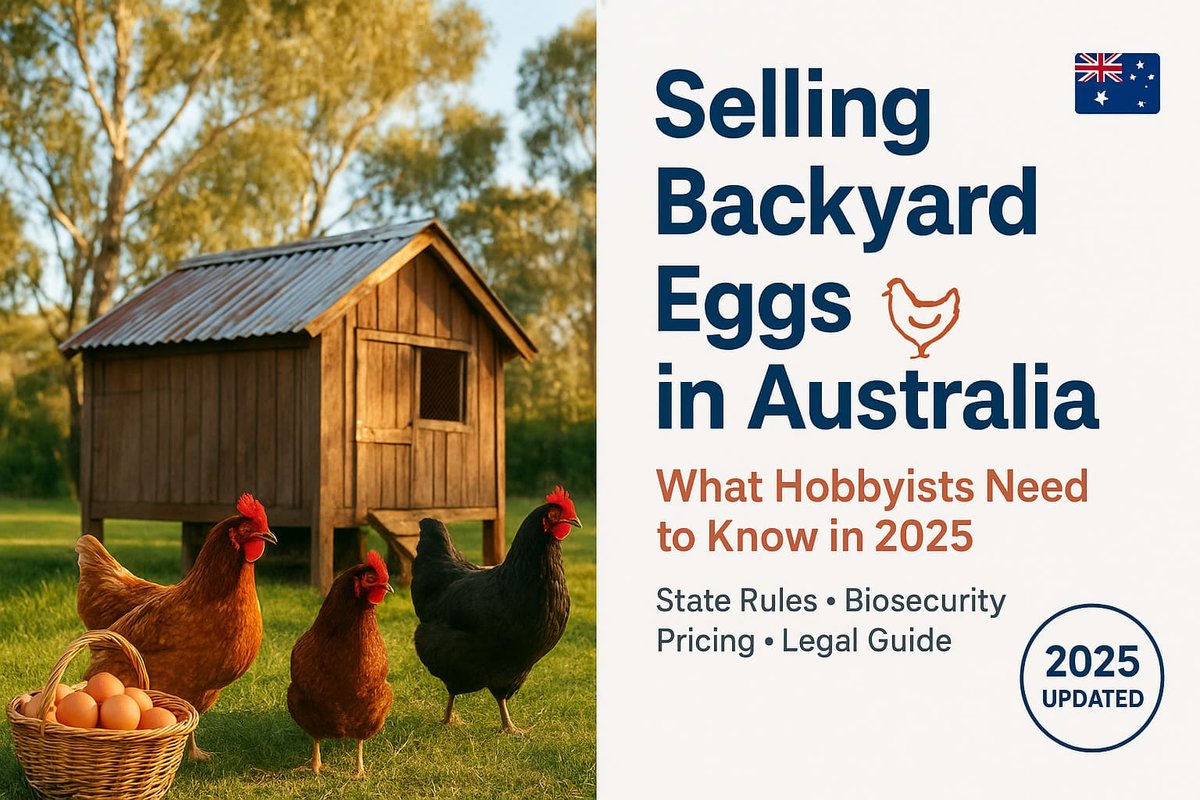
G’day! If you’ve got a few chooks scratching around the backyard, you know the joy of collecting fresh eggs every morning. It feels like a throwback to a simpler time, and honestly, it’s one of my favourite parts of keeping chickens.
But let’s be honest. With egg prices in the shops climbing steadily through 2025 and into 2026 (we’re seeing increases of 20 to 30 percent in many areas due to lingering avian flu impacts and supply chain pressures), and the general cost of living on everyone’s mind, you might be looking at your overflowing egg basket and wondering, “Can I sell my eggs for money in Australia?” With states like WA leading Australia’s battery cage phase-out, backyard eggs are more appealing to consumers than ever before.
The short answer is: Yes, you absolutely can.
I started with just 10 hens in my Sydney backyard several years ago. If you’re just getting started, I recommend reading our guide on where to buy chickens in Australia from reputable hatcheries and breeders. Now I make about $100 a month selling my extra eggs to neighbours and through a local honesty box. It’s a great way to make your hobby pay for itself, cover feed costs, and share that “fresh egg” joy with your community.
But here’s what I learned the hard way: you can’t just stick a sign out the front without knowing the rules. Selling food, even just a few eggs, comes with real responsibilities. We need to keep things safe, keep our customers healthy, and stay on the right side of the law.
This guide walks you through everything about selling backyard eggs in Australia as a small-scale hobbyist. I’m giving you the facts, not fluff, so you can get started the right way.
What You’ll Learn in This Guide
- Is it legal? The simple yes/no and what that really means
- Biosecurity: The number one rule you cannot ignore in 2026
- Permits and Rules: A deep dive into every state’s laws
- Stamping Eggs: Do you need to? And if so, how?
- Troubleshooting: Why you might be struggling to sell and how to fix it
- Storage and Safety: How to store eggs like a pro
- Selling Steps: A simple, actionable step-by-step guide
- Making Money: How much you can really make and how to set your price
- Tax Time: The simple ATO rules for hobbies vs. businesses
We’ll follow the official food safety standards, like those from Food Standards Australia New Zealand (FSANZ), but in simple terms. By the end, you’ll be a mini-expert, ready to sell your eggs safely and legally.
Is It Legal to Sell Eggs from Home in Australia?
Yes, it is completely legal to sell eggs from your home in Australia, especially for hobbyists.
You don’t need to be a massive commercial egg farming operation. The rules are set up to separate big farms from backyard folks like us. The government understands you’re not a giant company. You’re likely a family with 5 to 20 hens who ends up with more eggs than you can eat.
Before selling, make sure you’re also compliant with backyard chicken laws in Australia, which vary by council and cover flock limits, noise restrictions, and setback distances from property boundaries.
Understanding FSANZ Standard 4.2.5
The main rule for everyone, big or small, comes from FSANZ Standard 4.2.5 (Primary Production and Processing Standard for Eggs). This sounds fancy, but the basics for hobbyists are straightforward common sense:
Keep things clean: Your coops, nests, and collection areas must be clean. This stops eggs from getting covered in faeces or dirt, which is the main source of bacteria.
Prevent Salmonella: This is the big one. Salmonella is a nasty bug that can live on the outside of eggshells. Clean nests and healthy chooks are the best prevention.
Sell good eggs: Only sell eggs that are clean, not cracked, and fresh. A cracked egg is an open door for bacteria. According to FSANZ regulations, the sale of cracked and dirty eggs is explicitly prohibited for food safety reasons.
Keep chooks healthy: Ensure your chickens have clean water, good food, and are free from disease. Part of this also means protecting your flock from Australian predators like snakes, foxes, and birds of prey.
As a hobbyist, you are generally selling “ungraded” eggs. This just means you haven’t sorted them by weight (like 600g, 700g, etc.) in a big, expensive machine. This is totally fine for direct sales to friends, neighbours, or at the farm gate.
Biosecurity: Your Number One Responsibility in 2026
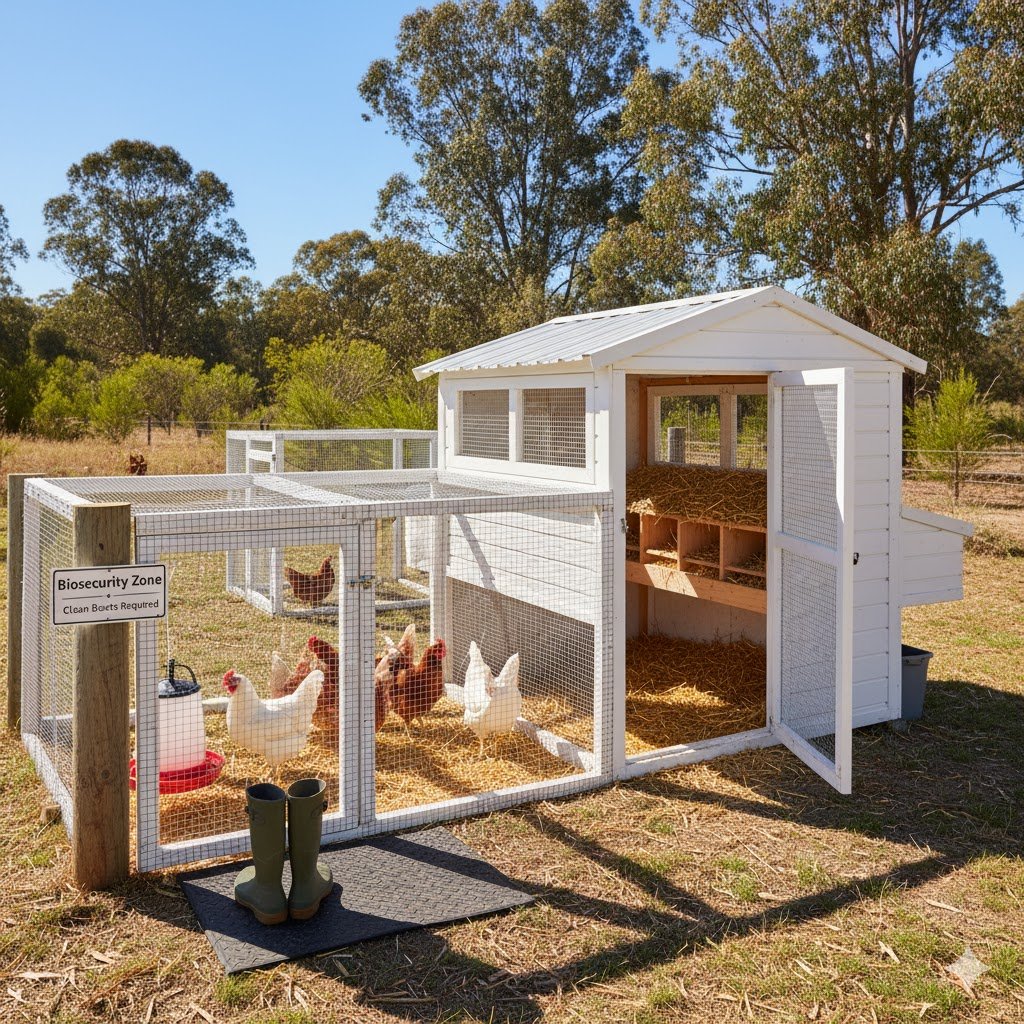
In 2026, knowing about biosecurity isn’t just for big farms. It’s for us, too. With ongoing concerns about Avian Influenza (bird flu) around the world and occasional detections in Australian wild bird populations, state authorities are maintaining heightened vigilance to protect all poultry.
According to guidelines from the Department of Agriculture, Fisheries and Forestry (DAFF), backyard flock owners play a critical role in Australia’s biosecurity framework.
“Biosecurity” just means protecting your flock from disease and stopping any disease from spreading from your flock. For a backyard owner, this means:
Pest Control
Keep rats, mice, and wild birds away from your coop and feed. They are major disease carriers. I learned this lesson when I found mice had been getting into my feed bin. Within weeks, I noticed my hens were off their laying. Once I switched to metal bins with tight lids, everything improved.
Clean Footwear
Have a pair of “coop boots” that you only wear inside your chicken run. This stops you from tracking in germs from the street.
Quarantine New Birds
If you get new chooks, keep them separate from your main flock for at least 14 to 30 days to make sure they’re healthy. This helps prevent disease transmission and is recommended under the Australian Animal Welfare Standards and Guidelines for Poultry.
Report Sick Birds
If you have multiple birds die suddenly or show strange symptoms, you must report suspicions to your local vet or the Emergency Animal Disease Watch Hotline at 1800 675 888.
This isn’t just a suggestion. It’s a key part of being a responsible animal owner and food seller. For deeper guidance, check out our comprehensive biosecurity plan for backyard flocks, which covers disease prevention, quarantine protocols, and emergency response.
Keeping your flock healthy is the first and most important step in selling safe eggs.
Can You Sell Eggs from Your Backyard Chickens?
So, “Can you sell eggs from your backyard chickens?” Yes! But as we’ve covered, the rules you need to follow depend on the scale of your operation. The government wants to encourage small-scale production but needs to ensure food safety.
Small Hobbyist vs. Big Business: Where Do You Fit?
Most states have a general limit for what they call a “small-scale producer” or hobbyist. This limit is often around 20 dozen (240 eggs) per week.
If you sell less than this, you’re typically classified as a hobbyist. If you sell more, you’re usually seen as a commercial business. That means you’ll need more permits, food safety programs, audits, and you’ll definitely have to stamp your eggs.
For most of us with a handful of chooks, we stay well under this limit. Before selling, understanding how much it costs to start with chickens in Australia helps you price your eggs fairly to cover your expenses.
Who Can You Sell To? Direct vs. Third-Party Sales
This is a critical rule. As a hobbyist, you are almost always limited to direct-to-customer sales.
You Can Sell To:
- At your farm gate or front step (an “honesty box” works perfectly)
- To your friends, family, and neighbours
- At a local farmers’ market (you’ll need to show your state or council registration)
You Cannot Sell To:
You generally cannot sell your eggs to a third-party business that will then sell them to someone else. This includes:
- Local cafes or restaurants
- Corner stores or grocers
- Bakers or other food makers
To sell to a business, you need a commercial licence, as the traceability and food safety rules become much stricter.
Staying “small scale” and selling “direct-to-customer” keeps things simple.
Do You Need a Permit? A State-by-State Guide
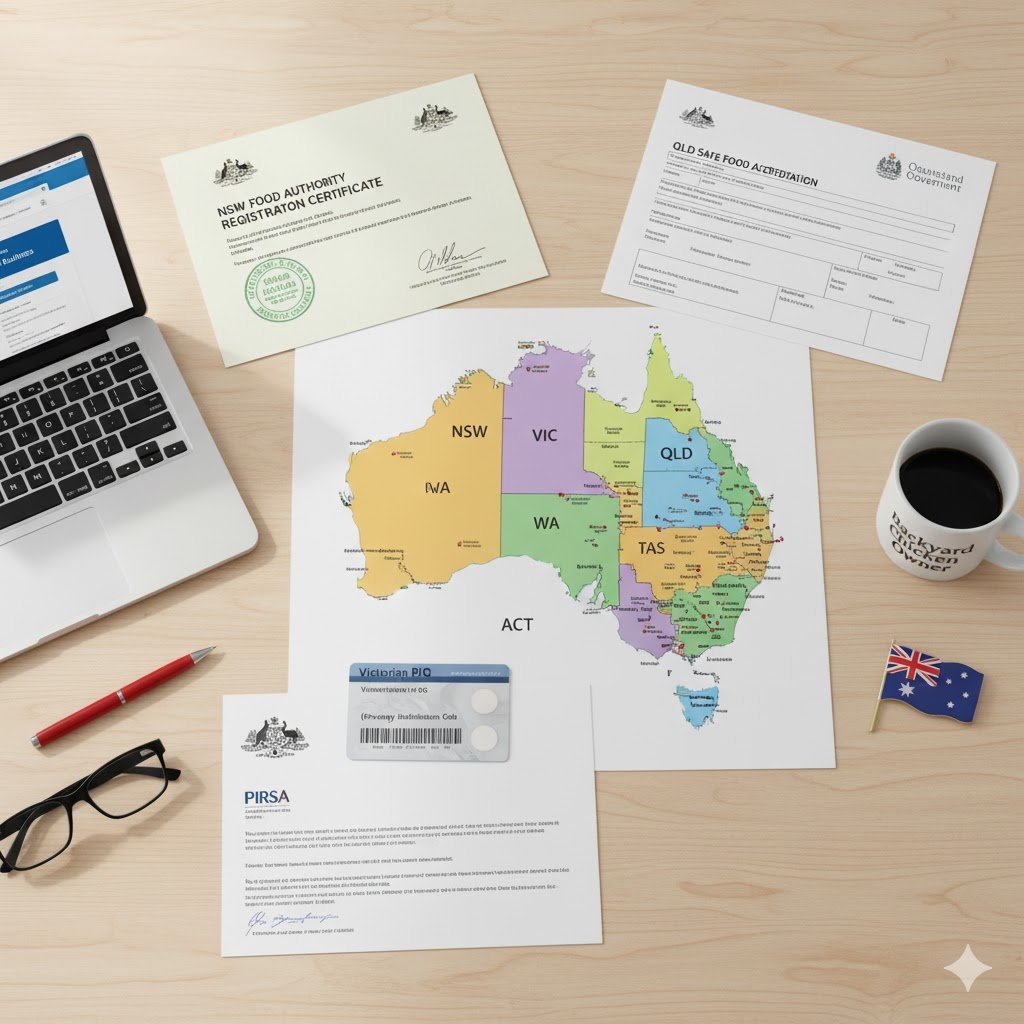
This is the most important question, and the answer depends entirely on your state. These Australian state egg laws for hobbyists are the main thing you need to learn.
Nationally, for small-scale sales, you don’t need a big federal permit. But state governments manage food safety, and their rules differ. This is where many people get confused.
State-by-State Permit Requirements
| State | Permit Needed for Small-Scale Hobbyists? | What It’s Called and Cost |
|---|---|---|
| NSW | Yes, registration required | NSW Food Authority registration. Free for small producers. |
| VIC | Yes, a PIC is needed | Property Identification Code (PIC) from Agriculture Victoria. Free or low cost. |
| QLD | Yes, strictest state | Safe Food Queensland Accreditation. Mandatory for anyone selling eggs, even one dozen. Can cost over $200 annually. |
| SA | Yes, registration required | PIRSA registration and a PIC. Free for small producers. |
| WA | Yes, registration required | Register with your local council as a “food business” (low-risk). Fees vary by council. |
| TAS | Yes, registration required | Register with your local council as a “food business.” Fees vary by council. |
My tip: Before you sell a single egg, search your state’s authority website (like “NSW Food Authority egg selling”) and check their current rules. It usually only takes a few minutes to register online.
Selling Eggs in NSW: Rules for Home Producers
If you’re selling eggs in NSW, the rules are quite friendly. You must register with the NSW Food Authority. It’s free and you can do it online through their portal. This just helps them know who is selling food in case of a safety issue.
As long as you sell less than 20 dozen eggs per week direct to the customer (at your gate or a market), you don’t need to stamp your eggs.
Selling Chicken Eggs in Victoria: Is It Legal?
For selling chicken eggs in Victoria, it’s also straightforward. You must get a Property Identification Code (PIC) from Agriculture Victoria. This isn’t really a “permit to sell” but a way for them to track all livestock (even one chicken) for health and biosecurity purposes. It’s free and you can apply online.
Like NSW, you don’t need to stamp eggs if you have fewer than 50 chickens and sell directly to the public.
Important 2026 Victorian Welfare Regulations Update
Starting in the first half of 2026, new poultry welfare regulations will take effect in Victoria, aligning with the Australian Animal Welfare Standards and Guidelines for Poultry. According to Agriculture Victoria, these new requirements affect all poultry owners, including backyard keepers, and include minimum space allowances, furnishing requirements, and lighting standards.
The regulations require that hens can perform natural behaviours such as standing at full height, perching, and nesting. Poultry owners must also take reasonable action to minimise access to poultry feed and drinking water by wild birds, helping prevent the spread of diseases.
A written contingency plan must also be developed by owners to minimise the impact of adverse events on poultry welfare in any type of housing system. Visit the Agriculture Victoria website or subscribe to their updates to stay informed about compliance requirements.
Selling Eggs QLD: What Hobbyists Need to Know
Listen up, Queenslanders! If you’re selling eggs in QLD, you have the toughest rules in Australia. You must be accredited with Safe Food Queensland, even if you only have one chook and sell one carton.
This involves an application, an annual fee (which can be over $200), and compliance with their standards. This is the number one hurdle for QLD hobbyists, but it is non-negotiable.
QLD Rules Apply to All Sales Channels
Important: These QLD rules apply whether you’re selling at your farm gate, giving eggs to friends and family, or selling and bartering eggs on Facebook Marketplace. The accreditation requirement covers all forms of egg distribution in Queensland, not just formal sales.
Rules for SA: PIRSA and Your PIC
South Australians also need to register. You must register as a “Primary Produce” business with PIRSA (Primary Industries and Regions SA) and get a PIC. For small producers (under 50 hens) selling direct, this is typically free.
You’ll be exempt from the costly auditing part of the SA Shell Egg Food Safety Scheme, but you still must be registered and follow all the safety and labelling rules.
Rules for WA and TAS: Register with Your Local Council
For hobbyists in Western Australia and Tasmania, the rules are managed at the local level. You must contact your local council and register as a “food business.”
It sounds full-on, but for a small home-based egg seller, you’ll be classified as a low-risk operation. There might be a small application fee, but it’s usually very simple.
In Tasmania, producers selling fewer than 20 dozen per week only to friends, family, and colleagues may have simpler requirements. Check with Biosecurity Tasmania and your council.
Do Eggs Need to Be Stamped for Selling Backyard Eggs in Australia?
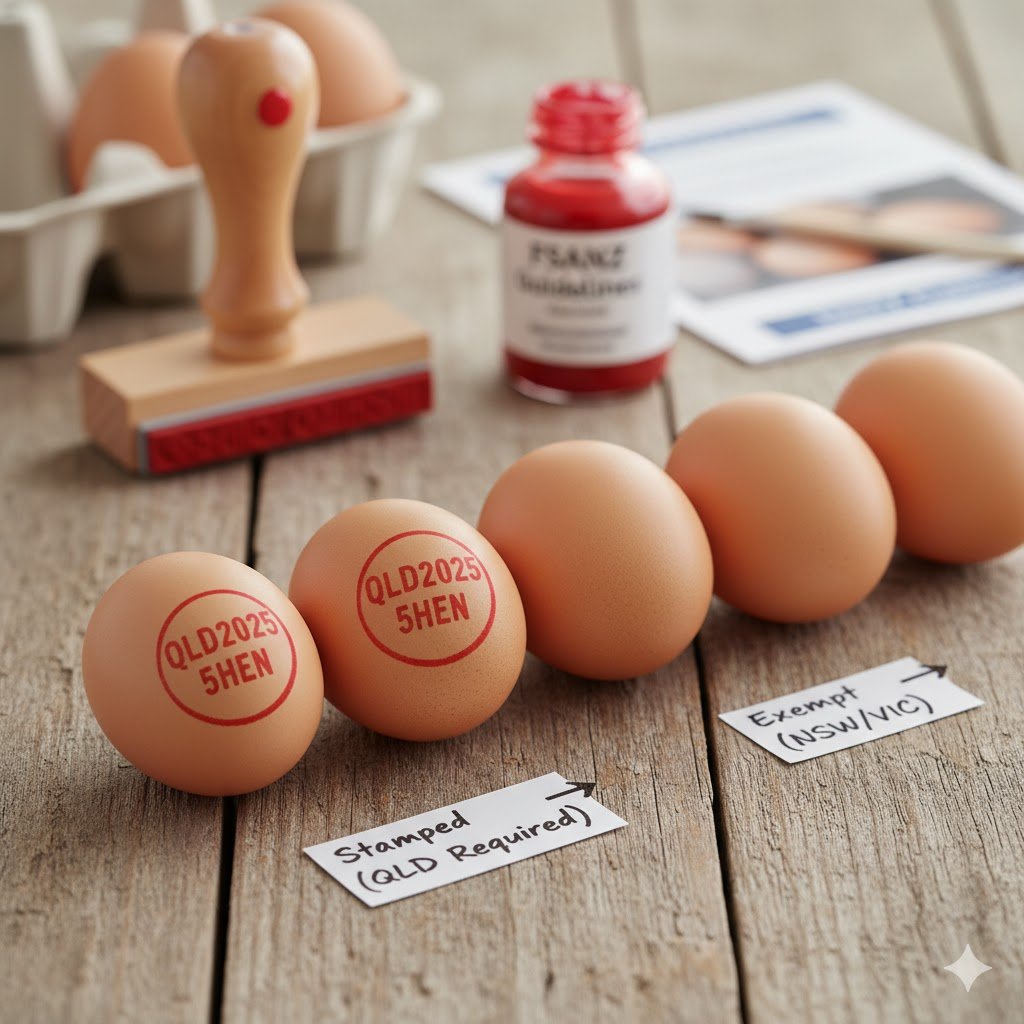
This is a really common question. You see the little red or blue codes on supermarket eggs, right?
For most hobbyists in NSW, Victoria, SA, WA, and TAS, the answer is NO.
If you are a small producer (for example, under 50 hens in VIC or selling under 20 dozen per week in NSW) and you sell directly to the customer, you are usually exempt from stamping.
In Queensland, YES. Part of your accreditation with Safe Food Queensland involves getting a unique code that you must stamp on every egg.
Egg Stamp Australia Explained
That stamp is all about traceability. If there’s a food safety issue (like Salmonella), authorities can use that egg stamp code to trace the eggs back to the exact farm, often within hours. It’s a key part of Australia’s food safety net.
How to Stamp Your Eggs (If You Need To or Want To)
Even if you’re exempt, some hobbyists choose to stamp. It makes your eggs look more professional and gives customers extra confidence. I noticed my sales increased after I started stamping, even though I wasn’t required to in NSW.
Getting Your Stamp
You can order a custom, self-inking rubber stamp online. You could have it made with your farm name or your registration code (if you’re in QLD).
Using Food-Grade Ink
This is essential. You cannot use regular office ink. You must buy “food-grade” or “food-safe” ink. This is a non-toxic, vegetable-based ink that is safe to use on eggshells. You can buy this from specialty stamp or food-supply websites.
A simple stamp and a bottle of food-grade ink is a worthwhile investment for anyone wanting to get serious about their egg sales.
Troubleshooting: Why Can’t I Sell My Eggs?
If you’re asking, “Why can’t I sell my eggs?” or finding that nobody is buying, it’s almost always one of these reasons. Here are the problems and their simple, actionable fixes.
Problem: You’re Not Registered
This is the biggest legal blocker. If you’re in QLD and not accredited, you legally cannot sell. In other states, you risk fines if you’re caught.
Solution: Get compliant! Go to your state authority’s website and complete the registration. It often takes just 10 minutes.
Problem: Your Eggs Are Dirty
Nobody wants to buy eggs with poo, dirt, or feathers stuck to them. It’s a huge turn-off and a massive food safety red flag.
Solution: The “Dry Clean” Method. Never wash your eggs in water. Washing removes the “bloom,” a natural, invisible protective layer on the shell that stops bacteria from getting inside.
Instead, “dry clean” them with a piece of fine sandpaper, a stiff brush, or a dry cloth to gently buff off any dirt just before you pack them. Clean nest boxes and proper ventilation start with good design. Our guide to chicken coop designs for hot Australian climates covers shade, airflow, and materials that keep eggs cleaner from the start.
Problem: Your Eggs Are Cracked
You must not sell cracked eggs. Even a tiny hairline crack can let in bacteria like Salmonella, which can make people very sick.
Solution: Inspect every single egg under a bright light before packing. Keep any cracked ones for yourself and use them quickly (make sure to cook them thoroughly).
Problem: Your Chooks Are Sick
If your flock has signs of disease (like lethargy, diarrhoea, or respiratory issues), you must not sell the eggs. This is a key biosecurity rule.
Solution: Stop sales immediately. Separate any sick birds and contact a vet. You cannot resume selling until your flock is healthy.
Problem: Your Setup Looks Unprofessional
Are you selling in old, stained supermarket cartons? Is your honesty box just a rusty tin? People “buy with their eyes” first.
Solution: Invest in your presentation. You can buy new, blank egg cartons in bulk from rural suppliers or online. A clean, neat label and a well-maintained honesty box make a world of difference. I started getting repeat customers only after I upgraded my presentation.
Understanding Your Limits: Scale and the Law
Can I Sell All of My Eggs?
Yes, you can sell all your eggs within the hobbyist limits.
If your 10 hens lay 70 eggs a week, you can sell all 70. The “limit” isn’t on how many of your eggs you can sell, but on the size of your operation (that roughly 20 dozen per week line) and who you sell to (direct-to-customer).
Once you get more than 50 to 60 hens and start producing over 20 dozen eggs a week, or if you want to sell to a cafe, you jump into the “commercial” category. That’s when you’ll need tougher licenses, regular audits, and a full food safety program.
What Happens If You Break the Rules?
It’s tempting to just put a sign out and hope for the best, but please don’t. State food authorities do follow up on complaints, and the penalties can be significant.
Selling from an unregistered business: Fines can be in the thousands of dollars for operating an unregistered food business.
Poor Labelling: Not having your name, address, or a best-before date can also result in penalties.
Making Someone Sick: This is the worst-case scenario. If your eggs cause a food poisoning outbreak, you could be personally liable for substantial fines, not to mention the guilt of harming someone.
For the 10 minutes it takes to register and the 30 seconds it takes to label a carton, it’s just not worth the risk.
How Do I Sell My Own Eggs? Step-by-Step Guide for Hobbyists
Ready to start? Here’s a simple, actionable guide.
Step 1: Check Your State’s Rules and Get Registered
We’ve covered this, but it’s the most important step. Go to your state authority’s website (NSW Food Authority, Agriculture Victoria, Safe Food QLD, etc.) and get registered. Do it before you sell anything.
Step 2: Collect and Clean Your Eggs
Collect Daily: Collect your eggs every day, or even twice a day in hot weather. This stops them from getting dirty or baking in the sun.
Dry Clean Only: Do not wash your eggs with water. Use a stiff brush, fine sandpaper, or a dry cloth to gently buff off any specks of dirt. A clean nest box makes this step much easier.
Inspect: Check every egg for cracks. Only clean, uncracked eggs can be sold.
Step 3: Pack and Label Your Eggs
This is where you look professional and meet your legal requirements.
Packing Your Eggs
Use new, clean egg cartons. Do not reuse old supermarket cartons. They can carry bacteria and look unprofessional. You can buy fresh, blank cartons in bulk from rural suppliers or online.
Label Requirements
You must have a label. A simple sticker will do, but it must include:
- Your Name and Physical Address: This is for traceability. A PO Box is usually not sufficient.
- A “Best Before” Date: For fresh eggs, this is typically 35 to 42 days from the lay date. Pick a system (such as 5 weeks from packing) and stick to it.
- Storage Instructions: A simple “Keep Refrigerated” is perfect.
Optional: You can also add words like “Farm Fresh,” “Backyard Eggs,” or “Free-Range.” Just make sure it’s true!
Claiming “Free-Range” on Your Labels
If you label or advertise your eggs as “free-range,” you must comply with Australian Consumer Law requirements. Your hens must have meaningful outdoor access during daylight hours, and you’re technically subject to the 10,000 hens per hectare stocking density rule under the national free-range egg labelling information standard.
For backyard flocks, this stocking density is rarely an issue since most hobbyists have far fewer birds per hectare. However, avoid using “free-range” claims if your chickens are kept in a fixed run without genuine outdoor foraging access. Misleading labelling can result in penalties under consumer protection laws.
Step 4: Store Eggs Correctly
You must store the eggs properly before you sell them. See the storage section below for detailed guidance.
Step 5: Sell Your Eggs
Here are the most common methods for hobbyists:
Farm Gate or Honesty Box: A small sign at your gate with a box for the money. This is very popular in Australian suburbs and regional areas.
Local Farmers Market: Check with your local market. You’ll need to show your state registration and often your public liability insurance (this typically costs $200 to $500 per year for $10 million cover).
Friends and Neighbours: Good old word-of-mouth remains the most reliable method.
Online: Local Facebook groups (like your suburb’s community page) or Gumtree can be great for advertising, but be sure to state “Pick-up only.” Remember, if you’re in Queensland, your Safe Food accreditation requirements apply even when selling through Facebook Marketplace.
How to Set Up a Secure Honesty Box
This is the easiest “set it and forget it” method.
Location: Put it in a visible, well-lit spot, ideally sheltered from rain and direct sun. In fire-prone areas, review our bushfire safety tips for backyard chickens to protect your setup during Australian summers.
The Box: A simple cooler (esky) keeps the eggs at a stable temperature.
The Money: Get a secure, lockable cash box and bolt it to your stand. A small slot on top is all you need. Check it daily.
Signage: Have a large, clear, friendly sign with the price per dozen and a “thank you” message.
How Do You Store Eggs for Selling?
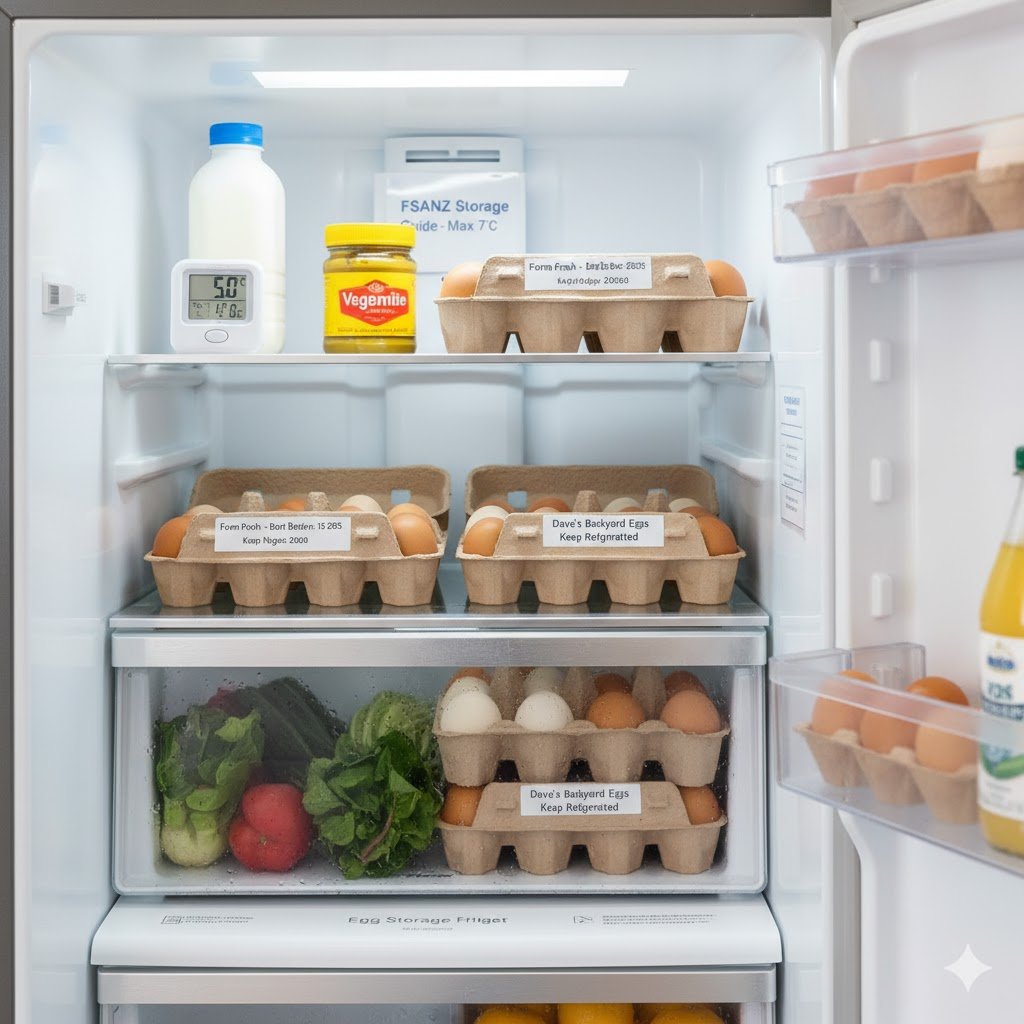
How you store your eggs directly impacts their quality and safety.
The Great Debate: Fridge vs. Counter
You’ll hear some people say fresh eggs last for weeks on the counter. This is partly true, thanks to that natural, invisible “bloom” (or cuticle) on the shell that we talked about. It seals the egg’s pores.
However, for selling to the public, you must be safer. According to FSANZ guidelines, to prevent Salmonella growth, eggs should be stored at or below 7°C.
Best Practice: Refrigerate your eggs as soon as possible after collecting and cleaning.
Consistency is Key: Once an egg is refrigerated, it must stay refrigerated. A cold egg brought out to room temperature can “sweat,” which creates moisture that can help bacteria grow.
Pro Storage Tips
Temperature: Store eggs at or below 7°C. A regular fridge is perfect (usually 4 to 5°C).
Storage: Keep them in the egg carton you’re selling them in. This protects them and stops them from absorbing smells from other foods (like onions).
Position: Store eggs pointy-end down. This keeps the yolk centred and the small air cell at the blunt end, which helps them stay fresh for longer.
When I started, I just used our kitchen fridge. Now that I sell a bit more, I have a small, dedicated bar fridge in the garage just for my eggs.
In hot Australian climates, proper storage is crucial. Learn more about keeping chickens cool in summer to prevent heat stress that affects egg quality.
How Much Money Do You Get for Selling Your Backyard Eggs?
Let’s talk money!
Most people sell by the dozen, not per egg. But let’s break it down.
Per Dozen: In 2026, prices for fresh, free-range backyard eggs range from $7 to $13 per dozen depending on your location and local market conditions.
Per Egg: This means you’re getting about $0.50 to $1.00 per egg.
I sell my dozens for $8 at my farm gate, and they sell out every weekend. My neighbour, who has rarer breeds with blue shells (Araucanas and Ameraucanas), sells hers for $10 to $12.
Choosing the right heat-tolerant chicken breeds for Australia ensures consistent egg production year-round, which matters when you’re building a customer base.
Why Are Backyard Eggs Worth More?
Why so much more than the $6 to $9 in supermarkets? Because yours are fresh. Truly fresh. Your customers know they were laid just days (or hours) ago, not sitting in a warehouse for weeks. The difference in taste is noticeable, and people are willing to pay for quality.
How to Set Your Price
Check the Market: Look on Facebook Marketplace and Gumtree for what others in your suburb are charging.
Visit a Market: See what local producers at your nearest farmers’ market are charging.
Consider Your Costs: Your price should at least cover your feed, cartons, and labels. Speaking of feed, our guide to best Australian poultry feed brands helps you choose quality nutrition at fair prices.
Don’t Undersell! People are happy to pay a premium for high-quality, local, fresh food. Yours are a specialty item, not a budget one.
Tax Time: Is It a Hobby or a Business?
This is the last big question. Do you have to pay tax? The Australian Tax Office has a very clear “hobby or business” distinction.
When It’s a Hobby
You’re doing it for pleasure, not as your main income, and you’re not really intending to make a big profit (for example, you’re just covering your feed costs). As a hobby, you do not pay income tax on your sales, but you also cannot claim expenses (like feed or coop repairs) on your tax return.
When It’s a Business
You start to operate in a business-like way. This includes:
- You intend to make a profit (not just cover costs)
- You do it regularly and have a clear system
- You’ve registered a business name or have a separate bank account
For 99% of backyard sellers, it’s a hobby. You don’t need to worry about tax.
According to ATO guidelines, you only need to register for GST if your turnover hits $75,000 a year, which is far beyond hobby levels. For hobbies, no income tax or deductions apply.
Frequently Asked Questions
Can I sell my chicken eggs in Australia?
Yes, it’s legal for hobbyists across all states. You’ll need to register with your state food authority (free in most states, with Queensland being the exception at over $200 annually). Direct-to-customer sales of under 20 dozen per week generally qualify for simplified hobbyist rules.
Can you sell eggs from home QLD?
Yes, but you MUST be accredited with Safe Food Queensland. This applies to everyone, even if you only sell one carton or give eggs to friends and family. This involves an application and an annual fee, and you will also need to stamp your eggs with your unique code. These rules apply whether selling at your gate, to neighbours, or through Facebook Marketplace.
Selling Eggs NSW: What are the rules?
Register free with the NSW Food Authority for small-scale direct sales under 20 dozen per week. No stamping needed for hobbyists selling directly to consumers.
Is it legal to sell eggs from home in Victoria?
Yes. Get a Property Identification Code (PIC) from Agriculture Victoria (free). If you have fewer than 50 chickens and sell directly to the public, you don’t need to stamp eggs. Note that new poultry welfare regulations take effect in the first half of 2026.
How much money do you get for selling your eggs?
You can get between $0.50 and $1.00 per egg. Most people sell by the dozen, with prices in 2026 ranging from $7 to $13 for a dozen fresh, free-range backyard eggs, depending on your location.
Do I need an egg stamp in Australia?
Not always. In NSW, Victoria, SA, WA, and TAS, small hobbyists (under 50 hens) selling directly to the public are usually exempt. In Queensland, stamping is mandatory for all sellers.
What is the main FSANZ rule for eggs?
The main rule for hobbyists from Food Standards Australia New Zealand is to produce eggs that are clean and safe. This means keeping coops clean to prevent contamination (especially with Salmonella) and only selling clean, uncracked eggs.
Can I sell unwashed eggs in Australia?
Yes! In fact, you should sell unwashed (or “dry-cleaned”) eggs. Washing eggs with water removes their natural protective layer (the “bloom”), which helps stop bacteria from getting inside. Use a dry brush or sandpaper to clean them instead.
Do I need to pay tax on selling my backyard eggs?
For most people, no. The ATO sees small-scale selling (like covering your feed costs) as a “hobby.” Hobby income is not taxable, and you can’t claim expenses. It only becomes taxable if it grows into a profit-focused business.
How many eggs will 1000 chickens lay a day?
This relates to commercial operations. A well-managed commercial flock of 1000 laying hens typically produces 800 to 900 eggs per day (80 to 90% lay rate). For backyard flocks, expect roughly 4 to 5 eggs per week per hen during peak laying season.
Is free range egg farming profitable?
It can be, but profitability depends on scale, feed costs, and local egg prices. For hobbyists, the goal is usually to cover costs and enjoy fresh eggs rather than generate significant profit. Commercial free-range operations require substantial investment in land, infrastructure, and compliance.

Oladepo Babatunde is the founder of ChickenStarter.com. He is a backyard chicken keeper and educator who specializes in helping beginners raise healthy flocks, particularly in warm climates. His expertise comes from years of hands-on experience building coops, treating common chicken ailments, and solving flock management issues. His own happy hens are a testament to his methods, laying 25-30 eggs weekly.