If you are reading this, you are probably doing the “egg walk.” You know the one—walking out to the coop three times a day, peeking into the nesting boxes, and walking back to the house empty-handed. We’ve all been there. No matter how long you’ve been keeping backyard chickens, one of the most exciting moments is when your hen lays her first egg. But the waiting game can be stressful for first-time chicken owners. Understanding chicken behavior before laying first egg signs is the key to knowing exactly when that magical moment will happen.
The good news is that your hens give off specific signals before they drop that first egg. In fact, if you know what to look for, you can predict it almost down to the day. I’ve kept backyard chickens for over 12 years, and this countdown has held true across dozens of first-time layers in my flock. This guide covers the specific signs you need to watch for, including a unique 48-hour countdown checklist to help you get your camera ready for the big moment.
Note: If you’re searching for “baby chicken behavior before laying first egg signs,” you’re actually looking for pullet behavior. A pullet is a young hen under one year old—baby chicks won’t lay for months yet!
When Do Chickens Start Laying Eggs? A Breed-by-Breed Timeline
Before we get into the behavioral quirks, we need to look at the calendar. If your pullets (young hens) are only 12 weeks old, you have a bit of a wait ahead of you.
According to the University of Wisconsin-Extension, most chickens start laying around 18-22 weeks of age. However, genetics play a huge role. Some production hybrids are early bloomers, while heritage breeds like to take their time. If you selected beginner-friendly breeds, you might see eggs on the earlier side of the spectrum.
Here’s a quick breakdown to see if your girls are in the “danger zone” for laying:
| Breed | Average Age to First Egg | Egg Color |
|---|---|---|
| White Leghorns | 16-20 weeks | White |
| Sex Links (Golden Comet, ISA Brown) | 16-20 weeks | Brown |
| Rhode Island Reds | 20-24 weeks | Brown |
| Barred Plymouth Rocks | 20-24 weeks | Brown |
| Easter Eggers | 20-24 weeks | Blue/Green |
| Buff Orpingtons | 18-24 weeks | Light Brown |
| Australorps | 20-24 weeks | Brown |
| Wyandotte | 20-28 weeks | Brown |
| Silkies | 28-36 weeks | Cream |
| Cochins | 28-30 weeks | Brown |
| Brahmas | 28-30 weeks | Brown |
Data compiled from verified breed timelines and American Poultry Association standards.
If your flock is in the age range above, it’s time to start watching for the signs a chicken is about to lay an egg.
Signs a Chicken is About to Lay an Egg: The Complete Behavioral Checklist
You don’t need a degree in poultry science to spot these changes. You just need to spend a little time observing your flock.
Bright Red Combs and Wattles—The First Visual Sign
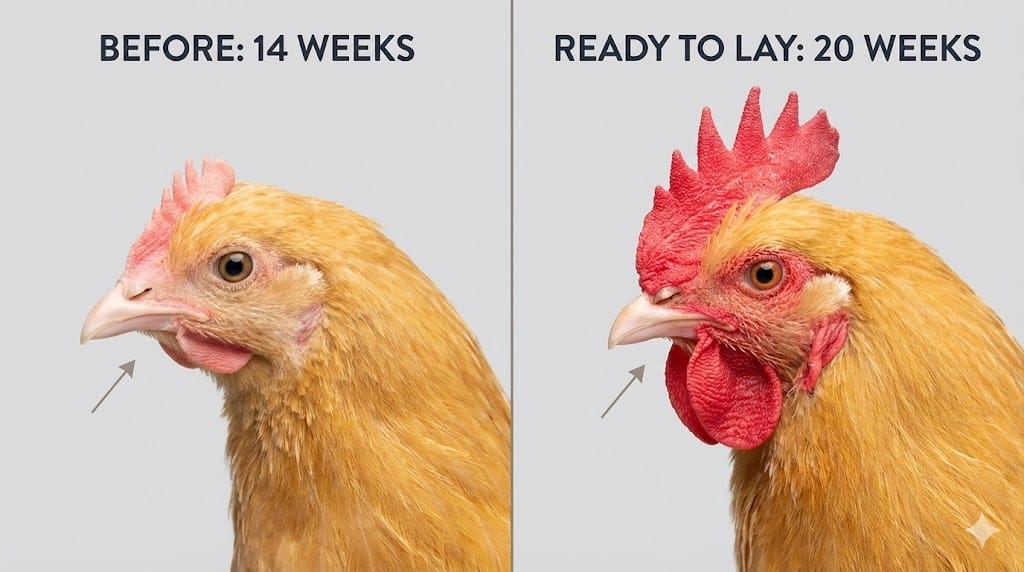
Weeks before an egg arrives, you will see a physical transformation. As a pullet matures, her hormones shift. This causes the comb (the fleshy crest on top of her head) and wattles (the skin dangling under her chin) to change from a dull, pale pink to a bright, vibrant red.
According to Permies poultry experts, “As Buff Orpingtons mature, their pale pink combs and wattles turn bright red. That color change is thanks to reproductive hormones kicking in.”
In my experience, the combs also get physically larger. If you have a hen whose comb has suddenly doubled in size and looks like a bright red strawberry, she is getting close.
Squatting Behavior: The #1 Sign Your Hen Will Lay Within Days
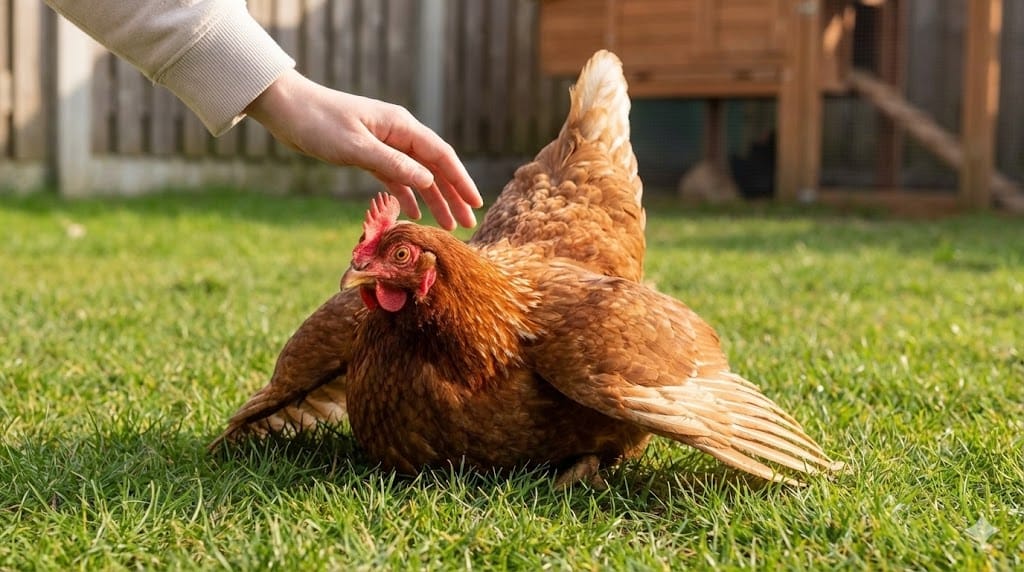
This is the big one. If you only look for one thing, look for the submissive squat.
According to Homestead and Chill, “Of all the signs that a chicken will start laying eggs soon, squatting behavior is the most telling… she may stop, squat, and put her wings out slightly to her sides.”
Here’s what it looks like: You walk up to your chicken to pet her or pick her up. Instead of running away, she suddenly drops to the ground, spreads her wings slightly, and freezes.
What does it mean when a chicken squats? Biologically, she is signaling that she is ready and willing to be mounted by a rooster to fertilize her forthcoming eggs. If there is no rooster around, she’ll submit to her human instead. It’s a sign of reproductive maturity.
So, how long after squatting will a chicken lay? Experienced keepers report that chickens “started laying eggs within a week or two” after exhibiting submissive squatting behavior. In my flock, it’s usually within 48 to 72 hours of the first strong squat.
Pre-Egg Nesting Behavior: When Your Hen Starts “Shopping” for the Perfect Spot
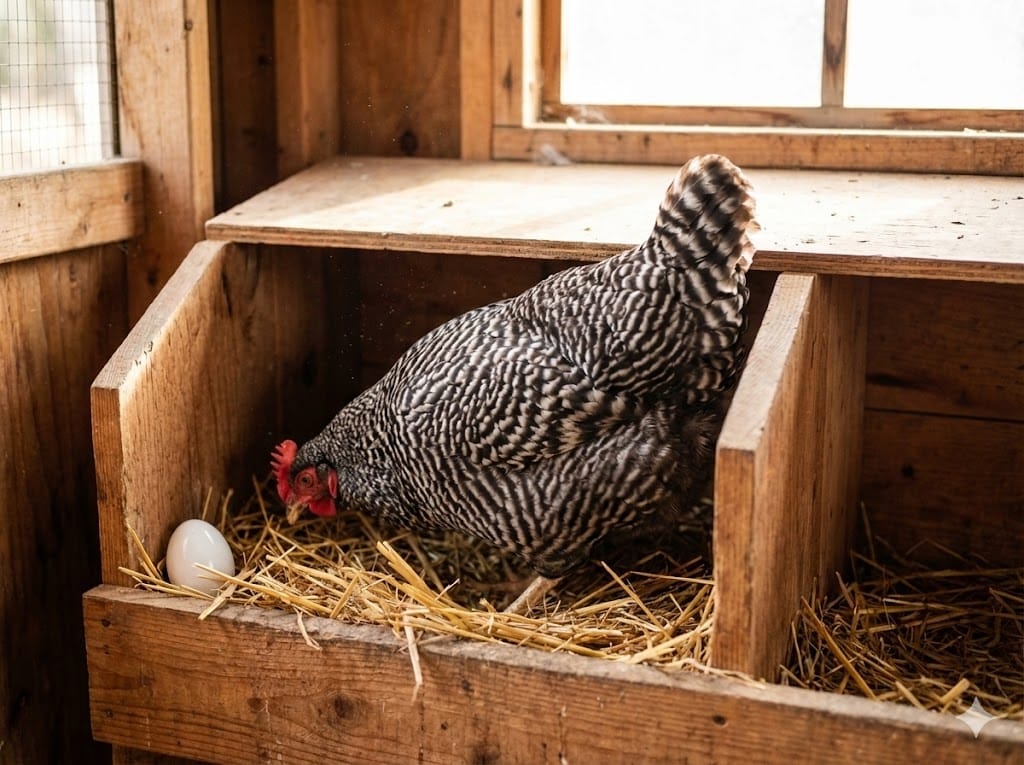
A few days before the main event, your pullet will start “shopping.” According to ImaginAcres, pullets will “meticulously inspect each nesting box for the perfect egg-laying spot. With a keen eye for safety and security, she’ll seek out a secluded and comfortable location.”
You might see her checking out dark corners of the coop, behind feed barrels, or in the actual nesting boxes. Members of the Backyard Chickens forum describe the sequence perfectly: “She would jump into the coop, scratch around her nest, jump out, squawk around, jump in, repeat for about 10 minutes.”
She is trying to figure out where this egg is supposed to go.
Why Your Quiet Pullet Suddenly Won’t Stop Clucking
We call this the egg song. According to Homestead and Chill, “Chickens sing and squawk for hours before and after they lay an egg. So, before your young chickens start laying eggs, they may become increasingly talkative too.”
It isn’t a normal “bawk-bawk.” It is a loud, repetitive cackle that sounds a bit like an alarm. ImaginAcres notes this vocalization “is a manifestation of her internal turmoil as she navigates the transition into egg-laying.”
Basically, she feels weird, and she wants everyone to know about it. I remember when my Buff Orpington, Elizabeth, laid her first egg. She screamed for 30 minutes before going quiet—and I found a perfect light brown egg in the box when I returned.
Physical Signs Your Pullet’s Body is Preparing for Egg Production
Your hen’s body changes shape as she reaches the point of lay.
- Appetite: She will eat more. Homestead and Chill points out that “The process of forming and laying eggs takes a lot of energy!”
- The Check: You can gently check her pelvic bones (located on either side of the vent). According to experienced keepers on Permies, if you can fit 3–4 fingers between the pelvic bones, laying is very close. If you can only fit one finger, her pelvic bones haven’t spread yet, and she isn’t ready.
Territorial Shifts: When Your Hen Claims Her Nesting Space
Suddenly, your sweet little hen might get a bit grumpy. According to ImaginAcres, “As your hen prepares to lay eggs, she may assert dominance by driving other flock members away from the designated nesting box.”
She is staking her claim. This protective behavior is natural; she wants a safe space for her potential offspring.
Social Changes Within Your Flock
If you have a rooster, keep an eye on him. ImaginAcres notes your pullet “may exhibit a heightened interest in the resident rooster, seeking out his company more frequently.” Conversely, the rooster may start dancing for her (dropping a wing and circling her) more often because he senses she is maturing.
The 48-Hour Countdown: What to Expect Hour by Hour Before the First Egg
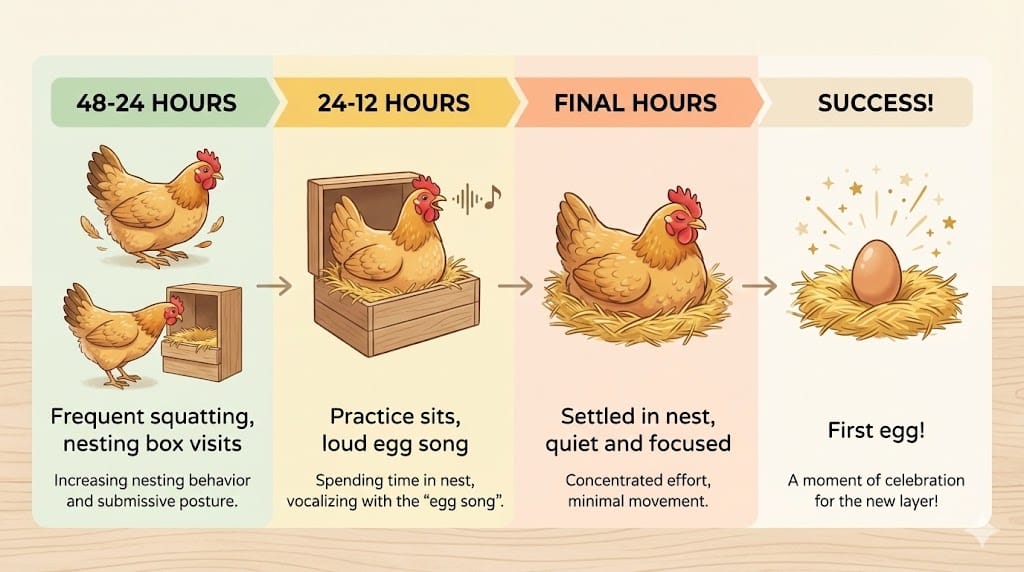
This is the timeline that separates the “soon” from the “now.” Here is the female chicken behavior before laying first egg broken down by the hour.
48 to 24 Hours Before:
- The Squat: She squats immediately when you reach for her.
- Inspection: She visits the nesting boxes multiple times a day but doesn’t sit for long.
- Chatter: She is vocalizing much more than usual.
24 to 12 Hours Before:
- Practice Runs: She sits in the nesting box for 10-20 minutes, then leaves.
- Restlessness: She seems agitated, pacing back and forth along the coop run fence.
- Volume: Her “egg song” gets louder and more frequent.
The Final Hours:
- Focus: She settles into the nest box and stays there.
- The Trance: She enters a “trance-like state.” According to Backyard Chickens community experts: “As they get ready to actually lay the egg, they will stand up and squat their vent downward. During that time they go into a trance like state.”
- The Result: You find your first egg!
How to Get Chickens to Lay Eggs for the First Time: Supporting Your Pullet
If you are seeing the chicken behavior before laying first egg signs, you can do a few things to help her succeed.
Switching to Layer Feed at the Right Time
Your hens need calcium and protein to build shells. According to the University of Florida IFAS Extension, providing a balanced diet with appropriate calcium is critical for egg production. You should gradually start switching to layer feed when they reach 18 weeks of age or when the first egg arrives.
Permies recommends: “At around 16–18 weeks, start giving layer pellets or crumbles with at least 16% protein and added calcium.”
Look for layer feed from reputable brands at your local farm supply store or agricultural cooperative. Most 16% protein formulas work well.
Why Oyster Shells Matter for First-Time Layers
Sometimes layer feed isn’t enough. Learning about calcium for laying hens is essential for new owners. Homestead and Chill advises putting out a source of free-choice grit or oyster shells either as soon as one hen starts laying eggs, or when you begin to notice the other tell-tale signs. Put this in a separate dish, not mixed into their food. They will eat it if they need it.
The 14-16 Hour Light Rule
Light triggers the hormones that release the egg. According to Penn State Extension, hens require about 14 to 16 hours of light daily to maintain consistent egg production.
If it is winter, this might be why you are waiting. Homestead and Chill explains: “Reduced daylight hours in the wintertime usually signals mature chickens to stop laying eggs.”
If you’re supplementing light in winter, a simple coop light on a timer can maintain the 14-16 hours your hens need without disrupting their natural rhythms.
Setting Up Nest Boxes That Encourage Laying
You need to show them where the “X” marks the spot. How do I know when my chicken will lay her first egg in the right place? You train her.
According to ImaginAcres, “Place one golf ball or fake egg in each nesting box. These surrogate eggs serve as visual cues for your hens, signaling that the nesting boxes are a safe and suitable location for laying eggs.”
For more details, check out our guide on setting up nesting boxes effectively. Quality nesting boxes with easy-clean liners, comfortable bedding materials like pine shavings or straw, and proper coop ventilation all contribute to a stress-free laying environment.
What to Expect from Your Pullet’s First Eggs
Don’t expect a jumbo carton egg right away. First eggs are often weird.
According to Permies, first eggs may be small, misshapen, or even “fart eggs” (tiny eggs with no yolk). ImaginAcres confirms: “As a pullet begins laying, the eggs she produces may exhibit irregularities in size and shape. These early eggs are typically smaller than those laid by mature hens.”
Homestead and Chill adds: “When chickens start laying eggs, their first eggs will be significantly smaller than what they’ll regularly lay as fully mature hens.” This is normal—her machinery is just warming up.
When Signs Don’t Lead to Eggs: Red Flags to Watch
Sometimes a hen shows all the signs but doesn’t produce an egg. While some delay is normal, watch for these warning signs according to Cotton River Farm and Mississippi State University Extension:
- Large amounts of blood or consistently bloody discharge
- Lethargy, puffed feathers, or sitting alone in a corner
- Straining or swelling near the vent area
- Soft-shell eggs that continue for more than a few days
Straining or swelling could indicate being egg-bound (an egg stuck in the reproductive tract) or a vent prolapse, both of which require immediate attention. If you notice these symptoms, consult a poultry veterinarian.
Frequently Asked Questions About Chicken Behavior Before Laying First Egg
Here are answers to common questions sourced from forums like Reddit and backyard poultry groups, addressing real chicken behavior before laying first egg signs that keepers discuss.
Q: At what age do chickens stop laying eggs?
Curious about how long chickens live and lay? Generally, chickens lay best for the first 2-3 years. Production drops after that, but they don’t usually stop completely until they are 6-8 years old. Older hens lay larger but fewer eggs.
Q: My chicken is squatting but no eggs yet—is something wrong?
Patience is key here. According to Homestead and Chill’s Aaron (Mr. DeannaCat): “When your chickens first start laying eggs, it can be fairly sporadic for the first month or so. As long as you are offering your hens free choice calcium like oyster shells or egg shells and they are healthy and acting normal, I would just give it some time.”
Q: Why did my hen lay eggs outside the nesting box?
First-timers often get surprised by the egg and drop it wherever they are standing. A Backyard Chickens forum member noted: “We found out she was laying because I was adding hay the other day and noticed 6 eggs in the corner of the coop. Not in the nest boxes.”
Homestead and Chill suggests: “If your birds have access to a free range or open space, you may also want to look around to be sure they aren’t laying eggs somewhere else.”
Q: My hen is sleeping in the nesting box—is this a problem?
Yes, because they poop while they sleep, leading to dirty eggs. According to Homestead and Chill: “Make sure their roost is higher than the nest boxes and that may keep them from sleeping in the nest boxes. It’s a lot easier if they sleep on their roosts or else your eggs will be quite ‘dirty.'”
So Here’s the Bottom Line
Watching for the chicken behavior before laying first egg signs is one of the most fun parts of raising a flock. Once you see those bright red combs and that unmistakable submissive squat, you know the 48-hour countdown has begun.
Keep checking those boxes, keep the calcium stocked, and get the frying pan ready. That first breakfast from your own backyard is going to taste amazing.

Oladepo Babatunde is the founder of ChickenStarter.com. He is a backyard chicken keeper and educator who specializes in helping beginners raise healthy flocks, particularly in warm climates. His expertise comes from years of hands-on experience building coops, treating common chicken ailments, and solving flock management issues. His own happy hens are a testament to his methods, laying 25-30 eggs weekly.