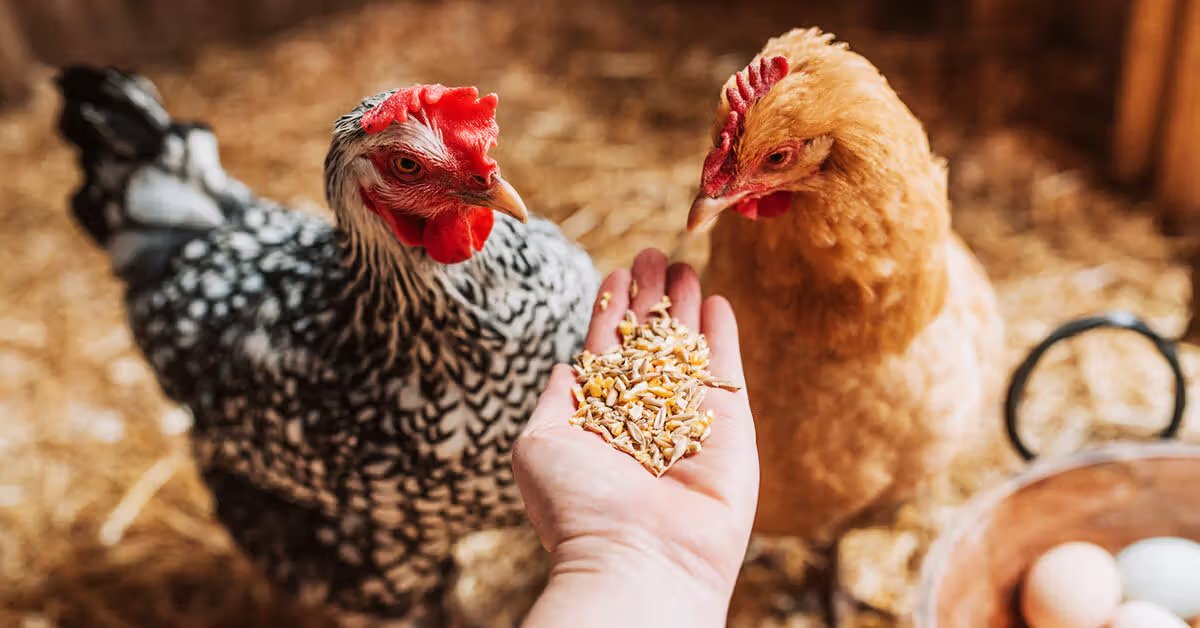
Backyard chickens typically live 5 to 10 years with proper care. Heritage breeds often reach 8 to 12 years or longer.
The current oldest living chicken is Pearl, an Easter Egger hen verified at 14 years and 69 days by Guinness World Records on May 22, 2025. The previous all-time record-holder, Peanut, lived to 21 years and 238 days before passing in December 2023.
Both record-holders laid few eggs in their later years, demonstrating how egg production intensity directly impacts poultry longevity.
Your pet chicken lifespan depends on four controllable factors: breed genetics, housing safety, nutrition quality, and preventive healthcare.
How Long Do Chickens Live: Quick Answer
| Category | Expected Lifespan |
|---|---|
| Heritage breeds | 8-12+ years |
| Production hybrids | 2-4 years |
| Bantam chickens | 7-10+ years |
| Peak egg production | First 1-2 years |
| Verified record | 21+ years (Peanut) |
How long do Chickens Live? Most backyard chicken lifespan falls between 5 to 10 years. Hardy heritage breeds like Plymouth Rocks and Orpingtons can exceed a dozen years with proper flock management.
Egg production is highest in the first 1 to 2 years, regardless of total lifespan.
When I started keeping chickens over five years ago, understanding this commitment changed how I approached everything.
Here’s what most beginners get wrong: they assume all chickens live roughly the same length of time.
They don’t.
A commercial ISA Brown might give you three productive years before health issues arise. Meanwhile, my Buff Orpingtons are thriving at year six with no signs of slowing down.
The difference comes down to four controllable factors.
The 4 Factors That Determine How Long Your Chickens Will Live
1. Breed Genetics: The Foundation of Longevity
Your breed choice is the single most influential decision affecting chicken lifespan.
Genetics dictate not just egg production but inherent hardiness and disease resistance. This is why breed selection matters more than almost any other factor.
Why This Matters
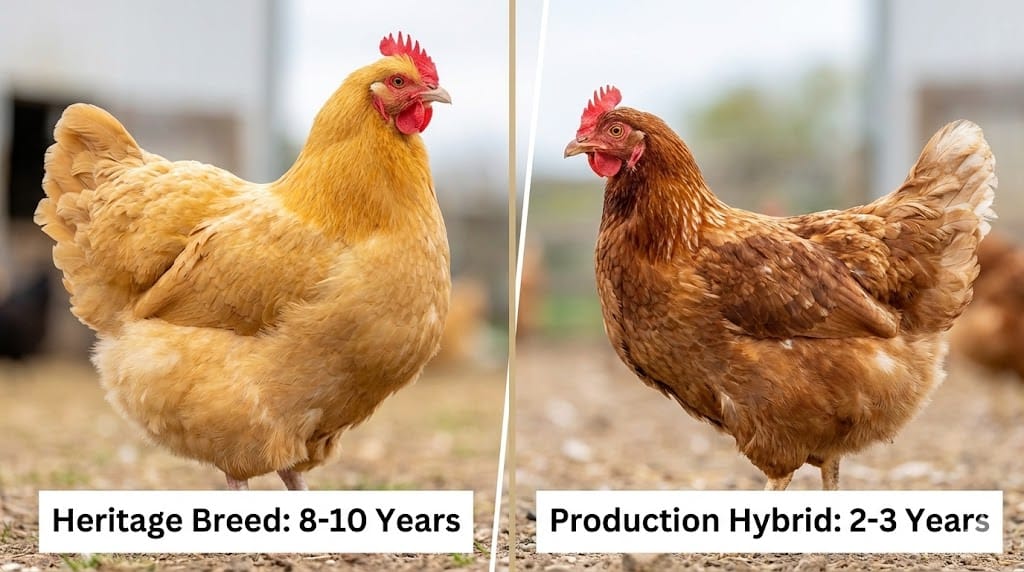
Production hybrids like Leghorns, ISA Browns, and Golden Comets are metabolic machines. They push out 280 to 320 eggs annually during peak production.
This intensity strains their reproductive organs. Most backyard keepers report these breeds declining after just a few intense laying seasons, typically living only 2 to 4 years.
Heritage breeds were developed for balanced, sustainable production.
Wyandottes, Plymouth Rocks, and Orpingtons lay 150 to 200 eggs yearly at a pace their bodies can handle. They commonly reach well over a decade with proper care.
Bantam chickens benefit from smaller body size and reduced metabolic demands. With proper care, they frequently surpass ten years. Peanut, the previous all-time record-holder at 21+ years, was a bantam cross.
The Role of Genetic Diversity
Breeds with a large gene pool, including mixed breeds, tend to live longer than chickens that are inbred for show quality or superior egg production.
This explains why Pearl, an Easter Egger (a mixed breed), defied the typical 5 to 8 year lifespan for her type. Chickens from smaller breeders usually live longer because they’re healthier and less prone to genetic issues.
Common Mistake
Choosing high-production breeds while expecting long companionship. Production breeds are designed for commercial operations that replace flocks every 18 to 24 months.
Hatchery vs. Breeder Stock
Long-time keepers report significant differences between hatchery and breeder birds.
Hatchery hens often develop major reproductive issues around their third year. Few make it past five years.
Birds from private breeders frequently thrive for seven to eight years or longer. The genetic diversity of smaller breeding programs makes a measurable difference.
Meat breeds like Cornish Cross present a different challenge entirely.
Bred for rapid 8-week growth, their skeletal and cardiovascular systems cannot support extended life. Their genetic predisposition for rapid growth leads to heart failure if not processed.
2. Housing and Predator Protection
A healthy chicken can be gone in seconds without proper protection.
Predation remains the leading cause of backyard chicken mortality, and it’s entirely preventable. Pearl survived a raccoon attack during her lifetime, proof that even close calls don’t have to be fatal with proper care afterward.
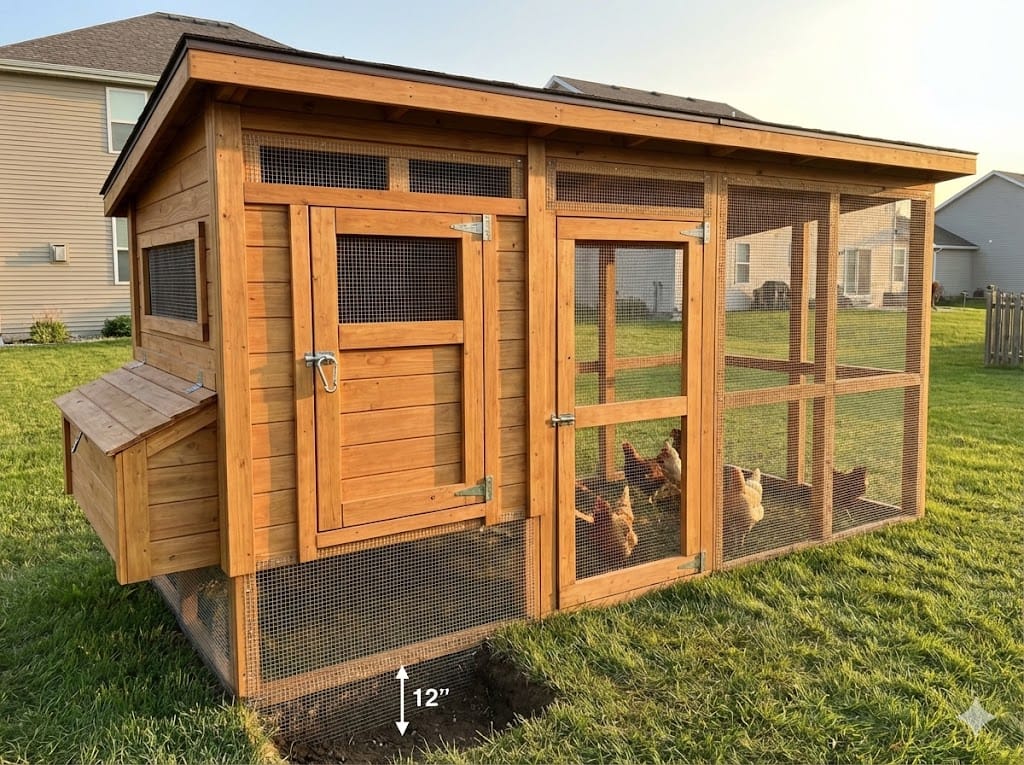
Think of your coop as a fortress, not a shelter.
Critical Security Measures
- Use ½-inch hardware cloth instead of chicken wire
- Bury barriers 12 inches deep around the entire perimeter
- Install raccoon-proof locks with carabiner clips
- Provide solid roofing against aerial predators
- Ensure proper ventilation without creating drafts
What I Learned the Hard Way
During my first year, a raccoon found a small gap I’d overlooked. One night cost me three hens.
Your predator-proofing strategy directly determines whether your chickens reach their genetic potential.
Space Requirements
Allow 3 to 4 square feet per bird inside the coop and 8 to 10 square feet per bird in the run.
Overcrowding creates stress, disease transmission, and pecking injuries that shorten lives.
Choosing a chicken breed is a commitment of potentially seven to eight years, the average lifespan of a well-cared-for bird.
Learn more about optimal space requirements for backyard flocks.
3. Diet and Nutrition Quality
A chicken’s body converts food into eggs with remarkable efficiency. Provide the wrong fuel, and that system breaks down prematurely.
Age-Appropriate Feeding
- Chick starter (0 to 8 weeks): 18 to 20% protein for rapid development
- Grower feed (8 to 18 weeks): 16 to 18% protein for controlled growth
- Layer feed (18+ weeks): 16% protein with added calcium
Beyond Commercial Feed
Fresh water constantly available. Dehydration causes laying cessation within 24 hours and can trigger organ damage within 48 hours.
Grit for digestion. Chickens lack teeth. They use grit in their gizzard to grind food, and proper grit access significantly improves feed conversion rates.
Calcium supplementation. Laying hens require constant calcium access through crushed oyster shells.
The sheer number of eggs produced causes calcium to be taken from the bones of the mother hen, resulting in bone loss that increases the likelihood of fractures. Deficiency also leads to soft shells and egg binding.
Treats under 10% of diet. Excessive treats lead to obesity and kidney problems.
What Record-Holders Ate
Pearl’s keeper feeds her fresh spinach and lettuce, a fruit and nut wheel, and quality chicken food like scratch and crumbles daily. This varied diet contributed to her exceptional longevity.
Experienced keepers also supplement with kelp and probiotics for immune support. Individual results vary based on care quality.
4. Healthcare and Disease Prevention
This is what usually shortens a chicken’s lifespan when other factors are handled correctly: undetected illness.
Prevention beats treatment every time. In most backyard settings, daily observation catches problems before they become fatal.
Common Threats
| Condition | Warning Signs | Prevention |
|---|---|---|
| Respiratory infections | Sneezing, bubbly eyes, wheezing | Proper coop ventilation |
| Reproductive issues | Lethargy, penguin stance, swollen abdomen | Breed selection, calcium |
| Marek’s disease | Paralysis, weight loss | Vaccination at hatch |
| Coccidiosis | Bloody droppings, hunched posture | Clean bedding, medicated starter |
| External parasites | Feather loss, pale combs | Mite checks, dust baths |
Pearl overcame a broken leg, a raccoon attack, arthritis, and avian pox during her 14+ years. Her survival demonstrates that chickens can recover from serious health challenges with dedicated care.
Important Note
For persistent or severe symptoms, always consult an avian veterinarian. Understanding when to call a vet can save lives.
Biosecurity Practices
- Never share equipment with other flocks
- Use dedicated boots and clothing for coop chores
- Prevent wild bird contact with covered runs
- Clean waterers daily
- Remove droppings regularly
Spending five minutes daily observing your flock catches problems before they become fatal.
Chicken Lifespan by Breed: Complete Comparison
Understanding breed-specific expectations helps you choose birds aligned with your goals.
Longest-Living Breeds (8+ Years)
Why These Breeds Thrive
Heritage and dual-purpose chickens developed over generations for balanced traits. Their diverse genetics mean the fittest survived, and the fittest tend to live longer.
They aren’t bred for one specific purpose, so their bodies don’t grow as fast or work as hard as production breeds.
Plymouth Rock: Exceptionally hardy dual-purpose birds thriving in cold climates. Most keepers report lifespans of 10 to 12 years when raised in proper conditions.
Orpington: These gentle giants maintain moderate laying pace that protects their reproductive systems. Eight to ten years is common for well-cared-for birds.
Easter Egger: Mixed genetics provide hybrid vigor and disease resistance. Most live 5 to 8 years, though Pearl proved exceptional longevity is possible with dedicated care.
Cochin: Fluffy, docile birds bred more for appearance than production. Their relaxed metabolism supports extended lifespans of 8 to 10 years.
Brahma: Large, slow-maturing birds with gentle dispositions. Their unhurried development contributes to longevity of 8 to 10 years.
Good Fits for Beginners
Dominique: Considered the oldest American chicken breed, these hardy birds adapt well to various climates and make excellent additions to family flocks.
Dorking: This ancient five-toed breed from England is known for versatility and moderate production that supports longer life.
About Landrace Breeds
Icelandic chickens, Swedish Flower Hens, and similar varieties developed through natural selection rather than human intervention.
They harbor pure genetics and strong immune systems that make them naturally resistant to many poultry diseases. Lifespans frequently exceed a decade.
Moderate Lifespan Breeds (5 to 8 Years)
Trade-Offs to Expect
These breeds balance good production with reasonable longevity. You’ll get more eggs than heritage breeds but slightly shorter overall companionship.
Rhode Island Red: Classic dual-purpose heritage birds. Robust and adaptable, living 5 to 8 productive years.
Australorp: Excellent layers with calm temperaments. When not pushed for maximum production, they thrive for 6 to 10 years. They hold the world record for most eggs in one year (364 eggs).
Silkie: Despite needing extra weather protection, these unique bantams commonly reach 7 to 9 years as beloved pets.
Sussex: Known for good health and longevity, often living 6 to 8 years.
Wyandotte: One of the widest lifespan ranges at 6 to 12 years, making them excellent choices for keepers seeking long-term companions.
Shorter-Living Production Breeds
What Shortens Their Lives
Production chicken breeds live shorter lives because they’re selected to grow faster than nature intended. Life’s tough on their bodies.
Leghorn: Prolific white egg layers averaging 4 to 6 years. Their high-strung temperament and intense production takes a toll.
ISA Brown: Commercial hybrids producing 300+ eggs in their first year. This intensity causes reproductive burnout. Most live just 2 to 3 years.
Golden Comet: Similar production intensity leads to rapid decline. The average life expectancy is only a few years due to digestive tract tumors and other health issues.
Cornish Cross: Meat birds processed at 8 to 12 weeks. If kept longer, genetic predisposition for rapid growth leads to heart failure.
Jersey Giant: Despite being a heritage breed, their large size shortens their lifespan. Most live only five to six years even under ideal circumstances.
Complete Breed Comparison
| Breed | Lifespan | Eggs/Year | Best For |
|---|---|---|---|
| Plymouth Rock | 10-12 years | 200 | Long-term companionship |
| Orpington | 8-10 years | 180 | Family flocks |
| Easter Egger | 5-8 years | 200 | Colorful eggs |
| Wyandotte | 6-12 years | 200 | Cold climates |
| Rhode Island Red | 5-8 years | 250 | Dual-purpose |
| Australorp | 6-10 years | 300 | Consistent layers |
| Leghorn | 4-6 years | 280 | Maximum eggs |
| ISA Brown | 2-3 years | 300+ | Commercial production |
Understanding the Complete Chicken Life Cycle
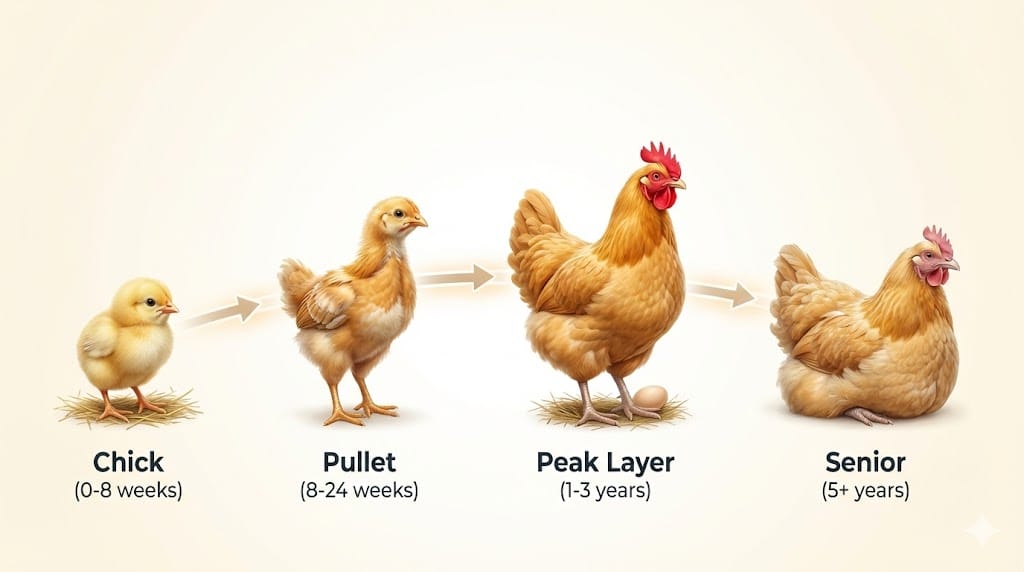
Each life stage brings different care requirements and expectations.
Year 1: Peak Production
Pullets begin laying at 18 to 24 weeks. This first year brings maximum egg production, often 5 to 6 eggs weekly from good layers.
Birds are energetic, curious, and establishing flock hierarchy.
Hens need around 14 to 16 hours of daylight to maintain regular laying patterns.
Watch for signs your hen is about to lay her first egg.
Years 2 to 4: Sustained Productivity
Egg production remains strong but gradually decreases 10 to 15% annually. Eggs often grow larger.
Your hens will experience their first major molt, temporarily stopping production while regrowing feathers.
Years 5 to 7: Hen Productivity Decline
Laying becomes irregular. Most older hens hit “henopause” around age 4 to 5 and generally stop laying but keep kicking.
Activity levels decrease. Age-related conditions like arthritis may appear.
Years 8+: Retirement
Egg laying is rare. Consider any egg a bonus.
Your hens are now companions rather than producers. Focus shifts to comfort care: lower roosts, softer foods, protected sleeping areas.
Productive Lifespan vs. Total Lifespan
This distinction matters for planning your flock.
Productive lifespan is the amount of time a chicken will be at peak egg production, typically just 2 to 3 years for most breeds.
A chicken can have a long total lifespan but a short productive lifespan. A Plymouth Rock might live 12 years but only produce eggs consistently for the first 4 to 5 years.
| Breed Type | Total Lifespan | Productive Years |
|---|---|---|
| Production hybrids | 2-4 years | 1-2 years |
| Dual-purpose | 6-8 years | 3-4 years |
| Heritage breeds | 8-10+ years | 4-5 years |
| Landrace breeds | 10+ years | 5-6 years |
Roosters vs. Hens: Who Lives Longer?
Generally, roosters and hens share similar genetic lifespan potential.
A rooster’s natural lifespan is typically the same as hens of his breed, about 5 to 8 years on average. Some keepers report roosters living 10 to 12 years when well-protected.
Why Hens Face More Challenges
Producing eggs demands enormous calcium, protein, and metabolic resources.
This sustained output strains reproductive organs, making hens susceptible to egg binding, internal laying, and reproductive tumors.
The Rooster’s Advantage
Without egg production demands, roosters experience less systemic stress.
Sometimes a rooster’s lifespan exceeds that of his hens simply because he doesn’t have the strain of reproduction.
The Flip Side
Roosters tend to get into trouble. Fighting and being too cocky around predators often results in early death.
If you’re wondering whether you need a rooster at all, explore whether roosters are necessary for egg production.
Caring for Senior Chickens
As your flock ages, their needs evolve.
Pearl’s owner created a cozy spot in their laundry room where the elderly hen could rest comfortably. She still goes outside daily to wander and fluff her feathers in the sun, but the Texas heat is too much for the senior chicken.
Signs of Aging
- Egg production drops below once weekly or stops
- Movement slows noticeably
- Comb and wattle color fades to pale pink
- Feathers become dull or brittle
- Increased sleeping, decreased activity
Most keepers consider chickens “senior” at around 5 years of age. They’re sometimes called “biddies” or “spent hens.”
Senior Care Adjustments
- Lower roosting bars (12 to 18 inches) for easier access
- Softer bedding to cushion arthritic joints
- Warm, dry sleeping areas with climate control
- Easy food and water access
- Softer foods like moistened feed
- Indoor rest areas for extreme weather
Pearl cannot walk very well due to her advanced age, but she can scoot and tries to stretch her arthritic legs and claws daily.
What Happens When Laying Stops?
This decision faces every chicken keeper eventually.
Keep them as pets. Most backyard keepers choose this path. Senior hens maintain flock social structure and provide companionship.
Rehome to sanctuaries. Some facilities specifically accept retired laying hens.
Process for stew. Older birds produce tougher meat best suited for slow-cooking methods.
The right answer depends on your relationship with your flock.
About Rescue Chickens
Ex-battery hens have had seriously tough lives. Their bodies will have been through a lot by the time you adopt them.
Rescue chickens typically live 2 to 12 months post-adoption, though some recover to enjoy several more years with proper care and patience.
Stress and Lifestyle Factors
Stress plays a huge role in poultry longevity. When chickens are stressed, their bodies have a harder time meeting daily demands.
Key Stress Factors
- Temperature: 60 to 75°F is ideal
- Space: Overcrowding is extremely stressful
- Exercise: Limited time outside the coop causes problems
- Ventilation: Poor air quality creates chronic stress
- Handling: Harsh handling causes fear responses
When stressed, egg production drops because less-important body functions stop.
Seasonal Care for Maximum Lifespan
Weather extremes challenge chicken health more than most beginners expect.
Summer Heat Management
- Provide multiple shade sources
- Refresh water several times daily with ice
- Offer frozen treats like watermelon
- Ensure maximum coop ventilation
- Watch for panting and lethargy
Deaths are more common during periods of heat stress. Learn specific strategies for feeding chickens during heatwaves.
Winter Cold Protection
- Winterize your coop while maintaining ventilation
- Apply petroleum jelly to combs and wattles to prevent frostbite
- Provide high-protein treats for extra warmth
- Use deep litter method for natural heat
- Ensure water doesn’t freeze using winter water solutions
A sudden drop into freezing temperatures can cause frostbite or even death without proper preparation.
Environmental Enrichment
Bored, stressed chickens have weakened immune systems and shorter lives.
Foraging Opportunities
Natural scratching instincts need an outlet. Scatter treats in bedding or create foraging boxes.
Discover ways to encourage natural foraging behavior.
Dust Bath Access
Critical for parasite control and mental wellbeing. Chickens denied dust bathing show stress behaviors.
Learn how to set up an effective dust bath area.
Novel Elements
Logs, stumps, or chicken swings provide mental stimulation. Rotate items periodically to maintain interest.
Pearl enjoys cuddling up with the mop in her laundry room and loves to sleep with her owner’s flip-flop. Even simple enrichment items matter to chickens.
Modern Factors Improving Chicken Longevity
Several developments have contributed to improved lifespans compared to historical averages.
Veterinary Advances
Good veterinary care can mean the difference between a chicken living one year and one living a decade.
Chickens are living longer because there’s more focus on disease prevention and treatment.
Nutritional Improvements
Chickens used to eat table scraps and whatever the farmer threw their way.
Modern feeds are specifically formulated for unique life stages, with premium options including prebiotics, probiotics, essential oils, and digestive enzymes.
Do Chickens Bond With Their Owners?
Yes, and this matters for lifespan.
Chickens recognize individual human faces and remember past interactions. They demonstrate complex cognitive abilities including facial recognition.
Why Bonding Matters
Birds comfortable with their keepers experience less handling stress, accept health checks more easily, and show illness symptoms more readily.
Building bonds takes consistent, gentle interaction: hand-feeding treats, speaking softly, spending quiet time near your flock.
Pearl gets along well with the other animals in her home, including an aging cat and a kitten. She likes to watch TV when she hears it on and comes out into the living room for company.
My most bonded hens actively seek my company, following me around the yard. This relationship makes health monitoring effortless.
Frequently Asked Questions on How Long Do Chickens Live?
What is the average backyard chicken lifespan?
A well-cared-for backyard chicken typically lives 5 to 10 years, with some heritage breeds like Plymouth Rocks extending lifespans to 10 to 12 years under optimal conditions.
How old do chickens get in ideal conditions?
A happy, healthy chicken has the potential to reach 15 to 20+ years with exceptional care. The verified Guinness World Record for longest-lived chicken is Peanut at 21 years and 238 days. The current oldest living chicken is Pearl at 14+ years.
Do hens lay eggs their whole life?
No. Peak production occurs during the first 1 to 2 years, declining 10 to 15% annually afterward.
Most chicken breeds have a productive lifespan of around 2 to 3 years.
Explore why chickens stop laying eggs for detailed causes.
Which chicken breeds live the longest?
Plymouth Rocks commonly reach 10 to 12 years. Cochins and Orpingtons typically reach 8 to 10 years.
Landrace breeds like Swedish Flower Hens can exceed a dozen years due to their robust genetics and natural disease resistance.
What is the hen life expectancy compared to roosters?
Roosters have the same natural lifespan as hens of their breed. Some keepers report roosters living 10 to 12 years. Sometimes roosters live longer because they don’t have the strain of egg production.
What is the pet chicken lifespan for bantams?
Bantam chickens commonly live for ten years or more when kept as pets with excellent care. Peanut, the previous record-holder at 21+ years, was a bantam cross.
What do backyard chickens usually die from?
Leading causes include predation, respiratory infections, and reproductive disorders (especially in production breeds).
Parasites like lice, mites, and worms can also significantly shorten lives.
Conducting regular chicken health checks catches problems early.
What is the oldest chicken ever recorded?
The verified Guinness World Record is held by Peanut, a Belgian d’Uccle/Nankin cross who lived to 21 years and 238 days before passing in December 2023. The current oldest living chicken is Pearl, an Easter Egger verified at 14 years and 69 days in May 2025.
The Bottom Line
By choosing hardy breeds and providing safety, nutrition, and attentive care, your chickens can thrive for 8 to 10 years or more.
Choosing heritage breeds like Plymouth Rocks (which commonly reach 10 to 12 years) or Orpingtons (8 to 10 years) and focusing on four key factors: safety, nutrition, cleanliness, and observation, creates conditions for your flock to reach their genetic potential.
Every chicken is an individual. Some surprise you with remarkable resilience. Pearl overcame a broken leg, a raccoon attack, arthritis, and avian pox to become the world’s oldest living chicken. Others face health challenges despite excellent care.
What remains consistent: the commitment you make to their wellbeing directly translates into years of companionship, eggs, and the unique joy backyard chickens bring to daily life.
Ready to start your chicken-keeping journey? Calculate your first-year costs and determine how many chickens your family needs.

Oladepo Babatunde is the founder of ChickenStarter.com. He is a backyard chicken keeper and educator who specializes in helping beginners raise healthy flocks, particularly in warm climates. His expertise comes from years of hands-on experience building coops, treating common chicken ailments, and solving flock management issues. His own happy hens are a testament to his methods, laying 25-30 eggs weekly.