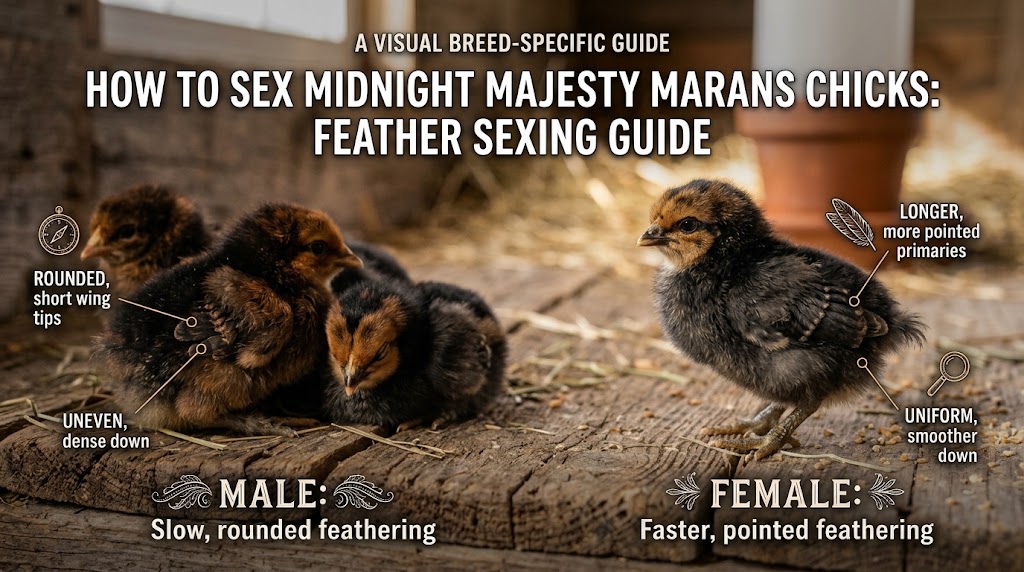
If you picked up Midnight Majesty Marans chicks and you’re not sure whether you have hens or roosters, you’re in luck. This is one of the few hatchery hybrids where you can make a confident guess on the very day they hatch, before a single feather grows in.
The short answer: solid black down at hatch means hen; barred down with a pale head spot means rooster. That single clue does most of the heavy lifting. Everything covered in this article expands on it, adds backup confirmation signs, and explains what to do when something doesn’t look quite right.
This article is for backyard chicken keepers who bought Midnight Majesty Marans from Hoover’s Hatchery, Tractor Supply, or a similar feed store and want to know what they have.
What Is a Midnight Majesty Marans?
Before getting into sexing, it helps to know what this bird actually is, because the name creates confusion.
Midnight Majesty Marans is a trademarked hybrid produced by Hoover’s Hatchery. It is not a purebred Marans and is not recognized by the American Poultry Association. It’s a purpose-built cross designed to produce dark brown eggs reliably, at a higher rate than most pure Marans.
The parentage most consistently reported across poultry communities is a Black Copper Marans rooster crossed with a Barred Rock hen. Hoover’s has not publicly confirmed the exact parent combination, so treat this as the widely accepted explanation rather than a guaranteed fact. What Hoover’s does confirm directly on their product page is that the males are barred, which aligns with this type of cross.
The same hybrid is sold under several other names, including Mystic Marans, Noir Marans, Rustic Rambler, Black Maran Sexlink, and Dominant Copper. If you’ve seen those names and wondered whether they’re the same bird, they’re close enough that the sexing information here applies to all of them.
Key facts worth knowing:
- Dual-purpose hybrid: bred for both egg production and meat
- Sex-linked cross: males and females can be told apart at hatch by down color
- Plumage: hens are solid black; roosters are barred
- Feathered feet: most hatch with feathered feet, some do not
- Single comb
- Mature weight: approximately 6–7 lbs for hens, 7–8 lbs for roosters
- Egg production: approximately 250 large dark brown eggs per year (hatchery figure; real-world results vary)
- Temperament: calm and friendly; described as beginner-friendly
For a deeper look at the Marans breed family, including the purebred parent lines, see the Marans chicken breed guide on ChickenStarter.
Why Sex-Linking Makes This Easier Than Most Breeds
Most chick sexing requires either vent sexing by a trained hatchery technician or waiting weeks for secondary characteristics to develop. Sex-linked crosses skip that wait by tying sex to a visible color difference that appears in the down from day one.
Here’s how it works for this cross. The barring gene in chickens is sex-linked, meaning it sits on the sex chromosome. When a non-barred rooster (like a Black Copper Marans) is bred to a barred hen (like a Barred Rock), the male offspring inherit one copy of the barring gene from their mother. Female offspring inherit none. One copy of the barring gene is enough to produce visible barring in the feathers, and it also causes the distinctive pale head spot seen in male chicks at hatch.
The result: barred chicks are male, solid black chicks are female. You don’t need to guess.
One important limit to understand: this sex-link only works reliably in the first (F1) generation. If you hatch eggs from two Midnight Majesty Marans, or breed a MM Marans rooster back to a MM Marans hen, the offspring will not be reliably sex-linked. The genetic predictability disappears in subsequent generations.
Day-One Sexing: The Most Reliable Clue
On the day your chicks hatch, look at the down color before anything else.
| Feature | Hen (Female) | Rooster (Male) |
|---|---|---|
| Down color | Solid black all over | Barred — lighter with dark streaks |
| Head spot | Small or absent | Large, pale white spot |
| Overall appearance | Dark and uniform | Noticeably lighter than females |
A female Midnight Majesty Marans chick is uniformly dark. No white spot on the head, no pale streaks through the down. A male has visible barring throughout his down and a clearly visible pale spot on top of his head. The spot is the barring gene expressing itself on the skull before full feathers grow in.
When you have a brooder with both sexes present, the difference is obvious. Males look washed out compared to the solid black females. If you’re looking at just one chick and aren’t sure, compare it against photos of verified day-old MM Marans chicks in backyard poultry communities.
One practical caveat: some head spots are clearer than others. The spot is most visible once the chick is fully dry after hatch. A wet or damp chick can look more uniformly colored until the down fluffs out. Give newly hatched chicks a few hours before making a final call.
What If My “Pullet” Looks Barred?
This comes up regularly in backyard chicken forums, and there are three likely explanations.
1. Hatchery sexing error. Even with sex-linked breeds, hatcheries report approximately 90% accuracy on sexed orders. Errors happen. If you ordered all pullets and ended up with one barred chick, it’s possible a cockerel slipped through.
2. Feed store mix-up. If you bought from Tractor Supply or another feed store, Barred Rock pullets are commonly sold alongside Midnight Majesty Marans chicks. A Barred Rock pullet is also black and white barred. She is not a MM Marans cockerel, but she can easily end up in the wrong bin and go home with you by mistake. A Barred Rock pullet will have yellow legs and a brighter yellow beak at hatch, while a MM Marans cockerel typically has darker legs. Leg color is not definitive, but it’s a useful flag when something doesn’t add up.
3. You have a different breed altogether. Cuckoo Marans and Black Sex Links look similar as chicks and are sometimes sold in the same areas. If the down coloring seems off or the feet are clean when you expected feathered feet, consider whether the chick might be something else entirely.
If in doubt, post clear photos to a poultry identification forum. The Backyard Chickens community handles these questions regularly, and the barring pattern on MM Marans chicks is distinctive enough that experienced keepers can usually make a confident call from photos.
Weeks 1 Through 3: Watch the Feathers Come In
During the first few weeks, the barring difference becomes even more obvious as true feathers replace the down. Wing feathers appear first, usually starting within a few days of hatch.
On a male Midnight Majesty Marans, the barring pattern carries directly into the incoming feathers. You’ll see alternating white and dark bars on the wing feathers as they emerge. These bars are broader on males than females because males carry two copies of the barring gene (one from each parent, since their Barred Rock mother carried two copies). Having two copies produces a lighter, more broadly barred bird overall.
On a female, wing feathers come in solid dark. No barring, no white streaks. Some female chicks may have a little white at the wing tips during the early days of feather development, which is normal and not the same as barring. True barring runs in alternating stripes throughout the feather shaft.
Also note: pullets typically feather in faster than cockerels. If you have a chick that’s staying fluffy and bare-backed while others are feathering out, that slower-developing chick is often a male.
Weeks 4 Through 6: Comb and Wattle Development
By four to six weeks, a second layer of evidence appears: comb size and color.
At this age, female Marans-type chicks have small combs that are pale yellowish-orange. Male chicks have combs that are noticeably larger and brighter, trending toward yellow at first, then pink, and eventually red as weeks pass.
On a Midnight Majesty Marans cockerel, the comb difference is usually clear enough by week five or six to leave little doubt. If you’re looking at two chicks side by side and one has a comb that’s obviously larger and more developed than the other, the larger-combed chick is almost certainly a male.
A few things to keep in mind:
- Some pullets develop their combs earlier than usual. A slightly larger comb on a pullet at four weeks doesn’t automatically mean rooster. Watch the rate of growth over several days. Cockerel combs grow rapidly and turn red faster. Pullet combs grow slowly and stay pale much longer.
- Wattles (the fleshy lobes under the beak) develop alongside the comb. Cockerels develop visible wattles earlier and they grow larger and redder faster than on pullets.
- Body size is another clue at this stage. Cockerels are generally larger and stand taller, with thicker legs. Pullets are more compact and hold a more horizontal posture.
Weeks 6 Through 8: Hackle Feathers and Body Shape
By six to eight weeks, the cockerel’s barring is well established throughout his plumage, and new clues are starting to appear in feather shape.
Hackle feathers are the feathers along the back of the neck. On a cockerel, hackle feathers are pointed at the tips. On a pullet, they are rounder and more oval-shaped. You may need to gently part the neck feathers and look closely to see the tip shape clearly. This distinction gets more obvious with age, but a careful look at weeks seven or eight will usually show it.
Saddle feathers are the feathers that grow just in front of the tail. These begin to develop a little later, often around nine to twelve weeks in most breeds, but early signs may appear toward the end of the eight-week window. Pointed saddle feathers = male. Round saddle feathers = female.
Tail shape is also starting to differentiate. A young cockerel’s tail will sit higher and more upright. A pullet’s tail is more modest and held at a lower angle.
Behavioral differences may be noticeable but are not reliable on their own. Some cockerels begin chest-bumping, standing tall over other chicks, or making early crowing attempts in this window. But some cockerels are calm at this age, and some pullets are assertive. Use behavior as supporting evidence, not the primary indicator.
Quick Reference: Signs by Age
| Age | Look For in Cockerel | Look For in Pullet |
|---|---|---|
| Day 1 | Barred down, large pale head spot | Solid black down, no head spot |
| Weeks 1–3 | Barred wing feathers coming in; slower to feather overall | Solid dark wing feathers; feathers in faster |
| Weeks 4–6 | Larger, brighter, faster-growing comb; wattles appearing | Small, pale comb; little to no wattle |
| Weeks 6–8 | Pointed hackle feathers; upright tail; larger body; possible early crow attempts | Rounded hackle feathers; modest tail; smaller, leaner build |
Midnight Majesty Marans vs. Mystic Marans: Are They the Same?
This question comes up often, and the honest answer is: they are very similar but not identical.
Both are black sex-linked Marans hybrids. Both produce dark brown eggs. Both use a similar parent cross (Marans male over barred female). The sexing rules in this article apply equally to both.
The key differences:
- Midnight Majesty Marans is Hoover’s Hatchery’s trademarked version, sold widely through Tractor Supply in the United States.
- Mystic Marans originated in the Czech Republic and is described by Townline Hatchery as a cross between Black Copper Marans and Barred Rocks imported from Europe. Mystic Marans are sometimes reported to lay slightly darker eggs and in higher volume (up to 270 per year by some accounts), though real-world results vary.
Both birds are sometimes listed interchangeably, which adds to the confusion. If your chicks came from Hoover’s or Tractor Supply, they’re almost certainly Midnight Majesty Marans. If they came from a different hatchery, check the listing to confirm which version you have.
What Color Eggs Do Midnight Majesty Marans Hens Lay?
Midnight Majesty Marans hens lay large, dark brown eggs. Hoover’s Hatchery markets them as dark egg layers, and the eggs are genuinely darker than most brown-egg breeds.
A few things to set realistic expectations:
The eggs are dark brown, not chocolate-black. Social media photos are frequently edited or taken in lighting conditions that make the eggs look darker than they are. Real-world eggs are a rich, deep brown, sometimes with darker speckles. They are noticeably darker than a standard brown egg but seldom as dramatically dark as viral photos suggest.
Egg color fades over a laying cycle. Hens typically lay darker eggs at the start of a laying period. The color lightens as they lay at a higher rate or as the season progresses. This is normal and not a sign of anything wrong.
Laying typically begins between 5 and 9 months of age. Hoover’s and Tractor Supply commonly list approximately 6 months as the target. Some community members report first eggs as early as 18 weeks; others report waiting closer to 8 or 9 months. The wide range is real. Late-hatched chicks, winter light conditions, and individual variation all affect when a hen lays her first egg.
Expect approximately 4 to 5 eggs per week at peak production, working out to around 200 to 250 eggs per year. For comparison with other high-production breeds, see ChickenStarter’s egg production rankings.
Are Midnight Majesty Marans Roosters Good?
Marans roosters are generally described as calm and docile. They are alert and will fulfill the typical rooster roles of watching over the flock and sounding an alarm, but they are not known for being aggressive toward people when raised with regular handling.
That said, individual birds vary. Some Midnight Majesty Marans cockerels go through an assertive adolescent phase between roughly 12 and 20 weeks, when hormones kick in and flock hierarchy is being established. This usually settles as the bird matures.
If you’re keeping a rooster, start with some basic rules before he finds them himself:
- Don’t chase or corner him repeatedly.
- Don’t let young children interact with him unsupervised, especially during the adolescent phase.
- If he shows persistent aggression toward people, that behavior is unlikely to improve on its own.
Check your local ordinances before keeping a rooster. Many municipalities and HOAs prohibit roosters or restrict flock sizes. ChickenStarter’s rooster laws by state guide is a useful starting point for understanding the rules in your area.
For more on why roosters crow, including why it happens well before sunrise, see Why Do Roosters Crow in the Morning.
What If I Bred Two Midnight Majesty Marans?
This is worth covering because it catches people off guard.
If you hatch eggs from a Midnight Majesty Marans rooster and a Midnight Majesty Marans hen, the offspring will not be reliably sex-linked. The sex-link only works in the first generation cross. Once you mix the genetics beyond F1, the barring gene is distributed in ways that no longer create a clean barred/solid split between the sexes. Some chicks may be barred, some may not, regardless of sex.
If you want to continue producing sex-linked offspring with this color pattern, you need to maintain the original cross: a non-barred Marans rooster over a barred hen. The MM Marans chicks themselves won’t do it.
Frequently Asked Questions
How do I tell if a Marans is a rooster?
For Midnight Majesty Marans specifically, the fastest answer is down color at hatch. A barred chick with a pale head spot is a rooster. A solid black chick is a hen. In older birds, look for a large red comb, wattles, pointed hackle feathers, a showy upright tail, and noticeably larger body size compared to hens in the same flock.
What breeds make a Midnight Majesty Marans?
The cross most consistently reported is a Black Copper Marans rooster bred to a Barred Rock hen. Hoover’s Hatchery has not officially confirmed the exact parent breeds, so this is the widely accepted explanation rather than a confirmed hatchery disclosure. Some sources suggest a Cuckoo Marans hen may be used instead of a Barred Rock, or in addition to one. Either way, the sex-link mechanism works on the same principle: a non-barred male over a barred female.
What are the first signs your chicken is a rooster?
For Midnight Majesty Marans, the first sign is visible at hatch: barred down and a pale head spot. After that, faster comb growth, slower feathering, broader barring in the wing feathers, and eventually pointed hackle feathers and saddle feathers all confirm a cockerel.
What color eggs do Midnight Majesty Marans hens lay?
Dark brown eggs, sometimes with darker speckles. Eggs are genuinely darker than standard brown-egg breeds, but not as dramatically dark as edited social media photos often make them appear. Color is richest at the start of a laying period and lightens somewhat over time.
Are Midnight Majesty Marans good roosters?
Generally yes, especially compared to some more aggressive breeds. They are described as calm and alert. Individual birds vary, and adolescent cockerels can be assertive during the 12–20 week phase. Check your local rooster ordinances before deciding to keep one.
Is the Midnight Majesty Marans the same as a Black Sexlink?
They are similar in concept (both are sex-linked crosses that produce barred males and black females) but different in parentage and egg color. A standard Black Sex Link typically has a Rhode Island Red or New Hampshire Red father over a Barred Rock mother, and lays medium-brown eggs. A Midnight Majesty Marans uses Marans in the cross and lays significantly darker eggs. For another interesting sex-linked hybrid, see ChickenStarter’s guide to the Starlight Green Egger.

Oladepo Babatunde is the founder of ChickenStarter.com. He is a backyard chicken keeper and educator who specializes in helping beginners raise healthy flocks, particularly in warm climates. His expertise comes from years of hands-on experience building coops, treating common chicken ailments, and solving flock management issues. His own happy hens are a testament to his methods, laying 25-30 eggs weekly.