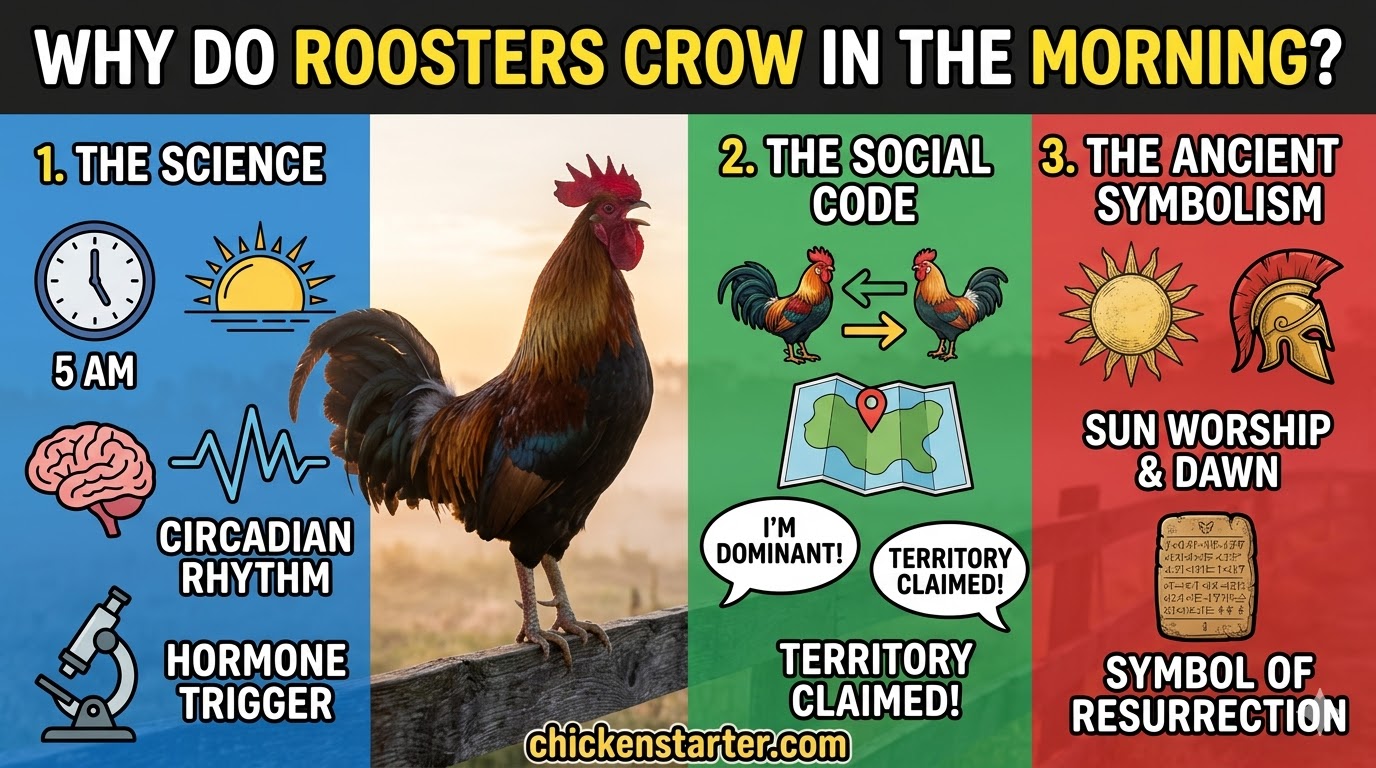
Roosters crow in the morning because their internal circadian clock tells them to, not because they see the sunrise. A landmark study published in Current Biology by researchers Tsuyoshi Shimmura and Takashi Yoshimura at Nagoya University proved that roosters kept in total darkness continued crowing on an approximately 23.7-hour cycle at what they “believed” to be dawn.
But there is a twist that makes this even more fascinating. In groups, the highest-ranking rooster always crows first each morning. Subordinate roosters, even when their own internal clocks say it is time, patiently wait for the boss to go first. Break this rule, and expect aggressive pecking and chasing.
Here is what most articles will not tell you: a rooster’s crow is louder than a chainsaw at close range, roosters have built-in “ear plugs” that physically shut their ear canals to avoid deafening themselves, and this simple morning call carries profound spiritual meaning across Christianity, Islam, Chinese tradition, and dozens of other cultures worldwide.
Whether you keep a single rooster in a suburban backyard in Ohio, manage a flock on a Canadian homestead, or raise chickens in rural Australia, understanding why roosters crow in the morning changes the way you hear that predawn call forever.
Why Do Roosters Really Crow in the Morning? The Peer-Reviewed Answer
For centuries, people assumed roosters crow because they see the sunrise. It seems obvious, right? The sun comes up, the rooster announces it. Simple.
Except it is wrong.
The real answer comes from two groundbreaking Japanese studies that changed everything we knew about rooster crowing behavior.
The 2013 Nagoya University Study That Proved the Internal Clock
In March 2013, researchers Tsuyoshi Shimmura and Takashi Yoshimura at Nagoya University published a study in Current Biology that settled the debate once and for all. According to the study, their observations proved that the rooster breaks the dawn every morning as a function of his circadian clock.
Here is what they did. They placed groups of four roosters in controlled environments, first on a schedule of twelve hours of light and twelve hours of dim light, then shifted them into constant dim light for fourteen days.
Under the controlled light schedule, the roosters consistently started crowing approximately two hours before the lights came on each day. They were not reacting to light. They were anticipating it.
When shifted to constant dim light with no sunrise cue at all, the roosters kept right on crowing each morning at what they believed to be dawn. Under these conditions, the researchers observed a free-running rhythm with a period of 23.7 hours. The roosters essentially ran on their own internal timer, slightly shorter than a 24-hour day.
This consistency continued for about two weeks before gradually beginning to fade. Their crowing became less regular during the second half of the experiment, suggesting that while the internal clock drives the behavior, roosters do need to see sunlight periodically to keep that clock properly calibrated.
The study also confirmed something equally important about external triggers. When the researchers exposed roosters to sudden flashes of light or played recordings of other roosters crowing near the anticipated dawn time, crowing rates increased significantly. But at other times of day, those same stimuli had virtually no effect. The circadian clock controls the rooster’s responsiveness to triggers, not just the crowing itself.
And here is the key detail for every backyard chicken keeper: since crowing is an androgen-dependent behavior, it is directly linked to testosterone levels. This is why only mature roosters crow, why young cockerels develop the behavior at puberty, and why crowing intensity increases during breeding season.
What this means for you: This is why your rooster starts crowing at 4 AM when sunrise is not until 6. He is not reacting to light. His body knows dawn is coming roughly two hours before it arrives. And it is why blacking out your coop windows reduces but does not eliminate morning crowing.
I can confirm this with my own roosters. In deep winter, when sunrise does not happen until after 7:30 AM, crowing starts at 5:15 to 5:30 like clockwork. In summer when the sun rises at 5:45, crowing begins around 4 AM. The clock shifts with the seasons, but it is always approximately two hours before dawn.
If you want to learn more about the full range of sounds chickens make, our guide on chicken noises and what they mean breaks down every vocalization in your flock’s repertoire.
Crowing Is Hardwired, Not Learned
Here is another finding from the Nagoya research that most articles skip entirely. Rooster crowing is an innate vocalization. It is genetically hardwired, not learned from other roosters.
This is fundamentally different from how most bird songs work. A songbird raised in isolation will never learn to sing properly because birdsong is learned behavior, passed from parent to offspring through imitation. But a rooster raised completely alone, with no other chickens around, will still crow perfectly when he reaches maturity.
You cannot train a rooster not to crow any more than you can train a dog not to bark in its sleep. The behavior is built into the DNA.
The Dominant Rooster Always Crows First: The Fascinating Social Code of Morning Crowing
If the circadian clock study was groundbreaking, the follow-up study in 2015 was extraordinary.
The same Japanese research team, now working through the National Institute for Basic Biology, published their findings in Scientific Reports (a Nature journal). What they discovered about the social dynamics of crowing is the most underreported finding in poultry behavioral science.
How They Proved the Pecking Order of Crowing
The researchers observed groups of four roosters and established their social hierarchy through standard behavioral observation. They tracked aggressive pecking, displacing, chasing, and threatening behaviors, then ranked each rooster from first to fourth.
Then they watched and recorded every single crow.
The results were remarkably consistent. According to the study, the top-ranking rooster always started to crow first, followed by its subordinates, in descending order of social rank. First-ranked, then second-ranked, then third, then fourth. Every morning. Without exception.
The starting time for the dominant rooster varied from day to day. Some mornings he started a bit earlier, some a bit later. But the subordinate roosters always waited. Their crowing always started right after the highest-ranking rooster’s first call.
The presence of a dominant rooster significantly reduced the number of predawn crows in subordinates. The lower-ranked birds actively suppressed their own urge to crow until the boss went first.
But here is the really clever part. When the researchers stimulated the roosters to crow using lights or sounds, the subordinate roosters crowed just as much as the dominant ones. This confirmed that subordinates absolutely have the ability to crow. They are not physically prevented from it. They choose to wait.
As the researchers stated, subordinate roosters are “patient enough to wait for the top-ranking rooster’s first crow every morning and thus compromise their circadian clock for social reasons.”
What Happens When the Boss Disappears
When the top-ranking rooster was physically removed from the group, the second-ranking rooster immediately took over first-crow duties. The chain of command simply shifted upward. The new boss stepped into the role without missing a beat.
Think of it like a military chain of command. The general speaks first at the morning briefing. Nobody interrupts. If the general is transferred, the colonel steps up. Your roosters are doing exactly this, every single morning.
When I had two roosters, my dominant Brahma would crow first every day without fail. My subordinate Easter Egger would wait 10 to 15 seconds, then follow. When I rehomed the Brahma, the Easter Egger took over the first-crow duties within 24 hours. The transition was seamless.
For more on how social dynamics play out in your flock, see our guide on pecking order problems and how to stop bully hens.
Why Do Roosters Crow at 3am? And 2am, and the Middle of the Night
“Why do roosters crow at 3am” is one of the most searched chicken questions on the internet, and most answers are vague and speculative. Here are six specific, science-backed reasons for nighttime crowing, ranked from most common to least common.
1. Anticipatory Pre-Dawn Crowing (This Is Normal)
This is the most common reason by far, and it is not a problem. It is biology working exactly as designed.
The sky begins to lighten long before the sun actually rises. It is completely normal for your rooster to start crowing as early as two hours before the sun comes up. If sunrise is at 6 AM, your rooster may start at 4 AM. In summer when dawn breaks early, this can easily mean crowing at 3 AM or even earlier.
Actionable check: Look up your local sunrise time and count back two hours. If your rooster’s crowing falls in that window, congratulations. His circadian clock is working perfectly. This is completely normal.
2. Artificial Light Disturbance
Your rooster’s internal clock responds to light cues to stay calibrated. When artificial light sources mimic dawn, his clock gets confused.
Street lights, porch lights, security floodlights, car headlights swinging through the property, and even an exceptionally bright full moon can all trigger crowing. If there is a constant light source shining near your coop at night, your rooster may crow repeatedly throughout the darkness.
Actionable fix: Walk around your coop area after dark and check for light leaks. A neighbor’s security light, a street lamp, even the glow from a barn window can be the culprit. Blackout curtains or repositioning the coop can solve the problem.
3. Predator Detection
Roosters are wired to respond to perceived threats, even at night. Predators moving near the coop in the dark, including raccoons, foxes, stray cats, coyotes, or even rats, can trigger crowing as a territorial broadcast to whatever is out there.
One keeper I know described hearing his rooster start bellowing at 10 PM. He ran out and found a large coyote stalking the hen house. Once the coyote was dealt with, the night crowing stopped immediately.
If your rooster suddenly starts crowing in the middle of the night after being quiet for months, check for predators first. It could be his way of telling you something is wrong. Our guide on predator-proofing your coop and best predator deterrents for chickens covers comprehensive solutions.
4. Contagious Crowing from Neighboring Roosters
If there are other roosters within earshot, even ones you do not own, your rooster may be answering their calls throughout the night. The sound of another rooster crowing is one of the most reliable triggers for additional crowing. It spreads like a ripple effect.
According to the 2013 Nagoya study, sound stimuli from other roosters induced crowing most strongly near the anticipated dawn period, but the contagious effect can happen at any hour.
Actionable reality: You cannot control the neighbor’s rooster. But understanding that this is a normal social response, not a behavioral problem with your bird, helps manage your expectations.
5. Testosterone Surges
Hormonal influences significantly impact the timing and intensity of rooster crows. Testosterone levels peak in the early pre-dawn hours, which aligns perfectly with the circadian crowing window. During breeding season, when testosterone runs highest, crowing sessions are longer, louder, and may start even earlier than usual.
This is also why crowing tends to decrease during fall and winter when daylight hours shorten and testosterone levels naturally decline.
6. Sleep Crowing (Yes, It Is a Real Thing)
Multiple experienced keepers report roosters that appear to crow briefly in the middle of the night for no apparent reason. When checked, the birds are still groggy or barely awake on the roost. They seem to crow once or twice and immediately go back to sleep, much like a dog that barks briefly in its dreams.
There is no published research specifically on sleep crowing in roosters. But the anecdotal reports are so consistent across keeper communities that it deserves mention. It appears to be harmless and infrequent.
A Rooster’s Crow Is Louder Than a Chainsaw, So Why Don’t They Go Deaf?
This is one of the most incredible facts in all of animal biology, and almost no chicken article covers it properly.
The Astonishing Decibel Reality
In 2017, researchers Raf Claes and colleagues from the University of Antwerp and the University of Ghent in Belgium published a study in the journal Zoology that measured exactly how loud a rooster’s crow is at the bird’s own ear.
They strapped tiny microphones directly to the roosters’ heads, positioned right at the entrance of the ear canal, and recorded the sound levels during crowing.
What they found was staggering. According to the study, audio recordings at the level of the rooster’s outer ear canal showed that sound pressure levels can reach amplitudes of 142.3 dB.
To put that number in perspective:
A normal conversation is about 60 to 70 decibels. An alarm clock is 80 dB. A chainsaw operates at 100 to 110 dB. A police siren hits 120 dB. A rooster crow at its own ear reaches 130 to 142 dB. A jet engine at takeoff from 25 meters is about 140 dB.
At a distance of just half a meter, the sound already drops to about 102 dB, which is roughly chainsaw level. But at the rooster’s own head, the crow exceeds the threshold of immediate hearing damage.
According to safety guidelines from the National Institute for Occupational Safety and Health (NIOSH), humans should limit noise exposure to 85 dB over an 8-hour period. At 100 dB, safe exposure drops to less than 15 minutes. Above 130 dB, hearing damage can occur in less than one second.
So how does a rooster crow every single day, multiple times a day, at sound levels that would permanently damage human ears, without going deaf?
Built-In Ear Plugs: One of Evolution’s Greatest Engineering Feats
The Belgian researchers performed micro-CT scans of rooster and hen skulls to examine the ear anatomy, and what they found is remarkable.
When a rooster opens its beak fully, as it does every time it crows, the auditory canal physically closes. The ear shuts itself off. Additionally, soft tissue covers approximately 50% of the eardrum. The rooster has built-in noise-cancelling ear protection that activates automatically every time it opens its beak to crow.
According to the American Academy of Audiology, this mechanism is not triggered by the sound itself but by the mechanical act of opening the jaw. The middle-ear system stiffens whenever the jaw opens, providing protection specifically during crowing but not in response to other loud external sounds.
Here is the even more fascinating part. This protection mechanism exists only in roosters. In hens, opening the beak only narrows the auditory canal. It does not close completely. This makes perfect sense. Hens do not need protection from their own vocalizations because hen calls only reach about 61 to 76 dB, roughly the volume of a normal conversation.
And as a final backup, birds have one more advantage over mammals. Unlike humans, birds can regenerate damaged hair cells in the inner ear. Even if some hearing damage occurs, the rooster’s ear can repair itself over time. Mammalian ears cannot do this.
Why Hens and Chicks Are Not Deafened
The sound drops dramatically with distance. At just half a meter from a crowing rooster, sound levels fall to about 102 dB. And roosters instinctively seek elevated vantage points when they crow, positioning themselves away from the hens and chicks. This ensures their call reaches maximum range while minimizing the impact on their flock.
Your rooster is not just loud. He is loud and considerate about it.
Why Do Roosters Crow All Day and Not Just at Dawn?
Anyone who owns a rooster for more than 24 hours will quickly discover that roosters do not limit their crowing to the morning. They crow all day long, and each session has a different trigger.
Territorial announcement is the primary all-day trigger. According to the original Nagoya research, crowing has been classified as a warning signal advertising territorial claims that challenges or threatens intruding males.
Responding to other roosters drives a huge amount of daytime crowing. If you have neighboring roosters within earshot, your rooster may be answering their calls throughout the day. This back-and-forth can create a chain reaction that continues for hours.
After mating, some roosters like to crow. Call it boasting if you want. It is a declaration of status and success.
Feeding time often triggers crowing. Many roosters will crow when they see you approaching with the feed bucket or treats. It is their way of claiming the resources in front of the flock.
Seasonal variation plays a significant role too. As daylight hours decrease in fall and winter, a rooster will crow less frequently. When daylight lengthens in spring and breeding season approaches, crowing intensifies noticeably.
Unfamiliar stimuli such as people walking past, cars, lawnmowers, other animals, or new objects in the yard can trigger crowing at any time. If a rooster perceives something as a potential threat or an intrusion into his territory, he responds vocally.
And sometimes, roosters crow simply because they feel like it. Not every crow has an identifiable trigger. Even the sweetest, most docile rooster will let out a hearty crow at random moments throughout the day. All roosters crow no matter what their personality is like.
For a full breakdown of rooster sounds versus hen sounds, check our guide on chicken noises and what they mean. If you are wondering whether keeping a rooster is worth it, see our article on do I need a rooster to get eggs.
How Accurate Is a Rooster as an Alarm Clock?
According to ScienceDaily’s coverage of the Nagoya research, the rooster’s crowing has informed human beings of the coming of morning since the Indus Valley Civilization (roughly 2600 to 1800 BC). That is over 4,000 years of rooster alarm clock service.
But how reliable is this alarm?
With regular natural light exposure, a rooster is remarkably accurate, consistently crowing 1.5 to 2.5 hours before sunrise. The timing shifts with the seasons as dawn times change, but the roughly two-hour predawn window stays consistent.
Without light cues, the internal clock runs on a slightly shorter-than-24-hour cycle (approximately 23.7 to 23.8 hours). This means the crowing time drifts slightly earlier each day until sunlight resets the clock.
Every rooster also has a slightly different internal clock. Even roosters housed together show different free-running periods for their body temperature rhythms, according to the 2015 study.
As an alarm clock, your rooster is more reliable than you might expect. But he will always go off before dawn, never at dawn. If you need to wake at sunrise, a rooster is about two hours too early. If you want a guaranteed wake-up call with no snooze button, he is perfect.
At What Age Does a Rooster Start to Crow?
According to My Pet Chicken, the age a rooster will first crow varies, but generally speaking, he will begin crowing at about four or five months of age, at about the time he begins to look like a mature rooster.
The first attempts are absolutely hilarious. They sound like a teenage boy whose voice is cracking. Raspy, broken, sometimes cutting off mid-crow. It takes weeks of practice before the call develops into the full, rich sound of a mature rooster.
Breed plays a significant role in timing. Based on keeper reports and breed resources:
Early crowers (5 to 12 weeks): Fayoumis can start as early as 5 weeks. Leghorns and some bantam breeds often start between 8 and 12 weeks. Barred Rocks may begin around 2 to 3 months.
Average (16 to 20 weeks): Rhode Island Reds, Plymouth Rocks, and Orpingtons typically fall in this range.
Late crowers (20 to 36 weeks): Brahmas and Cochins are notoriously slow to mature. Silkies often do not start crowing until 6 to 7 months. Some Jersey Giants and very large breeds may take even longer.
The presence of an established dominant rooster in the flock can also delay crowing in young cockerels. They instinctively suppress the behavior when an alpha is present, consistent with the pecking-order research from the 2015 study.
If you have a 6-month-old bird that has not crowed yet, do not assume it is a hen. Especially with larger breeds, patience is key.
Do Roosters Crow to Warn of Danger? It Is More Complicated Than You Think
This is a common misconception that needs clarification. While crowing can play a role in predator response, it is not the same as an alarm call.
Chickens have distinct alarm calls for different types of threats. Research in avian behavioral science has identified separate, specific calls for aerial predators (hawks, eagles) and ground predators (foxes, dogs, snakes). These alarm calls are short, sharp, urgent vocalizations that are completely different from the standard “cock-a-doodle-doo” crow.
The standard crow is primarily a territorial announcement and status broadcast. It tells the world, “This is my territory. I am here. These hens are mine.” It serves as a preventative signal, discouraging potential rivals and predators from approaching in the first place.
However, roosters will crow in response to disturbances at night, which is why nighttime crowing can indicate a predator is nearby. The distinction is between a reactive territorial response (crowing) and a specific warning to the flock (alarm calls).
Practical takeaway: If you hear frantic, short, sharp calls from your rooster, check for predators immediately. If you hear a standard crow, he is just doing his job. Knowing the difference could save your flock. Our guide on protecting your flock from predators covers comprehensive defense strategies.
Why Do Roosters Crow in the Morning? Spiritual Meaning Across Christianity, Islam, Chinese Tradition and More
The rooster’s predawn call has carried profound spiritual meaning for thousands of years across virtually every major culture and religion. The science explains the mechanism. But the symbolism tells us what the sound means to the human heart.
Christianity: Peter’s Denial and the Rooster’s Warning
The rooster holds an especially powerful place in Christian symbolism because of its connection to one of the most emotionally significant moments in the New Testament.
In the Gospel of Matthew (26:34), Jesus told the Apostle Peter: “Truly I tell you, this very night, before the rooster crows, you will disown me three times.” That night, Peter denied knowing Jesus three times. When the rooster crowed, Peter remembered Jesus’ words and wept bitterly.
This event made the rooster a symbol of repentance, spiritual vigilance, and divine forgiveness in Christian tradition. The image of Peter accompanied by a rooster became an indication of God’s capacity to forgive sinners who atone.
This is why rooster weathervanes (known as weathercocks) appear on church steeples across Europe, particularly in France, Germany, and throughout Scandinavia. They serve as a constant reminder to remain spiritually alert and to examine one’s conscience.
In broader Christian symbolism, the rooster also represents resurrection and the triumph of light over darkness, as its crow heralds the dawn after the long night.
Islam: The Rooster Sees Angels
In Islamic tradition, the rooster’s crow carries a beautifully specific meaning. According to a Hadith recorded in Sahih Bukhari (Hadith 3303) and Sahih Muslim (Hadith 2729), two of the most authenticated Hadith collections in Sunni Islam, the Prophet Muhammad (peace be upon him) said: “When you hear a rooster crow, then ask Allah for His bounty, for it has seen an Angel.”
This teaching encourages Muslims to use the sound of a rooster crowing as a prompt for supplication and prayer. The rooster is seen not merely as a farmyard animal but as a creature with spiritual perception, capable of seeing what human eyes cannot.
The timing of the rooster’s natural predawn crowing also aligns remarkably with the Fajr (pre-dawn) prayer, one of the five daily obligatory prayers in Islam. This alignment reinforces the rooster’s role as a spiritual reminder to remember God and to begin the day with devotion.
According to Islamic scholarly sources, there are traditions that translate the rooster’s crowing as an utterance that says, “Remember God, O the neglectful ones.”
Chinese Tradition: The Five Virtues and Good Fortune
In Chinese tradition, the rooster is one of the twelve zodiac animals and holds significant symbolic value. The rooster represents punctuality, fidelity, and reliability because of its unfailing dawn call.
Traditionally, the rooster embodies five virtues: civil responsibility (represented by the comb, resembling a scholar’s hat), martial spirit (represented by the spurs), courage (the willingness to fight enemies), benevolence (the habit of sharing food with the flock), and faithfulness (the reliable crowing at dawn).
Many believe this call chases away bad luck and brings in good fortune. The Chinese word for rooster, “ji,” is a homophone for “auspicious,” further emphasizing its positive connotations. During festivals and cultural celebrations, rooster imagery is used to invoke protection and prosperity.
Other Cultural Traditions Around the World
The rooster’s spiritual significance extends far beyond the three major traditions above.
In Japan, roosters are sacred to Amaterasu, the sun goddess in Shinto tradition. According to Japanese mythology, the rooster’s crow called the sun out of a cave where she had hidden, restoring light to the world. Roosters are allowed to roam freely around Shinto temples as a sign of respect.
In Greek mythology, Alectryon was a young soldier assigned by the god Ares to stand guard and warn of the approaching dawn. Alectryon fell asleep on duty, and as punishment, Ares transformed him into a rooster, condemned to announce the sunrise forever.
In France, the Coq Gaulois (Gallic Rooster) is a national symbol representing vigilance, courage, and the dawn of the French Republic. Rooster images appear on coins, logos, and emblems throughout the country.
In the Philippines, people believe roosters act like messengers between the visible world and the spirit world. When a rooster crows at night, it might mean that spirits are visiting. This idea reinforces the importance of honoring traditions and respecting invisible forces.
In European folklore, roosters are seen as protectors whose crow is thought to frighten away evil spirits and keep negative energy out of the home, almost like a feathered night watch.
Each of these traditions sees something different in the same sound. But they all share one common thread: the rooster’s crow represents the boundary between darkness and light, between sleep and wakefulness, between the unseen world and the visible one.
How to Reduce Rooster Crowing: What Works, What Does Not, and What Is Cruel
You cannot stop a rooster from crowing. Full stop. It is an innate, genetically hardwired behavior driven by the circadian clock and testosterone. You can no more eliminate crowing than you can eliminate breathing.
But you can reduce it with practical management.
What Actually Works
Keep the coop truly dark at night. Eliminate every artificial light source that could be leaking into the coop. Blackout curtains on coop windows can delay morning crowing by 30 to 60 minutes, which can make the difference between a 4 AM crow and a 5 AM crow.
Eliminate external light triggers. Check for street lights, porch lights, security flood lights, and even reflective surfaces near the coop.
Keep only one rooster if noise is a concern. Multiple roosters trigger competitive crowing that dramatically increases the total volume and frequency.
Ensure an adequate hen-to-rooster ratio. A ratio of about 8 to 10 hens per rooster reduces stress crowing. An under-henned rooster tends to crow more.
Consider breed selection. While no rooster is truly quiet, some breeds tend to crow less frequently and at lower volumes. Our guide on quietest chicken breeds for backyards covers the best options. That said, a “quiet rooster” is more like a lucky exception than a reliable plan.
What Does Not Work
No-crow collars are controversial devices that wrap around the rooster’s neck to restrict airflow during crowing, reducing volume. Some keepers report moderate success. Others report signs of distress, difficulty eating, and restricted breathing. They do not stop crowing. They only muffle it. I do not recommend them without veterinary guidance.
Insulated coops reduce how much sound reaches your neighbors, but they will not reduce crowing frequency. The rooster inside still crows just as much. Your neighbors just hear less of it.
“Training” a rooster not to crow does not work. Period. Crowing is innate, not learned. There is no behavioral modification technique that can eliminate it.
What Is Cruel and Should Never Be Done
Debarking or devocalization surgery is inhumane. Extreme confinement in tiny dark boxes to suppress crowing causes severe stress and suffering. Physical punishment does not work, damages trust, and is simply abusive.
The honest reality: Sometimes the most responsible answer is choosing a hens-only flock in areas where noise is a concern, or rehoming a rooster to a rural property where his crowing will not cause problems. Our guide on chicken laws by state can help you understand the legal framework in your area.
Are Roosters Happy When They Crow?
Crowing is not an expression of “happiness” in the way humans understand it. It is a complex mix of territorial announcement, hormonal drive, social signaling, and circadian biology. A rooster does not crow because he is happy any more than you blink because you are excited.
That said, roosters in good health, with adequate hens, proper nutrition, and a safe territory, do crow more confidently and consistently. A strong, full-throated crow from a bird with glossy feathers and bright eyes is generally a sign of a healthy, well-adjusted rooster.
Conversely, a rooster that stops crowing may be signaling a problem. Illness, extreme stress, injury, or severe bullying from a dominant bird can suppress crowing behavior. If your normally vocal rooster goes silent, check for health issues promptly. Our guide on how to tell if a chicken is sick covers the warning signs.
Frequently Asked Questions About Rooster Crowing
Why do roosters crow in the morning?
Roosters crow in the morning primarily because of their internal circadian clock, a biological timer running on an approximately 23.7-hour cycle. Research from Nagoya University published in Current Biology proved that roosters kept in total darkness continued crowing at “dawn” on schedule. The crow is an innate territorial and status announcement driven by testosterone, not a direct response to the sunrise.
Why do roosters crow at 3am?
Roosters naturally begin crowing approximately two hours before sunrise. In summer, when dawn breaks early, this can mean crowing at 3 AM or earlier. Other 3 AM triggers include artificial light sources such as street lights or security lights, predator disturbances from raccoons, cats, or foxes, neighboring roosters crowing, and hormonal testosterone surges in the pre-dawn hours.
What is the spiritual meaning of a rooster crowing in the morning?
Across cultures, rooster crowing carries profound spiritual significance. In Christianity, it symbolizes Peter’s denial and repentance, a reminder of spiritual vigilance. In Islam, a Hadith from Sahih Bukhari states that roosters crow because they have seen an angel, and believers are encouraged to ask Allah for His bounty upon hearing it. In Chinese tradition, the rooster represents five virtues and wards off evil spirits.
Why is the rooster crowing significant in Islam?
In Islamic tradition, the Prophet Muhammad (peace be upon him) said: “When you hear a rooster crow, then ask Allah for His bounty, for it has seen an Angel” (Sahih Bukhari 3303, Sahih Muslim 2729). The rooster’s predawn crowing also naturally aligns with the timing of Fajr (dawn) prayer, reinforcing its role as a spiritual reminder.
How long do roosters crow in the morning?
An individual crow lasts 1 to 2 seconds. A typical morning crowing session, from first predawn crow to settling down, can last 30 minutes to 2 hours. The dominant rooster crows first, followed by subordinates in rank order. External triggers such as light changes, other roosters, and human activity continue to prompt crowing throughout the morning.
Can you stop a rooster from crowing?
You cannot completely stop crowing. It is an innate, genetically hardwired behavior driven by the circadian clock and testosterone. You can reduce crowing by keeping the coop dark at night, eliminating artificial light disturbances, keeping only one rooster, maintaining a proper hen-to-rooster ratio of 8 to 10 hens per rooster, and choosing naturally quieter breeds.
Do roosters crow to warn of danger?
Not exactly. The standard crow is a territorial and status broadcast, not a danger alarm. Chickens have separate, distinct alarm calls for different threats. Short, sharp, urgent calls for aerial predators like hawks, and different calls for ground predators like foxes. However, nighttime crowing is often triggered by detected predators moving near the coop.
At what age does a rooster start crowing?
Most roosters begin crowing at about four to five months of age, though this varies significantly by breed. Early-maturing breeds like Fayoumis and Leghorns can start as young as 5 to 8 weeks. Late-maturing breeds like Brahmas, Cochins, and Silkies may not start until 6 to 9 months. The first crows are raspy and broken, resembling a teenage voice crack.
Key Takeaways
Roosters crow because of an internal circadian clock running on an approximately 23.7-hour cycle. Not because of the sunrise. The dominant rooster always crows first, and subordinates patiently wait their turn, even suppressing their own biological clock for social reasons.
Crowing is innate and genetic. You cannot train it out. A rooster raised alone with no other chickens will still crow perfectly when he reaches maturity.
A rooster’s crow reaches 130 to 142 dB at his own ear, louder than a chainsaw and comparable to a jet engine. But roosters have a built-in ear protection mechanism that physically closes the auditory canal when the beak opens, combined with the ability to regenerate damaged inner ear hair cells.
Normal pre-dawn crowing starts approximately two hours before sunrise. If your rooster is crowing in that window, his biology is working exactly as intended.
Crowing holds deep spiritual significance in Christianity, Islam, Chinese tradition, Japanese Shinto, Greek mythology, Filipino culture, and European folklore. Across all of these traditions, the rooster represents the boundary between darkness and light.
To reduce crowing, darken the coop, remove artificial light triggers, keep one rooster, and ensure he has enough hens. But accept that some crowing is simply part of keeping roosters. It has been nature’s alarm clock for over 4,000 years.
Want to learn more about rooster behavior and flock management? Check out our guides on chicken noises and what they mean, do I need a rooster to get eggs, and chicken laws by state.
This article draws on research published in Current Biology (Shimmura & Yoshimura, 2013, Nagoya University), the journal Scientific Reports (Shimmura et al., 2015, National Institute for Basic Biology), the journal Zoology (Claes et al., 2017, University of Antwerp and University of Ghent), coverage from National Geographic and ScienceDaily, noise safety guidelines from NIOSH, auditory analysis from the American Academy of Audiology, and authenticated Hadith sources from Sahih Bukhari and Sahih Muslim. All spiritual and cultural references were verified against original religious and scholarly texts as of March 2026.

Oladepo Babatunde is the founder of ChickenStarter.com. He is a backyard chicken keeper and educator who specializes in helping beginners raise healthy flocks, particularly in warm climates. His expertise comes from years of hands-on experience building coops, treating common chicken ailments, and solving flock management issues. His own happy hens are a testament to his methods, laying 25-30 eggs weekly.