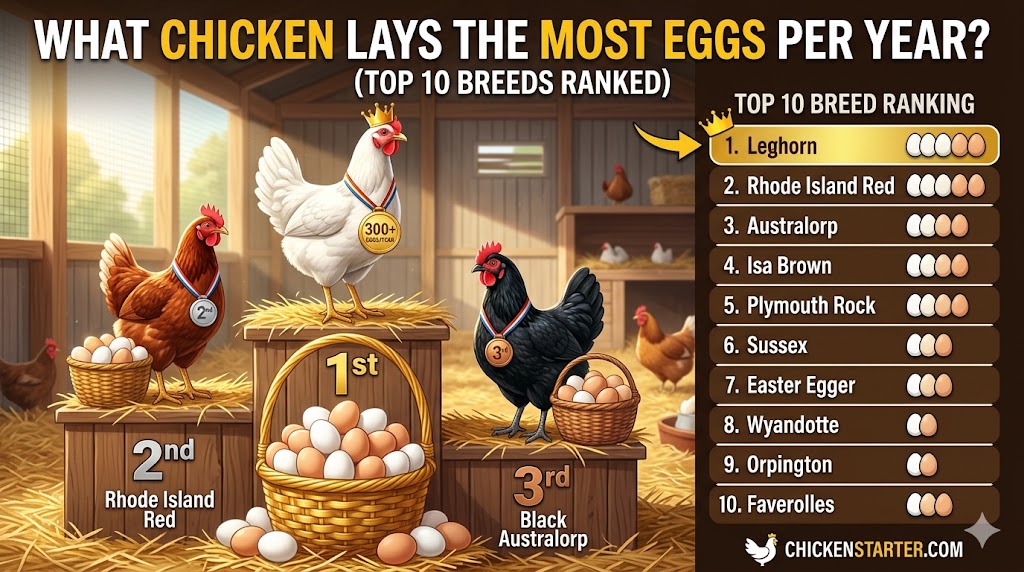
If you are choosing chickens specifically for egg production, the breed you pick matters more than almost any other decision you will make. The difference between a top-producing breed and an average one can be 100 or more eggs per year per hen. Over a flock of six birds, that gap adds up to hundreds of eggs and a significant amount of money saved or earned.
I have kept several different laying breeds over the years, and the production difference between my best layers and my ornamental birds is genuinely dramatic. My ISA Browns and Australorps fill the egg basket consistently, day after day, while my Silkies and Cochins are lucky to produce three eggs a week. Both types have their place in a flock, but if eggs are your priority, breed selection is everything.
This guide ranks the top 10 chicken breeds that lay the most eggs per year, based on documented production averages, hatchery data, and real-world backyard performance. I also cover the factors that influence laying rates, how to maximize production from any breed, and how to choose the right high-production hen for your specific climate and setup.
Quick Comparison: Top 10 Egg Laying Breeds Ranked
| Rank | Breed | Eggs Per Year | Egg Color | Egg Size | Temperament |
|---|---|---|---|---|---|
| 1 | ISA Brown | 300 to 350 | Brown | Large | Docile, friendly |
| 2 | Lohmann Brown | 300 to 320 | Brown | Large | Calm, adaptable |
| 3 | White Leghorn | 280 to 320 | White | Large | Active, flighty |
| 4 | Golden Comet | 280 to 320 | Brown | Large to XL | Friendly, gentle |
| 5 | Australorp | 250 to 300 | Light brown | Large | Calm, docile |
| 6 | Rhode Island Red | 250 to 300 | Brown | Large | Hardy, assertive |
| 7 | Barred Plymouth Rock | 250 to 280 | Light brown | Large | Friendly, steady |
| 8 | Sussex | 250 to 280 | Light brown to cream | Large | Curious, gentle |
| 9 | Hamburg | 200 to 255 | White | Small to medium | Active, alert |
| 10 | Legbar (Cream) | 230 to 270 | Blue to blue-green | Medium | Alert, active |
Now let me break down each breed in detail.
1. ISA Brown (300 to 350 Eggs Per Year)
The ISA Brown is the undisputed champion of egg production. This breed was developed in France in 1978 by the Institut de Sélection Animale (now part of Hendrix Genetics) specifically for commercial egg farming. It is a hybrid, not a heritage breed, and it was engineered from the ground up to lay as many eggs as possible.
A healthy ISA Brown in good conditions will produce 300 to 350 eggs in her first year of laying. That is nearly an egg every single day. The eggs are large to extra-large, uniformly brown, and have strong shells.
I currently keep four ISA Browns, and they are the most reliable birds in my entire flock. During their first full laying year, my best ISA averaged 6.2 eggs per week from March through November, dropping to about 4 per week during the shortest winter days. Even at reduced winter output, she outproduced every other breed I keep.
The trade-off with ISA Browns is longevity. Because they are bred for intense early production, their laying rate drops more sharply after the second year compared to heritage breeds. By year three, most ISA Browns are producing 60 to 70 percent of their peak output. They also tend to have a shorter overall lifespan, typically 5 to 8 years, partly because the metabolic demands of such high production take a toll.
For a detailed look at this breed, read our complete ISA Brown chicken guide.
2. Lohmann Brown (300 to 320 Eggs Per Year)
The Lohmann Brown is another commercial hybrid developed by Lohmann Tierzucht in Germany. It rivals the ISA Brown in production volume and is one of the most widely used layer breeds in commercial egg farming worldwide.
According to production data shared by Hendrix Genetics, modern commercial layer hybrids including the Lohmann Brown and ISA Brown are capable of producing over 500 eggs by 100 weeks of age under optimal management conditions. While backyard keepers rarely achieve those exact numbers due to differences in lighting, nutrition, and housing, the genetic potential of these birds is extraordinary.
Lohmann Browns produce large brown eggs with excellent shell quality. They are calm, adaptable birds that do well in both free-range and confined setups. Their temperament is slightly more relaxed than ISA Browns in my experience, making them a good choice for families with children.
Like ISA Browns, Lohmann Browns experience a steeper production decline after their second year compared to heritage breeds. Plan accordingly if sustained long-term laying is important to you.
3. White Leghorn (280 to 320 Eggs Per Year)
The White Leghorn is the breed behind the vast majority of white eggs sold in grocery stores across the United States. Originally from Italy, Leghorns have been refined through decades of selective breeding into one of the most efficient egg-producing machines in the poultry world.
A well-managed White Leghorn produces 280 to 320 large white eggs per year. They are lightweight birds (typically 4 to 5 pounds), which means they convert feed into eggs with remarkable efficiency. Less of their caloric intake goes toward maintaining body mass, and more goes toward egg production.
Leghorns are active, alert, and somewhat flighty. They are not the cuddliest backyard birds. They prefer to range freely and can be nervous around handling. But if your goal is maximum eggs with minimum feed cost, Leghorns are hard to beat.
I kept a small group of Leghorns during my second year of chicken keeping. They were fantastic layers but not a great match for my suburban setup because they were noisy, flighty, and difficult to keep contained in a standard-height run. If you have room for them to roam and are not bothered by their more independent personality, they are outstanding producers.
For more on this breed, check out our complete Leghorn chicken guide.
4. Golden Comet (280 to 320 Eggs Per Year)
The Golden Comet is a sex-linked hybrid, typically a cross between a Rhode Island Red rooster and a White Leghorn or White Plymouth Rock hen. The name “Golden Comet” is a trade name used by several hatcheries, and similar hybrids are sold under names like Red Star, Cinnamon Queen, and Gold Sex Link.
Golden Comets lay 280 to 320 large to extra-large brown eggs per year. They begin laying earlier than most breeds, often starting at 15 to 16 weeks of age compared to the more typical 18 to 22 weeks for heritage breeds.
Their temperament is one of their strongest selling points. Golden Comets are consistently described as friendly, gentle, and easy to handle. They do well in mixed flocks and rarely cause pecking order issues.
The sex-linked trait means you can identify the sex of the chick at hatch by its color, which eliminates the risk of accidentally ending up with a rooster. This makes Golden Comets a particularly smart choice for urban and suburban keepers in areas where roosters are not allowed.
5. Australorp (250 to 300 Eggs Per Year)
The Australorp holds the world record for egg production by a single hen. In 1922 to 1923, a team of six Australorps in Australia set a record of 1,857 eggs in 365 days, which averages out to 309.5 eggs per hen. According to records documented by the Livestock Conservancy, the Australorp was developed in Australia from Black Orpington stock and quickly gained recognition for its exceptional laying ability.
In a typical backyard setting, a healthy Australorp produces 250 to 300 light brown eggs per year. They are dual-purpose birds, meaning they are also a reasonable meat breed at 6 to 8 pounds.
What sets Australorps apart from the commercial hybrids ranked above them is their longevity and sustained production. While ISA Browns and Lohmann Browns drop off sharply after year two, Australorps maintain solid production for 3 to 4 years before a noticeable decline. They are also hardier overall, less prone to reproductive health issues, and have a longer natural lifespan.
I have two Black Australorps in my flock and they are two of my favorite birds. They are calm, curious, and remarkably consistent layers. Even during their third laying season, they are still producing 4 to 5 eggs per week each.
For everything you need to know about this breed, our full Australorp chicken guide covers temperament, health, and production in detail.
6. Rhode Island Red (250 to 300 Eggs Per Year)
The Rhode Island Red is one of the most recognizable and widely kept chicken breeds in the world. Developed in Rhode Island and Massachusetts in the late 1800s, this heritage breed was specifically bred for both egg production and meat quality.
A production-strain Rhode Island Red lays 250 to 300 large brown eggs per year. Heritage or show strains tend to produce less, closer to 200 to 250, because they have been selected more for appearance than for laying performance.
Rhode Island Reds are incredibly hardy. They handle cold winters, hot summers, and everything in between with minimal fuss. They are assertive birds that tend to rank high in the pecking order, which makes them a strong choice for mixed flocks where you want confident, self-sufficient hens.
For a detailed look at this classic breed, including production-strain versus heritage-strain differences, read our Rhode Island Red chicken guide.
7. Barred Plymouth Rock (250 to 280 Eggs Per Year)
The Barred Rock is a variety of the Plymouth Rock breed, recognizable by its striking black-and-white barred feather pattern. It is a true dual-purpose heritage breed that has been a backbone of American poultry keeping since the mid-1800s.
Barred Rocks produce 250 to 280 light brown eggs per year. They are steady, reliable layers that rarely go broody, which means fewer interruptions in production.
Their temperament is one of their strongest features. Barred Rocks are friendly, docile, and curious without being flighty. They are one of the most commonly recommended breeds for families and beginners.
I have kept Barred Rocks on and off for years, and they are a bird I always recommend to new chicken keepers. They are low-maintenance, consistent, and lay well through their first three to four years.
Our full Barred Rock chicken guide covers everything from temperament and egg production to how they compare to other Plymouth Rock varieties.
8. Sussex (250 to 280 Eggs Per Year)
The Sussex is a heritage British breed that has been valued for both eggs and meat for over a century. The Speckled Sussex variety is the most commonly available in the United States, though Light Sussex and Buff Sussex are also popular.
Sussex hens produce 250 to 280 large, light brown to cream-colored eggs per year. They are excellent foragers and do particularly well in free-range or garden-integrated setups.
If you are interested in using your chickens to help manage garden pests and improve soil health, the Sussex is an ideal candidate. Their strong foraging instincts make them natural garden workers. Our guide on how chickens can improve your garden naturally covers how to integrate foraging breeds into your garden rotation.
For a detailed breed profile, read our Speckled Sussex chicken guide.
9. Hamburg (200 to 255 Eggs Per Year)
The Hamburg is a smaller, active, ornamental-looking breed that lays far more eggs than most people expect. These birds produce 200 to 255 small to medium white eggs per year and are among the most efficient heritage layers in terms of feed-to-egg conversion because of their small body size.
Hamburgs are not a common recommendation for backyard flocks because they are flighty, active, and prefer to free-range. They do not handle confinement well and can be noisy. But if you have the space and want a productive heritage layer with a beautiful appearance, they are an underrated choice.
10. Cream Legbar (230 to 270 Eggs Per Year)
The Cream Legbar is a British autosexing breed that lays 230 to 270 blue to blue-green eggs per year. It is one of the highest-producing colored egg layers available, and the auto-sexing trait means you can determine the sex of chicks at hatch by their down color.
Cream Legbars are alert, active birds with good foraging ability. They do well in free-range systems and are relatively cold-hardy for a Mediterranean-type breed.
If you want both strong production and a colorful egg basket, the Cream Legbar is one of the best options. And if green eggs specifically interest you, our guide on what chicken lays green eggs covers every breed and cross that produces green, olive, and sage-colored eggs.
What Factors Affect How Many Eggs a Chicken Lays?
Breed genetics set the ceiling, but several management factors determine how close your hens actually get to their genetic potential.
Light Exposure
Chickens need approximately 14 to 16 hours of light per day to maintain peak egg production. During the shorter days of fall and winter, production naturally drops. Many keepers add supplemental lighting in the coop to extend the perceived day length, which maintains production through the darker months.
I use a simple LED light on a timer in my coop, set to turn on at 4:30 AM and off at sunrise. This extends the morning light window without disrupting the hens’ natural dusk-to-dark roosting cycle.
Nutrition
A complete layer feed with 16 to 18 percent protein and adequate calcium is the foundation of consistent egg production. Hens that are undernourished, fed too many treats, or lacking calcium will lay fewer eggs and produce thinner shells.
Supplementing with oyster shell in a separate dish ensures hens can self-regulate their calcium intake. Kitchen scraps are a great way to add variety and reduce food waste, but they should make up no more than 10 to 15 percent of the daily diet. Our article on how backyard chickens help reduce your food waste covers how to integrate scraps responsibly.
Age
Most hens reach peak production in their first full laying year (roughly 20 weeks to 72 weeks of age). After the first annual molt, production typically drops by 10 to 20 percent. By year three, most breeds are producing 60 to 80 percent of their peak output. Commercial hybrids decline faster than heritage breeds.
Health and Stress
Parasites, respiratory infections, overcrowding, predator threats, and extreme weather all reduce egg production. A healthy, stress-free hen in a clean, well-ventilated coop lays significantly more eggs than a bird dealing with any of these issues.
Broodiness
Broody hens stop laying for the duration of their broody period, which can last 3 to 8 weeks or longer. Breeds with a strong tendency to go broody (like Silkies, Cochins, and Buff Orpingtons) will produce fewer total eggs per year because of these production pauses. If maximum eggs are your goal, choose breeds with low broodiness, such as Leghorns, ISA Browns, and Barred Rocks.
Hybrid vs. Heritage: Which Should You Choose?
This is one of the most important decisions when selecting a high-production breed.
Commercial hybrids (ISA Brown, Lohmann Brown, Golden Comet) lay more eggs in the first two years than any heritage breed. They start earlier, lay more consistently, and produce larger eggs. The downside is a shorter productive lifespan, higher susceptibility to reproductive issues like egg yolk peritonitis, and a steeper production decline after year two.
Heritage breeds (Australorp, Rhode Island Red, Barred Rock, Sussex) lay fewer eggs per year but maintain production over a longer period. They are generally healthier, more self-sufficient, and live longer. Over a five-year period, a heritage breed may produce a comparable total number of eggs to a commercial hybrid that burns out faster.
My personal approach is a mixed flock. I keep ISA Browns for maximum short-term production and Australorps and Barred Rocks for steady, reliable long-term laying. This gives me a consistently full egg basket year-round without relying entirely on one type.
Setting Up for Maximum Egg Production
The best layers in the world will underperform if their housing, nesting, and nutrition are not right.
Make sure your coop provides 4 square feet of indoor space per bird with proper ventilation, predator-proof construction, and comfortable roosting bars. If you are building a new coop, our guide on popular chicken coop styles explained helps you choose the right design. For a budget build, a pallet chicken coop can house a small flock for under $200.
Provide one nesting box for every 4 to 5 hens, lined with clean bedding and refreshed weekly. Adding dried herbs to your nesting boxes naturally deters pests and keeps eggs cleaner. If egg eating or breakage is a concern, consider roll-away nesting boxes that protect eggs the moment they are laid.
Frequently Asked Questions
What chicken lays the most eggs per day?
No chicken lays more than one egg per day. The egg formation process takes approximately 25 to 27 hours, so even the most productive breeds like ISA Browns lay at most one egg per day, with an occasional skip day built into their cycle.
Do bigger chickens lay more eggs?
Not necessarily. Some of the most prolific layers, like Leghorns and Hamburgs, are among the smallest standard breeds. Body size does not correlate directly with egg production. Genetic selection for laying ability is what matters most.
How long do chickens keep laying eggs?
Most chickens lay eggs for 5 to 7 years, though production declines each year after the first. Commercial hybrids often slow down significantly by year three. Heritage breeds may continue laying moderately for 4 to 6 years.
Can I increase my chickens’ egg production?
You can help your hens reach their genetic potential by providing proper nutrition (complete layer feed plus oyster shell), adequate light (14 to 16 hours), a clean and stress-free environment, and parasite prevention. You cannot push a hen beyond her genetic capability, but good management ensures she reaches it.
What is the best egg laying chicken for beginners?
For beginners who want both high production and an easy-to-manage bird, the Golden Comet or ISA Brown are excellent choices. For a heritage breed with strong production and a calm temperament, the Australorp or Barred Rock are consistently recommended.
What breed lays the most colorful eggs?
If you want a variety of shell colors, keep a mixed flock of different breeds. White Leghorns for white eggs, Rhode Island Reds for brown, Ameraucanas for blue, Easter Eggers for green or pink, and Marans for dark chocolate brown. Our article on what chicken lays green eggs covers every breed that produces green, olive, and sage-colored shells.
Disclaimer
The information in this article is based on personal experience, documented breed averages, and widely accepted poultry keeping knowledge. Actual egg production varies depending on genetics, nutrition, housing, climate, and individual bird health. Commercial hybrid production figures reflect optimal management conditions and may not be fully replicated in backyard settings. For flock health concerns or specific breeding questions, consult a qualified poultry veterinarian or your local agricultural extension service.

Oladepo Babatunde is the founder of ChickenStarter.com. He is a backyard chicken keeper and educator who specializes in helping beginners raise healthy flocks, particularly in warm climates. His expertise comes from years of hands-on experience building coops, treating common chicken ailments, and solving flock management issues. His own happy hens are a testament to his methods, laying 25-30 eggs weekly.