I have to be honest with you about how I discovered this breed.
A friend of mine texted me a photo of her egg basket one Sunday morning, and I thought my phone screen had a color filter on it. The eggs were green. Not olive. Not brown with a green tint. Actual, unmistakable pastel minty green, sitting right next to her regular brown and white eggs like something out of a children’s book.
I called her immediately. She told me about her Starlight Green Egger chickens, a breed I had never heard of at the time. Two weeks later I had done enough research to fill this entire guide, and I have not stopped thinking about them since.
If you are here because you want the full truth about the Starlight Green Egger chicken, including where it comes from, what color eggs it really lays, how productive it actually is, what the temperament is like in a real backyard setting, and where you can buy one, you are in exactly the right place. Let’s go through every single thing you need to know.
What Is a Starlight Green Egger Chicken?
Let’s start from the beginning, because there is a lot of confusion online about what this bird actually is.
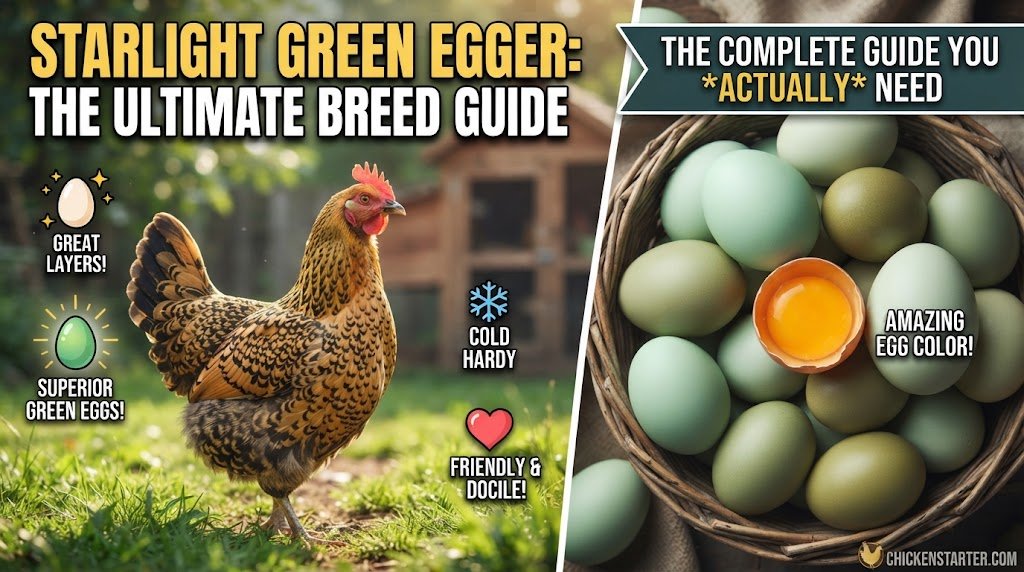
The Starlight Green Egger is not a pure breed. It is a hybrid chicken, a purpose-bred cross developed specifically to produce large quantities of green-shelled eggs while also giving keepers a bird with an eye-catching, highly variable appearance. According to Hoover’s Hatchery, who created this bird, the Starlight Green Egger was developed by crossing the Prairie Bluebell Egger with a brown egg layer, producing a hybrid that consistently lays green eggs at high volume.
There is one important thing Hoover’s has not publicly disclosed, and that is exactly which brown egg layer breed is used in the cross. The hatchery has kept that part of the formula proprietary. So while we know the blue egg parent clearly, the brown egg parent remains unspecified in all official communications.
Because it is a hybrid, it does not breed true. If you put two Starlight Green Eggers together and hatch their eggs, the chicks will not reliably replicate the parent traits. This is important to understand before you buy, because it means you always source new chicks from the hatchery or an authorized reseller rather than breeding your own replacement flock.
Hoover’s Hatchery registered the name Starlight Green Egger as a trademark in September 2021. So while other hatcheries sell similar crosses under different names, only Hoover’s produces the genuine trademarked Starlight Green Egger line.
Now here is the science behind the egg color, because it is genuinely fascinating and worth understanding. The Prairie Bluebell Egger parent lays blue eggs, carrying the blue egg gene rooted in Araucana or Ameraucana ancestry. When you cross a blue egg layer with a brown egg layer, the two pigment genes combine. Blue shell plus brown pigment overlay equals green. That is the genetic mechanism behind every green egg your Starlight Green Egger will ever lay. It is the same principle that produces olive eggs in Olive Egger crosses, just with a lighter brown pigment contribution that results in a brighter, mintier final shade.
Starlight Green Egger Chicken Colors: What Do They Actually Look Like?
This is one of the most talked-about things about this breed, and for good reason.
The plumage of Starlight Green Eggers is highly variable, with birds showing completely different color and pattern combinations even within the same hatch group. You can order ten chicks and end up with ten birds that look almost nothing like each other. That is not a defect. That is a feature of the hybrid genetics at work.
One thing that experienced keepers have observed is that red coloring shows up most commonly across the breed. Any variation of red, from deep mahogany as rich as a Rhode Island Red, to almost totally golden with orange stripes, or even a deep red body with a bronze head. Other birds from the same hatch can come out with black and white speckled patterns, mottled grey, buff, golden, or combinations of all of these across a single bird.
What tends to stay consistent across all birds is the pea comb, which is a small, low-profile comb that sits close to the head and is one of the traits inherited from the blue egg laying parentage. The legs are typically yellowish. The body is medium-sized and athletic in build, not heavy or blocky. Starlight Green Eggers also often lack the fluffy cheeks and ear tufts seen in some other colored egg layers, giving them a slightly more streamlined head compared to Easter Eggers.
As chicks, Starlight Green Eggers are usually light yellow to buff-colored with orange feet and pale pink beaks. At this stage they all look fairly similar, which is part of why sexing must be done at the hatchery rather than by color at hatch. As they grow toward their first lay, their adult feather colors and patterns become more apparent and distinctive week by week.
Once fully mature, according to information from Hoover’s Hatchery, the Starlight Green Egger reaches a mature weight of 5 to 6 pounds. Some third-party sources list hens at 4 to 5 pounds specifically, which is plausible given that hens are typically lighter than roosters within that range. Either way, this puts them firmly in the medium-sized category, manageable in hand and not too heavy for shared roosts and runs in a mixed flock.
What Color Eggs Do Starlight Green Eggers Lay?
Green, and usually a beautiful pastel or minty shade of it.
The egg shell color is green as the expected and standard output of this hybrid line. Many keepers describe the shade as a delicate pastel green comparable to a minty or sage tone. This is lighter and less saturated than what you would get from an Olive Egger, which tends toward a deeper, darker shade of green that can sometimes appear speckled or mottled depending on which dark brown layer was used in that cross.
Here is the one honest caveat that comes directly from Hoover’s Hatchery: there is approximately a 5% chance that any given Starlight Green Egger will lay brown eggs instead of green. This is a result of how hybrid genetics work. The gene expression is not 100% predictable across every hatch, and a small percentage of hens will end up with enough brown pigment dominance that the blue base layer gets covered rather than tinted. So if you buy ten hens, expect nine or ten to lay green and possibly one to lay brown.
Some third-party breeders and smaller operations using a similar cross but not Hoover’s trademarked line have reported a wider color range including light olive, blue, and brown. That wider variation appears more common in non-Hoover’s crosses that use the Starlight name loosely without the controlled genetics behind the original.
If your goal is specifically that minty green egg in your basket every morning, sourcing from Hoover’s Hatchery directly or from an authorized reseller like Tractor Supply gives you the most predictable result.
Are Starlight Green Egger Eggs Safe to Eat?
Yes, absolutely. The green color is only in the shell. The interior of the egg, the white and the yolk, looks and tastes exactly like any other chicken egg. Egg color is determined entirely by genetics and pigmentation in the shell membrane. It has no effect on flavor, nutrition, or food safety. The color comes from a pigment called oocyanin, the same compound found in any blue egg laying breed.
Starlight Green Egger Egg Production: How Many Eggs Per Year?
This is where things get genuinely impressive, and why so many backyard keepers are specifically adding this bird to their flocks.
According to information from Hoover’s Hatchery, the Starlight Green Egger is rated at 280 large green eggs per year. That works out to roughly five to six eggs per week per hen. For reference, most dual-purpose breeds like Rhode Island Reds or Buff Orpingtons peak at around 200 to 260 eggs per year. The Starlight Green Egger sits at or near the top end of what any laying hen can consistently produce.
Real-world production figures from keepers confirm this general picture. One keeper shared that her four-year-old Starlight Green Egger named Christmas laid an egg almost every single day without fail across multiple seasons. At four years old, that kind of consistency is impressive for any hen.
To be fair, some sources describe the practical production range as 200 to 280 eggs per year rather than a flat 280. Real output depends on daylight hours, nutrition, stress levels, weather, molt timing, and the individual bird’s age. A hen in her first laying year with proper feed, adequate light, and low stress will push close to that 280 target. A hen in year three managing a winter molt with shorter days and fluctuating temperatures may produce considerably less during those months.
These chickens are confirmed to be both cold and heat hardy, which means they can be kept in a wide variety of climates and will not stop laying during winter entirely, though production typically slows during the shortest days of the year when daylight drops below 14 hours.
What Age Do Starlight Green Eggers Start Laying?
Most Starlight Green Egger hens begin laying between 18 and 24 weeks of age, with some individual birds taking closer to 26 weeks before their first egg arrives.
In practical terms, 18 weeks is about four and a half months. If you bring home chicks in early spring, you can reasonably expect your first green egg sometime in mid to late summer. That is a fairly fast turnaround for a bird producing this many eggs at this level of quality.
Signs Your Starlight Green Egger Is About to Lay Her First Egg
This is something most guides skip over, and it is actually one of the most exciting parts of raising this breed for the first time.
In the week or two before a pullet lays her first egg, you will notice her behavior shifting noticeably. She will start spending time crouching low to the ground when you approach or reach over her, which is called the submissive squat. This is a clear hormonal signal that laying is close. She will also begin investigating nesting boxes with more interest than before, sometimes sitting in them for extended periods without producing anything. Her comb and wattles will grow larger and redder than they were even a few weeks prior. Some pullets also become louder and more vocal in the days leading up to that first egg.
When you see all of those signs together, check the nesting boxes morning and evening. Your first green egg is usually only days away. Our full guide on chicken behavior before laying the first egg covers every sign in detail so you do not miss any of them.
Starlight Green Egger Chicken Temperament: What Are They Really Like?
Here is where I want to give you the full picture, because the honest answer has some nuance that most breed guides gloss over.
The breed-wide reputation is friendly, curious, active, and easygoing. Within a mixed flock, Starlight Green Eggers typically fall toward the middle of the pecking order. They are confident enough not to be easily bullied, but they are also not inherently aggressive or dominant toward other birds. Their balanced temperament allows them to coexist well with a wide range of breeds, and their generally easygoing nature helps keep flock drama at a minimum.
They are described as relatively quiet compared to some other breeds, with roosters naturally louder than hens. That quieter profile makes them a reasonable consideration for suburban settings where neighbor noise is a genuine daily concern.
Starlight Green Eggers are known to be curious and genuinely interested in exploring their environment. You will notice this in the way they move through a yard, constantly scratching, pecking, investigating corners, and moving rather than parking themselves near the feeder all day. One keeper described her Starlight Green Egger as absolutely obsessed with soldier fly worms, which tells you this is a bird that engages enthusiastically with foraging treats and any form of enrichment you give them.
Now for the honest counterpoint, because you deserve the full picture rather than a glossy one.
Not every keeper has had the same experience. One small farm operator stated that her Starlight Green Eggers were not social, did not like being touched, and had reactive tendencies when she entered their space. She described them as ill-tempered and noted she had received scratches from them. This is a real, documented perspective from someone with direct hands-on experience, and it is worth taking seriously.
A practical tip from Tractor Supply’s breed care guidance is directly relevant here: for a calmer flock dynamic, reduce resource pressure. Give active birds enough room and clear access to feed, water, and nests, and you will see the easygoing traits more often. That single piece of advice explains a lot of the variation in keeper experiences. A Starlight Green Egger with adequate space and resources behaves very differently from one that is competing in a crowded or under-resourced environment.
My honest read of the temperament picture is this: the breed’s baseline genetics lean toward active and curious rather than clingy and docile. Birds raised with frequent gentle human interaction from a young age tend toward the friendly side. Birds raised in confinement without enough space or enrichment can lean toward the stressed, reactive side. Early socialization and adequate space matter enormously for the temperament outcome you actually live with.
If you want a lapbird that follows you around like a golden retriever, a Silkie or a Buff Orpington will serve you better. If you want a high-producing, visually striking bird that is pleasant to manage in a well-run coop, the Starlight Green Egger delivers that reliably for most keepers.
Starlight Green Egger Rooster: Male vs. Female Differences
If you buy straight-run chicks rather than sexed pullets, you may end up with a Starlight Green Egger rooster, and it is worth knowing what to expect from the males.
Roosters reach a mature weight of 5 to 6 pounds at the upper end of the breed range. They have a more developed pea comb that often becomes visible earlier and more prominently than the pullets’ combs, and their wattles grow larger and redder by 8 to 10 weeks of age. Saddle feathers, the pointed feathers over the lower back near the tail, begin appearing in roosters around 10 to 14 weeks and become distinctly pointed and shiny compared to the rounded, duller saddle feathers on hens. Hackle feathers around the neck also become more pointed and iridescent in males as they approach sexual maturity.
Because the Starlight Green Egger is not a sex-link hybrid, you cannot determine males from females by color at hatch the way you can with some other production hybrids. They must be sexed by vent sexing or feather sexing at the hatchery level. When you buy sexed pullets from Tractor Supply or directly from Hoover’s, the accuracy rate is generally high, but an occasional wrong-sex bird does slip through any sexed chick order.
Starlight Green Egger roosters follow the general active and alert temperament of the breed. They tend to be louder and more watchful than hens, and their protective instincts toward the flock can emerge early. A rooster in a well-managed flock with adequate hens and enough space generally does his job without causing major problems.
The Starlight Green Egger is not a recognized breed by the American Poultry Association, so there are no exhibition standards governing rooster or hen conformation. The birds are bred for hybrid vigor and egg production genetics, not for showing.
Starlight Green Egger Chick: What to Expect in the Brooder
Starlight Green Egger chicks hatch as light yellow to buff-colored birds with orange feet and pale pink beaks. At this stage they all look fairly similar to each other, which is part of why sexing is handled at the hatchery rather than by color observation after hatch.
In the brooder, these chicks tend to be active and alert almost immediately. They begin exploring their brooder space earlier than some calmer breeds and tend to feather out at a reasonable pace.
If you are setting up your first brooder, start the temperature at 95°F for the first week and lower it by 5°F each week after that until the chicks are fully feathered at around 6 to 8 weeks. One practical tip specific to active hybrid chicks: make sure the brooder walls are tall enough, because these birds get ambitious early. Our full guide on how to set up a brooder for new chicks walks you through every detail from heat lamp positioning to feeder placement.
Feed chick starter feed with at least 18 to 20% protein for the first 8 weeks. Switch to a grower feed from weeks 8 through 18, then transition to a layer ration around the time they are approaching laying age. Our guide on when to switch from starter to grower feed covers that transition timing so you do not underfeed or overfeed protein at the wrong stage.
One thing I always recommend with active, curious chick breeds like this one: handle them gently and frequently from the first week. Sit with them, let them climb on your hand, offer small crumble treats from your palm. The birds that grow up friendly and approachable are almost always the ones that received positive human contact consistently during those early brooder weeks. This investment of ten minutes a day in week one pays off for the next eight years.
Starlight Green Egger Lifespan: How Long Do They Live?
With proper care, Starlight Green Egger chickens can live up to 8 to 10 years. That makes them a genuinely long-term flock member rather than a short-term production tool.
It is worth being realistic about what that lifespan means in terms of productivity. Peak egg production happens in years one and two. From year three onward, output gradually declines. By years five or six, a hen may produce only a fraction of her peak numbers. Many backyard keepers choose to keep their older hens as established flock members long after peak production drops, because a bird that has been in your flock for six years is part of the community and maintains the social structure that benefits younger birds.
The factors that most affect lifespan are diet quality, predator protection, disease prevention, and stress management. A bird with access to balanced layer feed, clean water, a secure coop, and low flock stress will consistently outlive the same breed raised in poor conditions.
How to Care for Starlight Green Egger Chickens
Space, Housing, and Ventilation
Because the Starlight Green Egger is an active forager by nature, it does best with genuine outdoor access. This is a lightweight, alert bird with good flying ability, and confining it to a small indoor space without enrichment is a reliable recipe for stress and reactive behavior.
For indoor coop housing, provide at least 4 square feet of floor space per bird. The outdoor run should give each bird a minimum of 8 to 10 square feet, though more is consistently better for active breeds. If you can give them genuine free-range access even for part of the day, these birds will absolutely use it. They have been described by Hoover’s Hatchery directly as being excellent foragers in free-range situations, and their alertness to aerial and ground predators means they are somewhat better at avoiding trouble than heavier, slower breeds.
Ventilation inside the coop matters as much as square footage. Starlight Green Eggers need a dry, well-ventilated coop that is not overheated to stay comfortable and keep laying through seasonal changes. A poorly ventilated coop with ammonia buildup is one of the fastest ways to trigger respiratory problems in any active laying breed. Our detailed guide on how much ventilation a chicken coop needs gives you the exact calculations for your coop size.
Free-ranging comes with real predator risks that require active management. Our predator-proofing guide covers fencing, hardware cloth specifications, and coop design details that keep active foraging birds safe from both aerial and ground threats. And if you are figuring out exactly how much room your growing flock needs, our breakdown of how much space chickens really need gives you concrete numbers by flock size.
Feeding and Nutrition: Getting It Right at Every Stage
Starlight Green Eggers do best on a complete ration matched carefully to their life stage. Getting this wrong is one of the most common mistakes keepers make, and it shows up directly in egg shell quality, production rates, and long-term hen health.
For chicks from hatch to 8 weeks, use a chick starter crumble with 18 to 20% protein. For growers from weeks 8 to 18, transition to a grower pellet or crumble at 16 to 18% protein. From 18 weeks onward, switch to a complete layer feed formulated for laying hens with a minimum of 16% protein and adequate calcium levels of 3.5 to 4.5%.
For laying hens, calcium is especially important. A hen pushing close to 280 eggs per year is pulling significant calcium from her reserves with every shell she forms. If her feed does not supply enough, she will pull it from her own bones, which leads to poor shell quality, soft eggs, and serious long-term skeletal damage. Offer free-choice oyster shell alongside the layer feed at all times so each hen can self-regulate her calcium intake based on her individual production rate. Our calcium for chickens guide explains exactly why this matters and how to do it without overcomplicating the setup.
Grit is equally important for any bird that forages actively on pasture, eats whole grains, or receives treats. Unlike calcium in oyster shell, grit does not dissolve. It stays in the gizzard and physically grinds down food. Without it, birds that eat anything other than commercially milled feed cannot digest properly. Offer insoluble grit in a separate dish from the oyster shell, not mixed together, so birds can access each based on their own needs.
Treats should be kept to no more than 10% of daily intake. Too many treats dilute the nutritional balance of a properly formulated layer ration. When I give my high-production hens treats, I focus on protein-rich options like dried mealworms, black soldier fly larvae, or hard-boiled eggs during molt, and skip the scratch heavy days when they need their layer feed most.
Clean water must be available at all times without exception. Active birds in warm conditions need more water than most keepers expect, and even a few hours without water access can reduce feed intake and drop egg production noticeably for several days afterward.
Managing the Molt and Winter Production
Every laying hen goes through an annual molt, typically beginning in fall when daylight hours start shortening. During molt, hens stop laying and redirect all available protein into regrowing their feathers. For a high-production bird like the Starlight Green Egger, molt can feel abrupt and alarming the first time you experience it if you are not prepared.
During molt, switch from layer feed to a higher protein feed of around 20 to 22% protein to support faster feather regrowth. Some keepers use gamebird feed or add scrambled eggs and mealworms to the ration during molt weeks. After molt is complete and the hen has regrown her feathers, you can return to a standard layer ration and production will resume, typically with the quality of shells improving noticeably in the post-molt cycle.
Our detailed guide on chicken molting season covers exactly what to expect, how long it lasts, and what you can feed to get your flock back to laying as quickly as possible.
Cold and Heat Management
Starlight Green Eggers are both cold and heat hardy, meaning they can be kept across a wide range of climates and will continue laying through winter, though output typically slows during the shortest days. Their pea comb is a real advantage in cold climates because pea combs have far less surface area than single combs and are therefore much less susceptible to frostbite in freezing temperatures.
For hot weather management, prioritize shade, strong coop ventilation, and constant access to cool fresh water. Our guide on what to feed chickens during a heatwave gives you specific feeding adjustments you can make when temperatures spike above 90°F.
For cold climates and winter management, our article on raising chickens in cold climates covers insulation, ventilation balance, waterer management, and feed calorie adjustments to keep your flock in good health from November through March.
Nesting Boxes and Egg Collection
Provide one nesting box for every three to four hens as a general starting ratio. Starlight Green Eggers are listed as rarely broody by Hoover’s Hatchery, meaning most hens will lay their eggs and leave rather than sitting persistently. However, it is worth noting that some sources describe their broodiness as variable, with individual hens occasionally going broody depending on conditions and time of year. Do not count on them being entirely brood-free, but do not expect persistent sitting problems either.
Collect eggs daily to keep nesting boxes clean, dry, and free of broken shells. Leaving eggs in boxes too long is one of the most common ways a flock develops egg-eating behavior, which is genuinely difficult to reverse once it is established. Our article on what to put inside a chicken nesting box covers bedding, box positioning, and the small details that encourage consistent, clean laying behavior.
Integrating Starlight Green Eggers Into an Existing Flock
This is a topic that most breed guides skip entirely, and it gets people into trouble.
If you are adding Starlight Green Egger chicks or pullets to an existing flock, do not just drop them in and expect things to sort themselves out. The established birds will enforce the pecking order aggressively on any newcomer, and undersized or young birds can get seriously injured in that process.
The safest method is a quarantine and see-but-not-touch approach. Keep new birds in a separate pen within sight of the existing flock for two to four weeks. This allows both groups to get used to each other visually without physical contact. After that period, introduce them in a large space with multiple feeding and watering stations so the dominant birds cannot block all resources at once.
Starlight Green Eggers tend to fall toward the middle of the pecking order in a mixed flock, which means they are neither the bullies nor the easy targets. They hold their own reasonably well once established, but they still need a fair introduction rather than being thrown in cold. Our guide on pecking order problems and how to stop bully hens covers exactly what to do when integration goes sideways, including the specific interventions that actually work.
Starlight Green Egger Health: What to Watch For
The Starlight Green Egger is a generally hardy bird with the hybrid vigor that tends to make cross-bred chickens more resilient than many purebreds. That said, every chicken needs consistent monitoring, and high-production laying breeds carry specific risks worth knowing upfront.
Reproductive Health Issues
Hens producing close to 280 eggs per year are working their reproductive systems hard year-round. The most serious risks for high-production layers are egg binding, chronic laying stress, and egg yolk peritonitis.
Egg binding happens when an egg becomes stuck in the oviduct. Signs include a hen that is straining, walking stiffly like a penguin, sitting fluffed up in a corner, or pressing her abdomen against the ground. This is a genuine emergency that requires prompt action, not a wait-and-see situation. A warm soak in a basin of water at around 100°F for 20 minutes can sometimes help a bound hen pass the egg, but if she does not improve within a couple of hours she needs veterinary attention.
Egg yolk peritonitis occurs when yolk material escapes into the body cavity instead of traveling down the oviduct correctly. Signs include a swollen abdomen, labored breathing, lethargy, and a hen that stands with her tail low and her posture hunched. Our guide on egg yolk peritonitis treatment covers the warning signs in detail and the steps you can take while arranging veterinary care.
Respiratory Infections
Outdoor chickens that contact soil, wild birds, and other flocks have higher exposure to respiratory pathogens than confined birds. Mycoplasma gallisepticum is one of the most common respiratory bacterial infections in backyard laying flocks, presenting as rattling breathing, swollen faces, nasal discharge, and a general drop in activity and egg production. Viral diseases like fowlpox and Newcastle disease are also relevant concerns for any outdoor flock with exposure to wild bird populations.
Good coop ventilation is your first line of respiratory defense. If you smell ammonia when you walk into your coop, your ventilation is inadequate. That ammonia is damaging your birds’ respiratory mucous membranes every day, making them far more vulnerable to infections that would otherwise not take hold.
If you notice a hen sneezing, breathing with her beak open, or making rattling sounds, our guide on how to treat a sneezing chicken walks you through what to check first and when to involve a vet.
Internal and External Parasites
Range-raised birds that contact soil, insects, wild birds, and droppings have significantly higher exposure to internal worms and external parasites than confined birds. Roundworms, tapeworms, and cecal worms are all common in free-ranging flocks and can quietly reduce production and body condition before you notice visible symptoms.
De-worming protocols vary by region and local parasite pressure. The best approach is to have a fecal float test done by a veterinarian at least once a year to know what your birds are actually carrying before reaching for any treatment. Treating blindly without knowing the parasite species wastes money and can contribute to resistance.
For external parasites like mites and lice, active foraging birds that spend time in soil and vegetation have more exposure than confined birds. A regular visual check under the wings and around the vent area takes about 30 seconds per bird and catches infestations early when they are easy to treat. Our detailed guide on mites and lice on chickens covers identification by species, treatment options, and the prevention steps that keep your coop from becoming a reservoir for re-infestation.
For full internal parasite management, our guide on treating internal parasites and worms in chickens is worth bookmarking before you need it.
Knowing When to Call the Vet
I want to say this clearly, because a lot of backyard chicken resources encourage owners to handle everything at home: some things genuinely need a vet.
Egg binding, egg yolk peritonitis, severe respiratory infection, neurological symptoms, significant weight loss, or any bird that has been declining for more than 48 hours without clear improvement all warrant professional veterinary attention. Backyard chicken veterinary care has become more accessible in recent years, and acting early is nearly always cheaper and more effective than waiting too long. Our guide on when to call the vet for a backyard chicken helps you make that judgment call confidently.
Starlight Green Egger vs. Olive Egger: What Is the Real Difference?
People mix these two up constantly, and the confusion is understandable because both lay green eggs. But they are genuinely different birds with different genetics, different egg shades, and different production profiles.
The Starlight Green Egger is a trademarked Hoover’s Hatchery hybrid created by crossing the Prairie Bluebell Egger with an undisclosed brown egg layer. The result is a bird that lays a lighter, pastel or minty green egg in high volume.
The Olive Egger is a broader category of hybrid created by crossing a blue egg layer with a dark brown egg layer. Breeds commonly used include Marans, Welsummers, or other dark brown egg layers crossed with Ameraucanas, Easter Eggers, or Legbars. The result is an egg with a darker, more saturated olive or army green color that can sometimes be speckled, depending on which dark brown layer was used in that specific cross.
The key practical differences are:
Egg color: Starlight Green Eggers lay a brighter, lighter, minty green. Olive Eggers lay a darker, more muted olive green. If you want dark, rich olive eggs, the Olive Egger delivers that. If you want that bright, cheerful pastel green, the Starlight is your bird.
Egg production: Starlight Green Eggers tend toward higher production rates given their hatchery-optimized hybrid design focused specifically on output volume.
Broodiness: Starlight Green Eggers are listed as rarely broody. Olive Eggers have a more variable broodiness tendency depending on the specific breeds in their cross, with some individual birds going broody quite readily if a Marans or Welsummer with broody genetics is in the parentage.
Availability: Starlight Green Eggers are a specific, trademarked line available from Hoover’s and their resellers. Olive Eggers are produced by many different farms and hatcheries with varying levels of consistency.
Starlight Bluebell Egger vs. Starlight Green Egger: Are They the Same Bird?
These are two different birds that come from the same hatchery family tree, and the terminology trips people up regularly.
The Prairie Bluebell Egger is the parent breed used to create the Starlight Green Egger. The Bluebell Egger lays blue eggs and passes the blue egg gene to the Starlight cross. The Starlight Green Egger is the offspring cross that produces green eggs by adding the brown egg gene on top of that blue base.
So when you see “Starlight Bluebell Egger” or “Prairie Bluebell Egger” mentioned alongside the Starlight Green Egger, you are looking at parent versus offspring. Same hatchery origin, same general body type and active foraging temperament, but one lays blue and the other lays green.
Starlight Green Egger Pros and Cons: The Honest Summary
Before you decide whether to add these birds to your flock, here is the complete honest picture.
The advantages:
High egg production at roughly 280 green eggs per year, placing them near the top of any laying breed category.
Beautiful, highly variable plumage that makes every bird unique and every flock photograph interesting.
Medium size at 5 to 6 pounds makes them easy to handle and practical in mixed flocks without dominating the space.
Cold and heat hardy, making them a workable choice across most climate zones in the United States.
Pea comb reduces frostbite risk significantly compared to large single comb breeds in cold regions.
Rarely broody means more consistent laying throughout the year without the production interruptions that broodiness causes.
Active foragers that contribute to natural pest management in the yard and benefit from pasture access.
The disadvantages:
Does not breed true, meaning you cannot self-sustain your flock without returning to a hatchery or reseller.
Approximately 5% of hens lay brown eggs rather than green, which can disappoint buyers who paid specifically for green egg production.
Temperament varies between individuals and is influenced heavily by socialization and space. Not guaranteed to be a lapbird.
Availability is seasonal and sells out quickly, especially in spring when demand peaks.
Price is higher than common dual-purpose breeds, which matters on a tight budget.
No APA recognition means no show potential for anyone interested in exhibition poultry.
Where to Buy Starlight Green Egger Chickens for Sale
Hoover’s Hatchery (The Original Source)
Because Hoover’s Hatchery holds the trademark on the Starlight Green Egger name, buying directly from them at hoovershatchery.com gives you the genuine, pedigree-consistent cross. They sell sexed pullets, straight-run chicks, and in some cases hatching eggs depending on season. Spring availability sells out quickly, often weeks or months in advance, so plan your order early.
Tractor Supply Co.
Tractor Supply carries Hoover’s Hatchery chicks seasonally in many of their store locations, and they also list them through their online ordering for in-store pickup. This is one of the most accessible ways to get Starlight Green Egger chicks for keepers who prefer not to order a minimum quantity by mail.
Rural King
Rural King also carries Starlight Green Egger chicks seasonally at many locations. Several keeper accounts on BackYard Chickens confirm purchasing their birds successfully at Rural King, making it a solid alternative when Tractor Supply is out of stock.
Local Farm Listings
Some small farms that purchase from Hoover’s will resell chicks locally through Facebook poultry groups, Craigslist farm listings, and local feed store bulletin boards. Always ask the seller where their birds were sourced and whether the Starlight Green Egger name comes from an authorized Hoover’s reseller or was applied loosely to a similar cross.
Starlight Green Egger Chicken Price
Sexed Starlight Green Egger pullet chicks from hatcheries and authorized resellers typically range from $5 to $10 per chick depending on availability, time of year, and the seller. Straight-run unsexed chicks cost less. Adult laying hens, when available from small farm resellers, typically sell for $25 to $50 depending on age and how recently they were in production.
Is the Starlight Green Egger Right for Your Flock?
Let me give you a direct recommendation rather than a vague “it depends,” because you came here for a real answer.
The Starlight Green Egger is an excellent fit if you want high egg production from a medium-sized, climate-adaptable bird that adds genuine visual variety to your flock. Close to 280 green eggs per year from a manageable 5 to 6 pound hen is a compelling production-to-size ratio. These birds earn their keep from early in their first year and do so consistently across multiple seasons for keepers who give them adequate space, proper nutrition, and early socialization.
They are also a realistic and accessible choice for beginners. The breed is widely available through Tractor Supply and Hoover’s, the care requirements are straightforward, and the pea comb and climate hardiness make them forgiving of weather variation that some breeds struggle with.
Where they are not the best fit is for people who specifically want a docile, handleable lap chicken, a bird that breeds true, or a breed eligible for exhibition showing. Know what you want from your flock before you invest, and you will not be disappointed.
If you are building your first flock and not sure which breeds to pair alongside your Starlight Green Eggers, our guide on the easiest chicken breeds for beginners helps you pick compatible, steady flock mates. And if you want to understand how active foraging birds like these benefit your outdoor space beyond just egg production, our piece on how chickens can improve your garden naturally shows you the full picture.
You might also find our recent guide on is pasture-raised chicken really better relevant if you are thinking about how your management practices affect egg and meat quality in active, foraging breeds like this one.
Quick FAQ: Your Starlight Green Egger Questions Answered
What color eggs do Starlight Green Eggers lay?
Green, typically a pastel or minty green shade. About 5% of individual hens may lay brown eggs due to how hybrid genetics express differently across each hatch.
How many eggs per year do Starlight Green Eggers produce?
Hoover’s Hatchery rates them at 280 large green eggs per year, which is roughly five to six eggs per week. Real-world output ranges from 200 to 280 depending on management quality, season, molt timing, and the individual bird’s age.
What age do Starlight Green Eggers start laying?
Most begin laying between 18 and 24 weeks, with some individual birds taking up to 26 weeks. Signs like a bright red comb, the submissive squat, and interest in nesting boxes indicate laying is imminent.
Are Starlight Green Eggers friendly?
The breed’s general reputation is curious, active, and easygoing. Most keepers in well-managed setups describe pleasant, manageable birds. Individual variation exists, and early, consistent handling from the brooder stage makes the biggest difference in how friendly adult birds become.
How long do Starlight Green Eggers live?
With proper care including quality feed, predator protection, and regular health monitoring, 8 to 10 years is achievable. Peak production is in years one and two, with a gradual decline after that.
Are Starlight Green Eggers cold hardy?
Yes. Their pea comb is a significant advantage in cold climates, making them far less vulnerable to frostbite than large single comb breeds in the same conditions.
Is the Starlight Green Egger the same as an Olive Egger?
No. Starlight Green Eggers lay a lighter, mintier green. Olive Eggers lay a darker, more saturated olive green. Different parent crosses, different egg shades, and different production profiles.
Where can I buy Starlight Green Egger chickens?
Directly from Hoover’s Hatchery, through Tractor Supply Co., Rural King, and authorized local farm resellers. Spring availability sells out fast at all of these sources, so place your order well before you need the chicks.
Can I breed my own Starlight Green Eggers?
Not reliably. As a hybrid, the Starlight Green Egger does not breed true. The offspring of two Starlight Green Eggers will show unpredictable variation in egg color, production rate, and appearance. You will need to return to a Hoover’s-authorized source for consistent chicks.
If you are planning your first flock and want to get everything right from day one, our guide on mistakes every first-time chicken keeper makes is worth reading before you bring any birds home. And once your Starlight Green Eggers start delivering that beautiful green egg harvest, our guide on how long fresh eggs last on the counter will help you handle and store them properly.
The green egg in your basket every morning is not a gimmick. It is the result of clever genetics, a productive and resilient hybrid design, and a chicken that earns its place in any well-run flock. I think you are going to enjoy every single one of those minty green eggs from the very first one.

Oladepo Babatunde is the founder of ChickenStarter.com. He is a backyard chicken keeper and educator who specializes in helping beginners raise healthy flocks, particularly in warm climates. His expertise comes from years of hands-on experience building coops, treating common chicken ailments, and solving flock management issues. His own happy hens are a testament to his methods, laying 25-30 eggs weekly.