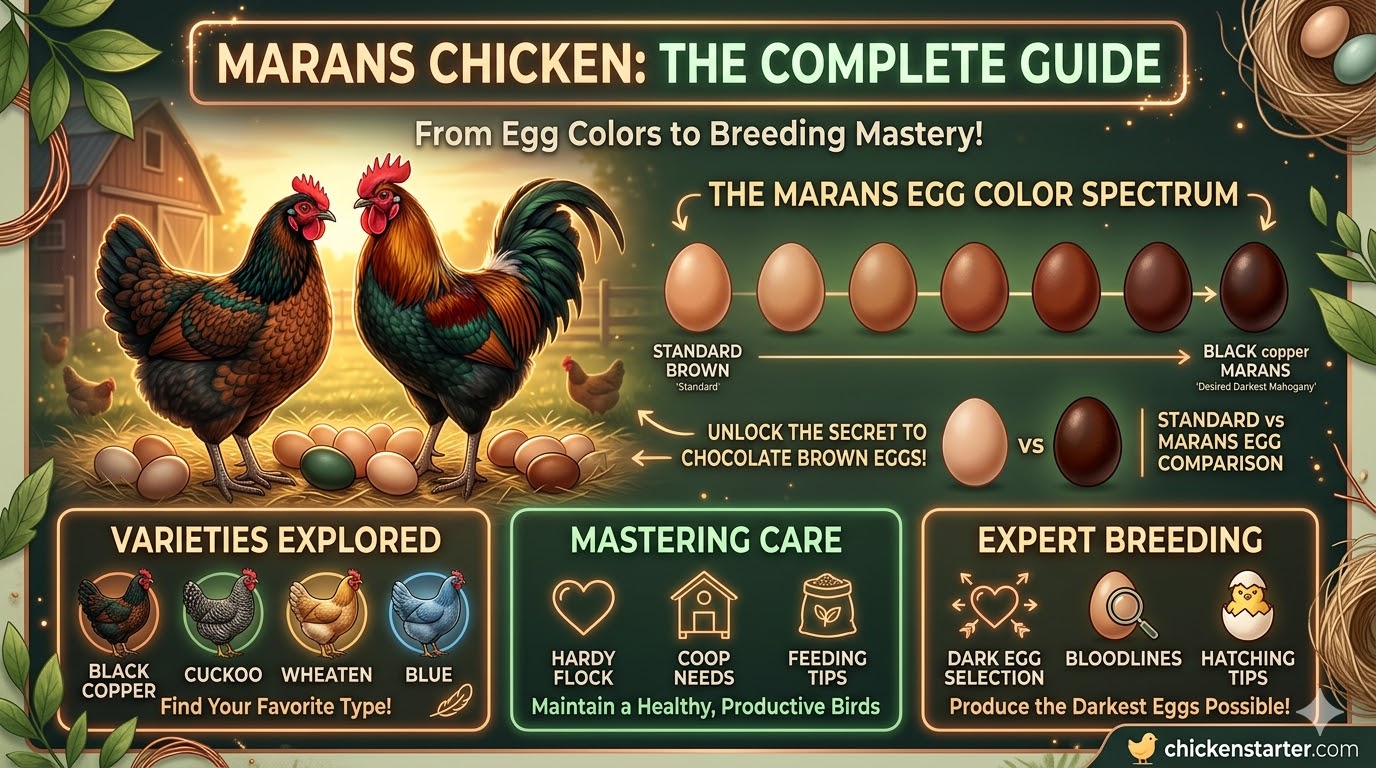
The Marans (always spelled with the “S,” pronounced mah-RAHN in French or mah-RANZ by most Americans) is a dual-purpose French heritage breed famous for laying the darkest chocolate-brown eggs of any chicken in the world. These eggs are so unique they are graded on their own breed-specific color scale from 1 to 9.
You will see this breed spelled both “Marans” and “Maran” across the internet. The correct spelling is always Marans, with the S, because the breed is named after the port town of Marans in the Charente-Maritime region of southwestern France. It is Marans whether you are talking about one bird or a hundred.
I added Black Copper Marans to my flock specifically for those legendary dark eggs. The reality? The eggs are beautiful. But getting consistent chocolate-brown color depends on genetics, source, and timing in ways most Maran chicken guides will not tell you honestly.
This Marans chicken guide covers every recognized variety, the science behind egg color and why it fades, the French vs. English Marans debate, honest hatchery vs. breeder expectations, and everything you need to know before investing in these stunning but sometimes unpredictable birds.
Quick Breed Reference
| Attribute | Details |
|---|---|
| Breed Type | Heritage, dual-purpose (eggs + meat) |
| Origin | Marans, Poitou-Charentes region, western France |
| APA Recognized | Yes (2011 — Black Copper; Wheaten also 2011; White 2014; Black) |
| Egg Color | Dark brown to chocolate — scored on 1-9 Marans color scale |
| Egg Size | Large (65-80g minimum per French standard) |
| Egg Production | 150-200 per year (3-4 per week) |
| Weight | Hens: 6-7 lbs; Roosters: 7-8.5 lbs |
| Lifespan | 5-8 years |
| Temperament | Docile, friendly, active foragers, roosters can be assertive |
| Cold Hardy | Yes — excellent in cold/damp climates |
| Heat Tolerance | Moderate — larger size makes extreme heat challenging |
| Broodiness | Occasional — most commonly in 2nd and 3rd season |
| Comb | Single, medium-sized, red |
| Legs | Feathered (French/APA standard) or clean (English/UK/AU standard) |
| APA Recognized Varieties | Black Copper, Black, Wheaten, White |
| French Recognized Varieties | 10 color varieties |
Marans Chicken Origin: From Medieval Seafarers to James Bond’s Favorite Egg
The history of the Marans is one of the most fascinating origin stories in the entire poultry world. It spans eight centuries, involves cockfighting sailors, a determined French woman, near-extinction in World War II, and a cameo in one of the most famous spy novels ever written.
The Port Town of Marans: Where It All Began
According to The Marans Club, the development of this breed can be traced as far back as the 12th century. In 1152, the marriage of Henri II to Eleanor of Aquitaine increased English trade with southwestern France. Cockfighting was a popular sport among English sailors, and they often brought gamecocks aboard as entertainment during long voyages.
When ships docked at the busy port of Marans, surplus gamecocks were traded or sold for provisions. These imported birds, with their vibrant colors and impressive stature, began mating with the local marsh hens (known as poules du pays, or “country chickens”) that roamed the swampy lands around the town.
For centuries, these crossbred chickens developed naturally in the marshy environment. In the late 1800s, breeds such as the Croad Langshan and Brahma were introduced to the genetic mix, and the Marans began to look more like the breed we know today. According to information from Wikipedia’s breed entry, it is believed the breed derives partly from birds brought by British ships to the port of La Rochelle, partly from local stock.
Standardization and the Dark Egg Legacy
The modern Marans story begins in 1921, when a woman named Marthe Rousseau-Charpentier in the small town of L’Île-d’Elle, near Marans, took it upon herself to formalize the breed. She began selecting for type, egg color, and plumage consistency, initially calling the birds Poule Marandaise.
According to information from The Marans Club, her cuckoo-patterned birds were first exhibited at La Rochelle in 1928. They caught the eye of Mr. Waroquiez, editor of The French Farmer magazine, who published an article in July 1929 that put Marans in the national spotlight.
The French Marans Club was created in September 1929. The first official breed standard was submitted and approved on November 22, 1931.
By 1932, there were six recognized varieties including silver cuckoo, golden cuckoo, black, and black copper neck.
Near-Extinction in World War II and Government Rescue
The Second World War devastated the breed. Germans occupied the Marans region, and many farms were destroyed. Marans were nearly driven to extinction.
According to The Marans Club’s historical record, it took nearly 20 years of dedicated breeding before the Marans made a full comeback. In 1950, a Poultry Cooperative Center was created with the help of the Marans Club and regional agricultural organizations. They practiced trap nesting, maintained individual pedigree records, studied genetics, and shared stock among members.
Without this coordinated rescue effort, the Marans breed may not exist today.
The Journey to America and APA Recognition
Marans are relatively new to North America. The breed did not arrive in significant numbers until the 1990s and early 2000s.
According to an article in Chicken Whisperer Magazine, the Marans Chicken Club USA was successful in getting Black Copper Marans recognized by the American Poultry Association in April 2011, followed by the Wheaten Marans in October of that year. White Marans received APA recognition in 2014. The club has been actively working toward recognition of the Black variety as well.
However, the breed’s early popularity in the United States nearly became its undoing. As the Chicken Whisperer Magazine reported, “enjoying a high demand, profiteers began to breed Marans indiscriminately, even crossing them with other dark brown egg breeds.” This diluted the genetic lines responsible for those coveted dark eggs, a problem that dedicated breeders are still working to correct.
James Bond’s Favorite Egg
Here is a detail that surprises almost everyone. James Bond was a Marans egg man.
In Ian Fleming’s 1957 novel From Russia with Love, Bond’s breakfast is described in meticulous detail. As referenced by Bond Lifestyle, Bond’s single boiled egg was “a very fresh, speckled brown egg from French Marans hens.” Fleming described it as boiled for precisely three and a third minutes, served in a dark blue egg cup with a gold ring around the top.
Bond apparently disliked white eggs and maintained, in his typically fussy way, that there was such a thing as the perfect boiled egg. For the most famous spy in fiction, that meant Marans.
For more on chicken breeds with fascinating histories, check out our guide to Gallus gallus domesticus, the species that includes all domestic chickens, and our Brahma chicken guide, one of the ancestor breeds that helped shape the modern Marans.
Types of Marans Chickens: Every Variety Explained with Egg Color Ratings
Most Marans articles focus exclusively on Black Copper Marans and barely mention that over a dozen varieties exist. That is a disservice to one of the most visually diverse breeds in the poultry world.
According to the Marans Chicken Club USA, the APA currently recognizes four varieties: Black, Black Copper, Wheaten, and White. According to Wikipedia, ten colors are recognized in the French breed standard. And several additional varieties exist outside any standard.
Here is a complete breakdown of every major variety, with egg color ratings on the Marans Egg Color Scale (1 being lightest, 9 being the darkest possible chocolate).
Black Copper Marans: The Star of the Breed
APA Recognized: Yes (2011) Typical Egg Color Scale: 6 to 9 (darkest of all varieties) Availability: Rare, high demand
The Black Copper Marans is the most sought-after variety and the one most people picture when they hear the name. Males have striking iridescent black plumage with fiery copper feathering on the hackles and saddle. Females are predominantly black with copper markings on the head and neck.
Of all Marans varieties, Black Copper are noted for laying the darkest eggs. According to a detailed explanation from Chicken Experts, the Black Copper hen is slightly less productive than other Marans varieties when it comes to egg quantity, which means she has more pigment available per egg, hence the darkest shade of chocolate.
This is the variety I keep, and the egg color from my breeder-sourced birds consistently hits a 6 to 7 on the scale. The color is rich, warm, and unlike anything else in my egg basket.
Wheaten Marans: The Underrated Beauty
APA Recognized: Yes (2011) Typical Egg Color Scale: 5 to 8 Availability: Rare
Wheaten Marans are among the most visually stunning chickens you will ever see. The sexual dimorphism is dramatic. Hens have gorgeous creamy wheat-colored plumage that shades to golden brown in the hackles, with darker wing tips and tail feathers. Roosters look completely different, with fiery red-gold hackles over an ebony body.
Multiple keeper reports describe Wheaten Marans as having the calmest, friendliest temperament of all the varieties. Even the roosters are generally peaceful.
Cuckoo and Silver Cuckoo Marans: The Most Common (But Not APA Recognized)
APA Recognized: No (despite multiple attempts) Typical Egg Color Scale: 3 to 6 Availability: Most common variety in the United States
If you have bought “Marans” from a large hatchery in the US, there is a good chance you received Cuckoo Marans. According to My Pet Chicken and Oklahoma State University’s breed database, Silver Cuckoo is the most available Marans plumage in North America.
Cuckoos look similar to Barred Plymouth Rocks with their dark and light barring pattern. They are excellent birds, hardy and reliable. However, their egg color tends to be lighter than Black Copper, typically in the 3 to 6 range.
According to information from Thrifty Homesteader, the sticking point on standardizing the Cuckoo variety is a question over leg feathering. Allowing clean legs makes it easier to breed for dark eggs, but French Marans purists believe feathered shanks are a key feature of the breed.
White Marans
APA Recognized: Yes (2014) Typical Egg Color Scale: 4 to 7 Availability: Rare
White Marans have clean, bright white feathers. According to Thrifty Homesteader, White Marans were created in the 1960s for use as commercial meat chickens. In roosters, minor straw-colored variation around the neck is acceptable.
Other Notable Varieties
Blue Copper Marans are growing in popularity. They have a beautiful blue-gray body with copper hackles, similar to Black Copper but with the blue dilution gene. Typical egg color falls in the 5 to 8 range.
Splash Marans have light gray or white plumage with darker splotches. They are visually striking but, according to Rose Hill Farm, maintaining dark egg color in birds carrying dilution genes is extremely difficult.
Birchen Marans feature a silver-laced pattern on black plumage and can produce eggs in the 5 to 8 range. Golden Cuckoo, Columbian, Black-Tailed Buff, and Crele varieties also exist, though they are very rare in North America.
If you are building a rainbow egg basket, our guides on what chicken lays blue eggs and what chicken lays pink eggs will help you round out the colors.
Marans Chicken Egg Color: The Science, the Scale and Why They Fade
The Marans chicken egg color is the single most discussed, most photographed, and most misunderstood aspect of the breed. This section gives you the real science, the official grading system, and honest expectations.
The Marans Egg Color Scale: 1 to 9, Explained
The Marans Club of France developed a breed-specific color scale for grading egg darkness, numbered 1 to 9.
According to information from the French Marans Club Australia, here is what each level means:
1 to 3: These do not qualify as true Marans eggs. If a bird does not routinely produce eggs darker than 4 on the color chart, it is not considered a proper Marans.
4 to 5: A good, solid dark brown. This is what most hatchery-sourced Marans produce consistently.
5 to 7: Extra dark russet-red eggs, often described as “chocolate.” The French standard notes that these eggs typically have a globular shape and a noticeable sheen or brightness.
8 to 9: Exceptional or even accidental. The French Marans Club Australia notes that these eggs approach “the colour of an unalloyed pigment” and are typically only seen at the very beginning of a hen’s laying cycle.
Important: Top breeders aim for consistent 6 to 7 ratings. Even champion lines rarely sustain 8 to 9 beyond the first few eggs of each laying cycle.
The Science Behind the Dark Color: Protoporphyrin IX
Here is something most people do not realize. Every Marans egg starts out white. All chicken eggshells are made primarily of calcium carbonate, which is white.
According to research published on PubMed, the major pigment in eggshells of brown-egg laying hens is protoporphyrin IX. This reddish-brown pigment is synthesized in the shell gland (the uterus of the hen’s oviduct) and deposited onto the shell surface during the final stages before the egg is laid.
In most brown-egg breeds, only a thin layer of protoporphyrin is deposited, creating a light tan or medium brown. In Marans, multiple dense layers of pigment are deposited, creating that rich chocolate coloration.
And here is the remarkable part that surprises almost everyone: you can wash the color off a fresh Marans egg. The pigment sits on the outermost layers of the shell and in the cuticle. If you scrub a freshly laid Marans egg under water, the dark brown washes away, revealing a lighter shell underneath. This is also why experienced Marans breeders use extra-soft bedding in their nesting boxes. Rough bedding can scrape the pigment off before you even collect the egg.
Why Marans Eggs Get Lighter Over Time: The Printer Ink Analogy
The single most important thing to understand about Marans egg color is this: eggs get lighter as the hen lays more of them.
Think of it like a printer running out of ink. According to information from Fresh Eggs Daily, the very darkest eggs you receive from your Marans hen will be her first egg, and the eggs will lighten ever so slightly with each subsequent egg until her annual molt.
After the molt, the hen’s reproductive system resets, and you will see her darkest egg again. But year over year, even that post-molt “reset” will not be quite as dark as year one.
According to the Marans Club of France’s official egg guidance, you cannot properly judge a hen’s egg color quality until she has laid at least a dozen eggs, because the first few can be a darker color she will not reproduce again in her laying life.
Several factors influence the color cycle:
Time in the laying sequence. The first egg laid after a rest day is always the darkest. In a series of 3, 4, or 5 consecutive eggs, the first is deepest.
Season. According to the Chicken Whisperer Magazine, egg color is at its darkest during cooler months and fades when temperatures increase during summer.
Laying frequency. The fewer eggs a Marans hen lays, the darker those eggs will be. This is the fundamental trade-off of the breed.
Age. First-year pullet eggs are darkest. Color gradually declines in subsequent seasons.
Stress and environment. Changes in location, weather extremes, or flock disruption can cause lighter eggs.
Hatchery vs. Breeder: Managing Egg Color Expectations
This is the section most Marans guides avoid because it is uncomfortable. But I want to be honest with you.
According to Thrifty Homesteader’s breed profile, due to the high demand and low availability of quality Black Copper Marans, many chicks sold as Black Copper Marans do not grow up to lay those coveted chocolate eggs. Novice breeders who do not know how to manage the breed’s complex genetic history are producing birds with diluted egg color genetics.
If you buy Marans from a large hatchery expecting level 8 or 9 chocolate eggs, you may be disappointed. Hatchery birds typically produce eggs in the 4 to 6 range on the color scale. According to Cackle Hatchery’s own product listing, their French Black Copper Marans eggs are “often ranked between #4 and #6 on the Marans egg color scale.”
For consistently dark eggs in the 6 to 8 range, buy from a dedicated Marans breeder who selects specifically for egg color. Expect to pay significantly more. According to the Chicken Whisperer Magazine, hatching eggs from quality breeders typically run $75 to $100 per dozen, not including shipping. Specialty breeders like Greenfire Farms, who import champion lines directly from France, charge premium prices for their stock.
According to the Meyer Hatchery Blog, keep in mind that social media photos may be somewhat unrealistic, as some photographers use filters to enhance egg color.
My recommendation: If you want Marans primarily for beautiful dark eggs, invest in breeder stock. If you want a good, friendly, dual-purpose bird that lays reasonably dark brown eggs and you are not obsessing over a specific shade number, hatchery birds are perfectly fine.
For more on egg production and management, see our guides on eggs from backyard chickens, why chickens stop laying eggs, and chicken behavior before laying their first egg.
French Marans vs. English Marans: What Is the Difference and Why It Matters
This is the single most confusing aspect of Marans ownership, and virtually no other guide explains it clearly. Here is the definitive comparison.
French Marans have feathered shanks and outer toes. This is the original breed type developed in France. The American Poultry Association only recognizes French-style feathered-leg Marans. According to Poultry Keeper, the APA has stated that feathered shanks are mandatory and a clean-shanked bird will not be accepted.
English Marans have clean legs with no feathering. The Poultry Club of Great Britain recognizes clean-legged Marans as its primary standard.
Here is the critical detail that most articles miss. According to Wikipedia’s entry on the breed, the Poultry Club of Great Britain states that the British Marans derives from cross-breeding of a variety of breeds including the Braekel, Coucou de Malines, Coucou de Rennes, Croad Langshan, Gâtinaise, Faverolles, and Barred Plymouth Rock. The English Marans “may be a distinct breed, unconnected to the French Marans.”
This is not just a cosmetic difference. English and French Marans may have genuinely separate genetic histories.
What this means for you in different countries:
In the United States, buy feathered-leg Marans if you plan to show. The APA does not recognize clean-legged birds. Many hatchery Cuckoo Marans are sold with clean legs, which are technically not to APA standard.
In the United Kingdom, clean-legged English Marans are the standard. Feathered shanks are considered a fault.
In Australia, according to the French Marans Club Australia, both types are acknowledged, with the French feathered-leg version following the original standard.
According to the Meyer Hatchery Blog, having the word “French” in front of the breed name does not indicate more or less leg feathering. All Marans originate from France. A “French Black Copper Marans” and a “Black Copper Marans” are the same breed.
Marans Chicken Egg Production: How Many Eggs and When Do They Start Laying?
Let me set realistic expectations. The Marans is not a production breed. It was never designed to be one. It is a heritage dual-purpose bird, and egg numbers reflect that.
Realistic egg production for a healthy Marans hen is 150 to 200 eggs per year, which works out to roughly 3 to 4 eggs per week. According to multiple keeper reports, experienced breeders typically see around 170 per year on average.
And here is the critical trade-off that defines this breed: birds that are better layers generally have poorer shell color. According to the breeding advice on Poultry Keeper, improving on only egg production or only egg color nearly always causes a decline in the other. They are opposing selection forces.
Point of lay is another area where expectations need managing. Most hatcheries advertise that Marans start laying at 5 to 6 months. In my experience, and according to multiple breeder reports, Marans take longer to mature than that. Seven to nine months (28 to 36 weeks) is more realistic for many individuals, particularly in the larger varieties and during cooler months.
According to information from My Pet Chicken, while Black Copper Marans typically start laying around 25 weeks, some can begin a little sooner.
Productive life extends to about 6 years, during which a good hen may lay 700 or more eggs in her lifetime.
For more on egg laying expectations, see our guides on chicken nesting box setup and what happens if you don’t collect eggs every day.
Marans Chicken Meat: Are They Good Dual-Purpose Birds?
In France, Marans have been valued for both eggs and meat since the breed’s inception. This dual-purpose heritage is sometimes forgotten in the egg-color obsession.
According to Oklahoma State University’s breed database, the Marans is a large, heavy chicken typically weighing 7 to 8 lbs, kept for both meat and egg production. My Pet Chicken’s breed profile puts mature hens at 6.5 to 8 lbs and roosters at 8.5 to 9.5 lbs.
According to Rose Hill Farm, the quality of meat produced by Marans is unmatched, with an exquisite texture and flavor that makes it quite distinct among heritage chickens.
That said, Marans mature significantly slower than dedicated meat breeds like Cornish Cross. If your primary goal is maximum meat production in the shortest time, choose a purpose-bred meat bird. If you want a bird that provides beautiful eggs and excellent meat with superior flavor, Marans deliver on both fronts.
For comparison with another large dual-purpose breed, check out our Jersey Giant chicken guide.
Marans Chicken Temperament: Friendly but Not Lap Chickens
Marans have a temperament that sits in a sweet spot for most keepers. They are friendly enough to follow you around the yard clucking excitedly, but independent enough that they do not demand constant handling.
According to My Pet Chicken’s breed profile, Marans are not typically known for being flighty or nervous. They tend to get along well with other chicken breeds, making them a good choice for mixed flocks. The Meyer Hatchery Blog describes them as generally quiet and very calm.
But do not expect a lap chicken. According to the review from Practical Self Reliance, while Marans are friendly and will follow you around the yard, they do not especially love to be handled or touched. Most people are happy enough to have a friendly chicken follow them for treats.
Variety-specific temperament notes: Wheaten Marans are widely reported as the calmest variety. Multiple keepers observe that Blue and Blue Copper varieties tend to be friendlier than solid Black birds, though individual personality always varies.
A word about roosters. Because of the gamecock genetics in the breed’s ancestry, Marans roosters can be assertive, particularly during breeding season. They should not be left unsupervised around small children. But many keepers report their Marans roosters as stately and non-aggressive.
Marans chicks are not autosexing. According to Practical Self Reliance, vent sexing is particularly difficult for Marans. Their batch of 7 “hens” ended up including 3 roosters. Be prepared for accidental roosters when buying chicks.
For more on flock dynamics, see our guides on pecking order problems and do chickens recognize their owners.
How to Care for Marans Chickens: Coop, Feed and Special Requirements
Feathered Legs Mean Extra Coop Attention
The most important care consideration specific to Marans is their feathered legs. Those lovely feathered shanks trap mud, moisture, and debris far more easily than clean legs.
Muddy runs are the number one enemy of feathered-leg breeds. Wet, matted foot feathers create a breeding ground for scaly leg mites and increase the risk of bumblefoot.
Use deep bedding in the coop, keep runs well-drained with sand or gravel, and consider covered runs in wet climates. Our guide on the best thing to put in the bottom of a chicken run and best flooring for muddy coops cover solutions in detail.
Climate Hardiness
Marans originated in the damp, marshy coastal lowlands of western France. They are excellent in cold and wet climates. Their dense, tight feathering provides strong insulation.
However, their single comb is vulnerable to frostbite in extreme cold. If you are in a northern climate with temperatures well below freezing, take precautions. Our guide on preventing and treating frostbite on chicken combs covers exactly what to do.
In hot climates, their larger body size makes extreme heat more challenging. Provide shade, fresh water, and good ventilation. They are not as heat-tolerant as lighter Mediterranean breeds like Leghorns.
Feeding for Optimal Egg Color
Standard 16% protein layer feed is the base diet. Free-range foraging enhances overall health and may support egg quality. Supplemental calcium via oyster shell is essential for strong shells. Our calcium guide for chickens covers this in depth.
According to Rose Hill Farm, providing supplemental protein can make a noticeable difference in egg color and size, especially during summer. Some breeders supplement with cooked eggs, alfalfa, or meat scraps a few days before collecting hatching eggs.
For a complete feeding overview, see our comprehensive chicken feeding guide.
Marans Chicken Health: Common Issues and Preventative Care
Marans are generally hardy birds with no breed-specific diseases. Their marsh-bred origins gave them robust constitutions.
However, there are several health considerations unique to the breed.
Feathered leg issues are the most common. Scaly leg mites are harder to detect and treat on feathered legs because the feathers hide the symptoms. Regular inspections are critical. See our guide on mites and lice on chickens for prevention and treatment.
Single comb frostbite is a risk in severe winters. Apply petroleum jelly to combs before cold snaps.
Incubation challenges are unique to Marans. According to Fresh Eggs Daily, Marans eggshells have smaller pores than other breeds and thicker shells and inner membranes. This makes the eggs stay fresher longer, but it also makes incubation harder. The dark shells make candling difficult, and the thicker shells can delay hatching or cause some chicks to fail to pip. Experienced breeders adjust humidity levels and wait until day 17 to candle.
Sexing difficulty means you should expect surprises. Plan for what you will do with accidental roosters before buying chicks.
For general health monitoring, our guide on how to tell if a chicken is sick covers the warning signs.
How to Breed Marans for Darker Egg Color
If you want to improve the egg color in your Marans flock over time, selective breeding is essential. This is not a set-it-and-forget-it proposition. Dark egg color must be actively maintained with every generation.
According to breeding guidance from Poultry Keeper, you should only select the darkest brown eggs to hatch. Breeding from hens and cocks that come from dark brown eggs themselves will help you concentrate the dark-egg genes in your strain.
The rooster matters enormously. According to the Marans Club of France’s egg research, there is evidence that cocks may be more effective at transmitting dark-egg genes in the first generation than hens. Choose a rooster from a lineage known for consistently dark eggs.
The fundamental rule: A breeder attempting to increase egg production will almost certainly sacrifice egg color. And once dark egg color is lost, it is very difficult to regain. Be clear about your priorities before breeding.
According to Greenfire Farms, they had their Black Copper Marans breeding flocks genetically tested in 2024 to ensure their breeders do not carry the white recessive gene. This level of genetic management shows how seriously top breeders approach Marans reproduction.
Practical breeding tips:
Hatch from the darkest eggs your hens produce, but time your collection to early in the laying season when color is strongest.
According to Poultry Keeper, it is advisable to hatch eggs laid very early and very late in the season. Hens that extend their laying season are usually your best layers.
Only hatch eggs of the proper shape and size. Hatching oddly shaped eggs perpetuates those traits.
Accept that incubation success rates will be lower than other breeds due to the thicker shells.
For incubation equipment, see our reviews of the best chicken egg incubators for beginners and our Brinsea vs. Nurture comparison.
Where to Buy Marans Chickens: Hatcheries, Breeders and What to Expect to Pay
Where you buy your Marans has a bigger impact on egg color than almost any other factor. Here is an honest pricing breakdown.
Large hatchery chicks (Cackle Hatchery, Meyer Hatchery, My Pet Chicken) typically cost $5 to $15 per chick. These birds are healthy, well-started, and perfectly good backyard chickens. However, egg color is usually in the 4 to 6 range on the Marans scale.
Hatching eggs from breeders are the most economical way to get quality genetics. According to the Chicken Whisperer Magazine, expect to spend $75 to $100 per dozen for eggs from a quality breeder, plus shipping. Shipped eggs have lower hatch rates, so factor that in.
Breeder chicks and started pullets from dedicated Marans breeders typically run $25 to $75+ per chick depending on bloodline quality.
Show and champion line stock from breeders like Greenfire Farms or birds from direct French imports can cost $50 to $200+ per chick or $100+ per dozen hatching eggs.
According to the Chicken Whisperer Magazine, the best advice for new Marans fanciers is to do your research before you even think about getting birds. Visit the Marans Chicken Club USA website to study the standard and connect with reputable breeders.
For overall cost planning, see our guides on the cost to raise chickens for the first year and the real cost of 6 chickens.
Marans Chicken Pros and Cons: Is This the Right Breed for You?
Pros:
The most beautiful, unique egg color of any chicken breed. A genuine heritage breed with a fascinating eight-century history. True dual-purpose, providing excellent eggs and superior-quality meat. Friendly, docile temperament that works well in mixed flocks. Excellent cold and damp hardiness from their French marshland origins. Active foragers that reduce feed costs. Multiple stunning varieties to choose from. Breed true, unlike hybrids, so you can start your own breeding program.
Cons:
Moderate egg production of 150 to 200 per year, making them far from the most prolific layers. The direct trade-off between laying frequency and egg color means you cannot maximize both. Dark egg color is not guaranteed and depends heavily on genetics and source. Hatchery birds often disappoint on egg color expectations. Slow to mature, with first eggs often not arriving until 7 to 9 months. Difficult to sex as chicks, meaning you should expect accidental roosters. Roosters can be assertive due to gamecock ancestry. Feathered legs require extra maintenance in wet climates. Premium pricing for quality breeding stock.
According to Rose Hill Farm, “if a bird does not routinely produce eggs darker than 4 on the egg color chart then it is not a Marans. Period.” The breed’s identity is inseparable from its eggs.
If you are looking for a breed that produces 300+ eggs per year, Marans are not the right choice. If you are looking for a bird that lays eggs so beautiful they stop people in their tracks, has a rich history, provides excellent meat, and rewards dedicated breeding with increasingly stunning results, Marans may be exactly what your flock needs.
Frequently Asked Questions About Marans Chickens
What color eggs do Marans chickens lay?
Marans lay dark brown to chocolate-brown eggs, graded on a breed-specific color scale from 1 to 9. Black Copper Marans typically score 6 to 9 (darkest), while Cuckoo Marans score 3 to 6. The color comes from a pigment called protoporphyrin IX deposited on the shell surface right before laying. Remarkably, this pigment can actually be washed off with water.
How many eggs do Marans lay per year?
Realistically, 150 to 200 eggs per year, working out to 3 to 4 per week. Hatcheries sometimes advertise higher numbers, but experienced breeders report closer to 170 on average. There is a direct trade-off: hens that lay more frequently produce lighter-colored eggs.
Is it “Maran” or “Marans”?
Always Marans, with the S, whether referring to one bird or many. The breed is named after the French port town of Marans. The S is part of the proper name and is always present. In French, the S is silent.
What is the difference between French and English Marans?
French Marans have feathered legs and follow the original French breed standard. English Marans have clean legs. The APA in the United States only recognizes French-style feathered-leg Marans. The UK primarily recognizes clean-legged English Marans. According to the Poultry Club of Great Britain, they may be genetically distinct breeds.
Are Marans good for beginners?
Yes, with realistic expectations. They are docile, hardy, and easy to care for. However, beginners focused purely on high egg production or expecting guaranteed chocolate-dark eggs may be frustrated by the moderate laying rate and variable egg color, especially from hatchery stock.
How long do Marans chickens live?
5 to 8 years on average, with hens remaining productive layers for about 6 years.
Are Marans chickens good for meat?
Yes. Marans are a genuine dual-purpose breed. Roosters reach 8.5 to 9.5 lbs and hens 6.5 to 8 lbs. The meat quality is considered excellent, particularly valued in French cuisine. They mature more slowly than dedicated meat breeds, but the flavor is superior.
Why are my Marans eggs not dark?
Several factors affect egg color: genetics (hatchery birds often lack concentrated dark-egg genetics), hen age (eggs lighten as she lays more), season (cooler months produce darker eggs), laying frequency (fewer eggs equals darker pigment per egg), and individual variation. For consistently dark eggs, buy from a breeder who selects specifically for egg color across multiple generations.
Key Takeaways
Marans lay the darkest brown eggs of any chicken breed, scored on a unique 1 to 9 color scale. The color comes from protoporphyrin IX pigment deposited in the final moments before laying.
It is a heritage French breed with a remarkable history spanning medieval seafarers, a determined woman breeder in the 1920s, near-extinction in World War II, and government rescue.
More than 10 varieties exist. Black Copper is most popular, but Wheaten, Cuckoo, Blue Copper, and others are all stunning in their own ways. Four varieties are currently APA recognized.
This is a true dual-purpose breed that provides beautiful eggs and excellent meat.
Egg color varies hugely by source. Breeder stock will produce dramatically darker eggs than hatchery stock. Set your expectations accordingly and invest in quality genetics if dark eggs are your priority.
Always spelled Marans with the S.
Looking to build a rainbow egg basket? See our guides to Easter Egger chickens, Ameraucana chickens, and what chicken lays blue eggs. If you are just starting your flock and want to compare breeds, our easiest chicken breeds for beginners guide is the best place to start.
This article draws on historical information from The Marans Club, breed standard data from the Marans Chicken Club USA and the French Marans Club Australia, egg science from Poultry Keeper, breed profiles from Oklahoma State University, and direct hands-on experience raising Marans in a backyard flock. All facts were verified against current published sources as of March 2026.

Oladepo Babatunde is the founder of ChickenStarter.com. He is a backyard chicken keeper and educator who specializes in helping beginners raise healthy flocks, particularly in warm climates. His expertise comes from years of hands-on experience building coops, treating common chicken ailments, and solving flock management issues. His own happy hens are a testament to his methods, laying 25-30 eggs weekly.