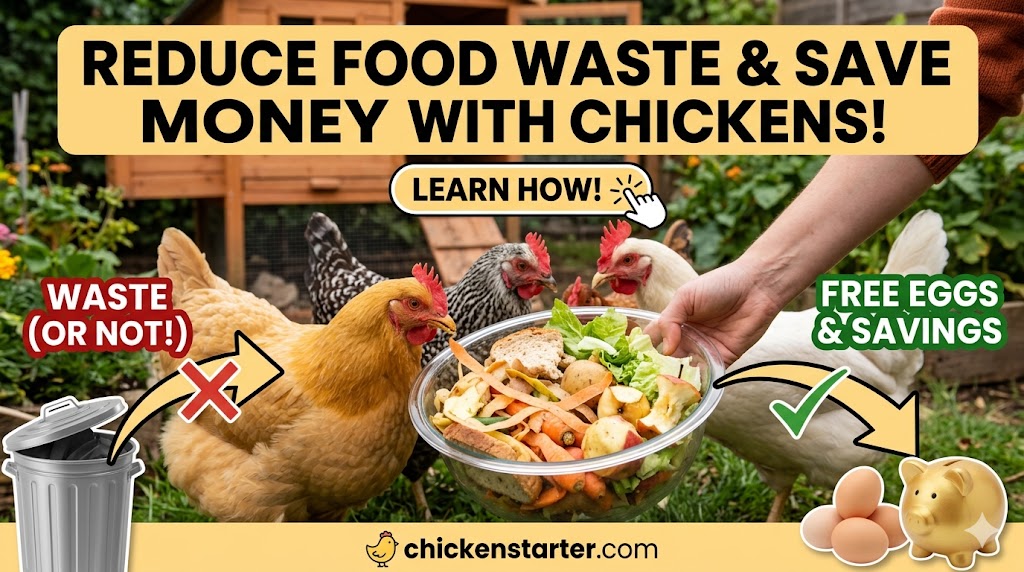
The average American household throws away roughly 30 to 40 percent of its food supply every year. That is hundreds of pounds of fruit peels, vegetable scraps, stale bread, leftover rice, and wilted greens going straight into the trash or down the garbage disposal. It costs the typical family between $1,500 and $2,000 annually in wasted groceries, and it fills landfills with organic matter that produces methane as it decomposes.
Backyard chickens are one of the simplest, most practical solutions to this problem. A small flock of hens will eagerly consume a surprising variety of kitchen scraps that would otherwise end up in your garbage, converting that waste into fresh eggs, rich garden compost, and natural fertilizer. It is recycling in its most satisfying form.
I started keeping chickens about four years ago, and one of the things that genuinely surprised me was how dramatically our household waste dropped. Before chickens, we filled our kitchen trash bin twice a week. After chickens, we barely fill it once. Vegetable trimmings, fruit past its prime, leftover oatmeal, stale cereal, and dozens of other scraps now go to the flock instead of the landfill. And in return, we get eggs that are fresher and better than anything we could buy at a store.
This guide covers exactly how backyard chickens reduce food waste, what scraps they can and cannot eat, how much waste a small flock can realistically process, and the broader environmental and financial benefits of closing this loop in your household.
How Much Food Waste Can Chickens Actually Handle?
A single laying hen eats approximately 1/4 to 1/3 pound of food per day, or roughly 1.5 to 2 pounds per week. Most of that should come from a complete layer feed that provides the balanced nutrition hens need for health and egg production. But a meaningful portion, generally 10 to 15 percent of their daily intake, can come from kitchen scraps and food waste without disrupting their nutritional balance.
For a small flock of 4 to 6 hens, that translates to roughly 1 to 2 pounds of kitchen scraps per day that your chickens can consume on top of their regular feed.
According to data referenced by the U.S. Environmental Protection Agency, food scraps and yard waste together make up more than 30 percent of what Americans throw away, and much of that organic material could be composted or otherwise diverted from landfills. Backyard chickens offer a living, productive alternative to composting for a significant portion of that food waste.
In my household of four people, we generate roughly 2 to 3 pounds of food scraps daily. My flock of 14 hens handles nearly all of it. The small amount they do not eat (onion skins, citrus peels, coffee grounds) goes into our compost bin. Between the chickens and the compost pile, our food waste going to the landfill has dropped to almost zero.
What Kitchen Scraps Can Chickens Eat?
Chickens are omnivores with a remarkably broad diet. They will eat most of the food scraps that a typical household produces. Here is a detailed breakdown of what is safe and beneficial.
Fruits
Chickens love fruit, and most common fruits are perfectly safe. Watermelon rinds and flesh, strawberry tops, blueberries, bananas and banana peels, apples (remove the seeds, which contain small amounts of cyanide compounds), grapes (cut in half for smaller birds), and pumpkin flesh and seeds are all excellent options.
Overripe fruit that you would not eat yourself is ideal for the flock. That bruised peach or the slightly soft bunch of grapes sitting in the back of your fridge is a perfect chicken treat instead of trash.
Vegetables
Most vegetables and vegetable scraps are safe. Leafy greens like lettuce, kale, spinach, and cabbage are flock favorites. Cucumbers, zucchini, carrots and carrot tops, sweet potatoes (cooked), corn on or off the cob, broccoli stems, cauliflower leaves, celery, and bell peppers are all fair game.
Vegetable trimmings that you would normally throw away, such as the ends of green beans, the outer leaves of cabbage, carrot peels, and cucumber ends, are exactly the kind of food waste that chickens eliminate from your trash.
Grains, Bread, and Starches
Stale bread, leftover cooked rice, cooked pasta, oatmeal, and unsweetened cereal can all go to the flock in moderation. These are calorie-dense foods, so keep portions small to avoid weight gain and nutritional imbalance. A handful of stale bread torn into pieces for a flock of six is a treat, not a meal replacement.
Cooked potatoes are fine. Raw potatoes and green potato skins should be avoided because they contain solanine, a toxic glycoalkaloid.
Protein Sources
Chickens are not strict vegetarians. They naturally eat insects, worms, and small animals when foraging. Cooked eggs (scrambled or hard-boiled), mealworms, small amounts of cooked meat scraps, and cottage cheese or plain yogurt are all safe protein-rich treats.
Feeding cooked eggs back to your flock might sound strange, but it is an excellent way to use cracked or surplus eggs. Just make sure to cook them first so hens do not develop a taste for raw eggs in the nesting box.
Dairy
Small amounts of plain yogurt, cottage cheese, and hard cheeses are fine as occasional treats. Most chickens enjoy yogurt, and the probiotics may support gut health. However, chickens have limited ability to digest lactose, so keep dairy portions small and infrequent.
What You Should Never Feed Chickens
Not everything from your kitchen is safe. These items are toxic or harmful and should never go to the flock:
- Avocado pits and skins (contain persin, which is toxic to birds)
- Raw or dried beans (contain phytohaemagglutinin, a dangerous lectin; cooked beans are safe in small amounts)
- Chocolate and anything containing caffeine
- Onions and garlic in large quantities (small amounts are debated, but large quantities can cause hemolytic anemia)
- Raw green potato skins and green tomatoes (solanine toxicity)
- Rhubarb leaves (contain oxalic acid)
- Heavily processed, salty, or sugary foods (chips, candy, fast food)
- Moldy or rotten food (some molds produce mycotoxins that are dangerous to poultry)
- Alcohol in any form
For a comprehensive guide to what chickens can and cannot eat from your kitchen, including specific fruits and vegetables, our article on what can chickens eat from your kitchen covers everything in detail.
The Full Cycle: From Food Waste to Fresh Eggs
What makes backyard chickens uniquely powerful as a food waste solution is that they do not just eliminate waste. They transform it into something valuable.
Kitchen Scraps Become Eggs
Every scrap your chickens eat contributes to the nutrients they need for egg production. A well-fed laying hen produces 4 to 6 eggs per week depending on breed, age, and season. While commercial layer feed provides the core nutrition, the vitamins, minerals, and variety from kitchen scraps supplement that diet and can contribute to richer yolk color and stronger shells.
My hens produce noticeably deeper orange yolks during the months when they get the most diverse scraps, particularly dark leafy greens, pumpkin, and berries. The difference compared to store-bought eggs is visible the moment you crack one open.
A flock of 6 hens producing an average of 4 eggs per day gives you roughly 28 eggs per week, which is more than enough for most families and often enough to share with neighbors or sell at a local farmers market.
Manure Becomes Compost and Fertilizer
Chicken manure is one of the richest natural fertilizers available. It is high in nitrogen, phosphorus, and potassium, the three primary nutrients plants need. When composted properly for 3 to 6 months, chicken manure becomes a safe, nutrient-dense amendment for garden beds, fruit trees, and flower gardens.
The scraps you feed your chickens pass through the birds and become manure, which you then compost and apply to your garden, which grows more food, some of which generates more scraps, which feed the chickens again. It is a genuinely closed-loop system that reduces waste at every stage.
Foraging Reduces Feed Costs and Pest Populations
Chickens that free-range or have access to a planted run will supplement their diet with insects, grubs, weeds, and grass. This natural foraging behavior reduces your feed costs, controls pest populations in your yard, and provides the birds with exercise and mental stimulation.
Ticks, grasshoppers, beetles, slugs, and even small mice are all on the menu for a foraging chicken. If you have ever dealt with a tick problem in your yard, a flock of chickens is one of the most effective and chemical-free solutions available.
For more on encouraging this behavior, our guide on how to encourage natural foraging in chickens covers habitat setup and planting ideas.
The Environmental Impact of Diverting Food Waste to Chickens
Reducing food waste is not just a household convenience. It has real environmental significance.
When food waste decomposes in a landfill, it produces methane, a greenhouse gas that is roughly 80 times more potent than carbon dioxide over a 20-year period according to data from the EPA. Diverting food scraps to backyard chickens instead of sending them to the landfill directly reduces methane emissions from your household.
A family that diverts 2 pounds of food scraps per day to their flock keeps approximately 730 pounds of organic waste out of the landfill each year. Multiply that across the estimated 10 to 15 million households in the United States that now keep backyard chickens, and the collective impact is substantial.
There is also a secondary environmental benefit. Every egg your flock produces is one less egg that needs to be commercially produced, packaged, refrigerated, and transported. The carbon footprint of a backyard egg is a fraction of a commercially produced one, especially when the hen’s diet includes kitchen scraps that would have been wasted anyway.
The Financial Benefits of Feeding Scraps to Chickens
Let me be honest about something. Raising backyard chickens is not always cheaper than buying eggs at the grocery store, especially in the first year when you are paying for coop construction, equipment, and chicks. But feeding kitchen scraps to your flock is one of the most effective ways to reduce ongoing feed costs and tilt the economics in your favor.
How Much Can You Save on Feed?
A 50-pound bag of quality layer feed costs between $18 and $35 depending on brand, formulation, and location. A flock of 6 hens goes through roughly one bag every 5 to 6 weeks.
If kitchen scraps replace 10 to 15 percent of your flock’s daily food intake, you are stretching each bag of feed by an extra week or more. Over the course of a year, that adds up to 2 to 3 fewer bags of feed, saving you $40 to $100 annually.
That might not sound dramatic, but combined with the $1,500 to $2,000 your household saves by not throwing away the food scraps themselves, the total financial picture is genuinely compelling.
For a detailed look at feed costs and how to manage them, our article on chicken feed calculator and cost guide helps you budget accurately.
The Egg Offset
At current grocery store prices, a dozen free-range eggs costs $4 to $7 depending on your location. A flock of 6 hens producing 28 eggs per week generates the equivalent of roughly 2.3 dozen eggs per week, or about 120 dozen per year.
At the low end of retail egg prices, that is roughly $480 to $840 worth of eggs your flock produces annually. Factor in the reduced feed costs from kitchen scrap supplementation, and the financial case for backyard chickens gets stronger every year after the initial setup investment.
How to Set Up a Kitchen Scrap Feeding System
Turning your kitchen waste into chicken feed does not require anything complicated. Here is the simple system I use.
The Scrap Bucket
Keep a dedicated container on your kitchen counter or under the sink for chicken-safe scraps. I use a 1-gallon stainless steel compost pail with a lid. Throughout the day, vegetable trimmings, fruit scraps, leftover grains, and other safe items go into the bucket.
Empty the bucket to the chickens every morning or evening. Do not let scraps sit for more than 24 to 48 hours, especially in warm weather, because decomposing food attracts fruit flies and can develop mold.
Feeding Method
I scatter scraps directly on the ground in the run rather than putting them in the feeder. This encourages natural scratching and foraging behavior, keeps the birds active, and prevents scraps from contaminating the regular feed.
For larger items like whole watermelon rinds, halved pumpkins, or cabbage heads, I hang them from a string or place them in a wire basket. This gives the hens something to peck at throughout the day, which provides mental enrichment and reduces boredom-related behaviors like feather picking.
The 10 to 15 Percent Rule
Kitchen scraps should make up no more than 10 to 15 percent of your flock’s total daily food intake. The rest should come from a nutritionally complete layer feed that provides the protein (16 to 18 percent), calcium, and vitamins hens need for consistent egg production and overall health.
Think of scraps as treats and supplements, not as a primary diet. A hen fed mostly scraps will produce fewer eggs, lay thinner-shelled eggs, and be more susceptible to nutritional deficiencies.
For a broader look at building a balanced feeding plan, our guide on a comprehensive guide to feeding your chickens covers macronutrients, supplements, and feeding schedules.
Common Concerns About Feeding Kitchen Scraps
Will scraps make my chickens stop eating their regular feed?
Not if you follow the 10 to 15 percent guideline. Offer scraps as a supplement, not a replacement. I give my flock their scraps in the afternoon after they have had access to their regular feeder all morning. By the time the treats arrive, they have already eaten most of their daily feed ration.
Will kitchen scraps attract rats and mice?
They can if scraps are left uneaten overnight. Remove any uneaten scraps before dark. Do not leave food sitting in the run or coop after the flock has gone to roost. This is good practice regardless of whether you feed scraps.
For comprehensive pest management advice, our article on how to keep rats out of the chicken coop covers every effective strategy.
Is it legal to feed chickens kitchen scraps?
In the United States, there are no federal laws prohibiting backyard chicken keepers from feeding kitchen scraps to their own flocks. However, some countries and regions have restrictions. In the UK and parts of the EU, for example, feeding certain categories of kitchen waste to poultry is restricted under animal byproduct regulations designed to prevent disease transmission.
According to guidance from DEFRA (UK Department for Environment, Food and Rural Affairs), catering waste including kitchen scraps from household kitchens is classified as a category 3 animal byproduct and there are restrictions on its use in animal feed. If you keep chickens in the UK, check the latest DEFRA guidance before feeding kitchen waste. In the US, Canada, and Australia, feeding household scraps to your own backyard flock is generally permitted.
Will certain scraps change the taste of my eggs?
Strong-flavored foods like garlic, onion, and fish can theoretically affect egg flavor if fed in large quantities. In practice, the small amounts of these foods that a typical household produces rarely make any noticeable difference. I have never detected a flavor change in my eggs from any kitchen scrap I have fed.
Getting Started: What You Need Beyond the Scraps
If the food waste reduction angle is what is drawing you toward backyard chickens, here is a quick overview of what else you need to get started.
A Coop
Your hens need a safe, weatherproof coop with proper ventilation, roosting bars, and nesting boxes. A flock of 4 to 6 hens needs a coop with at least 16 to 24 square feet of interior space plus an attached run. If you are budget-conscious, a pallet chicken coop can be built for under $200. Our guide on pallet chicken coops and how to build one for almost free walks through the entire process.
If you are looking for something more flexible and expandable, a modular chicken coop lets you start small and add sections as your flock grows. Our article on modular chicken coops and why they are trending explains how these systems work.
The Right Breeds
Some breeds are better foragers and scrap processors than others. Rhode Island Reds, Australorps, Buff Orpingtons, and Easter Eggers are all excellent dual-purpose birds that lay well and enthusiastically devour kitchen scraps. Heritage breeds with strong foraging instincts will get the most out of the scraps and free-range time you provide.
Layer Feed and Supplements
Kitchen scraps supplement but do not replace a balanced layer feed. Budget for one 50-pound bag of feed every 5 to 6 weeks for a flock of 6 hens. Provide oyster shell in a separate dish for calcium supplementation, and poultry grit if your birds do not have access to natural grit sources like sand and small stones.
My Personal Food Waste Numbers
To give you a real-world picture, here is what our household food waste looks like with and without chickens.
| Category | Before Chickens | After Chickens |
|---|---|---|
| Weekly kitchen scraps to trash | 10 to 14 lbs | 1 to 2 lbs |
| Weekly kitchen scraps to chickens | 0 lbs | 8 to 12 lbs |
| Weekly kitchen scraps to compost | 2 to 3 lbs | 2 to 3 lbs |
| Trash pickups per week | 2 | 1 |
| Eggs purchased per week | 2 to 3 dozen | 0 |
The scraps that still go to compost are items chickens should not eat: citrus peels, onion skins, coffee grounds, and the occasional avocado pit. Everything else goes to the flock.
The most satisfying part is watching food that would have been wasted turn into something genuinely useful. Every morning when I collect warm eggs from the nesting box, I know that yesterday’s vegetable trimmings and overripe fruit played a small part in producing them. That connection between waste reduction and food production is something you do not get from a compost bin or a garbage disposal.
Frequently Asked Questions
How many chickens do I need to handle my kitchen scraps?
A flock of 4 to 6 hens can easily process the food scraps from a typical household of 2 to 4 people. Larger families or households that cook frequently may need 6 to 10 birds.
Can chickens eat cooked food?
Yes. Cooked rice, pasta, oatmeal, vegetables, eggs, and small amounts of cooked meat are all safe. Avoid anything heavily seasoned, salted, or fried. Plain leftovers are best.
Will feeding scraps reduce my chickens’ egg production?
Not if scraps make up no more than 10 to 15 percent of the total diet. Overfeeding scraps at the expense of layer feed can reduce production, but moderate supplementation has no negative effect and may improve yolk color and shell quality through dietary variety.
Can I feed scraps to chicks?
Chicks under 8 weeks old should eat chick starter feed exclusively. After 8 weeks, you can begin introducing small amounts of soft scraps like cooked vegetables and fruit. Always provide grit when feeding anything other than commercial feed so the birds can properly digest it.
Do chickens eat food waste faster than composting breaks it down?
Much faster. A compost pile takes 3 to 6 months to break down food scraps into usable material. Chickens process scraps within hours and convert them directly into eggs and manure, which can then be composted for garden use. It is a significantly faster and more productive waste diversion pathway.
Disclaimer
The information in this article is based on personal experience and widely accepted backyard poultry keeping practices. Feeding guidelines and food safety regulations vary by country and region. Always verify that feeding kitchen scraps to poultry is permitted in your area. Kitchen scraps should supplement, not replace, a nutritionally complete commercial layer feed. If you have concerns about your flock’s diet or health, consult a qualified poultry veterinarian or your local agricultural extension service.

Oladepo Babatunde is the founder of ChickenStarter.com. He is a backyard chicken keeper and educator who specializes in helping beginners raise healthy flocks, particularly in warm climates. His expertise comes from years of hands-on experience building coops, treating common chicken ailments, and solving flock management issues. His own happy hens are a testament to his methods, laying 25-30 eggs weekly.