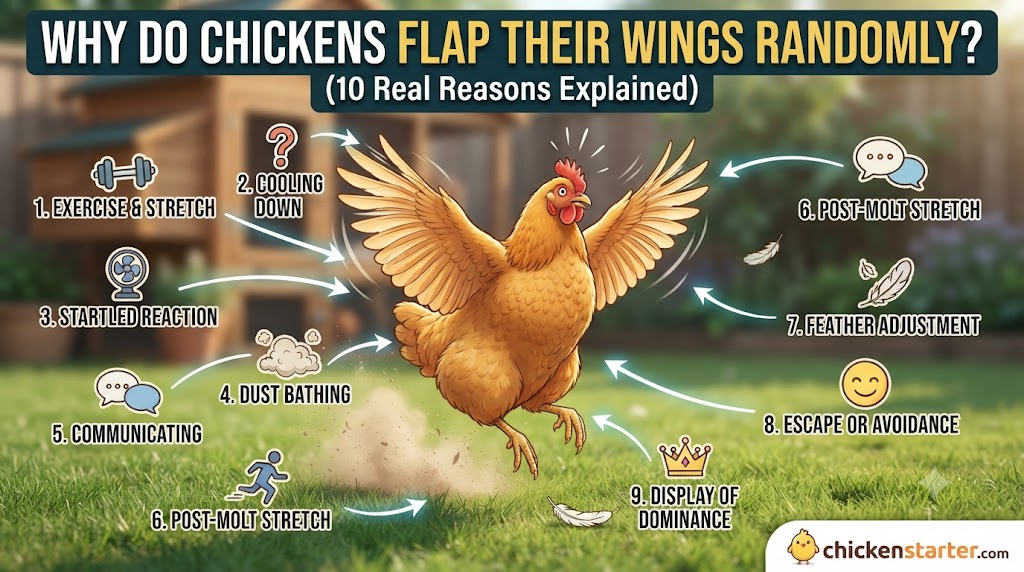
You step into the yard, your coffee still warm in your hand, and your hen suddenly bursts into a full wing display with no obvious reason. Is she okay? Is she angry? Is something wrong?
Here is the short answer: wing flapping in chickens is almost always completely normal. In fact, it is one of the richest forms of communication in your flock’s body language dictionary. What looks random to us is actually very intentional in chicken terms.
That said, a few specific types of wing behavior do deserve closer attention. This guide covers all the common and not-so-common reasons chickens flap their wings, how to read what your bird is actually saying, and exactly when to take it seriously.
Why Do Chickens Flap Their Wings? (Quick Answer)
Wing flapping can mean several different things depending on the context in which it is done. Sometimes, wing flapping is merely done for the purpose of stretching. Other times it signals happiness, dominance, submission, a response to heat, or preparation for a dust bath.
The key is not the flapping itself. The key is reading everything around the flap — the head position, the speed, the timing, and what the rest of the body is doing. Once you learn to read those signals, what seemed random starts making perfect sense.
The 10 Most Common Reasons Chickens Flap Their Wings
1. Stretching and Physical Exercise
This is the most common innocent reason and the one most easily overlooked. Flapping wings is a pretty normal behavior in chickens. After all, these birds can’t keep their wings closed all the time. They will have to flex their wings occasionally when they get the freedom to flap their wings.
Think of it like a human rolling their shoulders after sitting at a desk. Chickens need to stretch their wing muscles regularly, especially after long periods of confinement in the coop. It looks dramatic but means absolutely nothing concerning.
2. Joy and Excitement — The Happy Flap
Other times wing flapping means the chicken is content and happy. Content wing flapping is sometimes done while a chicken is free-ranging or after the flock has been let out of the coop.
This is one of the most satisfying behaviors to watch as a flock owner. The morning coop release is one of the most reliable triggers — your birds will practically explode out the door with wings going. That burst of energy is pure happiness. It is often paired with enthusiastic scratching, fast walking, and soft happy vocalizations. For a deeper look at what all those sounds mean, our guide to chicken noises and what they mean is a great companion to this one.
3. Cooling Down in Hot Weather
Chickens can tolerate cold weather better than hot. Chickens cannot sweat — they cool themselves by dunking their beaks in cold water or flapping their wings to air out their feathers. They may also pant when they are desperate to cool down.
This is a critical one to recognize in summer. When your chickens are flapping their wings in the heat, they are not panicking — they are actively trying to move air across their body and vent heat through their feathers. This is perfectly normal in warm weather.
However, watch for the danger line. If your birds are flapping combined with open-mouth panting, holding their wings away from their body, and refusing to move, that is heat stress progressing toward heat stroke. That level needs immediate intervention.
4. Dust Bathing — The Dirt Shower Flap
Chickens lie down and use their wings to flap up the loose dust to let it run between their feathers and “wash” away dirt. It can look a bit strange, almost alarming in some cases, but it’s something they love doing and that is very good for them as well.
This one genuinely alarms new chicken owners. Your hen will throw herself into the dirt, roll sideways, kick up clouds of dust, and flap away as if the ground has personally offended her. She is fine. In fact, she is better than fine — she is having a spa day. The wing flapping drives dust deep into the feathers, which helps remove external parasites and dead skin. Our article on how to set up a dust bath for your chickens covers everything you need to support this important behavior.
5. Dominance and Pecking Order Communication
Wing flapping can show excitement or frustration. Loud wing flapping and a high head posture show dominance; a lowered head and wing flapping indicate submission.
This is where things get genuinely interesting. Wing flapping is a key vocabulary word in flock hierarchy communication. Loud wing flapping with the head held high and the chest puffed out conveys dominance, whilst flapping with a lowered head and running in the opposite direction of the opposing chicken is a way for one chicken to show submission without any physical contact.
In practical terms: a bold, upright, chest-forward wing flap says “I’m in charge here.” A lower, apologetic-looking flap says “I know, I know — you outrank me.” A lower chicken will flap wings when a higher-up passes by. Understanding these displays goes a long way toward decoding what is actually happening in your flock. For more on managing the social structure of your birds, our article on pecking order problems and how to stop bully hens is worth reading.
6. Fear or Threat Response
Chickens are pretty fearful, and they are ever alert of danger. Your chickens will flap their wings when they get threatened by predators, humans, and other chickens. Flapping wings, in this case, is a sign of danger.
The speed and urgency of this type of flap is noticeably different from a casual stretch. If a hawk flies overhead, a dog barks nearby, or someone moves too quickly near the flock, you will see fast, forceful wing action combined with rapid movement and alarm calls. This is the flight instinct inherited directly from their wild ancestor, Gallus gallus domesticus.
7. Courtship and Mating Behavior
Roosters perform an elaborate wing display as part of their courtship routine. The classic move involves dropping one wing toward the ground and moving in a half-circle toward a hen. This is the “tidbitting and dance” display, and wing flapping is right in the middle of it. Wing flapping can also be a warning. Roosters that are about to fight or who have just fought will engage in wing flapping to further enhance their display of dominance. Post-mating wing flapping from both the rooster and hen is also completely normal — it is simply both birds resettling their feathers.
A broody hen guarding her nest uses wing flapping defensively too. A broody hen uses body language to defend her chicks from predators and other flock members who have invaded her personal space. She will draw herself up to twice her normal height, flaring her hackle feathers and raising her wings outwards. This intimidating stance is enough to make even the most inquisitive bird move away!
8. After Laying an Egg
Many hens do a quick wing shake and feather ruffle immediately after laying. This is normal settling behavior — your hen is simply getting comfortable again after the effort of laying. It takes just a few seconds and is usually followed by normal activity. There is nothing to investigate here.
9. Molting Season Behavior
Chickens naturally shed their old feathers and grow new ones in late summer and fall. It is called molting in chickens. The event is annual, and daylight changes start it. Egg laying usually drops off during this time.
During molting, new pin feathers push through the skin and are genuinely uncomfortable and sensitive. Chickens will flap their wings more frequently during this period to relieve the irritation. If your bird seems to be flapping more than usual in late summer or fall and you notice feather loss, molting is the most likely explanation. Our complete guide to chicken molting season walks through what to expect and how to support your flock through it.
10. Sunbathing with Wings Extended
Some chickens will go down on their sides, spread a wing out and become motionless on the ground. If people don’t realize that chickens sunbathe, they kind of look dead. Chickens tend to kind of zone out when they’re sunbathing, so you can get really close to them before they get up or move. Chickens love to sunbathe, often with their wings out. This helps them eliminate bugs, stay warm, dry off, and get vitamin D for healthy bones. This is one of the most startling things new chicken owners encounter. If your bird is splayed out in the sun with one wing spread flat and eyes half-closed, she is not dying. She is deeply enjoying herself. Step back and let her finish.
How to Read What the Wing Flapping Actually Means
Context is everything. The exact same physical motion means completely different things depending on these three factors.
Head Position Tells You Almost Everything
Loud wing flapping with the head held high and the chest puffed out conveys dominance. This is a confident, assertive display. The bird owns the space it is standing in.
A relaxed, neutral head position alongside a gentle flap means stretching or contentment. The bird is simply comfortable and moving naturally.
A lowered head combined with wing flapping and movement away from another bird is a submission signal. That bird is deferring to a more dominant flock member.
Speed and Force Give You the Emotion
- Slow, casual flap: stretching, contentment, or morning exercise
- Medium flap with soft sounds: dust bathing, cooling down, or general flock activity
- Fast, forceful flap with a loud crack: dominance challenge, aggression warning, or significant fear response
The Full Body Must Match
Never read wings in isolation. A wing flap paired with a relaxed tail, calm eyes, and soft sounds is almost always harmless. A wing flap paired with raised hackle feathers, a stiff neck, a fixed stare, and tense body posture is a completely different conversation.
When Roosters Flap Their Wings — And What It Means for You
Roosters use wing displays more dramatically and more frequently than hens. Understanding rooster wing body language is especially important for new owners.
The Dominance Display
A lot of times, chickens flap their wings to signal confidence, and many times roosters will when they are protecting their hens. A rooster standing tall, chest out, with a dramatic wing flap is performing for his flock. This is healthy rooster behavior and is not directed at you as a threat unless other warning signals are present.
Rooster Flapping Directly at You
A rooster challenging you will stare at you and flap wings with a loud popping sound. That combination — direct eye contact, stiff posture, loud forceful flap — is a genuine warning that he is escalating toward aggression. Never approach quickly, never show fear, and never run. Calm, steady movements are the right response.
If your rooster is flapping casually from across the yard without direct eye contact, you can liken it to a person stretching just to loosen themselves up a little bit. It is likely not aimed at you at all.
The Courtship Wing Drop
When a rooster drops one wing toward the ground, fans it out, and begins a circular shuffle toward a hen, this is his classic mating dance. The wing flapping that follows is part of normal reproduction. No action needed on your part.
When Wing Flapping Becomes a Warning Sign
Don’t assume your chickens are okay if they constantly flap their wings. Investigate what is making your birds flap their wings.
Most wing flapping is completely normal, but a few specific patterns deserve closer attention.
Signs That Something May Be Wrong
A wing drooping to one side passively — not an active flap but a wing that simply hangs lower than the other — is different from wing flapping and should be taken seriously. Droopy wings and tails are a common sign of multiple illnesses. If you notice a chicken with droopy wings, you should immediately examine your chicken. It appears as the chicken is slightly squatted, with its wings a bit spread and pointed downward, rather than held against the body as they would be normally.
Other warning signs to watch for:
- Wing flapping combined with open-mouth panting and extreme lethargy
- Loss of balance or stumbling alongside wing movement
- Compulsive, repetitive flapping that does not stop with no obvious trigger
- Wing flapping alongside shaking, head tilting, or loss of coordination
Health Conditions Linked to Abnormal Wing Behavior
Mites and lice cause restlessness, excessive preening, and unusual body movements including increased wing flapping. If you notice your chickens flapping, shaking, and scratching more than usual, part the feathers near the vent and skin to look for tiny moving insects or eggs. Our article on mites and lice on chickens covers identification and treatment in full.
Heat stress escalating to heat stroke will produce wing-spreading alongside heavy panting, stumbling, and collapse. This is a time-sensitive emergency requiring immediate cooling.
Neurological conditions including Marek’s disease can cause wing weakness, unusual positioning, and loss of coordination. If your bird cannot hold its wings normally and shows other neurological signs, contact a veterinarian promptly. For guidance on when a vet visit is actually necessary, our article on how to tell if a chicken is sick gives you a practical health check framework.
Quick Home Check When You Are Unsure
- Watch the bird for 5 minutes without approaching
- Note head position, tail position, and whether the bird is eating and moving normally
- Check under the wings and around the vent for signs of parasites
- Note breathing rate — excessive panting alongside flapping needs immediate attention
- If all other signs appear normal, the flapping is almost certainly behavioral and harmless
Wing Flapping in Chicks and Young Pullets
Baby chicks begin testing their wings from just a few days old. Even chicks at a young age will test out their wings and explore their ability to fly. While chickens are not the best flyers in the bird kingdom, they are able to fly short distances and use their wings to fly up to roosts and other raised areas.
Young cockerels will also use wing flapping heavily during their sparring and hierarchy-building phase. Sparring is an activity that young cockerels engage in when they are establishing hierarchy as they mature. Basically, sparring is play fighting that serves the important role of establishing dominance peacefully and preparing the young cockerels for when they may have to fight for a flock of their own. Wing flapping during these interactions is completely expected and healthy.
Myths vs. Facts About Chicken Wing Flapping
| Myth | Fact |
|---|---|
| “Wing flapping always means aggression” | 4When a chicken flaps its wings, it can mean multiple things. Most are neutral or positive. |
| “If a chicken flaps at me it hates me” | 4Chickens also flap their wings as a greeting. If your hen flaps her wings at you, she recognizes and appreciates you. |
| “Flapping on the ground means something is wrong” | It is usually dust bathing or sunbathing — both are healthy, normal behaviors. |
| “Only roosters flap wings aggressively” | Hens flap wings for dominance, protection of nests, and submission signals too. |
| “All wing flapping from a rooster toward you is a threat” | It doesn’t “mean” anything. Hens do it too. It is like a person stretching just to loosen themselves up a little bit. |
Frequently Asked Questions
Why do chickens flap their wings in the morning?
Morning wing flapping is one of the most common and completely normal behaviors you will see. After a night of roosting and stillness, chickens need to stretch and exercise their wings. The excitement of being let out of the coop combines with genuine physical need. Enjoy it — it means your birds are healthy and eager.
Why do chickens flap their wings at each other?
It is almost always pecking order communication. Chickens show dominance or submission through pecking, posturing including feather puffing and wing flapping, chasing, and even chest bumping. The bird with the higher posture and louder flap is asserting dominance. The bird that lowers its head and moves away is acknowledging the hierarchy.
Why does my rooster flap his wings at me?
Context matters greatly here. A casual flap from a distance is likely nothing more than stretching. A direct, forceful flap with eye contact and stiff posture is a dominance warning. Calm body language on your part is always the right response.
Is wing flapping a sign of happiness or distress?
It can be both, and the body context tells you which. Just as they express joy through wing flapping, chickens also use this behavior to communicate displeasure or discomfort. If you notice abrupt and intense wing flapping, it might be a signal that something’s amiss. Gentle, relaxed flapping after coop release is happiness. Sudden, frantic flapping combined with alarm calls and racing is fear or distress.
Can mites cause my chicken to flap its wings more?
Yes. External parasite infestations cause significant skin irritation and restlessness. If your bird is flapping, scratching, and preening more than normal, especially at night, check for mites and lice immediately.
What is the difference between wing drooping and wing flapping?
These are two entirely different behaviors. Active wing flapping is voluntary movement your bird is choosing to make. Wing drooping — where one or both wings hang passively lower than normal — is an involuntary sign of illness or injury. If you notice a wing consistently hanging low without active movement, have your bird examined by a vet.
When should I call a vet about my chicken’s wings?
Call when you see: one wing drooping persistently, wing flapping alongside loss of balance, flapping combined with heavy panting and lethargy, or any combination of neurological symptoms including head tilting or circling. For a full health check framework, our article on when to call a vet for a backyard chicken will guide you through the decision.
Final Thoughts
Wing flapping is one of the most expressive and frequently misunderstood behaviors in the entire chicken communication toolkit. Once you understand the context — the head position, the speed, the timing, the body language surrounding it — what looked random starts looking remarkably clear.
Most of the time, your bird is simply stretching, celebrating, cooling down, dust bathing, or working out the social math of the flock. Those moments are worth enjoying. They mean your birds are healthy, active, and communicating naturally.
Where to start if you are still unsure: Watch your birds for five minutes in different parts of the day. Morning release, midday foraging, and late afternoon free-range will show you the full range of wing behavior in one session. If everything else about your bird looks normal — eating, drinking, droppings, posture — the wings are almost certainly doing exactly what they should.
If you want to go deeper into understanding what your flock is telling you, our complete chicken body language and behavior guide is a great next read. And if you ever notice signs that something has moved from normal behavior into health territory, our guide on how to tell if a chicken is sick will help you assess the situation clearly and confidently.

Oladepo Babatunde is the founder of ChickenStarter.com. He is a backyard chicken keeper and educator who specializes in helping beginners raise healthy flocks, particularly in warm climates. His expertise comes from years of hands-on experience building coops, treating common chicken ailments, and solving flock management issues. His own happy hens are a testament to his methods, laying 25-30 eggs weekly.