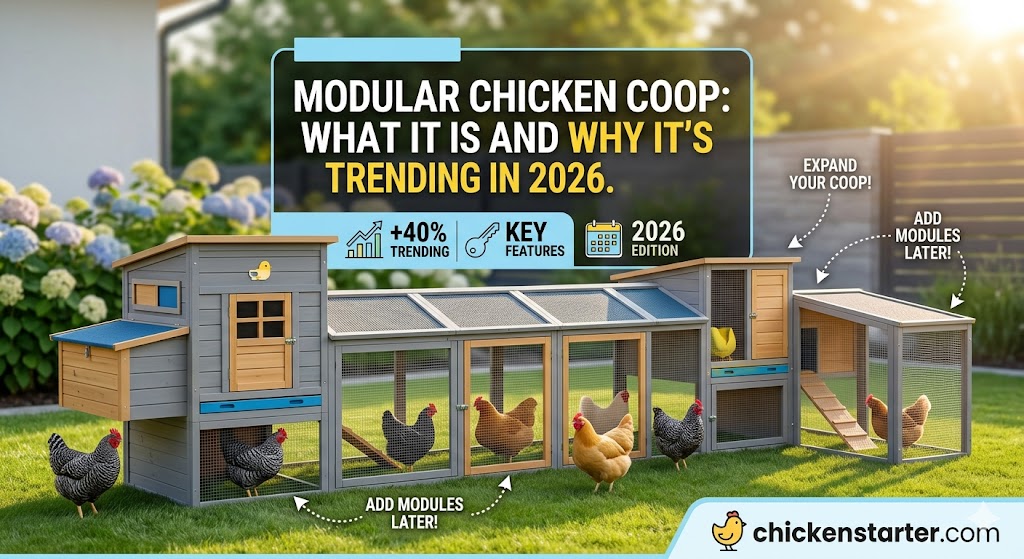
The modular chicken coop is quickly becoming one of the most talked-about trends in backyard poultry keeping. If you have spent any time browsing coop designs this year, you have probably noticed the shift. More and more manufacturers and DIY builders are moving away from traditional fixed structures and toward modular systems that can be expanded, reconfigured, relocated, and customized as your flock grows and your needs change.
The appeal is obvious once you understand the concept. A modular coop is not one rigid structure. It is a system of interchangeable panels, sections, and components that bolt or clip together, making it possible to start small and scale up without ever tearing down what you already built. In 2026, these designs are being built with recycled plastics, reclaimed wood, and increasingly integrated with smart sensors for temperature and humidity monitoring, which is a combination of sustainability and technology that fits where backyard chicken keeping is heading.
I have been watching this trend closely and recently helped a friend set up a modular system for her starter flock of six hens. After seeing how it works in practice, I am convinced this is the future of small-flock housing. This guide explains exactly what a modular chicken coop is, why the concept is gaining momentum, who it is best suited for, and how to decide whether it makes sense for your flock.
What Exactly Is a Modular Chicken Coop?
A modular chicken coop is a coop system built from standardized, interchangeable sections or panels that can be assembled, disassembled, rearranged, and expanded without specialized tools or permanent construction.
Think of it like building with large-scale blocks. Each module, whether it is a wall panel, a run section, a nesting box unit, or a roosting compartment, is designed to connect to other modules using a consistent attachment system. Bolts, clips, tongue-and-groove joints, or interlocking brackets are the most common connection methods.
This is fundamentally different from a traditional coop, which is framed, sheathed, and fastened permanently. With a traditional build, adding space means either constructing an entirely new structure or undertaking a major renovation. With a modular system, adding space means ordering or building another panel set and bolting it onto the existing structure.
Key Characteristics of a Modular System
- Standardized panel sizes that fit together in multiple configurations
- Tool-free or minimal-tool assembly using bolts, clips, or interlocking joints
- Expandable design that allows you to add run sections, coop modules, or nesting units over time
- Relocatable without disassembly in many cases, or easily disassembled and reassembled at a new location
- Replaceable components so that a damaged panel can be swapped out without rebuilding the entire structure
Why Modular Chicken Coops Are Trending in 2026
Several converging trends are driving the popularity of modular coop designs this year. This is not just a passing fad. The shift reflects real changes in how people approach backyard poultry keeping.
Sustainability and Eco-Friendly Materials
One of the biggest drivers is the growing demand for sustainable building materials. In 2026, modular coop manufacturers are increasingly using recycled plastics and reclaimed wood in their panel construction.
Recycled high-density polyethylene (HDPE) panels, for example, are rot-proof, moisture-resistant, easy to sanitize, and completely immune to the mite infestations that plague traditional wooden coops. They do not need painting, staining, or weatherproofing, and they last far longer than untreated wood.
According to information from Omlet, whose Eglu line uses recyclable, double-walled plastic panels, plastic coop construction provides superior insulation, eliminates the crevices where red mites hide in wooden coops, and can be cleaned with a simple hose-down. This kind of low-maintenance, long-lifespan design is exactly what modular systems are built around.
Reclaimed wood modules appeal to keepers who prefer a natural aesthetic but still want the flexibility of a modular system. Several small builders and Etsy-based coop makers now offer modular panel kits made from reclaimed barn wood, shipping pallets, and salvaged lumber.
If you are interested in building with reclaimed materials on a tight budget, our guide on pallet chicken coops and how to build one for almost free covers sourcing safe pallets, preparation, and step-by-step construction.
Smart Coop Technology Integration
The other major trend shaping modular coops in 2026 is the integration of smart sensors for real-time monitoring of coop conditions. Temperature sensors, humidity monitors, ammonia detectors, and automated ventilation controllers are being built directly into modular panel systems or offered as plug-and-play add-ons.
These sensors connect to smartphone apps that alert you when conditions inside the coop fall outside safe ranges. For example, if the internal temperature drops below freezing or humidity rises above 70%, you get a notification on your phone so you can take action before your flock is affected.
This technology is not entirely new. Standalone coop sensors have been available for a few years. What is new in 2026 is how modular coop manufacturers are designing their panels with built-in sensor mounts, cable routing channels, and power connections that make adding smart monitoring seamless rather than an afterthought.
For keepers who manage their flocks remotely during the workday or who live in climates with rapid temperature swings, this integration is a genuine game changer for animal welfare.
The “Start Small, Grow Later” Philosophy
Perhaps the most practical reason modular coops are trending is that they perfectly match how most people actually get into backyard chickens.
Nearly every chicken keeper I know, myself included, started with a small flock and expanded within the first year or two. With a traditional coop, that expansion usually means building a second coop, constructing an addition, or replacing the original structure entirely. All of those options cost significant time and money.
A modular system lets you start with a 4-chicken setup and expand to 8, 12, or more simply by adding modules. The initial investment is smaller because you are only buying what you need right now, and future expansion is planned into the system from day one.
If you are just starting out and trying to figure out how many birds to keep, our guide on how many chickens you need for a family of 4 helps you match flock size to your actual egg consumption.
Types of Modular Chicken Coop Systems
Not all modular coops are created equal. The term covers a range of designs, from premium manufactured systems to DIY panel-based builds. Here are the main categories.
Manufactured Plastic Modular Coops
These are the most polished and expensive modular options. Brands like Omlet (Eglu Cube, Eglu Go), Nestera, and several newer companies offer coops made from double-walled recycled plastic panels that snap or bolt together.
Advantages: Extremely easy to clean, mite-resistant, weather-resistant, UV-stable, lightweight, and expandable with brand-specific run extensions and accessories. Many come with integrated egg trays, removable droppings trays, and ventilation systems designed into the panels.
Disadvantages: Higher upfront cost (typically $400 to $1,000+ for a basic coop module, plus $150 to $500+ for run extensions). Limited aesthetic appeal for keepers who prefer a traditional wooden look. You are locked into one manufacturer’s system for expansions and replacement parts.
Manufactured Wood Panel Modular Coops
Several companies offer modular coops made from pre-cut wooden panels that bolt together without permanent fasteners. These provide a more traditional coop appearance while maintaining the expandability of a modular system.
Advantages: Natural wood aesthetic, easier to modify or customize than plastic systems, and typically less expensive than premium plastic options.
Disadvantages: Wood requires ongoing maintenance (painting, staining, rot repair). Wooden panels are heavier and harder to relocate than plastic. Mites can still colonize wood grain and joints, which is the same challenge you face with any traditional wooden coop.
DIY Modular Panel Systems
This is where the concept gets most interesting for handy chicken keepers on a budget. A DIY modular coop uses standardized panel frames that you build yourself from lumber, plywood, or reclaimed materials. Each panel is a self-contained unit (framed, sheathed, and finished) that bolts to adjacent panels using carriage bolts, wing nuts, or heavy-duty clips.
The key to a successful DIY modular system is consistency. Every panel must be the same height, use the same bolt-hole spacing, and connect with the same hardware. Once you establish your standard, you can build additional panels at any time and bolt them onto the existing structure.
I helped my friend design her DIY modular system using 2×4 frames sheathed with 1/2-inch plywood on one side and hardware cloth on the other (for ventilation panels). We used carriage bolts with wing nuts at every connection point, which means she can add or remove a panel in about 10 minutes with no tools other than her hands.
Hybrid Systems
Some of the most practical modular setups combine a permanent coop structure with a modular run system. The coop itself is traditionally built for maximum durability, while the attached run is made of modular panels that can be rearranged, extended, or reconfigured as needed.
This hybrid approach gives you the structural strength and weatherproofing of a conventional coop with the flexibility of a modular run. It is a smart compromise for keepers who want expandability without sacrificing coop quality.
For a complete comparison of coop styles, from A-frames to walk-ins, and how modular designs fit into the bigger picture, our guide on popular chicken coop styles explained covers every major option.
Advantages of a Modular Chicken Coop
Scalability
This is the headline benefit. A modular coop grows with your flock. Start with a setup for 4 hens and add modules as you expand to 6, 10, or more. No demolition, no rebuilding from scratch, no wasted materials.
Easy Relocation
Many modular coops can be moved as a unit or quickly disassembled and reassembled at a new location. This is valuable if you rent your property, want to rotate your coop’s position for pasture management, or plan to move in the future.
Simplified Cleaning and Maintenance
Removable panels and snap-out components make deep cleaning much faster. Plastic modular coops in particular can be hosed down and sanitized in minutes. Damaged panels can be replaced individually without affecting the rest of the structure.
Customizable Layout
Want to add a second nesting box unit? Bolt on a module. Need a larger run for summer? Add extension panels. Want to separate a broody hen? Reconfigure your modules to create a temporary isolation area.
Lower Initial Investment
You do not have to buy or build the full system upfront. Start with the minimum modules you need and invest in additional sections over time as your budget allows. This makes modular coops more accessible for beginners who are not ready to commit to a large build.
Better for Renters and Small Properties
Because modular coops are designed to be assembled and disassembled, they are ideal for renters who may need to remove the coop when a lease ends. They also work well on smaller properties where the coop may need to be repositioned seasonally to maximize yard space.
Disadvantages and Honest Limitations
No system is perfect. Here are the real downsides I have observed.
Higher Per-Square-Foot Cost for Manufactured Systems
Premium modular coops from brands like Omlet and Nestera cost significantly more per square foot than a DIY-built traditional coop. You are paying for the engineering, the materials, and the convenience. For keepers with strong DIY skills, building a custom coop from lumber will almost always be cheaper.
Proprietary Expansion Limitations
If you buy a manufactured modular system, you are typically locked into that brand’s ecosystem for expansion panels, accessories, and replacement parts. If the company discontinues your model or goes out of business, sourcing compatible components becomes difficult.
Structural Limitations in Extreme Weather
Bolted panel connections are inherently less rigid than permanently framed and sheathed walls. In areas with very high winds, heavy snow loads, or extreme temperature cycling, a modular coop may require additional bracing or anchoring that a traditional build would not need.
Aesthetic Trade-Offs
Many modular coops, especially plastic ones, have a utilitarian look that some keepers find unappealing. If coop aesthetics matter to you and you want something that blends with a traditional garden or farmstead, a manufactured plastic modular system may not be the right fit.
Smart Technology Costs and Complexity
Adding smart sensors, automated doors, and climate monitoring increases both the upfront cost and the ongoing maintenance burden. Sensors need calibration. Batteries need replacing. Apps need updating. For keepers who prefer a simple, low-tech approach, the smart features of modern modular coops may be more complexity than they want.
What to Look for When Buying a Modular Chicken Coop
If you are shopping for a manufactured modular system, evaluate these factors carefully before purchasing.
Material Quality
Recycled HDPE plastic is the gold standard for plastic modular coops. It is UV-resistant, rot-proof, and non-porous (which means mites cannot hide in it). Avoid thin, single-wall plastic panels that crack in cold weather or warp in heat.
For wood modular systems, look for pressure-treated or naturally rot-resistant lumber like cedar. Untreated softwood panels will deteriorate quickly in outdoor conditions without regular sealing.
Connection System
The bolt or clip system that holds panels together is the backbone of any modular coop. Look for stainless steel or galvanized hardware that will not rust. Test the connections for rigidity. Panels should feel solid when assembled, not wobbly or loose.
Ventilation Design
Ventilation is critical in any coop, and modular designs sometimes sacrifice airflow for panel uniformity. Make sure the system includes dedicated ventilation panels with hardware cloth covering positioned above roost height.
Predator Security
Every panel joint is a potential weak point for predator entry. Check that connections leave no gaps larger than 1/2 inch when assembled. Mesh panels should use 1/2-inch hardware cloth, not chicken wire. Doors should accept two-step latches or carabiner clips.
Expansion Availability
Before buying, confirm that expansion modules are readily available and that the manufacturer plans to continue producing them. Check reviews and forums for reports of discontinued panels or long shipping delays.
Adequate Space Per Bird
The same space requirements apply to modular coops as any other design. You still need 4 square feet of indoor space per standard chicken and 8 to 10 square feet of run space per bird. Do not let the modular marketing language distract you from verifying the actual interior dimensions. Our guide on how big should a chicken coop be provides exact square footage calculations.
DIY Modular Coop: How to Build Your Own Panel System
Building a DIY modular coop is surprisingly straightforward if you approach it with the right mindset. The key is designing a standard panel template that you use for every piece.
Design Your Standard Panel
Pick a panel size that works for your coop dimensions and is easy for one person to handle. A common choice is 4 feet wide by 4 feet tall. This is large enough to make construction efficient but light enough to carry and position alone.
Build each panel from a 2×4 frame (outer dimensions 4×4 feet) with 1/2-inch plywood sheathing on the exterior side. For ventilation panels, replace the upper half of the plywood with hardware cloth. For run panels, use hardware cloth on the full face.
Standardize Your Connection Points
Drill bolt holes in exactly the same positions on every panel. I recommend holes at 6 inches from the top, 6 inches from the bottom, and centered on each vertical edge. Use 3/8-inch carriage bolts with washers and wing nuts so panels can be connected and disconnected by hand.
Build a Base Frame
Construct a ground frame from pressure-treated 4×4 lumber or set concrete blocks as a foundation. The base frame establishes the footprint and supports the wall panels above ground level.
Assemble and Expand
Stand your panels on the base frame, bolt them together at the pre-drilled connection points, and add your roof. As your flock grows, build additional panels using the same template and bolt them onto the existing structure.
For keepers who want a more budget-friendly starting point, our article on chicken coop plans for 4 chickens covers small coop builds that can be adapted into a modular format.
Interior Setup for a Modular Coop
The interior of a modular coop should include the same essential features as any well-designed chicken house.
Roosting bars mounted at 36 to 40 inches off the floor, using 2×4 lumber with the wide face up. Allow 8 to 10 inches of bar length per bird.
Nesting boxes at 18 to 24 inches, always lower than the roost. Plan one box per 4 to 5 hens with a minimum of two boxes. Modular coops are especially well suited for roll-away nesting boxes, which can be designed as their own removable module. Our guide on roll-away nesting boxes and whether they are worth it covers everything from angle specifications to DIY plans.
Bedding of pine shavings at 3 to 4 inches on the floor and 2 inches in each nesting box. Add dried herbs like lavender, peppermint, and oregano for natural pest deterrence and a fresh scent. Our article on the best herbs to put in chicken nesting boxes covers which herbs work and how to use them.
Feeders and waterers positioned in the run area rather than inside the coop to minimize interior moisture and mess.
Who Should Consider a Modular Chicken Coop?
A modular coop is an excellent fit if you:
- Are a beginner who wants to start small and expand later
- Rent your property and need a coop that can be disassembled and moved
- Want a low-maintenance coop that is easy to clean and sanitize
- Are interested in smart monitoring technology for temperature, humidity, and ventilation
- Value sustainability and want to use recycled or reclaimed building materials
- Have a growing flock and do not want to rebuild every time you add birds
- Live on a small property where coop repositioning is necessary
A modular system is probably not the best choice if you are an experienced builder who enjoys custom carpentry, if you want a permanent heritage-style coop, or if you are working with an extremely tight budget (a simple DIY pallet or lumber coop will always cost less than a manufactured modular system).
My Perspective After Seeing Modular in Practice
After helping my friend set up her modular system and watching it perform over several months, I came away genuinely impressed. The speed of assembly was remarkable. What would have taken a full weekend as a traditional build took about three hours. The ability to reconfigure the run when she wanted to give her hens access to a different patch of yard was something I had never been able to do easily with my own fixed coop.
The smart sensor integration was the feature that surprised me most. She installed a simple temperature and humidity sensor kit that sends alerts to her phone. During a cold snap last winter, the humidity alarm went off at 2 AM, and she was able to go out and adjust the ventilation before condensation became a problem. That kind of proactive monitoring is hard to argue against.
Would I switch my entire setup to modular? Probably not, because I genuinely enjoy building with traditional lumber and I have a permanent property where relocation is not a concern. But if I were starting over today, especially as a renter or a first-time keeper, a modular system would be at the top of my list.
Frequently Asked Questions
How much does a modular chicken coop cost?
Manufactured plastic modular coops range from $400 to $1,200+ for the coop module alone, with run extensions adding $150 to $500. Wood panel modular kits typically cost $300 to $800. A DIY modular panel system can be built for $150 to $400 depending on materials.
Are modular chicken coops predator-proof?
They can be, but you need to verify every panel joint for gaps and ensure all mesh panels use 1/2-inch hardware cloth rather than chicken wire. Secure every door and hatch with two-step latches. The connection points between panels are the most vulnerable areas, so check them carefully during assembly.
Can I build a modular coop from pallets?
Yes. Pallets can be used as the basis for modular wall panels. Build each panel to a standardized size, pre-drill consistent bolt holes, and use carriage bolts with wing nuts for connections. This creates an extremely affordable modular system using free materials.
How long do plastic modular coops last?
High-quality recycled HDPE plastic coops are designed to last 15 to 25+ years with minimal maintenance. They are UV-stabilized, rot-proof, and do not require painting or sealing. This longevity is one of the strongest selling points of plastic modular systems compared to wood.
Do modular coops work in cold climates?
Double-walled plastic modular coops provide surprisingly good insulation. For extreme cold, look for systems with insulated panels or add supplemental insulation to DIY modular builds. Ensure that ventilation remains adequate even in winter, as moisture buildup is a bigger threat to chickens than cold temperatures alone.
Can smart sensors really improve chicken welfare?
Yes. Real-time monitoring of temperature, humidity, and ammonia levels allows you to identify and correct environmental problems before they affect your flock’s health. Automated alerts are especially valuable for keepers who are away from home during the day or who manage coops in locations with unpredictable weather.
Disclaimer
The information in this article is based on personal observation, hands-on experience, and widely accepted backyard poultry keeping practices. Product mentions are for informational purposes only and do not constitute endorsements. Coop construction requirements, setback regulations, and flock limits vary by location. Always check your local chicken laws before building or purchasing a coop. For flock health concerns, consult a qualified poultry veterinarian or your local agricultural extension service.

Oladepo Babatunde is the founder of ChickenStarter.com. He is a backyard chicken keeper and educator who specializes in helping beginners raise healthy flocks, particularly in warm climates. His expertise comes from years of hands-on experience building coops, treating common chicken ailments, and solving flock management issues. His own happy hens are a testament to his methods, laying 25-30 eggs weekly.
Oladepo,
Thanks for all your in-depth articles. I’ve now read a few a few of your articles and really appreciated the insight you provide. I’ve had chickens off and on for the last 30 years, and am starting back up after a few years with none. I am doubling the flock sizes I’ve had before (from 8 up to 16), so new planning concerns. Your articles have provided so much useful information for my new venture.
Thanks again,
Amy