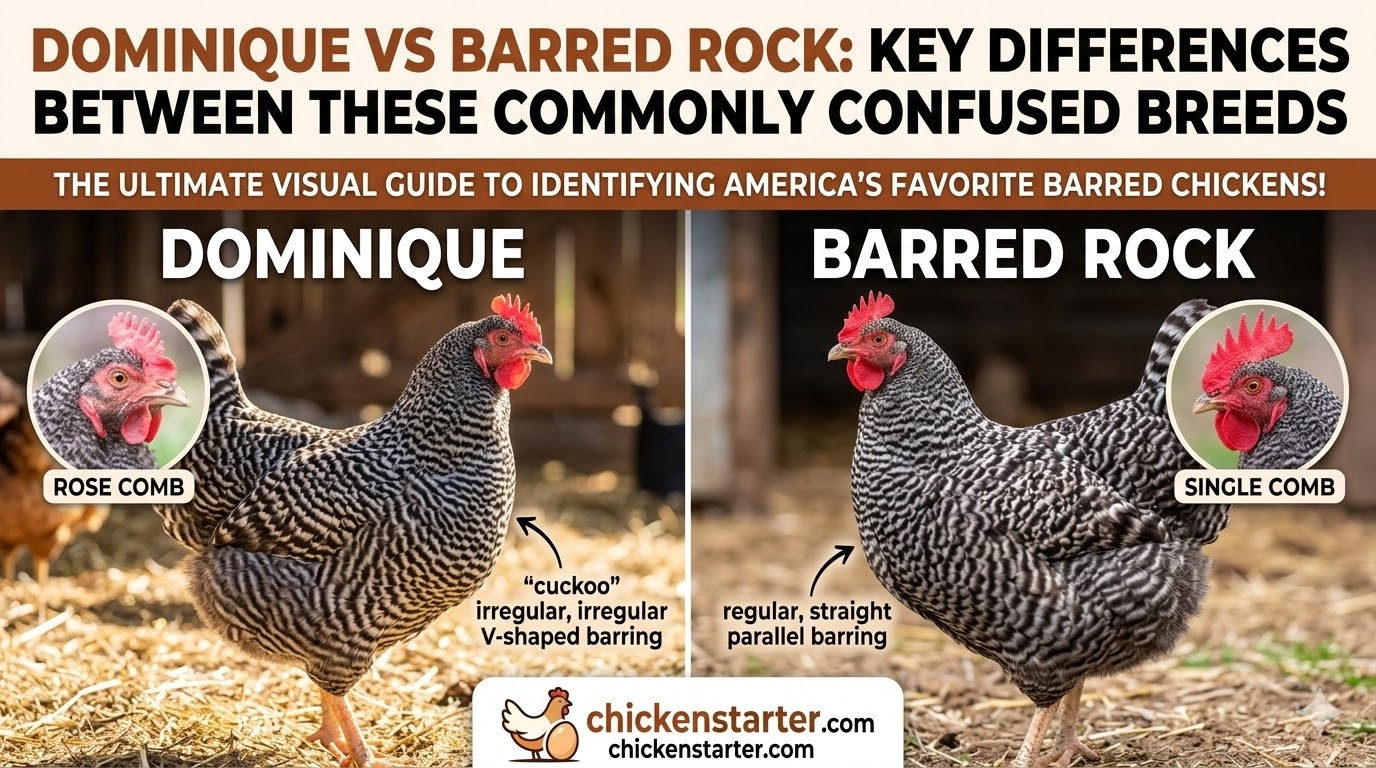
Dominique and Barred Rock chickens are two different breeds, though they look remarkably similar at first glance. The easiest way to tell them apart is by their comb type: Dominiques have a rose comb (low and flat with a small spike at the back), while Barred Rocks have a single comb (tall and upright with distinct points). The second key difference is their feather pattern. Dominiques display irregular, V-shaped “cuckoo” barring, whereas Barred Rocks show crisp, straight, parallel bars. Dominiques are also noticeably smaller, with hens weighing around 5 pounds compared to Barred Rock hens at 7.5 pounds.
The first time I tried to identify a “Dominecker” at a local poultry swap, I got it completely wrong. The seller insisted it was a Dominique, but the tall single comb should have been my clue. It was actually a Barred Rock. This confusion happens constantly because these breeds share a direct genetic connection. Barred Plymouth Rocks were developed from Dominiques in the 1860s, which explains why distinguishing them can feel nearly impossible without knowing exactly what to look for. The confusion became so widespread that in 1870, the New York Poultry Society issued an official ruling: rose-combed barred birds would be classified as Dominiques, and single-combed barred birds would be Plymouth Rocks. That ruling still defines how we identify these breeds today. In this guide, you will learn the precise physical differences, verified production numbers, temperament comparisons, and which breed might be the better fit for your backyard flock or small farm operation.
Are Dominique and Barred Rock the Same Breed?
No, Dominique and Barred Rock are definitively different breeds with distinct histories, physical characteristics, and breed standards. The confusion is understandable. They share similar coloring, both lay brown eggs, and historically people called both breeds “Dominecker” without distinction.
The Dominique is America’s oldest chicken breed, with documented presence in the United States since at least the 1750s. According to the Livestock Conservancy, these birds descended from chickens brought by early colonial settlers and became a foundation breed for American poultry. Dominiques gained significant popularity during the 1820s and were proudly displayed at the first American Poultry Show held in 1849.
The Barred Plymouth Rock came later. As documented by poultry historians, breeders in New England crossed Dominiques with Black Java chickens during the 1860s to create a larger, more productive bird. The new breed was first exhibited in 1869 in Worcester, Massachusetts, and quickly gained popularity for its size and egg-laying ability.
Before 1870, both breeds competed in the same “barred” category at poultry shows, which created chaos. Some owners would enter the same birds in both categories and win prizes twice. The 1870 ruling by the New York Poultry Society ended this practice by declaring that comb type would be the official distinguishing feature. Both breeds received formal recognition in the American Poultry Association’s Standard of Perfection in 1874, cementing their separate identities.
Key Differences Between Dominique and Barred Rock Chickens
| Feature | Dominique | Barred Rock |
|---|---|---|
| Comb Type | Rose comb (with spike) | Single comb (straight) |
| Barring Pattern | Cuckoo: irregular, V-shaped, mottled | Barred: straight, parallel, sharply defined |
| Bar Colors | Dark gray and white | Black and white |
| Bar Definition | Less distinct, slightly blurred | Crisp, equal-width bars |
| Hen Weight | 5 lbs | 7.5 lbs |
| Rooster Weight | 7 lbs | 8.5 to 9.5 lbs |
| Body Shape | Smaller, upright, refined | Larger, heavier, blockier |
| Rooster vs Hen Color | Roosters much lighter | Roosters slightly lighter |
| Eggs/Year | 180 to 260 | 200 to 280 |
| Egg Size | Medium-large | Large |
| Egg Color | Light to dark brown | Light brown |
| Temperament | Calm, sweet, gentle | Active, calm, kid-friendly |
| Cold Hardiness | Excellent (rose comb resists frostbite) | Very good (single comb can frostbite) |
| Heat Tolerance | Good | Good |
| Broodiness | Variable | Low to moderate |
| Lifespan | 6 to 8 years | 6 to 10 years |
| Origin | Colonial America (1750s+) | New England, 1860s |
| APA Recognition | 1874 | 1874 |
| Conservation Status | Watch | Recovering (heritage) |
| Availability | Less common | Widely available |
Comb Type: The Easiest Way to Tell Them Apart
The comb is your most reliable identification tool and the reason the 1870 ruling focused specifically on this feature. Once you know what to look for, you can identify the breed from across the yard.
Dominique chickens have a rose comb, a low, flat comb that sits close to the head with a distinctive short spike curving upward at the back. Some poultry keepers describe this as looking like “Robin Hood’s hat.” The rose comb has a bumpy, textured surface and never stands tall above the head.
Barred Rocks have a single comb, a tall, upright comb with five or six distinct points that can either stand straight up or flop over to one side. This comb is noticeably larger and more prominent than the Dominique’s compact rose comb.
This difference matters beyond identification. As noted by Cackle Hatchery, the rose comb provides superior frostbite protection in cold climates because it sits closer to the head with less exposed surface area. If you live in northern regions where winter temperatures regularly drop below freezing, the Dominique’s rose comb offers a practical advantage.
Feather Pattern: Barred vs Cuckoo
Both breeds display alternating light and dark stripes on their feathers, but the pattern structure differs significantly when you examine them closely.
Barred Rocks display true barred patterning: straight, parallel bars of roughly equal width running horizontally across each feather. According to Cackle Hatchery’s breed documentation, the bars are sharply defined black and white, creating a crisp, high-contrast appearance that some describe as looking like a precise barcode.
Dominiques display cuckoo patterning: irregular, V-shaped or staggered bars that appear less organized. The dark bars are more gray than pure black, and the overall effect looks slightly mottled or blurred compared to the Barred Rock’s clean lines. As the Livestock Conservancy describes, the barring on a Dominique “is less sharply distinct than true barring” and gives the bird a softer, more blended appearance.
If you put both breeds side by side, the Barred Rock looks crisper and more defined, while the Dominique appears somewhat smudged or painterly. This distinction becomes easier to see with practice, though lighting conditions can affect how clearly you perceive the patterns.
Size and Body Shape
Barred Rocks are substantially larger birds with a heavier, blockier build. According to poultry breed standards, Barred Rock hens typically weigh 7.5 pounds, and roosters reach 8.5 to 9.5 pounds. They have broad bodies with full breasts and an overall rectangular silhouette.
Dominiques are more refined and compact. As documented by the Livestock Conservancy, hens weigh approximately 5 pounds, and roosters average 7 pounds. They carry themselves more upright with a slightly more delicate head structure. While still described as “chunky mamas” with thick, wide-set bodies, they appear noticeably smaller when standing next to a Barred Rock.
Dominiques also have close feathering, meaning they hold their feathers tightly against their bodies. This makes them appear their actual size, unlike fluffy breeds such as Cochins that look larger than they really are. Barred Rocks have somewhat looser feathering that can make them appear even bigger.
Dominique roosters have longer tails with wider sickle feathers compared to Barred Rock roosters, providing another identification point if you are comparing males.
Rooster Color Differences
Male birds of both breeds appear lighter than females, but the degree of difference varies.
Dominique roosters are noticeably lighter than their hens because, as Cackle Hatchery explains, the white bars on their feathers are approximately twice as wide as the dark bars. This creates a distinctly pale appearance that makes males easy to spot in a mixed flock.
Barred Rock roosters are only slightly lighter than hens. The difference exists but is much more subtle. Both sexes display roughly equal-width bars, so the overall color impression remains similar.
This characteristic provides a useful secondary identification method, especially when comparing roosters of unknown breed origin.
Dominique vs Barred Rock Egg Production
| Feature | Dominique | Barred Rock |
|---|---|---|
| Eggs per year | 180 to 260 | 200 to 280 |
| Eggs per week | 3 to 5 | 4 to 5 |
| Egg size | Medium to medium-large | Large |
| Egg color | Light to dark brown | Light brown |
| Winter laying | Good | Good |
| Peak production | First 2 years | First 2 to 3 years |
How Many Eggs Do They Lay?
Both breeds qualify as solid heritage layers, though neither matches the output of commercial production breeds like Leghorns or ISA Browns.
Dominique hens produce approximately 180 to 260 eggs annually, with historical records suggesting averages of 230 to 275 eggs per year under optimal conditions. This translates to roughly 3 to 5 eggs per week during peak laying periods. Production remains consistent through the first two years before gradually declining.
Barred Rock hens produce approximately 200 to 280 eggs annually, giving them a slight edge in total output. They maintain a steady 4 to 5 eggs weekly during their productive years and often continue laying well into their third year at relatively high rates.
For practical purposes, this difference amounts to perhaps one extra egg per week from a Barred Rock hen. That is meaningful over time but not dramatic.
Egg Color and Size
Both breeds lay brown eggs, though shade and size differ.
Dominique eggs range from light to dark brown and fall into the medium to medium-large size category. Individual hens show variation in shell color, with some producing eggs closer to cream and others laying distinctly chocolate-tinted shells.
Barred Rock eggs are consistently light brown and reach large size. The eggs tend to be more uniform in both color and dimensions compared to Dominiques.
If maximizing egg size matters for your purposes, whether for selling, baking, or personal preference, the Barred Rock delivers larger eggs more consistently.
Dominique vs Barred Rock Temperament
Both breeds have earned reputations as calm, friendly, beginner-appropriate chickens that integrate well into mixed flocks and family settings.
Dominique hens are described as calm, sweet, and gentle with a notably curious personality. They tend to follow their keepers around during chores, always investigating whatever activity is happening. According to experienced keepers, “Dominique hens are super nosey and curious” and will “pretty much stalk” their owners during garden work, waiting for worms to appear. They make excellent free-range birds with strong foraging instincts.
Barred Rocks display an active but calm temperament and are frequently described as “kid-friendly.” As noted by Cackle Hatchery, they adapt well to handling and can become affectionate lap chickens with regular interaction. They tend to be slightly more independent than Dominiques but remain approachable and docile.
Both breeds perform well in confinement and free-range systems. Neither displays excessive aggression, flightiness, or problematic behaviors that would make them difficult for new chicken keepers.
The barred feather pattern on both breeds reportedly provides camouflage against aerial predators. Free-ranging birds with this coloring may have a survival advantage compared to solid-colored breeds that stand out more visibly.
Dominique vs Barred Rock Cold Hardiness
Both breeds qualify as cold-hardy heritage chickens suitable for northern climates, but the Dominique holds a specific advantage for extreme cold.
Dominiques excel in freezing conditions because of two physical traits: their rose comb and tight feathering. The compact rose comb has minimal surface area exposed to cold air, dramatically reducing frostbite risk. Their close-held feathers trap body heat efficiently without gaps where cold air can penetrate. As one breed resource specifically notes, “the small comb makes them great for cold climates where frostbite is a concern.”
Barred Rocks handle cold weather well but face higher frostbite risk due to their large single combs. The tall, pointed comb exposes more tissue to freezing temperatures, especially at the tips. Keepers in very cold regions (northern Canada, Minnesota, Alaska, northern European climates) often need to apply petroleum jelly to Barred Rock combs during severe cold snaps or provide heated coops.
For regions with harsh winters where temperatures regularly drop well below freezing, the Dominique offers a meaningful practical advantage. In moderate climates, this difference matters less.
Both breeds tolerate hot, humid conditions reasonably well, making them versatile choices across most North American, Australian, and European climates.
History: How Dominique and Barred Rock Are Related
The Dominique: America’s Oldest Chicken Breed
The Dominique holds the distinction of being the oldest American chicken breed, with documented presence in the United States since at least the 1750s. The breed likely descended from chickens brought by early colonial settlers, though exact origins remain debated. Some historians suggest the original birds arrived with Pilgrims, while others believe they developed from fowl kept in the French colony of Saint Dominique (modern-day Haiti).
Whatever their precise origin, Dominiques became established throughout colonial America and gained significant popularity during the 1820s. Their hardy constitution helped them survive harsh conditions, and they provided both eggs and meat for homesteading families.
The breed achieved formal recognition when Dominiques were displayed at the first American Poultry Show in 1849, a milestone that established them among America’s founding poultry breeds. Their resilience carried them through the Great Depression when their hardiness helped struggling families maintain some food production.
Dominiques faced near-extinction by the 1970s when only four flocks remained. Thanks to dedicated breeders, the Dominique Club of America, and the Livestock Conservancy, the breed recovered. Today they carry a “Watch” conservation status, meaning fewer than 5,000 breeding birds exist with an estimated global population under 10,000.
How Barred Rocks Were Developed
Barred Plymouth Rocks emerged in the 1860s when New England breeders crossed Dominiques with Black Java chickens. The goal was creating a larger dual-purpose bird that retained the Dominique’s reliable egg production while adding more meat-producing bulk.
The breeding program succeeded. The resulting Plymouth Rock breed combined the best traits of both parent breeds: the barred coloring and hardiness from Dominiques plus increased size from the Black Java.
Barred Plymouth Rocks were first exhibited in 1869 at Worcester, Massachusetts. The breed gained rapid popularity and eventually eclipsed the Dominique in commercial and backyard settings. While “Barred Rock” is the common name, the actual breed is “Plymouth Rock,” with barred being the original color variety. Other Plymouth Rock varieties developed later, including White, Buff, Columbian, and Blue.
This direct genetic relationship explains why distinguishing the breeds can feel so difficult. The Dominique is literally the Barred Rock’s ancestor.
The 1870 Ruling That Distinguished Them
Before 1870, both breeds competed together in “barred” categories at poultry shows. This created confusion and enabled cheating, as some exhibitors would enter the same birds under both names and collect double prizes.
In 1870, the New York Poultry Society issued a definitive ruling: rose-combed barred chickens would be classified as Dominiques, and single-combed barred chickens would be entered as Plymouth Rocks. This decision established comb type as THE official distinguishing characteristic, a standard that remains in effect today.
Both breeds received formal inclusion in the American Poultry Association’s Standard of Perfection in 1874, cementing their separate identities.
How to Tell if Your Chicken is a Dominique or Barred Rock
Quick Identification Checklist
| Look At… | Dominique | Barred Rock |
|---|---|---|
| Comb | Rose (low, flat, with rear spike) | Single (tall, straight, upright) |
| Feather bars | V-shaped, irregular, grayish | Straight, parallel, crisp black |
| Overall color | More mottled/gray appearance | Sharp black and white contrast |
| Body size | Medium (hens approximately 5 lbs) | Large (hens approximately 7.5 lbs) |
| Rooster tail | Longer, wider sickle feathers | Standard length |
| Leg color | Yellow | Yellow |
Identifying Chicks
Both breeds display sex-linked barring traits, meaning you can often determine gender in day-old chicks by examining head spots and leg markings.
Dominique chicks hatch with light gray to black down and yellowish-white patches on the head, chin, and underside. According to the Dominique Club of America, the head spot provides clues about gender. Males typically show larger, more diffuse spots while females display smaller, more defined spots.
Barred Rock chicks appear similar but tend to show slightly different spot patterns. Watch for comb development as chicks mature. This becomes the clearest identifier within a few weeks.
Both breeds develop their adult comb types relatively early, so observing comb growth provides the most reliable method for confirming breed identity in growing birds.
When You Still Cannot Tell
Some situations make identification genuinely difficult:
- Mixed-breed birds may show characteristics of both breeds
- Poor-quality breeding stock can have atypical features
- Individual variation exists within every breed
If you cannot determine breed identity after examining comb and feather patterns, consider these approaches: Wait for full comb development if the bird is young. Compare directly to confirmed breed photos from reputable sources. Contact the breeder or hatchery where you purchased the bird. Check your original order paperwork if purchased from a hatchery.
Dominique vs Barred Rock vs Cuckoo Marans
A third breed frequently enters this confusion: the Cuckoo Marans from France. All three breeds display similar barred/cuckoo patterning, but clear differences exist.
Cuckoo Marans display irregular barring similar to Dominiques rather than the crisp lines of Barred Rocks. However, two features make Cuckoo Marans easy to distinguish:
Leg color: Cuckoo Marans have pinkish-white or slate-colored legs. Both Dominiques and Barred Rocks have yellow legs. This single characteristic provides instant identification.
Egg color: Cuckoo Marans lay dark chocolate brown eggs, dramatically darker than the light-to-medium brown eggs from Dominiques and Barred Rocks.
Quick identification: Yellow legs mean Dominique or Barred Rock (then check comb type). Pink or slate legs mean Cuckoo Marans.
Which Should You Choose: Dominique or Barred Rock?
Choose Dominique If You Want:
- America’s oldest heritage breed with significant historical value
- Maximum frostbite protection from the rose comb design
- A slightly smaller, more refined bird
- To support heritage breed conservation (Watch status means they need preservation)
- Tight feathering optimized for cold climates
- A breed with documented colonial American history
Choose Barred Rock If You Want:
- Slightly higher egg production (200 to 280 vs 180 to 260 annually)
- Larger eggs consistently reaching large size
- More meat for dual-purpose use (2 to 2.5 pounds heavier)
- A breed that is easier to find and purchase
- The classic “striped chicken” appearance with crisp, defined barring
- A bird more commonly available at standard hatcheries
Both Are Excellent If You Want:
- A heritage dual-purpose breed with proven performance
- Calm, friendly temperament suitable for families
- Cold and heat tolerance for variable climates
- Strong foraging ability for free-range systems
- Beginner-friendly chickens that do not require special care
- Reliable brown egg layers for home use
Frankly, both breeds are excellent choices for backyard flocks and small farms. You genuinely cannot go wrong with either one. The “best” choice depends entirely on your specific priorities and circumstances.
Where to Buy Dominique and Barred Rock Chickens
Dominique Sources
Dominiques require slightly more effort to locate due to their lower population numbers and Watch conservation status.
Cackle Hatchery has bred Dominiques since 1979 and maintains quality stock. The Livestock Conservancy breeder directory connects buyers with dedicated heritage breed producers. Local heritage poultry groups and breed-specific clubs often maintain member directories.
Expect to pay slightly higher prices for Dominiques compared to common breeds, and anticipate possible waiting periods during peak hatching seasons.
Barred Rock Sources
Barred Rocks are widely available from virtually every major hatchery in North America.
Cackle Hatchery has bred Barred Rocks since 1936. Murray McMurray, Meyer Hatchery, and Ideal Poultry all stock Barred Rocks as standard offerings. Most local feed stores carrying chicks will have Barred Rocks during spring.
Availability is rarely an issue, and pricing tends to be competitive due to widespread production.
For more information on these heritage breeds, see our complete Barred Rock chicken guide and our breakdown of Barred Rock vs Plymouth Rock varieties. New chicken keepers should also review our easiest chicken breed for beginners guide for additional breed comparisons.
Historical Timeline
| Year | Event |
|---|---|
| 1750s | Dominiques established in America (oldest American breed) |
| 1820s | Dominiques become widely popular |
| 1849 | Dominiques displayed at first American Poultry Show |
| 1860s | Barred Plymouth Rock developed (Dominique × Black Java crosses) |
| 1869 | Barred Plymouth Rock first exhibited (Worcester, MA) |
| 1870 | New York ruling: Rose comb = Dominique; Single comb = Plymouth Rock |
| 1874 | Both breeds recognized by APA Standard of Perfection |
Which Breed Should You Choose?
| Your Priority | Better Choice | Why |
|---|---|---|
| Maximum cold hardiness | Dominique | Rose comb resists frostbite better |
| Larger eggs | Barred Rock | Consistently large vs medium-large |
| Higher egg production | Barred Rock | Slight edge in numbers |
| Heritage breed conservation | Dominique | Watch status, needs preservation |
| More meat (dual-purpose) | Barred Rock | 2 to 2.5 lbs heavier |
| Easier to find/buy | Barred Rock | More widely available |
| Historical significance | Dominique | America’s oldest breed |
| Either works well | Both | Temperament, foraging, beginner-friendly |
For cold climate management, see our guides on raising chickens in cold climates and how to prevent and treat frostbite on chicken combs.
Frequently Asked Questions
Are Dominique and Barred Rock the same chicken?
No. Dominique and Barred Rock are two distinct breeds with separate breed standards, different physical characteristics, and unique histories. The Dominique is America’s oldest breed (1750s), while the Barred Rock was developed from Dominiques in the 1860s. The 1870 New York ruling officially distinguished them by comb type.
How can I tell a Dominique from a Barred Rock?
Check the comb first. Dominiques have a rose comb (low, flat, with a spike), while Barred Rocks have a single comb (tall, upright). Then examine feather patterns: Dominiques show irregular, V-shaped cuckoo barring, while Barred Rocks display crisp, straight, parallel bars.
Which lays more eggs, Dominique or Barred Rock?
Barred Rocks have a slight edge, producing 200 to 280 eggs annually compared to the Dominique’s 180 to 260 eggs. Barred Rock eggs also tend to be larger. However, both breeds qualify as solid heritage layers.
Which is more cold hardy?
Both breeds handle cold well, but Dominiques have an advantage in extreme cold due to their rose comb, which resists frostbite better than the Barred Rock’s single comb. The Dominique’s tight feathering also provides superior insulation.
Can Dominique and Barred Rock chickens live together?
Yes. Both breeds have calm, friendly temperaments and integrate well in mixed flocks. Neither tends toward aggression, making them excellent flock mates for each other and other docile breeds.
Why are they both called Dominecker?
Historically, “Dominecker” (or “Dominiker”) was a general term for any barred chicken in America before breed standards were established. After the 1870 ruling distinguished the breeds by comb type, the name should technically only apply to true Dominiques, though many people still use it loosely.
Which is older, Dominique or Barred Rock?
The Dominique is significantly older, present in America since at least the 1750s and displayed at the first American Poultry Show in 1849. Barred Rocks were developed from Dominiques in the 1860s and first exhibited in 1869.
Which is better for beginners?
Both breeds work well for beginners due to their calm temperaments, hardiness, and low-maintenance care requirements. Barred Rocks may be slightly easier to obtain, while Dominiques offer better frostbite resistance. Either choice will serve new chicken keepers well. For more guidance, see our easiest chicken breed for beginners guide.
The easiest way to remember the key difference: think “Rose for the older breed.” The Dominique has the rose comb AND is the older breed. Once you train your eye to spot comb types, you will never confuse these two heritage American breeds again.

Oladepo Babatunde is the founder of ChickenStarter.com. He is a backyard chicken keeper and educator who specializes in helping beginners raise healthy flocks, particularly in warm climates. His expertise comes from years of hands-on experience building coops, treating common chicken ailments, and solving flock management issues. His own happy hens are a testament to his methods, laying 25-30 eggs weekly.