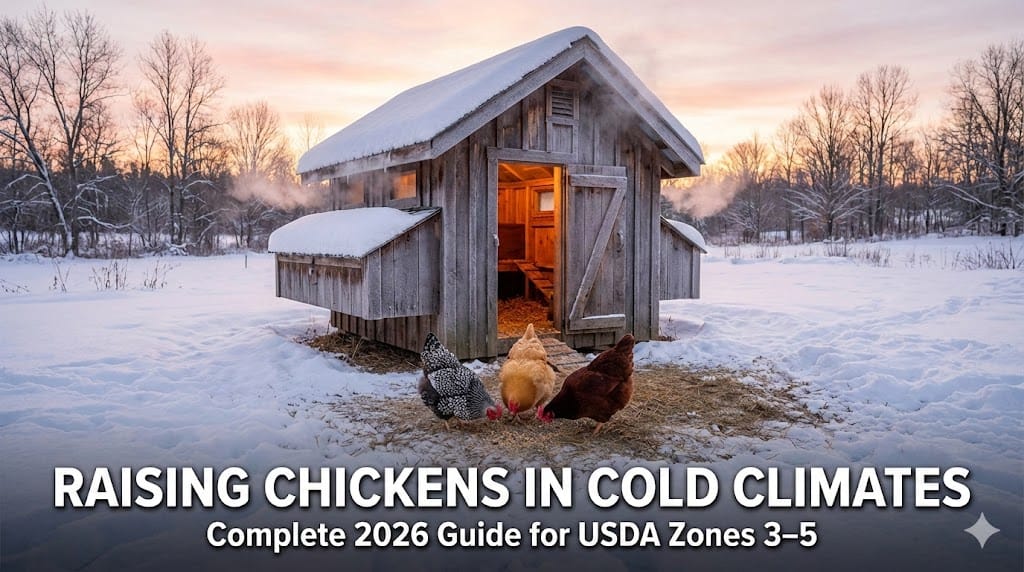
Raising chickens in cold climates like USDA Zones 3–5 is completely achievable, even where the air hurts your face and temperatures drop below -20°F (-29°C). But I’ll be honest: it can be scary at first. With the right cold-hardy breeds and a few coop tweaks, though, your flock can thrive without you running extension cords through the snow.
I still remember my first winter keeping chickens. I lost sleep staring at the thermometer as it dipped to -15°F, convinced my flock would freeze solid. Now, with over 12 years of experience managing flocks ranging from 6 to 40 birds in the bitter winds of the Upper Midwest, I know better. When I went out that first morning, they were happily scratching around, warm and fluffy. This guide covers breed selection, coop winterization, and frostbite prevention based on what actually worked for me (and the mistakes I made along the way).
TL;DR / Quick Summary: Raising chickens in cold climates (USDA Zones 3–5) relies on keeping the coop dry and draft-free, not necessarily hot. Choose cold-hardy breeds like Chanteclers or Wyandottes with small combs to prevent frostbite. Insulate your coop (R-13+) but prioritize ventilation to keep humidity below 60%. Use the deep litter method for natural heat and wide, flat roosts so birds can cover their toes. Avoid dangerous heat lamps; instead, focus on high-calorie feed and keeping water unfrozen.
What “Cold Climate” Really Means for Chickens (USDA Zones 3–5)
So, what counts as “cold”? It depends on who you ask, but for us in USDA Plant Hardiness Zones 3–5, we’re talking about the kind of cold where water freezes instantly.
If you live in these zones, you’re dealing with some serious winter realities:
- Zone 3: Average lows of -40°F to -30°F (-40°C to -34°C). (Ouch.)
- Zone 4: Average lows of -30°F to -20°F (-34°C to -29°C).
- Zone 5: Average lows of -20°F to -10°F (-29°C to -23°C).
Can Chickens Handle Cold Weather? (Yes, Better Than Heat)
New keepers always ask me, what temperature is too cold for chickens? The answer usually shocks them. According to Poultry Keeper, there’s effectively “no minimum temperature, just different levels of care.” I’ve talked to keepers in Canada who manage flocks at -20°C (-4°F) without any heaters.
Here’s the thing: Cold weather chicken coops and the birds inside them are built for this. Their bodies run hot (around 106°F or 41°C), and they have built-in down jackets. When it gets chilly, they fluff those feathers up to trap warm air against their skin.
But wind? Wind is the enemy. During the 2018 “Beast from the East” cold snap, UK keepers kept their flocks safe at -10°C (14°F) just by blocking the wind. Frostbite prevention is your main job here, not trying to heat up the great outdoors.
Best Cold Hardy Chicken Breeds for Raising Chickens in Cold Climates
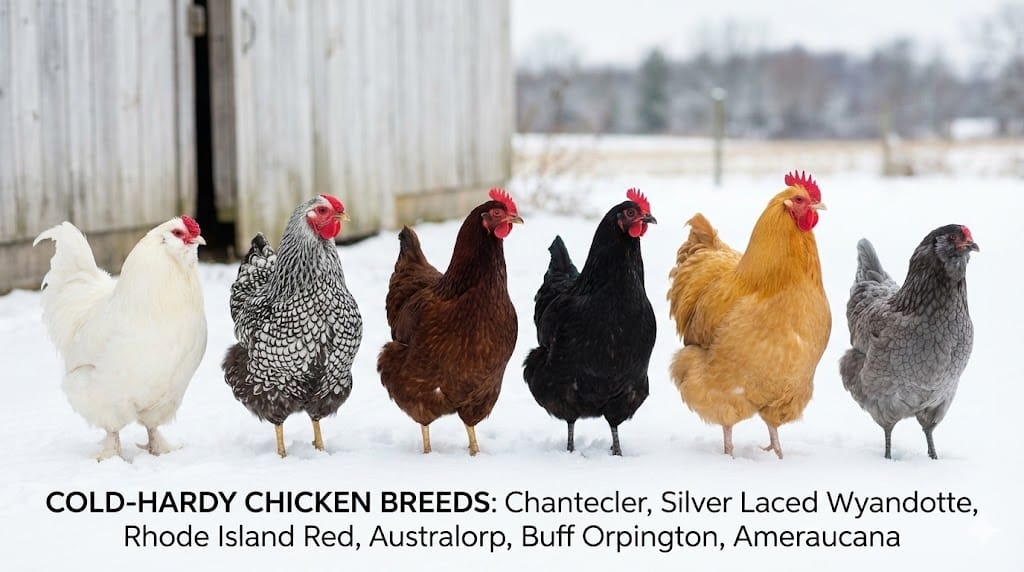
If you are raising chickens in cold climates, you can make your life way easier by picking the right bird. You want best cold hardy chicken breeds with thick feathers and tiny combs. Many of these are recognized by the American Poultry Association (APA) as “heavy breeds,” designed to hold body heat better than lighter production birds.
Why do combs matter? Think of a large single comb (the red thing on their head) like a radiator—it releases heat. And in winter, that’s a recipe for frostbite. According to Practical Self Reliance, “large, floppy combs and wattles are prone to frostbite in freezing temperatures.”
In my Zone 4 flock, my Wyandotte hens laid about 4 eggs a week through January while my Leghorns (a breed with massive combs) looked miserable and stopped laying entirely. The comb type really made the difference.
Best Cold Hardy Chicken Breeds Comparison Table
| Breed | Comb Type | Eggs/Year | Cold Hardiness | Best For |
|---|---|---|---|---|
| Chantecler | Cushion | 200-240 | Very Cold Hardy | Extreme cold (Canadian-developed) |
| Wyandotte | Rose | 200-260 | Cold Hardy + Heat Tolerant | All-around reliability |
| Rhode Island Red | Single | Up to 300 | Cold Hardy + Heat Tolerant | Maximum egg production |
| Australorp | Single | 250-300 | Cold Hardy + Heat Tolerant | Consistent layers |
| Buff Orpington | Single | 200-280 | Cold Hardy | Families, gentle temperament |
| Ameraucana | Pea | 150-200 | Cold Hardy + Heat Tolerant | Blue eggs |
| Russian Orloff | Cushion | 100-180 | Very Cold Hardy | Extreme cold, rare breed |
Other excellent dual-purpose breeds for cold regions include Speckled Sussex, White Plymouth Rock, and New Hampshire Red. These heritage breeds cold tolerance is legendary because they carry enough body mass to stay warm.
Why Pea and Rose Combs Matter
When looking at cold hardy chicken breeds, I always grab breeds with Pea comb, Rose comb, or Cushion combs. Here’s why:
- Less Surface Area: There’s just less skin exposed to the freezing air.
- Heat Retention: They sit tight against the head, keeping warmth in.
- Less Work: Single combs (like on a Rhode Island Red) need extra babying, like applying petroleum jelly, or they turn black from frostbite.
Winterizing Your Chicken Coop for Raising Chickens in Cold Climates
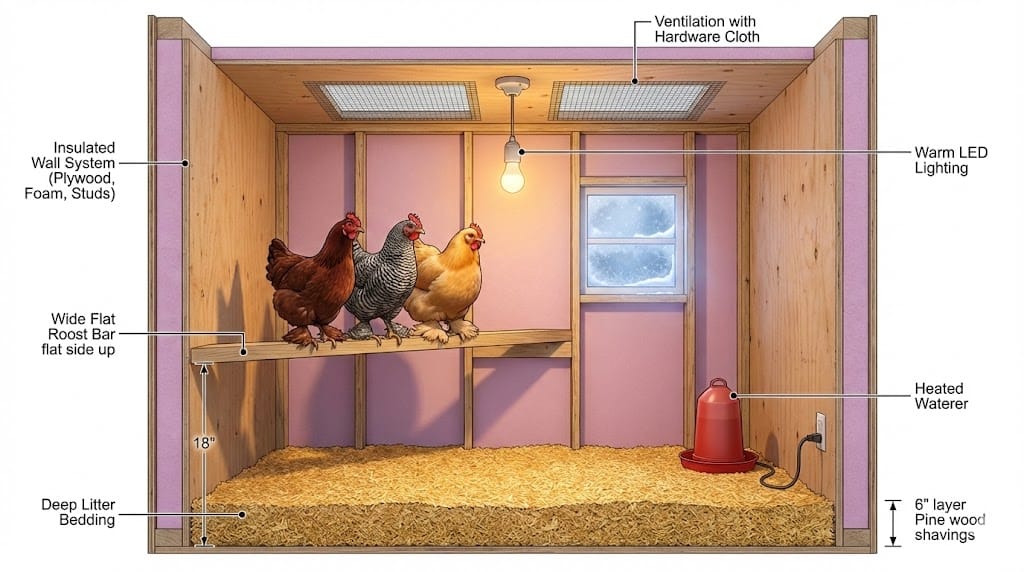
Knowing how do I winterize my chicken coop is critical. When raising chickens in cold climates, the goal isn’t a tropical paradise; it’s a dry, draft-free shelter.
First, ensure you have enough space. The University of Minnesota Extension recommends a minimum of 3 to 5 square feet of indoor space per bird. Overcrowding leads to moisture buildup and pecking issues, which get worse when they are stuck inside during blizzards.
Ventilation vs. Drafts: The Critical Difference
The biggest mistake I made starting out? I taped up every crack like I was building a submarine. Bad idea. You’ll smell the ammonia the second you open the door—it hits you like a wall.
- Drafts: Air blowing right on the birds while they sleep. This ruffles their feathers and lets cold air in. Avoid this.
- Ventilation: Moist air (from poop and breath) escaping through holes high up near the roof. You need this to prevent ammonia buildup and respiratory issues.
According to Michigan State University Extension, keeping humidity low is vital—specifically, you want to keep relative humidity below 50-60% to prevent frostbite. If you are wondering how much ventilation does a chicken coop need, a good calculation for success is 1 square foot (0.09 square meters) of ventilation for every 10 square feet (0.9 square meters) of floor space. So for a standard 4×8 ft (1.2 x 2.4 m) coop, I aim for about 3 square feet (0.28 sq meters) of vent opening, way up above their heads.
Wall and Roof Insulation for Zones 3–5
For those -20°F nights, insulation helps smooth out the temperature swings.
- Walls: Aim for Insulation R-value of R-13 to R-19 if you can.
- Materials: Rigid foam board is great, but you must cover it with plywood. Chickens are curious and will peck (and eat) exposed foam, which is toxic. Ohio State University Extension warns about this constantly.
- Cracks: I use caulk to seal cracks low down by the roosts to stop drafty coop issues, but I leave the vents open at the roofline.
Coop Insulation Buying Guide: What to Look For
Not all insulation materials are equal when it comes to livestock.
- Rigid Foam Board (Best Value): Offers a high R-value per inch and is moisture resistant. Easy to cut and fit between studs.
- Fiberglass Batts (Cheapest): Inexpensive but acts like a sponge if it gets wet. Requires a perfect vapor barrier, or it will mold.
- Reflective Bubble Wrap (Supplemental): Good for reflecting radiant heat but offers very little R-value (warmth retention) on its own. Use it with foam, not instead of it.
The Importance of Flat Roost Bars
Here is a critical detail many guides miss: your roosts should be wide and flat.
- The Design: Use a 2×4 board (wide side up) or a sturdy flat plank, about 2-4 inches wide.
- Why it Matters: When chickens sleep on a wide, flat surface, they can squat down and completely cover their feet with their warm belly feathers.
- Spacing: Ohio State University Extension specifies 6-8 inches of roost space per chicken.
- Height: If you aren’t sure how high should roosting bars be in a coop, aim for at least 18 inches off the ground, but keep them lower than your ventilation openings to avoid drafts.
Floor Design and Pop-Door Placement
Cold sinks, right? So a raised floor stops the frozen ground from sucking heat out of the bedding. Also, look at your “pop-door” (the little door they use). If you have heavy chickens in snow situations, put that door higher up.
Experiential Note: I learned this the hard way. One February morning, I had to shovel for 45 minutes just to let the birds out because I put the door too low. Raising it 12 inches (30 cm) would have saved my back!
How to Keep Chickens Warm in Winter Without Electricity
People ask how to keep chickens warm in winter without electricity all the time because they’re scared. But honestly? Electricity scares me more than the cold does.
Why Heat Lamps Are Dangerous (and Unnecessary)
I never use heat lamps. They are a massive fire hazard—imagine a hot bulb hanging over dry wood shavings and dusty feathers. One bump and the whole thing goes up. If you absolutely must use heat, look for a safe chicken coop heater for winter like a radiant flat panel, but generally, most cold-hardy breeds don’t require supplemental heat if the coop is properly insulated.
Deep Litter Method: How to Keep Chickens Warm Naturally
The best heater is actually… poop. I use the Deep Litter Method.
- Start: Put down 4-6 inches (10-15 cm) of pine shavings or hemp.
- Build: Don’t clean it out every week. Just toss fresh bedding on top of the mess.
- Science: The manure and bedding start to composting bedding right on the floor. This makes heat.
- Result: According to my own Deep Litter Method temperature study, I’ve measured my coop floor at 45°F (7°C) when it was freezing 32°F (0°C) outside. It’s like a natural heated floor.
Note: You gotta have good airflow for this, or it just gets soggy.
Water and Feed Management in Sub-Freezing Weather
Dealing with frozen water is the worst part of winter. Period. Chickens can’t regulate their body temp if they’re thirsty.
Preventing Frozen Water Without Electricity
If you have power, heated waterers are amazing. But if you’re off-grid, you need to know how to keep chicken water from freezing without electricity:
- Insulation: Wrap the bucket in bubble wrap or old wool blankets.
- Rotation: I bring warm water out twice a day. Aim for lukewarm water (around 50-60°F / 10-15°C). Surprisingly, boiling hot water can actually freeze faster than cooler water due to the Mpemba effect, and you don’t want to shock the birds.
- The Float Trick: Some folks put a ping-pong ball in the water bowl. The breeze moves it around, stopping ice from forming. (My experience: This works until about 15°F, then the ball just freezes into the ice!)
Buying Guide: Heated Waterer Features & Costs
If you decide to plug in, you’ll find that heated waterers generally range from $40 base-heater styles to $120 integrated units with thermostatic controls. For a full breakdown, check our best winter water solutions guide. Here is what to look for to get the best value:
- Base Heaters ($40-$60): These are metal plates you place under your existing metal founts. Note: Do not use these with plastic founts as they can melt.
- Integrated Plastic Units ($50-$80): These are all-in-one buckets with built-in heaters. Convenient, but check the cord length before buying.
- Thermostatically Controlled Units ($90-$120): These heavy-duty options only turn on when the water nears freezing, saving significantly on electricity costs over winter.
Winter Feeding Adjustments
To help your cold weather chickens stay warm, feed them more. You might be wondering what to feed chickens in winter specifically:
- Calories & Quantity: Ohio State University Extension states that each laying chicken requires roughly 2 pounds of feed per week. In winter, you should bump up this caloric intake by 10-15% to help them generate body heat.
- Corn at Night: Ohio State University Extension suggests feeding a handful of scratch grains or cracked corn before bed. Digestion creates internal heat, keeping their bellies warm all night.
- Grit: Since the ground is frozen rock-hard, give them a bowl of grit so they can actually digest that corn.
What Temperature Is Too Cold for Chickens?
I see people Googling “what temperature is too cold for chickens at night” constantly. Here’s a breakdown by age:
| Age/Condition | Safe Minimum Temp | Action Required |
|---|---|---|
| Fully feathered adults | -20°F (-29°C) | Provide dry, draft-free shelter. Watch for frostbite. |
| Molting hens | 40°F (4°C) | These poor girls are naked. They need a heater or a sweater. |
| Chicks (4-8 weeks) | 65-75°F (18-24°C) | Transition period. Don’t put them outside yet. |
| Chicks (0-4 weeks) | 85-95°F (29-35°C) | Brooder required. See our guide on winter care for young chicks and chickens. |
Poultry Keeper notes that experienced keepers handle -10°C (-14°F) easily if the birds are dry. But if a bird gets wet? Even 40°F can be deadly.
The University of Minnesota Extension recommends providing supplemental heat when coop temperatures fall below 35°F (2°C), particularly near nest boxes. However, well-insulated coops with cold-hardy breeds rarely reach this threshold even in Zone 3-4 winters.
Egg Production in Winter: What’s Realistic?
Egg production winter decline is real. Hens need about 14 hours light to lay eggs. In December, we might only get 9 hours.
- Natural Break: I usually just let my hens take a vacation in winter. It helps them rest and rebuild their bodies.
- Supplemental Lighting: If you want eggs year-round, you can add a simple LED bulb on a timer. Ohio State University Extension specifically recommends using the equivalent of a 60-watt incandescent (or 9-13 watt LED) hung at approximately 7 feet with a downward reflector. Turn lights on “early in the morning rather than late at night” so they don’t get stuck on the floor in the pitch black when the timer shuts off!
Frostbite Prevention and Winter Health Checks
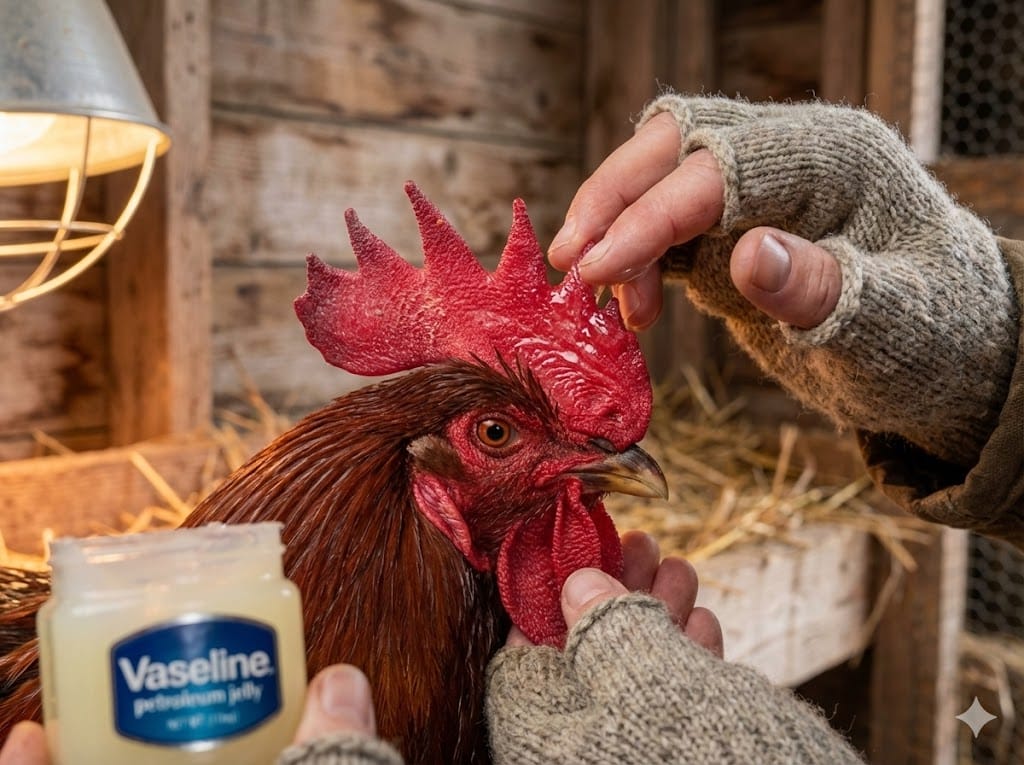
Frostbite prevention is way easier than treating it. It attacks the comb tips, wattles, and feet first. Severe frostbite may require veterinary attention—this guide covers prevention, not treatment of advanced cases.
Winter Health Check for Chickens: Weekly Routine
Every weekend, I grab my coffee and go check the birds to avoid cold stress.
- Combs: I look for black tips (frostbite) or pale color (maybe anemia). Learn how to prevent and treat frostbite on chicken combs before it gets bad.
- Feet: I check that they aren’t caked with mud or “snowballs,” which can freeze toes.
- Respiratory Check: Winter is prime time for respiratory issues like Mycoplasma or infectious bronchitis. Keep an ear out for sneezing, coughing, gasping, or bubbly eyes. If you suspect illness, read up on how to treat chicken respiratory infection.
- Breath: Listen for wheezing. You’ll know if the ammonia is too high.
Pro Tip: For my roosters with big combs, I smear a thick layer of petroleum jelly (Vaseline) or Waxlene on their combs on super cold nights. It acts like a shield against the moisture.
Free Range Chickens in Winter: Safe Outdoor Access
Can you have free range chickens in winter? Sure, but don’t force it.
Chickens in snow are funny. Some, like my Chanteclers, trek right out. Others stand in the doorway and scream at the white stuff.
- Shovel a Path: I always shovel a clear spot in the run and throw down some straw. They hate walking in deep snow.
- Snow Eating: You might wonder can chickens eat snow? While they can ingest small amounts, it consumes body heat to melt it, so liquid water is always better.
- Wind Breaks: I use cheap tarps on the north side of the run to block that biting wind (wind chill is real!).
- Electric Fence Warning: If you rely on electric netting for predators, be careful in Zones 3-5. Electric fences often fail in deep snow because the snow insulates the animal’s feet from the ground, breaking the circuit. You may need a “positive/negative” wire setup or hard wire mesh in winter.
- Limit Time: The Chicken Coop Company says outdoor time is fine, but maybe limit it “during extreme cold or icy conditions.”
Global Winter Regulations (UK, Canada, Australia)
Important Note for International Keepers: Winter often brings increased risk of Avian Influenza. In the UK and EU, mandatory “housing orders” (often called a “flockdown”) may legally require you to keep birds indoors or in fully covered runs during winter months to prevent contact with wild birds. In Australia and Canada, strict biosecurity laws emphasize preventing contamination of feed and water by wild waterfowl, which is critical during migration seasons. Always check your local Department of Agriculture or DEFRA (UK) for current alerts.
Sample Winterization Budget for Zones 3–5
Prepare your wallet so you aren’t shocked. Here’s roughly what I spend:
| Item | Bare Minimum | Practical | Comfort Level |
|---|---|---|---|
| Insulation | $50-75 (DIY Scraps) | $100-150 (Foam Board) | $200+ (Prof. Install) |
| Heated Waterer | $0 (Manual Carry) | $40-60 (Base heater) | $80-120 (Integrated unit) |
| Deep Litter Bedding | $30 (Bulk shavings) | $50 (Hemp/Flax) | $75 (Premium blends) |
| Ventilation Fixes | $20 (Hardware cloth) | $50 (New vents) | $100 (Louvers) |
| Cold Hardy Chicks | **$4-5/bird (Standard)** | $10-15/bird (Heritage) | $25+/bird (Started) |
| Total | $125-150 | $300-385 | $555-650+ |
Note: High-quality cold-hardy breeds like true Chanteclers often cost significantly more than standard production Reds.
🖨️ Printable Summary: Month-by-Month Winter Prep Checklist
(Tip: Screenshot this section or copy it to your phone notes for easy access in the coop)
- September: Look at your flock. Do you have old birds that might not make it? Order insulation materials now.
- October: It’s winterizing chicken coop time. Put up the insulation. Clean the coop deep before starting the litter method.
- November: Switch to high-calorie feed. Start the Vaseline routine if frost hits early.
- December – February: Maintenance mode. Check water 3x a day. Watch for cold stress.
- March: Check for damage. As it thaws, you might need to clean the litter out if it gets too wet.
Frequently Asked Questions on Raising Chickens in Cold Climates
Can chickens freeze to death?
Yes, but usually only if something goes wrong. Healthy, dry cold weather chickens can handle -20°F easily. Deaths usually happen because of wet feathers, bad drafts, or no water.
Do chickens need to be kept warm at night?
Not really. They are little heaters themselves! If your coop is draft-free and ventilated, their body heat (and huddling) is enough.
At what age can chickens handle 40-degree weather?
They need their full adult feathers first, usually around 6-8 weeks. Younger chicks need a brooder starting at 95°F (35°C).
How cold does it need to be for chickens to get frostbite?
Risk goes up fast below 20°F (-7°C), especially if it’s damp. Large combs get hit first. Ventilation is your best defense here.
Disclaimer: This guide is for informational purposes based on agricultural standards and personal experience. Always consult a veterinarian for specific health issues with your flock.

Oladepo Babatunde is the founder of ChickenStarter.com. He is a backyard chicken keeper and educator who specializes in helping beginners raise healthy flocks, particularly in warm climates. His expertise comes from years of hands-on experience building coops, treating common chicken ailments, and solving flock management issues. His own happy hens are a testament to his methods, laying 25-30 eggs weekly.