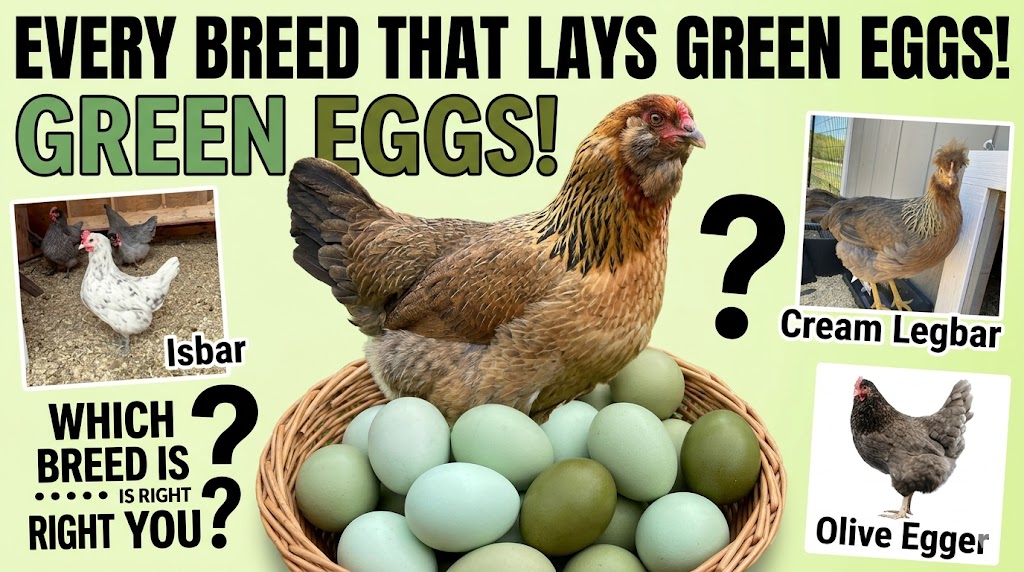
If you have ever cracked open a carton of farm-fresh eggs and spotted a beautiful green egg nestled among the browns and whites, you probably wondered which chicken laid it. Green eggs are not dyed, painted, or a gimmick. They are a natural result of specific genetics that only a handful of chicken breeds carry.
I keep several green egg layers in my own flock, and they are consistently the eggs that get the most attention when I share a dozen with friends or sell at our local farmers market. People are genuinely fascinated by them. The color ranges from a soft sage to a deep olive to a vibrant mint, and the shade can vary from hen to hen and even from egg to egg throughout the laying season.
This guide covers every breed that lays green eggs, explains the genetics behind the color, helps you understand the difference between blue, green, and olive eggs, and gives you practical advice on choosing the right green egg layer for your flock. If you want a colorful egg basket, this is everything you need to know.
How Green Eggshells Actually Happen (The Genetics)
Understanding why some chickens lay green eggs requires a quick look at eggshell pigment genetics. It is simpler than it sounds.
All eggshells start as white inside the hen’s shell gland (uterus). Two pigments can be applied during the shell formation process:
Oocyanin is a blue pigment derived from biliverdin. It is deposited throughout the shell structure, meaning the egg is blue all the way through. If you crack a blue egg and look at the inside of the shell, it is blue.
Protoporphyrin is a brown pigment applied as a coating on the outside of the shell during the final hours before laying. It sits on the surface, which is why the inside of a brown egg is white.
A green egg happens when a hen carries both the blue egg gene (oocyanin throughout the shell) AND the brown pigment gene (protoporphyrin coating on the surface). The brown pigment layered over the blue base creates a green appearance, similar to mixing blue and yellow paint.
The shade of green depends on how much brown pigment the hen deposits. A heavy brown coating over a blue shell produces a deep olive green. A lighter brown coating over a blue shell produces a sage or mint green. And the intensity can vary throughout a hen’s laying cycle, with eggs typically being darker early in the season and lighter as production continues.
According to information from the Livestock Conservancy, several heritage and specialty breeds carry the blue egg gene (known as the oocyanin gene or “O” gene), and when these are crossed with brown egg layers, green egg offspring are often the result.
Breeds That Lay Green Eggs
Not many purebred chicken breeds lay truly green eggs. Most green egg layers are either hybrid crosses or breeds with diverse genetic backgrounds. Here is a complete breakdown.
Easter Eggers
The Easter Egger is by far the most common and accessible green egg layer available to backyard chicken keepers. Easter Eggers are not a standardized breed recognized by the American Poultry Association. They are mixed-breed chickens that carry the blue egg gene from Ameraucana or Araucana ancestry, combined with genetics from brown egg laying breeds.
Because of this mixed heritage, Easter Egger egg color is unpredictable. Individual hens may lay green, blue, pink, tan, or even light brown eggs. You will not know what color a specific hen will produce until she lays her first egg. But once she starts, her color stays consistent for life.
In my flock, I have three Easter Eggers. Two lay a lovely sage green and one lays a blue-tinted mint. Their egg production is solid at roughly 4 eggs per week per hen, and they are friendly, hardy birds that tolerate both cold and heat well.
Easter Eggers are widely available from hatcheries across the United States, Canada, and Australia for $3 to $5 per chick, making them the most affordable entry point into green eggs.
For a complete breakdown of this breed, including temperament, care needs, and egg production details, read our full Easter Egger chicken guide.
Olive Eggers
An Olive Egger is a hybrid chicken specifically bred to lay dark green or olive-colored eggs. They are created by crossing a blue egg layer (typically an Ameraucana, Araucana, or Cream Legbar) with a dark brown egg layer (usually a Marans, Welsummer, or Barnevelder).
The first-generation cross (F1) produces hens that lay olive to dark green eggs. If you cross an F1 Olive Egger back to a dark brown egg layer, the second-generation hens (F2) can produce even deeper olive shades, sometimes approaching a dark army green.
Olive Eggers are not a standardized breed. They are a purposeful cross, and their appearance varies widely depending on the parent breeds used. Egg production is typically 3 to 4 eggs per week, and temperament depends heavily on the parent stock.
I added two Olive Eggers to my flock last year. Both came from a Cream Legbar x Black Copper Marans cross. Their eggs are a deep, rich olive that photographs beautifully and looks stunning in a mixed egg carton. They are slightly less prolific than my Easter Eggers, but the color intensity makes up for it.
Isbar (Silverudd’s Blue)
The Isbar (pronounced “ice-bar”) is a rare Swedish breed developed by Martin Silverudd in the 1980s. It is one of the only purebred, auto-sexing breeds that lays green eggs. The eggs range from mossy green to olive, with occasional blue-green tones.
Isbars are a lightweight, active breed that lays approximately 200 to 250 eggs per year. They are cold-hardy, good foragers, and relatively calm. However, they are difficult to find in the United States and command higher prices, typically $8 to $15 per chick from specialty breeders.
If you can source them, Isbars are an excellent choice for keepers who want a purebred green egg layer without relying on hybrid crosses.
Favaucana
A Favaucana is a cross between a Faverolles and an Ameraucana. This hybrid produces hens that typically lay sage green to olive-green eggs. They inherit the gentle, docile temperament of the Faverolles along with the blue egg gene from the Ameraucana side.
Favaucanas are not widely available from major hatcheries, but they are increasingly popular among small breeders and poultry enthusiasts who value both personality and egg color diversity. Expect 3 to 4 eggs per week from a healthy Favaucana hen.
For more on the Faverolles side of this cross, our Salmon Faverolles chicken guide covers the breed in detail.
Cream Legbar
The Cream Legbar is a British auto-sexing breed that primarily lays blue eggs. However, individual Cream Legbar hens sometimes produce eggs with enough brown overlay to appear green or blue-green, especially early in their laying cycle.
Cream Legbars are excellent layers at roughly 4 to 5 eggs per week and are active, alert birds with good foraging instincts. They are more readily available than Isbars but still less common than Easter Eggers at most hatcheries.
If you are specifically after green eggs rather than blue, Cream Legbars are a bit of a gamble. Some hens produce eggs that lean distinctly green, while others lay pure blue. Crossing a Cream Legbar with a brown egg layer is the most reliable way to guarantee green offspring.
Ice Cream Bar (Hybrid)
The Ice Cream Bar is a newer designer cross gaining popularity in 2025 and 2026. It is typically created by crossing an Isbar with a Cream Legbar. The resulting hens tend to lay eggs in various shades of green, from light mint to medium olive, with solid production rates of 4 to 5 eggs per week.
These hybrids are showing up more frequently in specialty hatchery catalogs and from small breeders who focus on colorful egg baskets.
Green Eggs vs. Blue Eggs vs. Olive Eggs: What Is the Difference?
People often confuse these colors or use the terms interchangeably. Here is a clear breakdown.
| Egg Color | Shell Appearance | Inside of Shell | Genetics |
|---|---|---|---|
| Blue | Blue all the way through | Blue | Blue gene only (oocyanin) |
| Green (light) | Sage, mint, or seafoam exterior | Blue-green inside | Blue gene + light brown overlay |
| Olive (dark green) | Deep green, army green, or khaki | Blue-green inside | Blue gene + heavy brown overlay |
| Brown | Brown exterior only | White inside | Brown pigment gene only |
The simplest way to tell if an egg is truly green (as opposed to a very light brown) is to look at the inside of the shell after cracking it. If the inside is blue or blue-green, the egg carries the blue gene and the exterior green color is genuine. If the inside is white, it is actually a brown egg with a lighter-than-usual pigment coat.
For more on blue egg laying breeds specifically, our article on what chicken lays blue eggs covers Ameraucanas, Araucanas, and Cream Legbars in detail.
How to Get Green Eggs from Your Flock
If you want green eggs in your egg basket, you have several options depending on your budget, availability, and preferences.
Buy Easter Eggers
This is the easiest and most affordable approach. Easter Egger chicks are available from virtually every major hatchery in the US, Canada, and Australia. They cost $3 to $5 per chick and are sold as straight-run or sexed pullets.
The catch is that not every Easter Egger will lay green. Some lay blue, some lay pink or tan. If green is specifically what you want, buy at least 4 to 6 Easter Egger chicks to increase your odds of getting multiple green layers.
Buy Olive Eggers
If you want a guaranteed dark green or olive egg, buy specifically labeled Olive Egger chicks from a hatchery or breeder. These are intentional crosses bred to produce green eggs, and the odds of getting green from an Olive Egger are much higher than from a random Easter Egger.
Breed Your Own
Cross a blue egg layer (Ameraucana, Araucana, Cream Legbar) with a brown egg layer (Marans, Welsummer, Rhode Island Red, Barred Rock) and the female offspring will lay green eggs. The shade depends on which brown egg breed you use. A Marans cross produces the darkest olive. A lighter brown layer like a Rhode Island Red produces a medium sage green.
This is a fun project if you already keep both blue and brown egg layers. You will need a rooster and an incubator or a broody hen. Our guide on how to tell if an egg is fertile covers what to look for if you are considering hatching your own.
Green Egg Layer Comparison Chart
| Breed/Cross | Egg Color | Eggs Per Year | Temperament | Availability | Price Per Chick |
|---|---|---|---|---|---|
| Easter Egger | Green, blue, or pink (varies) | 200 to 280 | Friendly, docile | Very common | $3 to $5 |
| Olive Egger (F1) | Olive to dark green | 150 to 250 | Varies by cross | Common | $5 to $8 |
| Olive Egger (F2) | Deep olive | 150 to 220 | Varies by cross | Moderate | $8 to $12 |
| Isbar | Mossy green to olive | 200 to 250 | Calm, active | Rare | $8 to $15 |
| Favaucana | Sage to olive green | 180 to 220 | Very gentle | Uncommon | $6 to $10 |
| Cream Legbar | Blue-green to blue | 230 to 270 | Alert, active | Moderate | $6 to $12 |
| Ice Cream Bar | Mint to medium green | 220 to 260 | Calm, friendly | Uncommon | $8 to $15 |
Do Green Eggs Taste Different?
No. The shell color has absolutely no effect on the taste, nutritional content, or cooking properties of the egg inside. A green egg, a blue egg, a brown egg, and a white egg from hens fed the same diet and kept in the same conditions will taste identical.
What does affect egg flavor and yolk quality is the hen’s diet and lifestyle. Hens that free-range on pasture, eat insects, and get plenty of dietary variety tend to produce eggs with richer, deeper orange yolks regardless of shell color. If you want better-tasting eggs, focus on nutrition and foraging access rather than shell color.
Our guide on how backyard chickens help reduce your food waste covers how kitchen scraps and foraging contribute to better eggs and a healthier flock.
Factors That Affect Green Egg Color Intensity
Even within the same breed, green egg color can vary. Here is what influences the shade.
Age of the hen. Pullets just starting to lay often produce their darkest, most intensely colored eggs. As a hen ages, the pigment can lighten slightly over successive laying cycles.
Time within the laying cycle. Eggs laid early in a laying cycle (after a molt or winter break) tend to be darker. As continuous laying progresses, the pigment lightens because the same amount of pigment is distributed over a larger number of eggs.
Stress and health. A stressed or ill hen may produce lighter-colored eggs. If your green egg layer suddenly starts producing noticeably paler eggs, it could be a sign of an underlying health issue or environmental stressor.
Diet. While diet does not change the fundamental genetics of shell color, overall hen health and nutrition affect the quality of pigment deposition. A well-nourished hen produces more consistent color.
Individual genetics. Even among Easter Eggers from the same hatch, each hen carries a slightly different genetic combination that determines her specific shade. This is part of what makes colorful egg breeds so fun to keep.
Choosing the Right Green Egg Layer for Your Flock
Your ideal green egg layer depends on what you are optimizing for.
If you want the most eggs: Choose Easter Eggers or Cream Legbars. Both are reliable producers at 4 to 5 eggs per week, and Easter Eggers are among the hardiest, most adaptable backyard breeds available.
If you want the darkest green: Choose Olive Eggers from a Marans cross. First-generation Olive Eggers from a Black Copper Marans father and an Ameraucana mother produce beautifully deep olive eggs.
If you want a purebred with green eggs: Look for Isbars. They are one of the only true-breeding green egg layers, but availability is limited.
If you want a gentle, family-friendly bird: Favaucanas combine the calm personality of the Faverolles with green egg production. They are wonderful for families with children who want to interact with the flock.
If you are a beginner: Start with Easter Eggers. They are cheap, widely available, hardy in all climates, friendly, and forgiving of the mistakes that every new chicken keeper makes. Our guide on the easiest chicken breeds for beginners covers other beginner-friendly options if you want to round out your flock with complementary breeds.
My Personal Green Egg Flock
For context, here is what I currently keep for green egg production and what I have learned over the past few years.
My flock includes three Easter Eggers and two Olive Eggers (Cream Legbar x Black Copper Marans cross). Together, these five hens give me an average of 17 to 20 green and olive eggs per week during peak production.
The Easter Eggers have been the most consistent layers. They rarely go broody, they lay through mild winters with only a brief slowdown, and they have never had a health issue that affected their production.
The Olive Eggers are slightly less prolific but produce stunningly dark eggs that are always the first to sell out when I bring a mixed dozen to the farmers market. People will pay a premium for a carton with a few deep olive eggs mixed in alongside brown, white, and blue ones.
If I were starting fresh and wanted to maximize green egg variety, I would keep two Easter Eggers (for volume and light green color), two Olive Eggers (for dark olive), and one Isbar (for a unique mossy green). That combination would give me a beautiful range of greens in every basket.
Setting Up for Green Egg Layers
Green egg laying breeds have the same basic housing and care needs as any other backyard chicken. They need a secure coop, proper nesting boxes, quality feed, and fresh water.
If you are setting up a new coop for your green egg layers, our guide on popular chicken coop styles explained covers the pros and cons of every major design. For a budget-friendly option, a pallet chicken coop can be built for under $200 and houses a small flock comfortably.
For nesting boxes, plan one box for every 4 to 5 hens. Adding dried herbs to your nesting boxes helps repel pests and keeps your beautiful green eggs clean and fresh.
Frequently Asked Questions
Are green eggs safe to eat?
Absolutely. Green eggs are nutritionally identical to white or brown eggs. The color is determined solely by the hen’s genetics and pigment deposition during shell formation. There is nothing artificial or harmful about the green color.
Will a green egg layer always lay green eggs?
Yes. Once a hen starts laying a specific color, she will produce that same color for her entire life. The shade may lighten slightly with age or during prolonged laying cycles, but a green egg layer will never switch to laying brown or white eggs.
Can I tell what color eggs a chick will lay before she starts laying?
Not definitively from looking at the chick. However, if you know the parentage (blue egg mother crossed with brown egg father, for example), you can predict green eggs with high confidence. For Easter Eggers with unknown parentage, you simply have to wait until the first egg arrives around 18 to 24 weeks of age.
Do roosters affect the egg color?
A rooster does not change what color eggs a hen lays. However, a rooster’s genetics influence what color eggs his daughters will lay. If you breed a blue egg rooster with a brown egg hen, the female offspring will likely lay green eggs.
How many green eggs per week can I expect?
This depends on the breed. Easter Eggers typically produce 4 to 5 green eggs per week. Olive Eggers average 3 to 4 per week. Isbars produce roughly 4 per week. Production slows during winter, molting, and as hens age past their second year.
Why are my Easter Egger’s green eggs getting lighter?
This is normal. Pigment intensity often decreases as a hen progresses through a continuous laying cycle. After a molt or winter break, the color usually returns to its original darker shade when laying resumes.
Disclaimer
The information in this article is based on personal experience raising green egg laying breeds and widely accepted poultry genetics and breeding knowledge. Egg color can vary between individual hens even within the same breed, especially among Easter Eggers and other non-standardized crosses. For specific breeding questions or flock health concerns, consult a qualified poultry veterinarian or your local agricultural extension service. Always verify breed availability and pricing with your chosen hatchery, as stock and prices fluctuate seasonally.

Oladepo Babatunde is the founder of ChickenStarter.com. He is a backyard chicken keeper and educator who specializes in helping beginners raise healthy flocks, particularly in warm climates. His expertise comes from years of hands-on experience building coops, treating common chicken ailments, and solving flock management issues. His own happy hens are a testament to his methods, laying 25-30 eggs weekly.