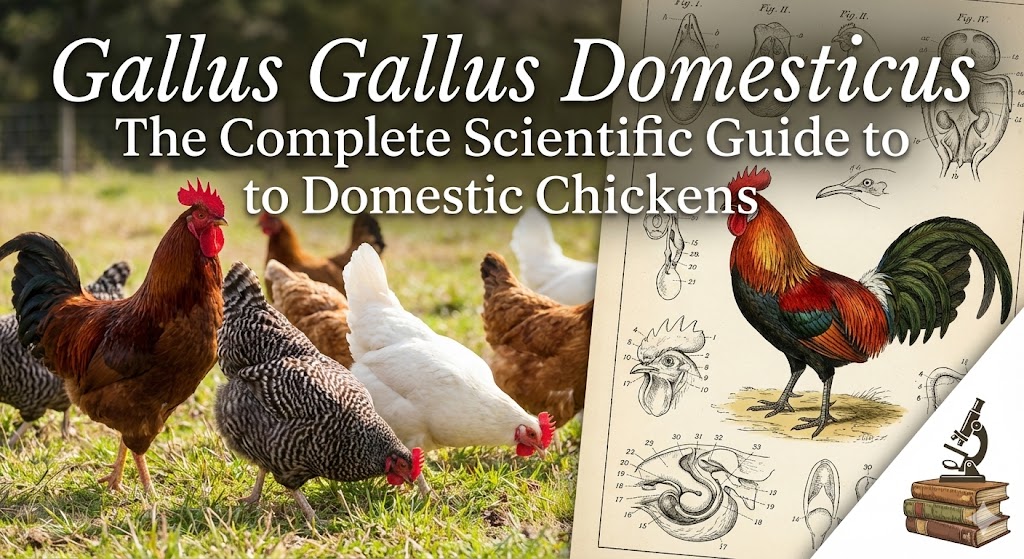
The humble backyard chicken has a name that sounds more like a Roman emperor than a farmyard bird. When I first started keeping chickens eight years ago, I never imagined I would find myself fascinated by the scientific classification of these birds scratching around my yard. Yet understanding where chickens come from and how they fit into the broader animal kingdom has genuinely changed how I care for my flock.
Gallus gallus domesticus is the scientific name for the domestic chicken, one of the most common and widespread domesticated animals on the planet. The domestic chicken is a descendant of the red junglefowl originally native to Southeast Asia. According to traditional estimates, domestication occurred approximately 7,000 to 10,000 years ago, though recent research from the University of Oxford suggests the domestication process may have begun more recently, around 1500 BC, driven by the arrival of dry rice farming in Southeast Asia.
This guide covers everything from the complete taxonomic classification to the etymology of the name, physical characteristics, domestication history, reproduction, and the relationship between your backyard hens and their wild jungle ancestors.
What Is the Meaning of Gallus Gallus Domesticus?
Breaking Down the Scientific Name
When you see a three part scientific name like Gallus gallus domesticus, each component tells you something specific about where this animal fits in the tree of life. Understanding this naming system helped me appreciate that my Buff Orpingtons and Rhode Island Reds share a direct lineage with wild birds still living in Southeast Asian jungles.
| Name Component | Language | Meaning |
|---|---|---|
| Gallus (first) | Latin | “Rooster” or “cock” referring to the genus |
| gallus (second) | Latin | Species name derived from the wild red junglefowl |
| domesticus | Latin | “Of the household” or “domesticated” |
The full meaning translates roughly to “the domesticated rooster of the household.” The repetition of “gallus” indicates that domestic chickens are a subspecies of the wild Gallus gallus, which is the red junglefowl.
There is ongoing debate in the scientific community regarding the proper classification. Some researchers consider the chicken to be a domesticated type of wild red jungle fowl and use Gallus gallus domesticus. Others, including the USDA, classify it simply as Gallus domesticus. According to the Penn State Extension poultry program, domestic chickens are simply classified as Gallus domesticus. Both naming conventions are scientifically accepted, though Gallus gallus domesticus more precisely indicates the subspecies relationship to wild junglefowl.
How to Pronounce Gallus Gallus Domesticus
I remember stumbling over this pronunciation at my first poultry show. Here is the correct way to say it:
GAL-us GAL-us doh-MES-ti-kus
Breaking it down by syllables:
- Gallus: GAL-us (two syllables, emphasis on first)
- gallus: GAL-us (identical pronunciation)
- domesticus: doh-MES-ti-kus (four syllables, emphasis on second)
The “g” is hard as in “garden,” not soft as in “gentle.”
Gallus Gallus Domesticus Classification: Complete Taxonomy
Full Taxonomic Hierarchy
Understanding where chickens fit in the animal kingdom helps explain many of their behaviors and needs. When I learned that chickens belong to the same order as turkeys, pheasants, and quail, their ground scratching behavior and preference for roosting suddenly made more sense.
According to the Penn State Extension, the chicken belongs to the genus Gallus of the family Phasianidae.
| Taxonomic Rank | Classification |
|---|---|
| Domain | Eukaryota |
| Kingdom | Animalia |
| Phylum | Chordata |
| Class | Aves (Birds) |
| Order | Galliformes |
| Family | Phasianidae |
| Genus | Gallus |
| Species | Gallus gallus |
| Subspecies | Gallus gallus domesticus |
Understanding the Classification Levels
Order Galliformes includes heavy bodied, ground feeding birds sometimes called landfowl or gamebirds. This order contains pheasants, turkeys, grouse, quail, and of course chickens. These birds share characteristics like strong legs for scratching, relatively short wings, and ground nesting habits. If you have ever watched your chickens vigorously scratch at the ground to uncover insects, you are witnessing millions of years of Galliformes evolution in action.
Family Phasianidae is a large family including pheasants, partridges, junglefowl, and Old World quail. Members of this family are known for sexual dimorphism, meaning males and females look noticeably different. This explains why roosters have such dramatically different plumage compared to hens.
Genus Gallus specifically refers to junglefowl. There are four species in this genus: red junglefowl, grey junglefowl, Sri Lankan junglefowl (also called Ceylon junglefowl), and green junglefowl. Of these, the red junglefowl is the primary ancestor of domestic chickens.
Gallus Gallus vs. Gallus Domesticus: What Is the Difference?
This distinction confused me for years. Here is the straightforward explanation:
| Term | Refers To |
|---|---|
| Gallus gallus | Wild red junglefowl species |
| Gallus gallus domesticus | Domesticated subspecies (chickens) |
| Gallus domesticus | Alternative scientific name used by USDA |
Gallus gallus refers to one species of wild animal believed to be the primary parent of the common domesticated chicken. Gallus gallus domesticus refers to all domesticated chickens, which is a remarkably broad category encompassing everything from tiny Seramas to giant Jersey Giants.
For practical purposes, if you are keeping backyard chickens, you are keeping Gallus gallus domesticus regardless of breed. If you ever visit Southeast Asia and spot a wild bird that looks surprisingly similar to your backyard rooster, that would be Gallus gallus, the wild red junglefowl.
Gallus Gallus Domesticus Common Name and Terminology
Common Names for Domestic Chickens
One thing that surprised me when I started showing chickens was how specific the terminology gets. Using the wrong term immediately marks you as a beginner. Here is the complete breakdown:
| Term | Definition |
|---|---|
| Chicken | General term for the species |
| Rooster/Cock | Adult male (rooster in US/Australia/Canada; cock in UK/Ireland) |
| Hen | Adult female |
| Cockerel | Immature or young male |
| Pullet | Immature or young female |
| Capon | Castrated male |
| Chick | Young chicken of either sex |
Regional variations exist across English speaking countries. In the Deep South of the United States, chickens are sometimes called “yardbirds.” In parts of the UK, people still use “fowl” as the general term.
Historically, “chicken” was originally a term only for an immature or young bird. In older sources from the 18th and 19th centuries, chickens as a species were typically referred to as “common fowl” or “domestic fowl.” This is why some traditional breed names include “fowl” rather than “chicken.”
For those new to keeping chickens, our guide on choosing between chicks vs adult hens explains which starting point works best for beginners.
Gallus Gallus Domesticus Description: Physical Characteristics
General Appearance and Size
Chickens are gregarious birds of medium size capable of performing short flights. In my experience, “short flights” is generous. My heaviest Brahma rooster can barely clear a three foot fence, while my lighter Leghorns can easily reach six foot perches. Flight capability varies dramatically by breed and individual bird weight.
Sexual dimorphism is immediately evident in chickens. Even people who have never kept poultry can usually distinguish a rooster from a hen at a glance.
Males (Roosters):
- Size: Up to 50 cm (20 inches) tall
- Weight: Up to 4 kg (8.8 lbs) for standard breeds, with some giant breeds exceeding this
- Features: Prominent comb on top of head, wattles hanging below beak
- Tail: Composed of large, arching sickle feathers
- Legs: Often fitted with spurs used for fighting and defense
- Plumage: Generally more colorful and iridescent than females
Females (Hens):
- Size: Typically no more than 40 cm (16 inches)
- Weight: About 2 kg (4.4 lbs) for standard breeds
- Features: Smaller combs and wattles, less striking coloration
- Tail: Shorter and less elaborate
- Purpose: Body designed for egg production
Distinctive Features
Adult chickens have a fleshy crest on their heads called a comb, or cockscomb. Several comb types exist including single, rose, pea, buttercup, and cushion combs. The comb type is breed specific and can help with identification.
The hanging flaps of skin on either side under the beak are called wattles. Both combs and wattles serve thermoregulation purposes, helping chickens release excess body heat. This is why breeds with large combs like Leghorns thrive in hot climates while breeds with small pea combs like Brahmas handle cold weather better. For more on cold weather breeds, see our Wyandotte chicken complete guide.
Life span depends significantly on breed and living conditions. Heritage breeds typically live five to ten years, with some hens reaching twelve or older. Commercial hybrid layers bred for maximum egg production generally have shorter lifespans. Our article on how long do chickens live covers this topic in detail.
Popular Breed Varieties
After keeping chickens for nearly a decade, I have had hands on experience with most common breeds. Here are some popular varieties of Gallus gallus domesticus:
| Breed | Characteristics |
|---|---|
| Rhode Island Red | Red-orange feathers, excellent layers, hardy |
| Buff Orpington | Golden buff color, docile, often goes broody |
| Plymouth Rock | Barred pattern, good dual purpose bird |
| Australorp | Black feathers with green sheen, record laying ability |
| Wyandotte | Laced feather patterns, rose comb, cold hardy |
| Leghorn | White, smaller body, exceptional layers |
| Brahma | Giant breed, feathered feet, gentle disposition |
Each breed represents centuries of selective breeding from the original Gallus gallus domesticus stock. Our easiest chicken breed for beginners guide helps new keepers choose appropriate starting breeds.
Origin and Domestication History
Evolutionary Origins
The evolutionary story of chickens connects them to one of the most dramatic events in Earth’s history. Galliformes, the order that chickens belong to, is directly linked to the survival of birds when all other dinosaurs went extinct approximately 66 million years ago.
Water or ground dwelling fowl similar to modern partridges survived the Cretaceous Paleogene extinction event that killed all tree dwelling birds and non avian dinosaurs. Some of these survivors eventually evolved into modern galliformes, making your backyard chickens distant relatives of the birds that survived the asteroid impact.
When I share this fact with visitors to my coop, they always look at my chickens differently. These seemingly ordinary birds represent an unbroken line of survival stretching back tens of millions of years.
Domestication Timeline: An Evolving Understanding
The timing of chicken domestication has been the subject of significant scientific debate, and our understanding continues to evolve as new research emerges.
Traditional estimates placed domestication at 7,000 to 10,000 years ago. According to research published in the Proceedings of the National Academy of Sciences, it was postulated that chickens became domesticated from wild junglefowls in Southeast Asia nearly 10,000 years ago. Archaeological remains of domestic chickens found in Neolithic sites along the Yellow River in Northeast China date back to approximately 8,000 years ago, leading researchers to conclude domestication must have occurred at least since that time.
According to the University of Wisconsin Livestock Extension, domestication probably occurred 7,000 to 10,000 years ago in Southeast Asia and Oceania.
Recent research challenges older estimates. According to major international research from the University of Oxford, previous efforts claiming chickens were domesticated up to 10,000 years ago in China, Southeast Asia, or India have been called into question. The new studies suggest this domestication process was underway by around 1500 BC in the Southeast Asian peninsula, considerably more recently than previously believed.
The Oxford research indicates that the driving force behind chicken domestication was the arrival of dry rice farming in Southeast Asia where the wild ancestor, the red junglefowl, naturally lived. Dry rice farming acted as a magnet drawing wild jungle fowl down from the trees and kickstarting a closer relationship between people and the jungle fowl that eventually resulted in domesticated chickens.
Key domestication timeline (traditional vs. revised):
| Traditional Estimate | Revised Estimate (Oxford) |
|---|---|
| 8,000-10,000 years ago | ~1500 BC (about 3,500 years ago) |
| Multiple domestication events in China | Single domestication in Southeast Asian peninsula |
| Food source as primary motivation | Dry rice farming created opportunity for domestication |
Original Purpose: Not What You Might Expect
Here is something that surprises most people. According to poultry historians, the reason why Gallus gallus was first domesticated was likely for the entertainment the cocks provided through their fighting, not primarily as a food source. The sport of cockfighting is believed to have been the principal reason for the initial dispersion of chickens across trade routes.
Distribution of chickens occurred rapidly and was widespread because of their ability to provide meat and eggs without being competitive for human food sources. But ceremonial and entertainment purposes preceded culinary ones.
Genetic Heritage
According to the Penn State Extension, the domestic chicken’s ancestry can be traced back to four species of wild jungle fowl from Southeast Asia. However, the Red jungle fowl (Gallus gallus) is the most commonly found wild species in the world today and is considered the main ancestor of the domestic chicken.
Most scientists agree that the Southeast Asian Red Junglefowl is the primary wild ancestor. However, because DNA studies show that the Red Junglefowl lacks the gene for yellow skin and shanks, it is believed that at some point hybridization with the Grey Junglefowl (Gallus sonneratii) of India occurred. This explains why some chicken breeds have yellow legs while others have slate or white legs.
Research published in 2020 analyzing 863 chicken genomes from worldwide sampling suggests that the red junglefowl subspecies Gallus gallus spadiceus, indigenous to northern Thailand, Myanmar, and southwestern China, is the closest wild progenitor of domestic chickens.
The classification of today’s chicken as Gallus gallus domesticus recognizes this primary origin from the Red Junglefowl.
Can Jungle Fowl Mate with Chickens? Breeding and Reproduction
Interbreeding with Wild Junglefowl
Yes, jungle fowl can mate with domestic chickens. This is possible because domestic chickens are scientifically classified as the same species as red junglefowl. They can and do freely interbreed where their populations overlap.
According to early research cited in genetic studies, Darwin proposed a single origin hypothesis based on the observation that only red junglefowl can produce fertile F1 offspring in a cross with chickens. However, subsequent hybridization experiments showed more complex results. Research demonstrated that although F1 females of red and green junglefowls show reduced fertility, they can produce F2 hybrids in backcrosses with red junglefowl. Hybridization of grey junglefowl and chickens has also been observed in the vicinity of villages.
This ongoing gene flow has contributed to the genetic diversity seen in domestic chicken populations across different regions.
Reproductive Biology
Gallus gallus domesticus is a social and polygamous species. In natural flock settings, males mate with several females throughout the year. One rooster can effectively manage a flock of 8 to 12 hens. Our guide on do I need a rooster to get eggs explains the relationship between roosters and egg production.
Mating mechanism: Sperm transfer occurs by cloacal contact between the male and female in a maneuver called the “cloacal kiss.” The rooster balances on the hen’s back, and both birds touch cloacas briefly to transfer sperm.
Nesting behavior: Females naturally nest communally when given the opportunity. A hen will lay one egg approximately every 25 to 27 hours during her laying cycle. Without intervention, she will accumulate a clutch of 8 to 12 eggs before beginning incubation. For more on nesting, see our backyard chicken nesting box guide.
Development timeline:
- Incubation period: 21 days
- 2 to 4 weeks after hatching: chicks develop juvenile feathers
- 8 weeks: adult plumage begins emerging
- 18 to 24 weeks: pullets reach point of lay
- Full maturity: approximately one year
Gallus Gallus Domesticus Egg Production
Modern domestic chickens have been selectively bred for dramatically increased egg production compared to their wild ancestors. According to research published in the Proceedings of the National Academy of Sciences, wild red junglefowl weigh less than 1 kg and lay only four to eight eggs per year. In contrast, a modern production Leghorn can lay 280 to 320 eggs annually.
This remarkable increase is the result of selective breeding that disabled the TSHR gene responsible for coordinating reproduction and day length in wild animals. According to geneticists who completed the chicken genome in 2004, our ancestors selected birds with a mutated TSHR gene that allowed chickens to lay eggs year round rather than seasonally.
Egg characteristics vary by breed:
- Color: White, brown, blue, green, olive, chocolate, cream (genetically determined)
- Size: Ranges from tiny bantam eggs to jumbo from production breeds
- Shell quality: Influenced by diet, age, and breed genetics
Hens do not require a rooster to lay eggs. They will lay unfertilized eggs regardless of rooster presence. However, fertilized eggs require a rooster and will only develop into chicks if incubated at proper temperature.
Behavior and Social Structure
Flock Dynamics and Pecking Order
The concept of “pecking order” originated from observations of chicken behavior. In 1921, Norwegian zoologist Thorleif Schjelderup Ebbe first described dominance hierarchies involving pecking in female chickens.
Chickens are gregarious animals, meaning they prefer living in groups rather than isolation. They develop social hierarchies within their flocks that determine access to food, mates, nesting sites, and other resources.
A typical flock hierarchy includes:
- One dominant male
- Subdominant males (if multiple roosters present)
- Dominant hen
- Middle ranking hens
- Subordinate hens
Individual chickens establish dominance through pecking, with dominant birds taking priority for feed and preferred roosting spots. In my own flock, I can clearly identify the alpha hen. She always eats first, claims the highest roosting spot, and chases subordinate birds away from treats.
Flock disruption: Removing or adding birds causes temporary disruption until a new pecking order is established. Adding younger birds to an existing flock can lead to fighting and injury. This is why experienced keepers use careful integration methods when introducing new chickens. Our guide on pecking order problems covers management strategies.
Social Behavior and Communication
Chickens have a distinctive social system with separate hierarchies for males and females. There is typically a dominant male and subordinate males who defer to him. Females maintain their own hierarchy independent of male dominance.
Female red jungle fowl, and by extension domestic hens, with their brown bodies help protect their offspring on the forest floor. Their precocial offspring are ready to run and learn from their mother within hours after they hatch.
Chickens communicate through a complex vocabulary of at least 30 distinct vocalizations. These include alarm calls for aerial versus ground predators, food calls, contentment sounds, and various signals between hens and chicks. After years of keeping chickens, I can distinguish between different alarm calls and know whether to look up for hawks or scan the ground for snakes.
The rooster’s crows and softer coos also alert his avian family to various situations, which our ancestors quickly learned to interpret during the domestication process.
Diet and Feeding
Omnivorous Diet
Chickens are true omnivores, meaning they eat both plant and animal matter. In the wild, red junglefowl are opportunistic feeders that consume whatever is available seasonally. Domestic chickens retain this dietary flexibility.
Since red jungle fowl spend most of their time foraging on the forest floor for insects and vegetation, this ground feeding behavior persists strongly in domestic chickens. This trait made them particularly suitable for domestication compared to other wild fowl that preferred to fly off when disturbed.
Natural diet includes:
- Seeds and grains (primary energy source)
- Insects, worms, and grubs (protein source)
- Small vertebrates including mice, lizards, and frogs
- Green vegetation and garden plants
- Fruits and berries
- Kitchen scraps in domestic settings
Chickens are polyphagous, meaning they eat many types of food. This adaptability is one reason they spread so successfully across diverse environments worldwide.
Habitat Requirements
Chickens live where they can obtain food and shelter. They occur in agricultural areas, natural forests, planted forests, grasslands, scrub, and urban areas. Feral populations exist on every continent except Antarctica.
For domestic chickens, housing requirements include:
- Protection from predators
- Shelter from weather extremes
- Roosting bars for sleeping
- Nesting areas for laying
- Adequate ventilation
- Access to food and water
Our how big should a chicken coop be guide provides detailed space requirements.
Common Diseases of Gallus Gallus Domesticus
Understanding potential health issues helps chicken keepers recognize problems early. Here are common diseases affecting domestic chickens:
| Disease | Cause | Key Symptoms |
|---|---|---|
| Avian influenza | Virus | Respiratory distress, sudden death |
| Marek’s disease | Herpesvirus | Paralysis, tumors, weight loss |
| Newcastle disease | Paramyxovirus | Respiratory signs, neurological symptoms |
| Coccidiosis | Coccidia parasites | Bloody droppings, lethargy |
| Mycoplasma | Bacteria | Respiratory rattling, swollen eyes |
| Bumblefoot | Bacterial infection | Swollen foot pad, lameness |
| Fowlpox | Virus | Lesions on comb, wattles, feet |
Chickens can also carry diseases transmissible to other bird species and potentially to humans. These include Salmonella, Campylobacter, and rarely avian influenza. Proper biosecurity and hygiene practices minimize these risks.
For health monitoring guidance, our chicken health check article covers routine examination procedures.
Frequently Asked Questions About Gallus Gallus Domesticus
Why are chickens called Gallus gallus domesticus?
Chickens are called Gallus gallus domesticus because they are the domesticated subspecies of the wild red junglefowl, which is classified as Gallus gallus. “Gallus” is Latin for rooster, and “domesticus” means “of the household” or domesticated. The trinomial name reflects their origin as domesticated descendants of wild junglefowl from Southeast Asia, distinguishing them from their wild ancestors while acknowledging the species relationship.
Can jungle fowl mate with chickens?
Yes, jungle fowl can successfully mate with domestic chickens. Since domestic chickens are classified as the same species as red junglefowl, they can freely interbreed and produce fertile offspring. Research has shown that even crosses with other junglefowl species like grey junglefowl can produce viable offspring, though with varying degrees of fertility. This interbreeding has occurred throughout history wherever domestic chickens and wild junglefowl populations overlap.
What is the meaning of Gallus gallus?
Gallus gallus refers specifically to the wild red junglefowl species, the primary ancestor of all domestic chickens. The word “Gallus” derives from Latin meaning rooster or cock. When “domesticus” is added to create Gallus gallus domesticus, it indicates the domesticated subspecies. The repetition of “gallus” in the binomial name follows standard taxonomic conventions where the genus and species names sometimes match.
What is the difference between Gallus gallus and Gallus domesticus?
Gallus gallus refers to wild red junglefowl living in Southeast Asian forests. Gallus gallus domesticus, or simply Gallus domesticus as some organizations like the USDA prefer, refers specifically to domesticated chickens. According to the Penn State Extension, domestic chickens are simply classified as Gallus domesticus. All domestic chickens are descendants of Gallus gallus but have been selectively bred over thousands of years for various traits including increased egg production, faster growth, docile temperament, and diverse appearances.
How many chickens exist in the world?
There are approximately three chickens alive for every human being on the planet, making them the most numerous domesticated bird species. Global chicken production and backyard flocks combined mean there are billions of Gallus gallus domesticus alive at any given time. This population exists almost entirely due to human cultivation, as wild red junglefowl populations are relatively small and limited to their native Southeast Asian range.
Are chickens really related to dinosaurs?
Yes. Birds are the only surviving lineage of dinosaurs, specifically theropod dinosaurs. Chickens belong to Galliformes, an order that survived the mass extinction event 66 million years ago. While chickens are not descended directly from famous dinosaurs like Tyrannosaurus rex, they share common ancestry with these animals. Modern genetic and fossil evidence confirms that birds, including chickens, are living dinosaurs in the scientific sense of the classification.
What is the most aggressive gamefowl?
While this article focuses on domestic chickens generally, breeds historically developed for cockfighting include Aseel (also spelled Asil), Shamo, and various regional fighting varieties. These breeds were selectively bred for aggression and retain strong territorial temperaments. However, cockfighting is illegal in most countries today, and modern breeding programs focus on meat production, egg laying, and exhibition rather than fighting ability.
When were chickens first domesticated?
The domestication timeline remains debated among researchers. Traditional estimates placed domestication at 7,000 to 10,000 years ago based on archaeological finds in China. However, recent research from the University of Oxford suggests domestication may have begun around 1500 BC (approximately 3,500 years ago) in the Southeast Asian peninsula, driven by the arrival of dry rice farming that attracted wild red junglefowl to human settlements.
Understanding the scientific background of Gallus gallus domesticus provides context for their behavior, care requirements, and remarkable journey from wild junglefowl to the most widespread domesticated bird on Earth. Whether you keep chickens for eggs, meat, companionship, or exhibition, you are participating in a relationship between humans and these birds that spans thousands of years.

Oladepo Babatunde is the founder of ChickenStarter.com. He is a backyard chicken keeper and educator who specializes in helping beginners raise healthy flocks, particularly in warm climates. His expertise comes from years of hands-on experience building coops, treating common chicken ailments, and solving flock management issues. His own happy hens are a testament to his methods, laying 25-30 eggs weekly.