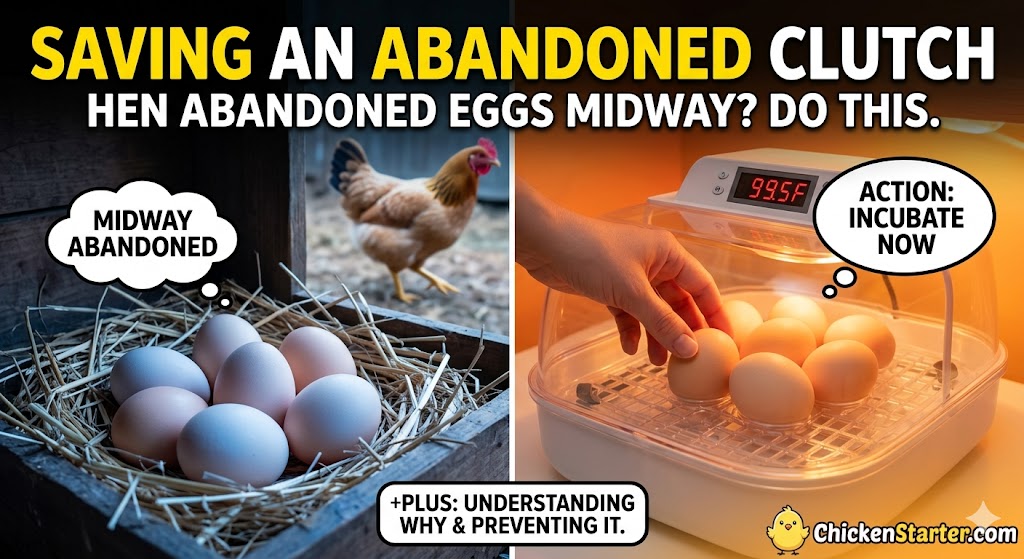
When a hen abandons her eggs midway through incubation, your first move matters enormously. The eggs need to get back up to temperature as quickly as possible, ideally within two hours of abandonment. Your options are an incubator, a second broody hen who can take over the clutch, or in some cases a careful assessment that tells you the eggs were never viable to begin with. What you should not do is panic and make assumptions about which eggs are lost before you investigate.
Hen-abandoned eggs are one of the most heartbreaking situations in backyard chicken keeping. You have invested weeks of patient waiting, careful monitoring, and genuine excitement about a coming hatch. Then you walk out to the coop and find the nest empty and cold. The hen is scratching in the run like nothing happened. And there are your eggs, sitting unattended in a nest that has already started cooling.
I have been there twice. The first time, I did exactly the wrong thing. I assumed the eggs were done for, removed them, and found out two days later from a more experienced keeper that eggs abandoned on Day 10 had an excellent survival chance if rescued quickly. I never made that mistake again. The second time, I had an incubator running within 45 minutes and hatched eight of the twelve eggs successfully. Knowing what to do and doing it fast is the difference between a failed hatch and a successful one.
Why Do Hens Abandon Their Eggs? The Real Causes
Understanding why your hen abandoned her eggs is just as important as knowing what to do with the eggs themselves, because the cause determines whether the abandonment was a one-time incident or a sign of a deeper management problem. It also tells you whether transferring the eggs to another broody hen or an incubator is practical, or whether something fundamental needs to change before you attempt another hatch.
Predator Disturbance or Flock Stress
This is the most common cause of mid-incubation abandonment, and it is the one that hits hardest because it is rarely the keeper’s fault. A predator approaching the coop at night, a hawk circling overhead and sending the flock into alarm, a dog pressing against the run wire, or even an unusually aggressive flock mate repeatedly attacking the broody hen can all trigger abandonment. The hen’s survival instinct temporarily overrides her incubation instinct, and in some cases, once she is off the nest, the hormonal state destabilizes and she does not return.
According to information from The Chicken Chick, one of the leading reasons broody hens abandon nests is significant disturbance during the incubation period, particularly in the first week when the hormonal commitment is not yet fully cemented. The first seven days of brooding are the most vulnerable period for abandonment.
If you find evidence of predator activity near the coop around the same time your hen abandoned her eggs, address the predator threat before considering another hatch. For comprehensive predator management strategies, see our predator-proofing guide.
Mite and Lice Infestation
A heavy parasite burden can drive a hen off her nest. Mites reproduce explosively in the warm, undisturbed environment of a broody nest. The hen sits for long periods in one place, creating ideal conditions for mite populations to explode. A severe infestation causes enough discomfort and blood loss to break even a determined broody’s commitment.
Check the nest material thoroughly after any abandonment event. Look for tiny moving specks in the bedding and around the base of the nesting box, particularly in crevices and corners. Check the hen herself around her vent area, under her wings, and along her neck. If you find evidence of significant parasite activity, treat both the hen and the coop before attempting any further hatching. See our complete guide on mites and lice on chickens for identification and treatment options.
A First-Time or Unreliable Broody
Not every broody hen who starts incubating will finish the job. First-time broodies in particular sometimes lose their hormonal commitment partway through, especially if conditions are not ideal. A hen who went broody enthusiastically but was never a reliable, experienced brooder may sit tightly for 10 days, then begin taking longer and longer breaks until she is effectively no longer brooding at all.
This is precisely why the three-day confirmation test before placing valuable hatching eggs matters so much. A hen who sits consistently on fake eggs for three days, growls when disturbed, and returns within minutes after removal has demonstrated commitment. A hen who goes through the initial motions of broodiness without those behavioral confirmations is a higher abandonment risk. For more on identifying a reliable broody from the outset, see our guide on how to tell if your hen has gone broody.
Excessive Heat
In hot climates or during summer heat waves, a broody hen’s own body heat combined with ambient temperature can push nest temperatures dangerously high. When a hen becomes too hot, she instinctively reduces her contact with the eggs or leaves the nest entirely to cool herself. In some cases, this becomes a cycle of brief sitting and frequent departures that effectively disrupts incubation rather than maintaining it.
If you are brooding during summer in Australia, the Southern United States, or any hot climate, nest placement matters enormously. A nesting box in direct sun or in a poorly ventilated corner of the coop can create conditions where even the most committed broody struggles to stay. Ensure the brooding space is shaded, well-ventilated, and as cool as possible while still being draft-free.
The Hatched Chick Conflict
Hens that have already hatched part of their clutch face a biological decision point. Once live chicks are moving and cheeping beneath her, the hen’s hormones begin shifting from incubation mode to brooding mode. Her instinct to care for the live chicks can override her commitment to the remaining unhatched eggs, causing her to leave the nest before the late-hatching eggs have completed development.
This is not truly “abandonment” in the conventional sense. It is a natural hormonal transition that happens to conflict with the staggered hatch rate of some clutches. The solution here is to either transfer remaining eggs to an incubator quickly or to accept that the hen has made her choice. For a detailed explanation of this transitional period and what to expect during the final days of hatching, see our guide on how long does a broody hen sit on eggs before they hatch.
Infertile or Non-Developing Eggs
Sometimes what looks like abandonment is actually the hen making an assessment you have not yet made. Experienced broodies sometimes appear to sense that a clutch is not developing and reduce their commitment accordingly. In my observation across multiple hatches, hens who abandoned nests around Day 12 to 14 sometimes turned out to have clutches with very low fertility rates. Whether this represents genuine sensory perception of non-developing eggs or simply coincidence, I cannot say with certainty. But it is worth candling the eggs carefully before assuming the abandonment was the problem rather than the outcome.
How Long Can Abandoned Eggs Survive Without Heat?
This is the most urgent question when you discover an abandoned nest, and the answer is more optimistic than most people assume. Eggs that have been incubating do not die the moment the hen leaves. The developmental process within a fertile, developing egg can tolerate a cooling period far longer than many guides suggest.
According to information published by Penn State Extension, embryos are remarkably tolerant of brief temperature drops, particularly during the first half of incubation. The earlier in development the abandonment occurs, the longer the eggs can survive cooling, because the embryo’s metabolic activity is lower and it has not yet reached the critical final development stages.
Here is the realistic cooling tolerance by stage:
| Stage | Days Incubated | Cooling Tolerance |
|---|---|---|
| Very early | Day 1 to 3 | 4 to 6 hours at room temperature |
| Early development | Day 4 to 7 | 2 to 4 hours |
| Mid-incubation | Day 8 to 14 | 1 to 3 hours |
| Late development | Day 15 to 18 | 30 to 90 minutes |
| Pre-hatch (internal pip) | Day 19 to 21 | 30 to 60 minutes, possibly less |
The critical window is the first two hours. If you find an abandoned nest and can get those eggs into an incubator or under another broody hen within two hours, your chances of a successful hatch remain reasonable. Beyond two hours, the probability decreases with each passing hour, particularly for eggs in the final week of incubation.
Do not rely on touching the eggs to feel their temperature and make assumptions. A cool egg to the touch may still be viable. A warm-feeling egg may have been abandoned longer than you realize. Check the ambient temperature of the space and estimate how long the hen has likely been gone based on your last observation of her on the nest.
The 4-Step Plan When You Find Abandoned Eggs
Step 1: Do Not Touch the Eggs Yet
Your first instinct may be to grab the eggs and rush them inside, but pause for five minutes first. Look around the coop. Is the hen still present? Is she showing any signs of wanting to return? Is she distressed by a predator or flock disruption that you might be able to resolve quickly? Sometimes what looks like permanent abandonment is actually a prolonged break caused by a specific stressor that, once removed, allows the hen to return.
Check the hen’s behavior. Is she pacing near the nesting area or looking toward the nest? Or is she contentedly scratching in the run with zero interest in her former nest? These behavioral cues tell you a lot about whether return is possible.
If the hen shows any inclination to return, give her 15 to 20 minutes to settle back before intervening. A hen who returns on her own to a nest that cooled briefly is always the best outcome.
Step 2: Candle the Eggs Before Making Decisions
Candling abandoned eggs tells you which ones are worth rescuing and which ones were never going to hatch. Before you set up an incubator or seek out another broody hen, spend five minutes candling in a dark room with a bright flashlight or dedicated egg candler. This step saves you considerable effort and expense.
What you are looking for depends on how far along incubation was:
Before Day 7: A developing egg shows blood vessels spreading from a central dark spot. A clear egg is infertile or very early quitter. Both are difficult to distinguish with certainty at this stage.
Day 7 to 14: A viable egg appears mostly dark with radiating blood vessels and possibly visible movement. An early death (or infertile egg) shows a clear area with a blood ring or simply a uniformly clear interior.
Day 14 to 20: A viable egg appears almost entirely dark except for the air cell at the wide end. Any visible clear area at this stage typically indicates a non-viable egg.
Day 20 to 21: A viable egg fills completely except the air cell. The chick may have already internally pipped. You might be able to see the egg moving or hear faint cheeping.
Remove clearly infertile and non-developing eggs before placing viable ones in the incubator or under a new hen. They take up valuable space and, in the later stages, can pose a contamination risk if they crack or begin to decompose. For detailed guidance on what to look for at each candling stage, see our complete guide on how to tell if an egg is fertile.
Step 3: Choose Your Rescue Method
Once you have candled and know which eggs are viable, you have two main options.
Option A: Transfer to an Incubator
If you have an incubator available or can get one running quickly, this is often the most reliable rescue method because it gives you complete control over temperature and humidity. Preheat the incubator to 99.5°F (forced-air) before placing the eggs inside. Bring the eggs to room temperature first if they are very cold, placing them on the kitchen counter for 30 to 60 minutes before transferring them to the incubator. Placing cold eggs directly into a heated incubator causes condensation that can introduce bacteria through the shell.
Set humidity to 50 to 55 percent for mid-incubation eggs and raise to 65 to 70 percent if you are within the final three to four days of hatch. Resume turning if the eggs are before Day 18. Stop turning if they are in the lockdown window (Days 18 to 21).
For the best incubator options at different price points, see our comprehensive guide on the best chicken egg incubators for beginners.
Option B: Transfer to Another Broody Hen
If you happen to have a second broody hen sitting on an active nest, you can slip the abandoned eggs beneath her during her daily break. She will accept them without knowing they are not her own, provided she already has eggs at a similar developmental stage and you do not overload her clutch beyond her coverage capacity.
The key consideration is that eggs at very different developmental stages under one hen create a timing conflict at hatch. A hen with 10-day eggs will sit for another 11 days, which is fine for abandoned 10-day eggs but potentially too long for abandoned 18-day eggs that need to hatch in three days. Match the development stage as closely as possible, or use the incubator for final-stage eggs.
For a complete comparison of what each rescue method involves and how to set expectations for hatch rates, see our detailed guide on broody hen vs. incubator: which is better for hatching eggs.
Step 4: Manage Realistic Expectations for the Rescued Clutch
Rescued eggs almost always have a lower hatch rate than eggs that were incubated continuously. The temperature disruption, the stress of transfer, and the variable cooling period all reduce the probability of successful development. This is not a reason to give up on the rescue. It is simply a reason to adjust your expectations going in.
A clutch that was abandoned on Day 8 and rescued within 90 minutes might ultimately hatch at 60 to 70 percent. A clutch abandoned on Day 18 and not discovered for four hours might hatch at 20 to 30 percent, if at all. Both outcomes represent real chicks that would otherwise certainly not have hatched. Every rescued chick is a win.
Keep candling every few days after rescue. Remove any eggs that show no further development or that begin to smell, as a rotten egg that cracks inside an incubator will contaminate everything else. A slight sulfur smell from one egg is enough justification to remove it carefully.
Can You Encourage an Abandoned Hen to Return?
In some cases, yes. If the abandonment was caused by a specific, identifiable stressor rather than a hormonal shift, removing that stressor and returning the hen to the nest can work, particularly in the first two weeks of incubation when broodiness is more easily rekindled.
The technique that works best is placing the hen directly back on the eggs in a quiet, darkened environment with no flock disturbance. Block the nest box entrance briefly with a piece of cardboard after placing her on the eggs so she has a few minutes of forced darkness and quiet. Many hens will resettle within 10 to 15 minutes if the original stressor has been removed.
This approach rarely works after Day 15. By the final week of incubation, the hen’s biology has usually shifted enough that a temporary abandonment becomes permanent. The incubator is more reliable for late-stage rescues.
Preventing Future Nest Abandonment: What Changes to Make
Every abandonment teaches you something about your brooding setup. The hens who abandon are often reacting to completely preventable management gaps.
Provide Isolated Brooding Space
A broody hen in a communal nesting setup is constantly vulnerable. Other hens trying to lay in her box, adding eggs to her clutch, stepping on her, and creating social stress around the nest all contribute to eventual abandonment. Moving a confirmed broody to her own private brooding space before setting hatching eggs dramatically improves commitment and hatch rates.
A wire dog crate in a corner of the coop, a small partitioned area, or a separate broody hutch all work well. Provide food and water within easy reach of the nest, good ventilation without drafts, and enough privacy that other flock members cannot physically reach her.
Control for Parasite Pressure Before Setting Eggs
Treat the nesting area and the hen herself for mites and lice before the brooding period begins. Once a hen is sitting, treatment is possible but more disruptive. Starting the 21-day incubation period with a clean nest and a parasite-free hen removes one of the most common causes of mid-incubation abandonment.
Choose Breeds Known for Reliable Broodiness
If abandonment has been a pattern across multiple hatches, the breed of your broody hen may be the fundamental issue. Silkies, Cochins, Buff Orpingtons, and Brahmas are the most reliably committed broodies in backyard settings. Heritage breed hens with a proven track record of completed hatches are far less likely to abandon than first-time broodies of inconsistent breeds.
Confirm Broody Commitment Before Setting Valuable Eggs
Use fake eggs or ceramic nest eggs to confirm a hen will sit tightly for three full days before giving her your best hatching eggs. A hen who demonstrates that level of commitment is far more likely to see the full 21 days through to hatch.
Assessing Egg Viability After Extended Abandonment
This is the question that keeps keepers up at night. If you found the abandoned nest late and are not sure whether the eggs are still viable, there are a few practical assessments that help you decide whether rescue is worth attempting.
The float test is often mentioned online but should be used cautiously and only as a last resort for older eggs. A fresh egg sinks flat. An older egg with an enlarged air cell stands upright. A floating egg is very likely non-viable. However, a floating egg that is actively moving or that you can hear cheeping from should never be discarded. A moving, cheeping egg that floats may simply have a large air cell from the development process, not from decomposition.
The smell test is reliable. A non-viable egg that has begun decomposing produces a distinct, unmistakable sulfur-like odor. Any egg with that smell should be removed from the incubator or from beneath the hen immediately and carefully. Hold it over an outdoor waste bin and crack it away from the incubator to confirm before discarding.
The candling test is the most reliable of the three. Under a bright light in complete darkness, a viable late-term egg appears almost completely dark except for the air cell. A non-viable egg shows unusual clear areas, visible blood rings, or no internal structure at all. When in doubt, candle rather than assume.
My Personal Experience with Rescued Clutches
The second time I dealt with an abandoned clutch, my hen was a Sussex who had been sitting for 14 days. I found the nest empty in the early afternoon on a warm spring day. The eggs were cool but not cold, meaning the core temperature had dropped but had not reached ambient room temperature yet.
I had an incubator set up in the house within 40 minutes. The transfer was straightforward. I candled all 11 eggs before placing them, removed two that showed no development, and set the remaining nine. The humidity in the incubator went to 55 percent, temperature to 99.5°F, and I resumed turning at the normal 3-times-daily schedule.
Seven of the nine eggs hatched on Day 22 and 23, one day later than the original expected hatch date, which is common with rescued mid-incubation eggs. Two did not hatch. The seven chicks that emerged were healthy, strong, and showed no developmental issues from the temperature disruption. All seven are still in my flock.
That experience fundamentally changed how I think about abandoned nests. Cool does not mean dead. The difference between seven live chickens and zero live chickens was 40 minutes and a decision to try.
Frequently Asked Questions About Abandoned Eggs
How long can an egg survive without heat from a broody hen?
In the first week of incubation, eggs can survive cooling for up to four to six hours without fatal developmental impact. In the second week, that window narrows to two to three hours. In the final week, the tolerance drops to roughly 30 to 90 minutes. The specific ambient temperature of the space also matters. Eggs in a warm coop cool more slowly than eggs in a cold garage in January.
Should I throw away abandoned eggs?
Do not discard abandoned eggs without candling them first. Many keepers throw away potentially viable eggs in the immediate emotional reaction to finding an abandoned nest. Candle every egg before making any decision. Clear, non-developing eggs can be discarded. Dark, developing eggs with visible structure should be given a rescue attempt, especially if the abandonment was recent.
Can I use a heating pad to rescue abandoned eggs without an incubator?
A heating pad is not an adequate substitute for an incubator because it cannot maintain precise temperature, does not provide even heat distribution, and offers no humidity control. It can be used as a temporary measure to prevent further cooling while you set up an incubator or locate a broody hen, but it should not be the primary rescue method for an extended period.
Why did my hen go broody and then stop?
First-time broodies, hormonal inconsistency, parasite infestation, predator disturbance, and excessive heat are the most common causes of a hen who begins brooding and then gives up before the 21-day incubation period is complete. The first seven days are the most vulnerable period for this type of abandonment because the broody hormonal state has not yet fully stabilized. Using the three-day confirmation test before setting hatching eggs significantly reduces this risk.
Should I try to restart my hen’s broodiness after an abandonment?
It depends on why she abandoned. If the cause was an external, removable stressor like a predator or parasite problem that you have now resolved, placing her back on the nest (or on a new set of eggs after a brief recovery period) can be successful. If the abandonment was caused by hormonal inconsistency or an unreliable broody nature, a new attempt with the same hen is likely to produce the same result. In that case, an incubator is the more reliable choice for future hatches.
Finding an abandoned nest is never a good moment. But it does not have to mean the end of the hatch. With quick assessment, prompt action, and realistic expectations, abandoned eggs give you a genuine second chance at the chicks you were hoping for.
For everything about managing the full natural hatching process from the beginning, see our guides on how to tell if your hen has gone broody and how long does a broody hen sit on eggs before they hatch.
Note: This guide is for educational purposes. Always consult a licensed poultry veterinarian if you suspect illness is contributing to nest abandonment or if your hen shows signs of health problems during or after the brooding period.

Oladepo Babatunde is the founder of ChickenStarter.com. He is a backyard chicken keeper and educator who specializes in helping beginners raise healthy flocks, particularly in warm climates. His expertise comes from years of hands-on experience building coops, treating common chicken ailments, and solving flock management issues. His own happy hens are a testament to his methods, laying 25-30 eggs weekly.