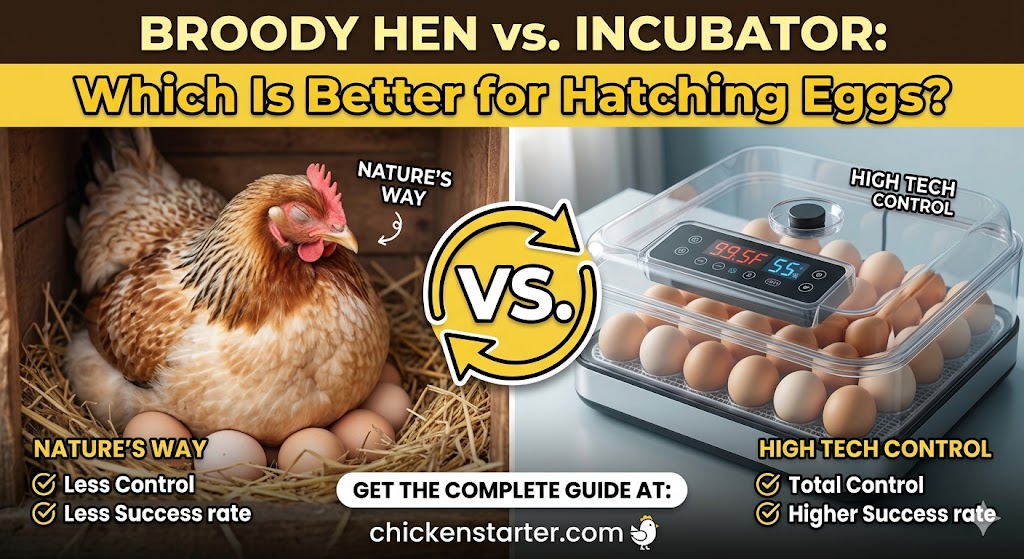
When it comes to broody hen vs. incubator hatching, the honest answer is that neither is universally better. A broody hen handles temperature, humidity, and egg turning automatically while also raising the chicks herself, eliminating the need for a brooder entirely. An incubator gives you complete control, works year-round regardless of whether any hen feels like cooperating, and can handle more eggs than any single hen can cover. The right choice depends entirely on your goals, your flock, and how much involvement you want in the process.
I have hatched chicks both ways more times than I can count at this point. My first hatch was with a borrowed incubator, a budget still-air model that held temperature about as reliably as a screen door holds heat, and I got 7 chicks out of 12 eggs. My first broody hen hatch, a Buff Orpington named Mabel who went broody the following spring, produced 10 out of 12 chicks with zero effort from me beyond candling on Day 7. That experience shifted my perspective considerably. But I have also had a broody hen abandon a nest on Day 15 and lose the entire clutch, which sent me back to the incubator fast.
Both methods work. Both have genuine trade-offs. This guide covers everything you need to make the right decision for your specific situation.
| Factor | Broody Hen | Incubator |
|---|---|---|
| Cost | Free | $30 to $500+ |
| Hatch Rate | 75 to 95% (experienced broody) | 75 to 85% (good incubator) |
| Eggs Per Hatch | 8 to 15 (breed-dependent) | 6 to 150+ (model-dependent) |
| Daily Attention | Minimal (food, water, vent check) | Moderate (temp, humidity, turning) |
| Chick Raising | Hen does it automatically | You need a brooder setup |
| Year-Round Use | No (seasonal, breed-dependent) | Yes |
| Power Outage Risk | None | Significant |
| Temperature Control | Automatic | Requires monitoring |
| Turning | Automatic (up to 50 times per day) | Manual or automatic (minimum 3x daily) |
| Abandonment Risk | Yes | None |
| Flock Integration | Seamless (hen raises with flock) | Requires gradual integration |
What Is a Broody Hen and How Does She Hatch Eggs?
A broody hen is a hen whose hormones have triggered a powerful instinct to sit on and hatch eggs. She will claim a nesting box, settle in, and refuse to leave except for brief daily breaks of 15 to 30 minutes to eat, drink, and poop. She flattens herself over the eggs, plucking feathers from her brood patch (the bare skin on her chest and belly) to transfer body heat directly to the eggs beneath her.
Her body temperature sits between 101 and 103°F, and she maintains the eggs at approximately 99.5 to 101°F underneath her, which is almost exactly the target temperature for successful artificial incubation. She turns the eggs roughly 30 to 50 times per day instinctively, far more frequently than any manual incubator schedule achieves. She adjusts her position and the moisture she brings back from her daily water visits to manage humidity naturally.
According to Penn State Extension, a broody hen provides the ideal incubation environment, and artificial incubation is an attempt to replicate what she does naturally. The key difference is that we are mimicking biology with technology, and biology has a significant head start.
Not every breed goes broody. This is the first practical limitation. Production breeds like Leghorns, ISA Browns, and most sex-link hybrids have had the broody instinct bred out of them over generations of commercial selection. Breeds known for strong broodiness include Silkies, Cochins, Buff Orpingtons, Brahmas, Sussex, and Orpingtons. Australorps and Wyandottes go broody occasionally. Rhode Island Reds and Barred Rocks are inconsistent.
For more on breeds that make excellent broodies, see our complete Buff Orpington chicken guide and our guide on Silkie bantam vs. standard Silkie.
The Broody Hen Method: Advantages, Disadvantages and What Nobody Tells You
The Advantages That Make Broody Hens Genuinely Remarkable
No equipment cost. A broody hen costs you nothing extra beyond her regular food and water. You do not need to purchase an incubator, a brooder, a heat lamp or heat plate, a thermometer, a hygrometer, or a turner. All of that is replaced by one determined hen.
No brooder setup after hatch. This is the single biggest practical advantage that most comparison articles fail to emphasize. When a broody hen hatches her eggs, she immediately begins brooding the chicks herself. She keeps them warm under her wings, shows them where to eat and drink, teaches them to forage, and protects them from flock harassment. You do not need to set up a brooder, manage temperature, or handle the 6-to-8-week transition to the coop. The hen manages all of it. According to information from The Chicken Chick, broody-hatched chicks integrate into the existing flock dramatically faster and more smoothly than incubator-hatched chicks raised in a brooder, because the mother hen advocates for them aggressively.
Superior hatch rates under the right conditions. An experienced broody hen who stays committed to her nest consistently achieves hatch rates of 85 to 95 percent on fertile eggs, which is higher than most home incubators produce. The Penn State Extension guide on incubation notes that a properly brooding hen naturally maintains better temperature stability and turning frequency than many artificial incubators.
Natural immunity transfer. A broody hen passes maternal antibodies to her chicks during the brooding period, giving them a head start on immune system development that incubator-hatched chicks do not receive.
Zero electricity dependence. A power outage kills an incubator hatch. A broody hen sits through anything.
The Disadvantages Nobody Warns You About
You cannot control when it happens. Broodiness is seasonal and individual. Most hens go broody in spring and early summer when day length triggers hormonal changes. If you want to hatch eggs in November, a broody hen is almost certainly not available unless you keep breeds predisposed to year-round broodiness.
She stops laying eggs for the entire brooding period and beyond. A broody hen stops laying the moment she commits to the nest. The incubation period is 21 days, plus she typically continues brooding chicks for another 4 to 8 weeks. That is 6 to 12 weeks of zero egg production from one of your hens. If you keep a small flock, this significantly impacts your egg supply. For more on how this affects production, see our guide on why chickens stop laying eggs.
She can abandon the nest. This is the one that has cost me the most sleep. Broody hens sometimes abandon their nests partway through incubation for reasons that are not always obvious. A predator scare, extreme heat, flock disturbance, mites in the nest, or simply a hormonal shift can cause her to walk away from a 15-day-old clutch. I lost an entire clutch of 11 Marans eggs this way when a raccoon got into the run at night on Day 16. The hen was physically fine, but she never returned to the nest.
Limited egg capacity. A standard-sized broody hen can comfortably cover 10 to 12 eggs. A large breed like a Brahma or Cochin may manage 14 to 15. A bantam Silkie might only cover 6 to 8. If you want to hatch 30, 50, or 100 eggs at once, a broody hen is simply not the right tool.
She may reject or kill chicks that hatch late. When the majority of eggs hatch, a broody hen’s instincts tell her it is time to start brooding. Eggs that hatch a day or two late may be abandoned or the chicks attacked by the hen who has already moved to brooding mode.
Nest hygiene challenges. A broody hen in a shared nesting box becomes a magnet for mite and lice infestations. Treating for mites and lice during active brooding is complicated because you need to treat without disrupting the incubation temperature for too long.
For strategies on managing (or stopping) unwanted broodiness, see our complete guide on how to break a broody hen.
The Incubator Method: Advantages, Disadvantages and Real Cost Breakdown
Why an Incubator Gives You Control the Hen Cannot
You decide when, what, and how many eggs to hatch. An incubator works in January, August, or any time you choose. You set the temperature, manage the humidity, and determine how many eggs to run. This is the incubator’s fundamental advantage: you are in charge.
Scale. You can hatch 6 eggs in a compact countertop incubator or 500 eggs in a commercial cabinet unit. The broody hen has a fixed ceiling based on her body size. Incubators have no such constraint beyond your budget.
Consistency with the right equipment. A good-quality forced-air incubator with automatic turning, digital temperature control, and humidity monitoring maintains conditions more consistently than an inexperienced or unreliable broody. For a full comparison of top incubator models, see our guide on the best chicken egg incubators for beginners and our detailed Brinsea vs. Nurture Right comparison.
No egg production disruption. Your flock keeps laying normally. The incubator runs independently of your hens.
Egg selection control. You choose exactly which eggs go into the incubator, allowing you to select the best examples from your best layers or purebred breeding pairs.
The True Cost of Incubator Hatching
This is where most comparison guides mislead people. The incubator itself is only the beginning.
| Item | Budget Setup | Premium Setup |
|---|---|---|
| Incubator | $30 to $80 (still-air, manual) | $150 to $500+ (forced-air, auto-turning, digital) |
| Hygrometer/Thermometer | $10 to $15 | Included in premium models |
| Egg Candler | $8 to $20 | $15 to $35 |
| Brooder setup (post-hatch) | $45 to $60 | $125 to $230 |
| Electricity (21 days) | $3 to $5 | $5 to $15 |
| Total First Hatch | $96 to $180 | $295 to $780 |
The brooder cost is one that many guides completely omit. When you hatch with an incubator, the chicks come out with no mother hen. You are the mother. That means a fully equipped brooder with heat source, bedding, feeders, waterers, and a secure lid. For a full breakdown of what brooding costs, see our guide on how to set up a brooder for new chicks.
The good news is that your incubator and most brooder equipment are reusable across multiple hatches. The per-hatch cost drops significantly after the first year.
The Real Disadvantages of Incubator Hatching
You must monitor it daily. Temperature spikes above 104°F for more than a few hours can kill developing embryos. Humidity that drops too low causes chicks to stick inside the shell during hatch. Even the best incubators require regular checks, water top-ups, and problem-solving.
Hatch rates are genuinely unpredictable with budget models. That $35 still-air incubator with a dial thermostat can swing temperature by 2 to 4°F throughout the day. The difference between 99°F and 103°F is the difference between healthy chicks and dead-in-shell. I learned this the hard way with my first hatch. After I invested in a quality forced-air incubator with digital temperature control, my hatch rates jumped from around 55 percent to consistently above 80 percent.
Power outages are catastrophic. A two-hour power outage on Day 10 drops incubator temperature to ambient room temperature. Developing embryos can survive brief temperature drops, but extended outages become increasingly dangerous as development progresses. According to Penn State Extension, embryos tolerate cooling better in the first week than in the final week. A broody hen does not share this vulnerability.
Chick imprinting and integration are harder. Incubator-hatched chicks raised in a brooder have no mother hen to advocate for them when it is time to join the flock. They face the full social gauntlet of the pecking order without protection. This typically requires a careful, staged integration process. For help managing flock introductions, see our guide on pecking order problems and how to stop bully hens.
The Critical Variables: Temperature, Humidity and Turning
Understanding the science behind incubation helps you succeed with either method. Whether you are running an incubator or setting fertile eggs under a broody hen, the same biological requirements apply.
Temperature
Forced-air incubators should run at 99 to 99.5°F measured at egg level. Still-air incubators should run at 101 to 102°F at the top of the egg, because still air creates a temperature gradient from top to bottom.
A broody hen maintains egg temperature at approximately 99.5 to 100.5°F beneath her body. Her body temperature is higher (101 to 103°F), but her brood patch and the insulating effect of her feathers create the right temperature at the egg surface.
Temperature deviations matter enormously. According to Penn State Extension, the optimum temperature for chicken egg incubation is 99.5°F in a forced-air incubator. Temperatures that are too high reduce hatch rates and increase deformities. Temperatures that are too low extend the incubation period and reduce hatch rates. A sustained temperature of 104.9°F for three hours is lethal to embryos.
Humidity
Days 1 to 18: Target 45 to 55% relative humidity in the incubator. The broody hen manages this instinctively through moisture on her feathers from her daily water drink and her own body’s evaporation.
Days 18 to 21 (lockdown): Raise humidity to 65 to 70% to prevent the inner membrane from drying and sticking to the chick as it pips and zips through the shell.
One of the most common incubator mistakes is adding too much water too early, keeping humidity too high throughout incubation. This reduces the air cell to the point where chicks run out of space in the final days and drown inside the shell. Many experienced hatchers now practice “dry incubation” with humidity at 25 to 40% for Days 1 to 18, only adding water at lockdown.
Turning
Incubator turning requirements: Eggs must be turned at minimum 3 times per day, ideally 5 to 7 times, and always an odd number of times so the egg rests on alternating sides overnight. Stop turning at Day 18 when you begin lockdown.
Broody hen turning: She turns eggs naturally, roughly 30 to 50 times per day, far exceeding what any manual schedule achieves. This is one of the reasons experienced broody hens achieve higher hatch rates than many home incubators.
Mark your incubator eggs with an X on one side and an O on the other so you can track whether manual turning is actually happening consistently.
Candling: What to Look For at Each Stage
Candling is essential whether you are using a broody hen or an incubator. It lets you identify unfertile eggs, early quitters (eggs that started developing and stopped), and late-term deaths before they become rotten eggs that can explode and contaminate your hatch.
Day 7: You should see a distinct network of blood vessels spreading from a central dark spot (the embryo). Infertile eggs appear clear. Early quitters show a blood ring with no central embryo. Remove clear eggs and blood rings carefully.
Day 14: The embryo should fill most of the egg. You can often see movement. The air cell at the wide end should be clearly visible and increasing in size.
Day 18 (lockdown): The egg should appear almost completely dark, with only the air cell visible at the wide end. This is when you stop turning, raise humidity, and do not open the incubator until hatch is complete.
For broody hen hatches, candling requires temporarily removing eggs from beneath the hen. Work quickly and confidently. Do not take more than 10 to 15 minutes. A brief temperature drop is not harmful, but prolonged exposure is.
For a detailed candling guide with photos describing what to look for at each stage, see our guide on how to tell if an egg is fertile and our review of the best egg candlers.
Setting Up a Broody Hen for Success: Practical Steps
If you have a broody hen and want to give her the best possible chance at a successful hatch, these steps make a significant difference.
Confirm She Is Truly Committed
A hen that has been sitting tightly on the nest for 3 full days and nights, growling when approached, and returning immediately after her brief breaks is a committed broody. Some hens go broody, sit for two days, then lose interest. Wait the three-day confirmation before putting valuable hatching eggs under her.
Move Her to a Private Space
A broody hen in the communal nesting boxes faces daily disturbance from other hens wanting to lay, hens trying to squeeze in beside her, and potential egg breakage or egg swapping. According to information from The Chicken Chick, giving a broody her own separate space dramatically improves hatch rates and reduces stress for both the hen and the flock.
A wire dog crate, a small separate coop section, or a dedicated broody hutch all work well. Set it up with a comfortable nesting area at ground level, private food and water within easy reach, and enough ventilation without drafts.
Move her at night. Hens are calmer and more accepting of relocation in darkness. Place her directly onto the eggs in the new location. Most committed broodies accept the move within an hour.
Check for Mites Before Setting Eggs
Examine the nest material and the hen’s vent area, under-wing areas, and around the face carefully. Mites and lice thrive in warm, undisturbed nesting environments and can make a broody hen miserable enough to abandon her nest. Treat any infestation before setting eggs.
Egg Count and Size
A standard-sized hen can comfortably cover 10 to 12 eggs. A large Brahma or Cochin might manage 14 to 15. A bantam Silkie typically manages 6 to 8 standard eggs. Overcrowding causes eggs at the edges to receive uneven incubation and increases breakage. It is better to run a slightly smaller clutch with full coverage than to maximize egg count at the expense of hatch rate.
Mark the Eggs
Other hens will sometimes sneak into a broody’s nest and lay additional eggs. If you do not mark your original setting eggs (a simple X in pencil works fine), you can end up with eggs at different stages of development under the hen. Mark each egg you set and remove any unmarked additions during the hen’s daily break.
Setting Up Your Incubator for the Best Possible Hatch Rate
The difference between a 50 percent hatch rate and an 85 percent hatch rate with an incubator is almost entirely preparation and monitoring. Most failed hatches are preventable.
Run the Incubator Empty for 24 to 48 Hours First
Before placing eggs, run your incubator empty and fully set up to confirm it holds stable temperature and that your humidity management is working. This catches equipment problems before they cost you a clutch of eggs.
Egg Storage Before Setting
Store hatching eggs at 55 to 65°F (not in the refrigerator) with the small end down, tilted at a 45-degree angle. Turn them slightly twice daily. Set within 7 days for best results. Hatch rates decline noticeably after 10 days and significantly after 14 days.
Bring eggs to room temperature for 4 to 6 hours before placing them in the incubator. Cold eggs placed directly into a heated incubator create condensation that can introduce bacterial contamination.
Temperature Calibration
Do not rely solely on your incubator’s built-in thermometer. Use an independent digital thermometer or probe thermometer placed at egg level to verify the actual temperature your eggs are experiencing. Many budget incubators display temperature at the top of the chamber rather than at the egg surface.
The Lockdown Period (Days 18 to 21)
On Day 18, stop turning, raise humidity to 65 to 70%, and do not open the incubator until at least 24 hours after the last chick hatches. Every time you open the incubator during hatch, you allow humidity to escape and dry out the membrane of chicks that have already pipped but not yet fully zipped. This causes chicks to get stuck in the shell, one of the most heartbreaking (and preventable) outcomes in incubator hatching.
Which Breeds Are Best for Hatching with a Broody Hen?
Breed selection matters significantly if you plan to rely on natural incubation. The breeds with the most reliable, committed broodiness include:
Silkies are the gold standard for reliable broodiness. They go broody frequently, sit tightly, and have been used for generations as surrogate mothers for other species including ducks, turkeys, and guinea fowl. Their patient, calm temperament makes them gentle with chicks after hatch. For more on this breed’s unique characteristics, see our Silkie bantam vs. standard Silkie guide.
Cochins are large, calm, extremely broody birds with heavy feathering that provides excellent coverage for large clutches. They are among the most reliable broodies available.
Buff Orpingtons go broody reliably and are large enough to cover 12 to 14 eggs. Their calm temperament makes them excellent mothers.
Brahmas make excellent broodies with their large size and calm nature. A Brahma hen can cover up to 15 eggs comfortably.
Speckled Sussex have a moderate to strong broody tendency and make good, attentive mothers.
Head-to-Head Verdict: When to Choose Each Method
Choose a Broody Hen When:
You have a reliable broody hen available and she has already committed to sitting. You want the simplest, lowest-effort hatching experience. You value natural chick rearing over the convenience of brooder control. You want the fastest, most seamless flock integration for new chicks. You live somewhere with unreliable electricity. You want to hatch a modest clutch of 8 to 15 eggs.
Choose an Incubator When:
You want to hatch eggs any time of year regardless of season. No hen in your flock is broody or your flock consists of non-broody breeds. You want to hatch large quantities (20, 50, or more eggs) at once. You need precise control over which eggs are set and when. You want to hatch eggs from breeds or sources that would not normally be available to a broody hen (shipped eggs, rare breeds). You have experience and enjoy the hands-on process of managing incubation.
The Best Strategy for Most Backyard Keepers
The most experienced backyard breeders I know use both methods depending on the season and their goals. When a reliable broody hen presents herself in spring, they put their best fertile eggs under her and enjoy the nearly hands-free process. During other seasons, or when they want to hatch large numbers or rare breeds from shipped eggs, they run incubators. The two methods are complementary rather than competing.
From my own experience, broody hen hatches produce chicks that are calmer, better integrated, and more behaviorally confident from an earlier age. But my incubator gives me the ability to hatch Marans eggs from a specific breeding pair in October when no hen in my flock will cooperate, and that flexibility is genuinely valuable.
Frequently Asked Questions
Is a broody hen or incubator better for first-time hatchers?
A reliable broody hen is the easier option for first-time hatchers because she handles temperature, humidity, and turning automatically. However, she requires you to already have a broody-prone breed in your flock. If you do not have a broody hen available, starting with a good mid-range forced-air incubator with automatic turning is more forgiving than a basic still-air model.
What hatch rate can I realistically expect?
With a committed, experienced broody hen and fertile eggs, expect 80 to 95 percent. With a quality forced-air incubator, digital controls, and auto-turning, expect 75 to 85 percent from fertile eggs. Budget still-air incubators often produce 50 to 70 percent in the hands of a beginner.
Can I use a broody hen to hatch shipped eggs?
Yes, but hatch rates for shipped eggs are lower regardless of method due to air cell damage during transport. Shipped egg hatch rates of 40 to 65 percent are common even under ideal conditions. Both a committed broody hen and a quality incubator give similar results with shipped eggs.
Does a broody hen need to take breaks from sitting?
Yes. A healthy broody hen takes one break per day lasting approximately 15 to 30 minutes to eat, drink, and relieve herself. If your hen has not taken a break in more than 24 hours, gently remove her from the nest yourself and place food and water in front of her. Some very committed broodies need encouragement to eat.
Can I move fertile eggs from an incubator to a broody hen mid-way?
Yes. If a hen goes broody after you have started eggs in an incubator, you can transfer the eggs to her on any day up to around Day 15. After that, the increased movement risk and the challenge of timing lockdown around the hen’s behavior makes the transfer less practical. The hen will not know or care that the eggs were previously in an incubator.
Whichever method you choose, the fundamentals are the same: fertile eggs, proper temperature, adequate humidity, consistent turning, and patience through the full 21-day incubation period. Master those basics and you will be hatching healthy chicks reliably with either a broody hen or an incubator.
For your complete hatching supply list, see our guide on bringing chicks home: 15 must-haves. And once those chicks hatch, whether from a hen or an incubator, our guide on how to set up a brooder for new chicks has everything you need for the next stage.
Note: This guide is for educational purposes. Hatch rates vary based on egg fertility, incubator quality, management, and many other factors. Always source hatching eggs from reputable, disease-tested flocks.

Oladepo Babatunde is the founder of ChickenStarter.com. He is a backyard chicken keeper and educator who specializes in helping beginners raise healthy flocks, particularly in warm climates. His expertise comes from years of hands-on experience building coops, treating common chicken ailments, and solving flock management issues. His own happy hens are a testament to his methods, laying 25-30 eggs weekly.