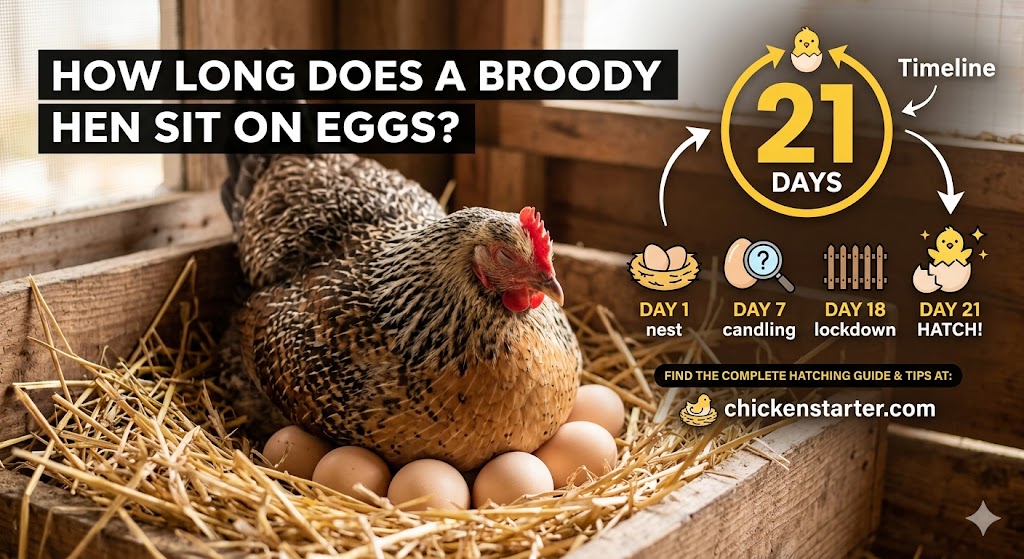
A broody hen sits on chicken eggs for exactly 21 days before they hatch. This is the standard incubation period for Gallus gallus domesticus, and it holds true whether your broody hen is a Silkie, a Buff Orpington, a Cochin, or any other breed. The timeline begins the moment she settles on a full clutch and begins incubating consistently. Day 1 is the first full day of committed sitting, and healthy chicks begin pipping (cracking through the shell) on Day 19 to 21.
The 21-day rule is reliable, but the full broody experience is more complicated than that single number suggests. How long will she sit if the eggs are infertile? What if some eggs hatch and others do not? What does the process actually look like day by day? And how do you know if something has gone wrong? These are the questions that matter most when you have a broody hen settled in your coop and you are waiting, checking, and probably checking again.
I have watched dozens of broody hen hatches at this point, and the thing that surprises new keepers most is not the 21-day wait. It is everything that happens around it: the weight loss, the daily drama of the 20-minute bathroom break, the heartbreaking abandoned nest, and the absolute joy of hearing tiny chirping sounds coming from beneath a puffed-up, growling hen three weeks after you tucked eggs under her.
The 21-Day Countdown: What Happens Inside the Egg
Chicken eggs hatch after 21 days of consistent incubation at the correct temperature. The hen maintains egg temperature at approximately 99.5 to 101°F through her brood patch, the bare, featherless area on her chest and belly that makes direct skin-to-egg contact. She turns the eggs naturally up to 30 to 50 times per day, which prevents the embryo from sticking to the inner membrane during the early development stages.
Understanding the developmental timeline helps you know what to expect at each stage.
Days 1 to 7: Early Development
During the first week, you will see nothing externally. Inside each fertile egg, blood vessels begin forming within the first 24 hours of incubation. By Day 4, the heart is beating. By Day 7, a healthy embryo with its surrounding blood vessel network is visible when you candle the egg with a bright light in a dark room. An infertile egg appears completely clear, while a developing embryo looks like a dark spot with radiating veins that resemble a spider web.
At this stage, the hen is deeply settled and easily startled. She leaves the nest only once per day for roughly 15 to 30 minutes to eat, drink, and relieve herself. That brief break is normal and necessary. If she does not leave at all for more than 24 hours, gently lift her off and place food and water directly in front of her. Some very determined broodies need encouragement to care for themselves.
Days 8 to 17: Active Embryo Development
Through the second week and into the third, development accelerates rapidly. The embryo grows feathers, develops organs, and fills more of the egg interior. By Day 14, the egg appears mostly dark when candled, with only the air cell at the wide end remaining clear. Experienced keepers sometimes see movement inside the egg at this stage when candling.
The hen becomes increasingly settled and difficult to disturb during this period. My own Buff Orpington barely moved from Days 12 to 18 on her last hatch, only taking her daily break at the exact same time each morning, which I eventually realized was when I opened the coop to top up the flock’s water. She was using me as her alarm clock.
Days 18 to 20: Internal Pip
Between Days 18 and 20, the chick rotates inside the egg and breaks through the inner membrane into the air cell. This is called internal pipping. You cannot see this from outside, but you can sometimes hear faint cheeping sounds coming directly from the eggs during this period. This is a deeply satisfying sound and one of the clearest signs that hatch is approaching on schedule.
The chick’s beak is now in the air cell, which contains enough oxygen for approximately 24 hours. During this stage, the hen becomes even more still and protective than usual. She flattens herself very low over the nest.
Day 20 to 21: External Pip and Hatch
External pipping is the moment you have been waiting for. The chick uses its egg tooth (a temporary hard projection on the tip of its beak) to crack through the shell from the inside. The first crack, called the pip, usually appears as a small star-shaped break near the wide end of the egg.
From the external pip, a healthy chick typically takes 12 to 24 hours to fully hatch. This process is called zipping: the chick rotates inside the shell while chipping along the circumference, eventually pushing the top of the shell off and emerging. If a chick has been pipping for more than 24 to 36 hours without progress, it may need assistance, though intervention should only happen as a genuine last resort.
Do not rush this process. The physical struggle of hatching is important for the chick’s cardiovascular development and for absorbing the remaining yolk sac. Helping a chick too early is more dangerous than waiting.
Day-by-Day Broody Hen Sitting Timeline at a Glance
| Day | What the Hen Does | What Is Happening Inside the Egg |
|---|---|---|
| Day 0 to 1 | Settles on full clutch, begins consistent incubation | Fertilization confirmed, cell division begins |
| Day 1 to 7 | Tight sitting, one short break daily, growling at disturbances | Heart beating by Day 4, blood vessels forming |
| Day 7 | Best time to candle and remove infertile eggs | Embryo and blood vessel spider web visible |
| Day 8 to 14 | Deeper commitment, decreasing breaks | Feathers developing, organs forming |
| Day 14 | Second candle check recommended | Egg mostly dark, air cell clearly visible |
| Day 18 to 19 | Very still, flattened low | Internal pip into air cell, chick may be cheeping |
| Day 20 | Alert but calm, attentive to sounds beneath her | External pip visible, chick zipping |
| Day 21 | First chicks emerging | Full hatch, chicks drying under hen |
| Day 21 to 22 | Begins choosing between remaining eggs and new chicks | Late-hatchers may be abandoned |
How Long Will a Broody Hen Sit on Unfertile Eggs?
A broody hen has no way to know her eggs are infertile, and she will sit on them indefinitely if not interrupted. This is one of the most important practical realities of natural brooding that new keepers need to understand.
Without candling at Day 7 to confirm fertility, a hen can sit on a nest of completely clear, never-developing eggs for 21 full days, then continue sitting and waiting for another week or two before her hormonal state gradually shifts and she gives up. Some particularly determined broodies have been reported sitting for five to six weeks on infertile eggs.
This prolonged sitting takes a serious physical toll. Broody hens lose significant body weight during incubation. According to information from the University of Florida Extension, a broody hen can lose 15 to 20 percent of her body weight during a normal 21-day incubation period because her reduced eating time and her metabolic focus on maintaining nest temperature dramatically limits caloric intake. Extended brooding beyond 21 days pushes that weight loss further and can leave a hen in poor physical condition.
The solution is simple: candle your eggs at Day 7. Remove any infertile or early quitter eggs and replace them with fertile eggs if you have them, or limit the hen’s total commitment to eggs you know are viable. For detailed guidance on candling technique and what to look for at each stage, see our guide on how to tell if an egg is fertile.
If you want to stop a broody hen sitting on infertile eggs before she damages her own health, see our complete guide on how to break a broody hen.
What If Some Eggs Hatch and Others Do Not?
This is one of the most emotionally complicated situations in natural brooding, and it requires a decision. When the first chicks hatch, the hen’s hormones begin shifting from “incubation mode” to “brooding mode.” She hears the cheeping of her new chicks and feels them moving underneath her, and her instinct to brood and protect the live chicks intensifies.
The problem is the eggs that have not yet hatched. If some eggs are only a day or two behind, the hen may stay settled and continue incubating them while also brooding the early chicks. Many experienced broodies handle this well for 24 to 48 hours.
But by Day 23 or 24, a hen will typically commit fully to her live chicks and leave the remaining unhatched eggs. She cannot distinguish between an egg that is simply late and an egg that stopped developing two weeks ago. Her biological clock says “time is up.”
What should you do with the remaining eggs?
If the eggs are only one to two days behind schedule (which can happen when eggs at the edge of the clutch received slightly less heat), you can transfer them to an incubator for the final day or two and hatch them artificially. They will need a brooder setup afterward since the hen will already be committed to her earlier chicks.
If the eggs are well past their due date or feel unusually light, they likely did not develop and can be removed. A floatation test is sometimes suggested by keepers to check late-term viability, but it can occasionally harm a viable chick and is not recommended by most hatchery professionals.
For a comprehensive comparison of natural and artificial hatching methods and what happens to late hatchers in each scenario, see our guide on broody hen vs. incubator: which is better for hatching eggs.
Different Poultry Species: Incubation Periods by Bird Type
If your broody hen is sitting on eggs from other poultry species, the timeline changes significantly. A Silkie or Cochin will happily sit on duck eggs, guinea fowl eggs, or turkey eggs, but you need to know the correct incubation period for each species to manage the hatch correctly.
| Species | Incubation Period | Notes |
|---|---|---|
| Chicken | 21 days | Standard timeline for all breeds |
| Bantam Chicken | 19 to 20 days | Slightly shorter than standard breeds |
| Duck (Mallard-derived) | 28 days | Muscovy ducks take 35 days |
| Muscovy Duck | 35 days | Longest common duck incubation |
| Turkey | 28 days | Same as most duck breeds |
| Guinea Fowl | 26 to 28 days | Variable by individual clutch |
| Quail (Coturnix) | 17 to 18 days | Among the shortest incubation periods |
| Peafowl | 28 to 30 days | Require larger broody hen or incubator |
| Pheasant | 24 to 25 days | Varies by species |
| Goose | 28 to 35 days | Too large for most hens to cover |
A Silkie hen brooding duck eggs faces one particular challenge. Ducklings need moisture applied to their eggs during the second half of incubation to maintain proper humidity levels inside the shell. Mother ducks achieve this naturally by returning to the nest with wet feathers. A Silkie cannot do this. Many experienced keepers who use broody hens for duck eggs lightly mist the eggs with lukewarm water from Day 14 onward when the hen is off her daily break.
How Long Do Different Chicken Breeds Take to Hatch?
The 21-day incubation period applies across all standard chicken breeds. You will sometimes see claims that smaller breeds hatch slightly earlier or larger breeds slightly later, but the scientific consensus is that all domestic chicken breeds (Gallus gallus domesticus) share the same incubation period.
What does vary between breeds is the reliability of the broody hen herself. Some breeds consistently produce determined, committed broodies who hatch at excellent rates. Others produce broodies who give up partway through or never go broody at all.
Highly reliable broody breeds (consistently sit for the full 21 days and beyond): Silkies, Cochins, Buff Orpingtons, Brahmas, Speckled Sussex, Orpingtons generally, and Dorking.
Occasional broodies (go broody but not reliably): Australorps, Wyandottes, Easter Eggers, Plymouth Rocks, Welsummers.
Rarely or never broody (broodiness has been selectively removed): Leghorns, ISA Browns, most commercial hybrid layers, Rhode Island Red production strains.
For a detailed breakdown of broody tendency by breed with management tips specific to each, see our complete Buff Orpington chicken guide as a starting point for understanding what reliable broodiness looks like in practice.
Signs That Eggs Are About to Hatch
Knowing what to watch for in the final two to three days prevents panic and unnecessary interference. These are the reliable signs that hatch is approaching or already underway.
Audible cheeping from the eggs. From approximately Day 19 onward, you may be able to hear faint chirping coming from inside the eggs when you put your ear close to the nest during the hen’s break. This is the chick breathing and vocalizing inside the air cell after internal pipping. The hen can hear this throughout incubation and responds by clucking softly to her eggs, establishing communication before hatch.
The eggs are moving on their own. A chick inside a pipped egg is actively working and its movements are sometimes visible to the naked eye, particularly in lighter-shelled eggs. The egg may wobble or rock slightly.
The hen becomes extremely still and vocal. In the final 48 hours, even hens that have been taking regular breaks may stay on the nest continuously and begin making soft clucking sounds directed downward. This is the maternal bonding response activating.
The first visible pip. A small star-shaped crack or hole appears on the shell, usually near the wide end. Once you see this, do not disturb the hen and do not open the nest unnecessarily. Hatch typically follows within 12 to 24 hours.
The hen appears agitated and protective. As chicks emerge and she feels them moving beneath her, she will puff up even larger, spread her wings slightly over the nest, and become even more aggressive toward anything that approaches. This is completely normal and a very good sign.
What to Do During the Hatch: The Golden Rule
Leave the hen alone. This is the golden rule of natural hatching, and it is the hardest instruction for any invested chicken keeper to follow. Every instinct tells you to check, intervene, and help. In almost every case, the right thing to do is nothing.
The hen knows what she is doing. She can hear each chick inside its shell. She adjusts her position to help chicks struggling to unzip. She clucks encouragement. She patiently waits. Her instincts have been refined over thousands of years. Your well-intentioned checking disturbs her, drops the nest temperature, and potentially causes her to accidentally break eggs or step on newly emerged wet chicks.
Check once in the morning and once in the evening during the hatch period. If the hen is settled and you can see or hear new chicks, everything is proceeding normally.
Caring for the Broody Hen During the 21-Day Wait
A broody hen’s health during incubation directly affects hatch success. A hen who is losing too much weight, stressed by flock disturbance, or suffering from a mite infestation will be more likely to abandon her nest before the eggs hatch.
Feeding and Water
Place food and water close to the nest so the hen does not have to travel far during her brief breaks. Some keepers place a small bowl of chick starter or a high-protein treat like dried mealworms directly beside the nest. This encourages her to eat more during each break without leaving the area.
High-protein food during brooding helps minimize weight loss. Scratch grains and low-protein treats should be minimized during this period in favor of a complete layer feed or a specially formulated broody feed.
Fresh, clean water within easy reach is essential. A dehydrated broody is a hen at risk of abandoning her nest.
Parasite Management
The warm, still, undisturbed nest environment is ideal habitat for mites and lice. Check the hen during her daily break for signs of infestation around the vent, under the wings, and around the head and neck. A significant mite infestation can cause a broody hen to abandon her nest before hatch.
Treat the bedding with food-grade diatomaceous earth or permethrin-based poultry dust during the hen’s break if parasites are found, working quickly so she can return to the nest promptly. For comprehensive parasite identification and treatment, see our guide on mites and lice on chickens.
Isolation from the Flock
If your broody hen is in a communal nesting box, other hens will disturb her daily, potentially adding new eggs to the clutch, breaking eggs, or stressing her enough to cause abandonment. Moving her to a private brooding space before or shortly after setting eggs significantly improves hatch outcomes.
A wire dog crate, a small separate coop section, or a purpose-built broody hutch all work well. Move her at night with the eggs, placing her directly onto them in the new location. Most committed broodies accept this within an hour.
What Happens After the Eggs Hatch?
Once all chicks have hatched and dried off, typically within 24 to 48 hours of the first hatch, the hen enters her brooding phase. She keeps the chicks warm under her wings, teaches them to eat and drink, and protects them aggressively from threats.
Chicks can survive for up to 72 hours after hatch without food or water because they are still absorbing the residual yolk sac. However, providing chick starter feed and clean water within the first 12 to 24 hours is best practice.
The hen will typically brood her chicks for 4 to 6 weeks, gradually weaning them from underneath her as they feather out and no longer need her warmth. She will rejoin normal flock behavior and resume laying approximately 4 to 8 weeks after the chicks hatch, once her hormonal state returns to normal.
One of the most remarkable things I have witnessed is watching a broody hen teach her chicks to forage. She calls them with a specific food-related cluck, then demonstrates scratching and pecking. The chicks mimic her behavior within hours of their first outing. No instruction from me was needed or helpful. It is genuinely one of the most satisfying things to watch in backyard chicken keeping.
When to Be Concerned: Signs That Something Has Gone Wrong
Most broody hen hatches proceed without incident. But there are situations that warrant attention.
The hen abandons the nest before Day 21. A broody hen who leaves her nest permanently before eggs hatch is a failed hatch in most cases. Fertile eggs exposed to ambient temperature for more than two hours are likely nonviable. If she abandons before Day 18, transferring the eggs to an incubator is possible if you have one available. For guidance on your incubator options, see our guide on the best chicken egg incubators for beginners.
No signs of hatching activity by Day 23. If there has been no external pipping or audible cheeping by Day 23, carefully candle the remaining eggs in a dark room. A viable chick will appear as a dark mass filling most of the egg. A non-viable egg may appear partially clear or have visible blood rings. Eggs that rattle when gently shaken or have an unpleasant smell should be removed carefully.
A chick has been pipping for more than 36 hours without progress. This can indicate that the chick is too weak to complete the hatch, that the inner membrane has dried and hardened around it, or that it is in an incorrect position. Intervention is a last resort and carries significant risks. If you feel intervention is necessary, dampen the area around the pip with warm water and very carefully enlarge the opening slightly, then leave the chick to complete the process on its own. Do not pull the chick out.
The hen is attacking newly hatched chicks. This is rare but occasionally happens with first-time or inexperienced broodies. If the hen consistently attacks chicks rather than accepting them, the chicks need to be removed and placed in a brooder immediately.
The hen appears very weak or unresponsive during or after hatch. A hen who has lost excessive weight or has an underlying health problem may be too depleted to care for chicks after a long incubation period. If a hen appears very thin, pale in the comb, or lethargic, consult a veterinarian before the situation deteriorates further. See our guide on when to call the vet for a backyard chicken for guidance on assessing urgency.
Common Questions About Broody Hen Sitting Time
How long does a broody hen sit on eggs that will not hatch?
A broody hen will sit indefinitely on infertile or non-developing eggs because she has no biological mechanism to detect whether an egg contains a living embryo. Without human intervention (candling and egg removal), she will sit for the full 21 days and often continue for another one to three weeks after that before her hormonal drive gradually diminishes. In documented cases, particularly determined broodies have sat for five to six weeks.
Can a broody hen leave the nest for too long?
Yes. A hen who leaves the nest for more than 45 to 60 minutes on a cold day allows egg temperature to drop significantly, which can harm developing embryos, particularly in the first and third weeks when temperature stability is most critical. A hen who consistently abandons the nest for several hours daily is not a reliable broody and the eggs may be better transferred to an incubator.
Will a broody hen sit on fake eggs?
Yes. A broody hen will sit on golf balls, ceramic eggs, or any object roughly egg-shaped. This behavior is used by keepers who want to confirm a hen is a reliable broody before giving her valuable hatching eggs. Allow her to sit on fake eggs for three to five days. If she remains committed, she is ready for real eggs.
What if my hen goes broody in winter?
A broody hen can successfully hatch eggs in winter if the coop environment is appropriate. The hen maintains nest temperature herself, so ambient cold is less of an issue than it might seem. The greater risk is that the chicks will hatch into conditions that are too cold for their survival without supplemental heating. If you live in a genuinely cold climate and a hen goes broody in January or February, consider whether you can provide adequate warmth for newly hatched chicks before allowing her to set eggs.
Can two hens share a broody nest?
Occasionally two hens will share a nest and co-brood a clutch. This can work, but it introduces risks including egg rolling and breakage during position changes and competition over preferred eggs at the center of the nest. A single committed broody on a properly sized clutch is more reliable than a shared broody situation.
The 21-day wait is one of the most ancient and consistent rhythms in domestic poultry keeping. Whether you are watching your first broody hen or your twentieth, there is something genuinely moving about hearing the first cheeping sounds from beneath a puffed-up, protective hen and knowing that in a few hours, tiny new lives will emerge. Understanding the timeline, the biology, and the realistic expectations of the process makes you a better, calmer, and more effective shepherd of that remarkable 21 days.
For everything you need to prepare for chicks after they hatch, including brooder setup if you are also incubating eggs artificially, see our complete guide on how to set up a brooder for new chicks.
Note: This guide is for educational purposes. Individual hen behavior, egg fertility, and hatch outcomes vary widely. Always consult a licensed poultry veterinarian for health concerns related to your broody hen or newly hatched chicks.

Oladepo Babatunde is the founder of ChickenStarter.com. He is a backyard chicken keeper and educator who specializes in helping beginners raise healthy flocks, particularly in warm climates. His expertise comes from years of hands-on experience building coops, treating common chicken ailments, and solving flock management issues. His own happy hens are a testament to his methods, laying 25-30 eggs weekly.