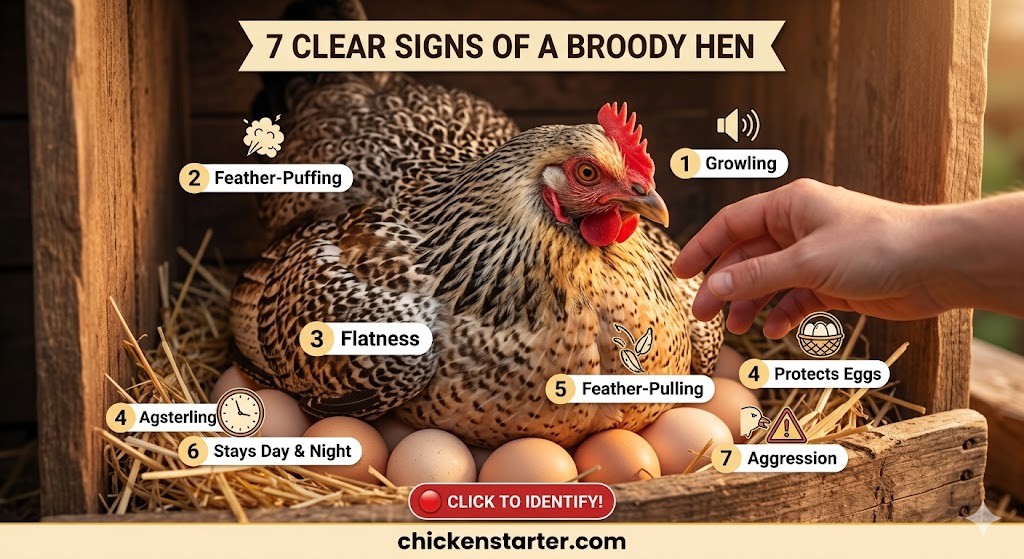
The signs of a broody hen are unmistakable once you know what to look for, but they can genuinely confuse newer chicken keepers who mistake broodiness for illness, injury, or plain stubbornness. A broody hen is a hen whose hormones have triggered a powerful, ancient instinct to sit on eggs and hatch them. She will claim a nesting box, refuse to leave, growl like something prehistoric when you reach for her, and dedicate her entire biological being to incubation whether or not there is a single fertile egg beneath her.
The seven clear signs of broodiness are: sitting in the nesting box for more than 24 hours straight, refusing to leave the nest even when physically removed, a dramatically puffed-up body posture, the distinctive growling vocalization when disturbed, a visible or palpable bare patch on the chest and belly called the brood patch, a complete stop in egg laying, and an obsessive return to the nest within minutes of any removal. If your hen is showing four or more of these signs simultaneously, she is almost certainly broody.
I have kept chickens for years across multiple breeds, and nothing prepared me for my first broody hen. She was a Buff Orpington named Dolores who I found flattened in the nesting box one morning looking like a feathery pancake with eyes. My immediate instinct was that something was terribly wrong. She was puffed to twice her normal size, her feathers were ruffled out sideways, and when I reached into the box to check on her, she screamed at me with a noise I can only describe as a velociraptor disagreeing with management. She was not sick. She was broody, and she stayed that way for the next six weeks.
What Does “Gone Broody” Actually Mean?
A hen “goes broody” when hormonal changes trigger an overwhelming instinct to incubate eggs and raise chicks. The primary hormone responsible is prolactin, the same hormone that drives incubation behavior in many bird species. Elevated prolactin levels suppress the production of LH (luteinizing hormone), which is why a broody hen stops laying eggs entirely. Her body is now redirected away from egg production and toward successful incubation.
This hormonal shift is influenced by several environmental factors. Increasing day length in spring is the primary trigger, which is why most hens go broody between March and August in the Northern Hemisphere. The sensation of eggs beneath her, warm nest temperatures, and darkness all reinforce the hormonal state once it begins. According to information from Penn State Extension, broodiness is influenced by genetics, season, and environmental conditions, with some breeds maintaining the instinct strongly while commercial strains have had it largely eliminated through selective breeding.
Understanding that broodiness is a hormonal state, not a behavioral choice, changes how you respond to it. A broody hen is not misbehaving. She is doing exactly what her biology is telling her to do with intense conviction.
Sign 1: She Has Been Sitting in the Nesting Box for More Than 24 Hours
The most reliable first indicator of broodiness is a hen who refuses to leave the nesting box. Every hen spends time in the nesting box when she is laying. That typically takes 20 to 45 minutes per day. A broody hen, by contrast, stays in the nesting box for hours at a stretch and returns immediately after any brief departure.
The distinguishing threshold is roughly 24 hours. If your hen has been sitting in the same nesting box overnight and is still there the next morning, take notice. If she is still there the following morning and the morning after that, she has almost certainly gone broody.
Pay attention to whether she is sitting in her normal laying spot or has claimed a specific box that she returns to consistently. A broody hen often has a preferred box and will fight other hens to maintain possession of it. She may even try to steal eggs from adjacent boxes by rolling them underneath her body.
One thing that confused me early on was distinguishing between a hen who lays late in the day and one who is going broody. A late layer who sits until dusk is not necessarily broody. But a hen who is still in the box at 9 PM, was there at 6 AM the next morning, and growled when I checked on her twice during the night? That is a different story entirely.
Sign 2: She Refuses to Leave Even When You Remove Her
A confirmed broody hen will return to the nest within minutes of being physically removed. This is the behavioral test that separates a genuinely broody hen from one who simply stayed on the nest a little longer than usual.
Gently lift her out of the nesting box and place her on the floor of the coop or run with food and water nearby. Watch what happens. A non-broody hen will shake herself off, look around, and go about her business. A broody hen will puff up, look deeply offended, take a hasty bite of food and a quick drink if she is thirsty, relieve herself (broody poop is massive and distinctive, often larger and more pungent than normal droppings because she has been holding it for hours), and march directly back to the nest.
Most committed broodies are back in the box within five to fifteen minutes. Some are back in two minutes. My most determined broody hen once returned to the nest before I had even closed the coop door behind me after removing her. She essentially walked underneath my arm and beat me back to her spot.
If a hen consistently returns to the nest within 15 to 20 minutes across three consecutive days, she is genuinely broody and the behavior is hormonally driven rather than habitual.
Sign 3: She Is Puffed Up and Flattened Simultaneously
The physical appearance of a broody hen is genuinely distinctive. She flattens her body low over the nest while simultaneously puffing her feathers outward and upward. The result looks paradoxical but makes perfect biological sense. The flattening maximizes contact between her brood patch and the eggs. The puffed feathers create an insulating dome that traps heat over the entire clutch.
From above, a broody hen looks much larger than she normally does. Her tail is held down low or flat rather than upright. Her wings may be spread slightly to the sides, creating a shelf-like covering over the edges of the nest. Her eyes are often half-closed in a focused, alert calm that is different from the drowsy look of a roosting hen at night.
She also looks significantly different from a sick or injured hen, which is important to know. A sick hen who is sitting quietly in the nesting box will typically be droopy, with a pale comb, closed eyes, and a generally deflated appearance. A broody hen has a tense, alert quality despite her stillness. Her comb may be slightly paler than normal from reduced blood flow during incubation, but her eyes are bright and she responds immediately to stimuli near the nest.
Sign 4: The Growling, Hissing or “Velociraptor” Vocalization
The broody growl is one of the most distinctive sounds in all of backyard chicken keeping. When you approach the nest or reach toward a broody hen, she produces a low, guttural, sustained growl that sounds nothing like any other chicken vocalization. Experienced chicken keepers describe it variously as a growl, a hiss, a dinosaur sound, or the noise a small dragon would make if it were intensely irritated.
This is not just bluster. A committed broody hen will peck, bite, and scratch to defend her nest. Some individuals are more aggressive than others. My Orpington Dolores was vocal but never bit me. A Silkie I kept two years later was entirely silent during her approach but would peck hard enough to leave a bruise if I did not use a glove. You learn quickly to respect the broody hen’s personal space.
The vocalization changes as the broody hen spends time on the nest. In the first few days, the growl is her primary communication. Later in incubation, you begin hearing her make soft clucking sounds directed downward at the eggs beneath her, particularly in the final days before hatch. This is maternal communication, and it is worth pausing to listen for it. Research shows that chicks inside the egg can hear these sounds and respond, beginning the bonding process before they even hatch.
For more on chicken vocalizations and what they communicate, see our guide on the chicken noises and what they mean page.
Sign 5: She Has Plucked Feathers from Her Chest and Belly (The Brood Patch)
A broody hen plucks feathers from her chest and belly to create a bare patch of skin called the brood patch. This is not a sign of feather pecking or illness. It is a deliberate, instinctive behavior that allows her to transfer body heat directly to the eggs without the insulating barrier of feathers in between.
The brood patch becomes warm, slightly swollen, and highly vascularized. If you carefully check beneath a broody hen during her daily break, you may be able to feel the warmth of the brood patch before you even touch her. The skin there is distinctly warmer than the surrounding feathered areas.
Not all broody hens develop an obvious brood patch, particularly first-time broodies or those with very dense, fluffy feathering like Cochins. Some broodies pluck significantly, leaving a large bare area. Others pluck minimally. The presence of a developing brood patch alongside the other behavioral signs is strong confirmation of genuine broodiness.
If you see feather loss on a hen who is not sitting on a nest and is not showing other broody behaviors, the cause is more likely molting, mites, lice, or feather pecking by flock mates. For guidance on distinguishing between those causes, see our guide on mites and lice on chickens and our chicken molting season guide.
Sign 6: Egg Laying Has Completely Stopped
A broody hen stops laying eggs entirely. This is one of the most practical and financially noticeable signs of broodiness, especially if you keep a small flock and are counting on consistent daily production.
The hormonal mechanism behind this is straightforward. Elevated prolactin levels suppress the luteinizing hormone (LH) that drives ovulation and egg production. When a hen goes broody, her reproductive system essentially pauses. There are no new eggs developing in her ovaries. She will not lay again until her broodiness breaks, either naturally after a 21-day incubation cycle or artificially if you intervene.
If you have been getting reliable eggs from a specific hen and production suddenly drops to zero with no other changes in management, health, diet, or day length, broodiness is high on the list of causes to investigate. Combined with any of the other signs in this article, it is a strong indicator.
The egg production hiatus associated with broodiness is significant. A hen who goes broody and then raises chicks may not resume laying for 8 to 12 weeks from the start of her broody episode. For a small backyard flock, this is worth factoring into your egg supply expectations. For more on managing production gaps, see our guide on why chickens stop laying eggs.
Sign 7: She Collects Eggs From Other Hens and Pulls Them Under Her
A broody hen is not particular about where the eggs beneath her came from. She will steal eggs from adjacent nesting boxes, roll them under her body, and sit on a growing pile that may include eggs laid by multiple hens over multiple days. Without intervention, a broody hen in a communal nesting setup can end up sitting on 15 to 20 eggs, many of which are at completely different stages of development.
This egg collecting behavior is a clear distinguishing sign of broodiness. A non-broody hen lays her egg and leaves. A broody hen actively gathers. You may notice eggs missing from nearby boxes, or you may find an unusually large clutch beneath one hen who seems to be hoarding the supply for the entire coop.
This is one of the reasons why marking your broody hen’s eggs is so important if you decide to allow her to hatch. Use a pencil to mark each egg you set with an X or O, then check daily during her brief breaks and remove any unmarked additions. Otherwise you end up with eggs at different developmental stages and a chaotic, staggered hatch that is difficult to manage.
Is My Hen Broody or Sick? The Critical Difference
Confusing a broody hen with a sick hen is one of the most common concerns for backyard chicken keepers, and it is worth addressing directly because the two conditions require completely opposite responses.
A broody hen is alert and responsive when on the nest, even if her response is aggressive. She takes daily breaks of 15 to 30 minutes. During these breaks, she eats, drinks, moves normally, and rejoins the flock briefly before returning. Her droppings during breaks are large and distinctive but normal in consistency. Her comb may be slightly less vibrant than usual but is not pale or dark purple. She returns purposefully to the nest after every break.
A sick hen shows distress throughout the day, not just at the nest. She is lethargic away from the box as well as in it. She may have discharge around the eyes, nose, or vent. Her droppings may be abnormal in color, consistency, or smell. She does not puff up aggressively when approached. She does not return to the nest purposefully. Her comb is often pale, shrunken, or discolored.
The decisive test is simple. Remove the hen from the nest and observe her behavior for 30 minutes. A broody hen will fuss, eat and drink briefly, then march determinedly back to the nest. A sick hen will find a corner, sit quietly with her eyes closed, and show no interest in returning anywhere specific.
If after observing your hen you remain uncertain about whether the issue is behavioral or medical, see our chicken health check guide and our guide on when to call the vet for a backyard chicken.
Which Breeds Are Most Likely to Show Signs of Broodiness?
Breed is the single most predictive factor in whether a hen will go broody. Selective breeding for commercial egg production has largely eliminated the broody instinct from high-production breeds. Heritage and dual-purpose breeds retain it strongly.
Highly Broody Breeds
Silkies are the most reliably broody chicken breed available. They go broody frequently, sometimes multiple times per year, and will sit on eggs from other species including ducks, turkeys, and guinea fowl. Their calm patience makes them exceptional surrogate mothers. For everything about this breed’s unique characteristics, see our Silkie bantam vs. standard Silkie guide.
Cochins are large, calm, and extremely broody. Their feathered feet and massive body coverage make them capable of incubating large clutches effectively. They are considered one of the best natural incubators available.
Buff Orpingtons go broody reliably and combine that instinct with a calm, manageable temperament. They are large enough to cover substantial clutches and make attentive, gentle mothers. For a complete profile of this breed, see our Buff Orpington chicken guide.
Brahmas are excellent broodies despite their size. They are calm, steady sitters and their large bodies provide excellent coverage and warmth for generous clutch sizes.
Speckled Sussex go broody moderately often and make reliable, protective mothers when they do.
Breeds That Rarely or Never Go Broody
Leghorns, ISA Browns, Golden Comets, Red Stars, and most commercial hybrid layers have had broodiness selectively removed over generations of production-focused breeding. These hens will almost never go broody. If you rely on these breeds for your flock, you will need an incubator if you want to hatch eggs.
Rhode Island Reds (production strains specifically) rarely go broody. Heritage strains go broody occasionally but not reliably.
How to Confirm Your Hen Is Broody: A Simple 3-Day Test
If you are still unsure whether your hen is genuinely broody or just having an off few days, use this three-day confirmation method before placing valuable hatching eggs under her.
Day 1: Remove her from the nest, place food and water in front of her, and observe. If she returns to the nest within 30 minutes, note the behavior.
Day 2: Repeat the removal and observation. If she returns to the nest again within 30 minutes, the behavior is consistent.
Day 3: Place a few fake eggs (golf balls work perfectly) or ceramic nest eggs under her and repeat the removal test. A genuinely broody hen will return to the fake eggs and sit on them with the same commitment as real ones.
A hen who passes this three-day test is a committed broody and a reliable choice for natural incubation. According to information from The Chicken Chick, allowing a hen to sit on test eggs for three days before placing valuable fertilized eggs under her is one of the most important steps in avoiding wasted hatching eggs on an unreliable broody.
What Should You Do Once You Have Confirmed Broodiness?
Once you have confirmed that your hen is genuinely broody, you have two clear options and one important decision to make.
Option 1: Let Her Hatch Eggs
If you have a rooster and fertile eggs, or if you can source quality hatching eggs, a confirmed broody hen is a remarkable natural incubator. She handles temperature, humidity, and turning automatically. She raises the chicks herself after hatch, eliminating the need for a brooder setup entirely. For a complete comparison of natural brooding versus artificial incubation, see our detailed guide on broody hen vs. incubator: which is better for hatching eggs.
If you decide to let her hatch, move her to a private space away from the communal flock, mark your setting eggs clearly, candle at Day 7 to confirm fertility, and plan for the full 21-day incubation timeline. For everything about that process and what to expect each week, see our guide on how long does a broody hen sit on eggs before they hatch.
Option 2: Break the Broodiness
If you do not want more chicks, cannot provide fertile eggs, or need your hen back in egg production, breaking the broodiness is the responsible choice. An unbroken broody hen who sits for weeks on infertile or no eggs loses significant body weight (up to 15 to 20 percent according to multiple poultry extension sources), risks health complications from prolonged reduced eating and drinking, and stops producing eggs for the duration.
The most effective method for breaking broodiness humanely is a wire-floored cage with no nesting material elevated slightly off the ground. The cool air flow underneath reduces the elevated body temperature associated with the broody hormonal state. Most hens break within two to four days of consistent cage time, with access to food and water but no comfortable nesting opportunity. For step-by-step guidance on every proven method for breaking broodiness safely, see our comprehensive guide on how to break a broody hen.
Broody Hen Management: Keeping Her Healthy Through Incubation
Whether you choose to allow your broody hen to hatch or you are in the process of breaking her broodiness, her health during this period deserves attention.
A broody hen eats significantly less than a normal hen because she restricts her daily activity to a single brief break. Provide high-protein feed, free-choice fresh water, and occasional protein-rich treats like mealworms or scrambled eggs within easy reach of the nest during her breaks. This minimizes weight loss without requiring her to travel far from the eggs.
Check the nesting area regularly for mite and lice infestations. The warm, undisturbed nest environment is ideal for parasite proliferation. Treat any infestation promptly during the hen’s daily break, working quickly to minimize the time her body temperature drops away from the eggs.
Keep her separated from the main flock if possible. Other hens constantly disturbing a broody, attempting to lay in her chosen box, or adding eggs to her clutch significantly increase the stress on the sitting hen and reduce hatch rates. A wire dog crate set up within or adjacent to the main coop provides visibility without disturbance, and allows gradual reintroduction to the flock when the brooding period ends.
Frequently Asked Questions About Signs of a Broody Hen
How do I know if my hen is broody or just laying?
A hen who is laying spends 20 to 45 minutes in the nesting box and then leaves. A broody hen stays in the nesting box for hours at a stretch, is still there overnight, returns immediately after removal, growls when approached, and has stopped laying new eggs. The combination of overnight nest occupancy and the growling defense response is the clearest diagnostic pair.
How long does broodiness last without eggs?
Without fertile eggs to hatch, a broody hen’s hormonal state typically persists for 6 to 8 weeks before naturally diminishing. Some exceptionally determined broodies remain broody for longer. Without intervention, this period of reduced eating, weight loss, and zero egg production takes a real toll on a hen’s condition. Breaking an unwanted broody promptly is both kinder and more practical than waiting it out.
Can a young pullet go broody?
Yes. A pullet can go broody at any point after she reaches sexual maturity and begins laying, typically from 18 to 22 weeks of age onward. Broodiness in a very young pullet is generally discouraged by many experienced keepers because her body is still developing and the physical demands of sustained incubation before she is fully mature can be stressful.
Do all chickens go broody?
No. Broodiness is strongly influenced by breed genetics. Silkies, Cochins, Buff Orpingtons, and Brahmas go broody reliably. Production breeds like Leghorns, ISA Browns, and commercial hybrid layers have had the instinct selectively removed and rarely or never go broody. Within any breed, individual hens also vary in their tendency and reliability as broodies.
Is a broody hen dangerous to other chickens?
A broody hen is not dangerous to healthy adult flock mates, though she will defend her nest aggressively from any hen who approaches too closely. She may also become aggressive toward newly introduced chicks that are not her own. The main management concern is that a broody hen in a shared nesting area can monopolize nesting space and cause stress for other laying hens. Giving her a private brooding space resolves this.
Can broodiness spread through a flock?
Experienced chicken keepers report that broodiness can appear to “spread” through a flock, with multiple hens going broody in quick succession. This is likely due to shared environmental triggers rather than social contagion. The visual cue of one hen sitting on a nest, the sound of other broodies, and the warming seasonal conditions all act as environmental cues that may trigger latent broody tendencies in susceptible hens around the same time.
Recognizing the signs of broodiness early gives you the time and information to make a deliberate choice about how to respond, whether that means setting hatching eggs under a willing hen, actively breaking an unwanted broody, or simply adjusting your expectations for the flock’s egg production over the coming weeks. A broody hen is not a problem to be solved. She is a biological event to be managed, and with the right knowledge, you can make that management both effective and straightforward.
Note: This guide is for educational purposes. Individual hen behavior and health conditions vary widely. Always consult a licensed poultry veterinarian if you are uncertain whether your hen is broody or unwell.

Oladepo Babatunde is the founder of ChickenStarter.com. He is a backyard chicken keeper and educator who specializes in helping beginners raise healthy flocks, particularly in warm climates. His expertise comes from years of hands-on experience building coops, treating common chicken ailments, and solving flock management issues. His own happy hens are a testament to his methods, laying 25-30 eggs weekly.