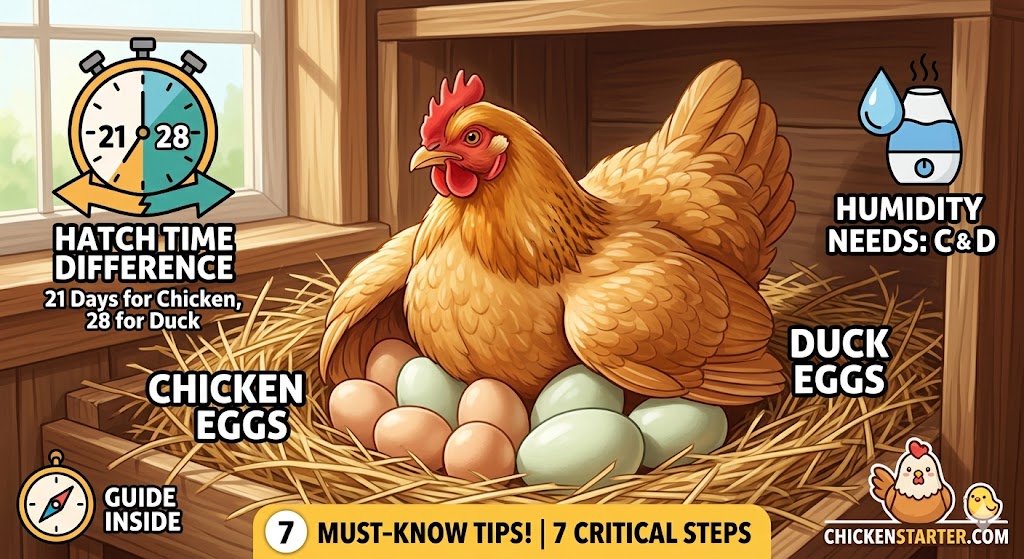
Yes, a hen can absolutely hatch duck eggs, and it happens in backyard flocks more often than you might think. A broody hen does not check the species on the label before she settles in. If the egg is roughly the right shape and fits beneath her brood patch, she will incubate it with the same fierce commitment she brings to her own eggs. The result, if managed correctly, is a clutch of healthy ducklings raised by a hen who has absolutely no idea what she has just done.
But the process is not as straightforward as sliding duck eggs under a sitting hen and walking away. Duck eggs take 28 days to hatch instead of the 21 days for chicken eggs, and that difference alone changes everything about how you manage the hatch. There are also real challenges around humidity, egg size, and what happens in the days after the ducklings emerge when they start waddling toward every puddle they can find while their adoptive mother has a quiet breakdown on the bank.
I hatched my first batch of Khaki Campbell ducklings under a Buff Orpington named Rosie three years ago. It was one of the most entertaining, occasionally stressful, and ultimately rewarding experiences I have had with backyard poultry. Rosie was an exceptional broody hen who had already successfully hatched two clutches of her own eggs. She sat on those duck eggs for 28 days without hesitation. She was an incredible mother to the ducklings for the first 10 days. Then the ducklings discovered the water trough and her confidence collapsed completely. She paced the edge making increasingly desperate clucking sounds while her babies splashed around perfectly happily. It was, objectively, hilarious.
That experience taught me a lot about what to prepare for. This guide covers everything.
How Long Does a Hen Sit on Duck Eggs?
A hen will sit on duck eggs for as long as it takes for them to hatch, provided she remains committed. The challenge is that this takes significantly longer than she is biologically accustomed to.
Standard chicken eggs hatch in 21 days. Most duck eggs (Mallard-derived breeds including Khaki Campbells, Rouens, Pekin ducks, and Welsh Harlequins) take 28 days. Muscovy duck eggs take even longer at 35 days. This means a hen brooding duck eggs must maintain her commitment for a full week longer than a normal chicken hatch, and Muscovy eggs require two full weeks of additional sitting beyond what her hormones would naturally expect.
According to information from Penn State Extension, the incubation period is fixed by species and cannot be shortened by any management change. A hen who has never brooded duck eggs before has no way of knowing that the expected outcome has been delayed. She simply sits. And sits. And sits some more.
This extended timeline creates the most significant practical challenge of using a hen to hatch duck eggs: broodiness is hormonally driven, and some hens lose their commitment around the 21-day mark when their internal clock says hatch should have happened already. A hen who abandons her nest on Day 22 with six perfectly viable duck eggs inside is a frustrating outcome that is entirely predictable if you choose the wrong breed or an unreliable broody for the job.
For a detailed breakdown of normal hen incubation timelines and what the behavioral signs of commitment look like throughout the process, see our guide on how long does a broody hen sit on eggs before they hatch.
Which Hen Breeds Are Best for Hatching Duck Eggs?
Breed selection is the single most important decision you will make in this process. A Silkie who reliably sits for 35 days on Muscovy eggs is far more valuable for this purpose than a first-time Wyandotte who gives up on Day 23. You need a breed with deep, reliable broodiness and a calm temperament that will not be easily thrown off by disruption.
Silkies: The Gold Standard
Silkies are widely considered the best breed for hatching duck eggs, and experienced duck keepers specifically seek them out as surrogate mothers. Their broodiness is legendary. They go broody frequently, sometimes multiple times per year, and they sit with a level of commitment that puts most other breeds to shame. A determined Silkie will outlast even Muscovy egg incubation periods without losing focus.
Their calm, gentle temperament also makes them excellent with ducklings after hatch. Silkies do not tend toward aggression, and ducklings, which are physically more robust than newly hatched chicks, are unlikely to be harmed by a Silkie hen. The size difference between a Silkie and ducklings is a consideration for very large duck breeds, but for bantam and standard duck breeds, the pairing works well. For more on this breed’s unique characteristics, see our Silkie bantam vs. standard Silkie guide.
Buff Orpingtons: Reliable and Large Enough
Buff Orpingtons go broody reliably and have the body size to cover a meaningful number of duck eggs. They are calm, patient, and consistent sitters who handle the extended incubation timeline better than many breeds. Their larger body size compared to Silkies gives them coverage capacity for larger duck eggs and bigger clutch sizes. I used a Buff Orpington for my first duck hatch and found her commitment unwavering through the full 28 days. For everything about this breed, see our complete Buff Orpington chicken guide.
Cochins and Brahmas
Both Cochins and Brahmas are excellent choices for the same reasons as Orpingtons: reliable broodiness, calm temperament, and sufficient body size to cover duck eggs adequately. Cochins in particular are known for their extraordinary patience as broodies and are regularly used by duck keepers who prefer natural incubation.
Breeds to Avoid for Duck Eggs
Avoid using first-time broodies of any breed for duck eggs. The extended incubation period is challenging enough for experienced broodies. A hen who has never completed a full chicken hatch should not be trusted with a 28-day or 35-day commitment.
Production breeds and hybrids including Leghorns, ISA Browns, Rhode Island Reds (production strains), and commercial sex-link hybrids have had the broody instinct largely removed through selective breeding. These hens almost never go broody and are entirely unsuitable for natural incubation of any species.
Breeds with inconsistent broodiness, including most Wyandottes, Easter Eggers, and Australorps, can work but carry higher abandonment risk. If you use one of these breeds, have an incubator ready as backup from Day 20 onward.
The Critical Humidity Problem No One Warns You About
This is the most technically important aspect of hatching duck eggs under a hen, and it is the part that most guides either gloss over or miss entirely.
In nature, a duck incubates her own eggs. When she leaves the nest for her daily bath, she returns with wet feathers. That moisture, transferred from her feathers to the eggs when she resettles, naturally raises the humidity around the developing embryos during the second half of incubation. Developing duck embryos need higher humidity than chicken embryos, particularly from Day 14 onward, to prevent the inner membrane from drying and tightening around the duckling as it tries to hatch.
A broody hen does not go swimming. She returns from her daily break with dry feathers, and she cannot provide the humidity boost that a mother duck instinctively supplies. Without intervention, the membranes inside duck eggs can dry and harden enough to make hatching difficult or impossible, even when all other conditions have been perfectly managed.
The solution is straightforward but requires consistency. From Day 14 of incubation onward, lightly mist the duck eggs with lukewarm water during the hen’s daily break. Use a clean spray bottle set to a fine mist. Aim to get the eggs visibly damp but not soaking wet. Allow them to sit in open air for a few minutes before the hen returns to the nest.
This brief cooling and moistening during the daily break mimics what the mother duck provides naturally. The hen will not object provided you work during her break and do not linger. Most experienced duck keepers who use hens for incubation describe this as the one non-negotiable intervention in an otherwise hands-off process.
Do not mist during the first 13 days of incubation. Early in development, excess moisture creates more risk than benefit. The targeted moistening from Day 14 to Day 25 is what protects the hatching membrane in the critical final days.
How Many Duck Eggs Can a Hen Cover?
The number of duck eggs a hen can effectively incubate depends on her body size and the size of the duck breed. Duck eggs are larger than chicken eggs. A standard Pekin duck egg weighs approximately 80 to 90 grams compared to a typical chicken egg at 55 to 65 grams. That size difference reduces how many eggs any given hen can cover effectively.
Here is a practical coverage guide:
| Hen Breed | Duck Egg Capacity | Best For |
|---|---|---|
| Silkie (standard) | 6 to 8 average duck eggs | Bantam ducks, Call ducks |
| Silkie (large standard) | 8 to 10 | Khaki Campbells, Mallards |
| Buff Orpington | 10 to 12 | Most standard breeds |
| Cochin (large) | 10 to 14 | Most standard breeds |
| Brahma | 12 to 15 | Large breed ducks, Pekins |
| Bantam hen | 4 to 6 | Bantam ducks only |
Overloading a hen with more eggs than she can comfortably cover reduces hatch rates significantly. Eggs at the edges of an overfull clutch receive inconsistent heat and humidity. It is always better to run a slightly smaller clutch with full, even coverage than to maximize egg count at the expense of hatch success.
If you want to hatch more duck eggs than one hen can cover, run the rest in an incubator alongside the hen-hatched clutch. This gives you the benefits of natural incubation for part of the clutch without compromising either batch. For guidance on running an incubator alongside a broody hen operation, see our complete comparison guide on broody hen vs. incubator: which is better for hatching eggs.
Setting Up the Brooding Space for Duck Egg Incubation
The brooding space for duck egg incubation needs a few specific modifications beyond what you would provide for a standard chicken hatch. Getting the environment right before you set eggs under the hen prevents the most common management problems.
Location and Nest Design
Provide a ground-level nest in a private, predator-secure location separate from the main flock. Duck eggs are larger and heavier than chicken eggs. A nest elevated from the floor creates a risk of eggs rolling out and breaking when the hen shifts position, which happens more often with the rounder, heavier duck eggs.
Use deep, absorbent nesting material. Straw or hay works well for duck egg hatches because it holds slight moisture without becoming waterlogged when you mist the eggs daily from Day 14 onward. Avoid wood shavings for duck egg hatches if possible, as they dry quickly and do not hold environmental moisture as effectively.
The nest should be deep enough to contain the clutch comfortably without eggs rolling to the edges. A circular nest approximately 14 to 16 inches in diameter works well for a standard Orpington or Cochin covering 10 to 12 duck eggs.
Access to Food and Water During the Brooding Period
Place high-protein food and fresh water within easy reach of the brooding area so the hen does not need to travel far during her brief daily break. A broody hen who has to walk across the entire coop to find food and water takes longer breaks and loses more body condition over the extended 28-day incubation period.
Some experienced duck-egg keepers provide their broody hen with duckling starter feed or grower feed during the final week of incubation and during the brooding period after hatch. Ducklings have different nutritional needs than chicks, and if the hen is eating alongside her ducklings after hatch, a feed that is appropriate for ducklings (and not harmful to the hen) simplifies management.
Critically, do not provide a deep water source near the brooding area during incubation. Once ducklings hatch, they will attempt to climb into any water container they can access, including standard chicken waterers that are far too deep for newly hatched ducklings. Use a shallow trough or nipple waterer during the first week after hatch.
Day-by-Day Management Through the 28-Day Hatch
Managing a duck egg hatch under a broody hen requires more active involvement than a standard chicken hatch, primarily because of the humidity intervention from Day 14 onward and the extended timeline that demands consistent monitoring.
Days 1 to 7: Early Incubation
The hen settles in and the earliest stages of embryonic development begin. Confirm she is a reliable broody by checking that she takes her break independently, returns within 20 to 30 minutes, and is actively covering the eggs when she returns. Do not disturb the nest unnecessarily during this period. The first week of any broody hatch is when disturbance-related abandonment is most likely.
Day 7: First Candle
Candle the duck eggs at Day 7 to assess fertility and remove any clear (infertile) eggs. Duck eggs have thicker, darker shells than chicken eggs in most breeds, which can make candling slightly more challenging. Use a very bright, focused LED candler and work in complete darkness for best visibility. A developing duck egg at Day 7 shows blood vessel development spreading from a central dark spot, similar to a chicken egg at the same stage but slightly larger in overall scale.
Remove clear eggs and eggs showing only a blood ring (early quitter) to reduce unnecessary load on the hen and eliminate the risk of a non-developing egg cracking and contaminating viable ones.
Days 8 to 13: Mid-Development, No Intervention Needed
The embryo develops rapidly during this period. The hen manages everything. Check on her once daily to confirm she is taking her break, eating, and drinking. Do not mist the eggs yet.
Day 14: Begin Moistening
From Day 14 onward, mist the eggs lightly with lukewarm water during the hen’s daily break. Allow a two to three minute air exposure before she returns. This is your most important active contribution to a successful duck hatch. Do not skip it.
Day 21: The Milestone That Can Break a Broody Hen
Day 21 is when a chicken would hatch. Nothing is happening on Day 21 with duck eggs. The eggs should be developing well. The hen has no biological reference point for the extended timeline.
Watch her behavior carefully from Day 20 through Day 24. Some hens become restless at this point, taking slightly longer breaks or seeming less settled on the nest. Most reliably broody hens work through this period without incident, but it is when hen-abandoned duck eggs most commonly occur. If your hen begins showing signs of restlessness, minimize all disturbances around the coop during this window.
If you are concerned about abandonment risk during this critical period, see our guide on what to do when your hen abandons her eggs midway for the specific rescue steps to take if the worst happens.
Days 25 to 27: Pre-Hatch Period
Increase misting frequency slightly during this period if the ambient humidity in your coop is very low. In the final days, the duckling is internally pipping into the air cell and preparing to externally pip through the shell. Adequate moisture prevents the membrane from drying and restricting the hatching process.
Stop misting entirely once you see the first external pip.
Day 28: Hatch Day
The first external pip should appear around Day 28, though it is not unusual for ducks to pip on Day 27 or take until Day 29. Once external pipping begins, leave the hen completely undisturbed. The hatching process from external pip to full emergence typically takes 24 to 48 hours for ducklings, which is longer than the 12 to 24 hours typical for chicks.
Do not assist a duckling unless it has been externally pipped for more than 48 hours with no progress. The membrane inside a duck egg is tougher than a chicken egg membrane. Ducklings need the physical exertion of hatching to stimulate cardiovascular development. Premature assistance almost always results in a duckling that is too weak to thrive.
What Happens After the Ducklings Hatch: The Mother Hen’s Reality
This is the part of the process that every first-time chicken-hatch-duck-eggs keeper needs to understand before committing to it. The post-hatch period is where the hen’s limitations become most apparent and where your management decisions matter most for duckling welfare.
The Water Problem
Ducklings are compulsively drawn to water within hours of hatch. They will splash, dive, and attempt to swim in any water source they can access. This is instinctive, species-appropriate behavior. Their mother duck would supervise this and provide preen oil from her oil gland to waterproof her ducklings’ downy feathers.
A hen cannot waterproof her ducklings because she does not have a duck’s oil gland. Newly hatched ducklings are not yet producing their own preen oil in sufficient quantities to waterproof themselves. This means unsupervised access to deep water in the first two to three weeks of life is genuinely dangerous for hen-hatched ducklings, because they can become waterlogged, chilled, and drown.
Provide only shallow water sources during the first three weeks, specifically water shallow enough for ducklings to drink but not submerge themselves. A chick waterer base works for very young ducklings. Restrict access to ponds, deep troughs, and other open water during this period.
After three to four weeks, as the ducklings’ own oil production increases and their adult feathers begin replacing their down, supervised water access becomes safe and eventually necessary for their welfare.
The Behavioral Confusion Factor
Rosie, my Buff Orpington, was confident and attentive with her ducklings for the first 10 days. She kept them warm, called them to food, and defended them fiercely from the rest of the flock. Then the ducklings discovered the water trough.
They began splashing, waddling at speed toward any wet surface, and refusing to respond to her food-clucking calls with the same consistent compliance chicks display. Rosie became increasingly agitated. She could not understand why her “chicks” were soaking wet, running into water rather than away from it, and growing at a speed and into a size that did not match her maternal template.
Most hens manage this mismatch with varying degrees of equanimity. Some continue mothering ducklings until they are fully independent at 6 to 8 weeks. Others gradually disengage from their ducklings around the 3 to 4 week mark as the behavioral differences become too significant to bridge. If your hen disengages before the ducklings are fully feathered and self-sufficient, you may need to step in with a supplemental heat source for the ducklings.
The Size Issue
By three to four weeks, ducklings of most standard breeds are growing rapidly and approaching or exceeding the size of a bantam or medium-sized hen. A Silkie mother may find herself brooding ducklings who are larger than she is by Day 28 of their life. Most hens manage this with surprising adaptability, but it can lead to the hen being occasionally trampled by enthusiastic ducklings who want to get underneath her for warmth. Watch for signs of stress in the hen during this period.
Candling Duck Eggs: What to Look For and When
Duck eggs present slightly different candling challenges than chicken eggs because of their thicker shells and, in breeds like Khaki Campbells and Mallards, darker shell pigmentation that reduces light transmission.
Use the brightest candler available. LED candlers specifically designed for duck eggs or for thick-shelled eggs work significantly better than standard flashlight methods. Work in complete darkness and hold the egg against the light for a full five seconds before drawing conclusions.
Day 7: Blood vessels radiating from a dark central spot indicate development. A clear egg is infertile. Remove clear eggs and blood rings.
Day 14: The egg should appear approximately 60 to 70 percent dark. The air cell at the wide end should be clearly defined and expanding. Vigorous embryos sometimes show visible movement at candling.
Day 21: The egg should be almost entirely dark. The air cell should occupy approximately 30 percent of the egg volume. This air cell size is important; a significantly undersized air cell suggests too much humidity, while an oversized air cell suggests the eggs have been too dry.
Day 25 to 27: Remove from candling to avoid unnecessary disturbance. The duckling is actively preparing to hatch and movement during candling can disrupt positioning.
For a complete guide to candling technique and what to look for at each stage, see our guide on how to tell if an egg is fertile.
When to Use an Incubator Instead of a Hen for Duck Eggs
A broody hen is not always the right choice for duck eggs, even when one is available. Several circumstances make an incubator the more reliable option.
If your only available broody is a first-time broody who has never completed a chicken hatch, do not use her for duck eggs. The extended 28-day timeline compounds the risk of hormonal abandonment around Day 21.
If you want to hatch Muscovy duck eggs, which require 35 days of incubation, even a reliable broody hen faces an extended commitment that carries significant abandonment risk past Day 28. An incubator removes this variable entirely.
If you are managing a large number of duck eggs beyond any single hen’s coverage capacity, running an incubator alongside a broody hen gives you the best of both methods.
If your broody hen shows any signs of early unreliability during the confirmation period, do not risk valuable fertilized duck eggs on her. For detailed guidance on confirming broody reliability before committing eggs, see our guide on how to tell if your hen has gone broody.
For a complete side-by-side analysis of when broody hens outperform incubators and vice versa, see our full guide on broody hen vs. incubator: which is better for hatching eggs.
Duckling Feed and Nutrition After Hatch
Ducklings have different nutritional requirements than chicks, and this creates a management consideration when they are being raised by a hen who is likely eating from the same feed source.
Ducklings require niacin (Vitamin B3) in significantly higher quantities than chicks. A niacin deficiency in ducklings causes leg weakness, developmental problems, and in severe cases, permanent joint damage. Standard chick starter feed does not contain enough niacin for healthy duckling development.
Provide waterfowl starter feed or unmedicated chick starter with niacin supplementation from hatch. You can supplement niacin by adding brewer’s yeast to the feed at a rate of approximately 2 to 3 tablespoons per cup of feed. According to information from the Merck Veterinary Manual, niacin deficiency is one of the most common nutritional problems in commercially raised ducklings, and the requirement for ducks is approximately four times higher than for chickens.
Do not use medicated chick starter for ducklings. Amprolium, the medication in most medicated chick starter feeds, is dosed for chicks based on their feed intake. Ducklings eat significantly more feed and drink significantly more water than chicks of the same age. Ducklings consuming medicated feed at their normal intake can receive an excessive dose that interferes with their thiamine metabolism.
Grit should be provided from the first week, separate from feed. Ducklings will forage aggressively from an early age if given any outdoor access, and they need grit to process anything they pick up.
For comprehensive feeding guidance that applies to the early weeks after hatch, see our guide on when to switch from starter to grower feed as a reference point for the transition timing.
Common Questions About Hatching Duck Eggs Under a Hen
Will the hen accept ducklings as her own?
Yes, in almost all cases. A broody hen does not distinguish between species at hatch. She responds to the sounds, warmth, and movement of newly hatched birds beneath her, and her maternal response is triggered by those cues regardless of species. The ducklings, for their part, imprint on the hen as their mother and follow her immediately.
The behavioral divergence comes later, as ducklings begin displaying species-specific behaviors that the hen cannot interpret or replicate. But at hatch and in the first week, the mother-offspring bond typically forms completely and warmly.
Can a bantam hen hatch duck eggs?
Yes, if the duck breed is appropriate for the hen’s size. A bantam hen can successfully hatch bantam duck eggs (Call ducks, East Indie ducks) or small standard duck eggs. She cannot physically cover the large eggs of heavy breeds like Pekins or Rouens. Match the egg size to the hen’s body size for adequate coverage and warmth.
What if the hen rejects the ducklings after hatch?
Rejection of hatchlings by a broody hen is uncommon but does occasionally happen, particularly with first-time broodies or when ducklings hatch significantly later than any chicken eggs in a mixed clutch. If a hen is actively pecking at or ignoring newly hatched ducklings, remove the ducklings immediately and set up a brooder with appropriate heat, water, and niacin-supplemented feed. For a complete brooder setup guide, see our article on how to set up a brooder for new chicks, which covers the same principles applicable to ducklings.
How long does a hen mother ducklings?
Most hens mother ducklings for 3 to 5 weeks before the growing size and behavioral differences of the ducklings cause the hen to disengage. Some particularly committed broodies continue mothering through 6 to 8 weeks. By Week 4, most ducklings are developing sufficient feathering and body size to regulate their own temperature with decreasing dependence on the hen.
The memory of Rosie pacing anxiously at the edge of the water trough while her ducklings splashed completely carefree is one I will carry for a long time. She never quite forgave them for loving water the way they did. But she hatched them beautifully, kept them warm through their most vulnerable days, and in every way that mattered in those first three weeks, she was their mother. That is what broody hens do, regardless of species.
Note: This guide is for educational purposes. Always consult a licensed poultry veterinarian for specific health concerns about your hens or ducklings. Duck and chicken husbandry requirements differ significantly, and ensuring appropriate care for both species is important for flock health.

Oladepo Babatunde is the founder of ChickenStarter.com. He is a backyard chicken keeper and educator who specializes in helping beginners raise healthy flocks, particularly in warm climates. His expertise comes from years of hands-on experience building coops, treating common chicken ailments, and solving flock management issues. His own happy hens are a testament to his methods, laying 25-30 eggs weekly.