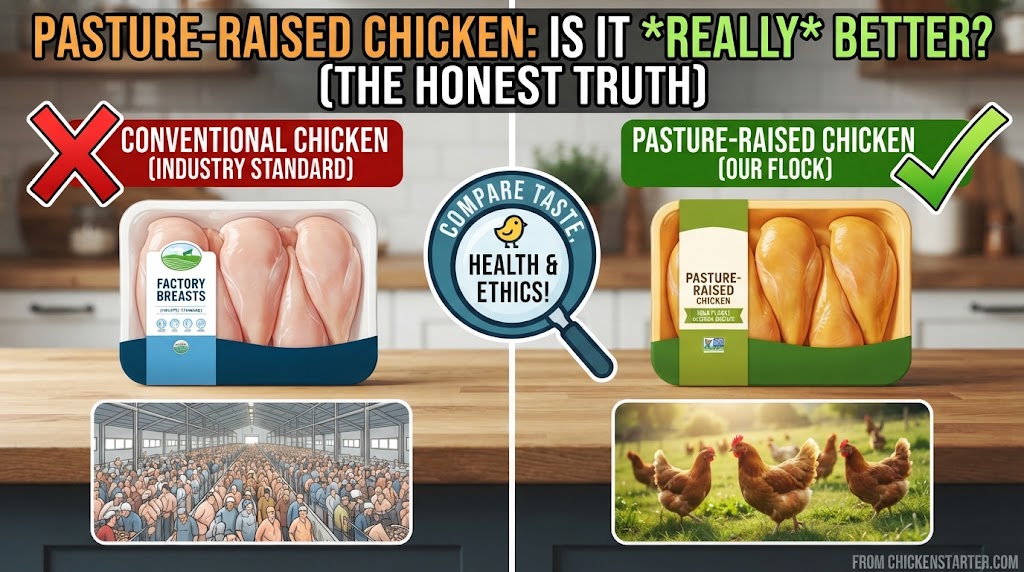
I’ll be upfront with you right from the start.
I used to grab whatever chicken was on sale at the grocery store. “Free range.” “Natural.” “Organic.” I assumed they all meant the same thing, that the chickens lived good lives outside, ate clean food, and that the meat on my plate was healthy.
I was wrong.
The day I brought home my first pasture-raised whole chicken from a local farm and roasted it, I stood in my kitchen genuinely confused. It tasted different. Richer. More like actual chicken. My family kept asking what I did differently. I hadn’t changed my recipe at all.
That experience sent me down a deep research rabbit hole. What I found changed how I shop for chicken forever. In this guide, I’m going to walk you through everything I learned, the real nutritional differences, the label tricks, where to buy it, how to raise it yourself, and whether the price premium is truly worth it.
Let’s start from the very beginning.
What Does “Pasture-Raised Chicken” Actually Mean?
Before we answer whether it’s better, we need to know what it actually is.
Here is the honest truth. For a long time, “pasture-raised” had no strict legal definition in the United States. Brands used it loosely, and it was treated almost the same as “free range,” which is a much weaker standard.
That changed in late 2024.
The USDA updated its animal-raising labeling guidelines to require that “pasture-raised” animals must be on pasture the majority of their life, where “pasture” is defined as land having rooted vegetative cover, grasses, or plants. This is different from “free-range,” which only requires that the animals have access to the outdoors.
This is a huge deal. The label now has teeth.
Pasture-raised chicken brand Pasturebird successfully petitioned alongside parent company Perdue Farms to update the US Department of Agriculture definition of “pasture-raised” meat and poultry, formally distinguishing it from “free range.” On March 16, 2023, Perdue filed a petition with the USDA Food Safety and Inspection Service to define separate “free-range” and “pasture-raised” claims for meat and poultry products. On August 28, 2024, the USDA accepted Perdue’s petition.
With the completion of the 60-day comment period on November 12, 2024, the new USDA guideline revisions took immediate effect, though there is currently a lag in the marketplace. That means you may still see old packaging from brands that have not updated their labels yet. Keep that in mind when you shop.
Certified Humane has incorporated the new FSIS guidelines into their Broiler Standards, giving producers the opportunity to follow these new regulations in tandem with the Certified Humane standard and thus have the USDA’s support for the use of their logo with the addition of a pasture-raised claim on pack.
The updated USDA guidelines are a significant win for consumers seeking pasture-raised products they can trust, as well as poultry farmers who put in the extra time, care, and resources to truly raise their birds on grass.
As one first-generation Michigan pasture-raised poultry farmer put it, “the real winner is the consumer who has been lied to for too long by companies saying one thing and doing another.”
In practical terms, a genuine pasture-raised chicken lives with 108 square feet of outdoor space per bird, roams on fresh vegetation, and eats natural forage like grass, bugs, and seeds as part of its daily life. That is a world away from how most chickens on supermarket shelves actually lived.
Is Pasture-Raised Chicken Really Better for Your Health?
This is the big question, and the honest answer is yes, with some important nuance.
Let me show you the actual numbers, not just buzzwords.
More Omega-3 Fatty Acids
One of the biggest nutritional revelations is that pasture-raised chicken meat contains up to 50% more omega-3 fatty acids than conventionally raised chicken.
Why does that matter? Omega-3s are the “good fats” that support heart and brain health, and they help balance out omega-6 fats, which are often too high in conventional grain-fed meat. Research indicates pasture-raised poultry has a significantly lower omega-6 to omega-3 ratio, closer to the optimal 4:1, whereas conventional chicken is much higher. This better fat ratio brings anti-inflammatory benefits, which can improve cardiovascular health and reduce overall inflammation in the body.
Think of it this way: the food you eat is shaped by the food your food ate. A chicken that forages on grass, bugs, and seeds eats a more varied, fat-balanced diet, and that balance passes directly to you when you eat it.
Less Total Fat and Less Saturated Fat
Research shows that pasture-raised chicken contains a lower ratio of omega-6 to omega-3, which is widely recommended by dieticians and nutritionists, and contains 21% less fat and 30% less saturated fat compared to conventionally raised chicken.
So if you are eating chicken thinking you are making a lean choice, you are actually making a leaner choice when it is pasture-raised.
Lower saturated fat is linked to reduced risks of heart disease and improved cholesterol levels. Meanwhile, the presence of healthy monounsaturated and polyunsaturated fats contributes to better overall fat quality, offering the right balance of omega-3 and omega-6 fatty acids.
Higher Vitamins A, D, and E
Scientific studies show that pasture-raised chicken meat contains higher concentrations of vitamins A and E, which are critical for immune function, vision, and skin health. The birds’ natural, varied diet of grasses and seeds enhances these levels, providing additional health benefits.
Pasture-raised chicken contains significantly higher percentages of Vitamin A than conventionally raised chicken. Vitamin A contributes to skin and bone health, ensures a strong immune system, and acts as a potent antioxidant.
With access to fresh grasses and a varied diet, pasture-raised chickens develop higher levels of antioxidants like carotenoids, which support overall immune function and health. Conventional chickens raised in confinement often miss out on these benefits entirely.
Higher in Conjugated Linoleic Acid (CLA)
Pasture-raised chicken also carries higher levels of conjugated linoleic acid, commonly called CLA. This is a naturally occurring fatty acid that some research links to reduced body fat accumulation and improved immune function. It is not a miracle compound, but it is a genuine bonus that comes from the bird living the life it was designed to live.
Fewer Antibiotics and Fewer Growth Hormones
Pasture-raised chickens experience less stress and far less overcrowding than their conventionally raised counterparts, which dramatically reduces the need for antibiotic intervention during their lives. This matters to you as a consumer because the overuse of antibiotics in livestock is one of the primary drivers of antibiotic-resistant infections in humans, a growing public health concern that the Centers for Disease Control and Prevention has flagged as one of the most urgent threats to modern medicine.
The Honest Nuance You Deserve
When people ask if pasture-raised chicken is “healthier,” the fairest answer is: it often is, but it depends on diet and management. Pasture access plus a balanced feed can improve fat quality and micronutrients, but results vary by farm, season, and feed.
Chickens are not ruminants. They gain most of their calories and protein from feed. Pasture adds exercise, variety, and phytonutrients, and supports better welfare, but the bird’s fatty-acid profile largely tracks its ration. The honest route is pasture access plus an appropriate feed, not pretending grass alone does the job.
So when you are evaluating a brand or a farm, ask about the feed too, not just whether the birds are outside.
Are Pasture-Raised Chickens Actually Pasture-Raised?
This is the question most people never think to ask. And for years, the answer was: not always.
When Perdue began its petition in March 2023, it requested that the USDA Food Safety and Inspection Service remove “pasture raised” from claims considered synonymous with “free-range,” because the two terms had been treated as interchangeable for far too long.
Before the November 2024 update, a chicken that never touched real grass could technically be marketed as “pasture-raised.” That is the loophole that the new definition closes.
As Mike Badger, Executive Director of the American Pastured Poultry Producers Association, put it: “USDA is finally acknowledging the grass roots difference that pasture raised has meant for small, independent farms for more than 30 years.”
What this means for you as a shopper right now is practical and actionable. First, look for the updated USDA “pasture-raised” label, not just the words on the front of a package. Second, look for third-party certification stamps. Certified Humane and Global Animal Partnership are the most credible and widely verified options. Third, remember that there is currently a lag in the marketplace, meaning some brands are still catching up with their labeling. When in doubt, buy from a local farm where you can see the birds on grass with your own eyes.
Pasture-Raised vs. Free-Range Chicken: What Is the Real Difference?
Let me put this side by side so you can see exactly what you are comparing.
| Pasture-Raised | Free-Range | |
|---|---|---|
| Outdoor space per bird | 108 sq ft | As little as 2 sq ft |
| What is outside? | Actual grass and vegetation | Often bare dirt or concrete |
| Real foraging? | Yes, grass, bugs, seeds | Rarely meaningful |
| Feed reliance | Supplemental feed plus natural forage | Almost entirely feed-based |
| Nutrition | Higher in Omega-3, Vitamins A, D, and E | Similar to conventional |
| Cost | Higher | Moderate |
Here is the thing that gets me every time I explain this to someone. A massive flock of chickens can be packed into a large shed. If that shed has a door that opens to a small patch of bare earth for even a few minutes a day, every bird in that shed qualifies for a “free-range” label under the old guidelines. That is not a farmer’s pasture. That is a technicality.
The new animal-raising labeling guidelines require that “pasture-raised” animals must be on pasture the majority of their life, where “pasture” is defined as land having rooted vegetative cover, grasses, or plants, which is different from “free-range,” which only requires that the animals have access to the outdoors.
That distinction is everything. It is the difference between a chicken that lived on real rotating pasture and one that technically stepped outside twice and came back in.
Pasture-Raised Chicken vs. Organic Chicken: Which Is Better?
People confuse these two constantly, and honestly, the food industry is not rushing to clear that confusion up.
Here is the key difference you need to carry with you every time you shop: organic is about what a chicken eats. Pasture-raised is about where and how it lives.
Organic chicken is certified by the USDA and must meet specific standards, including being fed organic, non-GMO feed and raised without antibiotics. However, the organic label does not guarantee outdoor access, real grass underfoot, or natural living conditions. An organic chicken may still spend its entire life in a crowded indoor barn, eating certified organic grain, and never touch soil.
There is also a detail that surprises a lot of people. Many organic chicken programs require a vegetarian diet. Chickens are not vegetarians. They naturally eat insects, worms, and seeds as part of a balanced diet. Forcing a chicken to eat only vegetarian feed, even clean organic vegetarian feed, runs against the bird’s natural biology and limits the nutritional diversity it passes to you.
Pasture-raised chickens, by contrast, eat the way chickens were designed to eat. Bugs, worms, seeds, and grasses from actual rotating land, supplemented with a balanced feed ration. That natural diet is what drives the superior nutritional profile we covered earlier.
So which is better? For animal welfare and natural nutrition, pasture-raised wins. For feed quality and antibiotic-free assurance, organic wins. The ideal choice, if your budget allows, is a chicken that is both certified organic and genuinely pasture-raised. That combination gives you clean feed and a natural outdoor life, and it is the gold standard on the market today.
What Does a Pasture-Raised Chicken Actually Eat?
Good pasture-raised broilers live on grass in movable shelters and are rotated daily. They forage and exercise outside, but they also eat a locally milled corn-and-soy feed because pasture alone cannot meet a broiler’s protein and energy needs.
So a well-raised pasture chicken gets natural foraging from bugs, worms, seeds, and living grasses. It also gets a balanced supplemental grain ration to fill the nutritional gaps that pasture cannot cover on its own. It gets sunlight, fresh air, and daily movement, all of which improve the quality of the meat.
This is why not all pasture-raised chickens taste the same or test the same nutritionally. The best farms use rotational grazing, moving their birds to fresh pasture every day or two, so the land stays alive and the birds always have access to genuine vegetation rather than worn-out dirt.
If you raise your own birds and want to understand what a proper diet looks like, our guide on what chickens eat breaks it down in detail.
Does Pasture-Raised Chicken Actually Taste Better?
In my experience, absolutely yes.
Because of natural foraging, the meat has a richer taste, firmer texture, and improved juiciness. Many customers and chefs describe pasture-raised chicken as having a flavor they call “real chicken,” the kind that reminds them of how chicken tasted decades ago, before industrial farming changed everything.
Here is a practical test you can try this week:
Buy one pasture-raised whole chicken and one conventional whole chicken. Season both simply with just salt, pepper, and olive oil. Roast them both at 425°F for about an hour. Taste them side by side without telling anyone which is which.
The difference in flavor depth, skin texture, and the richness of the thigh meat will be obvious. That taste difference is not placebo. It is the direct result of a more varied diet and a more active life. With access to fresh grasses and a varied diet, pasture-raised chickens develop higher levels of antioxidants like carotenoids, and those compounds contribute directly to flavor and color in the cooked meat.
Pasture-Raised Chicken and Animal Welfare
This section matters even if you care only about the food on your plate and nothing else, because how an animal lives affects the quality of what it produces.
Pasture systems let birds range, peck, dust-bathe, and move, which are all natural behaviors that chickens are wired to perform. When those behaviors are suppressed in confinement systems, you see higher stress hormones in the meat, more disease transmission between birds, and greater reliance on antibiotics to keep the flock alive long enough to process.
Pasture-raised chickens live in a more humane and natural environment. They have space to roam and forage, unlike conventional chickens that are often confined and fed high-calorie, processed grains.
If you raise your own backyard flock, you can replicate this at home. Our guide on how to encourage natural foraging in chickens shows you exactly how to set up your space so your birds behave naturally. And before you set up any outdoor space, it is worth reading our full breakdown of chicken run vs. free range pros and cons to understand what your birds actually need versus what is just convenient for you.
How to Raise Chickens on Pasture Yourself
This section is for the backyard keepers and small farmers who want to do this themselves. I love this part because it is where the real learning happens through action.
Step 1: Choose the right breed
Not all chickens thrive on pasture. Heritage breeds and dual-purpose breeds do far better outdoors than commercial Cornish Cross broilers, which are specifically bred for fast growth in indoor confinement and struggle when given real space to roam.
For pasture systems, I recommend starting with breeds that have strong foraging instincts and good mobility. Our guides on the Rhode Island Red, Barred Rock, Australorp, and Buff Orpington each cover what to expect from these breeds on pasture. If you want to get truly heritage with it, check out our American Bresse chicken guide, one of the most prized slow-growth meat breeds in the world.
Step 2: Use a moveable coop or chicken tractor
The secret to real pasture-raising is rotation. Broilers should live on grass in movable shelters and be rotated daily so they can forage and exercise outside, while also eating a locally milled feed because pasture alone cannot meet a broiler’s protein and energy needs.
A chicken tractor gives you that flexibility without complicated infrastructure. Read our full breakdown of chicken tractor vs. stationary coop to figure out what fits your land, and if you want to build your own, our DIY chicken tractor pros and cons guide walks you through the whole process.
Step 3: Give them the right amount of space
True pasture-raising requires 108 square feet of outdoor space per bird, and the birds should be outside for the majority of their lives. If you have ten chickens, that is roughly 1,080 square feet of rotating pasture. This is exactly why rotation matters. You cannot maintain living vegetation on a fixed patch of ground when birds are scratching and pooping on it every day. You move them, the grass recovers, and the cycle repeats.
Step 4: Feed a good supplemental ration
Do not let anyone tell you that pasture alone is enough. It is not, especially for meat birds. You need a quality grain-based feed to fill the protein and energy gaps. Our guide to the best organic and non-GMO chicken feeds helps you choose a feed that complements rather than replaces what your birds forage.
Step 5: Protect them from predators
Open pasture means more exposure to foxes, hawks, raccoons, and other threats. A pasture flock without solid predator protection is a disaster waiting to happen. Our predator-proofing guide covers the specific hardware, fencing types, and coop designs that actually keep birds safe, including what does not work as well as most people assume.
Step 6: Stay on top of their health
Outdoor birds can pick up parasites, respiratory issues, and other problems that indoor confined birds are somewhat protected from. Learn to do a regular chicken health check so you catch problems early. Our guide on mites and lice on chickens is also essential reading for any pasture flock owner.
Why You Should Support Pasture-Based Poultry Farmers
Even if you never raise a chicken yourself, buying from pasture-based farms has ripple effects far beyond your dinner plate.
Rotational grazing practices reduce carbon footprint and enhance soil health. When chickens scratch and fertilize actively rotating pasture, they are doing what nature designed them to do. The land benefits. The surrounding ecosystem benefits. And that is not greenwashing; it is basic ecology.
Research shows that over 85% of consumers in 2025 were willing to pay a premium for sustainably raised, local chicken, which tells you that people increasingly understand the value of this model. When you vote with your wallet, you are funding the farming practices you want to see more of.
Every dollar you spend on a pasture-raised chicken from a verified farm is a direct signal to the market that animal welfare, nutritional quality, and land stewardship are worth paying for. And right now, with the new USDA labeling rules in place, that signal is clearer and more enforceable than ever before.
What Is the Healthiest Type of Chicken to Buy?
Let me give you a clear ranking you can use every time you walk into a store.
Level 1 (Best): 100% Pasture-Raised and Organic. Real rotating pasture, organic non-GMO feed, no antibiotics, and third-party certified. This is the gold standard.
Level 2 (Excellent): 100% Pasture-Raised (not necessarily organic). Outstanding animal welfare and superior nutritional profile. A great choice even without the organic label, especially if the farm is local and transparent.
Level 3 (Good): Certified Organic (not pasture-raised). Clean feed and no antibiotics, but the bird may never have touched real soil. Better than conventional, but not as nutritionally rich as genuine pasture-raised.
Level 4 (Weak): Free-Range. As we covered, this label can mean almost anything. Some free-range farms are genuinely good. Many are not. Verify before you trust it.
Level 5 (Lowest): Conventional. Cheapest price point, lowest animal welfare standards, and the weakest nutritional profile of any category.
The research confirms the basic intuition that pasture-raised chicken has specific nutrients in higher concentrations than conventional chicken. The science lines up with common sense here.
Pasture-Raised Chicken Brands Worth Knowing
Here are the most trusted and verifiable pasture-raised chicken brands available today.
Pasturebird
Pasturebird is the world’s largest pasture-raised chicken brand and successfully petitioned the USDA to update the definition of “pasture-raised” meat and poultry. Their chickens live on rotating pasture with daily moves to fresh ground. You can find them at Whole Foods and order directly online. They are one of the most transparent operations in the space.
White Oak Pastures
A Georgia-based regenerative farm with a long track record of full transparency. They sell direct-to-consumer with nationwide shipping and have one of the most rigorous land stewardship programs of any poultry producer in the country. Their chickens are air-chilled, which preserves flavor and avoids the water-bath chlorine exposure common in industrial processing.
Vital Farms
Widely available at major grocery chains including Whole Foods and Kroger. Certified Humane and third-party audited, with public farm profiles so you can trace your bird back to its source.
Mary’s Free-Range Pasture-Raised
Available primarily on the West Coast and through online delivery. Known for their air-chilled processing method and clean raising practices.
Local Farm Direct (Often the Best Option)
The best pasture-raised chicken is almost always the one from a farm you can actually visit. Search LocalHarvest at localharvest.org or EatWild to find verified pasture-raised chicken farms near you. Ask the farmer directly how long their birds are on pasture each day, whether they rotate, and what supplemental feed they use. A farmer who cannot answer those questions clearly is a farmer worth being cautious about.
Pasture-Raised Chicken: Where to Buy It
Whole Foods Market
Whole Foods carries pasture-raised chicken that is traceable to the farm and Animal Welfare Certified by Global Animal Partnership. They are currently the only major supermarket chain with a store-brand pasture-raised whole chicken under the Better Chicken Project umbrella, making it one of the more accessible options for shoppers who do not have a local farm nearby.
Trader Joe’s
Yes, Trader Joe’s does sell pasture-raised chicken, and it is a particularly good option. They carry an All Natural Pasture Raised Heirloom Whole Chicken from a slow-growth heritage breed with a verified multi-generation genetic line. These birds are air-chilled, which means better flavor and no water-bath processing. They also carry pasture-raised heirloom boneless skinless chicken breasts and pasture-raised heirloom ground chicken, making it one of the best value options for pasture-raised chicken at a major retailer.
Is Costco Organic Chicken Pasture-Raised?
No. Costco’s organic boneless chicken breasts meet USDA organic standards for feed and antibiotic use, but the packaging does not carry a “pasture-raised” claim and they are not certified as such. If pasture-raised is your specific goal, Costco is not the place to find it.
Ordering Farm Fresh Chicken Online
Several farms ship pasture-raised and finished chicken directly to your door nationwide. White Oak Pastures, Pasturebird, US Wellness Meats, and Force of Nature all offer direct online ordering. This is often the most reliable way to get genuinely verified pasture-raised chicken, especially if your local stores are limited.
Pasture-Raised Chicken Near Me
The fastest way to find pasture-raised chicken farms near you is to visit localharvest.org and type in your zip code. Your local farmers market is also a good starting point. When you are there, ask the vendor directly how many hours per day their birds are on actual grass. That single question will tell you more than any label.
The Real Downsides of Pasture-Raised Chicken
I am not here to sell you on anything. Here is the honest list of cons so you can make a fully informed decision.
It costs significantly more. Expect to pay $8 to $14 per pound for pasture-raised chicken breasts compared to $3 to $6 for conventional. A whole pasture-raised bird can cost $25 to $40 depending on the farm and region.
Biosecurity is more complicated. Outdoor chickens can come into contact with wild birds, rodents, and contaminated soil in ways that indoor birds cannot. This is a real management challenge for pasture farmers, not a reason to avoid it, but worth knowing if you are raising your own birds. A solid poultry farm biosecurity plan is non-negotiable for any outdoor flock.
Predator risk increases. Chickens on open pasture are more exposed to aerial and ground predators. Good fencing and a secure nighttime coop are essential investments, not optional extras.
Availability varies by location. Depending on where you live, truly certified pasture-raised chicken breast near you may be limited to specialty stores or require online ordering. Urban areas often rely more on delivery; rural areas frequently have better access to local farms.
Not every farm delivers equal results. Farms that combine pasture with smart ration design tend to produce chicken with a lower omega-6 to omega-3 ratio and more antioxidants than standard commodity chicken, but exact numbers vary by farm. A bird called “pasture-raised” that spends minimal time on worn-out ground and eats mostly commercial grain will not deliver the same nutrition as one rotated on living pasture daily. Certification and farm transparency matter enormously.
Does Organic Chicken Get Washed in Chlorine?
This question comes up often, particularly from people who have lived in or visited European markets where chlorine-washed chicken is banned.
In the United States, conventional chicken processing commonly uses chlorine rinses and other antimicrobial washes during processing. This applies broadly across conventional, organic, and many pasture-raised birds processed at commercial facilities. Organic USDA certification governs feed and farming inputs, but processing plant practices are a separate layer that the organic label does not fully address.
According to the USDA Food Safety and Inspection Service, antimicrobial interventions including chlorine solutions may be used during processing as long as they meet established safety thresholds.
If chlorine exposure during processing is a concern for you, the practical solution is to look specifically for air-chilled chicken. Air-chilling replaces the traditional water-bath chilling process entirely, which means no water retention, better flavor, and no chlorine contact during the cooling stage. Brands like Pasturebird, White Oak Pastures, and Trader Joe’s heirloom chicken line all use air-chilling, and they typically say so clearly on the packaging.
Pasture-Raised and Finished Chicken: What Does “Finished” Mean?
You may see the phrase “pasture-raised and finished” on premium labels and wonder what the extra word adds.
“Finished” refers to the final weeks of a bird’s life before processing. Those last weeks have a significant effect on the final fat content, muscle tone, and flavor of the meat. A chicken that was raised on pasture for most of its life but pulled into a crowded barn and fed pure commercial grain for its final three to four weeks will lose a measurable portion of those nutritional benefits right at the end.
“Pasture-raised and finished” means the bird spent its entire productive life, including those final critical weeks, on genuine rotating pasture. That is the true gold standard for both nutrition and flavor. When you see the phrase “100% pasture-raised chicken” or “pasture-raised and finished” on a verified label, it is a signal worth paying attention to.
The Final Verdict: Is Pasture-Raised Chicken Really Better?
Yes. With clear, honest nuance.
The key advantages of pasture-raised chicken stem from both improved nutrition and health-conscious food production. When people ask if pasture-raised chicken is healthier, the fairest answer is that it often is, but results depend on diet and management. Pasture access plus a balanced feed can improve fat quality and micronutrients, and that improvement is consistently supported by the available research.
Here is the short version of everything we covered in this article.
Better nutrition: more omega-3s, Vitamins A, D, and E, less saturated fat. Yes.
Better animal welfare: real outdoor life, natural behavior, less stress, fewer antibiotics. Yes.
Better flavor: richer, firmer, more complex meat. Consistently yes.
Better for the environment: supports soil health, reduces carbon footprint through rotational grazing. Yes.
Higher cost: the one real downside. Yes.
Not all labels are equal: certification and farm transparency still matter, even under the new rules. Yes.
My honest recommendation is to start with one whole pasture-raised bird from a certified brand or a local farm. Season it simply, roast it plainly, and taste it against what you normally buy. Let the difference speak for itself. If the price does not fit every week, even switching 30 to 50 percent of your chicken purchases to genuinely pasture-raised options is a meaningful improvement for your health and for the farmers doing this right.
Quick FAQ
Who has the best pasture-raised chicken?
Pasturebird, Mary’s Pasture-Raised, and White Oak Pastures are among the most verified and trusted names nationally. Your best local pasture farm, if you have one nearby, will often beat them all on freshness and flavor.
Is free-range or pasture-raised better for chickens?
Pasture-raised, without question. Pasture-raised birds get 108 square feet of real vegetated outdoor space per bird. Free-range birds can legally get as little as 2 square feet of bare ground access and still carry the label.
Which is better, pasture-raised or organic?
For animal welfare and natural nutrition, pasture-raised. For feed quality and antibiotic-free assurance, organic. For the best of both, look for a product certified as both organic and pasture-raised.
Is Costco organic chicken pasture-raised?
No. Costco’s organic boneless chicken breasts are organic by USDA certification but are not verified or labeled as pasture-raised.
Does Trader Joe’s sell pasture-raised chicken?
Yes. Their All Natural Pasture Raised Heirloom Chicken line includes whole birds, boneless skinless breasts, and ground chicken, all air-chilled and from slow-growth heritage breeds.
Why not just buy rotisserie chicken from a big box store?
Rotisserie chickens from major retailers are almost universally from conventionally raised, fast-growth birds. They are convenient and inexpensive, but they carry none of the nutritional or welfare attributes of pasture-raised chicken. If convenience is your goal, buying a whole pasture-raised bird, roasting it yourself on a Sunday, and using the leftovers through the week is a practical and cost-effective middle ground.
If you raise your own birds and want them to thrive the way nature intended, start with the right breed, give them real outdoor rotation, and pair good foraging opportunities with a quality feed. Our chicken health check guide and article on how to encourage natural foraging in chickens are the two best places to start. And if you are dealing with pests that are common in any outdoor flock, our mites and lice on chickens guide covers everything you need to know to keep your birds healthy without reaching for harsh chemicals.
The healthiest chicken is the one that lived the best life. Now you know exactly how to find it, or raise it yourself.

Oladepo Babatunde is the founder of ChickenStarter.com. He is a backyard chicken keeper and educator who specializes in helping beginners raise healthy flocks, particularly in warm climates. His expertise comes from years of hands-on experience building coops, treating common chicken ailments, and solving flock management issues. His own happy hens are a testament to his methods, laying 25-30 eggs weekly.