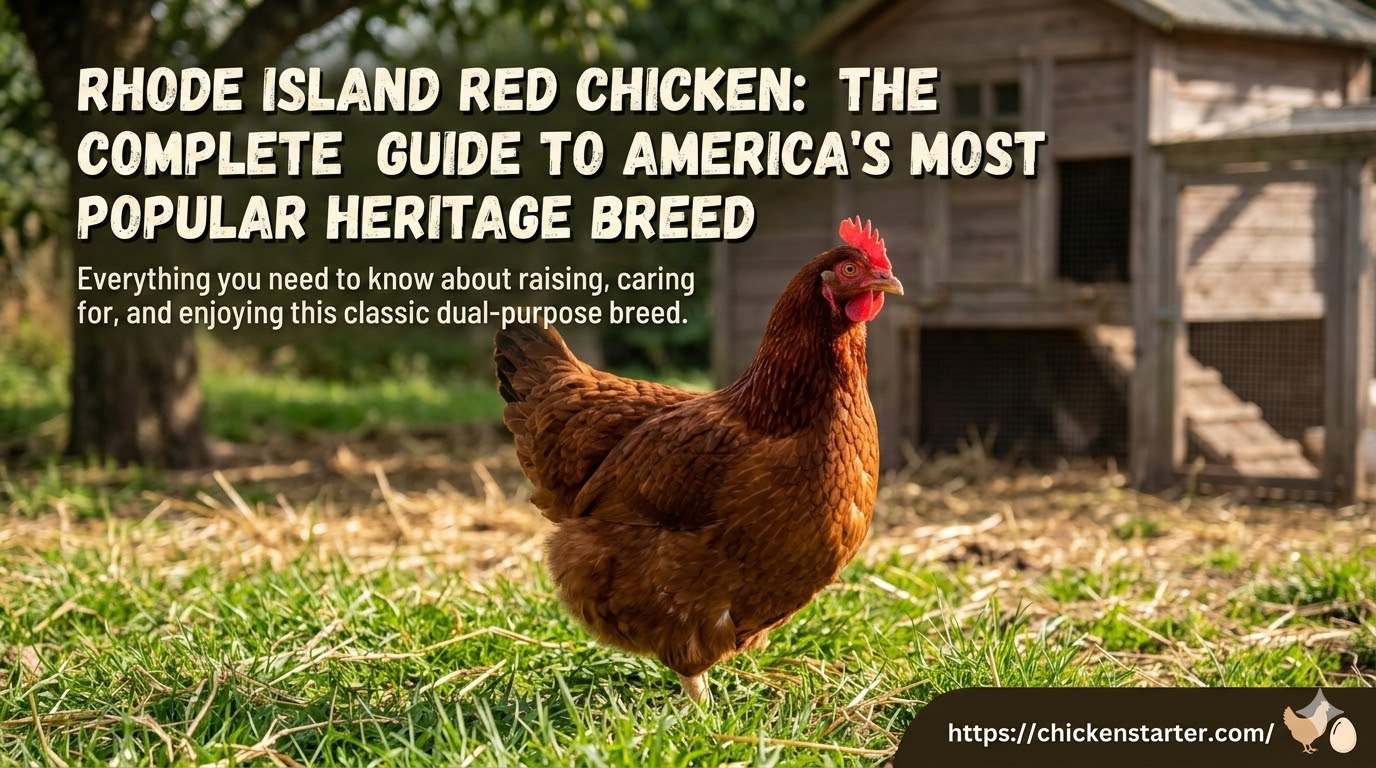
Quick Answer: The Rhode Island Red chicken is America’s most iconic dual-purpose heritage breed, known primarily for outstanding egg production of 250 to 300 large brown eggs per year, a hardy and assertive temperament, and deep mahogany red plumage that turns heads in any backyard flock. Standard hens weigh 6.5 lbs, roosters reach 8.5 lbs, and with proper care these birds live 5 to 8 years or longer. They are one of the best egg-laying breeds available to backyard keepers worldwide and remain the gold standard that most production hybrids are measured against.
I remember the exact afternoon I got my first Rhode Island Red chicken. Her name was Ruby, and she arrived as a 16-week-old pullet with feathers so deeply red they looked almost burgundy in afternoon sunlight. Within two days she had figured out how to unlatch the nesting box door from the inside, and by the end of her first week she had established herself firmly at the top of a mixed flock that included a Buff Orpington twice her apparent confidence level. That was six years ago. Ruby laid consistently for four full seasons, survived two harsh winters in my drafty first coop, and taught me more about chicken behavior than any book I had read before getting her.
If you are a backyard keeper in the United States, Canada, Australia, the United Kingdom, or anywhere else in the world trying to decide whether Rhode Island Red chickens belong in your flock, this guide covers everything you need to know. From the verified history and breeding origins to honest assessments of rooster temperament, current pricing, and where to find quality birds today, I have written this as the resource I wished existed when Ruby arrived and I had no idea what I was doing.
Rhode Island Red Quick Facts
| Feature | Detail |
|---|---|
| Breed Origin | Rhode Island & Massachusetts, USA (1850s) |
| Breed Type | Dual-purpose (eggs and meat) |
| APA Class | American |
| APA Recognition | 1904 (single comb), 1906 (rose comb) |
| Egg Color | Brown |
| Egg Size | Large |
| Eggs Per Year | 200-300 (heritage), 250-300+ (production) |
| Hen Weight | 6.5 lbs (2.9 kg) |
| Rooster Weight | 8.5 lbs (3.9 kg) |
| Comb Type | Single or Rose |
| Temperament | Hardy, assertive, active |
| Lifespan | 5-8+ years |
| Broodiness | Low (production), moderate (heritage) |
| Cold Hardy | Yes |
| Heat Tolerant | Moderate to good |
| Beginner Friendly | Yes (hens); Caution (roosters) |
Rhode Island Red History and Origin
The story of the Rhode Island Red chicken is genuinely one of the most interesting in American agricultural history, and it starts not with a scientist or a poultry professor but with a sea captain and his friend who were simply trying to build a better chicken.
What Two Chickens Make a Rhode Island Red?
The Rhode Island Red was not created from just two chickens. The full answer is more interesting than that. The breed’s story dates back to 1854 when William Tripp, a sea captain from Little Compton, Rhode Island, purchased a Malay rooster from a colleague. He crossbred this rooster with the chickens he already owned, and the results impressed him enough to keep going. Tripp then enlisted the help of his friend John Macomber, and together they crossbred multiple species to develop what they were after: a chicken that could produce both good eggs and decent meat under practical farm conditions.
The selective breeding program that followed drew from birds of Oriental origin, specifically the Cochin, Java, Malay, and Shanghai, crossed with Brown Leghorn birds from Italy. That last detail surprises people. The Brown Leghorn infusion gave the breed its egg-laying drive, while the Oriental breeds contributed the characteristic stiff feathering, the deep red plumage, and the rectangular body shape. According to verified breed history, the characteristic deep red plumage derived specifically from the Malay, which is one reason heritage Rhode Island Reds have such a distinctive, dark mahogany color that production strains have largely lost.
The breed was developed in both Rhode Island and Massachusetts during the second half of the nineteenth century, though Little Compton, Rhode Island is considered the true birthplace. The name honored the state where the foundational work happened.
APA Recognition and Breed Development
The American Poultry Association recognized the single comb variety of the Rhode Island Red chicken in 1904, with the rose comb variety following in 1906. This formal recognition marked a turning point in the breed’s history because it standardized what a Rhode Island Red should look like and perform like at a time when breed identity was still being established across American poultry.
In 1925, a monument was erected in Adamsville, Rhode Island specifically dedicated to the Rhode Island Red. That monument still stands today and is one of very few monuments in American history dedicated to a chicken breed, which tells you something about how significant this bird was to the agricultural identity of the region. The Rhode Island Red is also the official state bird of Rhode Island, a distinction it has held since 1954, which makes it uniquely placed as both an agricultural landmark and a cultural symbol.
The post-World War II period changed the breed significantly. According to breed historians, since about 1940, the Rhode Island Red has been selectively bred predominantly for egg-laying qualities, which created a divergence between the original dual-purpose heritage type and the lighter, more egg-focused production strain that most hatcheries sell today. Understanding this split is genuinely one of the most important things a buyer can know before purchasing birds.
Heritage vs Production Rhode Island Reds
This distinction matters enormously and most articles about Rhode Island Red chickens either miss it entirely or mention it briefly without explaining the practical implications for buyers.
Heritage Rhode Island Reds look the way the breed was supposed to look. They carry deep, dark, lustrous red plumage with a beetle-green sheen on the tail feathers, a broader and more rectangular body, and the kind of presence that makes people stop and look twice in the yard. The traditional dual-purpose old-type Rhode Island Red is included in the Ark of Taste of the Slow Food Foundation, which lists endangered traditional food products of cultural significance. The Livestock Conservancy also tracks heritage RIR breeding lines, though the breed overall is not endangered, quality heritage lines are genuinely harder to find than they were thirty years ago.
Production Rhode Island Reds are what you get from most large hatcheries. They carry lighter red plumage, sometimes closer to rust or orange-red, a slimmer body profile, and have been selected almost exclusively for laying performance. They still lay very well, typically 250 to 300 or more eggs per year, but they have largely lost the dual-purpose meat quality and the dramatic appearance of the heritage type.
If your goal is egg production, production strain birds are excellent and affordable. If your goal is raising the breed as it was originally developed, or if you want meat quality alongside eggs, seek out heritage lines specifically.
| Feature | Heritage Rhode Island Red | Production Rhode Island Red |
|---|---|---|
| Plumage Color | Deep, dark, lustrous red | Lighter red, sometimes rust |
| Body Shape | Broader, rectangular | Slimmer, more streamlined |
| Egg Production | 200-300/year | 250-300+/year |
| Temperament | More variable | Generally calmer |
| Broodiness | Occasionally broody | Rarely broody |
| Lifespan | Often longer | May be shorter |
| Meat Quality | Better dual-purpose | Less meat value |
| Availability | Specialty breeders only | Most hatcheries |
| Price | Higher ($10-25+/chick) | Lower ($3-5/chick) |
| Conservation | Listed (Ark of Taste) | Not listed |
Rhode Island Red Characteristics: Appearance, Size, and Standards
Physical Appearance
A well-bred Rhode Island Red chicken is genuinely striking, and once you have seen a quality heritage bird in person you understand immediately why the breed earned a monument. The APA standard requires rich, dark, lustrous red plumage with stiff feathering inherited from the Malay and Java ancestry. On the best heritage birds, the main body feathers show that deep mahogany red, while the tail feathers carry the distinctive beetle-green sheen that separates quality birds from lesser specimens.
The body shape is described as brick-like or rectangular, which sounds unflattering but actually creates an impressive, substantial silhouette. Rhode Island Reds carry their body nearly horizontal, which combined with their rectangular build gives them a purposeful, solid look that is quite different from the rounder profile of breeds like Cochins or Orpingtons.
The legs and feet are yellow, the eyes are red-orange, and the earlobes, wattles, and comb are red. The beak is a reddish horn color. Male birds typically show more intense coloring overall, with darker hackle and saddle feathers often showing black striping, and tail feathers that can appear almost black with that green-black sheen in good light.
Size and Weight Per APA Standards
The American Poultry Association standard establishes these weights for the breed:
| Class | Weight |
|---|---|
| Standard Rooster (Cock) | 8.5 lbs (3.9 kg) |
| Standard Hen | 6.5 lbs (2.9 kg) |
| Cockerel | 7.5 lbs (3.4 kg) |
| Pullet | 5.5 lbs (2.5 kg) |
| Bantam Rooster | 34 oz (965 g) |
| Bantam Hen | 30 oz (850 g) |
Production strain birds often run lighter than these standards, which is one of the visual cues experienced keepers use to identify heritage versus production birds when purchasing.
Rhode Island Red Comb Types
Rhode Island Red chickens come in two recognized comb varieties, and the choice between them is not just aesthetic.
Single comb is the most common type and what most people picture on a Rhode Island Red. It stands upright with five to six points and is moderately large, especially on roosters. The single comb is attractive and the breed standard, but it is vulnerable to frostbite in extreme cold. If you are keeping RIRs in northern Canada, Minnesota, Maine, or similar climates with genuinely brutal winters, a bird that tilts its water bowl during a cold snap and gets its comb wet before a hard freeze is at real risk.
Rose comb Rhode Island Reds carry a low, flat, bumpy comb that sits close to the head and is far more resistant to frostbite. The rose comb variety is less common than the single comb variety and may take more searching to find, but for cold climate keepers it is genuinely the better choice. Both comb varieties are officially recognized by the APA, so neither represents a breed defect.
Rhode Island Red White (Rhode Island White)
Here is a common source of confusion that deserves a clear explanation. The Rhode Island White is a separate breed, not a white color variety of the Rhode Island Red. They were developed independently in Rhode Island around the same time as the Rhode Island Red, using different ancestry including Partridge Cochins, White Wyandottes, and Rose Comb White Leghorns. Rhode Island Whites carry a rose comb and white plumage and have similar production characteristics to Rhode Island Reds, but they are genuinely distinct birds with different genetics. If someone offers you a “white Rhode Island Red,” that is either a Rhode Island White being described loosely or a bird with some crossbreeding in its background.
Rhode Island Red Black Variety
Searches for a “Rhode Island Red black” variety reflect a common misconception. There is no recognized black variety of the Rhode Island Red chicken. The breed is recognized by the American Poultry Association in one color variety only: the characteristic deep red. Birds being sold as “black Rhode Island Reds” are almost certainly Black Australorps, Black Copper Marans, or cross-bred birds. If you encounter this description from a seller, ask specifically about the breed’s ancestry and APA recognition status before purchasing.
Rhode Island Red Egg Production: How Many Eggs Per Year?
This is honestly the question that brings most people to the Rhode Island Red in the first place, and it is where the breed genuinely earns its reputation.
Annual Egg Production Numbers
A healthy Rhode Island Red hen in her prime laying years will give you roughly 250 to 300 large brown eggs per year, which works out to about 5 to 6 eggs per week at peak production. Heritage strains typically sit in the 200 to 300 range, while production strains push toward the higher end of that scale and sometimes exceed it.
Our three Rhode Island Red hens averaged 267 eggs each last year, which surprised me because two of them were in their third laying season when production typically starts showing the first signs of decline. They laid through both hot summer weeks and a cold February stretch that had our water nipples freezing overnight, and their consistency across those conditions is genuinely impressive.
Production naturally declines after the second or third laying season. You will see the clearest decline in year four, and by years five and six many hens are laying perhaps half their peak output. Some individual hens continue laying meaningfully into years seven and eight, particularly heritage birds, but planning for a gradual production decrease after year two is realistic and honest.
Rhode Island Red Egg Color
Rhode Island Red egg color is consistently medium to dark brown, with some variation between individual hens. Freshly laid eggs from some hens show a slightly pinkish-brown tint when the natural bloom is present, which is more pronounced in younger hens early in their laying cycle. The brown color comes from protoporphyrin-IX, a porphyrin pigment deposited during the final stages of shell formation in the shell gland. As hens age and lay more intensively, the pigment deposit typically becomes lighter, which is why experienced keepers notice a gradual fading of egg color over successive laying seasons.
Rhode Island Red Egg Size
Rhode Island Reds lay large to extra-large eggs, full stop. This breed does not lay small eggs. If anyone tells you Rhode Island Reds lay small eggs, that is either incorrect information or they are describing pullet eggs from a very young bird just starting to lay. New pullets do lay smaller eggs for the first few weeks, but they reach full large size within a month of starting production and maintain that size throughout their laying life. The large egg size is one of the breed’s consistent strengths compared to lighter Mediterranean breeds.
When Do Rhode Island Reds Start Laying Eggs?
Most Rhode Island Red pullets begin laying between 18 and 22 weeks of age, which is roughly 4.5 to 5.5 months. Production strain birds from commercial hatcheries sometimes begin as early as 16 to 18 weeks, while heritage strains with their slower maturation rate occasionally take until 24 weeks. Watch for these signs that your pullet is approaching her first egg: the comb and wattles deepening from pale pink to rich red, her posture becoming more horizontal, frequent squatting behavior when you reach toward her (a mating submission reflex), and increased interest in the nesting boxes. Understanding chicken behavior before laying the first egg helps you know exactly what to expect.
How Many Months Do Rhode Island Red Chickens Lay Eggs?
Rhode Island Red chickens lay eggs year-round, which is one of their most practical advantages for backyard keepers. They do show a natural production reduction during the shorter days of winter, particularly in northern climates, but they typically do not stop entirely the way some less hardy breeds do. If you want to maintain consistent winter production, supplemental lighting that extends the perceived day length to 14 to 16 hours will keep your hens laying through the coldest months.
The full productive lifespan of a Rhode Island Red hen spans roughly 5 to 8 years of laying, with peak production in years one and two, a moderate decline through years three and four, and reduced but ongoing production into years five through eight for well-cared-for birds. Heritage birds tend toward the longer end of this range.
Can a Chicken Lay 400 Eggs a Year?
No. This needs to be stated clearly. No standard chicken breed reliably lays 400 eggs per year, and claims suggesting otherwise are misleading at best. A year only contains 365 days. A hen’s body needs rest cycles, goes through molting season annually where laying pauses for weeks, and has physiological limits on reproductive output.
The verified record for egg production belongs to a Black Australorp hen that laid 364 eggs in 365 days, set during official Australian trials. That is an extraordinary performance by a single exceptional bird under optimized conditions, not a breed average. Commercial hybrid layers like the ISA Brown can reach 300 to 320 eggs per year under intensive commercial management. Rhode Island Reds at 250 to 300 eggs per year are genuinely among the best-performing heritage breeds available, and that honest figure is impressive enough without inflation.
Rhode Island Red vs Other Top Egg Layers
| Feature | Rhode Island Red | White Leghorn | Black Australorp | ISA Brown | Golden Comet |
|---|---|---|---|---|---|
| Eggs/Year | 250-300 | 280-320 | 220-240 | 300-320 | 250-320 |
| Egg Color | Brown | White | Brown | Brown | Brown |
| Egg Size | Large | Large/XL | Large | Large | Large |
| Weight (hen) | 6.5 lbs | 4.5 lbs | 6.5 lbs | 4.5 lbs | 5 lbs |
| Temperament | Assertive | Flighty | Shy/friendly | Calm | Friendly |
| Cold Hardy | Yes | Moderate | Yes | Moderate | Moderate |
| Lifespan | 5-8 yrs | 4-6 yrs | 6-8 yrs | 3-5 yrs | 3-5 yrs |
| Heritage Breed | Yes | Yes | Yes | No (hybrid) | No (hybrid) |
The key takeaway from that comparison is that Rhode Island Reds give you 90% of the egg output of commercial hybrids with double the lifespan and the genetics of a true heritage breed. For backyard keepers who want consistent production without replacing their flock every three years, that trade-off strongly favors the Rhode Island Red.
Rhode Island Red Temperament and Personality
General Temperament
Rhode Island Red chickens are best described as hardy, active, curious, and assertive. They are not the most affectionate breed and will not generally volunteer to sit in your lap, but they are confident, engaged with their environment, and responsive to their keepers in a way that makes them genuinely enjoyable to work with. Have you ever watched a Rhode Island Red methodically hunt grasshoppers across an entire lawn? They approach foraging with a focused efficiency that is almost impressive to observe.
The assertiveness that makes RIR hens excellent foragers and confident layers is the same quality that makes them dominant in mixed flocks. They are not typically aggressive in the way that a fighting breed would be, but they know where they stand in the pecking order and they intend to stay there. In a flock of all Rhode Island Reds this creates a manageable social dynamic. In mixed flocks containing gentler breeds like Buff Orpingtons or Silkies, the Rhode Island Reds will reliably establish themselves at the top and the gentler birds need monitoring to ensure they are getting adequate access to food and water.
Rhode Island Red Hens: Personality
Rhode Island Red hens are generally docile and manageable in day-to-day flock keeping. They are active foragers who genuinely benefit from free-range access or a large run, and birds kept in confined spaces with insufficient stimulation are more likely to develop pecking habits toward flockmates. Ruby, my first RIR, would patrol the entire yard in a systematic pattern every morning, checking the same locations in the same order, which always struck me as a kind of routine that showed how engaged she was with her environment.
Hens of this breed rarely go broody, especially production strains, which is either an advantage or a disadvantage depending on whether you want to hatch eggs naturally. If you want a hen that will sit reliably on a clutch of eggs, a Rhode Island Red production hen is not your answer. Heritage birds occasionally go broody, but it is not a trait the breed is known for.
Rhode Island Red Rooster: Temperament, Size, and What to Expect
Here is the thing about Rhode Island Red roosters that many breed guides dance around: they can be genuinely problematic in a family setting. Not all of them. Some Rhode Island Red roosters are calm, curious, and even affectionate with their keepers. My second RIR rooster, a heritage bird named Cardinal, was completely handleable from the day he arrived and never once charged at any family member in three years.
But some Rhode Island Red roosters become aggressive, especially during mating season and as they reach full maturity at around 12 to 18 months. Rooster aggression in this breed is a legitimate concern, not something to minimize because you love the breed. Aggressive RIR roosters are fast, have sharp spurs on mature birds, and can cause real injury to children especially. If you have young children and are considering a rooster, the Rhode Island Red is not the breed I would recommend without serious thought about your specific situation. A Buff Orpington or Brahma rooster carries significantly less risk.
What Rhode Island Red roosters do exceptionally well is protect their flocks. They are alert, watchful, and will give clear alarm calls at the first sign of predator activity. Their size at 8.5 lbs also means they are physically capable of confronting smaller predators in a way that lightweight roosters cannot. For a free-range flock in a rural setting where aerial and ground predators are real threats, a Rhode Island Red rooster provides meaningful protection.
Rhode Island Red Rooster vs Hen: How to Tell the Difference
Visual Differences
Mature Rhode Island Red roosters and hens are not difficult to distinguish, but young chicks and adolescent birds require more careful observation.
In adult birds, the rooster is significantly larger at 8.5 lbs versus the hen’s 6.5 lbs and carries a notably larger, deeper red comb and wattles. The rooster’s hackle feathers (around the neck) and saddle feathers (just above the tail) are pointed and often show black striping, while the same areas on hens have rounded feathers without that striping. The rooster carries long, curved sickle feathers in his tail that arch gracefully downward, while the hen’s tail is shorter and more upright. The rooster’s plumage is often slightly darker overall, particularly around the neck and tail.
| Feature | Rhode Island Red Rooster | Rhode Island Red Hen |
|---|---|---|
| Weight | 8.5 lbs (3.9 kg) | 6.5 lbs (2.9 kg) |
| Comb | Large, deeply red | Smaller, less developed |
| Wattles | Large | Small to medium |
| Hackle feathers | Pointed, black-striped | Rounded |
| Saddle feathers | Pointed, prominent | Absent |
| Tail feathers | Long, curved sickles | Short, upright |
| Spurs | Present on mature birds | Rare/absent |
| Plumage | Darker red, green-black tail | Consistent medium red |
Behavioral Differences
Behaviorally, mature birds are easy to read. Roosters crow (often starting before dawn), perform tidbitting behavior where they pick up and drop food to call hens over, and attempt to mate hens regularly. Hens make the egg song announcement after laying, squat low when an approaching hand or rooster gets near (a submission and mating reflex that appears when pullets reach sexual maturity), and show nesting behavior including spending time in the boxes before laying begins.
Sexing Rhode Island Red Chicks
At hatch, Rhode Island Red chicks are difficult to sex without professional vent sexing, which large hatcheries perform at a claimed accuracy of 85 to 90 percent. The most reliable way to get hens is to order sexed pullets from a reputable hatchery and accept that occasional errors happen.
Rhode Island Red roosters crossed with certain hens create sex-linked offspring that can be visually sexed at hatch, which is how Golden Comet and other sex-link hybrids work. With purebred Rhode Island Red chicks from two RIR parents, you are waiting until secondary sex characteristics appear between 8 and 12 weeks of age, when comb growth, feather patterns, and size differences make male birds identifiable.
Pros and Cons of Rhode Island Red Chickens
Every breed has real advantages and genuine drawbacks, and giving you an honest picture of both is more useful than cheerleading.
| ✅ PROS | ❌ CONS |
|---|---|
| Excellent egg production (250-300/year) | Roosters can be aggressive |
| Cold and heat hardy | Can bully timid breeds in mixed flocks |
| Low maintenance once established | Not cuddly or lap-chicken friendly |
| Outstanding foragers (reduce feed costs) | Production strains lack heritage appearance |
| True dual-purpose breed | Can be noisy (egg songs are loud) |
| Long productive lifespan | Heritage type harder to find and more expensive |
| Strong disease resistance | Egg production declines noticeably after year 3 |
| Widely available and affordable (production type) | Roosters not ideal for families with young children |
Disadvantages of Rhode Island Red Chickens
Being honest about the disadvantages is more useful to potential buyers than a one-sided promotional description, so let me expand on the real drawbacks that come up consistently from experienced keepers.
Rooster aggression is the most significant complaint associated with this breed. It comes up in practically every Rhode Island Red community discussion, and for good reason. While some Rhode Island Red roosters remain manageable throughout their lives, the breed has a higher incidence of aggressive roosters than genuinely docile breeds like Light Brahmas or Buff Orpingtons. If you have not kept roosters before and are not prepared to deal with a bird that might charge you or your children, the Rhode Island Red rooster is not where I would start.
Dominance in mixed flocks can become a real management problem rather than just a minor inconvenience. RIR hens, particularly production strains, will assert themselves strongly over gentler breeds. I have seen Rhode Island Red hens follow a Silkie hen away from the feeder repeatedly throughout the day, which creates a situation where the Silkie loses condition despite adequate food being available because she cannot get consistent access. If you are planning a mixed flock, house Rhode Island Reds with similarly assertive breeds like Plymouth Rocks or Wyandottes rather than gentle breeds like Cochins or Silkies.
Production versus heritage confusion creates legitimate frustration for buyers who want heritage birds and receive production-type stock described as “Rhode Island Reds” without the distinction being made clear. The two types look different, perform differently, and have different conservation significance. Know what you are buying before you purchase.
Egg production decline after year two to three is a reality that backyard keepers sometimes find surprising if they were expecting years of peak performance. Planning for this cycle, either by maintaining a rolling flock with new pullets coming into production each year or by accepting reduced output from older hens, is part of realistic Rhode Island Red keeping.
Rhode Island Red Care Guide
Housing Requirements
Rhode Island Red chickens need adequate space to express their active, curious nature without developing stress-related problems. Inside the coop, plan for a minimum of 4 square feet per bird, though 6 square feet produces noticeably less pecking and more relaxed flock dynamics. In the outdoor run, 10 square feet per bird is the absolute minimum and more is always better for this active breed.
These birds are built for free-range or large-run keeping. A Rhode Island Red confined to a small run will make it work, but a bird with access to pasture, lawn, or garden space becomes a noticeably different animal in terms of foraging behavior, health, and overall engagement with the world. Understanding how big a chicken coop should be before you build or buy saves you from having to reconfigure things after the fact.
Ventilation in the coop matters more than most beginners realize. Rhode Island Reds produce significant moisture through respiration and droppings, and damp coop air is the enemy of respiratory health in the winter months. The coop needs cross ventilation at roofline level that moves air without creating direct drafts on roosting birds.
Feeding Rhode Island Reds
For laying hens, a quality layer feed with 16 to 18 percent protein forms the nutritional foundation. Layer feeds contain added calcium, but the amount is often not sufficient for hens in peak production, which is why oyster shell offered free-choice in a separate container is standard practice. Let hens regulate their own calcium intake; they will consume what their bodies need.
For free-ranging birds, poultry grit should be available free-choice so they can properly grind the insects, seeds, and plant material they forage. Birds on commercial feed alone do not strictly need grit, but free-ranging and foraging birds do. Our guide to whether chickens need grit or oyster shells explains the difference and when each is necessary.
Treats should stay below 10 percent of total dietary intake to avoid diluting the nutritional balance of the layer feed. Rhode Island Reds are enthusiastic treat consumers and will absolutely overindulge if allowed to, so restraint from the keeper’s side is required.
Climate Tolerance
Rhode Island Red cold hardiness is one of the breed’s practical strengths. These birds handle cold climates well as a general rule, but the single comb is the vulnerability point. In climates that regularly drop below 0°F (-18°C), single comb birds are at real frostbite risk on their comb tips, particularly after cold snaps following wet weather. Protecting against this through frostbite prevention on chicken combs is manageable, but rose comb Rhode Island Reds are simply a better choice for keepers in northern Canada, the upper Midwest, or mountainous regions with serious winters.
Rhode Island Red heat tolerance is moderate to good. They handle typical warm summers in most of the United States, United Kingdom, and southern Australia without major problems, provided they have adequate shade, fresh cool water, and adequate ventilation. In extreme heat above 100°F (38°C), all chickens require careful management. Our guide on keeping chickens cool in Australian summer heat applies directly to Rhode Island Red keeping in hot climates globally.
Rhode Island Red Lifespan
A well-cared-for Rhode Island Red chicken typically lives 5 to 8 years, with some individuals reaching 10 years or more under favorable conditions. Heritage birds tend toward the longer end of this range, while production strains bred intensively for maximum output sometimes show earlier health declines. Our article on how long chickens live covers the factors that most influence longevity across breeds, and Rhode Island Reds sit in the upper middle range for overall lifespan among backyard breeds.
Rhode Island Red Health Issues
Common Health Problems
Rhode Island Reds are genuinely one of the hardier, more disease-resistant breeds available, which is one of their legitimate advantages over some fragile exhibition breeds. That said, they share the common health vulnerabilities of all chickens.
External parasites including mites and lice are the most frequent issue in any backyard flock regardless of breed. Regular monitoring for mites and lice through weekly or biweekly hands-on checks of your birds, particularly around the vent area and under the wings, catches infestations early when treatment is straightforward. Maintaining a proper dust bathing area is one of the best preventive measures available.
Bumblefoot, the bacterial foot infection that creates a hard abscess on the footpad, is more common in heavier birds because of the pressure their weight places on the feet. Rhode Island Reds at 6.5 lbs are not as heavy as Brahmas or Cochins, but they are substantial birds and rough roost surfaces, hard landings from heights, or minor cuts that go untreated can develop into bumblefoot. Our bumblefoot treatment guide covers recognition and treatment in detail.
Egg binding is a risk in any high-production hen and Rhode Island Reds qualify. A hen that is straining without producing an egg, holding her tail low, or looking uncomfortable and lethargic needs immediate attention. Please consult a poultry veterinarian if you suspect egg binding; it is a serious condition that can become life-threatening within 24 to 48 hours without intervention.
Respiratory infections occur in damp, poorly ventilated coop conditions. Rhode Island Reds are not especially prone to respiratory issues compared to more delicate breeds, but no breed is immune. Treatment for chicken respiratory infections depends on the specific pathogen involved and a veterinarian should be consulted for diagnosis and appropriate treatment.
Consult a licensed poultry veterinarian for any health concerns in your flock. General care information cannot replace professional veterinary assessment.
Preventive Care
The most effective health management for Rhode Island Red chickens is prevention through consistent husbandry rather than treatment after problems develop. Keep coops clean with regular bedding changes, ensure adequate ventilation, maintain proper stocking density, provide dust bathing access, follow a sensible deworming schedule based on fecal monitoring or your veterinarian’s recommendation, and do regular health checks on your birds to catch issues early
Rhode Island Red Breeding
Broodiness in Rhode Island Reds
Production strain Rhode Island Red hens rarely go broody. This trait has been largely eliminated through selective breeding focused on uninterrupted laying performance, which means if you want to hatch eggs naturally under a sitting hen, you will likely need a dedicated broody breed like a Silkie or a broody Australorp to do the work. Our guide on breaking a broody hen covers management when broodiness does occur, which is useful for the occasional heritage RIR hen who decides she wants to sit regardless of her breeding.
Heritage Rhode Island Red hens are more likely to go broody occasionally, though it is still not a reliable or predictable trait.
Rhode Island Red in Hybrid Breeding
The Rhode Island Red chicken has arguably contributed more to modern commercial poultry genetics than any other heritage breed. Several of the most popular commercial and backyard hybrid layers were created using RIR genetics.
The Golden Comet sex-link hybrid is produced by crossing a Rhode Island Red rooster with a White Leghorn hen (or sometimes White Plymouth Rock hens depending on the hatchery). The resulting chicks can be sexed by color at hatch, with pullets showing buff-gold coloring and males appearing white. Golden Comets are outstanding layers that frequently exceed their Rhode Island Red parent in annual egg output, though they have a shorter productive lifespan.
The ISA Brown, one of the most widely kept commercial laying hens in the world, has Rhode Island Red genetics in its foundation. New Hampshire Red chickens, a distinct breed recognized by the APA, were developed directly from Rhode Island Red stock in the early twentieth century, with selection focusing on faster growth, earlier maturity, and meat quality improvements.
The Rhode Island Red’s contribution to sex-link hybrid breeding reflects the breed’s genetic strength. When crossed with certain white breeds, Rhode Island Red genetics create auto-sexing offspring where males and females are visually distinct at hatch, making sexing practical and cost-effective at commercial scale.
Rhode Island Red Price: How Much Do They Cost?
Rhode Island Red Chicks Price
| Source | Price Range |
|---|---|
| Day-old straight run (hatchery) | $2-4 per chick |
| Day-old sexed pullets (hatchery) | $4-8 per chick |
| Heritage/exhibition quality chicks | $10-25+ per chick |
| Bantam chicks | $5-10 per chick |
The wide range between production hatchery chicks and heritage quality birds reflects real differences in what you are getting. A $4 sexed pullet from a large hatchery will be a good layer, but she likely comes from production stock without the deep red plumage or dual-purpose body type of heritage lines. A $15 chick from a breeder who specializes in heritage Rhode Island Reds, participates in poultry shows, and maintains APA-compliant stock is a different bird.
Started Pullets and Adult Rhode Island Reds Price
| Age/Type | Price Range |
|---|---|
| Point-of-lay pullets (16-20 weeks) | $15-30 each |
| Adult laying hens | $20-40 each |
| Breeding quality adults | $30-75+ each |
| Show quality birds | $50-150+ each |
Point-of-lay pullets represent good value for keepers who want to skip the brooder stage and go straight to egg production within a few weeks of purchase. Check our guide on chicks versus adult hens for beginners if you are weighing the cost and convenience trade-offs between starting ages.
Ongoing Costs
Monthly feed costs for a Rhode Island Red hen run approximately $15 to $25 per bird depending on feed brand, your location, and how much foraging supplements their diet. Free-ranging birds who have access to good pasture will eat noticeably less commercial feed than confined birds, which is one of the practical economic benefits of this breed’s foraging ability. Our detailed breakdown of the real cost of 6 chickens gives a full annual cost picture for a typical backyard flock.
Rhode Island Red Chickens for Sale: Where to Buy
Reputable US Hatcheries
Cackle Hatchery in Lebanon, Missouri is one of the few large US hatcheries that specifically offers exhibition type Rhode Island Reds alongside standard production birds, making them valuable if you want heritage quality without seeking out individual breeders. They ship day-old chicks nationwide and have been operating since 1936.
Murray McMurray Hatchery in Webster City, Iowa carries Rhode Island Reds reliably and is one of the oldest and most established hatcheries in the US. Their birds are production quality and readily available with good customer service and shipping practices.
Meyer Hatchery in Polk, Ohio offers good bird quality with strong veterinary practices including Marek’s disease vaccination available on request.
Ideal Poultry in Cameron, Texas is another solid option especially for southern US keepers, with competitive pricing and availability through most of the year.
For those interested in Stromberg’s selection and specialty breeds, our Stromberg Chickens buying guide helps you navigate their catalog.
Finding Heritage Rhode Island Reds
For heritage type Rhode Island Red chickens, large hatcheries are generally not the right source. The Livestock Conservancy maintains a breeder directory specifically for heritage breeds, and this is where I would start. Local and regional poultry shows are also excellent venues for meeting breeders who show heritage Rhode Island Reds, seeing the birds in person, and evaluating quality before purchasing. Heritage breed groups on agricultural forums and social media can also connect you with reputable breeders in your region.
Buying Rhode Island Reds in Canada, Australia, and the UK
Canadian keepers will find Rhode Island Reds available from provincial hatcheries and agricultural suppliers. The breed handles Canadian winters well with rose comb birds being the better choice for areas with genuinely cold winters like Manitoba, Saskatchewan, and Northern Ontario. Check provincial agricultural extension services for hatchery and breeder listings.
Australian keepers should be aware that Rhode Island Reds have been established in Australia for many decades and are widely available through poultry clubs, agricultural shows, and specialist breeders. Understanding where to buy chickens in Australia will help you navigate local sourcing options, and checking backyard chicken laws in Australia by council before purchasing is always recommended.
UK keepers will find Rhode Island Reds readily available through the Poultry Club of Great Britain’s breeder directory and at agricultural shows. The breed is well established in UK flocks and known for performing well in the British climate.
What to Look for When Buying
When evaluating Rhode Island Red chickens for sale, look for the deep, lustrous red plumage described in the breed standard. Production birds will be lighter in color, which is not a defect for egg production purposes but is visually distinct from heritage quality. Check for bright, alert eyes, clean nostrils, smooth unscaled legs, and active movement. Ask breeders specifically whether their birds come from exhibition or utility lines, whether they participate in poultry shows, and what their flock’s egg production history looks like.
Rhode Island Red vs Other Popular Breeds
| Feature | Rhode Island Red | Buff Orpington | Black Australorp | Plymouth Rock | Golden Comet |
|---|---|---|---|---|---|
| Eggs/Year | 250-300 | 200-280 | 220-240 | 200-250 | 250-320 |
| Egg Color | Brown | Light brown/pink | Brown | Brown/pink | Brown |
| Egg Size | Large | Large | Large | Large | Large |
| Weight (hen) | 6.5 lbs | 8 lbs | 6.5 lbs | 7.5 lbs | 5 lbs |
| Temperament | Assertive | Very docile | Shy/friendly | Friendly | Friendly |
| Cold Hardy | Yes | Yes | Yes | Yes | Moderate |
| Broodiness | Low | Moderate | Low | Low | Very low |
| Lifespan | 5-8 yrs | 8-10 yrs | 6-8 yrs | 8-10 yrs | 3-5 yrs |
| Heritage Breed | Yes | Yes | Yes | Yes | No (hybrid) |
Rhode Island Red vs Buff Orpington
The choice between these two breeds comes down to what you prioritize. Rhode Island Reds lay more consistently and will establish themselves confidently in any flock, while Buff Orpingtons are significantly more docile and better suited to mixed flocks with gentler breeds. If you want maximum friendliness and do not mind fewer eggs per year, Buff Orpington wins. If you want more production and are comfortable with a more assertive bird, Rhode Island Red is the choice. Read our full Buff Orpington chicken guide for the complete picture on that breed.
Rhode Island Red vs Golden Comet
This comparison highlights the heritage breed versus hybrid question directly. Golden Comets can match or exceed Rhode Island Red egg production at peak, are generally calmer and friendlier, and are easier to find sexed at hatch. But they carry a production lifespan of roughly 3 to 5 years before significant decline, while Rhode Island Reds can remain productive for 5 to 8 years. For long-term flock planning, Rhode Island Reds offer better value. For maximum first-year production without the long commitment, Golden Comets are competitive.
Rhode Island Red vs Plymouth Rock
Both are American heritage breeds with similar dual-purpose histories and brown egg production. Plymouth Rocks (both Barred and White varieties) tend to be slightly more docile and easier in mixed flocks, while Rhode Island Reds typically outperform them in annual egg production by 20 to 50 eggs per year. Plymouth Rocks are heavier at 7.5 lbs versus the RIR’s 6.5 lbs and have a longer average lifespan. It is a genuinely close comparison for keepers who want a reliable American heritage breed.
Rhode Island Red vs New Hampshire Red
The New Hampshire Red is essentially a Rhode Island Red that was developed with different priorities. New Hampshires were selected from Rhode Island Red stock beginning in the 1930s, with emphasis on faster growth, earlier feathering, and better meat quality. New Hampshires carry slightly lighter chestnut-red plumage, reach maturity faster, and are considered slightly more docile than typical Rhode Island Reds. Their egg production is comparable, and the two breeds are similar enough that some keepers cannot reliably distinguish them without documentation.
Rhode Island Red vs Australorp
The Black Australorp edges out the Rhode Island Red in documented egg production records, but the real-world difference between well-managed flocks of each breed is modest. Australorps tend to be shyer initially but warm up more than Rhode Island Reds typically do, making them arguably better lap chickens long-term. Our Australorp complete guide covers this breed in full if you are seriously comparing the two.
Frequently Asked Questions About Rhode Island Red Chickens
What is Rhode Island Red known for?
The Rhode Island Red chicken is best known for outstanding brown egg production of 250 to 300 large eggs per year, remarkable hardiness across diverse climates, and deep mahogany red plumage that made it the foundation of American commercial poultry production in the twentieth century. It is also the official state bird of Rhode Island and holds the distinction of being the only chicken breed with a dedicated historical monument.
Do Rhode Island Reds lay small eggs?
No. Rhode Island Reds consistently lay large to extra-large brown eggs. New pullets lay somewhat smaller eggs in their first few weeks of production, but eggs reach full size within a month of starting and remain large throughout the hen’s productive life.
What two chickens make a Rhode Island Red?
The Rhode Island Red was not created from just two breeds. The foundational cross involved a Malay rooster (purchased by sea captain William Tripp in 1854) crossed with his existing flock, followed by additional crosses with Java, Cochin, Shanghai, and Brown Leghorn birds, developed in collaboration with John Macomber in Little Compton, Rhode Island and Massachusetts.
How many eggs does a Rhode Island Red lay per year?
Heritage Rhode Island Reds lay 200 to 300 large brown eggs per year. Production strain Rhode Island Reds average 250 to 300 or more per year, working out to roughly 5 to 6 eggs per week at peak production during the first two laying seasons.
Are Rhode Island Red roosters aggressive?
Honestly, yes, some are. Rhode Island Red roosters vary in temperament; some individuals are calm and manageable throughout their lives while others become aggressive, particularly during mating season and as they mature past 12 months. The breed carries a higher risk of rooster aggression than notably docile breeds like Light Brahmas or Buff Orpingtons, and families with young children should take this seriously before acquiring a Rhode Island Red rooster.
What is the difference between heritage and production Rhode Island Reds?
Heritage Rhode Island Reds carry the dark, lustrous mahogany plumage and broader dual-purpose body type of the original breed, are listed in the Slow Food Foundation’s Ark of Taste, and are available only through specialty breeders. Production Rhode Island Reds are lighter in color, slimmer, and have been selected almost exclusively for laying performance. Hatchery chicks priced at $3 to $5 are virtually always production type.
Can Rhode Island Reds handle cold weather?
Yes, Rhode Island Reds are genuinely cold hardy birds. The main vulnerability is the single comb, which is susceptible to frostbite in extreme cold. Rose comb Rhode Island Reds are a better choice for climates with temperatures regularly below 0°F (-18°C). Raising chickens in cold climates requires preparation for both comb protection and water management.
Do Rhode Island Reds go broody?
Production strain Rhode Island Red hens rarely go broody because broodiness was largely selected out through decades of breeding for uninterrupted laying. Heritage strain hens are occasionally broody but it is not a predictable or reliable trait. If you need a dedicated broody hen for hatching, plan to use a Silkie or similar broody breed for the job.
What are the top 3 best egg-laying chickens?
For backyard keepers balancing production with longevity and breed quality, the top three are: Rhode Island Red (250-300 eggs/year from a heritage breed with a 5-8 year lifespan), White Leghorn (280-320 eggs/year of white eggs, very efficient converter), and Black Australorp (220-240 eggs/year with the backing of the all-time laying record). For pure egg volume without heritage breed considerations, commercial hybrids like ISA Brown outperform all three.
How long do Rhode Island Reds live?
With good care, Rhode Island Red chickens typically live 5 to 8 years, with some heritage birds reaching 10 years or more. Production strains kept under intensive conditions may have shorter productive lives, while well-managed heritage birds on proper nutrition in low-stress environments consistently live toward the upper end of the range.
Before adding Rhode Island Red chickens to your flock, make sure your setup is ready for them. Review your local chicken ordinances, since chicken laws vary significantly by state in the US and by local council in Australia and the UK. Have your nesting boxes set up properly before your hens reach point-of-lay, understand the cost of raising chickens in the first year realistically, and if you are new to this hobby, do not miss the most common mistakes first-time chicken keepers make before your birds arrive.
Honestly, if you can only keep one breed and you want reliable eggs, a manageable temperament in the hens, genuine heritage breed genetics, and a bird that will thrive in most North American, British, and Australian climates without constant fussing, the Rhode Island Red chicken is the one I would recommend. Ruby proved that to me six years ago, and every Rhode Island Red I have kept since has reinforced the same conclusion.
Oladepo Babatunde is a poultry expert and founder of ChickenStarter.com with over six years of hands-on experience raising more than 50 chickens across diverse climates. His practical approach combines traditional Nigerian poultry techniques with modern backyard keeping methods adapted for conditions across the United States, United Kingdom, Canada, and Australia. Certifications from the Nigerian Agricultural Extension Services.

Oladepo Babatunde is the founder of ChickenStarter.com. He is a backyard chicken keeper and educator who specializes in helping beginners raise healthy flocks, particularly in warm climates. His expertise comes from years of hands-on experience building coops, treating common chicken ailments, and solving flock management issues. His own happy hens are a testament to his methods, laying 25-30 eggs weekly.