So, you have got the chicken bug, huh? And like many aspiring backyard chicken keepers, you are probably wondering how many chickens you need for a family of 4. It is a fantastic question, and one I wrestled with myself when I first started out. The short answer is: it depends, but typically, a family of four looking for a consistent supply of fresh eggs will do well with 4 to 6 laying hens.
But let me be real: “it depends” is not exactly the concrete answer you are looking for, is it? It is like asking “How much chocolate do I need?” The answer changes if you are a casual nibbler or a full-blown chocoholic. Deciding on the right flock size involves more than just a quick calculation. It is about balancing your family’s needs, your available space, the time you can commit, and even your climate. Let me dive deep into all the juicy details so you can confidently plan your perfect backyard flock.
TL;DR: Quick Answers for a Family of 4
| Goal / Need | Recommended Chickens | Key Consideration |
|---|---|---|
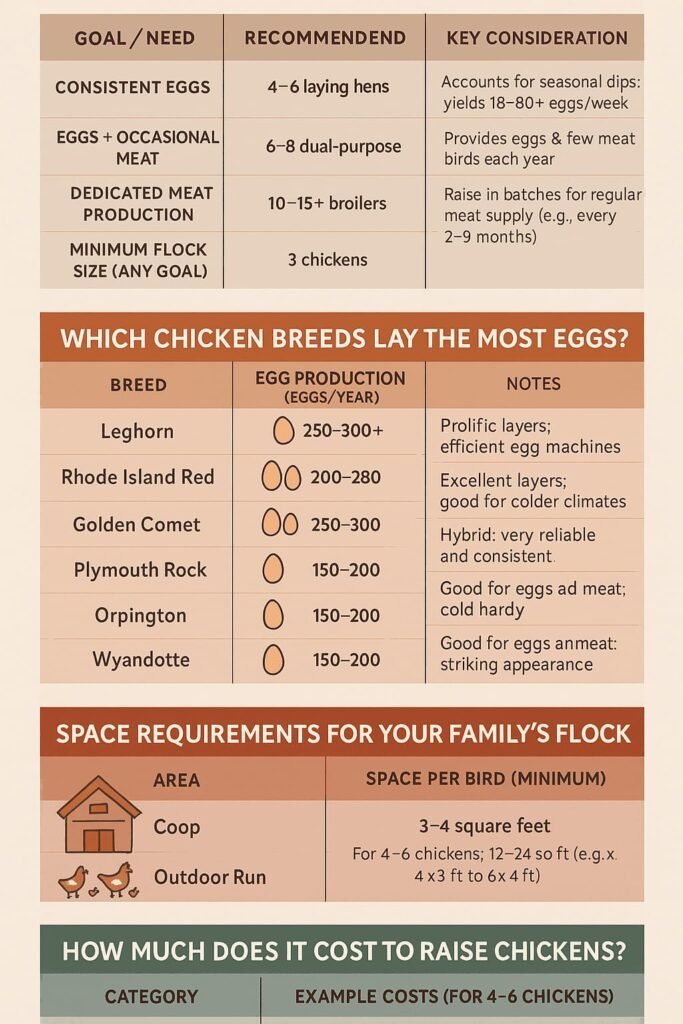
| Consistent Eggs | 4-6 laying hens | Accounts for seasonal dips; yields 18-30+ eggs/week |
| Eggs + Occasional Meat | 6-8 dual-purpose | Provides eggs and a few meat birds each year |
| Dedicated Meat Production | 10-15+ broilers | Raise in batches for regular meat supply (e.g., every 2-3 months) |
| Minimum Flock Size (Any Goal) | 3 chickens | Chickens are social; avoid keeping just one or two |
Consider Your Family’s Egg Consumption Habits
To figure out how many chickens you need for a family of 4, start by honestly assessing your family’s actual egg consumption. This is critical to avoid over-production.
Average Egg Consumption: The average person consumes about 2-3 eggs per week. For a family of four, that is roughly 8-12 eggs per week. But are you “average”? My family, for example, loves eggs. We are talking scrambled eggs for breakfast, hard-boiled eggs for snacks, and quiches for dinner. We easily go through 18-24 eggs a week. So, for us, two chickens would not even cover a single weekend.
Daily Egg Eaters vs. Occasional: Do some family members eat eggs daily, like clockwork, while others only occasionally? Or are you a household that bakes a lot, constantly needing eggs for cakes, cookies, and casseroles? If you are heavy bakers or simply egg enthusiasts, you will need a more robust supply. Think of it as a personalized egg production line.
Storing Excess Eggs: Fresh, unwashed eggs can last for several weeks (even months) on the counter, or longer in the fridge. Pretty cool, right? Think about your storage capacity. If you do not mind having a surplus for a while, perhaps even sharing with neighbors (who will instantly become your best friends), you might lean towards a slightly larger flock. If you want just enough with no fuss, then aim for a precise number. For more details, see my guide on ways to preserve eggs and reduce spoilage.
How many eggs does a family of 4 actually eat? That is for you to figure out by tracking for a week or two. Grab a notebook and start counting. You might be surprised. Do you need a constant supply? If yes, factor in seasonal dips in production, because nobody wants an egg drought.
Which Chicken Breeds Lay the Most Eggs?
If eggs are your priority, focus on high-producing chicken breeds. According to Azure Farm Life, Rhode Island Reds, Leghorns, and Plymouth Rocks are among the most reliable layers. These breeds are egg-laying machines and a key factor in flock size. Do not pick a breed based solely on how pretty their feathers are, unless you are just looking for garden decorations.
| Breed | Egg Production (Eggs/Year) | Egg Color | Temperament | Notes |
|---|---|---|---|---|
| Leghorn | 250-300+ | White | Active, Flighty | Prolific layers, efficient egg machines |
| Rhode Island Red | 200-280 | Brown | Hardy, Assertive | Excellent layers, good for colder climates |
| Golden Comet | 250-300 | Brown | Docile, Friendly | Hybrid, very reliable and consistent |
| Plymouth Rock | 150-200 | Brown | Calm, Dual-purpose | Good for eggs and meat, cold hardy |
| Orpington | 150-200 | Brown | Gentle, Broody | Good backyard pet, dual-purpose |
| Wyandotte | 150-200 | Brown | Calm, Cold-Hardy | Good for eggs and meat, striking appearance |
For a deeper dive into beginner-friendly options, check out my guide on the easiest chicken breeds for beginners.
Factors Affecting Egg Production: Remember, a chicken is not a factory. Egg laying is influenced by several factors:
Age: Pullets (young hens, typically 18-24 weeks old) start laying consistently. Production peaks in their first two years and then gradually declines. They are like young athletes at the top of their game.
Season: Hens lay less in winter due to shorter daylight hours. This is where having a few extra birds can bridge the gap if you rely solely on your flock for eggs. Otherwise, prepare for some store-bought eggs during the colder months. For tips on maintaining production, see my guide on what to feed chickens in winter.
Health and Feed: A healthy hen with a balanced, high-quality layer feed will be a better producer. Think of it as premium fuel for premium eggs. For tips on boosting output naturally, see my article on treats that boost egg laying.
Pullets vs. Older Hens: When you start, consider buying pullets close to laying age for immediate egg gratification. Who wants to wait, right? Older hens might be cheaper but will lay fewer eggs. Sometimes, instant gratification is worth the extra cost. I break down this decision in my guide on chicks vs. adult hens for beginners.
Which chicken breeds are best for eggs? For consistent production, go for Leghorns, Rhode Island Reds, or Golden Comets. How many eggs does one chicken lay per week? High producers typically lay 4-6 eggs per week during their peak, but average around 3-5 eggs over the year due to seasonal and age variations. It is like hoping for a home run every time, but a consistent base hit is still pretty great.
Beyond Eggs: Meat Production for a Family of 4
If the thought of truly homegrown chicken dinners is making your mouth water, consider raising broiler breeds like Cornish Cross for efficient meat production. This changes the “how many chickens do you need for a family of 4” equation significantly. We are talking about a whole different ballgame here.
Broiler Breeds vs. Dual-Purpose:
Broiler breeds (like Cornish Cross) are specifically bred for rapid growth and meat production. They are the sprinters of the chicken world, reaching processing weight (4-6 lbs) in just 8-10 weeks. If you are focused purely on meat, these are your go-to. They are not winning any beauty contests, but they grow fast.
Dual-purpose breeds (like Plymouth Rocks, Wyandottes, or Orpingtons) provide both eggs and meat, but grow slower and will not yield as much meat as broilers. They take 4-5 months to reach a good size. They are the all-rounders, good for a bit of everything.
Meat Yield: A Cornish Cross broiler typically yields 3-5 lbs of dressed meat. For a family of 4 wanting chicken once a week, you would need about 52 chickens per year. Suddenly, “how many chickens do you need for a family of 4” sounds like a very big number. If you process them in batches (say, 10-15 every 2-3 months), you would need around 10-15 birds at a time.
Freezing and Storing Meat: You will need substantial freezer space. A typical chest freezer can hold a decent number of processed birds, but plan accordingly. Do not underestimate this; you do not want a freezer full of delicious chicken with nowhere to put it.
Can I raise enough meat chickens for my family? Absolutely, but it requires more planning, processing, and space than just an egg-laying flock. It is a commitment, but the reward of knowing exactly where your dinner came from is huge. What breeds are good for meat? Cornish Cross for dedicated meat, or dual-purpose like Plymouth Rock or Wyandotte if you want eggs too.
Space Requirements for Your Family’s Flock
For healthy chickens, plan for adequate coop and run space. Cramped conditions lead to stress, disease, and behavioral issues like feather-picking. Imagine living in a tiny studio apartment with three other people and no balcony; that is how chickens feel in an overcrowded coop.
According to Poultry Extension, laying hens need a minimum of 3-4 square feet per hen indoors and 10 square feet per hen outdoors. Cotton River Farm confirms this standard, recommending 3-4 square feet of indoor coop space and 8-10 square feet of outdoor run space per chicken.
| Area | Space Per Bird (Minimum) | Notes |
|---|---|---|
| Coop | 3-4 square feet | For 4-6 chickens: 12-24 sq ft (e.g., 4×3 ft to 6×4 ft). More is better. |
| Outdoor Run | 8-10 square feet | For 4-6 chickens: 32-60 sq ft. Essential for foraging and exercise. |
| Perch/Roost | 8-10 inches | Per bird. Easy Coops recommends placing roosts 18 inches above the floor to prevent leg injuries when jumping down. |
| Nesting Box | 1 box per 4-5 hens | For 4-6 chickens: 2 boxes should be enough. |
For breed-specific requirements, Easy Coops notes that small breeds like Bantam chickens need about 2 square feet of coop space per bird, medium breeds like Leghorns need at least 3 square feet, and large breeds like Brahmas or Buff Orpingtons require a minimum of 4 square feet per bird.
If your chickens cannot access outdoor runs, Easy Coops recommends increasing indoor coop space by 50%: 3 square feet for bantams, 4.5 square feet for average-sized breeds, and 6 square feet for large breeds.
Impact of Flock Size on Space: Simply put, more chickens equal more required space. Do not try to squeeze 10 chickens into a coop meant for 4. Overcrowding is a recipe for disaster, turning your peaceful flock into a stressed-out mob. Trust me, it is not pretty.
How much space do chickens need? Inside the coop, chickens need a minimum of 3-4 square feet per bird. In the outdoor run, aim for 8-10 square feet per bird. What size coop for how many chickens? For a family of 4’s needs (4-6 chickens), a coop around 16-24 square feet is a good starting point, plus a run of 40-60 square feet. Give them room to breathe (and cluck). For more detailed guidance, see my complete guide on how big a chicken coop should be and how much space chickens really need.
Time and Effort: Managing Your Chickens for a Family of 4
Caring for chickens is not a set-it-and-forget-it deal, but it is also not a full-time job. The time commitment scales with your flock size, so think about what you can realistically handle. Expect to spend 15-30 minutes daily on basic chores for a small flock.
Daily Chores (15-30 minutes):
Feeding and Watering: This is paramount. Fresh food and water daily. Automated feeders and waterers can cut down on this time significantly, turning a chore into a quick check.
Egg Collection: A quick trip to the coop to gather those warm, fresh eggs. This is usually the most rewarding part of the day, like finding little treasures.
Quick Health Check: Observe your birds. Are they moving well? Eating? Any unusual behavior? You will quickly learn their quirks, and a quick daily glance can catch problems early. I have a detailed weekly health check routine that covers what to look for.
Weekly Chores (1-2 hours):
Coop Cleaning: Removing soiled bedding and replenishing. A “deep litter” method can extend this to monthly, which is a lifesaver for busy folks. Learn more about keeping your coop from smelling.
Run Maintenance: Raking, rotating areas, or adding fresh dirt/sand. Keeps things tidy and healthy.
Monthly/Seasonal Chores (Varies):
Deep Cleaning: Thorough scrubbing of the coop. Think spring cleaning, but for chickens.
Predator Protection: Checking for any weak spots in your fencing or coop. I learned this the hard way when a crafty raccoon found a tiny gap in our run. The heartbreak of losing a bird is something you want to avoid at all costs. See my guide on predator-proofing your coop.
Health Checks: More thorough inspections for mites, lice, or other issues. A little preventative care goes a long way.
The Impact of More Chickens on Time Commitment: While more birds mean more eggs or meat, they also mean more waste, more feed consumed, and potentially more health issues to monitor. Going from 4 to 10 chickens more than doubles the waste, even if daily feeding time only slightly increases. Are you up for the challenge?
How much time does it take to care for chickens? For 4-6 birds, expect 15-30 minutes daily, plus a few hours weekly/monthly. Is a larger flock significantly more work? Yes, proportionally, especially when it comes to cleaning and feed consumption. Your shovel will become your new best friend.
Expert Tips for efficient chicken management:
Automate: Invest in large-capacity feeders and waterers. Trust me, future you will thank you.
Deep Litter Method: Build up wood shavings and turn them regularly. This creates a natural composting system that reduces cleaning frequency. It is surprisingly effective.
Strategic Coop Design: Make sure your coop is easy to access for cleaning. Raised coops are a lifesaver for your back. No more crouching in tiny spaces.
How Much Does It Cost to Raise Chickens?
Starting a backyard flock involves initial costs and ongoing expenses. Expect initial setup costs between $300-$800+, and ongoing monthly expenses of $30-$60 for a small flock. How many chickens you need for a family of 4 also factors into your budget. It is not just about the cute chicks; it is about the long-term investment.
| Category | Example Costs (for 4-6 chickens) | Notes |
|---|---|---|
| Initial Setup | ||
| Coop | $300-$1000+ | Can be DIY or pre-built |
| Chicks/Pullets | $3-$30 each | Chicks are cheaper, pullets lay sooner |
| Feeders and Waterers | $30-$100 | Essential equipment |
| Bedding (initial) | $20-$40 | Start-up supply |
| Ongoing (Monthly) | ||
| Feed | $20-$40 (50lb bag) | Your biggest recurring cost |
| Bedding | $10-$20 | Regular replenishment |
| Health Supplies | $5-$15 | Grit, oyster shell, occasional supplements |
| Miscellaneous | Varies | Pest control, electricity for winter lights (if used) |
For a detailed breakdown, see my guides on first-year costs for raising chickens, the real cost of 6 chickens, and how much a 50 lb bag of chicken feed costs.
Potential Savings: While there is an upfront investment, fresh eggs from your own flock are virtually free after the initial costs. And if you raise meat birds, you are saving significantly on grocery store prices. Can you put a price on knowing exactly where your food comes from, anyway? I think not.
How much does it cost to start a flock? Expect $300-$800+ for a basic setup. What are the recurring expenses? Primarily feed and bedding, averaging around $30-$60 per month for a small flock. It is an investment, but a rewarding one.
Common Mistakes to Avoid When Planning Your Flock Size
When I started, I made a few blunders. Learning from others’ mistakes (or mine) is always easier and a lot less frustrating. The most common errors involve underestimating space, overestimating egg consumption, and impulse buying. Consider these as friendly warnings from someone who has been there, done that, and probably cleaned up a lot of chicken mess. For more pitfalls to watch for, see my complete guide on mistakes every first-time chicken keeper makes.
Underestimating Space Needs: This is probably the most common mistake. People buy a cute little coop that says “for 6 chickens” but it is really meant for 2. According to Backyard Chickens forum discussions, many keepers find that manufacturer claims are often optimistic and recommend erring on the side of more space. Overcrowding leads to stress, bullying, and disease. Always give more space than the minimum recommended. Your chickens deserve a decent amount of personal space, just like you do.
Overestimating Egg Consumption: You might think you need a dozen eggs a day, but unless you are feeding a small army, you will likely end up with a huge surplus. Be realistic about your family’s actual needs. Or, be prepared to become the neighborhood’s favorite egg dealer.
Not Accounting for Roosters (if applicable): If you hatch your own eggs or buy “straight run” chicks, you might end up with roosters. They do not lay eggs, can be noisy (prepare for early morning crowing), and multiple roosters can fight. Plan how you will manage them. It is a surprise bonus you might not want. See my guide on whether you need a rooster to get eggs.
Impulse Buying Too Many Chicks: They are adorable, I know. Those tiny chirps and fluffy bodies are irresistible. But resist the urge to buy every fluffy chick you see. According to The Everyday Farmhouse, starting with a small flock of 3-5 chickens is often recommended for beginners, allowing you to manage them effectively while gaining experience. Stick to your plan for how many chickens you need for a family of 4, or you will quickly be overwhelmed. I once started with too many chicks because they were “on sale,” and it turned into a comical but messy learning experience. My backyard looked like a feathered disco.
Seasonal Considerations and Flock Management
The seasons play a big role in your chickens’ productivity and your management. It is like gardening; you would not expect tomatoes in winter, right? Expect egg production to fluctuate with the seasons, especially dropping in fall and winter.
| Season | Egg Production Impact | Care Considerations |
|---|---|---|
| Spring/Summer | Peak Production | Ensure shade, plenty of cool water, good ventilation |
| Fall | Production slowly drops | Prepare for colder weather, may start molting (less laying) |
| Winter | Significantly lower (or stop) | Provide warmth (if needed), extra feed, fresh unfrozen water |
Heat Stress in Summer: Chickens do not handle heat well. Provide plenty of shade, cool water, and good ventilation in the coop. On really hot days, you might even see them panting. A little frozen treat (like a block of ice with corn in it) can be a lifesaver. For breed recommendations in warm climates, Azure Farm Life notes that chickens with large combs and wattles are best suited to warm environments, including Rhode Island Reds, Leghorns, and Naked Necks. See my guide on heat-tolerant chicken breeds.
Predator Activity: Predators like raccoons, foxes, and hawks are active year-round but may change patterns seasonally. Ensure your coop and run are secure against all threats, 24/7. Losing a chicken to a predator is absolutely heartbreaking and a preventable tragedy. Do not skimp on security. See my detailed guide on predator-proof chicken coops.
Adjusting Feed and Water: In winter, they might eat more to stay warm. In summer, they will drink significantly more water. Adjust accordingly. Listen to your flock; they will tell you what they need through their behavior. For cold-weather preparation, see my winterizing chicken coop guide.
Do chickens lay fewer eggs in winter? Yes, significantly. So, if you are picturing year-round abundance, prepare for a slight reality check. How do seasons affect chicken care? You will need to provide more warmth/light in winter and more shade/water in summer. It is like having feathered little weather vanes.
Scaling Up or Down: Adjusting Your Chicken Numbers
Your family’s needs or your available time might change, and it is totally fine to adjust your flock size. Chicken keeping is an evolving journey, not a fixed destination. You can always adjust your flock size through careful introduction of new birds, rehoming, or culling.
Introducing New Birds: Chickens have a strict pecking order (literally). Always introduce new birds carefully, ideally by housing them in a separate but visible “integration pen” for a week or two before fully merging the flocks. This minimizes stress and aggression. Imagine throwing a stranger into your family dinner; it takes a little time to get acquainted. See my guide on pecking order problems and how to stop bully hens.
Rehoming or Culling: If you have too many birds, you might need to rehome some or, in the case of meat birds or older layers, cull them. Have a plan for this emotional but practical step. It is never easy, but sometimes necessary for the health of the entire flock.
Monitoring Flock Health and Productivity: Keep an eye on egg production and the overall health of your birds. If production drops significantly across the board, or you are constantly finding sick birds, it might be time to assess your flock size and management. Your flock will give you clues if something is off.
What if I want more or fewer chickens later? It is possible. Life happens, and your chicken journey can adapt. How do I add new chickens to my flock? Slowly and carefully, using a separate space for initial introduction. Patience is a virtue, especially in the chicken world.
FAQs about How Many Chickens Do You Need for a Family of 4
Can a family of 4 get enough eggs from just 2 chickens?
It is unlikely for a consistent supply. Two chickens, even high-producing ones, will give you 8-12 eggs per week at their peak. During molting or winter, this number will drop significantly. You would likely run out of eggs regularly, leading to those awkward moments where you have to buy eggs from the store.
What is the minimum number of chickens you should have?
Chickens are social creatures and thrive in groups. You should never keep just one chicken; they will get lonely and stressed. According to Backyard Chickens, most experts recommend keeping between three and six chickens, and limiting that number to four if you are a beginner. Think of it as a small, clucking support group.
How long do chickens lay eggs for?
Most hens lay consistently for 2-3 years, with peak production in their first year. After that, their production gradually declines, though they may continue to lay sporadically for several more years. They earn their retirement after all that hard work. See my guide on how long chickens live.
Do I need a rooster for my hens to lay eggs?
No. Hens will lay eggs whether a rooster is present or not. A rooster is only needed if you want fertilized eggs to hatch chicks. Otherwise, he is just there to look handsome and crow at the crack of dawn (or sometimes, oddly, at noon). For more details, see my complete guide on whether you need a rooster to get eggs.
Is it cheaper to buy eggs or raise chickens?
Initially, it is more expensive to start a flock due to coop costs and setup. However, over the long term, once your infrastructure is in place, the cost per egg from your own flock is often significantly cheaper than buying organic, free-range eggs from the store. Plus, you cannot beat the freshness and taste. It is like the difference between eating a mass-produced candy bar and a gourmet chocolate truffle: both are good, but one is clearly superior. For a detailed cost comparison, see my guide on whether raising backyard chickens is cheaper than buying eggs.
Ready to start your flock? Check out my guide on bringing chicks home: 15 must-haves or calculate your first-year costs before you buy.

Oladepo Babatunde is the founder of ChickenStarter.com. He is a backyard chicken keeper and educator who specializes in helping beginners raise healthy flocks, particularly in warm climates. His expertise comes from years of hands-on experience building coops, treating common chicken ailments, and solving flock management issues. His own happy hens are a testament to his methods, laying 25-30 eggs weekly.