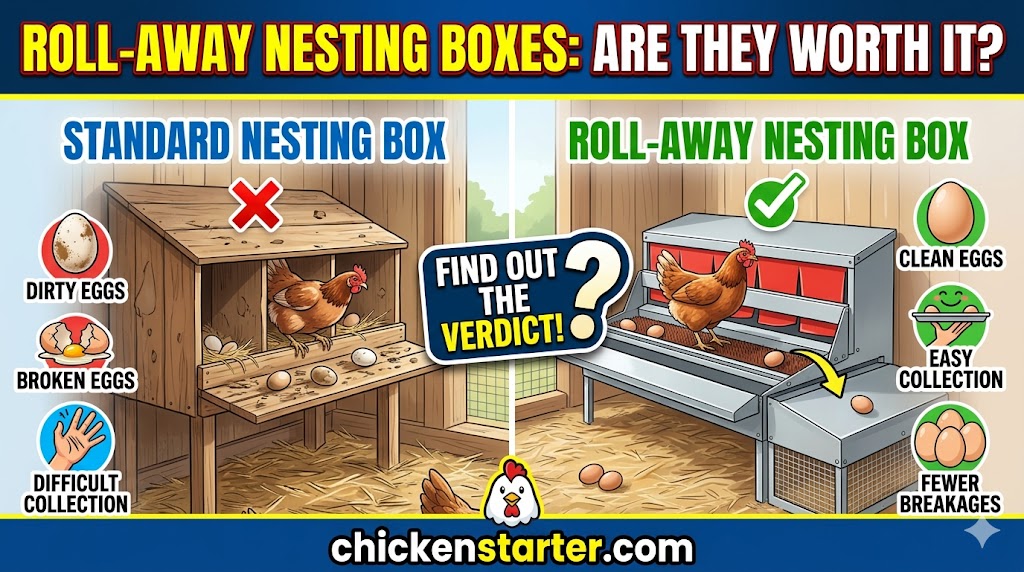
If you have ever walked into your coop to find a cracked egg, a yolk-smeared hen, or worse, a chicken happily gobbling up her own eggs, you already know the frustration. A roll-away nesting box is designed to solve exactly that problem by gently rolling each egg out of reach the moment it is laid. But are they actually worth the investment, or just another overhyped piece of poultry equipment?
I have been raising backyard chickens for several years now, and I switched half of my nesting boxes to a roll-away design about two seasons ago. In this guide, I will share everything I have learned from personal experience, real-world testing, and thorough research so you can decide whether a roll-away nesting box for chickens is the right choice for your flock.
What Exactly Is a Roll-Away Nesting Box?
A roll-away nesting box is a specially designed nest where the floor is angled so that once a hen lays an egg, gravity gently rolls it forward or backward into a padded collection tray. The egg ends up safely out of the hen’s sight and reach, protected behind a small lip or inside a covered compartment.
Unlike traditional flat-bottom nesting boxes, the angled floor means the egg does not sit underneath the hen. This single design feature addresses some of the most common nesting box headaches, including egg eating, egg breakage, and dirty eggs covered in droppings or mud.
The concept is widely used in commercial poultry operations around the world. According to information from the University of Georgia Cooperative Extension, commercial layer houses have relied on sloped egg collection systems for decades to minimize breakage and maintain egg quality. Backyard chicken keepers have now adapted this same principle into smaller, coop-friendly designs.
How Does a Roll-Away Nesting Box Work?
The mechanics are simple but need to be precise. Here is what happens step by step:
The hen enters the box and settles onto a slightly angled floor surface. Most designs use a slope between 7 and 15 degrees. The nesting material on the angled floor is kept intentionally thin, just enough for the hen to feel comfortable but not so thick that it stops the egg from rolling.
The egg is laid and immediately begins to roll down the slope. The floor surface is typically smooth plywood, plastic, or a rubberized mat that allows the egg to glide without cracking.
The egg reaches the collection area, which is usually a padded tray lined with soft material like artificial turf, rubber shelf liner, or foam padding. This tray sits behind a small barrier or underneath a lip that prevents the hen from seeing or reaching the egg.
You then collect clean, intact eggs from the tray without ever disturbing the hens.
What Is the Correct Angle for a Roll-Away Nest Box?
Getting the nest box angle right is critical. Too steep and the hens will refuse to use it because they feel unstable. Too shallow and the egg will not roll at all, especially if you have used too much bedding.
From my own testing, the sweet spot is between 8 and 12 degrees. I started at 15 degrees and noticed my hens were reluctant to sit. When I adjusted down to about 10 degrees, every hen in the flock started using the boxes within a few days.
Here is a quick reference:
| Angle | Result |
|---|---|
| Less than 7 degrees | Eggs may not roll, especially with any bedding |
| 8 to 12 degrees | Ideal range for most breeds and egg sizes |
| 13 to 15 degrees | Works but some hens may resist using the box |
| Over 15 degrees | Most hens will refuse to sit and eggs may crack from rolling too fast |
If you are building your own, a simple way to measure is to raise the back of the nesting box floor by about 2 inches for every 12 inches of depth. That gives you roughly a 9 to 10 degree slope, which works well for standard breeds like Buff Orpingtons, Rhode Island Reds, and Australorps.
Do Roll-Away Nesting Boxes Actually Prevent Egg Eating?
Yes. This is the single biggest reason most backyard chicken keepers invest in a roll-away design, and based on my experience, it works.
Egg eating is one of the most frustrating habits a hen can develop. Once one bird starts, others often learn by watching. Breaking this behavior with traditional nesting boxes is extremely difficult because the hen has immediate access to the egg she just laid.
With a roll-away box, the egg disappears from view within seconds. The hen never gets the chance to peck at it. I had two persistent egg eaters in my flock, a Barred Rock and an Easter Egger, and both stopped the behavior completely within a week of switching to roll-away boxes. They simply could not access the eggs anymore.
If you are currently dealing with this problem, you can learn more about why it starts and other ways to address it in our guide on chickens eating their own eggs.
Do Roll-Out Nesting Boxes Really Work?
They do, but with some important caveats. A roll-away nesting box is not a “set it and forget it” solution. Here is what I have found makes the difference between success and frustration.
What makes them work well:
The egg collection tray must be properly padded. Without padding, eggs will crack when they bump into each other in the tray, which defeats the entire purpose. I use a piece of rubber shelf liner cut to fit, and I have had zero breakage in over a year.
The nesting surface needs to be comfortable enough that hens will actually use the box. A bare, slippery angled floor will deter most hens. I lay a very thin layer of soft straw or a cut piece of artificial turf on the slope. The key word is thin. If the bedding is more than about half an inch deep, eggs get stuck.
What causes problems:
Hens are creatures of habit. If they have been using traditional nesting boxes for months or years, some will resist switching. Patience and training are needed, which I will cover in detail below.
Very heavy eggs from large breeds can roll too aggressively on steeper slopes and crack against the collection tray wall. If you keep heavy breeds like Jersey Giants or Brahmas, aim for the lower end of the angle range and use extra padding.
Bantam eggs, on the other hand, are lighter and may not roll as reliably. You may need a slightly steeper angle, closer to 12 degrees, for smaller breeds like Silkie Bantams.
Roll-Away Nesting Box Plans: How to Build Your Own (DIY)
Building a DIY roll-away nesting box is a straightforward weekend project that costs a fraction of buying a premade unit. Here are the dimensions and materials I used for my own build that has held up beautifully through two full laying seasons.
Materials You Will Need
- 3/4 inch plywood for the frame and sides
- 1/4 inch smooth plywood or hardboard for the angled floor
- Rubber shelf liner or artificial turf for the collection tray padding
- Hinges for the rear access door or top lid
- Wood screws (1.5 inch and 2 inch)
- A small lip or strip of wood (about 2 inches high) at the front of the collection area to stop eggs from rolling out
- Optional: roll-away nesting box insert (a premade angled tray that fits inside an existing nesting box frame)
Roll-Away Nesting Box Dimensions
For standard sized breeds, each individual nesting compartment should be:
- Width: 12 to 14 inches
- Height: 12 to 14 inches
- Depth (front to back): 12 to 14 inches for the nesting area, plus an additional 6 to 8 inches for the egg collection tray
The collection tray extends out from the back (or front, depending on your design) and should be enclosed and dark so that hens are not tempted to investigate.
If you are planning a coop build from scratch, our article on how big should a chicken coop be will help you figure out the overall layout and space allocation for nesting boxes.
Step-by-Step Build Overview
Step 1: Cut the side panels, top, and bottom pieces from your 3/4 inch plywood. For a 3-compartment unit, the total width will be about 42 inches (three 14-inch compartments).
Step 2: Cut the angled floor from 1/4 inch smooth plywood. Mount it so the back edge sits about 2 inches higher than the front edge if you want eggs to roll forward, or vice versa if you prefer rear collection.
Step 3: Attach the angled floor to the side panels. Make sure the surface is completely smooth with no rough spots, splinters, or screw heads that could crack an egg or stop it from rolling.
Step 4: Build the collection tray area. This is the lower section where eggs come to rest. Line it with rubber shelf liner or a folded piece of soft fabric. Install a small lip (1.5 to 2 inches high) at the opening to prevent eggs from rolling out onto the floor.
Step 5: Attach a hinged door or panel over the collection tray for easy egg gathering. I used a simple piano hinge on mine, and it has worked perfectly.
Step 6: Mount the unit in your coop at the correct height. Nesting boxes should sit about 18 to 24 inches off the ground for standard breeds, and always lower than your roosting bars so hens do not sleep in them. For more details on roosting bar placement, check our guide on how high should roosting bars be in a coop.
Roll-Away Chicken Nesting Box Plans (PDF)
If you prefer working from a printed plan, several poultry equipment manufacturers and university extension services offer free downloadable PDF plans for roll-away nesting boxes. Search for “roll away nest box construction plans” on your state or provincial extension website for designs that have been tested with backyard flocks. I personally found the plans from the Mississippi State University Extension Service to be the clearest and most practical for a small flock of 6 to 12 hens.
Best Roll-Away Nesting Boxes for Chickens (for Sale)
Not everyone wants a DIY project, and that is perfectly fine. Several premade roll-away nesting boxes are available that are well built and ready to install. Here is what to look for and what I have seen perform best.
What to Look for When Buying
- Durable construction: Metal or heavy-duty plastic holds up far better than thin wood in a coop environment with moisture and droppings.
- Adjustable angle: Some premade models let you tweak the slope, which is a huge advantage because every flock and coop setup is slightly different.
- Removable collection tray: Makes cleaning and egg collection much easier.
- Adequate size: Make sure the interior dimensions are at least 12 by 12 inches per compartment. Anything smaller will deter larger breeds.
- Ventilation holes: Hens generate heat and moisture. Proper airflow in the box helps keep eggs dry and bedding fresh.
Roll-Away Nesting Box Insert Option
If you already have traditional nesting boxes and do not want to replace them entirely, a roll-away nesting box insert is a cost-effective middle ground. These are angled trays or floor panels that slide into your existing box frame, converting a standard flat-bottom nest into a roll-away design.
Inserts typically cost between $15 and $40 per compartment depending on material and brand. They are a smart option if you want to test the concept before committing to a full rebuild.
What to Put in a Roll-Away Nesting Box
This is where many people make mistakes. The nesting material in a roll-away box must be handled differently than in a traditional nesting box.
In a standard box, you can pile in straw, wood shavings, or hay to create a thick, cozy nest. In a roll-away box, too much material will block the egg from rolling. Here is what works:
- Thin layer of soft straw: No more than half an inch. Just enough for comfort.
- Artificial turf or astroturf: Cut to fit the angled surface. This is my personal favorite because it provides grip for the hen’s feet, cushions the egg at the moment of lay, but is smooth enough to let the egg roll. It is also incredibly easy to clean.
- Rubber shelf liner on the collection tray: Prevents eggs from cracking as they come to rest.
- Nesting box pads: Commercial felt or foam pads designed specifically for poultry nesting boxes work well and are washable.
Avoid using: sand (too heavy, will not allow rolling), deep wood shavings (they bunch up and stop the egg), or hay (tends to mat and create uneven surfaces).
For a deeper look at traditional nesting box materials, our detailed article on what to put inside a chicken nesting box covers all your options including herbs and aromatics that help deter pests.
How to Get Chickens to Use a Roll-Away Nesting Box
This is probably the most commonly asked question about roll-away nesting boxes, and I will be honest with you. It takes a bit of patience.
Hens can be stubborn about change. If they have been laying in a traditional box or, worse, on the coop floor, convincing them to switch requires some strategy.
Training Tips That Actually Work
Block access to old nesting spots. If your hens have a favorite corner or old box, physically block it off. Remove or cover the old nesting boxes entirely during the transition period.
Place fake eggs or golf balls in the new boxes. Hens are drawn to lay where they see existing eggs. A ceramic egg or golf ball sitting on the angled surface signals to the hen that this is a safe, approved nesting location.
Make the box dark and inviting. Hens instinctively seek enclosed, dimly lit spaces for laying. If your roll-away box is too open or too bright, add a curtain made from burlap or an old towel across the entrance. Leave enough gap at the bottom for the hen to walk in.
Use familiar nesting material. If your hens are used to straw, put a thin layer of straw on the new angled floor. The familiar scent and texture help them feel at home.
Be patient. Most hens take 3 to 7 days to fully adopt new nesting boxes. Some stubborn birds may take up to two weeks. If a hen starts laying on the floor during the transition, gently place her in the new box a few times. She will get the idea.
If your hens are consistently avoiding nesting boxes altogether, our troubleshooting guide on why is my chicken laying on the floor addresses every common cause and fix.
Do Chickens Share Nesting Boxes?
Yes, and this is important to understand when planning your roll-away setup. Chickens absolutely share nesting boxes. In fact, most flocks develop a strong preference for one or two “favorite” boxes, even when you provide plenty of options.
The general rule is one nesting box for every 3 to 4 hens. So a flock of 12 hens needs 3 to 4 boxes. With roll-away designs, this ratio still applies. You do not need a box for every bird.
That said, with roll-away boxes there is an added benefit. Because eggs roll away immediately, there is no buildup of eggs in the nest that might encourage broody behavior or attract egg eaters. The box stays “empty” from the hen’s perspective, which actually keeps traffic flowing more smoothly.
For more on understanding flock dynamics and nesting behavior, our article on backyard chicken nesting boxes covers layout, placement, and sizing in detail.
What Are the Disadvantages of Roll-Away Nesting Boxes?
No piece of equipment is perfect. Here are the honest downsides I have encountered.
Higher upfront cost. A premade roll-away box costs noticeably more than a simple wooden nesting box. Budget $40 to $100+ per unit for commercial options. DIY builds are cheaper but still require more materials than a basic flat-bottom box.
Hens may resist them initially. As I mentioned, the transition period can be frustrating. Some hens are more adaptable than others. Heritage breeds and older hens tend to be more stubborn about change.
Not ideal if you want broody hens. If you want a hen to go broody and hatch eggs, a roll-away box is the opposite of what you need. The egg rolls away before the hen can sit on it. You will need at least one traditional nesting box available if hatching is part of your plan. Our article on broody hen vs incubator explains when each method makes sense.
Requires precise setup. The angle, bedding depth, and collection tray padding all need to be right. A traditional box is more forgiving because there are fewer variables.
Ongoing maintenance of the collection tray. The padding in the tray needs regular cleaning and occasional replacement. Rubber liners can develop odor if not washed, and artificial turf collects dust and feather dander.
Egg cracking can still happen if the collection tray is not padded well enough or if the slope is too steep. This is especially true for thin-shelled eggs, which are often a sign of a calcium deficiency. If you are noticing soft or thin shells, our guide on calcium for chickens covers supplementation in depth.
Roll-Away Nesting Box Ideas for Different Coop Setups
Not every coop is the same, so here are some layout ideas based on common setups.
Small Coop (3 to 6 Hens)
A single 2-compartment roll-away box mounted on the interior wall works well. Use rear egg collection with an access door that opens to the outside of the coop. This way you can gather eggs without even entering the coop.
Medium Coop (7 to 15 Hens)
A bank of 3 to 4 compartments along one wall is standard. Consider building a communal collection tray that runs the full width of the unit so all eggs from every compartment roll into one central area.
Large Coop or Poultry Farm (16+ Hens)
Stack two rows of nesting boxes vertically or run a long bank of 6 to 8 compartments. In this setup, a continuous collection channel at the back works best. Commercial poultry farms use a similar system with conveyor belts, but for a backyard or small farm operation, a simple padded gutter-style tray does the job.
If you are still in the coop planning phase, our article on chicken coop plans for 20 chickens includes layout diagrams that show where nesting boxes fit into the overall design.
My Personal Verdict: Are Roll-Away Nesting Boxes Worth It?
After using roll-away nesting boxes for two full laying seasons with a mixed flock of 14 hens, here is my honest assessment.
They are absolutely worth it if you are dealing with egg eating, frequent egg breakage, or dirty eggs. The difference in egg cleanliness alone justified the investment for me. Before switching, I was washing roughly 30 to 40 percent of my eggs. After switching, that number dropped to under 5 percent.
They are also worth it if you sell eggs. Clean, uncracked eggs with no fecal staining look more professional and meet food safety expectations, especially if you are selling at a farmers market or following your state’s egg sale regulations. Our guide on how to legally sell your backyard chicken eggs covers the rules you need to know.
They are not necessary if your hens lay reliably in traditional boxes, you do not have an egg eating problem, and you are happy with your current egg quality. A well-managed traditional nesting box with clean bedding works perfectly fine for many flocks.
For anyone on the fence, I would recommend trying a roll-away nesting box insert in one or two of your existing boxes first. It is a low-cost way to test whether your hens adapt to the design before committing to a full build or purchase.
The bottom line is this: a roll-away nesting box is not a luxury item or a gimmick. It is a practical piece of poultry coop equipment that solves real problems. If those problems exist in your flock, it is one of the smartest upgrades you can make.

Oladepo Babatunde is the founder of ChickenStarter.com. He is a backyard chicken keeper and educator who specializes in helping beginners raise healthy flocks, particularly in warm climates. His expertise comes from years of hands-on experience building coops, treating common chicken ailments, and solving flock management issues. His own happy hens are a testament to his methods, laying 25-30 eggs weekly.