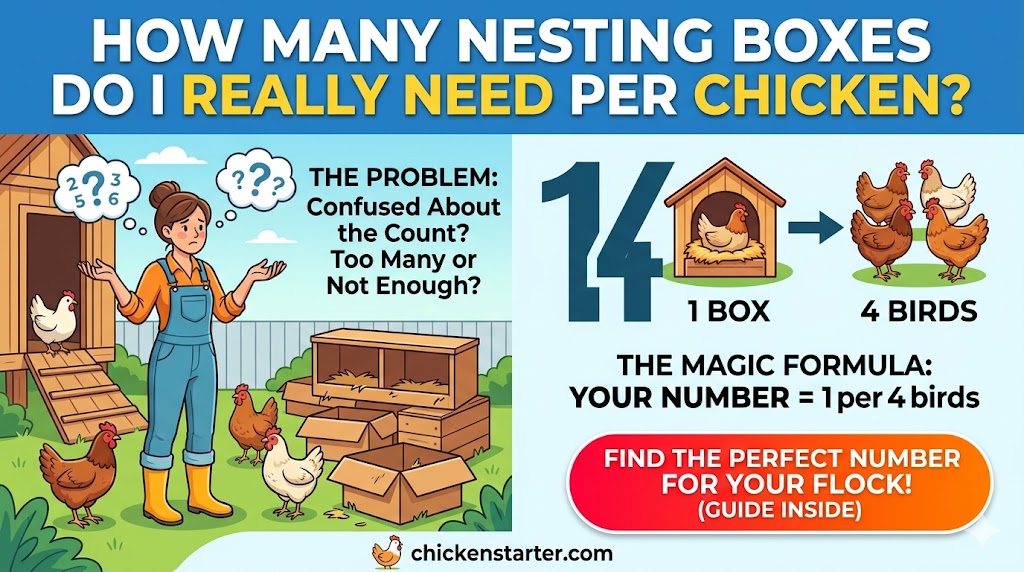
You do not need one nesting box for every chicken. The widely accepted guideline is one nesting box for every 4 to 5 laying hens, with a minimum of two boxes no matter how small your flock is. But that simple ratio only tells part of the story. Flock size, breed, temperament, laying frequency, and coop layout all influence the number that actually works in practice.
I have kept backyard chickens for several years now, and I have experimented with different nesting box ratios across two different coop setups. What I have learned is that the “right” number depends less on a formula and more on watching your hens and understanding their behavior. Let me walk you through everything I know so you can get this right the first time.
The Standard Rule and Why It Works
The general recommendation from experienced poultry keepers and hatcheries is one nesting box for every 4 to 5 hens. According to information from Cackle Hatchery, the rule of thumb is to furnish one nest for every four to five hens, while also suggesting a minimum of two boxes even for very small flocks to prevent crowding when two hens want to lay at the same time.
This ratio works because hens do not all lay at the same hour. Most chickens lay their eggs in the morning, typically between 7 AM and noon, but they stagger throughout that window. On any given day, only a portion of your flock is actively looking for a nesting box at the same moment.
Here is a quick reference chart:
| Flock Size | Minimum Nesting Boxes | Recommended Range |
|---|---|---|
| 2 to 4 hens | 2 | 2 |
| 5 to 6 hens | 2 | 2 to 3 |
| 7 to 10 hens | 2 | 3 to 4 |
| 11 to 15 hens | 3 | 3 to 5 |
| 16 to 20 hens | 4 | 4 to 7 |
| 20+ hens | 5+ | 1 per 4 hens |
If you are planning your first coop and still figuring out flock size, our guide on how many chickens do you need for a family of 4 will help you decide how many birds to start with, which directly determines how many boxes you will need.
Why You Should Never Provide Just One Box
Even if you only have two or three hens, always install at least two nesting boxes. I learned this the hard way during my first year of keeping chickens.
I started with three hens and a single nesting box, thinking that was more than enough. What happened was predictable in hindsight. Two of my hens consistently wanted to lay around the same time each morning. One would occupy the box while the other paced, squawked, and eventually laid her egg on the coop floor.
Floor eggs get dirty, they crack more easily, and once a hen starts laying on the floor it becomes a difficult habit to break. Adding a second box solved the problem overnight.
If your hens are currently ignoring their boxes and laying on the floor instead, our troubleshooting article on why is my chicken laying on the floor covers every common cause and practical fix.
Can You Have Too Many Nesting Boxes?
Yes, and it is a more common mistake than you might think.
Too many nesting boxes create several problems. Extra boxes take up valuable coop space that could be used for roosting or floor area. Unused boxes collect dust, droppings, and pests because they are not being regularly disturbed. And perhaps most importantly, surplus nesting boxes invite hens to loiter and sleep in them instead of using the roost bars.
Hens sleeping in nesting boxes means soiled bedding, dirty eggs, and a higher risk of parasites. According to guidance shared on BackYard Chickens, installing one nest for every hen in your flock is overkill because even among the best layers, not all hens will lay at the same time or even on the same day.
When I downsized from six boxes to four for my flock of 14 hens, I actually noticed cleaner eggs because the hens cycled through fewer boxes more consistently, and I could focus my bedding changes on fewer spots.
The “Favorite Box” Phenomenon
Here is something that surprises nearly every new chicken keeper. No matter how many nesting boxes you provide, your hens will almost certainly pick one or two favorites and ignore the rest.
I have four nesting boxes in my main coop. Two of them get used constantly. One gets occasional use. The fourth has been essentially decorative for over a year.
This is completely normal chicken behavior. Hens are drawn to boxes where they see other eggs already sitting, or where another hen has recently laid. They view it as a signal that the spot is safe. This is actually the same instinct that makes placing fake eggs or ceramic eggs in a new box such an effective training tool.
Do not panic if some boxes go unused. It does not mean you have too many. It means your hens have made their choice, and as long as there is no fighting, squawking, or floor laying, the system is working fine.
What Size Should Your Nesting Boxes Be?
Getting the box count right matters, but so does getting the nesting box dimensions correct. A box that is too small will make hens uncomfortable and reluctant to lay. A box that is too large invites two hens to squeeze in at once, which leads to cracked eggs and territorial squabbles.
Recommended Nesting Box Sizes by Breed
| Breed Size | Box Dimensions |
|---|---|
| Bantam breeds (Silkies, Bantam Cochins) | 10 x 12 x 10 inches |
| Standard breeds (Rhode Island Reds, Barred Rocks, Australorps) | 12 x 12 x 12 inches |
| Large breeds (Buff Orpingtons, Wyandottes, Brahmas) | 14 x 14 x 14 inches |
| Extra large breeds (Jersey Giants) | 15 x 15 x 15 inches |
If you keep a mixed flock with different breed sizes, build all your boxes to the 14 x 14 inch standard. It is large enough for big birds and not so big that smaller breeds feel exposed. My flock includes Buff Orpingtons, Easter Eggers, and a couple of Australorps, and the 14-inch boxes work perfectly for all of them.
For breed-specific details on some of these chickens, check out our complete guides on Buff Orpingtons and Australorps.
Where to Place Nesting Boxes in Your Coop
The location of your nesting boxes inside the coop is just as important as the quantity. Poorly placed boxes lead to underuse, dirty eggs, and stressed hens.
Height Off the Ground
Nesting boxes should sit approximately 18 to 24 inches off the coop floor. This height is comfortable for most standard breeds to hop into and discourages rodents and ground-level pests from getting inside.
The critical rule is that your roosting bars must always be higher than your nesting boxes. Chickens instinctively roost at the highest available point in the coop. If your nesting boxes are higher than the roost bars, hens will sleep in the boxes instead of on the roosts. This results in droppings in the nesting material, filthy eggs, and a much harder cleaning routine.
For detailed guidance on roost placement, our article on how high should roosting bars be in a coop walks through the ideal heights for different breeds.
Privacy and Light
Hens prefer to lay in a quiet, dimly lit, and secluded spot. Position your nesting boxes away from the coop door, away from high-traffic areas, and out of direct sunlight. A slightly dark corner works best.
Adding a small curtain of burlap or fabric across the front of each box can make hens feel more secure, especially in coops with a lot of natural light. I added simple burlap flaps to my boxes last spring and noticed that my most skittish hen, an Easter Egger who used to pace for 20 minutes before committing to a box, started settling in much faster.
Orientation
If your coop design allows it, exterior-access nesting boxes are a game changer. These are boxes built into the wall of the coop with a hinged lid or door on the outside, letting you collect eggs without entering the coop at all. This is especially convenient during muddy seasons or if you have a rooster that gets territorial in tight spaces.
What to Put Inside Your Nesting Boxes
The bedding material you use affects egg cleanliness, hen comfort, and how often you need to change it out.
Best Nesting Box Materials
- Pine shavings are the most popular choice. They are absorbent, affordable, and widely available at farm supply stores. Use a 2 to 3 inch layer and fluff it up regularly.
- Straw works well and is what many traditional poultry keepers prefer. Use clean, dry straw and replace it weekly or whenever it looks matted.
- Nesting box pads made from felt, foam, or washable fabric are a newer option. They are easy to clean and provide a consistent surface. I use these as a base layer in all my boxes with a light topping of pine shavings, and the combination keeps eggs remarkably clean.
- Dried herbs like lavender, mint, and oregano sprinkled into the bedding can help deter pests and add a pleasant scent. This is not essential, but it is a nice touch.
For a complete breakdown of nesting box materials, bedding options, and herb blends, our full guide on what to put inside a chicken nesting box covers every option in detail.
Materials to Avoid
Hay (as opposed to straw) retains moisture and promotes mold growth much faster. Cedar shavings release aromatic oils that can irritate a chicken’s respiratory system. Sand is too heavy and abrasive for nesting boxes, although it works fine as coop floor material.
How Laying Breed Affects the Number of Boxes You Need
Not all flocks lay at the same rate, and this directly impacts how many nesting boxes you need.
High-production breeds like Leghorns, ISA Browns, Rhode Island Reds, and Australorps can lay 5 to 6 eggs per week per hen. With these breeds, more of your flock will be actively seeking a nesting box on any given morning. You may want to lean toward the lower end of the ratio, closer to one box per 3 to 4 hens, to avoid queuing and stress.
Moderate layers like Wyandottes, Barred Rocks, and Easter Eggers lay 3 to 4 eggs per week. The standard one box per 4 to 5 hens works perfectly for these breeds.
Low-production or ornamental breeds like Silkies, Polish, and Cochins may only lay 2 to 3 eggs per week. You can comfortably use one box per 5 to 6 hens with these flocks.
I keep mostly moderate to high production birds, and I have found that one box per 4 hens is the sweet spot for my flock. I tried stretching to one per five and noticed my Australorps getting impatient and occasionally pushing into already-occupied boxes.
Should You Consider Roll-Away Nesting Boxes?
If you are dealing with egg eating, frequent egg breakage, or consistently dirty eggs, a roll-away nesting box might be worth exploring. These boxes have a gently angled floor that rolls the egg into a padded collection tray the moment it is laid, keeping it out of the hen’s reach.
The same box-per-hen ratios apply to roll-away designs. You still need one compartment for every 4 to 5 hens.
Roll-away boxes do cost more than traditional designs, but they can save you significant frustration if egg eating has become a habit in your flock. I converted half my boxes to a roll-away design two seasons ago and the difference in egg cleanliness and breakage rates was dramatic.
For a full breakdown of roll-away nesting box pros, cons, DIY plans, dimensions, and buying advice, read our complete guide on roll-away nesting boxes and whether they are worth it.
Signs You Need More Nesting Boxes
Watch for these behaviors in your flock. They are clear indicators that you do not have enough boxes or that something about your current setup needs adjusting.
Hens queuing outside the boxes. If you see two or three hens waiting near the nesting area while others lay, you need at least one more box.
Eggs on the floor. An occasional floor egg is not unusual, especially from young pullets still learning. But if you find floor eggs regularly, your hens may not have enough nesting space, or the boxes may be placed in an undesirable location.
Broken or cracked eggs inside the box. This often happens when two hens crowd into the same box at the same time. Adding another box usually solves it.
Loud, prolonged squawking near the nesting area. Hens vocalize when they are frustrated. If the noise around laying time seems excessive, observe whether there is competition for box access.
Hens laying in unusual spots. If a hen suddenly starts laying under a bush, behind the feed bin, or in a corner of the run, she may be avoiding a crowded or uncomfortable nesting area.
Signs You Have Too Many Nesting Boxes
Multiple boxes go completely unused for weeks at a time. One or two empty boxes is normal because of the favorite-box phenomenon. But if more than half your boxes are consistently empty, you can remove a few.
Hens are sleeping in nesting boxes instead of on the roost bars. Excess boxes become sleeping spots, which leads to dirty bedding and soiled eggs. Reducing the number of available boxes and ensuring your roost bars are higher than the boxes usually corrects this.
You are spending too much time maintaining bedding in boxes that never get used. Simplify your setup and focus your effort on the boxes your hens actually prefer.
Tips for Getting Hens to Use Their Nesting Boxes
If you have just installed new boxes, moved your coop, or introduced young pullets that have never laid before, you may need to encourage your hens to use the nesting area.
Place fake eggs or golf balls in the boxes. This signals to hens that the spot is safe and appropriate for laying. Ceramic eggs work best because they look and feel realistic. Some hens are suspicious of golf balls, but most accept ceramic eggs without hesitation.
Block off any previous laying spots. If your hens have been laying on the floor or in a corner, temporarily block access to that area so they are redirected to the nesting boxes.
Keep the boxes clean and fresh. Hens will refuse to use a dirty, soiled nesting box. Clean out droppings daily and replace bedding at least weekly.
Make sure the boxes are dark and private. Open, bright, or exposed boxes feel unsafe to laying hens. Add curtains or reposition the boxes to a quieter corner if needed.
Avoid disturbing hens while they are laying. If you collect eggs while a hen is in the box, she may associate the box with being bothered and start avoiding it.
If you are working with a brand new flock that has never laid before, our article on chicken behavior before laying their first egg will help you recognize the signs that eggs are coming so you can have everything ready.
My Personal Setup and What I Would Change
For context, I currently keep 14 laying hens in a medium-sized walk-in coop. I have four nesting boxes: two traditional flat-bottom boxes with pine shavings, and two roll-away boxes with artificial turf on the angled floor.
All four boxes are mounted at 20 inches off the ground along the back wall of the coop, below my roosting bars which sit at 36 inches. The boxes face inward, away from the pop door, so hens laying inside are not startled by flock traffic going in and out.
Three of the four boxes get regular use. The fourth, a traditional box at the far end of the row, is rarely touched. I keep it available as a backup but I could remove it without any impact on the flock.
If I were starting over, I would build all four boxes as roll-away designs and mount them with exterior access doors. The time saved on cleaning and egg collection would have been worth the extra upfront effort.
Frequently Asked Questions
Can two hens share one nesting box at the same time?
They can and they sometimes will, but it is not ideal. When two hens occupy the same box, the risk of egg breakage increases significantly. Dominant hens may also peck at or stress a subordinate hen sharing the space. Providing enough boxes at the correct ratio prevents this from being a regular occurrence.
Do roosters need nesting boxes?
No. Roosters do not lay eggs and do not use nesting boxes. Only count your laying hens when calculating how many boxes to provide.
How often should I clean nesting boxes?
Remove any visible droppings daily. Replace the bedding material fully at least once a week, or more frequently during wet or humid weather. A dirty nesting box is the fastest way to end up with stained eggs and a hen that refuses to lay where she is supposed to.
Should nesting boxes be inside or outside the coop?
Nesting boxes should always be sheltered and enclosed, but they can be built into the coop wall with an exterior access hatch for egg collection. Either interior-only or exterior-access designs work well. The key is that the laying area itself is dark, dry, and protected from weather and predators.
What if my hens keep sleeping in the nesting boxes?
This usually means your roost bars are too low, too narrow, or positioned lower than the nesting boxes. Chickens always seek the highest spot to sleep. Raise your roost bars above nesting box height, make sure each hen has at least 8 to 10 inches of roosting space, and block access to the boxes after dark for a few nights if needed to retrain the habit.
Disclaimer: The information in this article is based on personal experience and widely accepted backyard poultry keeping practices. It is intended for general guidance only. If you have specific concerns about flock health, egg production, or coop design, consult a qualified poultry veterinarian or your local agricultural extension service. Local regulations regarding coop construction and flock sizes vary, so always check your local chicken laws before making changes to your setup.

Oladepo Babatunde is the founder of ChickenStarter.com. He is a backyard chicken keeper and educator who specializes in helping beginners raise healthy flocks, particularly in warm climates. His expertise comes from years of hands-on experience building coops, treating common chicken ailments, and solving flock management issues. His own happy hens are a testament to his methods, laying 25-30 eggs weekly.