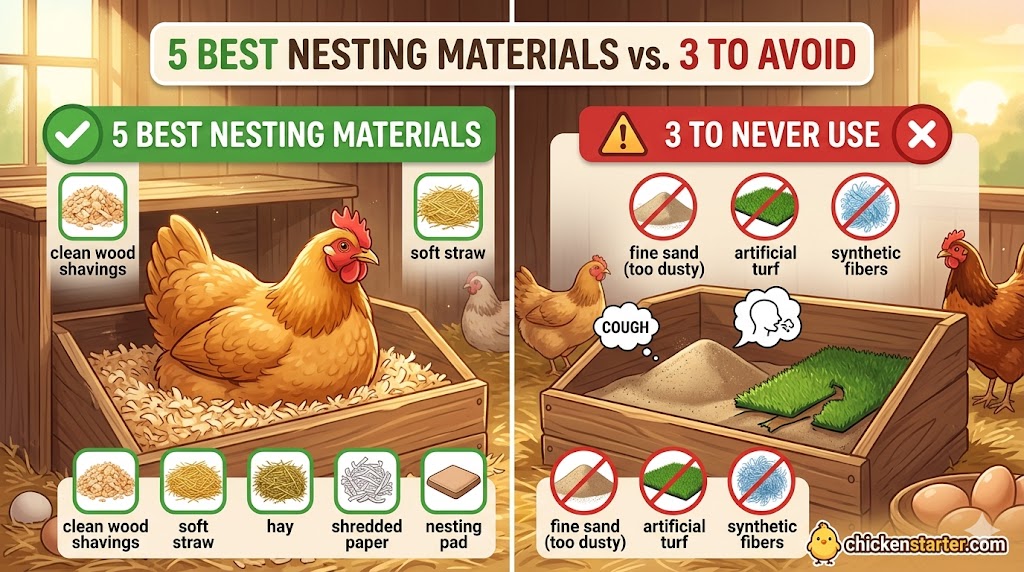
What you put inside a chicken nesting box directly affects egg cleanliness, shell integrity, hen comfort, and your flock’s overall reproductive health. The best nesting box materials are absorbent enough to wick moisture away from eggs, soft enough to cushion against breakage, deep enough to contain the eggs when a hen shifts position, and either naturally antimicrobial or easy enough to replace frequently. The five best options are pine shavings, straw, hemp bedding, pine needles, and nesting box pads, and each has specific advantages depending on your coop setup, climate, and budget.
Getting the nesting box material right is one of those small management decisions that has a disproportionate impact on your daily experience as a chicken keeper. I learned this the hard way in my second year. I switched from pine shavings to a layer of dried hay because hay was free from my neighbor’s barn, and within two weeks I was dealing with broken eggs, damp nests, and a mite problem that I had to treat while one of my Buff Orpingtons was actively broody. Changing back to pine shavings and adding a weekly dried lavender handful resolved everything. The detail matters.
This guide covers what works, what to avoid, how deep to fill the boxes, how often to change the material, and the handful of additions that experienced chicken keepers swear by for reducing egg damage and deterring parasites.
Why Nesting Box Material Matters More Than Most Keepers Realize
The nesting box is where your investment in quality laying hens pays off, or where preventable losses quietly accumulate. A poorly filled nesting box leads to broken eggs, egg eating behavior triggered by shell fragments in the nest, bacterial contamination from cracked shells mixed with moist bedding, and hens who avoid the box and lay in corners of the coop or run instead.
According to information from Penn State Extension, nesting boxes should be filled with clean, dry, absorbent nesting material that is replaced regularly to maintain hygiene and encourage hens to use designated laying areas. The material depth, cleanliness, and absorbency all directly influence laying behavior, egg quality, and disease prevention.
Beyond egg quality, the nesting box is also the space a broody hen occupies for 21 days or longer during incubation. The material underneath a broody hen needs to hold its structure, resist moisture from the hen’s body and environment, and not harbor the parasite populations that can drive a committed broody off her nest. For everything about managing a broody hen through a full incubation cycle, see our guide on how long does a broody hen sit on eggs before they hatch.
The 5 Best Materials to Put in a Chicken Nesting Box
1. Pine Shavings: The Reliable All-Around Choice
Pine shavings are the most widely recommended nesting box material for good reason. They are absorbent, readily available at any farm supply store, affordable, dust-tolerant, and comfortable for hens to settle into. They also compress slightly under a hen’s weight to form a natural bowl shape that keeps eggs centered and reduces rolling.
Kiln-dried pine shavings (the bagged variety sold specifically for poultry bedding) are the best choice. Fresh, un-kiln-dried pine shavings off a lumber saw can contain oils that are irritating to respiratory systems, but the dried, commercial bagged product has had those volatile compounds reduced substantially through the drying process.
Fill nesting boxes with 3 to 4 inches of pine shavings for best results. Less than 3 inches does not provide adequate cushioning against egg breakage. More than 5 inches tends to shift excessively and reduces the natural bowl shape that keeps eggs secure.
Pine shavings stay relatively clean for one to two weeks in a well-managed nesting box before needing a full replacement. Spot-clean daily by removing any droppings or cracked egg material. A full replacement costs roughly $5 to $12 per large bag, which typically fills three to four nesting boxes twice over.
The one genuine limitation of pine shavings in nesting boxes is their behavior in humid environments. In consistently damp climates or during wet seasons, pine shavings can clump and become less absorbent faster than usual. In those conditions, hemp bedding may be a better choice.
2. Straw: The Traditional Option With One Important Caveat
Straw is the traditional nesting material that generations of farmers have used, and it remains a functional choice if you use it correctly. The critical distinction is between straw (the hollow stems left after grain harvest, relatively non-absorbent) and hay (dried grasses and legumes cut for livestock feed, significantly more absorbent and prone to mold).
Use straw, not hay, in nesting boxes. Hay holds moisture in a way that promotes bacterial and fungal growth. A nest full of damp hay quickly becomes a disease risk. Straw, with its hollow stems, maintains structure better and resists moisture more effectively, though it is still less absorbent than pine shavings.
The advantage of straw is that hens enjoy manipulating it. A hen settling into a straw nest will turn and arrange the straw around herself, creating a well-formed cup that holds eggs securely. This nesting behavior appears to satisfy the same instinct that wild jungle fowl express when choosing a nest site, and hens who can arrange their own nesting material often seem more settled and contented in the box.
Straw nesting material needs more frequent inspection than pine shavings because its structure can hide droppings and broken egg material more effectively. Replace completely at least once per week in actively used boxes.
Chopped straw is superior to long straw in nesting boxes. Long straw can trap a hen’s foot or leg if it tangles, and it is easier for nesting material to shift away from the center of the box. Chopped straw at 3 to 4 inch pieces stays in place better and provides more uniform cushioning.
3. Hemp Bedding: The Premium Option Worth the Investment
Hemp bedding has become one of the most recommended nesting box materials among experienced chicken keepers over the past several years, and if you have not tried it yet, it is worth the additional cost for the performance difference it delivers.
Hemp bedding has several properties that make it exceptional for nesting boxes. It is highly absorbent, absorbing several times its own weight in moisture. It has natural antimicrobial properties that slow bacterial growth and odor development. It is very low in dust, making it an excellent choice for keepers or birds with respiratory sensitivities. It decomposes efficiently in a compost pile after use.
The material also holds its structure well. A hemp-filled nesting box maintains its depth and cushioning capacity significantly longer than pine shavings or straw before needing replacement. Some keepers who use hemp bedding replace their nesting box material every two to three weeks rather than weekly, which offsets the higher purchase price with reduced labor and replacement frequency.
The main barrier to hemp bedding adoption is cost. It is typically two to three times the price of pine shavings per volume. For keepers with small flocks and a few nesting boxes, this is a manageable premium. For larger operations, the cost adds up quickly. Our full material comparison guide, hemp vs. straw vs. sand chicken bedding, covers the full cost-to-performance breakdown if you want to evaluate this option in detail.
4. Dried Pine Needles: The Underrated Natural Option
Dried pine needles are a legitimately excellent nesting box material that almost no mainstream guide discusses. They are soft, aromatic, naturally antimicrobial (pine oil is a well-documented natural antimicrobial agent in its natural form within the needles rather than as a refined oil), and if you have pine trees on your property, they are entirely free.
The natural pine scent appears to deter mites to some degree, which is a genuine practical benefit. Experienced keepers who live in areas with abundant pine trees often report that pine needle nests have noticeably lower mite pressure than adjacent boxes filled with straw.
Pine needles provide excellent egg cushioning because of their interlocking structure, which creates a naturally formed bowl that holds eggs securely. The material stays in place better than straw and does not clump like damp pine shavings. It decomposes readily in a compost pile after use.
The limitation of pine needles is sourcing. If you have pine trees available, this material costs nothing. If you do not, it is not worth purchasing commercially at the prices it is sometimes sold. It is also slightly harder to source in bulk quantities than commercial bedding products.
Collect pine needles from healthy trees, allow them to dry completely in the sun for a few days before use, and replace every one to two weeks just as you would with any other bedding material.
5. Nesting Box Pads and Artificial Turf Inserts: The Convenience Option
Pre-formed nesting box pads and artificial turf-style nesting inserts have become increasingly popular with backyard chicken keepers who want consistent cushioning, easy cleaning, and predictable nest shape without the mess of loose material.
Commercial nesting pads are typically made from compressed excelsior (fine wood shavings), astroturf-style synthetic material, or rubber mat compounds designed specifically for poultry nesting. They provide a stable, non-shifting surface that keeps eggs secure and prevents the pile-at-the-back problem that loose materials sometimes create when a hen repeatedly settles in the same spot.
The main advantage is ease of management. A rubber or synthetic nesting pad can be removed, rinsed, and returned to the box in a few minutes. Excelsior pads are disposable and replacement is straightforward. Neither requires the daily sifting and spot-cleaning that loose materials benefit from.
The limitation of synthetic pads is that many hens prefer to manipulate their nesting material rather than settle on a fixed surface. Some hens accept pads readily. Others will obsessively scratch and rearrange the pad until it folds against the side of the box, defeating the purpose. Excelsior pads fare better in this regard because they have enough texture and slight give that hens accept them more naturally.
If you use synthetic or rubber pads, add a small handful of loose pine shavings or dried herbs on top of the pad. This satisfies the hen’s instinct to arrange her nest while the pad underneath provides stable cushioning for the eggs.
3 Nesting Box Materials You Should Never Use
Cedar Shavings: Natural-Looking but Genuinely Harmful
Cedar shavings are sold at many pet and farm stores alongside pine shavings, and the similarity in appearance causes a significant number of keepers to use them without knowing the difference. Do not use cedar shavings in nesting boxes or anywhere else in your coop.
Cedar contains aromatic oils including plicatic acid and thujone that are documented respiratory irritants in chickens and other small animals. Chronic exposure to cedar shavings has been linked to respiratory damage and immune suppression in poultry. The same oils that make cedar smell pleasant to humans are the problem for birds. Kiln-drying reduces the volatile oil content in pine shavings but does not eliminate the problematic compounds in cedar to a safe level.
Always check the label when buying bagged bedding from farm stores. The bags often look almost identical. Pine is safe. Cedar is not.
Newspaper: The Egg Breakage and Hygiene Disaster
Newspaper in a nesting box creates two serious problems. First, it provides almost no cushioning for eggs. A hen landing in a newspaper-lined box drops her full body weight onto the eggs in the nest. Shell cracking rates increase dramatically, and cracked eggs in the nest introduce bacterial contamination and often trigger egg eating behavior in hens who encounter the broken shells.
Second, newspaper is non-absorbent. Any moisture from droppings, egg whites from a cracked shell, or condensation sits on the surface and creates exactly the damp, bacteria-friendly environment you are trying to avoid. Newspaper may seem convenient and free, but the management problems it creates are not worth it.
If you are starting a flock with no bedding supplies immediately available, paper towels are a temporary substitute that is less problematic than newspaper because of their greater absorbency and softer texture. But purchase proper nesting material as soon as possible.
Sand: Wrong Tool for the Wrong Location
Sand is an effective coop floor material in certain climates and management systems. As nesting box material, it is a poor choice. Sand does not provide adequate cushioning for eggs. It does not form a stable bowl to hold eggs in place. It is heavy, making nesting boxes difficult to clean and move. And it does not absorb moisture effectively, instead allowing liquid to pool in the base of the nesting box.
Sand is occasionally recommended in online forums for nesting boxes because of its effectiveness in other coop contexts. That reputation does not transfer to the nesting box application. Keep sand on the coop floor if you use it. Keep soft, absorbent material in the nesting boxes.
How Deep Should Nesting Box Material Be?
Fill nesting boxes with 3 to 4 inches of material. This depth provides adequate cushioning for eggs, retains enough warmth for a comfortable laying environment, and gives hens enough material to arrange to their satisfaction.
Less than 3 inches means eggs can contact the hard floor of the nesting box when the hen’s body weight shifts the bedding to the sides. That direct contact with a hard surface is one of the most common causes of shell cracking in backyard flocks.
More than 5 inches creates a different problem. Deep, loose bedding encourages hens to scratch aggressively, which can cause eggs already in the box to get buried. Buried eggs are eggs you either find days late or do not find at all until they become a smell problem. A 3 to 4 inch depth that naturally bowls under the hen’s weight keeps eggs visible and accessible.
For broody hens specifically, a slightly deeper nest of 4 to 5 inches provides better insulation around the edges of the clutch and supports the nest cup shape that a sitting hen maintains through weeks of incubation. For everything about managing nesting box environments for brooding hens, see our guide on how to tell if your hen has gone broody.
How Often Should You Change Nesting Box Material?
Spot-clean daily and do a full nesting box change every one to two weeks for boxes in regular use. The specific timing depends on flock size, how many boxes you have relative to your number of hens, your climate, and the material you are using.
A box that sees heavy daily use from multiple hens needs more frequent attention than a lightly used box. Hemp bedding can typically go two to three weeks between full changes. Pine shavings in a busy box may need replacement weekly. Straw, which is least absorbent, sometimes needs replacement every five to seven days.
The practical test is simple. Pick up the material in your hand. If it feels damp, compacted, or smells of ammonia, replace it. If it still feels dry and fluffy with no odor, it can stay another few days.
Remove any cracked egg material immediately, regardless of how recently you last changed the box. Broken egg residue in a nesting box is one of the most reliable triggers for egg eating behavior. For detailed guidance on managing this problem, see our guide on chickens eating their own eggs.
Helpful Additions to Enhance Your Nesting Box Material
Dried Herbs: The Natural Deterrent That Actually Works
Dried lavender, mint, rosemary, and lemon balm are consistently recommended by experienced chicken keepers for their parasite-deterrent and calming properties. Lavender specifically contains linalool, which has documented repellent effects on mites and other insects. It also produces a calming effect in the laying environment.
Add a small handful of dried herbs on top of your nesting material when you refresh the box. You do not need large quantities. A two-tablespoon scattering is enough to provide the aromatic benefit. Replace when you change the bedding.
Caution: use only dried herbs in nesting boxes. Fresh herbs bring moisture into the box and can mold quickly beneath a sitting hen. Dry them completely before use or purchase pre-dried poultry herbs from farm supply stores.
Diatomaceous Earth: Use Carefully and Sparingly
Food-grade diatomaceous earth (DE) is sometimes added to nesting box material as a mite preventive. It works through physical rather than chemical action, damaging the exoskeletons of soft-bodied insects. Used correctly and sparingly, it is a legitimate addition to nesting box management.
The key word is sparingly. DE is a respiratory irritant in dust form when inhaled by chickens in excessive quantities. A light dusting of 1 to 2 tablespoons worked into the bottom layer of nesting material is appropriate. Do not apply it in amounts that create visible dust clouds when hens land in the box.
For a comprehensive mite and lice prevention and treatment guide that covers all your options including DE, see our guide on mites and lice on chickens.
Fake Eggs or Golf Balls: The Nest Training Tool
Placing a ceramic nest egg or golf ball in a nesting box signals to new layers that this is the correct place to lay. Young pullets approaching point of lay are looking for cues about where to deposit their eggs. A visible egg-shaped object in a dark, comfortable box is one of the most effective cues available.
Keep one fake egg in each box you want hens to use consistently. Remove them once your pullets have established reliable laying patterns, usually after three to four weeks of consistent use.
Fake eggs also serve as a deterrent for egg eating. A hen who pecks at a fake egg and gets no reward eventually loses interest in pecking at eggs in the nest, which can help interrupt the habit before it becomes entrenched.
Nesting Box Setup and Location Tips
Material alone is not enough if the nesting box itself is poorly positioned or designed. The best nesting material in the world will not encourage hens to use a box that is too bright, too exposed, or placed in a high-traffic area.
Hens prefer nesting boxes that are dark, enclosed, and slightly elevated above the coop floor. The ideal placement is along a shaded wall, away from the main coop door, and positioned at least 18 inches above the floor but not so high that hens have to jump awkwardly to access them.
Provide one nesting box for every three to four hens. Insufficient nesting space leads to competition, stress, and hens laying in floor corners instead of designated boxes. Our complete guide on backyard chicken nesting boxes covers sizing, placement, and design considerations in full detail.
Block nesting box access at night. Hens who roost in nesting boxes deposit significant droppings there overnight, soiling the nesting material and eggs laid the following morning. Use a simple board or sliding cover that you prop open each morning when you let the flock out. This single management step dramatically reduces the frequency of nesting material replacement needed. For overall coop sizing and setup guidance, see our guide on how big should a chicken coop be.
Nesting Box Material for Broody Hens: What Changes
A broody hen sitting on eggs for 21 days or longer needs specific consideration in the nesting box material choice. The standard guidelines above apply, but with a few additional priorities.
The material under a broody needs to hold its structure for weeks rather than days. Hemp bedding or a deep base of pine shavings perform best here because they resist the compression and matting that occurs when a hen sits in the same spot continuously for three weeks.
The nest cup shape is critical for incubation success. A well-formed cup keeps eggs beneath the hen’s brood patch consistently rather than rolling to the edges where heat coverage is incomplete. Add extra material around the outer edge of a broody hen’s nest at the start of her sitting period to reinforce the bowl shape.
Check the broody hen’s nesting material every few days during her daily break. Replace immediately if it is damp or soiled significantly. A mite-infested or unsanitary nest is one of the leading causes of mid-incubation abandonment. For guidance on what to do if a hen abandons her nest despite your best management efforts, see our guide on what to do when a hen abandons her eggs midway.
If you are considering allowing a broody hen to hatch versus using an artificial incubator, the nesting box environment is one of the factors that influences that decision. Our complete comparison guide on broody hen vs. incubator: which is better for hatching eggs covers everything you need to make that choice confidently.
Quick Reference: Nesting Box Material Comparison
| Material | Absorbency | Cost | Durability | Mite Resistance | Best For |
|---|---|---|---|---|---|
| Pine Shavings | Good | Low ($5 to $12/bag) | 1 to 2 weeks | Average | General use, all climates |
| Straw (chopped) | Moderate | Low (free to $8) | 1 week | Average | Traditional setups, dry climates |
| Hemp Bedding | Excellent | High ($15 to $25) | 2 to 3 weeks | Good | Humid climates, respiratory concerns |
| Dried Pine Needles | Good | Free (if available) | 1 to 2 weeks | Good | Free-range setups near pine trees |
| Nesting Pads | Good (with top layer) | Moderate ($10 to $30 reusable) | Months (washable) | Average | Ease of cleaning, small flocks |
| Cedar Shavings | Good | Low | Good | Good | NEVER USE |
| Newspaper | Poor | Free | Days | Poor | NEVER USE |
| Sand | Poor | Low | Long | Poor | NOT FOR NESTING BOXES |
What I Use and Why It Works
After trying nearly every option on this list across multiple coop configurations and seasons, my current setup is a 3-inch base of kiln-dried pine shavings with a handful of dried lavender tucked into each corner of the box. I replace the shavings completely every 10 to 12 days and spot-check daily during the summer months when my flock is at peak production and the boxes see the most traffic.
For my broody hens, I switch to hemp bedding specifically because the structural durability over three plus weeks of sitting is noticeably better than pine shavings, which compacts and shifts more under the sustained weight and heat of a sitting hen.
The lavender addition happened after a frustrating mite problem in my second year. I cannot definitively prove causality, but since I started using dried lavender consistently, I have had significantly fewer mite issues in the nesting boxes specifically compared to the rest of the coop, which gets the same cleaning schedule but no herb addition.
Small details compound. The difference between a well-managed nesting box and a neglected one is the difference between clean, intact eggs every morning and a daily collection that includes cracked shells, floor-laid eggs, and increasingly expensive veterinary conversations about why your hens are eating their production. Get the material right, maintain it consistently, and your nesting boxes will reward you with clean, whole eggs on a schedule you can rely on.
Note: This guide is for educational purposes. Individual flock management needs vary. Always choose materials appropriate for your specific climate, flock size, and coop design.

Oladepo Babatunde is the founder of ChickenStarter.com. He is a backyard chicken keeper and educator who specializes in helping beginners raise healthy flocks, particularly in warm climates. His expertise comes from years of hands-on experience building coops, treating common chicken ailments, and solving flock management issues. His own happy hens are a testament to his methods, laying 25-30 eggs weekly.