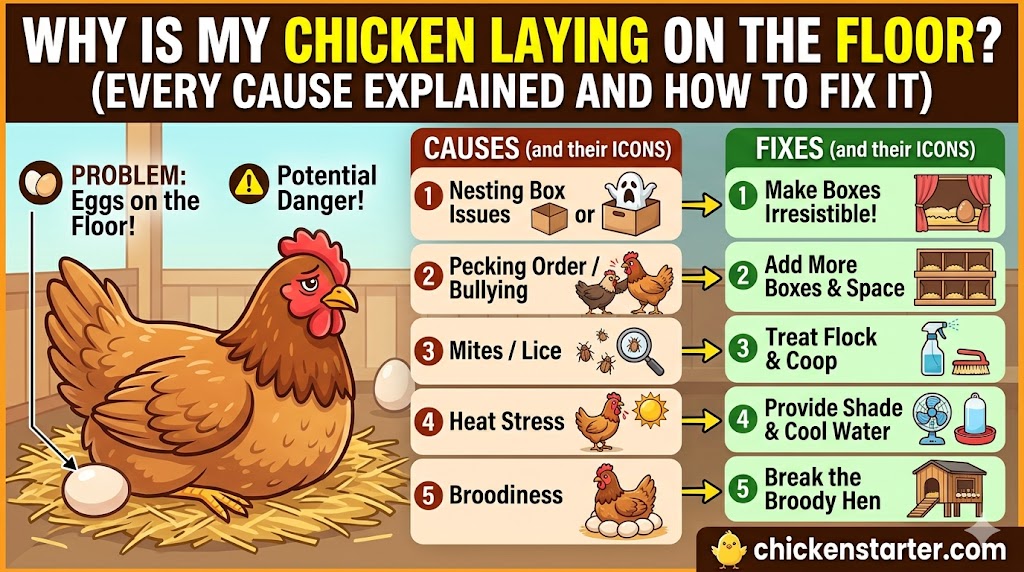
A chicken laying on the floor is one of the most common problems backyard keepers encounter, and it means completely different things depending on whether your chicken is laying eggs on the floor, sleeping on the floor at night, or lying down flat on the ground during the day. Each situation has its own set of causes, its own urgency level, and its own solution. Some are simple management fixes you can handle in an afternoon. Others are early warning signs of health problems that need immediate attention.
The most important thing to understand upfront is this: a chicken lying flat on its side or unable to stand is a medical emergency that requires a veterinarian. A chicken laying eggs on the floor is a management problem you can solve with some coop adjustments. A chicken sleeping on the coop floor instead of roosting is a pecking order or housing issue. These are three completely different situations, and this guide addresses all of them with the specific detail each deserves.
I have dealt with every version of this problem across my years of keeping chickens. Floor eggs drove me crazy in my first flock until I figured out that my nesting boxes were positioned too high for my young pullets. A hen lying flat on the ground once sent me running for the phone to call my vet, and that turned out to be the right call. Understanding what you are actually looking at is the most important diagnostic step before anything else.
My Chicken Is Laying Eggs on the Floor: 7 Reasons It Happens
Floor eggs, sometimes called ground eggs, happen when hens lay in the coop or run floor instead of in the designated nesting boxes. They are frustrating because floor eggs get dirty faster, break more frequently, and if left undiscovered for even a few hours, can trigger egg eating behavior. Understanding the specific cause in your flock determines the fastest fix.
Reason 1: The Nesting Boxes Are Not Accessible to Young Pullets
This is the most common cause of floor laying in new flocks, and it is entirely preventable. Young pullets approaching their first point of lay at 18 to 22 weeks are physically smaller and less agile than mature hens. If your nesting boxes are positioned at the standard adult height of 18 to 24 inches off the floor, a young pullet who needs to lay urgently may not feel confident jumping up to access them.
The result is a floor egg laid wherever the urge became irresistible, usually in a corner of the coop with whatever nesting material happened to be nearby.
The fix is temporary but effective. Install a small step or ramp leading to the nesting boxes during the first few weeks your pullets are in lay. Once they have used the boxes a few times and built the habit, remove the ramp. In my experience, once a pullet has successfully used a nesting box even twice, she will seek it out reliably going forward.
Reason 2: Not Enough Nesting Boxes for the Flock Size
The standard recommendation is one nesting box for every three to four laying hens, and exceeding that ratio creates competition that pushes lower-ranking hens off the box and onto the floor. Hens have strong preferences about where they lay, and dominant hens will occupy the favored boxes for extended periods, sometimes before they actually need to lay, simply to guard the resource.
A hen who approaches the boxes, finds them occupied, tries repeatedly for 20 to 30 minutes, and eventually cannot hold on any longer will lay on the floor. This is not bad behavior. She did everything right except have access to the right space at the right time.
If you are seeing regular floor eggs alongside normal nesting box use, count your hens and count your available nesting boxes. If the ratio is off, adding one or two additional boxes often solves the problem within a week.
For detailed guidance on nesting box sizing, placement, and setup, see our complete guide on backyard chicken nesting boxes.
Reason 3: The Nesting Box Material Is Unappealing or Uncomfortable
Hens have opinions about their nesting boxes. A box with soiled, wet, compressed bedding, a box that is infested with mites, or a box that is simply too uncomfortable will be avoided by hens who would otherwise use it without issue. If the available boxes are uninviting and the floor has a soft, dry patch of litter, hens will choose the floor.
This is especially common in the warmer months when mite populations explode in warm, undisturbed nesting boxes. A hen who gets bitten every time she sits in the nest box will eventually stop sitting there. The floor is not ideal from her perspective either, but it is at least not actively unpleasant.
Inspect your nesting boxes closely. Check the material for moisture, smell, and signs of mite or lice activity. For a full guide on the best materials to use and which ones to avoid, see our detailed guide on what to put inside a chicken nesting box.
Reason 4: The Nesting Boxes Are Too Bright or Too Exposed
Hens instinctively seek dark, enclosed, private spaces to lay eggs. This is a predator-avoidance behavior inherited from jungle fowl ancestors who laid eggs in concealed locations to protect them from theft or discovery. A nesting box that is positioned in bright light, too close to the coop door, or too open on the front face does not trigger the safety response that encourages a hen to settle in and lay.
Nesting boxes should be located on the shadiest wall of the coop, away from windows and main access points, with at least a partial roof overhang that creates shadow inside the box. If your boxes are in a well-lit position, a simple fix is attaching a curtain of burlap or fabric across the front of the box. Many keepers report an almost immediate improvement in box usage after adding nesting curtains.
Reason 5: A Young Pullet Laying Her First Eggs
First-time layers often produce their earliest eggs in unexpected locations because the laying process is still new to them behaviorally and physically. A pullet who has never laid before does not yet know where to go when the urge arrives. She may lay in the nesting box, on the floor, in the run, or in whatever corner she happened to be standing in when the process became unavoidable.
This is temporary. Most pullets establish consistent nesting box use within two to three weeks of their first egg. You can accelerate this process by placing a ceramic nest egg or golf ball in each nesting box to signal that this is the correct location. This visual cue is remarkably effective for guiding new layers toward the intended location.
For everything about behavioral signs before a pullet’s first egg, see our guide on chicken behavior before laying their first egg.
Reason 6: A Broody Hen Has Claimed All the Best Boxes
When a broody hen settles into a nesting box, she does not share. She claims the box as her territory, guards it aggressively, and refuses to move for any other hen who wants to lay. If your most popular nesting box is occupied by a broody hen for days or weeks at a stretch, other hens lose access to their preferred laying location and some will resort to floor laying.
This is most common in spring and early summer when broodiness peaks. If you have a broody hen you are not using for hatching, breaking the broodiness promptly resolves the issue for the rest of your flock. For a complete guide to identifying and managing a broody hen, see our article on how to tell if your hen has gone broody.
Reason 7: The Hen Has Simply Developed a Floor-Laying Habit
This is the most frustrating cause because it has no obvious trigger. Some hens, once they discover a comfortable floor corner or a particular patch of litter in the run, develop a persistent habit of laying there regardless of the nesting box situation. Habit formation in chickens is surprisingly strong, and a hen who has been rewarded with the comfort of her chosen floor spot 10 or 15 times will return to it consistently.
Breaking this habit requires making the floor spot unappealing while simultaneously making the nesting box more attractive. Block the preferred floor location temporarily with a piece of wood, a cardboard box, or any physical barrier. Place a nest egg in the nesting box. Confine the offending hen to the coop (not the run) for a few days so the nesting box is her only realistic option. Most hens reform within a week of this intervention.
How to Stop Chickens From Laying on the Floor: A Step-by-Step Fix
The solution to floor laying is almost always a combination of environmental improvement and brief behavioral intervention. Here is the practical process:
Step 1: Identify which hens are laying on the floor. If you have a mixed flock, spend 30 minutes observing laying behavior. Knowing whether it is one hen or multiple hens narrows the cause significantly. One chronic floor layer is usually a habit problem. Multiple floor layers usually indicate a nesting box access issue.
Step 2: Evaluate your nesting boxes honestly. Check material cleanliness and depth (should be 3 to 4 inches). Check for mites by examining the box corners and under the material. Check the lighting level. Check access for young or small hens. Resolve any deficiencies you find.
Step 3: Verify your hen-to-box ratio. Count laying hens. Divide by four. That is the minimum number of nesting boxes you need. Add more if you are under.
Step 4: Block floor laying spots. Temporarily cover the corner, patch of litter, or run spot where floor eggs have been found. A bucket, a plank of wood, or even a pile of material in that spot disrupts the habit.
Step 5: Add nest eggs to the nesting boxes. One ceramic egg or golf ball per box signals that this is where eggs belong. Hens follow visual cues from other eggs when choosing a laying location.
Step 6: If one chronic floor layer persists, confine her. Keep her in the coop with access only to the nesting boxes for three to five days. Ensure food, water, and comfortable nesting material are available. Most hens break the floor-laying habit during this brief reorientation period.
Why Are My Chickens Sleeping on the Floor Instead of Roosting?
Chickens sleeping on the floor of the coop at night is a completely separate issue from egg-laying on the floor, but it is equally common and equally worth fixing. Chickens are instinctively driven to roost off the ground at night because elevation provides safety from ground-level predators. A chicken that is choosing the floor instead of the roost is either physically unable to use the roost, being excluded from the roost by dominant flock members, or living in a coop where the roost setup is physically inadequate.
They Cannot Access the Roost
Roosts that are too high, too narrow, or lack a proper approach path are inaccessible to some birds. Bantams, younger pullets, heavy breeds like Brahmas and Cochins, and birds with foot problems like bumblefoot cannot easily reach roosts that are positioned at heights suited to lighter, more agile breeds.
According to information from Penn State Extension, roosts for backyard flocks should be placed at a height of 2 to 4 feet, with lower options for heavy or less-agile breeds, and should be positioned so birds can fly or hop up to them from a lower intermediate surface if needed. A 2-by-4 board installed with the wide side up gives chickens a flat surface to wrap their toes around comfortably.
If your roost is positioned higher than 4 feet without an intermediate perch or ramp, add a step. Heavy breeds and older birds especially benefit from a lower roost option even in coops where other birds use higher bars.
Pecking Order Exclusion
Lower-ranking hens are sometimes prevented from accessing the roost by dominant birds who guard the best spots. A flock where the top-ranking hens claim all available roost space leaves subordinate birds with nowhere to go but the floor.
In my own flock, I noticed two of my Wyandottes consistently sleeping in the corner after I added three new Rhode Island Reds. The RIRs were claiming the full roost bar every night, leaving my Wyandottes physically displaced. Adding a second roost bar at a slightly lower height gave everyone adequate space within days and ended the floor-sleeping completely.
Ensure your total roost length provides 8 to 10 inches of linear space per bird. A flock of 10 hens needs at minimum 80 to 100 inches (roughly 7 to 8 feet) of usable roost length. For managing the social dynamics behind this type of problem, see our guide on pecking order problems and how to stop bully hens fast.
New or Young Birds Who Have Not Learned to Roost Yet
Newly introduced adult birds and young pullets transitioning from the brooder to the coop often sleep on the floor for the first week or two while they learn the social hierarchy and the physical layout of their new home. This is normal transitional behavior and does not require intervention beyond ensuring the roost is physically accessible.
Most birds figure out roosting within one to two weeks of entering a new coop. You can gently place young birds on the roost bar for several consecutive evenings after dark, when they are calm and less likely to jump off. This physical placement at the right time teaches the behavior remarkably fast.
The Coop Is Too Hot
In summer, a coop that retains heat at roost height may drive hens to sleep on the cooler floor. Hot air rises. If your coop lacks adequate ventilation at the top, the temperature difference between floor level and roost height can be significant enough that hens choose the floor on hot nights for comfort rather than any management-related reason.
Improve upper ventilation in your coop during summer months. Adding ventilation openings near the roofline allows hot air to escape and keeps the roost area at a more comfortable temperature.
My Chicken Is Lying on the Ground During the Day: When to Worry
A chicken lying flat on the ground in the middle of the day is the scenario that requires the most urgent attention. Normal chickens do not lie flat on the ground during active hours unless they are dust bathing, sunbathing, or severely ill.
Normal Reasons a Chicken Lies Down During the Day
Sunbathing. Chickens spread their wings and lie on their sides in a patch of warm sunlight, looking to the uninitiated like they have had a medical emergency. The first time I saw one of my hens do this, I ran across the yard certain something terrible had happened. She was fine. She was enjoying the sunshine. The giveaway is that a sunbathing hen returns to normal posture immediately when approached and shows no sign of distress.
Dust bathing. A hen engaged in a dust bath will roll, scratch, and lie on her side repeatedly in a patch of dry soil or dust. She looks chaotic and occasionally makes it seem like something is very wrong. She is not. Dust bathing is essential parasite management behavior.
Resting in heat. During hot weather, hens sometimes sit flat on cool ground with their wings slightly spread to dissipate heat. This is normal provided they are alert, responsive, and have access to shade and cool water.
When Lying Down Is a Serious Warning Sign
A hen who is lying on the ground, unable to stand without assistance, unresponsive to your approach, or showing other symptoms is a medical emergency. Common health conditions that cause a chicken to lie on the floor or ground unable to rise include:
Egg binding. A hen who cannot pass an egg in her oviduct becomes progressively weaker and will eventually be unable to stand. She often makes straining movements and may have a distended abdomen. This is a potentially fatal condition that requires veterinary intervention within hours.
Marek’s disease. This herpesvirus causes progressive paralysis, often appearing first as leg weakness followed by an inability to stand. Affected birds typically show a characteristic posture with one leg stretched forward and one backward.
Newcastle disease or avian influenza. Neurological symptoms including inability to stand, twisted neck, and inability to coordinate movement can accompany several serious poultry diseases. Any neurological symptom in your flock requires immediate veterinary contact and potential reporting to your state or national animal health authority.
Injury. A hen who was attacked by a predator, hit by a vehicle near a free-range area, or injured in a flock altercation may be unable to stand from pain or trauma.
Severe parasitism. A bird severely depleted by a heavy mite, lice, or internal worm burden may become too weak to maintain normal posture and activity.
If your hen is lying on the ground and does not stand when you approach, pick her up immediately and examine her for obvious injuries, check her vent for a prolapsed tissue or stuck egg, and contact a poultry veterinarian. For a full assessment guide covering all causes of a lethargic, recumbent chicken, see our guide on why is my chicken lethargic: 17 causes and how to help. For guidance on when a situation warrants a vet call, see our guide on when to call the vet for a backyard chicken.
My Chicken Is Laying on Its Side: Is This an Emergency?
A chicken lying completely on its side requires you to answer one question immediately: is she responsive?
A responsive chicken who rights herself when touched, runs away when approached, or shows any normal behavioral response is almost certainly sunbathing or dust bathing and does not need intervention.
An unresponsive chicken who does not react when you approach, does not attempt to right herself when you touch her, or who rights herself slowly and then immediately lies back down is showing signs of serious illness or injury. This is an emergency.
The most common health causes of a truly non-responsive chicken found on her side include heat stroke (especially in summer, especially in heavy-feathered or overweight birds), severe infection, neurological disease, and egg-related peritonitis. All of these require veterinary assessment. Do not wait to see if she improves on her own.
Why Are My Laying Hens Not Laying? Floor Eggs Versus Production Drop
Sometimes what looks like a production problem is actually a floor egg problem in disguise. Before concluding that your hens have stopped laying, check every corner of the coop, the run, and any free-range areas your birds access. Check under bushes, behind the coop, in tall grass, and in any sheltered corner. Hens are creative about choosing laying locations and an undiscovered floor-laying spot can make it appear that your flock has stopped producing entirely.
If you have genuinely confirmed that eggs are not being laid anywhere, rather than just not being laid in the nesting boxes, then a production drop has occurred. The most common causes include reduced daylight hours in autumn and winter, nutritional deficiency (particularly calcium and protein), stress from a predator event or flock disruption, a disease affecting the reproductive system, and the natural production decline that occurs as hens age past their second year.
For a comprehensive breakdown of every cause of reduced egg production and how to address each one, see our guide on why do chickens stop laying eggs.
How to Train Hens to Use Nesting Boxes: The Complete Process
The most effective approach to stopping floor laying permanently is a combination of environmental management and behavioral guidance. Here is the full process in order of priority:
Audit your nesting boxes first. Assess material depth (3 to 4 inches), cleanliness, lighting (darker is better), privacy (more enclosed is better), and accessibility (low enough for all birds in your flock). Fix any deficiencies before trying behavioral interventions.
Add nest eggs. Place a ceramic egg, plastic egg, or golf ball in every nesting box you want hens to use. This single step improves box use dramatically for most flocks within three to five days.
Block floor laying locations. Cover every spot where floor eggs have been found with a physical barrier for at least two weeks. Hens need consistent failure in their preferred floor location to abandon the habit.
Confine chronic floor layers to the coop only. Remove run access for three to five days. With only the coop available and the floor spots blocked, most hens will accept the nesting box. Once they have used it successfully a few times, the habit transfers.
Maintain nesting box quality consistently. The single most reliable long-term solution to floor laying is a nesting box that is consistently more appealing than any floor alternative. Clean, deep, dark, and pest-free nesting boxes are ones that hens choose voluntarily without any behavioral intervention needed.
For a full guide to nesting box material selection, depth recommendations, and how to maintain boxes for consistent hen use, see our comprehensive guide on what to put inside a chicken nesting box.
Frequently Asked Questions
Why is my chicken laying on the floor in the morning?
Morning floor eggs are most common when hens feel the urge to lay before the nesting boxes become accessible, or when a hen is producing her first eggs as a young pullet. Check whether your coop pop door opens at a consistent time that may be later than some hens want to access the run. Also verify that nesting boxes are not being blocked by roosting birds who have not yet vacated their spots from the previous night.
Why are my chickens sleeping on the floor of the coop?
Chickens sleeping on the floor instead of roosting are usually responding to roost bars that are too high, too narrow, too crowded, or inaccessible due to pecking order exclusion. Verify that your roost provides 8 to 10 inches of linear space per bird, is installed at an accessible height with a clear approach path, and is not dominated by a small group of assertive hens who exclude others.
My chicken is laying down all day. Should I be worried?
A chicken who is laying down throughout the day without engaging in normal foraging, eating, and social behavior is showing signs of illness or injury. Normal chickens are active during daylight hours. Prolonged lying down combined with lethargy, a pale comb, loss of appetite, or any discharge requires veterinary assessment. Do not attribute this to laziness or heat if other symptoms are present.
Why are my chickens laying eggs on the ground outside?
Hens who lay eggs in the run, in the yard, or in other outdoor locations are usually doing so because the nesting boxes are inaccessible, unappealing, or occupied when the laying urge arrives. Free-range hens who have discovered a sheltered outdoor location may prefer it over nesting boxes, particularly in spring and summer. The solutions are the same as for indoor floor laying: improve nesting box accessibility and appeal while blocking the preferred outdoor location.
Can floor eggs still be eaten?
Floor eggs are safe to eat if collected promptly and the shells are intact. The concern with floor eggs is faster contamination (from feces, dirt, and moisture contact) and increased shell cracking. Intact floor eggs collected within a few hours of laying are no different in food safety terms from nesting box eggs. Cracked floor eggs should be discarded.
The chicken laying on the floor is a problem with solutions at every level, from the simple nesting box adjustment that fixes it in a week to the medical emergency that requires a phone call right now. The key is reading the specific situation in front of you correctly and responding proportionately. Most floor laying problems are management problems, and management problems have management solutions.
Note: This guide is for educational purposes. Any chicken showing signs of illness, inability to stand, or neurological symptoms should be evaluated by a licensed poultry veterinarian promptly.

Oladepo Babatunde is the founder of ChickenStarter.com. He is a backyard chicken keeper and educator who specializes in helping beginners raise healthy flocks, particularly in warm climates. His expertise comes from years of hands-on experience building coops, treating common chicken ailments, and solving flock management issues. His own happy hens are a testament to his methods, laying 25-30 eggs weekly.