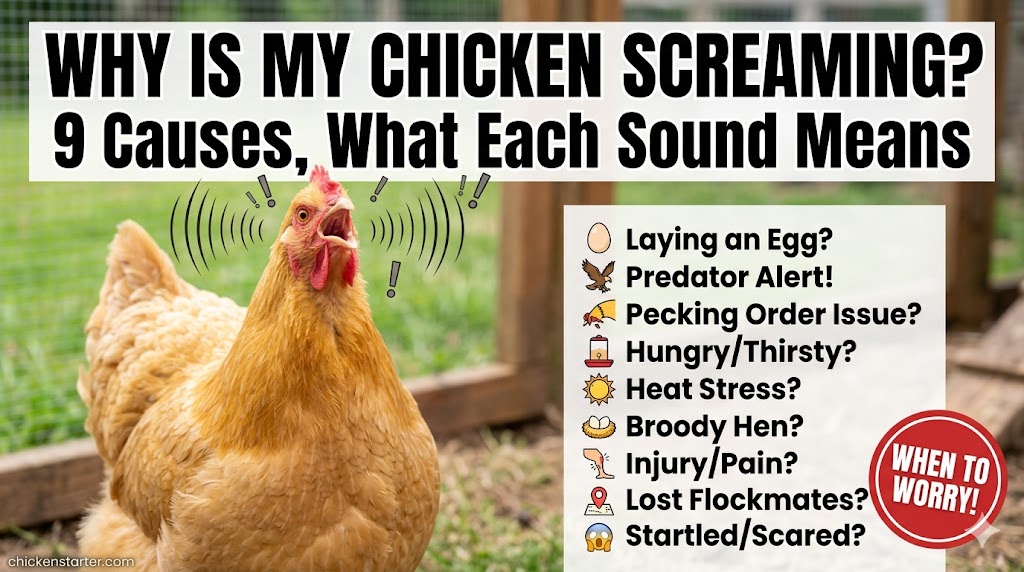
If your chicken is screaming, it is trying to tell you something specific. Chickens do not scream randomly. According to research published in the journal Animal Behaviour, chickens produce over 30 distinct vocalizations, each serving a specific communication purpose. A sudden, loud, high-pitched scream almost always falls into one of nine categories: the egg song, a predator alarm call, pain or illness, broody behavior, a roosting dispute, social conflict, fear or startle response, isolation distress, or a respiratory problem that sounds like screaming but is actually a medical emergency.
I have kept chickens for several years now, and the first time one of my hens let out a full-throated scream at 6 AM on a Saturday, I genuinely thought something was attacking the coop. I ran outside in my pajamas clutching a flashlight. She was standing in the run, perfectly fine, yelling at the sky because another hen was in her favorite nesting box. That was my introduction to the fact that chickens are dramatic creatures with strong opinions and zero volume control.
But here is the thing. Sometimes that scream is genuinely urgent. A predator alarm call sounds very different from an egg song, and a chicken screaming from pain sounds different from a chicken screaming because she wants her nesting box back. Learning to tell the difference can save your flock.
For a deeper dive into all chicken vocalizations, see our complete guide on chicken noises and what they mean.
The Egg Song: The Most Common Reason Your Chicken Is Screaming in the Morning
The egg song is by far the most common cause of chicken screaming, and it is completely normal. If your chicken is screaming in the morning or during the first half of the day, there is an excellent chance she is singing the egg song.
According to poultry author and PBS host Lisa Steele of Fresh Eggs Daily, the egg song is a loud, staccato vocalization that hens produce before, during, or after laying an egg. It sounds something like “bawk-bawk-bawk-ba-GAWK” repeated at high volume, sometimes for several minutes. Some breeds perform it louder than others. Steele notes that her Ameraucanas and Australorps are the main squawkers, while her Lavender Orpingtons are fairly quiet about the whole affair.
Here is what makes this extra confusing for new chicken keepers. The hen doing the screaming is not always the one laying. In my flock, my noisiest hen frequently screams the egg song while standing outside the nesting box that another hen is currently occupying. She is essentially yelling “hurry up in there” at maximum volume.
Why Do Chickens Scream When They Lay Eggs?
Nobody knows the definitive answer, but behavioral research points to three likely explanations.
The escort call theory suggests that after laying an egg away from the flock, the hen calls for the rooster or flock leader to escort her safely back to the group. This makes evolutionary sense. A hen alone at a nest is vulnerable to predators. I have personally watched my rooster respond to the egg song by rushing over, doing his courtship dance, and then walking the hen back to the flock. It happens like clockwork.
The distraction theory suggests that the hen is drawing attention to herself and away from the eggs in the nest. She moves away from the nesting box before screaming, creating a “look at me, not at my eggs” diversion for any nearby predator.
The nesting box frustration theory simply says that a hen who wants to lay but finds her preferred box occupied will loudly protest. Think of it as the chicken equivalent of someone banging on a locked bathroom door.
If the screaming happens during the morning hours, lasts a few minutes, and the hen is otherwise healthy and active, it is almost certainly the egg song. No action needed. For more on pre-laying behaviors, see our guide on chicken behavior before laying their first egg.
Predator Alarm Call: Why Your Chicken Is Screaming at Night
A chicken screaming at night is almost always a predator alarm call, and you should investigate immediately. Chickens are generally quiet and settled after dark. Any loud vocalization at night is a serious warning sign.
Chickens produce two distinct types of predator alarm calls. The first is a loud, high-pitched, rapid-fire shriek that signals a ground predator such as a fox, raccoon, weasel, or rat. This call is meant to alert every bird in the flock and create as much noise as possible to startle the intruder.
The second is a sharp, single, very high-pitched scream followed by silence. This signals an aerial predator like a hawk or owl. The flock responds by freezing in place and staying quiet, trying to avoid detection from above. Experienced keepers on BackYard Chickens describe this as the “air raid” call, noting that when a rooster makes this sound, every chicken within earshot drops flat and goes completely silent.
What to Do When Your Chicken Screams at Night
Go check on them. Now. Bring a flashlight. Look for signs of a predator attempting to enter the coop: scratching at hardware cloth, digging under walls, or reaching through openings. Common nighttime predators include raccoons, possums, foxes, weasels, minks, owls, and rats. Even a mouse scurrying through the coop can trigger a panicked alarm call from a nervous hen.
I lost a hen to a raccoon several years ago because I dismissed nighttime screaming as “just chickens being chickens.” I will never make that mistake again. Now, any nighttime vocalization gets an immediate investigation.
For comprehensive coop security strategies, see our predator-proofing guide and our guide on the best predator deterrents for chickens.
Pain, Injury or Illness: The Scream That Means Something Is Wrong
A chicken in severe pain will scream in a way that sounds distinctly different from any other vocalization. It is a sharp, desperate, sustained cry that experienced keepers describe as unmistakable once you have heard it.
Chickens are remarkably good at hiding pain and illness. It is a survival instinct. A visibly weak chicken in the wild is the first one a predator targets. So if a chicken’s pain has reached the point where she is screaming, something is seriously wrong.
Common causes of pain-related screaming include egg binding (a potentially fatal condition where an egg gets stuck in the oviduct), bumblefoot (a painful staph infection on the foot pad), injuries from predator attacks or flock aggression, prolapsed vent, and internal reproductive problems like egg yolk peritonitis.
If your chicken is screaming and you cannot identify an obvious cause like the egg song or a predator, perform a physical examination. Check her vent for prolapse or egg binding. Check her feet for swelling, heat, or dark scabs (bumblefoot). Look for wounds hidden under feathers. Feel her abdomen for swelling or hardness. Check her crop for impaction.
For a complete diagnostic checklist, see our guide on how to tell if a chicken is sick.
Respiratory Distress: When Screaming Is Actually a Medical Emergency
Sometimes what sounds like screaming is actually a chicken struggling to breathe. This is the scenario that requires the most urgent attention.
According to veterinary information from Dine-A-Chook Australia, respiratory illness can be dangerous in chickens and it is vital to treat it early, as recovery is rare without intervention. A chicken with a respiratory infection may produce sounds that include honking, high-pitched squeaking, gurgling, rattling, or whistling. To an inexperienced ear, these can sound like screaming.
Key signs that the “screaming” is actually respiratory distress include the chicken extending her neck and stretching upward while making the sound, open-mouth breathing (chickens normally breathe with a closed beak), foamy or bubbly eyes, nasal discharge, and lethargy or decreased appetite alongside the abnormal vocalization.
Common respiratory diseases in chickens include Mycoplasma gallisepticum (chronic respiratory disease or CRD), Infectious Bronchitis (a coronavirus), Infectious Laryngotracheitis (a herpes virus), and gapeworm (a parasitic worm that attaches to the trachea).
Will a chicken respiratory infection go away on its own? Some mild viral infections like low-pathogenic Newcastle Disease may resolve without treatment. But most bacterial respiratory infections like CRD require antibiotic treatment prescribed by a veterinarian. Untreated respiratory infections can spread to your entire flock. Once infected with Mycoplasma, a chicken carries the bacteria for life.
If you suspect respiratory illness, isolate the sick bird immediately and consult a veterinarian. For more detailed guidance, see our complete guide on treating chicken respiratory infections.
Broody Hen Screaming: The Growling, Puffed-Up Terror
A broody hen will scream, growl, shriek, and even bite when disturbed from her nest. If your normally sweet hen has suddenly turned into a hissing, puffed-up ball of fury that screams every time you approach the nesting box, congratulations. She is broody.
Broody screaming sounds completely different from other types. It is lower, more guttural, often described as growling or dinosaur-like. Some keepers call it the “velociraptor growl.” My broody Buff Orpington once screamed so dramatically when I reached under her for eggs that my daughter asked if the chicken was dying. She was not. She was just very committed to her empty nest.
Broody behavior is hormonally driven. The hen believes she is incubating eggs (whether eggs are actually present or not) and will aggressively defend her nest from anything she perceives as a threat. This includes you.
To manage a broody hen, see our detailed guide on how to break a broody hen.
Fear and Startle Response: Chickens Screaming for “No Reason”
Chickens that appear to be screaming for no reason are almost always reacting to something you have not noticed. Their senses are sharper than ours, particularly their eyesight. A chicken can see a hawk circling at a distance you would need binoculars to spot.
Common triggers for startle-screaming include sudden loud noises (a car backfiring, a dog barking, power tools), unfamiliar animals in the yard (a neighbor’s cat, a wild bird, a squirrel), unusual objects (a new garden ornament, a plastic bag blowing across the yard), and shadows from overhead (planes, large birds, even clouds moving fast on a windy day).
I once spent 20 minutes trying to figure out why my flock was screaming intermittently throughout the afternoon. It turned out my neighbor was flying a kite. The shadow passing overhead triggered the aerial predator alarm every time it drifted over the run. Chickens do not distinguish between a hawk and a kite-shaped shadow. They scream first and evaluate later.
Environmental changes that seem trivial to you can be deeply alarming to a chicken. A new piece of furniture near the coop window, a changed walking path, a different colored jacket on a familiar person. All of these can trigger startle vocalizations.
Social Conflict and Pecking Order Disputes
Dominant hens will scream at subordinate flock members to enforce the pecking order. This is particularly common when new birds are introduced, when the flock hierarchy is disrupted by adding or removing birds, or when resources like food, water, or favorite roosting spots are limited.
These screams are sharp, confrontational, and usually directed at a specific bird. You will typically see the screaming hen puffed up, head forward, sometimes chasing or pecking at the target of her displeasure.
If the screaming is accompanied by aggressive behavior that draws blood or prevents lower-ranking birds from accessing food and water, intervention is needed. Ensure adequate space, provide multiple feeding and watering stations, and separate any bird causing injuries. See our guide on pecking order problems and how to stop bully hens for detailed strategies.
Why Do Male Chickens Scream in the Morning?
Roosters do not technically scream. They crow. But if you are not expecting it, a rooster’s early morning crowing can absolutely sound like screaming, especially at 4:30 AM when you are trying to sleep.
Roosters crow for several reasons. They announce their territory to other roosters. They signal the flock that a new day is beginning. They assert their position as flock leader. And they crow in response to environmental stimuli like lights, sounds from other roosters, or even headlights from passing cars. A rooster with a particularly loud or unusual crow can sound genuinely alarming to someone unfamiliar with the sound.
If your rooster’s early morning crowing is a problem, see our guide on why roosters crow in the morning and our guide on the quietest chicken breeds for backyards if you are considering a flock change.
Two Signs of an Unhealthy Chicken Every Owner Should Know
If your chicken is screaming and you suspect illness, look for these two critical warning signs that distinguish a sick bird from a healthy one being dramatic.
Lethargy combined with the vocalization. A healthy chicken that screams is active, alert, and engaged with her flock between screaming episodes. A sick chicken that is vocalizing abnormally will also show reduced activity, fluffed-up feathers, closed or half-closed eyes, and a hunched posture. This combination always warrants concern.
Changes in eating, drinking, or egg production alongside the screaming. A chicken screaming the egg song will eat breakfast enthusiastically five minutes later. A chicken screaming from pain or illness often refuses food, drinks less, or suddenly stops laying. Any vocalization change paired with appetite loss or production drops should prompt a veterinary consultation.
For a thorough health assessment process, see our chicken health check guide and our guide on when to call the vet for a backyard chicken.
How to Stop a Chicken From Screaming
The answer depends entirely on the cause. There is no single solution because screaming is a symptom, not a problem.
If it is the egg song: You cannot and should not try to stop this. It is normal behavior. Insulating your coop can reduce the volume your neighbors hear. Choosing naturally quieter breeds helps if you are in a noise-sensitive area.
If it is a predator alarm: Investigate the threat and address it. Improve coop security. Install motion-activated lights. Remove habitat that attracts predators near the coop.
If it is pain or illness: Identify and treat the underlying health issue. Consult a veterinarian.
If it is broody behavior: Break the broodiness using proven methods.
If it is fear or startle: Identify and remove the triggering stimulus. Provide more cover and hiding spots in the run.
If it is social conflict: Increase space, add feeding stations, and separate aggressive birds if needed.
If it is respiratory distress: Isolate the bird and seek veterinary treatment immediately.
Do not spray chickens with water to “train” them to stop screaming. Some online sources recommend this, but it does not address the underlying cause, stresses the bird, and can damage your relationship with your flock.
Frequently Asked Questions
What does it mean when a chicken screams?
A screaming chicken is communicating a specific message. The most common cause is the egg song (normal, happens during laying hours). Other causes include predator alarm calls (especially at night), pain or illness, broody behavior, social disputes, fear, or respiratory distress. The context, including the time of day, duration, and accompanying behaviors, determines which cause is most likely.
Why is my chicken screaming at night?
A chicken screaming at night is almost always responding to a predator or perceived threat. Chickens have very poor night vision and are vulnerable after dark. Any nighttime vocalization should be investigated immediately. Check for raccoons, possums, foxes, weasels, rats, owls, or other predators near or inside the coop.
Why is my chicken screaming in the morning?
Morning screaming is typically the egg song, a loud vocalization associated with egg laying. Hens sing before, during, or after laying, and other flock members often join in. This is completely normal and not a cause for concern unless accompanied by signs of distress or illness.
Why is my chicken making a high-pitched noise?
A high-pitched noise can indicate either a predator alarm call or respiratory distress. If the chicken is alert, active, and looking upward or at a specific point, it is likely an alarm call. If the chicken is lethargic, extending its neck, breathing with an open beak, or showing nasal discharge, it may be a respiratory emergency requiring veterinary attention.
Will a chicken respiratory infection go away on its own?
Some mild viral respiratory infections may resolve without treatment, but most bacterial infections require antibiotics. Chronic Respiratory Disease (CRD) caused by Mycoplasma gallisepticum requires antibiotic treatment and creates lifelong carriers. Never assume a respiratory infection will resolve on its own. Isolate the bird and consult a veterinarian.
How do I stop my chicken from screaming?
Identify and address the underlying cause. There is no universal “off switch” for chicken screaming. The egg song is normal and should not be suppressed. Predator alarms require security improvements. Pain and illness require medical treatment. Broody screaming requires breaking the broodiness. Social conflict requires flock management adjustments. Treating the cause stops the screaming.
Your chickens are not being dramatic for the sake of it (well, usually not). Every scream has a message. Learn to read those messages, and you will be a better, calmer, and more responsive chicken keeper.
Note: This guide is for educational purposes. Always consult a licensed poultry veterinarian for diagnosis and treatment of health issues in your flock. If you suspect a notifiable disease like avian influenza, contact your state or national veterinary authority immediately.

Oladepo Babatunde is the founder of ChickenStarter.com. He is a backyard chicken keeper and educator who specializes in helping beginners raise healthy flocks, particularly in warm climates. His expertise comes from years of hands-on experience building coops, treating common chicken ailments, and solving flock management issues. His own happy hens are a testament to his methods, laying 25-30 eggs weekly.