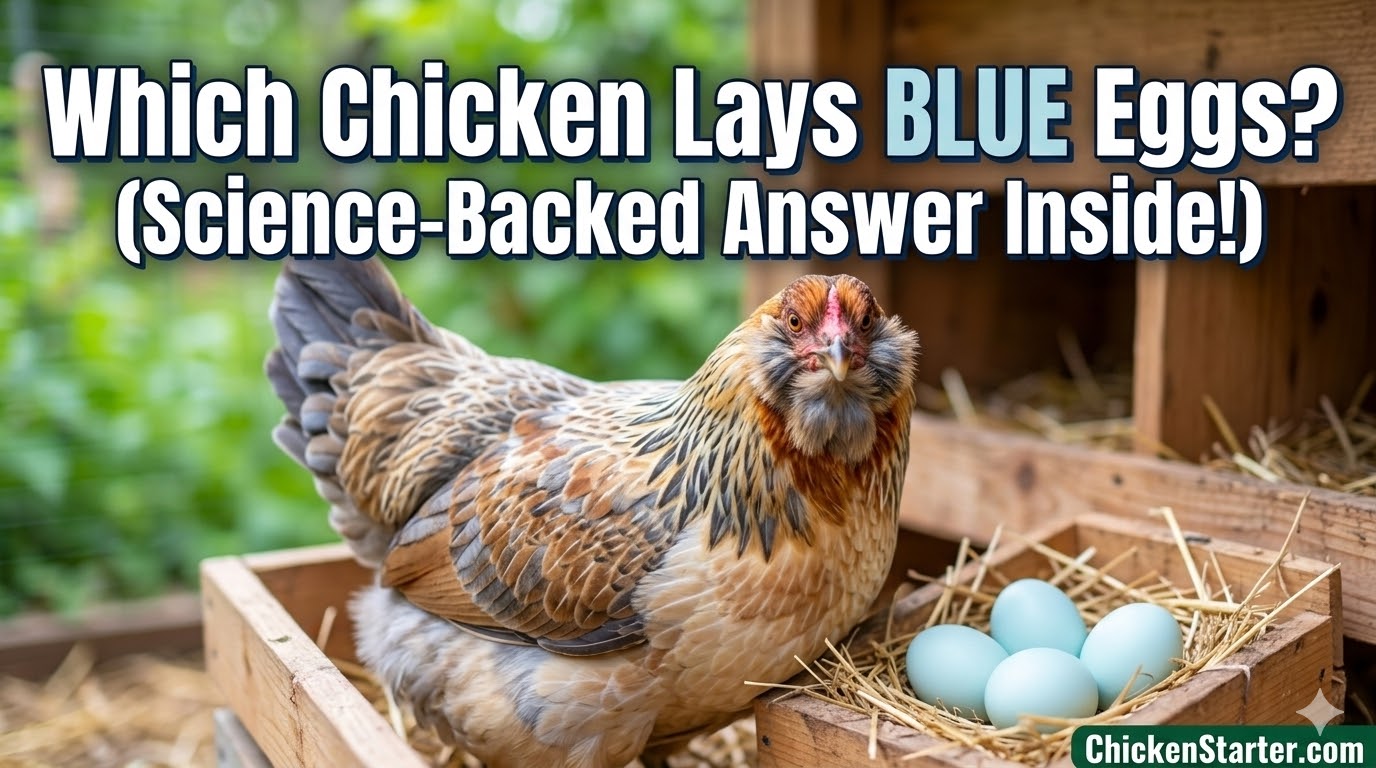
What chicken lays blue eggs? The main breeds that lay blue eggs are the Araucana, Ameraucana, Cream Legbar, Whiting True Blue, and Easter Egger. Blue eggshell color is caused by the oocyan gene (O gene), which triggers the deposit of a pigment called biliverdin throughout the entire shell during formation. This means blue eggs are blue on the inside and outside when you crack them open, unlike brown eggs which are white inside. Blue eggs are completely safe to eat and contain no nutritional difference from white or brown eggs. Shell color is determined by genetics alone, not diet or health.
The first time I found a blue egg in my nesting box, I genuinely stopped and stared at it for a solid 30 seconds. It was sitting there among the usual brown eggs from my Buff Orpingtons, and the color was so vivid I thought something was wrong. Then I remembered my new Ameraucana hen, Sapphire, had just started laying. I picked it up, brought it inside, and cracked it open. The inside of the shell was blue too. That was the moment I fell down the rabbit hole of egg color genetics, and what I learned about why some chickens lay blue eggs is genuinely one of the most fascinating stories in all of poultry science. It involves an ancient retrovirus, two completely independent evolutionary events on opposite sides of the planet, and a famous geneticist you probably studied in high school biology class. Whether you keep backyard chickens in the United States, Canada, Australia, or the United Kingdom, this guide covers every blue egg breed, the real science behind the color, and where to find these remarkable birds.
Why Do Some Chickens Lay Blue Eggs? (The Genetics Explained)
The O Gene: A Retrovirus Changed Everything
Blue eggs are not just a cosmetic variation. They represent one of the most unique genetic events in poultry history.
As published in PLOS Genetics by Wang et al. (2013), blue eggshell color is caused by the insertion of an endogenous avian retrovirus called EAV-HP into chicken DNA near the SLCO1B3 gene. This retroviral insertion causes the overexpression of the SLCO1B3 gene specifically in the shell gland (uterus) of the hen’s oviduct.
The SLCO1B3 gene encodes a membrane transporter protein called OATP1B3. As explained by Vincent Racaniello on Virology Blog, this protein mediates the uptake of a wide range of organic compounds into the cell, including bile salts. When SLCO1B3 is overexpressed in the shell gland, it transports biliverdin, a blue-green pigment that is a natural byproduct of hemoglobin breakdown, directly into the eggshell as it forms around the egg.
This trait is governed by what geneticists call the oocyan gene (O gene), which is autosomal dominant. As confirmed in the PLOS One study by Wragg et al. (2013), oocyan or blue/green eggshell color “is an autosomal dominant trait found in native chickens (Mapuche fowl) of Chile.” One copy of this gene is enough to produce blue eggs.
Blue Eggs Are Blue All the Way Through
This is the detail that surprises most people and the one that makes blue eggs genetically unique among all egg colors.
Crack a blue egg open and the inside of the shell is also blue. Crack a brown egg open and the inside is white. This fundamental difference exists because the two pigments are deposited in completely different ways.
Biliverdin (blue pigment) is incorporated throughout the entire calcium carbonate shell structure during formation. It penetrates every layer from inside to outside. Protoporphyrin-IX (brown pigment) is applied only as a surface coating during the final hours before the egg is laid. It sits on top of the shell like paint on a wall.
This is why you can scratch a brown egg and reveal white underneath, but a blue egg remains blue no matter how deeply you scratch.
Two Separate Origins: Convergent Evolution
Here is where the story becomes truly remarkable. The same retrovirus created blue eggs in two completely separate chicken populations on opposite sides of the world, independently.
As the PLOS Genetics study by Wang et al. (2013) confirmed, the EAV-HP insertion was found in both South American Araucana chickens and Chinese Dongxiang and Lushi chickens. However, the integration sites are different. As the PLOS One study by Wragg et al. (2013) documented, “identical host integration sites and DNA sequences are found for the South American and European chickens,” while “the host integration site is different” for the Dongxiang chicken. As the researchers concluded, “the results clearly indicate the independent acquisition of the oocyan phenotype in native Asian and South American chickens.”
This is called convergent evolution: two completely separate evolutionary events producing the same result. The same retrovirus, inserting near the same gene, in chickens on two different continents, thousands of years apart, both producing blue eggs. As stated in PLOS Genetics, “we provide unambiguous evidences that the genetic basis of blue shell phenotype in Araucana is different from that in Chinese blue-shelled breeds, indicating independent originations.”
How Green and Olive Eggs Work
If blue eggs come from biliverdin and brown eggs come from protoporphyrin, what happens when a chicken carries genes for both?
You get green eggs.
The shell forms with biliverdin throughout (making the base blue), and then protoporphyrin is applied on the surface (adding a brown coating). Blue base plus brown surface equals a green appearance. The intensity of the green depends on how much brown pigment the individual hen deposits.
Olive eggs follow the same principle but use a darker brown. When you cross a blue egg layer (like an Ameraucana) with a dark brown egg layer (like a Black Copper Marans), the resulting offspring lays eggs with a deep olive or army green color. These hybrids are called Olive Eggers.
This is also why Easter Eggers can lay such a wide range of colors. Depending on the strength of both the blue gene and the brown pigment genes in their mixed genetics, individual Easter Egger hens produce anything from vivid blue to sage green to mint to even pinkish tones.
What Breed of Chicken Lays Blue Eggs? (Complete List)
| Breed | Egg Color | Blue Reliability | Eggs/Year | Egg Size | Hen Weight | APA Status | Availability | Best For |
|---|---|---|---|---|---|---|---|---|
| Araucana | True blue | Excellent | 150 to 180 | Medium | 4 to 5 lbs | Recognized | Rare | Purists, show breeders |
| Ameraucana | Blue | Excellent | 200 to 250 | Medium-large | 5.5 lbs | Recognized (1984) | Breeders only | Reliable blue + breed standard |
| Cream Legbar | Blue/blue-green | Very Good | 180 to 200 | Medium | 5.5 to 6 lbs | Not APA (UK standard) | Moderate | Autosexing + blue eggs |
| Whiting True Blue | Blue | Excellent | 280 to 300 | Medium-large | 4.5 to 5.5 lbs | Not recognized | Growing | Maximum blue egg production |
| Easter Egger | Variable | Not guaranteed | 200 to 280 | Large | Variable | Not recognized | Very common | Budget, color variety |
| Olive Egger | Olive/dark green | N/A (green) | 150 to 200 | Large | Variable | Not recognized | Moderate | Dark green/olive eggs |
| Dongxiang | Blue-green | Very Good | 120 to 160 | Small-medium | 3 to 3.5 lbs | Not in US standard | Extremely rare | Genetics research |
Araucana: The Original Blue Egg Chicken
The Araucana is where the blue egg story begins. This breed originated in Chile and was bred by the Mapuche indigenous people for centuries before European contact. According to the Livestock Conservancy, Professor Salvador Castelló first described the birds in Chile in 1914. As documented by the Araucana Club of America, he later introduced them at the World Poultry Congress in The Hague in 1921, presenting them as a new breed with three defining characteristics: blue eggs, rumplessness, and ear tufts.
The Araucana produces the purest, most vivid blue eggs of any breed. They lay approximately 150 to 180 eggs per year, with hens weighing 4 to 5 pounds.
What makes Araucanas particularly challenging to breed is the lethal tufting gene (Et). As documented by multiple poultry genetics sources, when a chick inherits two copies of this gene (homozygous Et/Et), it is lethal to the embryo. This means approximately 25% of embryos from tufted-to-tufted matings die before hatching, making breeding programs difficult and hatch rates consistently lower than other breeds.
True Araucanas are rumpless (completely lacking tail vertebrae) and tufted (feather tufts protruding from a fleshy pad near the ears). They are recognized by the American Poultry Association and carry a Critical conservation status from the Livestock Conservancy. They are rare and expensive, with chicks ranging from $15 to $50 or more from quality breeders.
For more details, see our Araucana chicken breed guide.
Ameraucana: The Reliable Blue Egg Layer
The Ameraucana was developed in the United States during the 1970s specifically to solve the Araucana’s breeding challenges. Breeders worked with Araucana stock to eliminate the lethal tufting gene while preserving the blue egg trait.
The key differences from the Araucana: Ameraucanas have a tail (they are not rumpless), they have muffs and a beard (not tufts), and they carry no lethal gene. They were recognized by the American Poultry Association in 1984 in eight color varieties: Black, Blue, Blue Wheaten, Brown Red, Buff, Silver, Wheaten, and White.
Ameraucanas lay reliably blue eggs at a rate of approximately 200 to 250 per year, making them more productive than Araucanas. Hens weigh approximately 5.5 pounds and have a gentle, friendly temperament well suited for backyard flocks.
A word of warning: I hate to break it to you, but if you bought “Ameraucanas” from a major hatchery for $3 to $5 per chick, you almost certainly have Easter Eggers, not true Ameraucanas. Most hatcheries sell mixed-breed birds under the “Ameraucana” or “Americana” (deliberate misspelling) label. True Ameraucanas come from specialized breeders conforming to the APA standard, and they cost significantly more. The Ameraucana Breeders Club is the definitive resource for finding legitimate stock.
For the full breakdown, see our Ameraucana chicken breed guide and our detailed Ameraucana vs Easter Egger comparison.
Cream Legbar: The Autosexing Blue Egg Layer
The Cream Legbar has one of the most fascinating origin stories in all of poultry breeding, and it involves a name you probably remember from high school biology class.
As documented by Cackle Hatchery and multiple breed references, the Cream Legbar was created by Reginald Crundall Punnett and Michael Pease at the Genetical Institute of Cambridge University in England. Yes, that is the same Punnett of Punnett Square fame, the foundational genetics tool still taught in biology classrooms worldwide.
As Backyard Poultry magazine reports, Punnett was Britain’s first genetics professor and was charged by the British government with developing breeds that could be sexed at hatch. He created the Legbar lines by crossing Brown Leghorns with Barred Plymouth Rocks. As Poultry Keeper explains, these birds were later crossed with Cream Araucanas in 1940 that Punnett had at Cambridge, which had crests and laid blue eggs. From this cross, the Crested Cream Legbar was established.
The Cream Legbar is an autosexing breed, meaning male and female chicks display different down colors at hatch. Male chicks are pale cream with faint barring, while female chicks are darker with a distinct chipmunk stripe down the back. This eliminates the guesswork of chick sexing entirely.
Cream Legbars lay blue to blue-green eggs at a rate of approximately 180 to 200 per year. Hens weigh 5.5 to 6 pounds and are active, alert, excellent foragers with a distinctive small crest on the head. They are very popular in the United Kingdom but less common in the United States and Australia. They are not APA recognized but are standardized under UK breed standards.
Whiting True Blue: The Purpose-Bred Blue Egg Layer
The Whiting True Blue is the breed most articles about blue eggs completely overlook, and it deserves far more attention.
Developed by Dr. Tom Whiting of Whiting Farms in Colorado, the Whiting True Blue was purpose-bred specifically for two goals: consistent blue egg color and high production. Dr. Whiting, known primarily for breeding roosters whose feathers are prized by fly-fishing enthusiasts, applied his selective breeding expertise to create a blue egg line that would outproduce every other blue egg breed on the market.
The results speak for themselves. Whiting True Blues lay approximately 280 to 300 blue eggs per year, making them the highest-production blue egg layer available. Hens weigh 4.5 to 5.5 pounds and have an active, friendly temperament.
They are not APA recognized and have variable appearances since they were bred for eggs rather than looks. But if your goal is to fill a basket with consistent blue eggs every single week, the Whiting True Blue is the best choice available today. They are gaining rapid popularity among backyard keepers across the United States and are now available from several major hatcheries.
Easter Egger: The Most Common “Blue Egg” Chicken
The Easter Egger is not a true breed. It is a classification for any chicken carrying the blue egg gene mixed with other genetics. According to poultry breed standards, Easter Eggers are not recognized by the APA because they do not breed true to a standard.
This matters because Easter Eggers do not guarantee blue eggs. Depending on each individual bird’s genetics, an Easter Egger hen may lay blue, green, pink, cream, or even brown eggs. You will not know what color your hen will lay until she produces her first egg. If you want a specific color, buy a specific breed. For more on why egg color varies, see our article on why is my Easter Egger laying pink eggs.
That said, Easter Eggers are excellent chickens. They lay approximately 200 to 280 eggs per year, have friendly temperaments, and are widely available from every major hatchery at $3 to $5 per chick, making them the most affordable route to potentially blue eggs.
The critical point: most hatchery birds sold as “Ameraucanas” or “Araucanas” are actually Easter Eggers. If it came from a standard hatchery at a standard price, it is almost certainly an Easter Egger. This is not a bad thing. Just manage your expectations about egg color. For the full breed profile, see our Easter Egger chicken guide.
Dongxiang: The Chinese Blue Egg Chicken
The Dongxiang chicken from Jiangxi Province, China, represents the other half of the convergent evolution story. This ancient heritage breed carries the same EAV-HP retrovirus insertion near the SLCO1B3 gene, but at a different integration site than the Araucana, confirming that blue eggs evolved independently in China.
Dongxiang chickens have black skin (fibromelanistic trait), lay blue-green eggs, and produce approximately 120 to 160 eggs per year. They are extremely rare outside China and are primarily significant for genetics research rather than practical backyard keeping.
Lushi Chicken
The Lushi chicken from Henan Province, China, is another heritage Chinese breed that carries an independent EAV-HP insertion. Lushi chickens lay variable egg colors including blue-green and pink. Like the Dongxiang, they are extremely rare outside their native region and are primarily studied for their contribution to understanding blue egg genetics.
What Black Chicken Lays Blue Eggs?
Several options exist if you want a black-feathered bird that lays blue eggs:
- Ameraucana (Black variety): APA recognized, reliably blue eggs, black feathers
- Fibro Easter Egger: An Easter Egger carrying the fibromelanistic gene (black skin and feathers), often producing blue or green eggs
- Dongxiang: Black-skinned Chinese heritage breed with blue-green eggs (extremely rare outside China)
Myth-bust: Ayam Cemani does NOT lay blue eggs. This is one of the most persistent myths in the poultry world. The Ayam Cemani is famous for its striking black skin, black bones, and black organs due to fibromelanosis. However, this melanistic trait affects skin, meat, bones, and internal organs. It does not affect eggshell pigmentation. Ayam Cemani hens lay cream to light-tinted eggs, not blue or black. Despite what viral social media posts claim, no chicken on earth lays a black egg. For more on the domestic chicken species, see our article on Gallus gallus domesticus.
What White Chicken Lays Blue Eggs?
If you prefer white-feathered birds with blue eggs:
- Ameraucana (White variety): Pure white feathers with reliably blue eggs, APA recognized
- Whiting True Blue: Can come in white or light-feathered varieties, consistent blue eggs
- Cream Legbar: Cream and white coloring with blue to blue-green eggs
- Easter Egger: Some individuals are white-feathered with blue egg potential
What Grey Chicken Lays Blue Eggs?
Grey-feathered blue egg layers include:
- Ameraucana (Blue variety): Slate blue/grey feathers with blue eggs. This is one of the most popular Ameraucana color varieties.
- Ameraucana (Lavender variety): Pale grey/lavender feathers. Not yet APA recognized but increasingly popular.
- Cream Legbar: Can display grey tones in their plumage
- Easter Egger: Variable colors including grey
Chickens That Lay Green and Blue Eggs
How Green Eggs Happen (Blue Plus Brown)
As explained in the genetics section above, green eggs result from the combination of the blue egg gene (biliverdin throughout the shell) and brown pigment genes (protoporphyrin on the surface). The intensity of the green depends entirely on how much brown pigment each individual hen deposits.
Olive Egger: The Darkest Green
Olive Eggers are not a breed but a deliberate hybrid cross, typically an Ameraucana or Cream Legbar (blue egg parent) crossed with a Black Copper Marans or Welsummer (dark brown egg parent). First-generation crosses produce the darkest olive or army green eggs.
They lay approximately 150 to 200 eggs per year and are available from specialty hatcheries. If you want the deepest olive color, the first-generation cross is essential. Second-generation Olive Eggers tend to produce lighter, less consistent colors.
Whiting True Green
Dr. Tom Whiting also developed a green egg line by combining blue egg genetics with brown pigment genetics. The Whiting True Green produces consistent green eggs at a high rate of 280 or more per year, mirroring the production levels of the Whiting True Blue.
Easter Eggers (Green Variety)
Many Easter Eggers lay green rather than blue because they carry the blue gene alongside varying levels of brown pigment genetics. Shades range from mint green to sage to seafoam to olive, depending on the individual bird’s genetic makeup.
What Chicken Lays Light Blue Eggs?
The lightest, most vivid blue eggs come from:
- Araucana: The purest blue of any breed
- Ameraucana: Reliable medium-to-light blue
- Whiting True Blue: Consistent light-medium blue
- Cream Legbar: Can range from light blue to blue-green
Several factors affect blue intensity in any breed: age (younger hens lay more vivid eggs), individual genetics (some hens naturally lay lighter or darker blue), laying cycle (the first eggs after a molt tend to be most vivid), and overall health and diet (well-nourished hens produce better shell quality).
Are Blue Eggs Safe to Eat?
Completely Safe: No Nutritional Difference
Yes, blue eggs are 100% safe to eat. Shell color has absolutely zero effect on the nutritional content of the egg inside. Blue eggs contain the same proteins, fats, and vitamins as white or brown eggs. The biliverdin pigment is a natural compound from hemoglobin breakdown and is completely harmless.
What actually determines egg nutrition is the hen’s diet and living conditions, not shell color. Free-range eggs from any breed outperform caged eggs of any shell color in terms of nutrient density. For more on backyard egg quality, see our guide on eggs from backyard chickens.
What Egg Color Is the Healthiest?
No egg color is “healthier” than another. This is a persistent myth that has been thoroughly debunked. Shell color is determined by genetics and tells you nothing about what is inside the egg. A free-range blue egg from a backyard Ameraucana is nutritionally comparable to a free-range brown egg from a backyard Rhode Island Red, assuming both hens eat a similar diet.
Do Blue Eggs Taste Different?
No. Shell color does not affect flavor. Diet affects flavor. Pasture-raised hens that eat a varied diet of insects, greens, and quality feed produce richer-tasting eggs regardless of shell color. Many keepers swear their blue eggs taste better, but this is almost certainly because backyard eggs in general taste better than commercial eggs, not because of the color.
What Is the Rarest Color of Chicken Eggs?
| Egg Color | Rarity | Reason | Breed Example |
|---|---|---|---|
| Dark chocolate | Very rare | Quality Marans lines only | Black Copper Marans |
| True blue (Araucana) | Rare | Araucanas themselves are rare | Araucana |
| Dark olive | Rare | Requires specific first-gen cross | Olive Egger |
| Consistent blue (any breed) | Uncommon | Needs true blue egg breed | Ameraucana, Whiting True Blue |
| Light green | Common | Many Easter Eggers produce this | Easter Egger |
| Pink | Common but inconsistent | Bloom-dependent, not genetic | Silkie, Buff Orpington |
| Brown | Very common | Most breeds | RIR, Orpington, Australorp |
| White | Common | Production breeds | Leghorn |
For more on pink eggs specifically, see our article on what chicken lays pink eggs.
Are Blue Eggs More Expensive?
Yes, generally. The rarity and novelty of blue eggs commands a premium at every level:
| Breed | Day-Old Chick | Started Pullet | Where to Buy |
|---|---|---|---|
| Araucana | $15 to $50+ | $40 to $80+ | Araucana Club breeders |
| Ameraucana | $8 to $25+ | $30 to $60+ | Ameraucana Breeders Club |
| Cream Legbar | $8 to $15 | $25 to $45 | Specialty hatcheries |
| Whiting True Blue | $5 to $10 | $20 to $35 | Major hatcheries |
| Easter Egger | $3 to $5 | $15 to $25 | Every major hatchery |
| Olive Egger | $5 to $10 | $20 to $35 | Specialty hatcheries |
At farmers markets, blue eggs often sell for $1 to $2 more per dozen than standard brown eggs. The visual appeal and novelty factor make them highly marketable.
Blue Egg Laying Chickens for Sale: Where to Buy
Finding True Ameraucanas
The Ameraucana Breeders Club maintains a directory of legitimate breeders producing birds that conform to the APA standard. This is the only reliable way to guarantee true Ameraucanas. Do not rely on major hatchery descriptions.
Finding True Araucanas
The Araucana Club of America maintains a breeder list. Availability is very limited, and expect higher prices. True Araucanas with proper tufts and rumplessness from quality lines are among the most expensive common breed chickens.
Cream Legbar Sources
Specialty hatcheries increasingly carry Cream Legbars. Cackle Hatchery stocks them, and availability is growing in the United States and Australia.
Whiting True Blue Sources
Major US hatcheries now carry Whiting True Blues, including Cackle Hatchery and Meyer Hatchery. This is the best value option for consistent blue eggs at a reasonable price.
Easter Egger Sources
Almost every major hatchery stocks Easter Eggers. Cackle Hatchery, Murray McMurray, Meyer Hatchery, and Ideal Poultry all carry them as standard offerings. They are the most affordable and available option.
What Chicken Lays Blue Eggs UK?
In the United Kingdom, the Cream Legbar is the most popular blue egg breed and is widely available from UK breeders. The Araucana is also available, though the UK breed standard differs from the US standard. As documented on multiple breed registries, the UK Araucana may be tailed (unlike the US standard which requires rumplessness). Both tailed and rumpless varieties may be exhibited in Australia. For general UK chicken keeping guidance, see our guide on keeping chickens in the UK.
What Chicken Lays Blue Eggs Australia?
Araucanas are available from specialty breeders across Australia, and Easter Eggers are becoming more common. Cream Legbars are gaining popularity through dedicated breeders. Check state poultry clubs and breed societies for current availability. For purchasing guidance, see our guide on where to buy chickens in Australia.
Ameraucana vs Araucana vs Easter Egger: The Confusion Explained
| Feature | Araucana | Ameraucana | Easter Egger |
|---|---|---|---|
| True Breed? | Yes | Yes | No, mixed genetics |
| APA Recognized? | Yes | Yes (1984) | No |
| Egg Color | Blue (purest) | Blue (reliable) | Variable (blue, green, pink, brown) |
| Guaranteed Blue? | Yes | Yes | NO |
| Tail | NO (rumpless) | Yes | Usually yes |
| Facial Feathers | Tufts (near ears) | Muffs + beard | Variable |
| Lethal Gene? | Yes (Et gene) | No | No |
| Eggs/Year | 150 to 180 | 200 to 250 | 200 to 280 |
| Price (chick) | $15 to $50+ | $8 to $25+ | $3 to $5 |
| Availability | Very rare | Specialized breeders | Every hatchery |
| Sold at hatcheries as “Ameraucana”? | No | Rarely | Yes (often mislabeled) |
Why the Confusion Exists
The confusion stems primarily from hatchery marketing practices. Many hatcheries label Easter Eggers as “Ameraucana” or use the deliberate misspelling “Americana” to imply a connection without technically violating truth in advertising. Buyers expect blue eggs and sometimes receive green, pink, or even brown.
How to Tell What You Have
- True Araucana: Rumpless (no tail at all) + tufted (feathers from fleshy pad near ears) + blue eggs
- True Ameraucana: Has a tail + has muffs and beard (not tufts) + blue eggs + conforms to one of the 8 APA recognized color varieties
- Easter Egger: Everything else. Variable appearance, variable egg color, does not conform to a breed standard.
If you paid $3 to $5 per chick from a major hatchery, you almost certainly have an Easter Egger, regardless of what the label said.
For the full detailed comparison, see our Ameraucana vs Easter Egger article.
How Egg Colors Are Made
| Egg Color | Pigment | Location | Genetic Basis | Example Breeds |
|---|---|---|---|---|
| White | None (calcium carbonate only) | N/A | Default, no pigment genes | Leghorn, Polish |
| Blue | Biliverdin | Throughout entire shell | O gene (dominant) | Araucana, Ameraucana |
| Brown | Protoporphyrin-IX | Surface coating only | Multiple genes | Rhode Island Red, Orpington |
| Green | Biliverdin + Protoporphyrin | Blue throughout + brown on surface | O gene + brown genes | Easter Egger, Olive Egger |
| Dark olive | Heavy biliverdin + heavy protoporphyrin | Blue throughout + thick brown coat | O gene + Marans dark brown | Olive Egger (Ameraucana x Marans) |
| Pink | Light protoporphyrin + bloom | Light surface + fresh bloom | Light brown genes | Silkie, Salmon Faverolles |
Tips for Building a Blue Egg Basket
Best Breed Combinations for All-Blue Eggs
If your goal is a basket full of nothing but blue eggs, your best strategy is:
- Whiting True Blue for production volume (280 to 300 eggs per year)
- Ameraucana for reliability and breed standard beauty (200 to 250 per year)
- Add a Cream Legbar for the autosexing advantage and the fascinating Punnett connection
Rainbow Egg Basket
If you want every color in one basket, consider this combination:
- Blue: Ameraucana or Whiting True Blue
- Green: Olive Egger or Easter Egger
- Dark brown: Black Copper Marans
- Light brown/pink: Buff Orpington or Salmon Faverolles
- White: Leghorn
Each breed adds a different color, and the visual effect of a rainbow egg basket never gets old. Visitors will not believe the colors are natural until they see the hens themselves. For guidance on choosing breeds, see our easiest chicken breed for beginners guide.
Frequently Asked Questions
What breed of chicken lays blue eggs?
The main breeds that lay blue eggs are the Araucana, Ameraucana, Cream Legbar, and Whiting True Blue. Easter Eggers may also lay blue eggs, but there is no guarantee since they are not a standardized breed and individual egg color varies.
Why are some chicken eggs blue?
Blue eggs are caused by the oocyan gene (O gene), which is triggered by an ancient retrovirus (EAV-HP) that inserted near the SLCO1B3 gene in chicken DNA. This causes the shell gland to deposit biliverdin, a blue-green pigment, throughout the entire eggshell during formation.
Are blue eggs safe to eat?
Yes, completely safe. Shell color has zero effect on nutrition, safety, or flavor. Biliverdin is a natural pigment from hemoglobin breakdown and is harmless. Diet and husbandry determine egg quality, not shell color.
What does it mean if a chicken lays blue eggs?
It means the hen carries the dominant oocyan (O) gene, which causes biliverdin pigment to be deposited throughout the shell. This is a genetic trait inherited from breeds like the Araucana that carry the EAV-HP retroviral insertion near the SLCO1B3 gene.
Do blue eggs taste different?
No. Shell color does not affect flavor. Diet affects flavor. Free-range hens eating varied diets produce richer-tasting eggs regardless of shell color.
Are blue eggs more expensive?
Generally, yes. True Ameraucana chicks cost $8 to $25 or more from breeders, and Araucana chicks range from $15 to $50 or more. At farmers markets, blue eggs often sell for $1 to $2 more per dozen. Easter Eggers at $3 to $5 per chick are the budget option, but blue eggs are not guaranteed.
What is the difference between Ameraucana and Easter Egger?
Ameraucanas are a recognized APA breed with a defined standard, eight recognized color varieties, muffs and beard, and guaranteed blue eggs. Easter Eggers are mixed-breed birds carrying some blue egg genetics with no breed standard and no guarantee of egg color. Most hatchery “Ameraucanas” are actually Easter Eggers.
Do Ayam Cemani lay blue eggs?
No. This is a widespread myth. Ayam Cemani lay cream to light-tinted eggs. Their fibromelanistic trait affects skin, bones, and organs but does not affect eggshell pigmentation. No chicken lays black eggs.
Can any chicken lay blue eggs?
No. Only chickens carrying the oocyan (O) gene can lay blue eggs. This gene originated in South American Araucana chickens and independently in Chinese Dongxiang and Lushi chickens. It must be inherited. A brown egg layer cannot suddenly start laying blue eggs.
What is the rarest egg color?
True dark chocolate brown (from show-quality Black Copper Marans lines), true blue (from pure Araucanas, which are rare birds themselves), and consistent dark olive (requiring specific first-generation cross breeding) are among the rarest colors. White and brown are the most common.
What chicken lays the most blue eggs per year?
The Whiting True Blue lays approximately 280 to 300 blue eggs per year, making it the highest-production blue egg layer available. It was purpose-bred by Dr. Tom Whiting of Whiting Farms in Colorado specifically for consistent blue color and maximum output.
Are hatchery “Ameraucanas” real Ameraucanas?
In most cases, no. The vast majority of birds sold as “Ameraucana” or “Americana” by standard hatcheries are Easter Eggers. True Ameraucanas come from specialized breeders affiliated with the Ameraucana Breeders Club and cost significantly more than the $3 to $5 hatchery price point.
If you take away one thing from this guide, let it be this: blue eggs are not a paint job. They are blue from the inside out, created by an ancient retrovirus that independently rewired the same gene in chickens on two different continents. That is not just interesting poultry trivia. That is one of the most elegant examples of convergent evolution in all of domesticated animal science. And you can have it in your egg basket every single week.

Oladepo Babatunde is the founder of ChickenStarter.com. He is a backyard chicken keeper and educator who specializes in helping beginners raise healthy flocks, particularly in warm climates. His expertise comes from years of hands-on experience building coops, treating common chicken ailments, and solving flock management issues. His own happy hens are a testament to his methods, laying 25-30 eggs weekly.