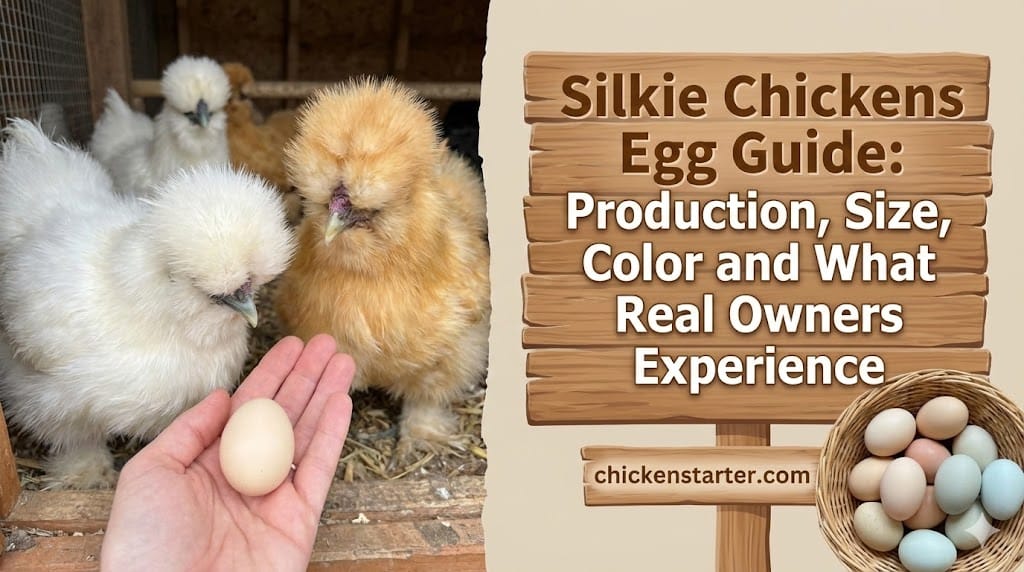
Silkie chickens produce approximately 100 to 155 eggs per year, placing them among the lower-producing breeds in the poultry world. But those numbers only tell part of the story, and after keeping Silkies for three years in my subtropical Queensland flock alongside 50+ birds of various breeds, I have learned that measuring these fluffy hens by egg count alone misses what makes them genuinely valuable.
This guide shares what actually works for Silkie egg production based on documented owner data, tracked flock statistics, and my own results raising these unique birds through tropical heat, unexpected rain, and more broody spells than I care to count.
Silkie Chickens Egg Production: How Many Eggs Per Year?
The standard range you will find across most sources is 100 to 120 eggs annually. As noted by Backyard Chickens, this estimate holds true for typical flocks, though individual variation can push numbers considerably higher. Owner surveys conducted by Chicken Experts revealed that 60% of Silkie keepers report receiving 4 eggs per week, with some “super-momma Silkies” consistently laying 5 eggs weekly.
A detailed tracking study from Hickorycroft Farm challenges the “poor layer” narrative entirely. Their flock of 36 laying Silkie hens produced 2,462 eggs over a 10-month period. In October alone, with shorter days and no artificial lighting, they collected 451 eggs and achieved a 50 to 60% lay rate, which is impressive for any heritage breed in late fall conditions.
Here is what realistic production looks like based on multiple verified sources:
| Production Metric | Range | Notes |
|---|---|---|
| Annual yield | 100 to 155 eggs | Varies by individual hen and management |
| Weekly production | 2 to 4 eggs | Most common range reported |
| Owner survey results | 60% report 3 to 5 eggs weekly | Based on Chicken Experts community polling |
| Peak production rate | 50 to 60% lay rate | Measured in late fall without supplemental lighting |
Over the past 12 months, my three Silkie hens produced a combined 287 eggs. That works out to roughly 96 eggs per hen annually, right in line with typical expectations. My best producer, a white Silkie I call Snowball, consistently delivered 3 eggs weekly, while my broodiest hen managed only 2 per week due to her frequent sitting spells. I track every egg in a simple notebook, and that habit has taught me more about my flock than any guide ever could. In January, my Silkies laid 24 eggs, but that dropped to just 18 in February when “The Sitter” (my broodiest hen) went into her first broody spell of the year.
Monthly Production Data: What Real Tracking Reveals
The Hickorycroft Farm tracking study provides month-by-month data that illustrates how Silkie production actually fluctuates throughout the year. As shown in the chart below, production remains surprisingly stable across seasons:
| Month | Eggs Collected (36 hens) | Notes |
|---|---|---|
| January | 186 | Winter production strong |
| February | 191 | Consistent with January |
| March | 304 | Spring surge begins |
| April | 243 | Steady production |
| August | 129 | Vacation period (reduced collection) |
| September | 232 | Recovery after summer |
| October | 451 | Peak fall production |
This data demonstrates that Silkies maintain relatively consistent production year-round, without the dramatic seasonal drops many keepers expect. The October peak of 451 eggs from 36 hens translates to roughly 12.5 eggs per hen for the month, or about 3 eggs per week per bird.
Why Egg Production Varies Between Silkie Hens
Several factors explain why your neighbor’s Silkie might outproduce yours by a significant margin.
Broodiness interruptions represent the biggest production killer. Silkies are legendarily broody, and when a hen decides to sit, she stops laying entirely. Some of my hens have gone broody four or five times in a single year, which can easily cut annual production in half.
Climate plays a major role as well. In my experience raising chickens in hot, humid subtropical Queensland conditions, Silkies handle heat better than many breeds due to their lack of standard feathering, but according to Australian poultry keepers, some Silkies stop laying entirely during extreme heat. Keepers in temperate climates like parts of the UK often report higher numbers than those dealing with Australian summers or Canadian winters.
Nutrition quality directly impacts output. A Silkie receiving proper layer feed with adequate calcium will outperform one surviving on scratch grains and kitchen scraps. If you are interested in optimizing your feed program, our guide to making your own chicken feed covers the essential nutrient ratios that support consistent laying.
Individual genetics matter more than many keepers realize. Even within the same hatch, some Silkies are simply better producers than their siblings. The good news is that hens who take longer to start laying often produce more consistently over their lifetime.
Silkie Chickens Egg Laying: When Do They Start?
Silkies are notoriously slow to mature compared to production breeds. Most hens begin laying between 7 and 9 months of age, though some take considerably longer. Do not panic if your Silkie pullet reaches her first birthday without producing a single egg. This is normal for Silkies, and research from Backyard Chickens suggests that the later a pullet starts to lay, the better she seems to do in the long run.
One benefit that surprised me: Silkies start laying at their regular pace much earlier in the year than other hens in your flock. While my Australorps were still recovering from winter slowdown, my Silkies had already resumed consistent production. Their dense feathering keeps them comfortable enough to lay when other breeds are still waiting for warmer weather.
The late maturity caught me off guard with my first Silkie pullets. I had been spoiled by my Australorps, which started laying around 5 months old. When my Silkies hit 8 months with no eggs in sight, I worried something was wrong. They finally started at around 9 months, and I have had consistent (if modest) production ever since.
Signs Your Silkie Is About to Start Laying
Knowing what to look for saves a lot of anxious coop checking. Watch for these indicators:
Reddening of the comb and wattles is the most reliable sign. Even though Silkie combs are smaller and walnut-shaped (unlike the single combs on most breeds), you will notice them becoming more vibrant as laying approaches.
Squatting behavior typically appears a week or two before the first egg. When you approach your pullet and she drops low to the ground with wings slightly spread, she is getting close. Our detailed guide on chicken behavior before laying their first egg walks through each stage.
Nest box exploration intensifies in the final days. Your pullet will spend more time investigating nesting areas, rearranging bedding, and practicing the sitting position.
Increased vocalization is another telltale sign. Pullets nearing point of lay often become chattier, particularly with a distinctive “egg song” that sounds like excited clucking.
What Color Are Silkie Chickens Eggs?
Silkie eggs are cream to white in color, sometimes appearing slightly off-white or having a subtle tint. Despite the breed’s exotic appearance with black skin, blue earlobes, and fluffy feathers, their eggs look quite ordinary.
This surprises many first-time Silkie owners who expect something more unusual. I remember checking my nesting boxes repeatedly after my first Silkie started laying, convinced the plain cream egg must have come from another hen. It had not.
The blue earlobes confuse people because in some breeds (like Ameraucanas), blue earlobes indicate blue egg production. But the genetics work differently in Silkies. The gene responsible for their unusual pigmentation, called fibromelanosis, affects skin, bones, and meat color but has no connection to eggshell pigmentation.
For comparison with other breeds:
| Breed | Egg Color |
|---|---|
| Silkie | Cream to white |
| Ameraucana | Blue |
| Easter Egger | Blue, green, pink (varies) |
| Marans | Dark chocolate brown |
| ISA Brown | Brown |
| Leghorn | White |
The consistency of Silkie egg color is actually quite reliable. Unlike Easter Eggers, where each hen might lay a different shade, your Silkie will produce the same cream-colored eggs throughout her laying life. If you want colorful eggs in your basket, our Ameraucana breed guide covers another option worth considering.
Do Black Silkie Chickens Lay Different Eggs?
Black Silkies lay the same cream to white eggs as Silkies of any other color variety. The black skin, meat, and bones that make Silkies unique (a trait called fibromelanosis) does not affect egg color whatsoever.
This surprises many keepers who assume the unusual pigmentation extends to eggs. It does not. Whether your Silkie is black, white, blue, splash, or paint colored, expect identical cream-colored eggs from all of them.
I keep both black and white Silkies in my flock, and without marking eggs at collection, I cannot tell which hen produced which egg. The shells are indistinguishable. The only difference I have noticed is that my black Silkie tends to be slightly more heat-tolerant during Queensland summers, which means she maintains slightly better production during our hottest months, but the eggs themselves are identical.
Silkies are also polydactyl, meaning they have five toes instead of the standard four, another genetic quirk that makes them instantly recognizable in any flock. This trait, like the fibromelanosis, is controlled by separate genes that have no influence on egg characteristics.
Silkie Chickens Egg Size: What to Expect
Silkie eggs fall into the small to extra-small category, which is appropriate given that Silkies themselves are bantam-sized birds. Backyard Chickens notes that egg sizes across all chicken breeds can range from 35g to 70g (1.2 oz to 2.5 oz) per egg.
Under US egg grading standards, a small egg weighs 42.5 grams or less, while a peewee or extra-small egg comes in under 35.4 grams. UK standards define small eggs as anything under 53g. Most Silkie eggs fall comfortably within these parameters, typically weighing between 18 and 21 ounces per dozen.
To visualize the difference: a Silkie egg is roughly two-thirds the size of a standard large egg you would buy at the supermarket. As you can see in the image showing my morning egg collection, three Silkie eggs fit comfortably in my palm where two standard eggs would feel crowded. When I bake, I typically substitute three Silkie eggs for every two large eggs a recipe calls for.
How Silkie Eggs Compare to Other Bantam Breeds
Silkie eggs are actually on the larger end for bantam breeds. Chicken Experts describes them as “relatively large-sized bantam eggs,” which means if you have kept other bantam breeds like Sebrights or Dutch Bantams, you will find Silkie eggs noticeably more substantial. The higher yolk-to-white ratio also makes them feel richer than their size suggests.
Does Smaller Mean Less Valuable?
Not at all. Silkie eggs have a higher yolk-to-white ratio than standard eggs, which means more of the good stuff in a smaller package. According to a quote from Successful Farming cited by Chicken Experts, “Silkies are excellent layers of relatively large-sized bantam eggs,” which acknowledges that while the eggs are small overall, they are substantial for a bantam breed.
Research from the Department of Foods and Nutrition in Japan found that Silkie eggs contain higher nutritive constituents than eggs from standard chicken breeds. The study indicated better oxidative stability and overall nutritional density.
Practically speaking, the richer yolk makes Silkie eggs excellent for custards and ice cream bases, homemade pasta (the extra yolk creates beautiful golden noodles), children’s portions (one Silkie egg is a perfect kid-sized serving), and baking recipes where richness matters.
My kids actually prefer Silkie eggs to our larger Australorp eggs for their scrambled eggs. The portions are just right, and they swear they taste better. Whether that is placebo effect or genuine preference, I cannot say for certain, but they eat them without complaint.
Can You Eat Silkie Chicken Eggs?
Yes, Silkie eggs are completely safe and edible. In fact, many backyard keepers consider them a delicacy.
The taste is richer and more concentrated than standard eggs, which makes sense given the yolk proportions. Several members of poultry communities describe them as “creamier” and “more flavorful” than eggs from production breeds.
Nutritionally, Silkie eggs provide all the same benefits as standard chicken eggs, including protein, healthy fats, vitamins, and minerals. The Japanese research mentioned earlier suggests they may offer additional antioxidant properties, though more studies would be needed to confirm this conclusively.
Best Uses for Silkie Eggs in the Kitchen
The high yolk ratio makes Silkie eggs particularly well-suited for certain recipes:
Custards and crème brûlée benefit enormously from the extra yolk richness. I use Silkie eggs exclusively for custard-based desserts now because the texture is noticeably silkier.
Fresh pasta turns a beautiful deep golden color with Silkie yolks. The higher fat content also creates a more tender noodle.
Hollandaise and mayonnaise made with Silkie eggs have a richer flavor profile than those made with standard eggs.
Kids’ breakfasts work perfectly because one Silkie egg is an appropriately sized portion for a young child.
How to Know If Your Silkie Eggs Are Safe to Eat
Freshness matters regardless of breed. Here are the standard checks:
The float test remains the most reliable home method. Place eggs in a bowl of water. Fresh eggs sink and lie flat on the bottom. Slightly older eggs (still safe to eat) may tilt upward slightly. Eggs that float should be discarded.
Visual inspection catches obvious problems. Cracks, unusual discoloration, or foul odors indicate an egg that should not be consumed.
Storage guidelines are the same as any other chicken egg. Unwashed eggs can be stored at room temperature for about two weeks in moderate climates. Washed eggs or eggs in warm environments should be refrigerated and used within a month.
I made the mistake early on of washing my eggs immediately after collection, which removes the protective bloom and requires refrigeration. Now I leave them unwashed until ready to use, which extends their shelf life significantly. For more storage options, our guide on ways to preserve eggs and reduce spoilage covers multiple methods that work well for Silkie eggs.
Are Silkie Chickens Good Egg Layers?
This depends entirely on what you are measuring and what you need from your flock.
If your primary goal is maximum egg production at minimum cost, Silkies are not your best choice. Production breeds like Leghorns or ISA Browns will lay 250 to 300 eggs annually, more than double what Silkies produce. According to United Egg Producers, commercial laying hens average 301 eggs per year with an 82.5% daily lay rate, numbers that Silkies simply cannot match.
However, evaluating Silkies solely on egg output misses several important factors:
| Factor | Silkie Rating | Notes |
|---|---|---|
| Egg quantity | 2 out of 5 | Below average compared to dedicated layers |
| Winter laying consistency | 4 out of 5 | Continue laying through cold months |
| Egg quality | 4 out of 5 | Rich, flavorful eggs with good yolk ratio |
| Dual-purpose brooding | 5 out of 5 | Exceptional mothers, will hatch other poultry |
| Pet temperament | 5 out of 5 | Extremely docile and friendly |
| Child-friendly | 5 out of 5 | Gentle, rarely aggressive |
Frank R. Reese Jr. of Good Shepherd Turkey Ranch in Lindsborg, Kansas, explains that Silkies “are such good moms” that “they’ll sit on anything and hatch anything. They’ll hatch ducks, turkeys, chickens.” This brooding ability has genuine economic value for keepers who want to hatch eggs without investing in incubators.
Who Should Choose Silkies for Eggs
Silkies make sense if you have a small family and need only modest egg production, want chickens primarily as pets with egg benefits, plan to hatch eggs naturally using broody hens, have children who interact with your flock, value gentle temperament over productivity, or keep chickens in a smaller space where bantams work better.
Who Should Look Elsewhere
Silkies are probably not right if you need to maximize egg production per bird, plan to sell eggs commercially, want large eggs for baking or selling, have limited patience for broody behavior, or need predictable daily egg counts.
When I built ChickenStarter, one of my goals was providing honest assessments that help people choose the right breeds for their situations. Too many guides either oversell or undersell certain breeds. If you are evaluating different options, our guide to the easiest chicken breeds for beginners compares multiple breeds across various criteria.
Silkie Chickens and Broodiness: Impact on Egg Production
Here is the reality that production numbers alone do not capture: Silkies are among the broodiest chicken breeds in existence. This trait significantly affects their effective egg yield.
When a Silkie goes broody, she stops laying eggs entirely. She will sit in the nesting box all day and night, puffing up defensively if you try to move her, and refusing to leave even to eat or drink properly. A single broody episode can last three weeks or more if you let nature take its course.
According to experienced Silkie keepers, some hens go broody multiple times per year. If your hen spends three months of the year sitting on eggs (or attempting to), that represents a 25% reduction in her already modest laying capacity.
I will be honest: I almost gave up on Silkies after that first disappointing year. Three hens, maybe 200 eggs total, and one went broody so often I nicknamed her “The Sitter.” But something changed in year two. I learned to recognize the early signs of broodiness and intervene quickly, which kept production much more consistent.
Managing Broodiness to Maximize Production
If you want eggs rather than chicks, you will need strategies for breaking broody behavior. Our detailed guide on how to break a broody hen covers multiple approaches, but here are the basics:
Remove her from the nest repeatedly throughout the day. This is the gentlest approach but also the least effective with determined Silkies.
Use a broody breaker by placing the hen in a wire-bottomed cage or crate elevated off the ground. The airflow underneath discourages the sitting instinct. Most hens break within three to five days using this method.
Block access to nesting boxes during the day, allowing entry only in the morning laying hours. This works better as prevention than cure.
One thing I learned the hard way: the longer you let broodiness continue, the harder it becomes to break. Catch it early and act quickly.
Embracing Broodiness as a Feature
Alternatively, you can work with the broodiness rather than against it. If you want to expand your flock or hatch eggs from other birds, Silkie mothers are invaluable.
I use my broodiest Silkie as a dedicated hatching hen. She has successfully hatched eggs from my Australorps, Easter Eggers, and even some quail eggs a neighbor gave me to try. The success rate with a dedicated broody hen often exceeds what you get with mechanical incubators, especially for first-time hatchers.
Do Silkie Chickens Lay Eggs in Winter?
Yes, and this is one area where Silkies genuinely shine.
Many chicken breeds slow down or stop laying entirely during winter months when daylight decreases. Silkies, with their dense fluffy feathering, remain comfortable and productive through colder weather.
According to Successful Farming (as cited by Chicken Experts), “silkies will continue laying eggs throughout the winter because their fluffy feathers keep them warm and content.” The thick plumage acts like insulation, keeping hens comfortable enough to continue their normal laying patterns. The same source notes that Silkies “might be considered a bit below average when it comes to egg production, but they lay consistently throughout the colder months.”
This consistency has value beyond just winter eggs. Egg prices typically spike during winter months when production drops across backyard flocks. Having birds that continue laying helps maintain your household supply when it matters most.
For keepers in extremely cold climates like parts of Canada or northern US states, winter laying still requires proper coop management. Our guide on winterizing your chicken coop covers the essentials for keeping any breed productive through harsh conditions.
Why Aren’t My Silkie Chickens Laying Eggs?
If your Silkies have stopped laying or never started, work through these common causes systematically. Here is a quick-reference troubleshooting guide:
| Symptom | Likely Cause | First Action |
|---|---|---|
| Hen sitting constantly, puffed up | Broodiness | Remove from nest repeatedly or use broody breaker |
| No eggs, hen under 9 months | Immaturity | Wait patiently, ensure proper nutrition |
| Sudden stop, adult hen | Molting or stress | Check for predator signs, assess diet |
| Gradual decline, hen over 3 years | Age-related | Normal; consider her value as broody mother |
| Summer production drop | Heat stress | Provide shade, cool water, ventilation |
| Thin or soft shells | Calcium deficiency | Offer oyster shell free-choice |
Broodiness is the most frequent culprit. Check whether your hen is spending excessive time in the nesting box, puffing up when approached, or refusing to leave the nest. A broody hen stops laying entirely until the behavior breaks.
Age-related factors matter in both directions. Young pullets under 7 months simply are not mature enough. Hens over five years old produce at about 50% of their peak capacity, declining further as they age. Backyard Chickens confirms that at eight years old, your Silkie may only lay an egg once in a while.
Molting periods halt production while hens redirect protein toward feather regrowth. Molting typically occurs annually in fall and can last 8 to 12 weeks. Our guide on chicken molting season explains what to expect.
Nutritional deficiencies directly impact laying. Ensure your Silkies receive proper layer feed (not just scratch grains) and have access to calcium supplements like crushed oyster shell. Backyard Chickens warns that a hen deficient in calcium might even eat her own eggs.
Stress from predators or environmental changes can halt production even if the hens appear physically healthy. New flock members, predator activity near the coop, extreme weather, or changes in routine can all trigger laying pauses.
Hidden health issues require closer examination. Lethargy, unusual droppings, respiratory symptoms, or changes in appetite alongside laying cessation warrant veterinary attention.
Summer heat affects some Silkies more than others. According to Australian keepers, some Silkies stop laying entirely during extreme heat. Provide shade, cool water, and ventilation during hot periods.
Silkie Egg Incubation: Hatching Your Own Chicks
The incubation period for Silkie eggs is 20 to 21 days, slightly shorter than the 21 days typical for large fowl breeds. As Backyard Chickens explains, “Bantam eggs like the ones you’ll get from your Silkies tend to hatch a day or so earlier than large fowl eggs.”
If you are incubating Silkie eggs in a mechanical incubator, note these important differences from standard eggs:
Stop turning on day 17 rather than day 18. Bantam eggs develop slightly faster and benefit from the earlier lockdown period.
Humidity requirements are higher due to the shell characteristics. Silkie eggs tend to have sturdy, porcelain-type shells that need extra moisture to hatch successfully. Maintain 45 to 55% humidity for the first 17 days, then increase to 65% for the hatching phase.
Temperature remains standard at 99.5°F (37.5°C) for forced-air incubators or 101 to 102°F (38.3 to 38.9°C) for still-air models.
Expect variation in hatch timing. Silkie eggs may begin hatching as early as day 19 and continue through day 22. Do not give up on eggs that have not hatched by day 21 if you see signs of life during candling.
For those new to incubation, our guide to the best chicken egg incubators for beginners compares options across price points. Proper equipment makes a significant difference in hatch rates. The best results are obtained from eggs collected from hens in their second laying season.
How Long Do Silkies Continue Laying?
Silkie hens maintain productive laying for approximately two years after they start. Production then begins a gradual decline rather than an abrupt stop. As Backyard Chickens notes, a hen will not simply stop laying one day. You will only notice that she might not be laying as much as usual anymore and then she might skip an entire week.
Here is what to expect over a Silkie’s laying lifetime:
| Age | Production Level | Notes |
|---|---|---|
| Year 1 | 100% (peak production) | After reaching laying age |
| Year 2 | 80 to 90% | Still strong production |
| Year 3 | 60 to 70% | Noticeable decline begins |
| Year 5 | 50% of peak | Significant reduction |
| Year 8+ | Occasional eggs only | May lay just a few per month |
The good news is that Silkies live longer than many chicken breeds, typically reaching 7 to 9 years or more with proper care. Even after egg production declines significantly, they continue providing value as broody mothers, pest control, and beloved pets.
One of my original Silkies is now approaching five years old. Her egg production has definitely slowed, maybe two eggs per week on a good week, but she remains the best broody mother in my flock and earns her keep that way.
Silkie Chickens Eggs for Sale: Where to Buy
Finding Silkie eggs depends on whether you want hatching eggs to incubate or eating eggs for your kitchen.
Silkie Hatching Eggs
Local breeders offer the best option for hatching eggs. Shipping stress reduces hatchability, so locally sourced eggs typically yield better results. Check poultry swap events, agricultural fairs, or online classifieds in your area.
Online hatcheries provide wider selection but lower success rates. Expect 50 to 70% hatch rates from shipped eggs compared to 80% or higher from fresh local eggs. Factor this into your planning when ordering quantities. Cackle Hatchery lists Silkie fertility rates at 40 to 55%, which reflects the challenges of shipping bantam eggs.
Poultry shows and exhibitions connect you with serious breeders who prioritize quality. Show-quality breeding stock produces more valuable hatching eggs, though you will pay premium prices.
When evaluating sellers, ask about fertility rates from recent hatches, shipping methods and timing, health certifications for the breeding flock, and return policies for non-viable eggs.
Regional Buying Guide
In Australia, check with local poultry clubs or search for breeders through state-based poultry associations in Queensland, Victoria, or New South Wales. Somerzby and similar Australian suppliers sometimes connect buyers with reputable Silkie breeders. Our guide on where to buy chickens in Australia covers additional options.
In the UK, smallholding networks and local farming groups provide reliable connections. The British Poultry Standard recognizes Silkies, so breed clubs can point you toward quality stock.
In the US and Canada, online communities, local farming groups, and hatcheries like Cackle Hatchery or My Pet Chicken ship hatching eggs nationally, though local sources remain preferable for best results.
Silkie Eggs for Eating
Silkie eating eggs rarely appear in commercial retail settings. Your best sources include local backyard keepers (check community groups or farmers market connections), specialty farms focusing on heritage breeds, and direct purchases from breeders who have excess production.
Silkie Chickens Egg Price: What to Expect
Pricing varies significantly based on egg purpose and quality.
Hatching eggs typically sell for premium prices compared to standard eating eggs. Prices depend heavily on the quality of breeding stock, color variety, and seller reputation.
Factors affecting price include color variety (rare colors like blue, splash, or paint command higher prices than common black or white varieties), breeding documentation (eggs from show-winning stock cost more), fertility guarantees (some sellers offer partial refunds for low fertility), and shipping costs (can add significantly to total investment).
For context on the broader Silkie market, including differences between bantam and standard varieties, our Silkie bantam vs standard Silkie comparison covers the variations you will encounter.
Caring for Silkies to Maximize Egg Production
Proper care directly impacts how many eggs your Silkies produce. Here are the essentials that actually matter.
Diet for Laying Silkies
Layer feed should be the foundation once your hens reach point of lay, typically around 7 to 9 months. Layer feed contains the calcium and protein ratios needed for consistent egg production.
Calcium supplementation matters even more for Silkies than larger breeds. Their smaller bodies produce eggs at a similar rate to larger hens, creating higher calcium needs for their size. Offer crushed oyster shells free-choice alongside regular feed.
Protein boosts help during molting or periods of lower production. Mealworms, black soldier fly larvae, or other high-protein treats support feather regrowth and egg quality.
Avoid the temptation to overfeed treats. Scratch grains and kitchen scraps should comprise no more than 10% of total diet. Too many treats dilute the balanced nutrition in layer feed and reduce egg production.
Housing Requirements
Shelter from moisture is critical for Silkies. Unlike standard chickens, Silkie feathers lack the barbicels (tiny hooks) that make feathers waterproof. Wet Silkies become chilled quickly and can develop health problems. Always provide covered areas where your Silkies can stay dry during rain.
Nesting box ratios follow standard guidelines: one box per three to four hens. Silkies often prefer lower nesting boxes than other breeds due to their limited flying ability.
Predator protection requires extra attention because Silkies cannot fly to escape threats and their fluffy feathering obscures their vision somewhat. Hardware cloth beats chicken wire for secure enclosures. Our guide to nesting boxes includes placement tips that work well for Silkies.
Why Silkie Feathers Cannot Get Wet
This deserves emphasis because it surprises many new keepers. Standard chicken feathers have tiny structures called barbicels that hook adjacent feather strands together, creating a waterproof barrier similar to roof shingles. Silkie feathers lack these structures entirely, which is what gives them their characteristic fluffy, fur-like appearance.
Without waterproofing, wet feathers soak through to the skin. A soaked Silkie loses body heat rapidly and can become hypothermic even in moderate temperatures. In cold climates, this becomes dangerous quickly.
I lost my first Silkie to this issue before I understood it properly. She got caught in an unexpected rainstorm while the rest of my flock (standard feathered breeds) were fine. By the time I found her, she was severely chilled. The lesson cost me a beloved hen, but I have never made that mistake again.
Practical implications include positioning water containers so splashing does not wet feathers, providing covered outdoor areas for rainy days, checking Silkies after unexpected weather changes, and drying wet Silkies with towels and providing warmth if needed.
Frequently Asked Questions About Silkie Chickens Eggs
How often do Silkie chickens lay eggs?
Silkie hens typically lay 2 to 4 eggs per week under normal conditions. Chicken Experts found that 60% of Silkie keepers receive 3 to 5 eggs weekly from their hens, with some exceptional “super-momma” Silkies producing 5 eggs per week consistently. Production varies based on individual genetics, diet, age, and whether the hen is experiencing broody periods.
What color eggs do Silkies lay?
Silkies lay cream to white colored eggs. Despite their unusual appearance with black skin and blue earlobes, their eggs look quite ordinary. The color remains consistent throughout a hen’s laying life and does not vary based on the Silkie’s feather color.
How big are Silkie eggs?
Silkie eggs are small to extra-small, typically weighing under 42.5 grams (US small standard) or under 35.4 grams (peewee classification). They are roughly two-thirds the size of standard large eggs from the grocery store, weighing between 18 and 21 ounces per dozen.
Are Silkie eggs good to eat?
Yes, Silkie eggs are completely edible and many keepers consider them superior to standard eggs. They have a higher yolk-to-white ratio, creating richer flavor. Research from the Department of Foods and Nutrition in Japan found that Silkie eggs contain higher nutritive constituents than standard chicken eggs.
When do Silkies start laying eggs?
Most Silkie hens begin laying between 7 and 9 months of age, though some take up to a year. This is significantly later than production breeds, which often start laying at 5 to 6 months. Experienced keepers note that the longer a Silkie takes to start laying, the better she seems to do in the long run.
How long do Silkies lay eggs?
Silkies maintain productive laying for approximately two years after starting. Production then slowly drops, reaching about 50% of peak by age five. Hens may continue laying occasional eggs into their eighth year or beyond.
Why are Silkies so expensive?
Silkie pricing reflects several factors: difficulty sexing chicks accurately (resulting in unwanted roosters), slower maturity requiring longer care before sale, specialized breeding for show qualities, lower reproduction rates compared to production breeds, and strong demand as ornamental and pet chickens.
Do Silkies lay in winter?
Yes, Silkies are known for consistent winter laying. Successful Farming notes that Silkies “will continue laying eggs throughout the winter because their fluffy feathers keep them warm and content.” Their dense feathers provide excellent insulation, keeping them productive when other breeds slow down or stop.
Can I hatch Silkie eggs in an incubator?
Yes, with some modifications to standard incubation practices. Silkie eggs incubate for 20 to 21 days. Stop turning eggs on day 17 rather than day 18, and maintain higher humidity (up to 65%) during the hatching phase due to their sturdy, porcelain-type shells. Silkie hatches may begin as early as day 19 and finish as late as day 22.
Why did my Silkie stop laying?
Common reasons include broodiness (the most frequent cause), molting, age-related decline, inadequate nutrition, stress from predators or environmental changes, illness, seasonal light reduction, or extreme heat. Broodiness in Silkies can last weeks and completely halts egg production during that period.
Is any of this making Silkies sound like more trouble than they’re worth? I get it. Before you write them off though, consider what you actually want from your flock. If maximum eggs are the goal, look at our Australorp breed guide for a reliable layer. But if you want fluffy, friendly birds that provide decent eggs, exceptional brooding services, and genuine companionship, Silkies deliver something no production breed can match.
What has your experience been with Silkie egg production? If you have tracked your flock’s numbers like Hickorycroft Farm did (2,462 eggs from 36 hens in 10 months), I would love to hear how they compare.

Oladepo Babatunde is the founder of ChickenStarter.com. He is a backyard chicken keeper and educator who specializes in helping beginners raise healthy flocks, particularly in warm climates. His expertise comes from years of hands-on experience building coops, treating common chicken ailments, and solving flock management issues. His own happy hens are a testament to his methods, laying 25-30 eggs weekly.