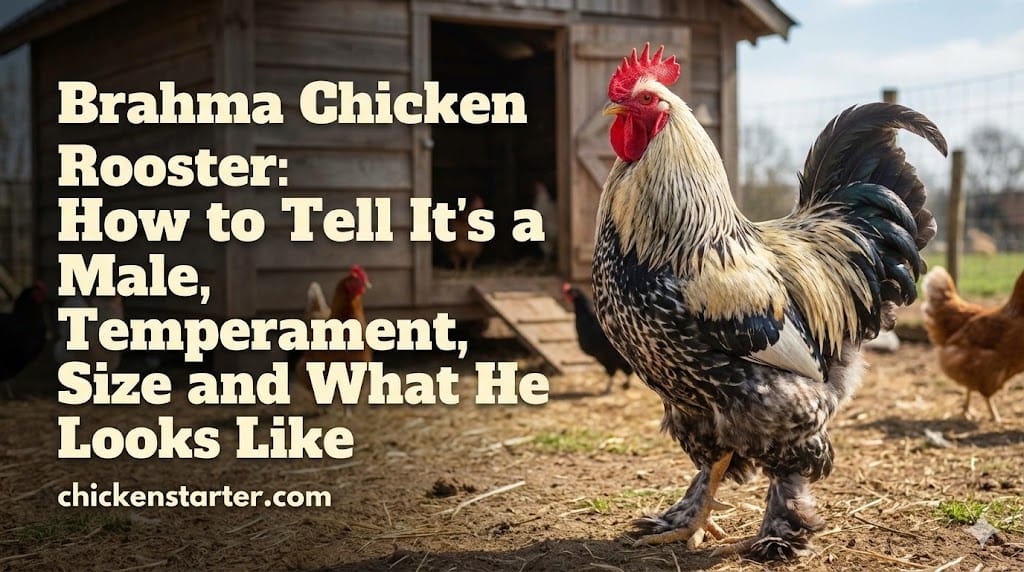
The first time I saw a Brahma chicken rooster in person, I genuinely thought someone had crossbred a chicken with a small turkey. Standing nearly waist-high with feathered legs that looked like furry boots, this bird commanded attention in a way no other chicken in that breeder’s yard could match.
After six years of raising backyard chickens across multiple breeds in tropical conditions, I have learned that few birds generate as many questions as the Brahma rooster. People want to know how to tell males from females, whether these giants are actually gentle or secretly aggressive, and what it takes to keep one happy in a backyard flock. This guide answers all of those questions based on verified breed standards, owner experiences, and my own observations working with large fowl breeds. For a complete overview of the breed including hens and general care, see our comprehensive Brahma chicken guide.
Whether you are trying to sex young Brahma chicks, deciding if a Brahma rooster fits your family situation, or simply curious about what makes these “King of All Poultry” so special, you will find practical answers here.
How Do You Tell If a Brahma Is a Rooster?
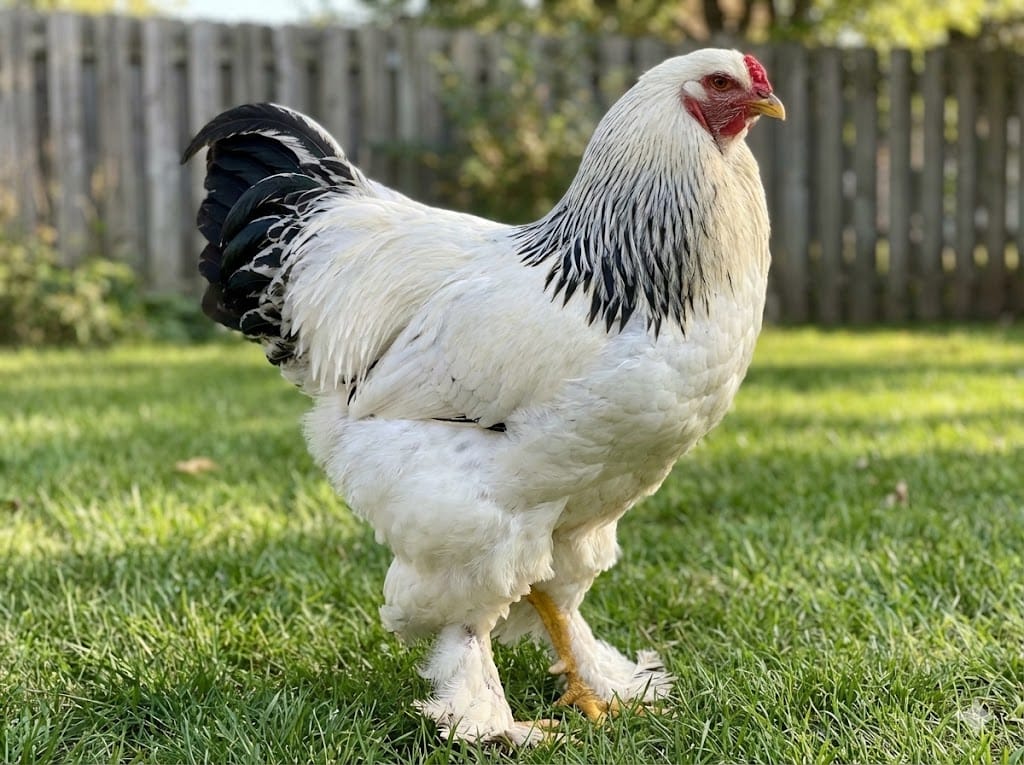
Sexing Brahma chickens can be tricky in the early weeks, but several reliable indicators emerge as the birds mature. Here are the clearest ways to identify a Brahma rooster.
Feather Shape Differences
Hackle feathers on the neck provide one of the most reliable visual tells. Brahma roosters develop pointed, elongated hackle feathers that drape over the neck and shoulders. Hens have rounded hackle feathers that lie flat against the body. This difference becomes visible around 12 to 16 weeks of age.
Saddle feathers near the tail follow the same pattern. Roosters grow long, pointed saddle feathers that cascade down toward the tail. Hens have shorter, rounded feathers in this area. The saddle feathers are often the first clear indicator that distinguishes males from females.
Sickle tail feathers are the most dramatic difference. Brahma roosters develop long, curved sickle feathers that arch gracefully over the tail. These can grow quite impressive on mature birds. Hens have shorter, fan-shaped tails without the dramatic curve.
Comb, Wattle, and Leg Development
Comb and wattle development happens earlier and more prominently in roosters. While Brahmas have small pea combs, which is part of what makes them cold-hardy, males typically show redder, slightly larger combs and wattles by 8 to 10 weeks. Hens develop these features more slowly and they remain smaller.
Leg thickness is another indicator. Brahma roosters develop noticeably thicker legs and larger feet than hens. Given that Brahmas already have impressive feathered legs, the male’s legs appear even more substantial.
Behavioral Indicators
Behavior patterns emerge as birds mature. Young cockerels often begin chest-bumping, sparring, and attempting to crow, usually badly at first, between 12 and 20 weeks. They may also start showing interest in the hens through wing-dropping courtship displays.
The challenge with Brahmas specifically is their slow maturation rate. According to experienced breeders on BackYard Chickens forums, these birds take considerably longer to develop adult characteristics than most breeds. Where a Leghorn cockerel might be crowing confidently at 16 weeks, a Brahma rooster might still look ambiguous at the same age.
For a detailed guide specifically on identifying Light Brahma males from females at every stage of development, including the saddle striping test and feathering rate differences, see our complete Light Brahma rooster vs pullet sexing guide.
Autosexing Buff Brahma Chicks
This autosexing characteristic gives Buff Brahmas a significant practical advantage for keepers who want to know gender early. Our Buff Brahma rooster size and color guide includes detailed photographs showing what to look for when sexing day-old chicks and tracks how these color differences develop through maturity.
Wing Feather Sexing Method
For Light and Dark Brahma chicks where autosexing is not possible, try the wing feather method on slightly older chicks. While gently yet securely holding your chick, spread out their little wing tips. Male chicks will have a neat “all one length” feather pattern, while the females will show an alternating pattern of long and short feather sprouts. This method works best between 3 and 7 days of age.
Brahma Rooster vs Hen: Side-by-Side Comparison
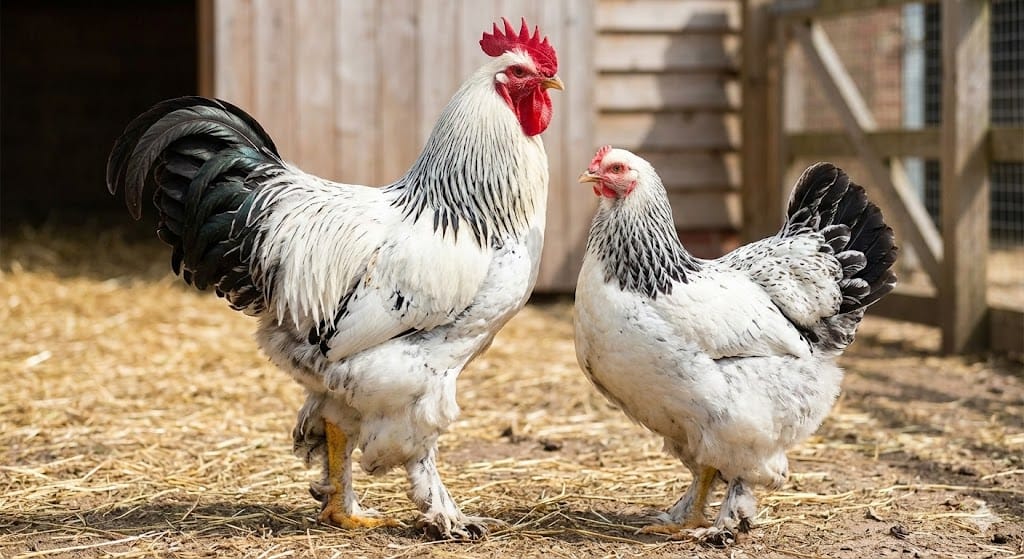
Understanding the differences between Brahma roosters and hens helps with both identification and flock planning. Here is a detailed comparison:
| Feature | Brahma Rooster | Brahma Hen |
|---|---|---|
| Weight (standard) | 10 to 12 lbs (some reach higher) | 8 to 10 lbs |
| Height | Up to 30 inches | 24 to 26 inches |
| Hackle feathers | Long, pointed, flowing | Short, rounded, flat |
| Saddle feathers | Long, pointed, draping | Short, rounded |
| Tail | Long curved sickle feathers | Fan-shaped, shorter |
| Comb and wattles | Larger, redder, develops earlier | Smaller, paler, develops later |
| Legs | Thicker, more substantial | Slightly thinner |
| Feather shine | Often more iridescent sheen | Less pronounced shine |
| Spurs | Develops spurs, though often small | No spurs or very small bumps |
| Behavior | Crowing, courtship displays, protective posturing | Nesting behavior, egg laying |
One detail that surprised me when I first researched large breeds: the size difference between Brahma roosters and hens is less dramatic than in many other breeds. Both sexes are impressively large, which is one reason Brahmas can be harder to sex visually than breeds with more pronounced sexual dimorphism.
Timing of Visual Differences
The feather-shape differences in hackle, saddle, and sickle feathers typically become reliable indicators around 12 to 16 weeks. Before this age, both sexes look remarkably similar, and even experienced breeders sometimes make mistakes.
Light Brahmas present the greatest sexing challenge among the three recognized varieties because both sexes share identical coloring. Our dedicated guide on telling Light Brahma roosters from hens walks through the feather shape differences, saddle striping test, and realistic timeline for confident identification.
For those hatching their own Brahma eggs, our guide to the best chicken egg incubators for beginners covers equipment selection, though be prepared for the 50/50 gamble on sex that comes with any hatch.
What Does a Brahma Chicken Rooster Look Like?
The Brahma rooster is one of the most visually striking chickens you will encounter. According to The Livestock Conservancy, Brahmas are characterized by feathers on their yellow shanks and toes, pea comb, reddish-brown eyes, red earlobes, yellow beaks, smooth fitting plumage with dense down in all sections, and a broad, wide head with skull projecting over the eyes, a feature termed “beetle brow.”
Breed Identification Card
| Characteristic | Description |
|---|---|
| Comb type | Pea comb with three ridges, low profile |
| Feet and legs | Yellow shanks covered in feathers with feathered toes |
| Head shape | Broad with prominent beetle brow over eyes |
| Eye color | Reddish-brown |
| Ear lobes | Red |
| Beak | Yellow |
| Body type | Broad, deep chest with muscular build |
| Feathering | Dense, tight-fitting with thick down underneath |
| Recognized varieties in the US | Light, Dark, Buff |
| Other color varieties | White, blue exchequer, and gold partridge have been developed |
Light Brahma Rooster Appearance
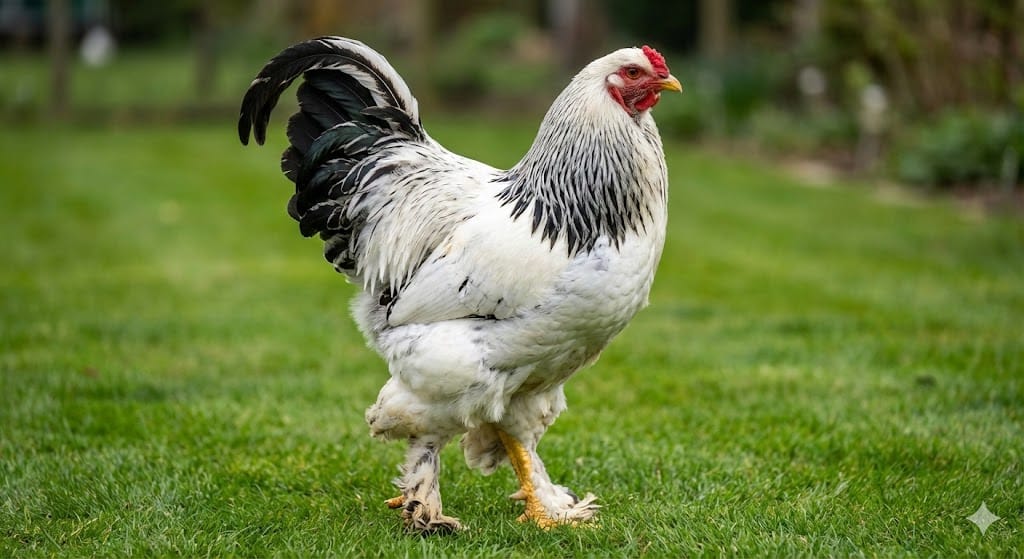
Light Brahma roosters display a striking contrast pattern. The body is predominantly white with black hackle feathers edged in white and a black tail. The saddle feathers show the same black-edged-in-white pattern. This variety creates a dramatic, formal appearance that many keepers find particularly handsome.
The contrast between the white body and black markings makes Light Brahmas instantly recognizable in any flock. Because both Light Brahma roosters and hens share this columbian pattern, sexing this variety requires careful attention to feather shape rather than color. Our Light Brahma chicken rooster sexing guide covers the specific indicators that distinguish males from females at each age.
Dark Brahma Rooster Appearance
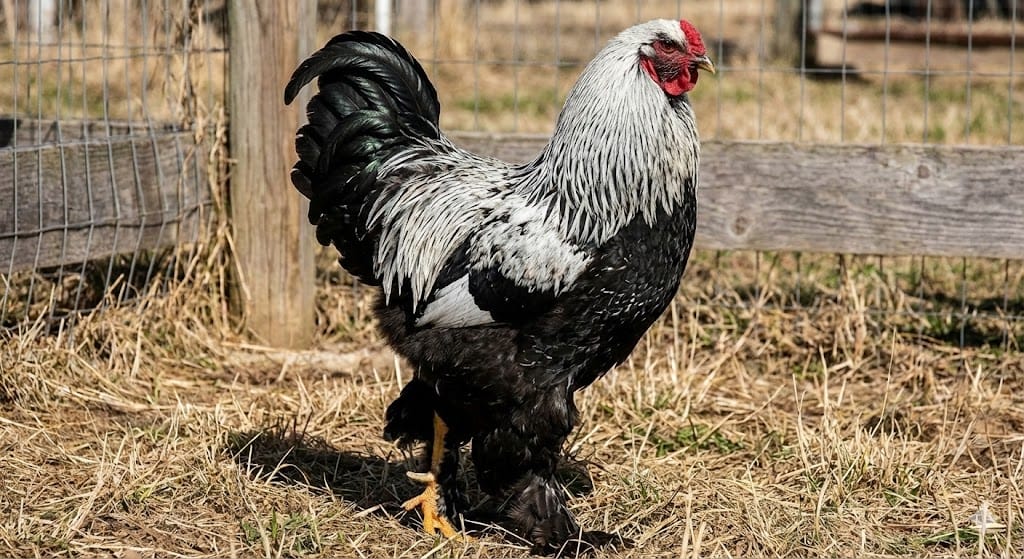
Dark Brahma roosters are essentially the reverse of the Light variety but with more intricate patterning. Standing loud and proud, the Dark Brahma rooster boasts a striking silver hackles and saddles with bold black striping, a black body, and solid silver wing bows that stand in sharp contrast to the penciled gray coloring of Dark Brahma hens.
Unlike Light Brahmas where both sexes share similar coloring, Dark Brahma roosters and hens look dramatically different, making this variety one of the easiest to sex visually. The rooster’s silver and black contrast against the hen’s intricate penciling creates what appears to be two completely different breeds standing side by side. For detailed photographs and identification guidance, see our complete Dark Brahma rooster appearance guide.
Buff Brahma Rooster Appearance
Buff Brahma roosters feature warm golden-buff coloring throughout, with black hackle and saddle feathers edged in buff. The tail is black. This variety has a warmer, more uniform appearance than the contrasting Light and Dark patterns.
Buff Brahmas are often considered the “friendliest looking” of the three recognized varieties, with their soft golden tones creating a welcoming appearance. They share the same physical structure as Light and Dark varieties but with that distinctive caramel coloring that many keepers find irresistible. For detailed information on Buff Brahma rooster size specifications, color patterns, and temperament characteristics, see our complete Buff Brahma rooster guide. If you enjoy golden-feathered birds, you might also appreciate the Buff Orpington, another large, gentle breed with similar coloring.
All three varieties share the same physical structure: the massive body, feathered feet, pea comb, and that distinctive beetle brow that gives Brahmas their somewhat serious, thoughtful expression.
The Feathered Feet
The feathered shanks and toes are perhaps the most immediately noticeable feature of any Brahma. These “boots” extend down the outer toes, creating an appearance that one breeder I consulted with described as “wearing fuzzy slippers.” Other feather-footed breeds like Cochins share this characteristic, though Brahmas tend to have a more upright carriage.
This feathering serves a practical purpose in cold climates, providing insulation against frozen ground. However, it creates challenges in wet or muddy conditions. The feathers can become caked with mud, which is uncomfortable for the bird and can lead to foot problems if not addressed. Our guide on how to fix a muddy chicken run covers solutions that help protect feather-footed breeds.
Pin Feather Concerns
One issue specific to heavily feathered breeds like Brahmas is pin feather breakage. The pin feathers, which are the thicker developing feathers, can get caught on things as the birds walk by. Sometimes these will break and cause the bird to bleed. Regular inspection of your Brahma rooster’s feathering helps catch these issues early.
Brahma Rooster Temperament: Are They Aggressive or Gentle?
This is the question I hear most often about Brahma roosters, and the answer requires some nuance.
The Gentle Giant Reputation
Brahmas are widely described as calm, docile, and gentle. According to The Livestock Conservancy, they have “calm and docile personalities, and are not flighty or skittish.” Multiple experienced owners confirm this reputation. One long-time Brahma keeper on BackYard Chickens forum notes that her roosters “follow me around like dogs” and are “the sweetest roos.”
The breed’s gentle nature makes Brahma roosters popular choices for families with children. Their large size can be intimidating at first glance, but their typically relaxed demeanor means they rarely pose the aggression risks associated with some other breeds. If gentle temperament is your priority, our guide to the easiest chicken breeds for beginners compares several docile options.
Are Brahma Roosters Aggressive?
However, temperament is not guaranteed. As one experienced keeper cautions, “Temperament can be a lottery: if you happen to get an aggressive Brahma rooster, it’s likely their male relatives will display similar behavior.” This suggests genetics within breeding lines matters significantly.
Several owner reports confirm this variability. One keeper on BackYard Chickens forum reports having a Brahma rooster that “is MEANER THAN MEAN” and “has attacked everyone including ME.” While this appears to be an outlier experience, it demonstrates that individual variation exists.
The consensus among experienced keepers:
- Most Brahma roosters are gentle, friendly, and easy to handle
- Some breeding lines may produce more aggressive individuals
- Spring breeding season can temporarily increase testosterone-driven behavior in any rooster
- Handling from a young age helps maintain docility
Do Brahma Roosters Crow a Lot?
Brahma roosters crow like any other rooster, typically starting at dawn and continuing periodically throughout the day. However, they are considered fairly quiet compared to other breeds. Their crow is not notably louder or more frequent than other breeds, though their larger size can produce a somewhat deeper tone.
If noise is a concern, our guide on quietest chicken breeds for backyards discusses options, though keeping any rooster involves accepting crowing as part of the package.
Practical Considerations for Keeping Brahma Roosters
Space requirements are significant. These are large birds that need room to move comfortably. Standard recommendations suggest at least 4 square feet per bird inside the coop and 10 or more square feet in the run, but bigger is better for Brahmas. Our guide on how much space chickens really need provides detailed calculations for various flock sizes.
Mating concerns arise from the rooster’s size. A 12-pound rooster mounting an 8-pound hen repeatedly can cause feather damage and skin abrasions on the hen’s back. Many keepers use hen saddles, which are protective aprons, to prevent injury. This is especially important if you keep smaller hens in a mixed flock with a Brahma rooster.
Flock protection disappointments are common with this breed. Despite their impressive size, multiple owners report that Brahmas are not effective protectors against predators. One keeper observes, “I’ve never seen a Brahma rooster protect his flock from a visiting dog or fox.” Their calm, non-aggressive nature that makes them safe around humans also makes them passive when threats appear.
If predator protection is a priority, you may need additional measures. Our guide on predator-proofing your coop covers hardware and management strategies that do not rely on rooster intervention.
Mixed flock considerations deserve attention. Brahma roosters generally get along well with other breeds due to their non-aggressive nature. However, their size can be problematic if you keep bantam hens. The weight difference during mating can injure smaller birds.
When to Consider Rehoming
Even gentle roosters are not right for every situation. Consider rehoming a Brahma rooster if:
- He shows consistent aggression toward family members, especially children
- You have only bantam hens that cannot safely mate with him
- Local ordinances prohibit roosters (check our guide to chicken laws by state for US regulations)
- His crowing creates neighbor conflicts
- You do not need fertile eggs and he is not providing other value
The good news is that Brahma roosters are generally in demand. Their reputation for gentleness makes them desirable, and their striking appearance attracts buyers. If rehoming becomes necessary, you will likely find takers more easily than with some other breeds.
Brahma Chicken Rooster Size: Weight, Height, and Growth Timeline
The Brahma’s size is legendary in poultry circles. These birds were once called the “King of All Poultry,” and their dimensions justify the title.
How Big Do Brahma Roosters Get?
According to The Livestock Conservancy and Oklahoma State University’s breed profiles, standard Brahma weights are:
- Roosters: 11 to 12 lbs depending on variety
- Hens: 8.5 to 10 lbs depending on variety
Historical records from the 1850s describe Brahmas weighing even more. According to The Livestock Conservancy, some individual birds were documented to have reached the incredible weights of 13 to 14 lbs for females and 17 to 18.25 lbs for males. Modern Brahmas have been bred somewhat smaller than these historical giants, but they remain among the largest chicken breeds available.
Brahma Rooster Height
Brahma chickens can reach impressive heights. Multiple sources confirm that mature Brahma roosters can stand up to 30 inches tall, with hens reaching around 26 inches. For context, that puts a Brahma rooster’s head roughly at knee height for an average adult human.
This height, combined with the upright carriage and prominent beetle brow, creates the imposing presence that makes Brahmas so visually striking. According to one experienced keeper on BackYard Chickens, “My Brahma rooster is currently 2’6″ and he is not even close to the largest specimens.”
Bantam Brahma Size
A bantam variety of Brahma exists, though it is less common. According to breed standards:
- Bantam roosters: 38 ounces, approximately 2.4 lbs
- Bantam hens: 34 ounces, approximately 2.1 lbs
Bantam Brahmas are described as “hard to find” with limited breeders available. They retain the breed’s characteristic appearance including feathered feet, pea comb, and beetle brow in a much smaller package. If you are interested in comparing bantam and standard varieties of other breeds, our guide on Silkie bantam vs standard Silkie explores similar considerations.
Brahma Chicken Rooster Growth Timeline
Brahmas are notoriously slow growers. This is one of the most important things to understand before adding them to your flock.
| Age | Development Stage | What to Expect |
|---|---|---|
| 0 to 4 weeks | Chick stage | Fluffy chicks with tiny feathered feet; slow growth compared to other breeds |
| 5 to 8 weeks | Feathering begins | Leg feathering and chest plumage developing; awkward stage begins |
| 12 to 16 weeks | Adolescent stage | Legs look long, proportions awkward; sex differences becoming visible |
| 5 to 7 months | Early maturity | Hens may begin laying small eggs; roosters filling out but not finished |
| 8 to 10 months | Approaching full size | Roosters reach 10+ lbs; feathering fills out dramatically |
| 12+ months | Full maturity | Maximum size achieved; full adult plumage |
For comparison, most standard laying breeds reach point of lay at 4 to 5 months. According to Meyer Hatchery, Brahma hens usually begin laying between 20 to 24 weeks old, with full production coming later.
This slow maturation has practical implications:
- Feed costs are higher because you are feeding large birds for longer before they produce
- Patience is required when sexing, as male characteristics develop slowly
- Full rooster magnificence takes over a year to achieve
If you are raising Brahmas from chicks, our guide on when to switch from starter to grower feed covers the nutritional transitions these slow-growing birds need.
Historical Context: The Brahma as a Meat Breed
The Brahma was generally considered the leading meat breed for the period from the mid-1850s through about 1930, some 70-plus years of dominance according to The Livestock Conservancy. Oklahoma State University’s breed profile classifies Brahmas as “a very heavy fowl for the production of heavy roasters or capons.” While modern keepers often raise Brahmas for eggs and companionship, their historical role as premier meat birds explains their substantial size.
Brahma Rooster Care Requirements
Keeping a Brahma rooster healthy requires attention to their specific needs as a large, feather-footed breed.
Housing Considerations
Coop sizing needs adjustment for Brahma proportions. Standard nest boxes measuring 12 by 12 inches are too small. Brahmas need larger boxes, approximately 14 by 14 inches or bigger, to comfortably settle in. Our guide on chicken nesting boxes covers sizing for various breeds. Similarly, doorways should be wider than standard to accommodate their bulk.
Roost height matters more for heavy breeds. Brahmas can injure themselves jumping down from high roosts. Keep roosts at 18 to 24 inches maximum, with a lower option available. Our guide on how high roosting bars should be explains the reasoning. When jumping down, their weight could cause injury to their feet or drive foreign objects that might be present on the floor of the coop into their feet, which can result in bumblefoot or fractures. Our guide on how to spot and treat bumblefoot in chickens covers prevention and treatment.
Ground conditions affect feather-footed breeds significantly. Brahma roosters’ feathered feet collect mud, which can mat the feathers and lead to foot problems. Providing dry, well-drained areas is essential. Consider sand or gravel in high-traffic areas.
Climate Considerations
Brahmas thrive in cold weather. Their dense, tight feathering with thick down underneath provides excellent insulation, and their pea combs are less susceptible to frostbite than large single combs. The Livestock Conservancy notes they were “popularly known as the least susceptible chicken to cold and exposure.” If you live in a cold region, our guide on raising chickens in cold climates provides additional winter care tips.
However, Brahmas do not tolerate heat well. Their heavy feathering and large body mass make them vulnerable to heat stress. The same source notes they are “not an ideal fowl for southern climates, where they need ample shade and water.”
If you keep Brahmas in warm climates:
- Provide abundant shade
- Ensure constant access to cool, fresh water
- Consider fans or misting systems in extreme heat
- Watch for signs of heat stress including panting and wings held away from body
Despite their obvious cold adaptations, some sources note that Brahmas can also adapt reasonably well to heat with proper management, making them a “great all rounder” according to experienced keepers. Our guide on keeping chickens cool in Australian summers covers strategies that apply anywhere hot weather is a concern.
Foot Feather Maintenance and Health
The beautiful feathered feet require regular attention:
- Check weekly for mud caking, especially after wet weather
- Inspect for scaly leg mites since the dense feathering can hide parasites, making them harder to spot in feather-footed breeds. Our guide on mites and lice on chickens covers identification and treatment.
- Trim excessively long feathers if they are causing problems
- Keep bedding dry to prevent moisture-related issues
- Watch for pin feather breakage and bleeding
Include leg inspections in your regular chicken health checks.
Feeding Requirements
Brahmas eat more than smaller breeds simply due to their size. Budget accordingly, especially during the long growth period before hens begin laying. Our chicken feed calculator can help estimate costs for your flock size.
A standard feeding program works well:
- Starter feed with 18 to 20% protein for the first 8 weeks
- Grower feed with 16 to 18% protein until point of lay
- Layer feed with 16% protein and added calcium once hens begin laying
- Free-choice oyster shell for additional calcium (see our guide on calcium for chickens)
- Grit for digestion
Brahma Rooster Egg and Breeding Considerations
While roosters do not lay eggs, understanding Brahma egg production helps inform decisions about keeping a rooster for breeding purposes.
Brahma Hen Egg Production
According to The Livestock Conservancy, Brahma hens can produce “up to 200 large, medium-brown eggs per year.” Meyer Hatchery reports Brahmas lay 3 to 6 medium to large brown eggs per week during active production.
The eggs are often described as caramel brown in color, a warm medium brown that many keepers find attractive.
What makes Brahmas unusual is their laying season. They are described as “superior winter-layers” who “produce the bulk of their eggs from October to May.” This reversed schedule compared to most breeds that lay heavily in spring and summer can be valuable for keepers who want eggs during the months when other hens slow down. For more on seasonal egg production, see our guide on why chickens stop laying eggs.
Breeding Considerations
If you are keeping a Brahma rooster for breeding:
Fertility is generally good, though the rooster’s size can make mating awkward with smaller hens.
Broody behavior is common in Brahma hens. They tend to go broody in early summer and sit devotedly on nests. However, their size creates a risk of accidentally crushing chicks, so careful monitoring during hatching is recommended. According to The Livestock Conservancy, because of the size of the hen, the hatchlings need to be watched to make sure they do not get trampled. Our guide on how to break a broody hen covers management options if broodiness becomes problematic.
Slow growth means Brahma chicks take longer to mature than most breeds. Plan for 6 to 7 months minimum before pullets begin laying.
Sex ratios in any hatch average 50/50, meaning you will likely end up with cockerels to rehome or process if you hatch frequently.
Frequently Asked Questions About Brahma Chicken Roosters
Do Brahma roosters get aggressive?
Most Brahma roosters are notably calm and docile, which is a hallmark of the breed. However, individual variation exists, and some breeding lines may produce more aggressive birds. Handling roosters regularly from a young age helps maintain their gentle disposition. Spring breeding season may temporarily increase assertive behavior in any rooster, but aggressive Brahmas are generally the exception rather than the rule.
How long do Brahma roosters live?
With proper care, Brahma roosters can live 8 to 10 years or more. Like most chickens, their lifespan depends on genetics, diet, housing conditions, and predator protection. For more details on chicken longevity, see our guide on how long chickens live.
Are Brahma roosters good for meat?
Historically, Brahmas were bred primarily as meat birds due to their substantial size. A fully grown Brahma rooster provides a significant amount of meat, comparable to a supermarket roasting chicken. However, their slow growth rate of 12 or more months to full size makes them less economical for meat production than modern broiler breeds. Many keepers today raise Brahmas primarily for eggs and companionship, with meat as a secondary consideration.
Will a Brahma rooster protect my flock from predators?
Unfortunately, Brahma roosters are generally not effective flock protectors despite their impressive size. Multiple owners report that their Brahmas fail to defend against dogs, foxes, or other predators. Their calm, non-aggressive nature works against them in this role. If predator protection is important, invest in secure fencing and coop design rather than relying on your rooster. See our guide on predator-proof chicken coops for effective solutions.
Can I keep a Brahma rooster with bantam hens?
This combination is generally not recommended. The significant size difference between a 12-pound rooster and 2-pound hens can cause injury during mating. If you want to keep Brahmas in a mixed flock, pair them with standard-sized hens that can handle the rooster’s weight.
At what age do Brahma roosters start crowing?
Brahma cockerels typically begin attempting to crow between 4 and 6 months of age, though their slow maturation means some may start later. Early crows often sound raspy or broken, improving as the bird matures.
Do I need a rooster to get eggs from my Brahma hens?
No. Hens lay eggs regardless of whether a rooster is present. A rooster is only necessary if you want fertile eggs for hatching. Our guide on whether you need a rooster to get eggs explains this in detail.
Can you keep a Brahma rooster with kids?
Brahma roosters are generally considered one of the safer breeds around children due to their calm, non-aggressive temperament. Their large size may initially intimidate small children, but most Brahmas are gentle enough to be handled. That said, any rooster can have an off day, especially during breeding season. Supervise young children around any rooster, and teach them proper handling techniques.
My Experience with Large Breed Roosters
While I have not kept Brahmas specifically due to their poor heat tolerance making them unsuitable for my tropical Queensland conditions, I have worked extensively with other large, gentle breeds including Buff Orpingtons and Australorps. I have also consulted with several Brahma keepers in cooler Australian regions, and their experiences confirm the temperament patterns I have observed in similar large breeds.
My Buff Orpington rooster, whom we called “Big Yellow,” demonstrated the same gentle-giant personality that Brahma owners describe. He would follow me around the yard waiting for treats, tolerated my children petting him, and never showed aggression toward family members. But he was absolutely useless when a neighbor’s dog got into the run one afternoon. He just stood there while the hens scattered.
That experience taught me something important: gentle temperament and protective instinct rarely come in the same package. If you want a rooster that is safe around your family AND protects your flock, you may be looking for a bird that does not exist. For most backyard keepers, the gentle option is the better choice, with predator protection handled through infrastructure rather than rooster intervention.
The other lesson from large breed roosters: watch your hens’ backs. Literally. Big roosters, no matter how gentle their disposition, can damage hens through repeated mating. I started using hen saddles after noticing bare patches on my favorite Australorp hen. The saddles solved the problem completely.
When I started ChickenStarter, one of my goals was sharing the practical lessons that only come from hands-on experience with different breeds. The Buff Orpington guide and our comprehensive Brahma chicken guide both draw on this combination of research and real-world observation.
Making the Decision: Is a Brahma Rooster Right for You?
After reviewing temperament, size, care requirements, and practical considerations, here is a framework for deciding whether a Brahma rooster belongs in your flock.
A Brahma Rooster Is Likely a Good Fit If You:
- Want a gentle, handleable rooster safe around family members
- Live in a cold climate where their cold-hardiness is an advantage
- Have adequate space for large birds
- Keep standard-sized hens that can handle his weight
- Appreciate their striking appearance and enjoy ornamental value
- Do not depend on your rooster for predator protection
- Have patience for their slow maturation
- Can provide dry conditions to protect their feathered feet
A Brahma Rooster May Not Be Ideal If You:
- Live in a hot climate where they will struggle
- Keep only bantam hens
- Have very limited space
- Need an aggressive flock protector
- Want rapid maturation and early breeding
- Cannot provide appropriate roost heights and flooring
- Have wet, muddy conditions that would damage their foot feathering
The Brahma rooster offers a unique combination of impressive size, gentle temperament, and striking appearance that few other breeds can match. For the right situation, they make wonderful additions to a backyard flock. For the wrong situation, their size and specific care requirements can create challenges.
Whatever you decide, understanding what you are getting into before bringing home a Brahma rooster will help ensure both you and your new bird have a positive experience.

Oladepo Babatunde is the founder of ChickenStarter.com. He is a backyard chicken keeper and educator who specializes in helping beginners raise healthy flocks, particularly in warm climates. His expertise comes from years of hands-on experience building coops, treating common chicken ailments, and solving flock management issues. His own happy hens are a testament to his methods, laying 25-30 eggs weekly.