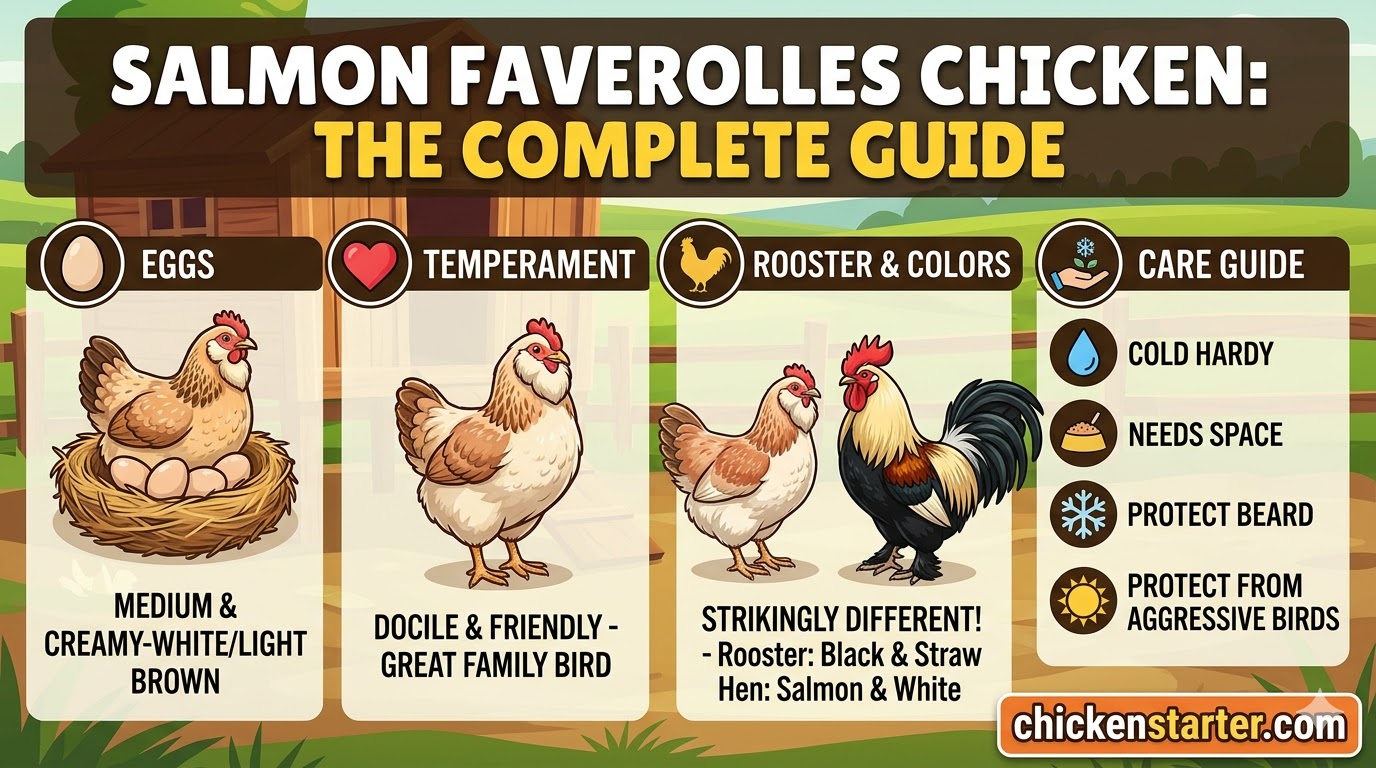
The Salmon Faverolles (always spelled with the “S,” pronounced FAV-er-ol with a silent S) is a French heritage dual-purpose breed famous for three things: an irresistibly comedic personality that earns them the nickname “barnyard comedians,” stunning color differences between hens and roosters, and reliable winter egg production of 180 to 200 tinted cream-to-pink eggs per year.
You will see this breed spelled both “Faverolles” and “Faverolle” online. According to Wikipedia’s breed entry, the breed was given the name of the village and the singular is thus also Faverolles, not Faverolle. The APA uses “Faverolle” without the S for singular, but breeders and historians consider this incorrect since the name comes from the French village of Faverolles. I use “Faverolles” throughout this Salmon Faverolle chicken guide because it is the historically correct form.
I added Salmon Faverolles to my flock expecting a cute egg layer. What I got was the most entertaining, talkative, human-obsessed chicken I have ever raised. But their extreme docility comes with a serious downside that most guides barely mention, and I will explain exactly what it is.
Quick Breed Reference
The Faverolles is a unique, French heritage breed known for its distinctive appearance and charming personality. Below is a structured summary of its characteristics and requirements.
Quick Reference
- Breed Type: Heritage, dual-purpose (eggs, meat, pets, exhibition)
- Origin: Village of Faverolles, Eure-et-Loir, France (1860s)
- APA Class: Continental
- Conservation Status: Watch (Upgraded from Threatened in 2022)
Production & Physicality
| Feature | Details |
|---|---|
| Egg Production | 150 – 200 per year (3 – 4 per week); up to 240 from top lines |
| Egg Color | Tinted, cream to light brown, sometimes with a pinkish hue |
| Egg Size | Medium to Large |
| Weight (US) | Roosters: 8 lbs |
| Weight (UK) | Roosters: 9 – 11 lbs |
| Lifespan | 5 – 8 years |
| Comb Type | Single, small, red |
Temperament & Hardiness
- Temperament: Docile, friendly, comedic, talkative, and “cuddly.”
- Climate Tolerance:
- Cold Hardy: Excellent
- Heat Tolerance: Poor to moderate (requires shade/cooling in summer)
- Broodiness: Variable, generally moderate.
Unique Breed Features
Faverolles are easily identified by their “fluffy” appearance and specific anatomical traits:
- Five Toes: Unlike most chickens which have four, Faverolles possess a fifth toe.
- Facial Plumage: Notable beard and muffs that give them a “chipmunk” or “owl” face.
- Legs: Feathered legs and feet.
- Body Shape: A distinct, heavy trapezoid body shape.
APA Recognition
- Salmon: Recognized in 1914
- White: Recognized in 1981
Salmon Faverolles Origin: How a French Utility Chicken Became the World’s Favorite Barnyard Comedian
The story of the Faverolles begins with a problem. In the late 1800s, the Houdan was the dominant chicken breed supplying Parisian markets with fresh eggs and meat. But the Houdan despised confinement. When early cage systems were trialed in France, Houdans exhibited terrible cage-induced behavioral problems.
French farmers needed a replacement. They needed a hen that tolerated confinement, laid eggs through winter, and was large enough for the table.
The Breeds Behind the Faverolles
According to the Livestock Conservancy, the Faverolles was developed by crossing many chicken breeds including the Houdan, Brahma, French Rennes, Flemish Cuckoo, Malines, and Dorking, then selecting offspring specifically for production qualities.
Each ancestor left a fingerprint. The Dorking and Houdan contributed the distinctive five toes. The Brahma brought size, feathered feet, and cold hardiness. The Cochin and Langshan added bulk and dense feathering. Local cuckoo breeds from Rennes and Malines contributed hardiness and adaptability.
By about 1886, a distinct type with consistency of feathering had emerged. The result was a bird that could do everything the Houdan could do, and more, all while tolerating the confinement that the Houdan could not handle.
For more on the Brahma, one of the key ancestor breeds, see our complete Brahma chicken guide.
The Paris Market Takeover
The Faverolles’ rise was rapid. According to Backyard Poultry Magazine, the Faverolles chicken became France’s leading industry-produced table bird, a favorite of Parisian restaurants and the bourgeoisie.
The breed was so successful that it essentially replaced the Houdan in commercial production. According to Wikipedia, when battery cages began to be used at the very beginning of the twentieth century, Faverolles tolerated the close confinement better than the Houdan breed, and became the primary breed producing eggs for the Paris market.
International Spread and APA Recognition
According to the Livestock Conservancy, the breed was introduced to England in 1894. Dr. A.H. Phelps of Glen Falls, New York, imported Faverolles to America in 1901 and 1902, where the breed developed an enthusiastic following.
The Salmon variety was recognized by the American Poultry Association in 1914. The White variety followed much later in 1981. According to Chicken Talks, the bantam variety was recognized in 1925, though it nearly disappeared after the Second World War.
Near-Extinction and Revival
Like many heritage breeds, Faverolles experienced a sharp decline during the Second World War. According to Heritage Acres Market, by the 1960s and 70s the birds had almost disappeared entirely. It was only due to the work of the Houdan-Faverolles Club of France that the breed did not vanish altogether.
According to Backyard Poultry Magazine, in 2022, the Livestock Conservancy moved the breed from the Threatened to the Watch category following a major population increase.
By keeping Faverolles, you are helping conserve a rare heritage breed with a fascinating 160-year history. That alone makes them worth considering.
Exhibition vs. Utility Lines: A Split Nobody Talks About
According to Hobby Farms, today the breed comes in two distinct breeding lines: exhibition and utility.
Utility Faverolles come from French and German bloodlines. According to Thrifty Homesteader, these birds mature more quickly and can begin laying as early as four months. They often have less pronounced facial feathering and their tails are not as upright, which makes them better foragers and more predator-aware.
Exhibition Faverolles have been bred for show qualities. They have fuller muffs, more dramatic beards, and more upright tail feathering. They are stunning to look at. But the larger muffs create a vision problem I will address in detail later in this guide.
Understanding which line your birds come from explains a lot about their behavior, egg production, and predator awareness.
Salmon Faverolles Hen vs. Rooster: Why They Look Like Completely Different Breeds
The sexual dimorphism in Salmon Faverolles is among the most dramatic of any chicken breed. Hens and roosters look so different that new keepers sometimes cannot believe they are the same breed.
Salmon Faverolles Hen Appearance
According to the Livestock Conservancy, females appear as “a much more lightly colored Wheaten than females of other breeds.” The hen’s feathers are a rich, golden salmon color over the back, head, and wings. According to Mile Four’s breed guide, hens display soft salmon-pink breasts with creamy white bodies.
The breast, muff, and lower half of the body are lighter straw and cream shades. The under-fluff is grayish. The overall effect is warm, soft, and distinctly honeyed, a color pattern that exists exclusively in this breed.
Salmon Faverolles Rooster Appearance
The Salmon Faverolles rooster is a completely different visual experience. According to Backyard Poultry Magazine, the rooster has a black beard, muffs, breast, abdomen, and thighs, with a straw hackle and saddle, and mahogany or straw back and coverts. There is a beetle-green luster to the black tail, and the wing feathers are black, golden, and white.
According to My Pet Chicken, roosters are “huge and magnificent, parading around with a virtual rainbow of colors: iridescent black where the hens are white, burnished with bronze on their backs and wings, while their hackles and saddles the color of pale straw.”
Five Unique Physical Features That Set Faverolles Apart
Five toes. Most chickens have four. Faverolles have five on each foot, a genetic trait inherited from the Dorking. According to Chicken Experts, this fifth toe quite literally points to the presence of the Dorking chicken in the breed’s bloodline.
Beard and muffs. The fluffy facial feathering conceals their earlobes and nearly invisible wattles. This gives them their signature “owl face” appearance. The French nickname for them was “Tête de hibou”, meaning “head of an owl.”
Feathered legs and toes. Both legs and outer toes have light feathering, contributing to their cold hardiness but requiring extra maintenance in wet conditions.
Trapezoid body shape. Wide, deep, and low to the ground. The body is broad across the back and breast with significant depth through the keel.
Nearly invisible wattles. According to Heritage Acres Market, their wattles are almost not there, and their earlobes are small and hidden behind the muffs.
Sexing Chicks: When Can You Tell?
Good news. According to Practical Self Reliance, around 3 to 5 weeks old the males will begin to show black on their chest, then develop dark feathers on their belly and tail. The hens will stay lighter and show brown and salmon markings on their breast.
This makes Salmon Faverolles one of the easier breeds to sex at a young age, though they are not truly autosexing.
Size: Why Sources Disagree
You will see very different weight numbers depending on which standard you reference.
According to the Livestock Conservancy, the US standard calls for males at 8 lbs and females at 6.5 lbs. But according to Wikipedia, the Poultry Club of Great Britain standards list cocks at 9 to 11 lbs and hens at 7.5 to 9.5 lbs.
British and German Faverolles are genuinely larger birds than their American counterparts. Their fluffy, abundant feathering also makes them appear even bigger than their actual weight.
Faverolles Chicken Colors: Every Variety from Salmon to Splash
Salmon is by far the most popular and recognizable variety, but Faverolles come in many more colors than most people realize.
According to the Livestock Conservancy, in America only the Salmon and White varieties are accepted by the APA. According to Chicken Experts, there are three types of Faverolles internationally: the original French, the German, and the British, each accepting different color varieties.
Salmon is APA recognized (1914) and available in the US, UK, France, Germany, and Australia. The most popular variety worldwide.
White is APA recognized (1981) and available in the US, UK, and France.
Black is not APA recognized but accepted in the UK, Germany, and France.
Mahogany is recognized in Germany.
Blue and Laced Blue are recognized in the UK and Germany.
Cuckoo is recognized in France.
Ermine is recognized in France and Germany.
Blue Salmon exists in Germany.
Splash and Buff varieties also exist in limited availability.
According to the Livestock Conservancy, the Salmon color is unique. It is a pattern found exclusively on the Faverolles chicken and does not appear in any other breed.
For more on colored eggs from different breeds, see our guides on what chicken lays blue eggs and what chicken lays pink eggs.
Salmon Faverolles Egg Color: Cream, Light Brown, Tinted, or Pink? The Honest Answer
The Salmon Faverolles egg color is one of the most debated topics in the backyard chicken world. Some sources say cream. Some say light brown. Some say pink. So which is it?
According to the Livestock Conservancy, “Faverolles hens usually lay tinted eggs (though colors of light brown to pink tint are not unknown).”
According to McMurray Hatchery, “the Salmon Faverolles lay a cream colored egg.” According to Murray McMurray Hatchery’s blog, most French breeds lay white eggs, but “Faverolles produce light brown to cream shades with an occasional pink-tinted bloom showing up.”
Here is the honest answer. The egg color ranges from cream to light brown, with some hens producing eggs that have a subtle pinkish tint. You will not get bright pink eggs. The “pink” is really a warm tinted-cream that looks pinkish compared to a white egg and distinctly different from a standard brown egg.
According to The Peasant’s Daughter, the color or hue of pink your hen lays will vary from one chicken to another. If the color is important to you, seek out good breeders who focus on this unique trait.
The pinkish tint is most visible in the first eggs of the laying season. Like all egg pigments, the tint fades slightly as the hen lays more eggs through the cycle.
My recommendation: If you are buying Faverolles specifically for pink eggs, talk to your breeder about their flock’s egg color. Not every line produces eggs with a visible pink hue. Many produce a beautiful cream that is equally lovely but distinctly not pink.
Salmon Faverolles Egg Production: How Many Eggs and When Do They Start Laying?
According to the Livestock Conservancy, hens have been known to lay from 150 to over 200 eggs per year. According to My Pet Chicken, you can expect 4 to 5 eggs per week, which works out to about 180 to 240 eggs per year from top production lines.
According to multiple keeper reports, the realistic average for most backyard flocks is 180 to 200 eggs per year, roughly 3 to 4 per week.
Winter Laying: Their Original Purpose
This is where Faverolles truly shine. According to McMurray Hatchery, the Salmon Faverolles was originally bred as a utility poultry breed in France specifically for winter eggs. According to Oklahoma State University’s breed database, this fowl will continue to lay eggs in winter where other birds will have stopped.
If you live in a cold climate and want eggs through the dark months, Faverolles are one of the best heritage breeds for the job.
Point of Lay: When Will They Start?
According to Chicken Talks and Practical Self Reliance, most hens start laying at about 19 to 24 weeks of age, which is reasonably early for a heritage breed. According to Thrifty Homesteader, utility-line Faverolles can begin as early as four months.
My Pet Chicken estimates 5 to 6 months for most birds. Expect some individual variation.
How Long Do They Keep Laying?
According to Heirloom Grown, to be classified as a heritage chicken, the hens have to be productive for 5 to 7 years. This means you will keep your egg-laying hens longer than what is typical for commercial hybrids.
For more on egg production, see our guides on chicken behavior before laying the first egg and why chickens stop laying eggs.
Salmon Faverolles Temperament: Why They Are Called the Barnyard Comedians
This is the section that makes Faverolles unlike any other breed guide you will ever read. Because no other chicken has a personality quite like this.
According to The Happy Chicken Coop, “Salmon Faverolles are exuberant about life. They are friendly, curious, and comical. They will dash wildly around the yard bumping into each other, and carry on as if whatever they are doing is of the utmost importance.”
The Famous Chest Bump
According to Heirloom Grown, “they have this thing where they will run to another Faverolle chicken and then jump and do a chest bump. I have no idea what that is about, but it amuses me.” According to Chicken Experts, they describe this behavior as “a poultry fist pump amongst barnyard buddies.”
This chest-bumping ritual is one of those Faverolles behaviors that you have to see to believe. They run at each other, bump chests, and then walk away as if absolutely nothing happened. Nobody knows why they do it. But it is hilarious.
Cuddly, Talkative, and Human-Obsessed
According to My Pet Chicken, unlike some more independent breeds, Salmon Faverolles enjoy attention and even seek out companionship. The Happy Chicken Coop notes they “enjoy talking with you, especially one on one.”
These are birds that will follow you around the yard, hop onto your lap uninvited, and chatter at you nonstop. They are not just friendly. They are needy in the most endearing way possible.
The Pecking Order Problem
There is a serious flip side to all that gentleness. According to My Pet Chicken, Faverolles “often rank low in the pecking order due to their docile nature, so they do best with other calm breeds like Cochins, Silkies, or Orpingtons.”
According to Chicken Fans, it is best not to keep Faverolles with assertive breeds such as Rhode Island Reds or Wyandottes. They recommend looking for calmer birds or keeping a flock of only Faverolles.
If you house Faverolles with assertive breeds, the Faverolles will be bullied. They will not fight back. They will simply accept it. This can lead to feather loss, stress, reduced egg production, and in severe cases, injury.
For strategies on managing flock dynamics, see our guide on pecking order problems and stopping bully hens.
Salmon Faverolles Rooster: The Gentlemen of the Chicken World
The Salmon Faverolles rooster deserves his own section because he is unlike virtually any other rooster you will encounter.
According to Wikipedia, some Faverolles cocks “are the quietest of all breeds.” According to BackYard Chickens forum reviews, keepers who have had Faverolles for multiple years report that “I’ve yet to have a rooster be aggressive toward me or anyone else.”
According to Heritage Acres Market, Salmon Faverolles roosters are generally reported as being non-aggressive and calm. They tend to run from aggression rather than confront it.
This makes them safe around children and ideal for suburban flocks where an aggressive rooster would be a problem. Their crowing is expressed in a lower register, though it can still be relatively loud.
The trade-off is obvious. A rooster that will not fight cannot protect a flock from predators or from aggressive roosters of other breeds. If you need a flock protector, a Faverolles rooster is not the right choice.
For more on whether you need a rooster at all, see our guide on do I need a rooster to get eggs. And if noise is a concern, our quietest chicken breeds for backyards guide covers the best options.
Common Faverolles Chicken Problems: The Muff Vision Issue Nobody Talks About
This is the section that sets this guide apart from every other Faverolles chicken article on the internet. It explains why Faverolles sometimes seem “dumb.” And it proves they are not dumb at all.
According to The Featherbrain, “if your Faverolles are exhibiting any of these behaviors, it’s because they can’t see past their giant muffs. Some strains of this breed have very large muffs that do impede their vision quite a bit.”
According to Thrifty Homesteader, “Faverolles can have difficulty seeing the ground because of their muffs and beards. They are often fearful of heights and tend to prefer to roost and nest on low, flat areas.”
How Vision Problems Explain Every “Weird” Faverolles Behavior
When you hear owners complain that Faverolles walk around aimlessly, get lost, get stuck behind fences, do not run from predators, or sleep on the floor instead of roosting, the answer is almost always the same: they cannot see properly.
According to Thrifty Homesteader, show-quality Faverolles with full, pronounced muffs “may have difficulty seeing the ground around them” and “their foraging ability may be impaired.” They tend to avoid heights and ground-nest like ducks.
Utility-line Faverolles with less pronounced facial feathering have much fewer of these issues.
The Predator Vulnerability Connection
This is the critical safety issue. Faverolles that cannot see well cannot detect approaching predators. According to Heritage Acres Market, it is not recommended to keep Faverolles in a wide-open free-range environment. They are prone to attack by predators as their fluffy faces can obscure their vision.
Covered, secure runs are essential for Faverolles. This is not optional. If you free-range Faverolles in an area with hawks, foxes, dogs, or other predators, you will lose birds. Their docile nature means they do not have the fight-or-flight response that more alert breeds rely on.
What You Can Do
According to The Featherbrain, if your Faverolles’ muffs are impeding their vision, trimming them down can greatly improve your birds’ quality of life. They note that muff feathers can also curl back into the birds’ eyes, leading to discomfort and possible infection.
Provide low perches. According to Hobby Farms, their beards and muffs can limit their vision, so low perches and nesting boxes help them move safely.
Use ramps instead of jumps. According to Thrifty Homesteader, keep the area around roosts clear as Faverolles will often fly down rather than jump since they can see ahead but not down. Adding ramps helps them navigate safely.
Invest in serious predator protection. Our guides on predator-proofing your coop and building a predator-proof coop are essential reading for any Faverolles owner.
How to Care for Salmon Faverolles: Coop, Feed, Fifth Toe and Feathered Feet
Feathered Feet Mean Dry Conditions Are Essential
According to Know Your Chickens, feathered legs are prone to developing bad scaly leg mite infestations. The feathers make it challenging to spot until the problem is well-advanced.
Keep runs well-drained. Use sand, gravel, or deep bedding. Avoid mud at all costs. Wet, matted foot feathers are a breeding ground for parasites and can lead to bumblefoot.
For run flooring solutions, see our guide on the best thing to put in the bottom of a chicken run.
The Fifth Toe Requires Regular Trimming
This is a care detail almost no other guide mentions. According to Hobby Farms, Salmon Faverolles have a fifth toenail that requires routine trimming to prevent injury or discomfort.
The fifth toe points upward and does not wear down naturally through scratching and walking the way the other four toes do. If left untrimmed, the toenail can curl backward and press into the leg, causing pain and gait problems.
According to The Chicken Coop Company’s care guide, these birds are best suited to low roosting poles, and care should be taken to protect their delicate fifth toe.
Check and trim the fifth toenail every 4 to 6 weeks, just as you would trim a dog’s nails. Use sharp nail clippers and avoid cutting into the quick.
Climate Hardiness
Faverolles are excellent in cold, damp climates. Their dense, fluffy feathering provides outstanding insulation. Their small single comb and nearly invisible wattles minimize frostbite risk.
According to Heirloom Grown, the only winter issue they may have is frostbite on their combs during severe cold snaps. Applying Vaseline before extreme weather helps.
Heat is a different story. According to the Murray McMurray Hatchery blog, Faverolles do not like the heat. They need plenty of shade, cool water, and good ventilation in warm climates. Their thick feathering, which is such an asset in winter, becomes a liability when temperatures rise.
Feeding and Obesity Risk
Standard 16% protein layer feed is appropriate. Supplement with oyster shell for calcium. Faverolles are enthusiastic foragers when they can see well enough to forage, and free-range time reduces feed costs.
However, Faverolles can be prone to obesity if confined without adequate exercise. Watch their weight and avoid overfeeding treats. Obesity reduces egg production and shortens lifespan.
For complete feeding guidelines, see our comprehensive chicken feeding guide.
Salmon Faverolles as Meat Birds: The Forgotten French Table Heritage
Most modern keepers think of Faverolles purely as egg layers or pets. But this breed was created to feed Paris.
According to Backyard Poultry Magazine, the Faverolles chicken became France’s leading industry-produced table bird.
According to a keeper review on Cackle Hatchery, “I can confidently recommend this bird as an outstanding eating bird. With this breed the roos still have tender leg quarters even at nearly a year old. I’ve never had any breed do that.”
According to Practical Self Reliance, Salmon Faverolles have excellent meat, though to reach table weight it may take 6 to 8 months. They are slow growers compared to commercial meat breeds, but the flavor is considered superior.
The honest assessment: If maximum meat production in minimum time is your goal, choose a dedicated meat breed. If you want a bird that provides steady eggs, has an unforgettable personality, and yields flavorful meat when processed, Faverolles deliver on all three fronts.
What Is the Lifespan of a Salmon Faverolles?
According to My Pet Chicken, the average lifespan is 5 to 8 years. According to Practical Self Reliance, expect 5 to 7 years on average. According to The Chicken Coop Company, the average is about 5 years.
Realistically, 5 to 7 years with good care is the most honest estimate. Some individuals live longer, especially in low-stress environments with excellent nutrition and predator protection.
For more on chicken longevity, see our guide on how long do chickens live.
Salmon Faverolles Pros and Cons: Is This the Right Breed for You?
Pros:
Among the most friendly, cuddly, human-bonded chicken breeds in existence. Excellent for families with children. Reliable winter egg layer producing 180 to 200+ tinted eggs per year. Stunning appearance with dramatic sexual dimorphism between hens and roosters. Roosters are exceptionally gentle and quiet. You are helping conserve a heritage breed on the Watch list. True dual-purpose providing eggs and respectable meat quality. Excellent cold hardiness. Tolerates confinement well. Easy to sex at 3 to 5 weeks.
Cons:
Extremely predator-vulnerable due to muff-impaired vision and docile nature. Will be bullied in mixed flocks with assertive breeds. Feathered feet need dry conditions, and mud is a serious problem. Fifth toe requires regular trimming. Talkative and vocal, which some keepers find loud. Heat-sensitive due to thick feathering. Can be prone to obesity in confinement. Slow growers for meat compared to dedicated meat breeds. Hatchery birds may not match the breed standard’s ideal coloring.
Frequently Asked Questions About Salmon Faverolles
What color eggs do Salmon Faverolles lay?
Salmon Faverolles lay tinted eggs ranging from cream to light brown, with some hens producing eggs with a subtle pinkish hue. The “pink” is a warm tinted-cream rather than a bright pink. The degree of tint varies between individual hens and breeding lines. If pink eggs are important to you, seek a breeder who selects specifically for this trait.
How many eggs do Salmon Faverolles lay per year?
180 to 200 eggs per year on average, which works out to 3 to 4 per week. Top production lines can reach 240. They are especially valued as winter layers, bred specifically for Paris markets during cold months when most breeds slow down or stop entirely.
Are Salmon Faverolles good for beginners?
Yes. They are one of the best beginner breeds due to their docile temperament, tolerance for confinement, and forgiving nature. The main caveat for beginners is that predator protection must be excellent, since these birds are extremely vulnerable.
How big do Salmon Faverolles get?
US standard: roosters 8 lbs, hens 6.5 lbs. UK standard: roosters 9 to 11 lbs, hens 7.5 to 9.5 lbs. Their fluffy feathering makes them appear significantly larger than their actual weight.
What are common Faverolles chicken problems?
The most underreported issue is vision impairment from their large muffs, which contributes to predator vulnerability, disorientation, and floor-roosting. Other concerns include scaly leg mites that are hard to detect under feathered legs, fifth toe injuries requiring trimming, obesity in confined birds, and bullying from more assertive breeds.
What is the lifespan of a Salmon Faverolles?
5 to 8 years, with 5 to 7 being most realistic. As heritage breeds, they tend to live longer than commercial hybrids. Heritage hens remain productive layers for 5 to 7 years.
Is it “Faverolle” or “Faverolles”?
The correct spelling is always “Faverolles” with the S, both singular and plural, because the breed is named after the village of Faverolles in France. The APA uses “Faverolle” without the S for singular, but breeders and historians consider this incorrect since it is a proper place name. The final S is silent in French.
Are Salmon Faverolles roosters aggressive?
No. Salmon Faverolles roosters are among the most gentle roosters of any breed. They tend to run from aggression rather than confront it. They are safe around children and rarely crow excessively. However, because they are so non-aggressive, they cannot protect a flock from predators or assertive roosters of other breeds.
Key Takeaways
Salmon Faverolles are one of the most friendly, entertaining, and human-bonded chicken breeds in existence. Their “barnyard comedian” personality, complete with chest bumps and nonstop chatter, makes them a joy to keep.
They produce 180 to 200 tinted cream-to-pink eggs per year, with particular strength as winter layers, the purpose for which they were originally bred.
Predator protection is absolutely non-negotiable for this breed. Their muffs impair their vision, their docile nature eliminates fight-or-flight response, and they simply cannot defend themselves. Covered, secure runs are essential.
House them with other gentle breeds only. Buff Orpingtons, Cochins, Brahmas, and Silkies make excellent flock mates. Rhode Island Reds, Leghorns, and other assertive breeds will bully them mercilessly.
Five toes, feathered feet, beard and muffs. Extra care required, but worth every minute. And always spelled Faverolles with the S.
Looking for more family-friendly breeds? Check out our guides to Buff Orpington chickens, Cochin chickens, and our easiest chicken breeds for beginners.
This article draws on breed data from the Livestock Conservancy, standard specifications from the American Poultry Association, breed profiles from Oklahoma State University, historical research from Backyard Poultry Magazine, vision impairment analysis from The Featherbrain and Thrifty Homesteader, care guidance from Hobby Farms, and hands-on experience raising Salmon Faverolles in a backyard flock. All facts were verified against current published sources as of March 2026.

Oladepo Babatunde is the founder of ChickenStarter.com. He is a backyard chicken keeper and educator who specializes in helping beginners raise healthy flocks, particularly in warm climates. His expertise comes from years of hands-on experience building coops, treating common chicken ailments, and solving flock management issues. His own happy hens are a testament to his methods, laying 25-30 eggs weekly.