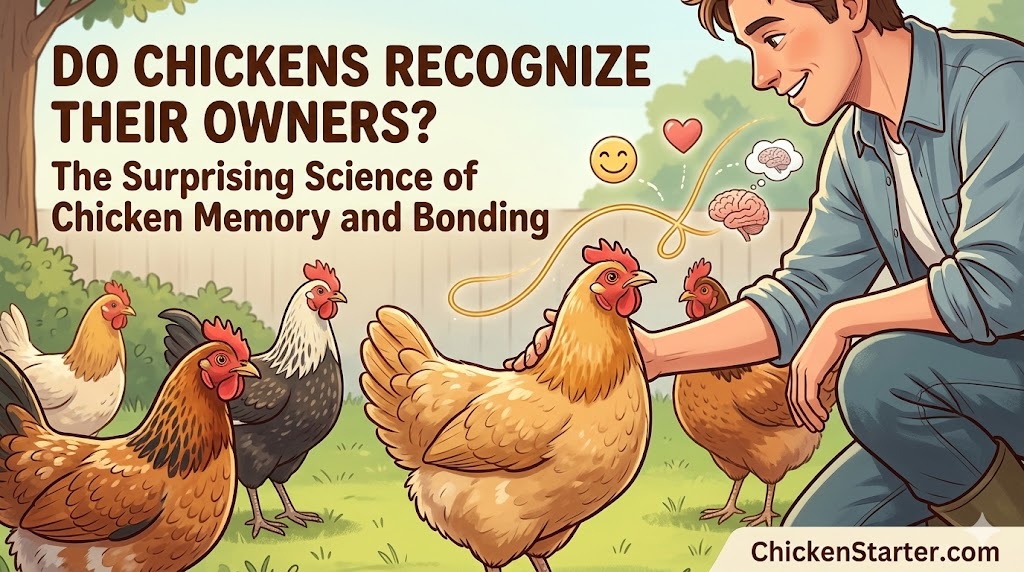
The first time I realized my chickens knew exactly who I was, I was standing in my backyard in a borrowed raincoat.
It was 2021, my second year keeping chickens after moving to the US from Nigeria. I had six hens at the time, a mix of Buff Orpingtons and Rhode Island Reds. That morning, it was pouring rain and I had thrown on a neighbor’s oversized yellow raincoat with the hood up. I looked nothing like my usual self. I walked out to the coop expecting the usual morning rush, and every single hen came running toward me like they always did. Not a moment of hesitation.
My neighbor, who had visited the coop with me a few times, walked out behind me in his regular clothes. The same hens froze, clucked nervously, and backed away from him. Same yard, same morning, same weather. They ran to the person in the bizarre outfit they had never seen, and they avoided the person they had met several times before.
That was the moment I stopped wondering whether chickens recognize their owners and started wondering just how much more was going on in those little feathered heads than I had ever given them credit for.
The answer, according to a growing body of peer-reviewed research, is quite a lot.
Yes, Chickens Really Do Recognize Their Owners
Let me be direct: chickens absolutely recognize their owners. This is not wishful thinking from besotted chicken keepers, although there is plenty of that too. It is supported by published research in animal cognition.
According to a landmark review published in the journal Animal Cognition by Dr. Lori Marino, a neuroscientist formerly on the faculty of Emory University, chickens are just as cognitively, emotionally, and socially complex as most other birds and mammals in many areas. Her review, published through Springer’s Animal Cognition journal, examined peer-reviewed data on chicken intelligence and found evidence of self-awareness, social learning, self-control, and the ability to perceive time and anticipate future events.
So how does this translate to recognizing you specifically?
Chickens use a combination of visual recognition, voice identification, routine association, and behavioral memory to identify their human caretakers. According to research referenced across multiple poultry science sources, chickens are capable of recognizing and distinguishing between up to 100 individual faces, both chicken and human. They do not just recognize faces in a general sense. They associate specific faces with specific experiences, positive and negative, and they adjust their behavior accordingly.
As Lisa Steele, bestselling poultry author and 5th-generation chicken keeper behind Fresh Eggs Daily, has observed in her own flock, her chickens recognize their human “flock members” regardless of hairstyle changes, hats, or other visual variations. According to Steele, studies have shown that chickens prefer looking at people with symmetrical faces, and it is thought that they can remember both positive and negative experiences with various humans and even share that information with other flock members.
That sharing detail is remarkable. It means your chickens are not just remembering you. They may be communicating their assessment of you to the rest of the flock.
How Do Chickens Recognize Their Owners? The Four Pathways
Understanding how chickens identify you helps explain why the bond feels so real and why some birds seem to know you better than others.
Visual Recognition: They Know Your Face
Chickens have excellent vision. According to Dine A Chook, chickens can focus on both close and distant objects at the same time, a unique feature among animals. They also see more colors than humans do, including ultraviolet light, which gives them an extraordinarily rich visual world.
According to a 2015 study published in Frontiers in Neural Circuits, even newly hatched chicks demonstrated the ability to distinguish between familiar and unfamiliar human faces within their first week of life. The chicks were sensitive to changes in the face’s age, gender, and orientation. A 2024 study published in Proceedings of the National Academy of Sciences went further, identifying a population of neurons in one-week-old chicks that respond to face-like stimuli, suggesting that face recognition may be partially innate rather than entirely learned.
In practical terms, this means your chickens are studying your face every time you visit the coop. They are cataloguing your features and filing them away. Over time, your face becomes associated with food, safety, routine, and (hopefully) positive experiences.
This also explains why chickens often react differently to strangers. As Whitney Out West, a chicken keeper and homesteading blogger, has observed, a flock of chickens may be wary of strangers, but they are often entirely comfortable around the people they know. The contrast in behavior between how your chickens treat you and how they treat a visitor is one of the most obvious demonstrations of facial recognition in action.
Voice Recognition: They Know Your Sound
Chickens do not just rely on sight. They are remarkably attuned to sound. According to Small Pet Select’s research summary, chickens have a good memory for sounds, especially the voices of those with whom they regularly interact. They can recognize their owners through sounds, whether it is footsteps or the tone of your voice.
According to Dine A Chook, chickens even begin communicating while still in the egg. Mother hens and chicks use sounds to bond before hatching. This means that auditory recognition is one of the very first cognitive abilities a chicken develops.
I use this in my own flock management. Every time I walk to the coop, I use the same call: a drawn-out “chick-chick-chick” that I have been consistent with since my hens were pullets. They come running from across the yard the moment they hear it. My wife uses a different call, and the hens respond to hers too, but with a slightly different energy. They know which human is calling.
According to Melissa Caughey, author of the book How To Speak Chicken, some chickens even “name” their owners, using distinct cluck patterns to greet them. Chickens are capable of making at least 30 different sounds, each with a specific meaning, as Steele has documented. It is not unreasonable to think that they develop specific vocalizations associated with specific humans.
Routine Recognition: They Know Your Schedule
Chickens are creatures of habit, and they are remarkably good at learning and remembering daily routines. According to Dr. Marino’s review in Animal Cognition, chickens perceive time intervals and can anticipate future events.
This is something every backyard keeper notices. My hens know what time I come out in the morning. They know what time treats happen in the afternoon. They know the sound of the back door opening. They know the difference between me walking toward the coop (food is coming) and me walking toward the garden (nothing interesting). Their perception of time and memory is proved by the fact that they have routines they adhere to daily and they can become distressed if their routine changes.
This routine recognition works hand in hand with owner recognition. Your chickens are not just recognizing your face and voice. They are recognizing you as the person associated with a specific, predictable set of daily events that matter deeply to them: food, water, coop opening, treat time, and the general rhythm of their day. For more on establishing a good routine with your flock, see our guide on the best feeding schedule for backyard chickens.
Emotional Association: They Remember How You Treated Them
This is perhaps the most fascinating pathway. Chickens do not just recognize you. They remember how interactions with you made them feel.
According to research cited across multiple poultry behavior sources, chickens can remember individual humans for months, especially if interactions were meaningful, whether positive or negative. They develop preferences for humans who treat them well, and they remember and avoid humans who have handled them roughly or caused them stress.
As Pet Educate summarizes, it appears that chickens develop preferences to humans who treat them well, and that they can recognize them for it. Chickens that have been handled gently, fed treats by hand, and spoken to calmly form positive associations with their keeper. Chickens that have been chased, grabbed roughly, or startled form negative associations and may avoid that person even months later.
This has practical implications. If you are building a bond with a new flock or trying to tame skittish birds, your behavior matters enormously. Every interaction is being logged and remembered. For tips on building trust with a new flock, see our guide on the easiest chicken breeds for beginners and bringing chicks home: 15 must-haves.
How Long Can Chickens Remember Faces?
The honest answer is that the exact duration of chicken facial memory has not been precisely measured in a controlled laboratory setting. Science has not yet given definitive numbers. However, based on the research that does exist and the extensive anecdotal evidence from keepers worldwide, chickens appear to have surprisingly strong long-term memory.
According to studies cited by multiple poultry research sources, chickens can remember individual humans for weeks or even months, especially when those interactions were emotionally significant. Backyardchicken keepers regularly report that hens recognized them after absences of several months. One keeper documented that after being away for four months, her flock sprinted to her the moment she walked outside, while continuing to be cautious around the substitute caretaker who had been feeding them daily during her absence.
My own experience supports this. In 2023, I traveled for six weeks and had a neighbor manage my flock. When I returned, my Buff Orpington Ada (the same hen who gave me my first egg back in 2020) ran to me the moment she heard my voice from the back door. The neighbor had been feeding them daily for six weeks. They recognized him and tolerated him, but when I came back, the difference in their excitement was unmistakable.
Does that mean chickens remember faces forever? We honestly do not know. According to Backyard Farm Life, chickens certainly remember their owners when they see them regularly, as they associate companionship, food, and safety with their owners. However, if you move on permanently without your chickens, they may not hold that association forever. But there are instances where people have reported their chickens remembering them after several months of separation, so the limits of chicken memory remain unclear and likely vary by individual bird.
Can Chickens Get Attached to Their Owners?
This is where the science gets nuanced and the answer depends partly on how you define “attachment.”
If attachment means developing a positive association with a specific person, preferring their company, seeking them out, and showing behavioral signs of comfort in their presence, then yes, chickens absolutely get attached to their owners. This is well documented both in research and in the lived experience of millions of chicken keepers worldwide.
According to Dr. Marino’s review, chickens experience a range of complex negative and positive emotions, including fear, anticipation, and anxiety. They make decisions based on what is best for them. They also possess a simple form of empathy called emotional contagion. Not only do individual chickens have distinct personalities, but mother hens show a range of individual maternal personality traits that affect the behavior of their chicks.
However, whether chickens experience attachment in the same emotionally complex way that dogs or cats do is a more difficult question. As Pet Educate carefully notes, the science does not quite confirm that chickens can feel empathy, or these other more sophisticated emotions, towards humans. What we can say with confidence is that chickens develop strong positive associations with their primary caretaker and behave in ways that look very much like attachment.
In my experience, some individual hens form genuinely strong bonds. My Buff Orpington Ada has followed me around the yard for years, chosen to sit near me when I am in the garden, and produced what I can only describe as a contented purring sound when I hold her. Is that love in the way a dog loves? I honestly do not know. But it is something real, consistent, and specific to me. She does not do it for anyone else.
Do Chickens Miss Their Owners?
This is the question that tugs at the heartstrings of every chicken keeper who has ever gone on vacation.
According to Jack’s Hen House, a long-running poultry behavior resource, chickens can, do, and will mourn your “loss” and may even seem depressed, stop or reduce eating when their primary caretaker is absent. They note that chickens often run to their returning owner with obvious excitement, and then, in a behavior that is oddly reminiscent of cats, they may actually shun you temporarily afterward to punish you for leaving.
Melissa Caughey documents similar patterns in How To Speak Chicken, describing how chickens will call out for missing flock members using a specific vocalization that essentially means “Where are you?”
Whether this constitutes genuinely “missing” someone in the way humans or dogs do is debatable. What is not debatable is that chickens notice when their regular caretaker is absent, their behavior changes in response to that absence, and they react with obvious recognition and excitement when that person returns.
I have experienced this firsthand. When I returned from my six-week trip in 2023, my neighbor reported that the flock had been “moodier” than usual, less enthusiastic about treat time, and that two of my hens had temporarily reduced their egg production. When I walked back into the yard, the entire flock sprinted across the run to meet me at the gate. Coincidence? Maybe. But it has happened every time I have been away for more than a few days.
Do Chickens Know Their Names?
Yes, with consistent training, chickens can learn to respond to their names.
According to Pet Educate, chickens can learn their names, so long as the name is repetitively and consistently used in reference towards them. According to Thank Chickens, if they are handled and told their name over and over from a young age, they have the ability to learn their name. They will not always come when called like a dog, but they will turn around and acknowledge when called by name.
In my flock, I have names for all my hens, but only a few actually respond to their individual names. Ada (my oldest Buff Orpington) will look up and walk toward me when I say “Ada!” in a specific tone. My Rhode Island Red, who I call Red, responds to “Red!” but I suspect she is actually responding to the excited tone of my voice rather than the specific word. My Easter Eggers do not respond to individual names at all, though they all come running when I use the general flock call of “chick-chick-chick.”
The key is consistency. If you want your chickens to learn their names, use the same word in the same tone every time, and pair it with something positive, ideally a treat. Over weeks and months, they will learn to associate that specific sound with themselves and with good things happening. For more on treats that help with training and bonding, see our guide on best chicken treats that boost egg laying.
Do Chickens Know When You Are Talking to Them?
Chickens are remarkably responsive to human speech, though not in the way we might romantically imagine.
Chickens do not understand the meaning of your words. They do not comprehend language in the semantic sense that humans do. However, they are highly attuned to tone, pitch, rhythm, and emotional content of the sounds you make. According to research from Dalhousie University, where scientists are using artificial intelligence to decode chicken vocalizations, chickens have a range of sounds that vary in pitch, tone, and context, and they use these to communicate emotional states.
When you talk to your chickens in a calm, soft voice, they register that as a non-threatening, positive sound. Over time, they associate your specific voice patterns with safety and food. When you change your tone, raise your voice, or make sudden loud sounds, they register that as a potential threat.
Many experienced keepers, including Caughey in How To Speak Chicken, describe how their hens seem to respond to conversation, tilting their heads, making soft clucking responses, or moving closer when spoken to. While the chickens are not understanding your words, they are absolutely engaging with the sound of your voice and responding to its familiar, comforting qualities.
I talk to my chickens constantly. Not because I think they understand what I am saying, but because the sound of my voice is a consistent auditory cue that reinforces our bond. They hear my voice and they know: this is the person who feeds us, opens the coop, and brings good things. Whether I am talking about the weather or reciting grocery lists does not matter. The sound itself is what carries the meaning for them.
Do Chickens Recognize Voices?
Yes, and this may be even more reliable than facial recognition in some contexts.
According to Lisa Steele of Fresh Eggs Daily, newly hatched chicks can recognize their own mother by sight and sound. In studies, when a sitting hen was removed in the dark from her chicks and another broody hen put in her place, the chicks still found their mother hen without being able to see her. When the hen was disguised by various means, her chicks came to her anyway. The chicks relied on vocal recognition when visual cues were altered.
This auditory recognition extends to human voices. Several experienced keepers on the BackYard Chickens forum noted that vocal cues and sticking to a routine are more helpful than visual familiarity for building trust. One keeper observed that her chickens react to motion and voice patterns more consistently than to visual appearance.
Multiple experienced chicken keepers, including contributors to BackYard Chickens forums, note that they sing, whistle, or use specific verbal cues every time they approach the coop, and their chickens respond to these sounds from a distance, often before they can even see the person approaching.
Do Chickens Remember Trauma?
This is an important question, and the answer has real implications for how we manage our flocks.
According to Melissa Caughey in How To Speak Chicken, chickens react to horrible experiences the way many other animals do: they can sink into a depression and show signs of fear and distress for a long time afterward. She describes a friend’s flock that survived a weasel attack, in which nearly all of the hens were killed. The three survivors stopped laying eggs and spent their days hiding. It took months before they began behaving normally again and were able to become part of a new flock.
According to CoopCrate, traumatic experiences have an even stronger effect on chicken memory than positive ones. This means a single terrifying event, such as a predator attack, a rough handling experience, or even a loud, sudden noise, can leave a lasting impression that affects the bird’s behavior for weeks or months.
I saw this in my own flock after a predator scare in 2022. A neighborhood dog managed to get close to the run before I chased it away. No birds were injured, but for nearly two weeks afterward, my hens were reluctant to go into the area of the run closest to where the dog had been. They eventually resumed normal behavior, but the spatial memory of the threat persisted well beyond the actual event. This is why predator-proofing your coop is so important, not just for physical safety, but for the long-term psychological wellbeing of your flock.
Studies have also shown that chickens recover more quickly from stressful situations when in the company of friends. They associate being with their flock as being safe and prefer to be with familiar chickens over unknown ones. This is why, whenever possible, I avoid isolating individual birds unless it is medically necessary.
Do Chickens Love Their Owners?
This is the big question, and I want to answer it honestly rather than sentimentally.
The scientific evidence tells us that chickens form strong positive associations with their primary caretakers. They recognize us, seek our company, respond to our voices, follow us around, and show behavioral indicators of comfort and trust in our presence. According to Dr. Marino’s review, chickens are capable of experiencing a range of emotions and have distinct individual personalities.
But whether what chickens feel toward their owners constitutes “love” in the way we understand the term is something science cannot definitively confirm. As Pet Educate carefully notes, we do not quite know whether a chicken generally cares and loves their owner, or whether they just develop positive associations around certain people.
What I can tell you from six years of personal experience is that whatever my chickens feel toward me, it is real, it is consistent, and it is individual. Ada the Buff Orpington responds to me differently than she responds to anyone else who enters the yard. She seeks me out. She makes specific sounds when I approach. She lets me pick her up and hold her against my chest while she makes a soft, contented purring vibration. She does not do any of this for my neighbor who also feeds her.
Is that love? I think it is something in the neighborhood of love, even if it does not map perfectly onto how mammals experience the emotion. And for a chicken keeper, that is more than enough.
Do Chickens Know Their Way Home?
Yes, chickens have a strong homing instinct and excellent spatial memory.
This is why, when you first get new chickens, experienced keepers recommend confining them to the coop and run for 3 to 5 days before allowing any free-range time. During that confinement period, the chickens are mapping their environment and learning that this specific structure is “home,” the safe place where they sleep, eat, and are protected. For more on this important first step, see our guide on how to get chickens back in the coop at night.
Once they have established their coop as home base, chickens will reliably return to it every evening at dusk. In my experience, free-range chickens rarely get truly lost unless they are chased by a predator or physically displaced to an unfamiliar location. They have a remarkably accurate internal map of their territory.
According to Dr. Marino’s review, chickens demonstrate object permanence (the understanding that objects and places continue to exist even when out of sight) within their first two days of life, a cognitive milestone that human babies typically reach around age two. This spatial awareness helps them navigate their environment, find food sources, and return home consistently.
Do Chickens Smell? Can They Recognize People by Scent?
This is a question I get surprisingly often, and it is worth addressing because there is a common misconception.
According to Lisa Steele, chickens actually do not have a very developed sense of smell at all since it would have very little utility for them in the wild. She specifically notes that if you are adding new flock members and trying to “mask scents” to trick your existing chickens, it will not work because chickens do not rely on smell for recognition.
Chickens identify each other and their owners primarily through vision and sound, not scent. This is actually an important practical detail. It means that changing your soap, shampoo, or perfume will not confuse your chickens. But changing your appearance dramatically (like wearing a completely unfamiliar hat or mask) might give them a moment’s pause, though they will likely still recognize your voice and movement patterns.
As for whether chickens themselves smell (in the sense of producing odor), a clean, well-managed chicken does not produce significant body odor. The smell people associate with chickens comes from their droppings, particularly when bedding is wet or poorly managed. Keeping your coop clean and well-ventilated eliminates the vast majority of odor issues.
Which Breeds Bond Most Strongly With Their Owners?
Breed temperament plays a significant role in how readily chickens recognize and bond with their human keepers. According to Feathered Farm Life, breeds like Silkies and Polish are known for their docile nature and strong attachment to humans, while other breeds may be more skittish or independent.
Based on my personal experience and consistent reports from the chicken keeping community, these breeds tend to form the strongest bonds with their owners:
Buff Orpingtons: Consistently the most human-friendly breed in my experience. Gentle, calm, and genuinely affectionate. My Orpingtons have been the hens that follow me around the yard, sit in my lap, and respond most reliably to their names.
Silkies: Extraordinarily docile and people-oriented. Often described as the “lap dogs” of the chicken world. Check out our Silkie egg guide for more on this breed.
Cochins: Big, fluffy, and famously calm. They tend to enjoy human interaction and handling.
Brahmas: Despite their large size, Brahmas are often described as “gentle giants” and tend to be comfortable around people.
Easter Eggers: Typically curious and friendly, though individual personality varies more within this group.
Australorps: Calm, docile, and generally comfortable with handling.
Breeds that tend to be less interested in human bonding include Leghorns (productive but flighty), Hamburgs (nervous and independent), and most game breeds (bred for independence and often human-wary).
However, I want to emphasize that individual personality matters as much as breed. I have had a standoffish Orpington and a cuddly Leghorn. Early socialization (handling chicks gently and frequently from a young age) has a bigger impact on bonding than breed alone. For more on choosing the right breed for your situation, see our guide on the easiest chicken breeds for beginners.
How to Build a Stronger Bond With Your Chickens
If you want your chickens to recognize you, trust you, and show genuine comfort in your presence, here are the practices that have worked consistently for me across six years and multiple flocks:
Be the treat person. Nothing builds a positive association faster than food. Hand-feeding treats like mealworms, scratch grains, or fresh produce creates a powerful connection between your presence and good things. Learn more about healthy options in our guide on what chickens can eat from your kitchen.
Use a consistent call. Every time you approach the coop or bring food, use the same verbal cue. Mine is “chick-chick-chick.” Within a few weeks, your hens will associate that sound with you and with food, and they will come running from across the yard when they hear it.
Move slowly and calmly. Quick movements trigger prey instincts. Approach from the side rather than directly from above (approaching from above mimics a predator). Crouch down to their level when possible.
Talk to them. The content does not matter. The consistency of your voice does. Regular, calm conversation creates a familiar auditory environment that chickens find comforting.
Spend time just sitting with them. Some of my best bonding moments have come from simply sitting in a chair in the run and letting the hens approach me on their own terms. No food, no agenda, just quiet presence. The curious ones approach first. The shy ones follow eventually. Over weeks, even the most skittish birds learn that your presence is safe.
Never chase your chickens. Chasing creates a predator-prey dynamic that undermines trust. If you need to catch a chicken, wait until dusk when they are roosting, or use the submissive squat to your advantage (see our guide on why chickens squat when you pet them).
Handle them regularly and gently. Weekly health checks serve double duty: they keep your flock healthy, and they acclimatize your birds to being held. The more positive handling experiences a chicken has, the more comfortable she becomes with human contact.
Frequently Asked Questions
Do chickens recognize their owners?
Yes. Research published in the journal Animal Cognition confirms that chickens are capable of recognizing and distinguishing between up to 100 individual faces, including human faces. They identify their owners through a combination of facial recognition, voice recognition, routine association, and emotional memory.
Can chickens get attached to their owners?
Yes, in a meaningful sense. Chickens develop strong positive associations with their primary caretakers, seeking their company, responding to their voices, and showing behavioral signs of comfort and trust. Whether this constitutes emotional “attachment” in the same way dogs experience it is scientifically uncertain, but the behavioral evidence is compelling.
Do chickens remember who you are?
Yes. Chickens have been demonstrated to remember individual humans for months, particularly when interactions were emotionally significant (positive or negative). They use both visual and auditory cues to identify familiar people.
How long can chickens remember faces for?
The exact duration has not been precisely measured in controlled studies, but keepers regularly report recognition after absences of several months. Chickens likely retain facial memories for weeks to months at minimum, with stronger memories persisting longer.
Do chickens know when you are talking to them?
Chickens do not understand human language semantically, but they are highly responsive to tone, pitch, and rhythm of your voice. They can distinguish your voice from others and respond to familiar vocal patterns with attention and approach behavior.
Do chickens miss their owners?
There is evidence suggesting chickens notice and respond to the absence of their regular caretaker. Behavioral changes such as reduced eating, decreased egg production, and increased calling have been reported when primary caretakers are away. They often show obvious excitement when the owner returns.
Do chickens know their names?
With consistent training, chickens can learn to respond to their individual names. They will not always come when called like a dog, but they can learn to turn, acknowledge, and approach when their specific name is used consistently and paired with positive reinforcement.
Do chickens remember trauma?
Yes. According to poultry behavior experts including Melissa Caughey, chickens can sink into depression and show signs of fear and distress for weeks or months after traumatic events such as predator attacks. Traumatic memories appear to be stronger and more persistent than positive ones.
Do chickens love their owners?
Science confirms that chickens form strong positive associations, show individual preferences, and display behavioral indicators of trust and comfort toward their primary caretakers. Whether this constitutes “love” as humans define it remains scientifically uncertain, but the behavioral evidence suggests something meaningful beyond simple food association.
Do chickens recognize voices?
Yes. Chickens are highly attuned to auditory cues. They recognize their owner’s voice, specific verbal calls, and even footstep patterns. Newly hatched chicks can identify their mother hen by voice alone, even when she is visually disguised.
Do chickens know their way home?
Yes. Chickens have strong spatial memory and homing instincts. Once they have established a coop as their home base (typically requiring 3 to 5 days of initial confinement), they will reliably return to it every evening at dusk.
Do chickens smell, and can they recognize owners by scent?
Chickens have a very poorly developed sense of smell and do not use scent for individual recognition. They rely primarily on vision and hearing. The odor commonly associated with chickens comes from poorly managed droppings and bedding, not from the birds themselves.
Do roosters recognize their owners?
Yes. Roosters recognize their owners just as hens do, and they can be even more expressive about it. A rooster that trusts his owner may perform his protective “alarm call” around strangers but remain calm around his regular caretaker. See our guides on Brahma roosters and Ameraucana rooster temperament for breed-specific rooster behavior.
Final Thoughts: They Know You Better Than You Think
After six years of keeping chickens across two continents, with breeds ranging from scrappy Nigerian village chickens to pampered American Buff Orpingtons, the thing that still surprises me most is how much these birds pay attention to us.
They know your face. They know your voice. They know the sound of your footsteps, the time you usually appear, and the tone that means treats are coming. They remember the time you accidentally stepped on that hen’s foot two years ago, and they remember the time you sat quietly in the run and let them fall asleep in your lap.
Chickens are not dogs. They will not greet you at the door with a wagging tail or pine visibly by the window when you leave. But they are far more aware of you, far more connected to you, and far more individual in their responses to you than most people ever realize.
The next time you walk out to the coop and your flock comes running to meet you, know that it is not just about the food (though the food definitely helps). They know who you are. They chose to run to you.
And that, for a chicken keeper, is a genuinely wonderful thing.
About the Author: Oladepo Babatunde is the founder of ChickenStarter.com with over 6 years of hands-on experience raising more than 50 chickens across diverse climates. Drawing from training with the Nigerian Agricultural Extension Services and practical work adapting tropical poultry techniques to US, UK, Australian, and Canadian conditions, Oladepo provides data-driven, experience-backed guidance for backyard chicken keepers worldwide. His work is informed by USDA, APHIS, and American Poultry Association standards. He is not a licensed veterinarian. Always consult a qualified poultry DVM for chicken health concerns.

Oladepo Babatunde is the founder of ChickenStarter.com. He is a backyard chicken keeper and educator who specializes in helping beginners raise healthy flocks, particularly in warm climates. His expertise comes from years of hands-on experience building coops, treating common chicken ailments, and solving flock management issues. His own happy hens are a testament to his methods, laying 25-30 eggs weekly.