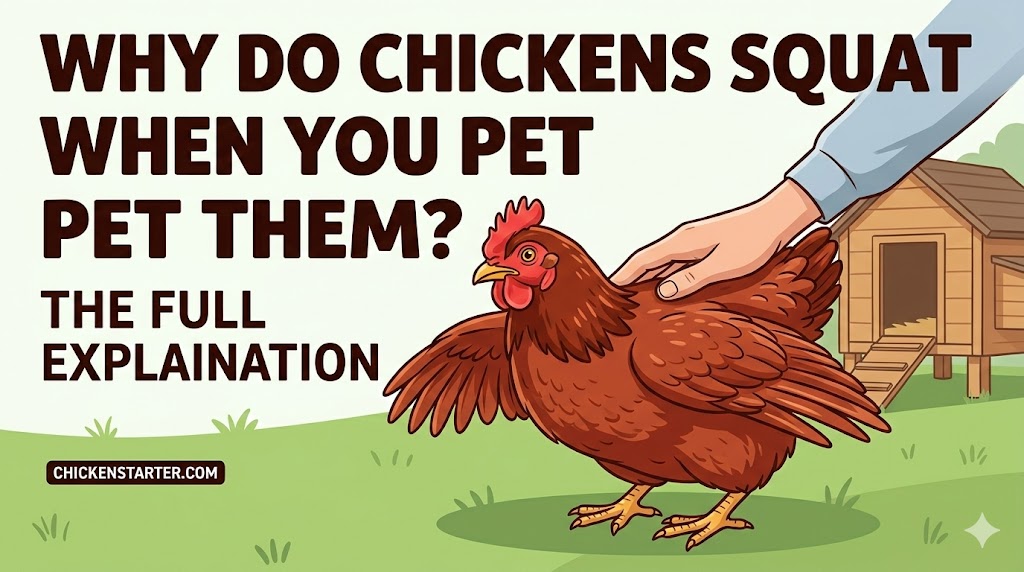
You reach down to pet your favorite hen, and instead of running away, she drops low to the ground, flattens her back, spreads her wings slightly, and just… freezes. She holds perfectly still while you stroke her feathers, and when you step away, she stands back up, gives herself a vigorous full-body shake, and waddles off like nothing happened.
If you are a first-time chicken keeper, this behavior is puzzling. Maybe even a little alarming. Is she scared? Is something wrong? Does she actually want to be petted?
I remember the first time one of my hens did this to me. It was 2020, my first year keeping chickens in the US after growing up around poultry in Nigeria. I had a young Buff Orpington pullet named Ada who had just turned about five months old. For weeks, she had been running away every time I walked past her. Then one morning, I walked into the run, and she stopped dead in her tracks, dropped into this low crouch at my feet, and stayed there. I honestly thought she was hurt. I crouched down, checked her legs, looked at her feet. Nothing wrong. I petted her back gently, she stayed frozen, then when I stood up, she shook herself off and walked away to peck at some scratch grain like it was the most normal thing in the world.
Two days later, I found her first egg in the nesting box.
That is not a coincidence, and once you understand what this behavior means, you will never look at it the same way again. In this guide, I am going to explain exactly why chickens squat when you pet them, why they also do it when you simply approach them, what it signals about their development, and when squatting actually indicates a health problem rather than normal behavior.
What Is the Chicken Squat? The Science Behind the Behavior
The behavior you are seeing has an official name: lordosis. In poultry science, lordosis describes the posture a hen assumes when she crouches to the ground, flattens her back, spreads her wings slightly outward, and lowers her tail. According to Nature’s Best Organic Feeds, chicken squatting is also commonly referred to as the “chicken submissive squat” because of how vulnerable the bird appears while doing it.
Many chicken keepers, including well-known poultry author Lisa Steele of Fresh Eggs Daily, refer to it casually as the “submissive squat.” According to Steele, the correct scientific term is lordosis, and it begins when young hens are just about mature enough to lay eggs, typically around five months of age.
The squat itself looks like this: the hen bends her legs and crouches low, flattens her back into a slightly concave position, extends her wings marginally outward for balance, tucks her head down, and holds completely still. She may stamp or shuffle her feet slightly. Then, after the moment passes (whether that involves a rooster, a dominant hen, or you), she stands back up, gives herself a distinctive full-body shake, and walks away.
That shake at the end, by the way, is significant. It is the same shake hens perform after mating. More on that in a moment.
The Three Real Reasons Chickens Squat When You Pet Them
There is no single reason for this behavior. Based on my six years of hands-on observation across different breeds and flock setups, combined with what poultry behaviorists and veterinary sources confirm, chickens squat for three primary reasons.
Reason 1: It Is a Mating Position (And They See You as the Flock Leader)
This is the main reason, and there is no way to sugarcoat it.
The submissive squat is fundamentally a mating behavior. In a natural flock setting, a hen crouches like this to signal to a rooster that she is receptive to mating. The rooster then steps onto her back (called “treading”), balances himself by gripping her back feathers, and mating occurs through a brief contact called the “cloacal kiss.” The entire process lasts only a few seconds.
According to Kathy Shea Mormino of The Chicken Chick, the submissive squat is the deferential posture assumed by a hen when approached by a rooster for mating. She crouches down, spreads her wings to the side for balance, and lowers her tail.
Now here is the part that surprises most backyard keepers: when you do not have a rooster in your flock, your hens will often direct this behavior toward you. According to multiple poultry behavior sources including Fresh Eggs Daily, Grit Magazine, and the Backyard Chickens community, hens without a rooster in their flock frequently see their human keeper as the dominant figure, essentially filling the role the rooster would occupy. When you approach and especially when you reach your hand down toward them, you are triggering the same instinctive response a rooster’s approach would trigger.
As Tove Danovich wrote in her poultry behavior newsletter Under the Henfluence, “the party the hen has invited me to and the one I think I’m attending are very different.” It is a humorous way of acknowledging the reality: when your hen squats for you, she is not asking to be petted. She is assuming the mating position because you are the authority figure in her world.
Should this make you feel weird about petting your squatting hens? Not really. Your hen is responding instinctively. She is not distressed. You are not hurting her. It is simply how her biology is wired. As Lisa Steele puts it, if you want to go on believing that they are squatting so you will pet them, go right ahead. No harm in that.
Reason 2: It Signals She Is About to Start Laying Eggs
This is the detail that makes the squatting behavior genuinely useful for chicken keepers.
According to Mormino, the submissive squat is the most telling physical sign that an egg can be expected within a week or so. When a pullet (a young hen under one year old) begins squatting, she is signaling that her reproductive system has matured and she is approaching the point of lay.
In my experience, this timeline is remarkably consistent. Across my flock of Rhode Island Reds, Buff Orpingtons, and Easter Eggers, the gap between the first squat and the first egg has ranged from about 3 days to roughly 2 weeks. The average in my flock has been about 7 to 10 days.
So when your five-month-old pullet suddenly starts squatting at your feet, get your nesting boxes ready. Eggs are coming soon.
Other physical signs that accompany the onset of laying include:
- Comb and wattles becoming larger, plumper, and turning a brighter red
- The hen spending more time investigating the nesting boxes
- Increased vocalization, sometimes called the “egg song”
- A wider, more visible gap between the pelvic bones (you can feel this by gently placing two fingers between the bones above the vent)
For a deeper look at these pre-laying signs, see our guide on chicken behavior before laying their first egg.
Reason 3: It Is a Protective and Defensive Posture
Beyond mating and maturity signaling, squatting also serves as a self-defense mechanism.
According to Lisa Steele, a squatting hen is a protected hen. By squatting and freezing in place when a predator approaches, the hen gets very low to the ground, which shields her vulnerable underbelly. Additionally, predators, especially aerial predators like hawks, hunt partially by looking for movement. By squatting and not moving, the hen has a better chance at going undetected.
Terry Golson, a chicken behavior expert who has kept a backyard flock for over two decades, adds a further layer. Golson notes that the squat is also a protective position during rough mating or aggressive encounters with dominant hens. When a weaker hen is attacked by a bully, she will turn her back and squat. This shields her head and belly and changes her center of gravity so she stays upright rather than being knocked over.
This protective element explains why some hens squat not just when you pet them, but whenever anything large approaches from above, including your hand reaching down, a shadow passing over, or even a large dog walking past the run. Their instincts cannot always distinguish between “dominant flock member approaching” and “potential predator approaching,” so the squat response covers both scenarios.
Chicken Squatting When Approached: Why She Does It Before You Even Touch Her
Many keepers notice that their hen squats not when they pet her, but when they simply walk toward her. You have not even reached out your hand yet, and she is already dropping into the crouch.
This is the same lordosis behavior, just triggered by your approach rather than by physical contact. According to Steele, young hens will start to squat down when you go to pet them or even just walk past them. The trigger is the presence of a perceived dominant figure (you) entering her personal space, not the physical touch itself.
In my experience, this “squat on approach” is more common in certain breeds than others. My Buff Orpingtons are notorious for it. They will spot me coming from across the yard and squat before I am even close enough to reach them. My Easter Eggers, on the other hand, are more likely to run first and squat only if I manage to corner them. Personality and breed temperament play a significant role.
Golson makes an important observation about individual variation: not all good layers squat. She notes that one of her daily layers, a lean Andalusian named Misty, never squats. If someone looms over her, she speeds off. Meanwhile, a mild-mannered Ameraucana named Beatrix squats readily. Temperament and individual personality matter as much as reproductive status.
This is consistent with what I see in my own flock. Squatting is common in docile, people-oriented breeds like Buff Orpingtons, Australorps, Cochins, and Silkies. Flightier, more independent breeds like Leghorns and many game breeds are less likely to squat for humans, even though they perform the same behavior for roosters.
Why Is My Chicken Squatting While Walking? When Squatting Is NOT Normal
Here is where things get serious. Normal squatting is a brief, voluntary behavior. The hen drops, holds for a moment, then stands back up and walks away normally. If your chicken is squatting while walking, meaning she is moving around in a low, crouched position and seems unable to stand normally, that is a completely different situation and may indicate a health problem.
According to a veterinary consultation documented on JustAnswer, slow movement and half-squatting in chickens can indicate leg or joint pain, possible infection, or nutritional deficiencies.
Normal squatting (lordosis):
- The hen stops, drops, and freezes voluntarily
- It happens in response to an approaching person, rooster, or dominant hen
- She stands up normally and walks away when the moment passes
- She gives herself a shake afterward
- She is otherwise eating, drinking, and behaving normally
Abnormal squatting (potential health issue):
- The hen walks around in a low, crouched position continuously
- She seems unable to stand upright or stand at all
- She is lethargic, fluffed up, or not eating
- Her gait is unsteady, staggering, or she is waddling with a “penguin walk”
- She is straining, puffing, or showing signs of distress
Possible medical causes of abnormal squatting while walking include:
Egg binding: A hen that cannot pass an egg may squat, strain, and waddle in obvious discomfort. This is a veterinary emergency. The underlying causes can include an excessively large egg, low blood calcium, or a reproductive tract issue. If your hen is squatting and straining with no egg appearing, she needs veterinary attention. For more on reproductive issues, see our guide on egg yolk peritonitis.
Bumblefoot or foot injuries: Pain in the feet from bumblefoot or other injuries can cause a hen to crouch lower while walking to reduce pressure on painful footpads.
Marek’s disease: This viral disease can cause progressive paralysis starting in the legs, leading to a hen that crouches, loses coordination, and eventually cannot stand.
Internal parasites: Heavy worm burdens can cause weakness and reduced mobility.
Calcium deficiency: Laying hens with insufficient calcium can develop leg weakness and difficulty standing.
If your chicken is squatting abnormally while walking, is lethargic, or shows any other signs of illness, see our comprehensive guide on how to tell if a chicken is sick and consult a veterinarian.
Do Roosters Squat When You Pet Them?
Short answer: no, not typically. Squatting is overwhelmingly a hen behavior.
Roosters do not perform the submissive squat because in the natural mating dynamic, they are the ones who approach and mount, not the ones who crouch. A rooster’s body language when approached by a person is very different from a hen’s. He is more likely to stand tall, puff up his hackle feathers, or step sideways to position himself between you and the hens, all dominant posturing rather than submissive behavior.
However, there are a few exceptions worth noting.
Young cockerels (juvenile roosters under about 6 months old) may occasionally squat when approached by a person or a dominant older bird. This is a temporary juvenile submissive behavior that typically disappears as the cockerel matures and his testosterone levels increase.
Roosters at the bottom of a multi-rooster pecking order may crouch submissively for a dominant rooster, though this is more of a defensive crouch than the flat-backed lordosis posture hens display.
Sick or injured roosters may squat or crouch involuntarily due to weakness, leg pain, or illness. This is not behavioral squatting but rather a health-related inability to stand normally.
If your adult rooster is regularly squatting or crouching when approached, and he is not a young cockerel working out his social position, it is worth investigating whether there might be a health issue. Check his legs and feet for injuries, assess his weight and body condition, and observe whether he is eating and drinking normally.
According to the Chicken Fans poultry resource, in flocks without a rooster, the most dominant hen sometimes takes on rooster-like behaviors, including mounting lower-ranking hens. This dominant hen will not squat for others, just as a rooster would not. The dynamic mirrors the natural hierarchy, with squatting being performed by those lower in rank toward those perceived as higher.
Signs a Chicken Trusts You: Beyond the Squat
Many chicken keepers interpret the squat as a sign of trust and affection. And while the squat itself is primarily an instinctive reproductive and submissive behavior, it is true that a hen who squats for you is, at minimum, not afraid of you. She is comfortable enough in your presence to assume a vulnerable position rather than fleeing.
According to BackYard Chickens, if your hen crouches low when you approach, that is often a sign of trust. It is her way of saying she is comfortable and recognizes you as safe.
But trust goes beyond just squatting. Here are the genuine signs that your chickens trust you, based on my experience and what poultry behavior resources consistently confirm:
She follows you around. A chicken that follows you across the yard, even when you do not have treats, considers you part of her social world. According to The Homesteading Hippy, this “flocking” behavior is a chicken’s way of showing that they trust you and feel comfortable around you.
She eats from your hand. A prey animal that willingly puts its head into your hand to eat is demonstrating significant trust. Food is a powerful bonding tool. If you are working on building trust, our guide on what chickens eat and best chicken treats that boost egg laying can help.
She falls asleep near you or on you. Some hens will doze off while sitting in their keeper’s lap or while being held against the chest. Chickens are prey animals. A chicken does not sleep in the presence of something she perceives as a threat.
She vocalizes softly around you. Chickens have a rich vocabulary. Soft clucking, gentle “brrr” sounds, and conversational purring when you are nearby are positive social vocalizations. According to The Homesteading Hippy, some chickens make soft cooing or half-clucking sounds when they feel affection from their humans.
She preens near you. Preening (grooming her feathers) is a relaxed, vulnerable activity. A chicken that preens while you are sitting nearby is comfortable in your presence.
She does not alarm-call when you approach. This is particularly telling with roosters. If your rooster does not sound the alarm call when he sees you coming, he does not register you as a threat.
She allows you to handle her without struggle. A chicken that lets you pick her up, check her over, and put her back down without panic has learned to trust your handling. This makes routine health checks much easier.
Building trust with chickens takes time and consistency. The breeds most likely to become friendly with humans include Buff Orpingtons, Silkies, Cochins, Brahmas, Easter Eggers, and Salmon Faverolles. But individual personality always matters more than breed. I have had shy Orpingtons and friendly Leghorns. You never know until you spend time with them.
Can You Pet Chickens on Their Back? How to Handle Them Properly
Yes, you can pet chickens on their back, and this is actually the most natural spot for most hens to accept touch. When a hen squats, her back is what she is presenting. Gently stroking the back feathers, from the base of the neck down toward the tail, is well tolerated by most chickens.
However, there are some important considerations.
Where chickens generally enjoy being petted:
- Back and wing area (the most naturally accepted spot)
- Back of the neck, gently working your fingers through the feathers
- Chest and crop area (once the chicken is comfortable with you)
- Under the chin and wattles (some hens enjoy this)
Where to be cautious:
- The tail and vent area (this is a sensitive, private area, and touching it can cause distress)
- The legs and feet (most chickens dislike having their legs handled unless they are very tame)
- Under the wings (startling and uncomfortable for most birds)
An important note about back petting and squatting hens. One experienced keeper on BackYard Chickens made a nuanced observation: when you pick up a hen from above and constrain her wings, then set her back down, she often performs the post-mating shake. But if you lift a hen from below by sliding your hand under her feet without touching her back, she does not do the shake when set down. This suggests that the back-touching specifically triggers the mating-behavior circuit.
This does not mean you should avoid petting your hens’ backs. It simply means that when a squatting hen gives herself a shake after you pet her back, she is completing the mating behavioral sequence as her instincts dictate. It is a normal, harmless process.
Tips for petting chickens safely and building trust:
- Move slowly and calmly. Quick movements trigger prey instincts.
- Approach from the side rather than directly from above (approaching from above mimics a predator).
- Talk softly as you approach. Chickens respond well to consistent, gentle vocal tones.
- Offer treats first. Food builds positive associations faster than anything else.
- Never chase a chicken to pet it. If she runs, let her go.
- Be consistent. Daily, brief, positive interactions build trust far faster than occasional long sessions.
Chicken Squatting but No Eggs: What Is Going On?
Your hen has been squatting for a week, maybe two, and still no eggs. Is something wrong?
Usually, no. There is a natural gap between when squatting begins and when the first egg actually appears. According to Pentagon Pets, once a hen starts to squat, it is usual for her to start laying within one or two weeks, although the exact timescale varies from hen to hen.
However, if your hen has been squatting consistently for more than two to three weeks with no eggs, consider these possibilities:
She is laying somewhere you have not found. Free-range hens are notorious for laying in hidden spots: under bushes, behind garden furniture, in corners of the garage, or even in a neighbor’s yard. Before assuming there is a problem, do a thorough search of everywhere she has access.
Seasonal timing. If your hen reaches laying age in late fall or winter, the shorter daylight hours may delay the onset of laying even after her body has matured enough to squat. Chickens typically need 14 to 16 hours of light to sustain peak production. She may not start laying until the days lengthen in spring. For more on this, see our guide on why chickens stop laying eggs.
Stress factors. Moving to a new coop, introducing new flock members, predator scares, loud construction nearby, or any significant disruption can delay the onset of laying even in a physically mature hen.
Coop issues. Make sure your nesting boxes are in place, positioned in a dark and quiet area of the coop, and filled with clean bedding. Some hens will not lay until they feel they have a safe, suitable spot. Check that nothing in the coop is putting them off, such as mites, rodents, or excessive noise. See our guide on nesting box setup for best practices.
Another hen is eating the eggs. Egg eating is a frustrating habit that some chickens develop. If you suspect this, check for wet spots or yolk residue in the nesting box.
Nutritional deficiency. A hen that is not receiving adequate nutrition, particularly calcium and protein, may be slow to start laying even though her hormones are triggering the squatting behavior. Make sure she is on a quality layer feed and has access to oyster shell or another calcium supplement.
If your hen is squatting, appears healthy, is eating and drinking normally, and is of appropriate laying age (typically 18 to 24 weeks depending on breed), she will almost certainly start laying soon. Be patient. Different breeds and individual hens develop on their own timeline.
The Chicken Squat “Exercise”: What Keepers Can Learn From Observing It
Some chicken keepers jokingly refer to the squatting behavior as the “chicken squat exercise” because of how it looks. And while it is not an exercise in the fitness sense, the physical mechanics of the squat are actually worth understanding because they tell you something about your hen’s physical condition.
A hen that performs a strong, stable squat, dropping low and holding the position firmly, is typically in good physical health. Her legs are strong, her balance is good, and her neuromuscular function is normal.
A hen that wobbles, tips to one side, or cannot hold the squat position may have an underlying issue with leg strength, joint health, or neurological function. This is a subtle diagnostic clue that most keepers overlook.
Beyond the behavioral aspects, the squat is genuinely useful to keepers in practical terms. As multiple experienced chicken owners note, the squat comes in extremely handy when you need to catch, pick up, or handle your hens. Whether you need to do a health check, apply treatment for mites, trim nails, or simply move a hen from one area to another, a squatting chicken is far easier to pick up than one sprinting across the yard at full speed.
I use the squat to my advantage constantly. When I need to check feet for bumblefoot, apply parasite treatment, or just give one of my hens a general once-over, I walk calmly toward her, let her squat, then gently scoop her up. No chasing, no stress, no drama.
Why Some Chickens Squat and Others Never Do
Not every hen in your flock will squat when you approach. This is completely normal and does not necessarily mean anything is wrong. Here is what influences whether a particular hen squats for humans:
Breed temperament. Docile, human-friendly breeds like Buff Orpingtons, Cochins, Brahmas, and Silkies are far more likely to squat for their keepers. Independent, flighty breeds like Leghorns, Hamburgs, and most game breeds are more likely to run.
Individual personality. Even within the same breed, personality varies enormously. I have two Buff Orpingtons from the same hatch. One squats every single time I walk past. The other has never squatted for me in three years, though she squats readily for the dominant hen in the flock.
Presence or absence of a rooster. In flocks with a rooster, hens direct their squatting behavior primarily toward him rather than toward humans. According to multiple sources, you will see this behavior aimed at human keepers more often in flocks that do not have a rooster. Our guide on whether you need a rooster to get eggs explains the dynamics.
Laying status. Non-laying hens (those that are too young, too old, molting, or broody) squat less frequently. The behavior is most pronounced during active laying periods.
Socialization. Hens that were handled frequently as chicks and have positive associations with humans are more likely to squat and allow petting. Those that were not socialized or that have had negative human experiences are more likely to flee.
Frequently Asked Questions
Why do chickens squat when you pet them?
Chickens squat when you pet them because of an instinctive behavior called lordosis, which is primarily a mating posture. Hens assume this crouching position when approached by a rooster or by any figure they perceive as dominant, including their human keeper. It signals reproductive maturity and submission within the flock hierarchy.
Is squatting a sign that my chicken is about to lay eggs?
Yes. Squatting is one of the most reliable signs that a pullet is approaching her first egg. According to poultry experts, you can typically expect the first egg within one to two weeks of when a young hen begins squatting, though the exact timing varies by individual.
Do roosters squat when you pet them?
No, adult roosters do not typically perform the submissive squat. Squatting is a hen behavior tied to mating receptivity and submission. Roosters are more likely to stand tall, puff up, or position themselves protectively. Very young cockerels may occasionally squat as a juvenile submissive behavior, but this usually stops as they mature.
Why is my chicken squatting while walking?
If your chicken is walking in a continuous low, crouched position (rather than briefly squatting and then standing normally), this may indicate a health problem such as egg binding, leg or joint pain, internal parasites, Marek’s disease, or calcium deficiency. Normal lordosis is brief and voluntary. Abnormal crouching while walking warrants a closer examination and potentially a veterinary consultation.
My chicken is squatting but not laying eggs. Should I worry?
Not immediately. There is a natural gap between when squatting starts and when laying begins, sometimes up to two weeks. If squatting continues for more than three weeks with no eggs, check for hidden nesting spots (free-range hens often lay in unexpected places), seasonal factors (short daylight hours delay laying), stress, or coop issues.
Is it okay to pet a chicken on her back?
Yes. The back is the most naturally accepted spot for petting. Gently stroking the back feathers from neck to tail is well tolerated by most hens, especially those that squat when approached. Be aware that back touching specifically can trigger the mating-behavior response, which is why your hen may shake herself off afterward.
What are the signs a chicken trusts you?
Signs of trust include following you around the yard, eating from your hand, falling asleep near you or on your lap, soft vocalizing when you are present, preening near you, allowing handling without struggle, and squatting when you approach rather than running away.
Do all hens squat?
No. While squatting is a common and instinctive behavior, not every hen does it, especially not in response to humans. Breed temperament, individual personality, socialization history, and whether a rooster is present in the flock all influence whether a particular hen squats for her keeper.
Why does my chicken shake after I pet her?
The full-body shake your hen performs after being petted (especially on the back while squatting) is the same post-mating shake hens perform after a rooster dismounts. It is an instinctive behavior that completes the mating behavioral sequence. It does not mean your hen is distressed.
At what age do chickens start squatting?
Most chickens begin squatting around 16 to 24 weeks of age (roughly 4 to 6 months), which coincides with reaching sexual maturity. The exact age depends on the breed. Early-maturing breeds like Leghorns and sex links may begin squatting as early as 16 weeks, while slower-maturing breeds like Brahmas and Orpingtons may not start until 22 to 26 weeks.
Final Thoughts
The chicken squat is one of those delightful intersections of instinct, biology, and the unique bond between humans and their backyard flocks. It is rooted in mating behavior, it signals reproductive maturity, it serves a protective function, and yes, it does indicate that your hen is at least comfortable enough in your presence to assume a vulnerable position rather than running for cover.
Understanding why your chickens squat takes the mystery out of the behavior and gives you practical tools: you will know when eggs are coming, you will be able to catch and handle your hens more easily, and you will be able to distinguish between normal healthy squatting and abnormal crouching that warrants investigation.
And if you want to keep believing your hen is squatting because she loves you and wants to be petted? Well, as Lisa Steele says, go right ahead. No harm in that.
About the Author: Oladepo Babatunde is the founder of ChickenStarter.com with over 6 years of hands-on experience raising more than 50 chickens across diverse climates. Drawing from training with the Nigerian Agricultural Extension Services and practical work adapting tropical poultry techniques to US, UK, Australian, and Canadian conditions, Oladepo provides data-driven, experience-backed guidance for backyard chicken keepers worldwide. His work is informed by USDA, APHIS, and American Poultry Association standards. He is not a licensed veterinarian. Always consult a qualified poultry DVM for chicken health concerns.

Oladepo Babatunde is the founder of ChickenStarter.com. He is a backyard chicken keeper and educator who specializes in helping beginners raise healthy flocks, particularly in warm climates. His expertise comes from years of hands-on experience building coops, treating common chicken ailments, and solving flock management issues. His own happy hens are a testament to his methods, laying 25-30 eggs weekly.