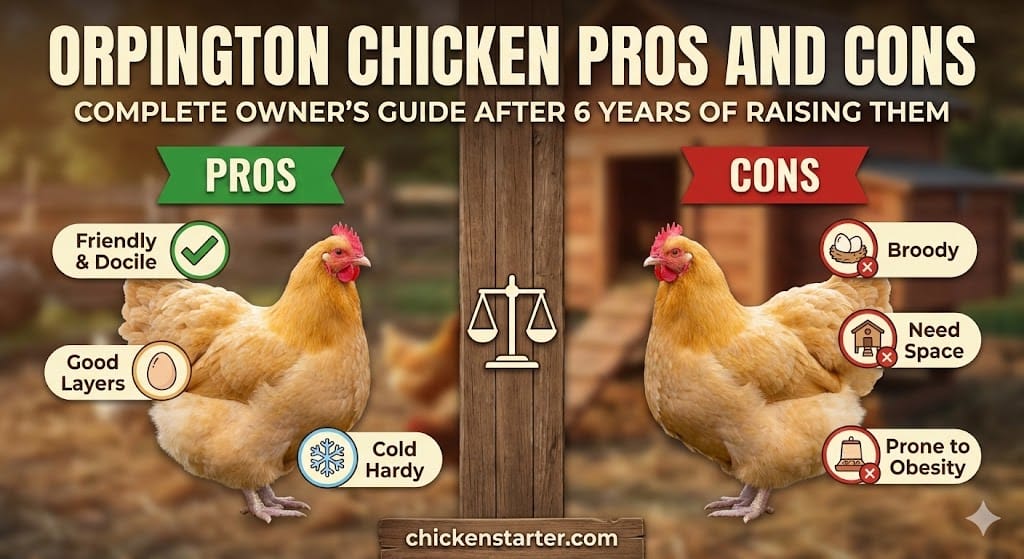
When someone asks me what are the pros and cons of Orpingtons, I always start with a confession: these fluffy golden birds completely changed how I think about backyard chickens. They taught me that egg production numbers on a hatchery website tell only a fraction of the story.
I have raised Orpingtons alongside Australorps, Easter Eggers, and various heat-hardy local breeds for over six years now in a tropical climate. That experience has given me a perspective that most chicken keeping guides miss entirely. Most advice about Orpingtons comes from keepers in temperate climates with mild summers and cold winters. My reality involves year-round heat, humidity that makes feathers a liability rather than an asset, and predator pressures that test every breed’s survival instincts.
This guide will give you an honest assessment of Orpington chickens based on real ownership experience, verified breed characteristics, and practical considerations for different climates and situations. Whether you are considering Buff Orpingtons, the increasingly popular Lavender variety, or any other Orpington color, you will find the information you need to make a smart decision.
Why the Orpington Debate Matters for New Chicken Keepers
Orpingtons consistently rank among the most recommended breeds for beginners. Walk into any chicken keeping forum or Facebook group, and you will see Buff Orpingtons suggested within the first few responses to almost any “what breed should I get” question. This popularity creates a problem: new keepers often get Orpingtons without understanding whether this breed actually fits their specific situation.
According to research from The Featherbrain, Buff Orpingtons are “certainly one of the reigning favorites of American backyard chicken keepers” because they offer something for almost everyone. The breed works as an egg layer, a meat bird, a broody mother, and a family pet all in one package. But that versatility comes with tradeoffs that many breed guides gloss over or mention only briefly.
The real question is not whether Orpingtons are good chickens. They absolutely are. The question is whether they are the right chickens for your specific climate, goals, space, and management style. That requires understanding both sides of the equation.
The Complete Pros of Orpington Chickens
Let me start with what Orpingtons do exceptionally well, because there are genuine reasons this breed has remained popular for over a century since its development in England.
Exceptional Temperament and Family Friendliness
If I could only highlight one Orpington advantage, temperament would be it. These birds are genuinely gentle in a way that sets them apart from most other breeds I have raised.
My first Buff Orpington, a hen I named Butterscotch, would follow me around the yard like a golden retriever. She would squat down when I approached, clearly expecting to be picked up. When I sat outside in the evenings, she would hop into my lap and make a purring sound that I later learned was a sign of contentment. I had never experienced that level of affection from a chicken before.
This temperament makes Orpingtons ideal for families with children. The birds tolerate handling well, rarely peck aggressively, and seem to genuinely enjoy human interaction. One keeper described them as “the Golden Retriever of the chicken world,” and that comparison captures their personality perfectly.
For anyone wanting chickens as pets rather than purely livestock, Orpingtons deliver a companionship experience that production breeds simply cannot match. Our guide on the easiest chicken breeds for beginners ranks Orpingtons highly specifically because of this trainable, gentle nature.
Reliable Dual Purpose Production
Orpingtons are one of the few breeds that genuinely earn the “dual purpose” label. Many breeds get called dual purpose when they really excel at only one function, but Orpingtons deliver meaningfully on both eggs and meat.
Egg production: Expect 200 to 280 light brown eggs annually from a healthy Orpington hen. This falls below dedicated laying breeds like Leghorns or commercial hybrids, but it represents solid production that will keep a family supplied with eggs. The eggs are large to extra-large, and many keepers describe the color as having a slight pinkish or cream tint that makes them distinctive.
Meat quality: Roosters reach 8 to 12 pounds, and hens reach 6 to 8 pounds at maturity. The breed has broad breasts and meaty thighs that provide substantial table fare. Multiple keepers specifically praise the leg and thigh meat, noting that the dark meat from Orpingtons exceeds what you get from faster-growing commercial meat breeds.
One experienced homesteader noted that her Orpingtons were “excellent meat birds” with the only challenge being that “you gotta get them early or they are too big for the crock pot.” That is a quality problem rather than a flaw.
For homesteaders who want one breed that handles multiple roles, Orpingtons make practical sense. You can keep hens for eggs, use extra roosters for meat, and let broody hens hatch replacement chicks. This self-sustaining approach appeals to anyone focused on food resilience.
Outstanding Cold Weather Performance
Orpingtons were developed in England, and their dense, fluffy feathering reflects that origin. These birds handle cold weather exceptionally well, continuing to lay through winter months when other breeds shut down production entirely.
The profuse feathering acts as natural insulation, keeping body heat in during freezing temperatures. Orpingtons will venture out into snow, remain active during cold snaps, and generally seem unbothered by conditions that send lighter-feathered breeds huddling in the coop.
For keepers in northern climates across the United States, Canada, the UK, and similar regions, this cold hardiness provides real practical value. You do not need to worry as much about supplemental heating or production crashes during winter months.
Our comprehensive Buff Orpington chicken guide covers winterization strategies in detail, but the baseline is that these birds tolerate cold far better than most heritage breeds.
Natural Brooding Ability
Orpingtons are famous for going broody, meaning they want to sit on eggs and hatch chicks. While this trait has downsides I will address later, it provides genuine value for keepers who want their flock to reproduce naturally.
A broody Orpington hen will dedicate herself completely to hatching eggs. She will sit on the nest for the full 21-day incubation period, turn the eggs regularly, and maintain the proper temperature and humidity through instinct alone. After hatching, she will protect and teach the chicks with fierce dedication.
This natural reproduction capability means you can maintain your flock without purchasing new birds from hatcheries, without investing in incubators and brooders, and without the hands-on management that artificial hatching requires. For homesteaders seeking self-sufficiency, broody Orpingtons provide a renewable source of replacement birds.
I have watched Orpington hens successfully raise clutches of chicks with minimal intervention from me. They teach the chicks to forage, protect them from perceived threats, and gradually wean them as they mature. The maternal instinct in this breed runs deep.
Beautiful Appearance Across Multiple Varieties
Orpingtons are simply gorgeous birds. The classic Buff variety has golden feathers that seem to glow in afternoon sunlight. The birds carry themselves with a rounded, fluffy profile that makes them look larger and more substantial than their actual weight.
Beyond Buff, Orpingtons come in multiple recognized colors:
Blue Orpingtons have a striking slate-gray color that chicken keepers find increasingly desirable. The blue shade can vary from light to dark depending on genetics.
Black Orpingtons feature iridescent black feathers that shimmer green and purple in direct light. They share the same body type and temperament as Buffs but offer a dramatically different appearance.
White Orpingtons provide a clean, pure white appearance that some keepers prefer for aesthetic or practical reasons.
Lavender Orpingtons have become especially popular in recent years. Their diluted gray-purple coloring creates a soft, almost pastel appearance that photographs beautifully and stands out in any flock.
Splash Orpingtons display a mottled pattern of white and blue that makes each bird unique.
This variety means you can choose Orpingtons that match your aesthetic preferences while still getting the breed’s characteristic temperament and production traits. Many keepers maintain mixed-color Orpington flocks specifically for the visual appeal.
Tolerance for Confinement
Unlike some breeds that become stressed, aggressive, or destructive when confined, Orpingtons adapt well to run-based management. Their calm temperament and relatively low energy level means they tolerate limited space better than more active breeds.
This matters for suburban keepers who cannot free-range due to predators, HOA restrictions, or limited yard space. Orpingtons will remain content in a properly sized run without developing the behavioral problems that confinement can trigger in flightier breeds.
Of course, more space is always better, and Orpingtons do enjoy foraging when given the opportunity. But their adaptability to confinement makes them practical for situations where free-ranging is not possible.
The Complete Cons of Orpington Chickens
Now for the honest assessment of Orpington limitations. These are the factors that breed guides often minimize but that create real management challenges for many keepers.
Serious Heat Intolerance
This is where my personal experience diverges sharply from most Orpington recommendations. In my tropical climate, Orpingtons struggle significantly during hot weather, and this struggle is not minor inconvenience. It can be fatal.
The same dense feathering that makes Orpingtons cold-hardy becomes a serious liability when temperatures climb. The birds cannot dissipate body heat effectively, leading to visible heat stress: panting with beaks open, wings held away from the body, reduced activity, and dropped egg production.
I lost my first Orpington, that same Butterscotch I mentioned earlier, during an extreme heat wave in her second summer. Other breeds in my flock handled the same conditions without apparent distress. She simply could not regulate her body temperature despite my efforts with shade, frozen treats, and electrolyte water.
Multiple experienced keepers report similar experiences. One noted that her Buff Orpington “sadly died in our second summer in an extreme heat wave. Everyone else was totally fine, but she just couldn’t handle it.” Another lost hers during a heat wave when the bird was only a year and a half old.
For keepers in hot climates across the southern United States, Australia, tropical regions, or anywhere with sustained summer temperatures above 30°C (86°F), Orpingtons require serious heat management or should be avoided entirely. Our guide on raising chickens in hot humid climates addresses heat management strategies, but the fundamental reality is that Orpingtons were not bred for heat tolerance.
If you live somewhere hot, consider our list of best heat-tolerant chicken breeds for alternatives that will thrive rather than merely survive.
Broodiness Disrupts Egg Production
The same brooding instinct that makes Orpingtons excellent natural mothers becomes a production problem for keepers who want consistent eggs rather than chicks.
When an Orpington hen goes broody, she stops laying entirely. She dedicates all her energy to sitting on eggs (or empty nests, or golf balls, or whatever she decides represents eggs) instead of producing new ones. A broody spell can last three weeks or longer if not interrupted, representing a significant gap in your egg supply.
One keeper reported that “within a month of laying, two went broody,” meaning her new pullets barely started producing before their brooding instincts kicked in. This frequency varies between individuals and bloodlines, but Orpingtons as a breed tend toward broodiness more than most.
For keepers who want maximum egg production without the complication of hatching chicks, this tendency creates management overhead. You either accept reduced production or actively break broody behavior when it starts. Our guide on how to break a broody hen covers the techniques, but the need to intervene repeatedly can become tiresome.
Poor Predator Awareness and Evasion
Orpingtons’ gentle, trusting nature has a dangerous flip side: they lack the survival instincts that protect other breeds from predators.
These birds do not respond quickly to threats. Multiple keepers report that their Orpingtons are “the first breed to be targeted by hawks, coyotes, raccoons and other predators” during free-ranging. One noted that her Orpingtons are “very slow in reacting to a predator” and will “just stand there or slowly walk straight into the predator.”
The light coloring of Buff, White, and Lavender Orpingtons compounds this problem by making them more visible to aerial predators. A golden chicken on green grass attracts hawk attention in ways that darker birds avoid.
This vulnerability means Orpingtons require more protection than predator-savvy breeds. They do best with covered runs, supervised free-ranging, or guardian animals that can compensate for their lacking survival instincts. Keepers who cannot provide this protection should expect higher predator losses.
Higher Initial Cost Per Bird
Orpingtons typically cost more than hybrid laying breeds or common dual-purpose chickens. In the UK, expect to pay around £50 per bird compared to £30 for typical hybrids. Similar price premiums apply in other markets.
This higher cost reflects their purebred status, smaller production batches, and the extra care required in breeding programs. For someone starting a flock on a tight budget, this premium adds up quickly.
The rarer color varieties like Lavender command even higher prices due to limited availability and breeding complexity. A Lavender Orpington can cost two to three times what you would pay for a Buff.
Whether this cost premium matters depends on your goals. If you want a few pet chickens and value temperament over economy, the extra expense is worthwhile. If you need maximum production per dollar invested, hybrid breeds offer better value.
For detailed pricing information, our guide on how much does a Buff Orpington cost breaks down current hatchery prices and what to expect at different ages.
Slower Growth and Maturity
As a heritage breed, Orpingtons grow more slowly than modern production breeds. Hens typically do not start laying until 22 to 26 weeks of age, which can feel like an eternity when you are waiting for your first eggs.
For meat production, Orpingtons require 5 to 6 months to reach good slaughter weight compared to 6 to 8 weeks for commercial Cornish Cross broilers. This extended timeline means more feed costs, more management time, and delayed return on your investment.
One breeder noted that Orpingtons are “slow to reach full slaughter weight” and that this extended growth period should be factored into any meat production calculations. If you are raising birds primarily for meat, faster-growing breeds provide better feed conversion efficiency.
Tendency Toward Obesity
Orpingtons love food. They will eat enthusiastically whenever food is available and are not inclined toward the active foraging that helps other breeds burn calories. This combination creates obesity risk that affects both health and production.
Overweight hens experience more laying problems, reduced fertility, and increased heat stress vulnerability. They may become too heavy to roost properly, leading to foot problems including bumblefoot.
Managing Orpington weight requires controlled feeding rather than free-choice access, limited treats despite their begging behavior, and encouragement of activity through environmental enrichment. Our guide on how to spot and treat bumblefoot in chickens addresses one consequence of this weight issue.
Mite and Lice Vulnerability
The dense, fluffy feathering that makes Orpingtons cold-hardy also creates ideal habitat for external parasites. Mites and lice can establish themselves deep in Orpington feathers where they are difficult to detect and harder to treat.
Regular inspection and preventive treatment become essential parts of Orpington care. The same feathering that looks beautiful can hide infestations until they become serious. Our comprehensive guide on mites and lice on chickens covers detection and treatment protocols that every Orpington keeper should know.
Limited Vaccination Availability
Because Orpingtons are a pure breed produced in smaller batches than commercial hybrids, they often come with fewer vaccinations. Commercial hybrid pullets receive comprehensive vaccination programs as part of large-scale production. Heritage breeds like Orpingtons may lack this protection.
For new keepers unfamiliar with poultry health management, this limited vaccination creates added risk. You may need to arrange vaccinations yourself, implement stronger biosecurity practices, or accept higher disease vulnerability.
This factor matters most in areas with known poultry disease pressure or for keepers adding Orpingtons to existing flocks where they might be exposed to pathogens that vaccinated birds would resist.
Lavender Orpington Pros and Cons: Specific Considerations
Lavender Orpingtons deserve separate attention because their popularity has surged in recent years, and they have some unique characteristics beyond their stunning color.
Lavender Orpington Advantages
Aesthetic appeal: The diluted gray-purple coloring is genuinely beautiful and photographs exceptionally well. Many keepers choose Lavender Orpingtons specifically for their visual impact in the flock.
Same temperament: Lavender Orpingtons share the gentle, friendly disposition of other Orpington varieties. The color difference does not affect their suitability as family pets or their tolerance for handling.
Growing availability: While still less common than Buffs, Lavender Orpingtons have become easier to find as breeding programs expand to meet demand.
Lavender Orpington Disadvantages
Shredding gene: Lavender Orpingtons carry a genetic trait that can cause feather quality issues. The “lavender” gene that creates their beautiful color is linked to feather structure problems in some lines, causing ragged or incomplete feathering.
Higher price: Expect to pay premium prices for Lavender Orpingtons compared to common Buff varieties. Their relative rarity and breeding complexity drive costs up.
Limited genetic diversity: Because Lavender Orpingtons come from a smaller breeding population, genetic diversity can be limited. This may increase susceptibility to certain health issues or reduce overall vigor compared to more broadly bred Buff lines.
Breeding challenges: If you want to breed your own Lavender Orpingtons, the genetics become complicated. Lavender to Lavender breeding can intensify the shredding gene problem, requiring knowledge of color genetics to maintain both appearance and feather quality.
Climate-Specific Orpington Assessment
Let me break down Orpington suitability by climate type, since this factor often determines whether the breed will work for you.
Cold Climate Suitability: Excellent
Orpingtons excel in cold climates. Their dense feathering provides natural insulation, they continue laying through winter, and they tolerate snow and freezing temperatures without requiring supplemental heat in properly ventilated coops.
Best for: Northern US states, Canada, UK, northern Europe, New Zealand’s South Island, Tasmania.
Key management: Prevent frostbite on large combs (especially roosters) by ensuring coop ventilation eliminates moisture. Keep feathers dry, as wet Orpingtons lose their insulating ability.
Temperate Climate Suitability: Good
In temperate regions with distinct seasons but moderate extremes, Orpingtons perform well year-round. They handle the cold months easily and can manage warm summers with appropriate shade and water access.
Best for: Mid-Atlantic US, Pacific Northwest, most of England, coastal Australia, New Zealand’s North Island.
Key management: Provide shade options for summer, ensure good coop ventilation, and watch for heat stress during heat waves.
Hot Climate Suitability: Poor
This is where I must be blunt based on my experience: Orpingtons struggle in hot climates and may not be a wise choice if sustained heat is your reality.
Challenging for: Southern US states, inland Australia, tropical regions, Mediterranean climates with hot summers.
Key management: Extensive shade, multiple water stations, cooling measures like misters or frozen treats, willingness to lose birds during heat waves despite your best efforts.
If you live somewhere hot, seriously consider whether Orpington beauty and temperament justify the management burden and mortality risk. Breeds developed for heat tolerance will give you happier, healthier birds.
Making the Orpington Decision: A Practical Framework
After six years with Orpingtons and many other breeds, here is how I recommend approaching this decision.
Choose Orpingtons If:
You want chickens primarily as pets that also produce eggs. The temperament alone justifies the breed for keepers who value the relationship with their birds.
You live in a cold climate where their feathering becomes an advantage rather than a liability.
You want natural flock reproduction through broody hens and are willing to manage (or enjoy) the broodiness that comes with it.
You appreciate beautiful birds and want a flock that looks as good as it performs.
You have predator protection in place or can supervise free-ranging, since Orpingtons cannot protect themselves effectively.
You are patient enough to wait for pullets to mature and do not need immediate production.
Avoid Orpingtons If:
You live in a hot climate and cannot provide extensive cooling measures. The heat intolerance is real and can be fatal.
Maximum egg production per bird is your primary goal. Dedicated laying breeds will outproduce Orpingtons significantly.
You want birds that can free-range without supervision in areas with predator pressure.
Budget constraints make the higher per-bird cost prohibitive.
You do not want to deal with broody behavior disrupting your egg supply.
You need birds that reach laying or slaughter weight quickly.
Consider Mixed Flocks
One approach that works well for many keepers is including some Orpingtons in a mixed flock rather than keeping them exclusively. This gives you the temperament benefits and brooding capability of Orpingtons while other breeds provide higher production or better heat tolerance.
I currently keep two Orpington hens alongside heat-hardy local varieties. The Orpingtons add personality and can hatch eggs when I want chicks, while the other birds maintain production through our hot season. This balanced approach captures Orpington advantages while mitigating their limitations.
Frequently Asked Questions About Orpington Pros and Cons
Are Orpingtons good chickens for beginners?
Orpingtons are often recommended for beginners because of their calm temperament, tolerance for handling, and forgiving nature. However, beginners in hot climates may find heat-tolerant breeds easier to manage. The breed’s tendency toward broodiness and predator vulnerability also require some management knowledge.
Do Orpingtons lay eggs in winter?
Yes, Orpingtons are reliable winter layers when other breeds often stop. Their cold hardiness and heritage genetics support year-round production, though laying rates may decrease somewhat during the shortest days without supplemental lighting.
How many eggs do Orpingtons lay per year?
Expect 200 to 280 large brown eggs annually from a healthy Orpington hen. Production varies based on individual genetics, nutrition, and management. This falls below dedicated laying breeds but represents solid output for a dual-purpose heritage breed.
Are Lavender Orpingtons good layers?
Lavender Orpingtons lay comparably to other Orpington varieties, producing 200 to 280 eggs annually. The color difference does not affect production, though some Lavender lines bred primarily for show appearance may have slightly lower production than utility-focused Buff lines.
What is the main disadvantage of Orpington chickens?
Heat intolerance is the most serious disadvantage for keepers in warm climates. For keepers in cool climates, broodiness disrupting egg production is typically the most significant ongoing challenge. Both issues require active management.
Do Orpington roosters get aggressive?
Orpington roosters are generally among the least aggressive rooster breeds. They share the calm temperament of the hens and are often described as respectful and mild-mannered. Individual variation exists, but aggression problems are uncommon in this breed.
How long do Orpingtons live?
With proper care, Orpingtons typically live 5 to 8 years, with some individuals reaching 10 years or more. Their heritage genetics generally support longer lifespans than commercial production breeds, though actual lifespan depends heavily on predator protection, disease management, and climate suitability.
Can Orpingtons handle hot weather?
Orpingtons struggle significantly in hot weather. Their dense feathering prevents effective heat dissipation, making them prone to heat stress when temperatures exceed 30°C (86°F). Keepers in hot climates must provide extensive shade, cooling measures, and should expect reduced performance during hot months.
Are Black Orpingtons the same as Buff Orpingtons?
Black and Buff Orpingtons share the same breed characteristics including size, temperament, and production. The only difference is feather color. Black Orpingtons have iridescent black feathers while Buffs have golden-yellow feathers. Both varieties make equally good backyard chickens.
Do Orpingtons need special care?
Orpingtons require attention to a few breed-specific concerns: regular parasite checks due to their dense feathering, weight management to prevent obesity, heat protection in warm climates, and predator protection given their poor evasion instincts. None of these needs are extreme, but they do require awareness.
Final Thoughts on Orpington Ownership
After raising Orpingtons through tropical heat waves, watching them hatch chicks with devoted maternal care, and experiencing the unique joy of a chicken that genuinely wants to sit in your lap, I can say this breed earns its popularity for good reasons.
Orpingtons are not the highest-producing layers. They are not the fastest-growing meat birds. They are not the most predator-savvy foragers or the most heat-tolerant summer survivors. But they are quite possibly the most loveable chickens you will ever keep.
The question is not whether Orpingtons are good chickens. They absolutely are. The question is whether their specific strengths align with your situation and whether their specific weaknesses create problems you can manage.
For keepers in appropriate climates who value temperament alongside production, who can provide predator protection, and who either want broody mothers or can manage broodiness when it occurs, Orpingtons reward their owners with years of companionship, consistent eggs, and the kind of chicken-keeping experience that makes the whole endeavor worthwhile.
For keepers in hot climates, those prioritizing maximum production, or those unable to provide the protection these gentle birds need, other breeds will serve you better. There is no shame in choosing a breed that fits your reality rather than fighting against a mismatch.
Whatever you decide, make the choice with full information rather than relying solely on the enthusiastic recommendations that dominate chicken keeping discussions. Orpingtons deserve owners who understand both their gifts and their limitations.

Oladepo Babatunde is the founder of ChickenStarter.com. He is a backyard chicken keeper and educator who specializes in helping beginners raise healthy flocks, particularly in warm climates. His expertise comes from years of hands-on experience building coops, treating common chicken ailments, and solving flock management issues. His own happy hens are a testament to his methods, laying 25-30 eggs weekly.