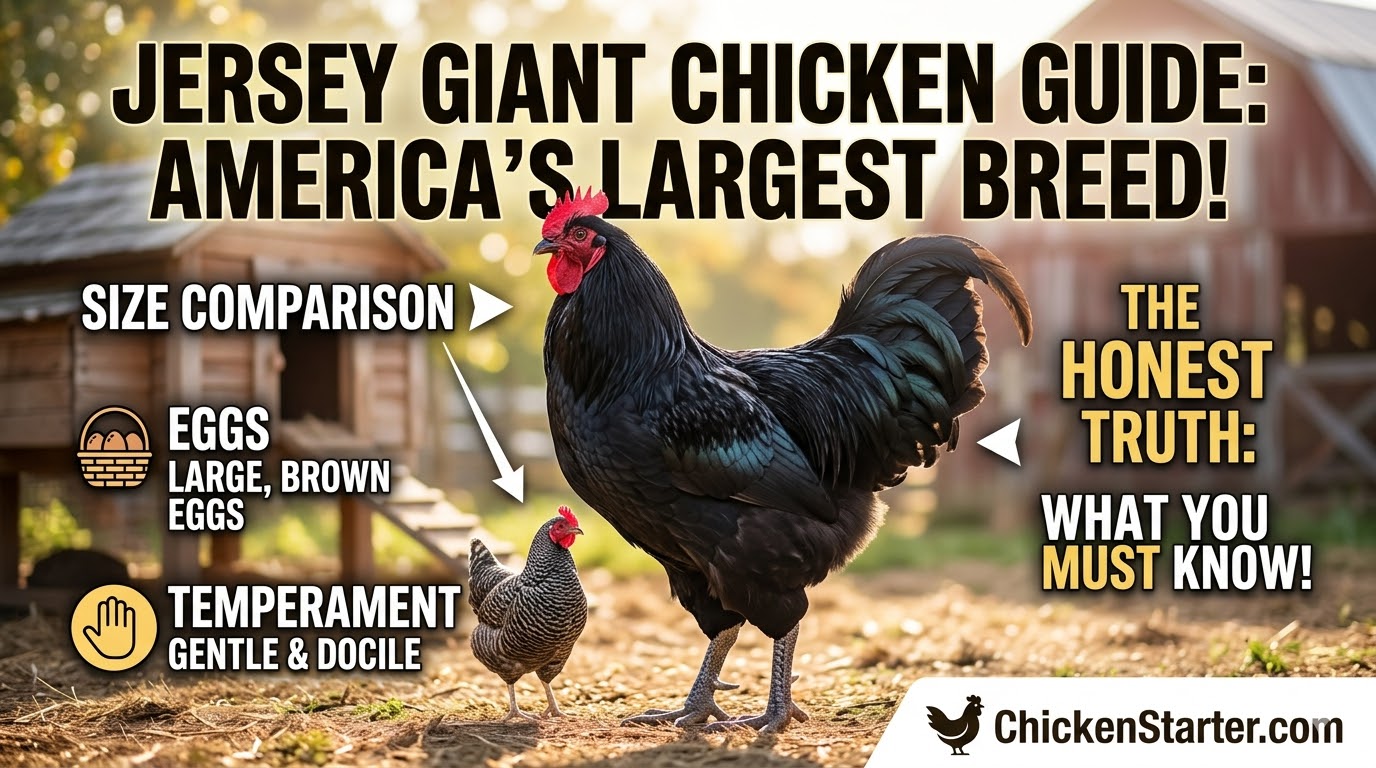
When I ordered Jersey Giant chicks, I genuinely expected a chicken the size of a small turkey. The breed is literally called “Giant.” Every website said “the largest purebred chicken in America.” I pictured a bird that would tower over my Orpingtons and make my Australorps look like bantams.
Eighteen months later, my fully grown Jersey Giant rooster stands maybe 2 to 3 inches taller than my Brahma rooster and weighs about 2 pounds more. He is big. Undeniably big. But he is not the prehistoric-looking monster I had imagined.
And you know what? That is completely fine. Because the Jersey Giant turned out to be one of the best breeds I have ever owned, for reasons that have nothing to do with size. Their calm, gentle temperament, steady brown egg production through winter, and the fascinating all-American origin story make them a genuinely excellent homestead bird. But you need to go in with the RIGHT expectations.
JERSEY GIANT AT A GLANCE:
- Origin: Burlington County, New Jersey, USA (1880s)
- Developers: John and Thomas Black
- APA Recognition: 1922 (Black), 1947 (White), 2003 (Blue)
- Class: American
- Primary Purpose: Dual-purpose (originally bred to replace turkey)
- Egg Production: 150-200 eggs/year
- Egg Color: Light to medium brown (sometimes pinkish tint)
- Egg Size: Large to extra-large
- Weight: Rooster: 13 lbs; Hen: 10 lbs (standard) / Bantam: Rooster 38 oz; Hen 34 oz
- Height: Roosters 22-26 inches tall; Hens 16-20 inches
- Lifespan: 6-10 years
- Temperament: Calm, docile, gentle, friendly — the “gentle giant”
- Cold Hardy: Excellent (single comb is moderate risk, but body mass retains heat)
- Heat Tolerant: Poor to moderate (large body mass generates excess heat)
- Beginner Friendly: ✅ Yes — gentle temperament
- Broodiness: Moderate — some hens go broody, but their weight can crush eggs
- Noise Level: Low to moderate — one of the quieter large breeds
- Flying Ability: Very poor — too heavy to fly over even low fences
- Time to Maturity: 8-9 months (body) / 6-7 months (first egg) / 12-18 months (full adult weight)
History and Origin: The Chicken Created to Replace the Turkey
The Jersey Giant has one of the most uniquely American origin stories in poultry history, and it starts with an audacious idea that ultimately failed, but left us with a magnificent breed.
The Ambitious Vision
According to The Livestock Conservancy, the Jersey Giant chicken was developed between 1870 and 1890 by brothers John and Thomas Black in Burlington County, New Jersey, near the town of Jobstown. The original intention of the Black brothers was to create a chicken that could potentially replace turkeys as a premium table bird.
At the time, turkeys were the dominant large poultry for holiday meals and roasts, but they were difficult to manage, slow-growing by the standards of the era, and required extensive space. The Blacks reasoned that a truly giant chicken would be easier to raise, more feed-efficient than turkeys, and produce eggs as a bonus.
The 20-Year Breeding Program
According to information from Wikipedia and confirmed by the National Jersey Giant Club, the breed was produced by crossing three large breeds: Black Javas, Black Langshans, and Dark Brahmas. According to Backyard Poultry, the best records available reveal that the breed was developed between 1870 and 1880. The brothers selected for maximum body size, a calm temperament, and robust fleshing.
As noted by Hobby Farms, around 1895, the breed was called simply “Giant.” Their flock had so much influence on the breed that it became known as Black Giants, in honor of the developers’ surname, not the plumage color. According to The Livestock Conservancy, breeder Dexter P. Upham of Belmar, New Jersey, later added “Jersey” to the name. In 1921, the American Association of Jersey Black Giant Breeders Clubs was created, and the name “Jersey Giant” was officially adopted.
APA Recognition
According to The Livestock Conservancy, the Jersey Giant was recognized by the American Poultry Association Standard of Perfection in 1922. The White variety was recognized in 1947, and the Blue variety in 2003. Today, all three color varieties are accepted.
Why the Turkey-Replacement Plan Failed
Despite their impressive size, Jersey Giants never replaced turkeys commercially. According to Mother Earth News, the Black Jersey Giant grew too slowly to compete with Cornish Rock broilers, which are ready for market in a few weeks. The Jersey Giant grows its large frame first, then covers it with flesh.
Additionally, the Broad-Breasted White turkey ultimately proved more feed-efficient for meat production, growing faster and yielding more breast meat per pound of feed consumed. The Jersey Giant survived not as a commercial meat bird, but as a beloved homestead dual-purpose breed, valued for its size, gentle temperament, and steady egg production.
How Big Do Jersey Giants REALLY Get? The Expectations vs. Reality Guide
This is the section I wish someone had written for me before I ordered my first Jersey Giant chicks. Let me give you the honest numbers.
The Official Numbers
According to The Livestock Conservancy, mature roosters weigh 13 to 15 lbs and hens weigh 10 to 11 lbs. The Black variety is, on average, about a pound heavier than the White variety upon maturity. Male birds stand 22 to 26 inches tall and females 16 to 20 inches.
Some breeders have produced exceptional individuals exceeding these standards, with roosters reaching 15+ lbs. According to Raising Chickens, at one time they would capon roosters, allowing them to grow to an amazing 20 lbs. But these are exceptional specimens, not typical hatchery stock.
The Reality Check: How They Compare to Other Large Breeds
| Breed | Rooster Weight | Hen Weight | Difference from Jersey Giant |
|---|---|---|---|
| Jersey Giant | 13 to 15 lbs | 10 to 11 lbs | Baseline |
| Brahma | 12 lbs | 9.5 lbs | Only 1 to 2 lbs lighter |
| Cochin | 11 lbs | 8.5 lbs | Noticeably smaller |
| Buff Orpington | 8 to 10 lbs | 6 to 8 lbs | 3 to 5 lbs lighter |
| Rhode Island Red | 8.5 lbs | 6.5 lbs | Significantly smaller |
| Australorp | 8.5 lbs | 6.5 lbs | Significantly smaller |
| Barred Rock | 9.5 lbs | 7.5 lbs | Noticeably smaller |
| Tom Turkey | 25 to 45 lbs | 14 to 20 lbs | Turkey is 2 to 3x heavier |
The Jersey Giant IS the heaviest purebred American chicken. This is factually correct. But the difference between a Jersey Giant and a Brahma is only about 1 to 2 lbs per gender. Barely noticeable in person. The difference between a Jersey Giant and an Orpington is about 3 to 5 lbs. Noticeable, but not dramatic.
Jersey Giants are NOT turkey-sized. Not even close. A mature tom turkey weighs 25 to 45 lbs, two to three times a Jersey Giant rooster.
Why Hatchery Jersey Giants Are Often Smaller
As Thrifty Homesteader warns, since these lines fell out of favor for a while, there is a lot of anecdotal information to suggest that not all breed lines of Jersey Giants will reach the staggering 10 to 13 pounds of chicken that once came standard for the breed. This is echoed by keepers on BackYardChickens.com, where one member bluntly stated that their hatchery Jersey Giants would be “better called Jersey Dwarfs.”
If you want true-to-standard sizes, buy from reputable breeders who select for size. Hatchery stock is still a good bird. Just do not expect record-breaking size.
My Jersey Giant rooster, at 18 months old, weighed 12.5 lbs on my kitchen scale. My Brahma rooster weighed 11 lbs. The difference? About 1.5 lbs and maybe 2 inches in height. Standing next to each other, you can tell the Giant is bigger, but you have to look. Next to my Buff Orpington hen at 7 lbs, the difference is much more noticeable. If you are expecting a chicken that looks dramatically different from other large breeds, you may be disappointed. If you are expecting a big, beautiful, gentle bird, you will be thrilled.
Jersey Giant Color Varieties: Black, White, and Blue
The APA recognizes three color varieties of the Jersey Giant. According to The Livestock Conservancy, all share the same body type and temperament, but differ in plumage and minor details.
Black Jersey Giant (Recognized 1922)
The original and most common variety. Solid black plumage with a beautiful beetle-green sheen in sunlight. According to The Livestock Conservancy, legs are black with yellow feet soles and four toes on each foot. They do not have leg feathering. The beak is black and may have a little yellow at the tip. Eyes are dark brown.
The yellow foot soles are the definitive breed identifier. According to Rooted in Love Rescue, a reliable way to distinguish Jersey Giants from Australorps (which look very similar) is by checking the color of their foot soles: Australorps have pinkish to white foot soles, while Jersey Giants have yellow foot soles.
White Jersey Giant (Recognized 1947)
Pure white plumage. According to The Livestock Conservancy, White birds have willow-colored shanks with yellow soles and a more yellow beak. They originally appeared as a sport (genetic mutation) from Black Jersey Giants. According to Thrifty Homesteader, White Jersey Giants are actually recessive white, meaning they need two copies of the white gene to produce a white bird. The Black variety is, on average, about a pound heavier than the White.
Blue Jersey Giant (Recognized 2003)
The newest APA-recognized variety and the most sought-after. According to The Livestock Conservancy, the Blue variety has nearly black or dark willow shanks, and their feathering is a slatey-blue with darker blue lacing.
According to Thrifty Homesteader, when you breed a Blue Jersey Giant hen and rooster, you will end up with roughly 50% Blue, 25% Black, and 25% Splash offspring. The blue gene is an incomplete dominant, which means it does not breed true for color.
The Blue Jersey Giant Egg Myth: DEBUNKED
Blue Jersey Giants do NOT lay blue eggs. All three Jersey Giant varieties lay light cream to dark brown eggs. According to The Livestock Conservancy, their egg colors range from dark brown to light cream. The “blue” in Blue Jersey Giant refers ONLY to feather color, not egg color. If you want blue eggs, you need an Ameraucana, Araucana, or Cream Legbar. See our guide on what chicken lays blue eggs for the full breakdown.
Jersey Giant Egg Production: What to Realistically Expect
Production Numbers
Jersey Giants are moderate layers. According to The Livestock Conservancy, the hens of this breed tend to lay more eggs than other heavy breeds. Their eggs are extra-large in size with colors ranging from dark brown to light cream, and they lay about 150 to 200 eggs per year.
That works out to approximately 2 to 4 eggs per week, varying by season, age, and individual hen. This places them well behind production breeds like Leghorns (280 to 320) and Rhode Island Reds (250 to 300), but comparable to other large heritage breeds like Brahmas (150 to 200).
Egg Characteristics
The eggs are one of the breed’s understated strengths. They may not lay as many as a Leghorn, but each egg is impressively large, often weighing 2.5+ ounces. Egg color ranges from light cream to medium brown, sometimes with a slight pinkish tint. Shell quality is generally good.
When Do Jersey Giants Start Laying?
Jersey Giants are late maturers. According to The Livestock Conservancy, they start to lay between 8 months and a year of age, though some owners have reported their hens laying at 5 months. According to Practical Self Reliance, since they are so large and late-maturing, you may not see eggs for eight to ten months, even with the best nutrition and circumstances.
This late start is a direct consequence of their slow growth. They put energy into body development first, egg production second. For signs that your hens are approaching laying age, see our guide on chicken behavior before the first egg.
How Jersey Giants Compare to Other Breeds
| Breed | Eggs Per Year | Egg Size | Age of First Egg | Egg Color |
|---|---|---|---|---|
| Jersey Giant | 150 to 200 | Large to XL | 6 to 10 months | Cream to brown |
| Brahma | 150 to 200 | Large | 6 to 7 months | Brown |
| Buff Orpington | 200 to 280 | Large | 5 to 6 months | Brown/tinted |
| Rhode Island Red | 250 to 300 | Large | 5 to 6 months | Brown |
| Australorp | 250 to 300 | Large | 5 to 6 months | Brown |
| Leghorn | 280 to 320 | Large to XL | 4.5 to 5 months | White |
| Silkie | 100 to 120 | Small | 7 to 9 months | Cream |
For more on egg production, see our guides on eggs from backyard chickens and why chickens stop laying eggs.
What Are the Disadvantages of Jersey Giants? The Honest Assessment
I believe in being brutally honest about breed disadvantages. It builds trust and prevents buyer’s remorse. Here are the real drawbacks.
1. Extremely Slow Growth Rate (THE #1 Disadvantage)
This is the single biggest challenge with Jersey Giants. According to The Livestock Conservancy, most take up to 8 to 9 months to reach a harvestable size with good body proportions. According to BackYardChickens.com, for the first 6 months, they are primarily growing their skeletons to support their adult weight. Jersey Giants reach their full adult weight between 18 to 24 months.
This means longer time before first egg, more feed consumed before productivity, and impractical for meat production at any kind of scale.
2. Poor Feed Conversion for Meat
According to The Livestock Conservancy, although they can produce a lot of meat per bird, they are a slow-growing breed, and they have poor feed-to-meat conversion, so they must eat a lot of food to get them to a harvestable weight. By the time a Jersey Giant reaches a processing weight of 10 to 12 lbs, you will have invested 6 to 9 months of feed. A Cornish Cross would reach the same weight in 6 to 8 weeks on far less feed.
3. Heat Intolerance
Large body mass generates more internal heat and is harder to cool. According to The Livestock Conservancy, they do not do well in the heat, so they must have options to keep them cool in warm climates. Jersey Giants are NOT the best choice for Texas, Arizona, Florida, or tropical Australia without significant shade and cooling provisions. See our guides on best heat-tolerant chicken breeds and keeping chickens cool.
4. Space Requirements
Their large body size demands more coop space. According to The Happy Chicken Coop, if they are to be totally confined, coop space should be minimally four square feet per bird, with several sources recommending eight square feet per bird. According to Chickens and More, nesting boxes need to be 18×18 inches, and perches should not be more than 2 feet from the ground. See our guides on how big a chicken coop should be and how to build roost bars for heavy chickens.
5. Broodiness Can Be Problematic
According to The Livestock Conservancy, some Jersey Giant hens go broody and some do not. They are good mothers, but they can have problems with setting due to their weight, as they can crush their eggs. If you want a Jersey Giant to hatch eggs, limit the clutch size and monitor closely.
6. Hatchery Quality Inconsistency
As covered in the size section, hatchery Jersey Giants are often smaller than breed standard. True-to-standard birds require purchasing from serious breeders at higher cost.
7. Late Start to Egg Production
First eggs at 6 to 10 months means 2 to 5 extra months of feeding before any return compared to faster-maturing breeds. For keepers on a budget, this extended non-productive period is a real cost. See our feed cost calculator for detailed budgeting.
The slow growth was the one thing I wish I had been better prepared for. Watching my Jersey Giant chicks next to same-age Orpington chicks, the Orpingtons were fully feathered and nearly adult-sized at 16 weeks. My Giants still looked like gangly teenagers at that age. It was not until month 8 to 9 that they started looking like the big, impressive birds I had expected. Patience is genuinely required.
Jersey Giant Temperament: The True “Gentle Giant”
This is where Jersey Giants absolutely shine, and it is the opposite of the Leghorn temperament.
The Gentle Giant Personality
According to Wikipedia, the Jersey Giant is a calm and docile breed; the cocks are rarely aggressive. According to My Pet Chicken, Jersey Giants are known for their gentle and docile temperament. They are often described as calm and friendly birds, making them suitable for both backyard flocks and exhibition purposes.
According to The Livestock Conservancy, they are calm and docile and get along with other chicken breeds, and some Jersey Giants are tolerant of other roosters. Many like to cuddle with their owners.
Are Jersey Giants Aggressive?
No. Aggressiveness is one of the least common traits in Jersey Giants. According to Know Your Chickens, their size alone will cause the seas to part. They tend to be mediators in the flock, and having one can actually dispel some of the regular pecking order fighting you might see in the coop.
However, their docile nature means faster, bossier breeds like Leghorns can sometimes intimidate them despite the size difference. See our guide on pecking order problems for managing mixed-flock dynamics.
Are Jersey Giant Hens Loud?
Jersey Giants are one of the quieter large breeds. Hens do sing the “egg song” after laying, but it is generally shorter and less intense than breeds like Leghorns or Rhode Island Reds. Roosters crow at standard volume. Overall, they are a reasonable choice for suburban settings where noise is a mild concern. See our guide on quietest chicken breeds for backyards.
My Jersey Giant rooster is the gentlest rooster I have ever owned. He has never charged me, never challenged my kids, and is genuinely calm enough that my seven-year-old can carry him (with both arms, because he is heavy). In my mixed flock, he settles disputes by simply standing between the arguing hens. His size is his authority.
How to Tell If a Jersey Giant Chick Is Male or Female
Jersey Giants are notoriously difficult to sex as chicks, especially the Black variety where both sexes appear nearly identical as day-olds.
Why They Are Hard to Sex
According to discussions on BackYardChickens.com, you generally cannot sex Jersey Giant chicks as day-olds by visual inspection alone. The breed’s slow maturation means secondary sex characteristics like comb development and feathering differences appear later than in faster-maturing breeds.
Sexing Methods by Age
| Age | Method | What to Look For | Reliability |
|---|---|---|---|
| Day 1 | Vent sexing | Professional technique, requires a trained sexer | 90 to 95% (professional only) |
| 2 to 4 weeks | Feather development | Males may show slightly slower feather development | 60 to 70%. Unreliable |
| 4 to 6 weeks | Comb and wattle growth | Males: comb turns pink/red earlier, grows larger and faster | 70 to 80% |
| 6 to 10 weeks | Leg thickness | Males develop noticeably thicker legs earlier | 75 to 85% |
| 8 to 12 weeks | Feather pattern | Males: hackle and saddle feathers become pointed. Females: rounded | 85 to 90% |
| 12 to 16 weeks | Body size and posture | Males: taller, more upright stance, heavier | 90%+ |
| 16+ weeks | Crowing or egg-laying | Definitive. Males crow, females lay | 100% |
At 4 to 6 weeks, look at the comb. Males’ combs turn pink and begin growing noticeably faster. Males’ legs are thicker. Compare same-age chicks standing side by side. The definitive answer often does not come until 12 to 16 weeks. Later than most breeds. Patience, once again, is required with Jersey Giants.
Jersey Giant Chicken vs. Broiler Chicken
This comparison exists because many people wonder whether Jersey Giants can serve as a viable meat bird alternative. Here is the honest side-by-side:
| Factor | Jersey Giant | Cornish Cross Broiler |
|---|---|---|
| Primary purpose | Dual-purpose (eggs + meat) | Meat only |
| Time to processing weight | 8 to 9+ months | 6 to 8 weeks |
| Adult weight | 10 to 15 lbs | 8 to 12 lbs at processing |
| Body type | Large frame, lean then fills | Broad, heavy, sedentary |
| Egg production | 150 to 200 per year | Almost none |
| Lifespan | 6 to 10 years | 6 to 12 weeks (not designed for long life) |
| Feed efficiency for meat | Poor | Excellent |
| Activity level | Active, good forager | Sedentary, limited mobility |
| Meat quality | Flavorful, firm, excellent for roasting | Tender, well-marbled, large breast |
| Can they reproduce naturally? | ✅ Yes | ❌ Generally no |
According to Self-Reliance.com, for the self-sustaining homestead, where “fast” is not as strong a consideration as “humane” and “reproducible,” the Jersey Giant has proven to be a superb choice. If your primary goal is efficient commercial meat production, Cornish Cross is the clear winner. If your goal is a self-sustaining homestead breed that provides both eggs and meat from a bird that can reproduce naturally, the Jersey Giant has real advantages.
Jersey Giant Housing, Feed, and Care Requirements
Housing
Provide a minimum of 6 to 8 square feet per bird inside the coop. Run space should be 12 to 15 square feet per bird minimum. According to Chickens and More, nesting boxes need to be 18×18 inches. Standard 12×12 boxes are too small.
According to Chickens and More, perches should not be more than 2 feet from the ground. Heavy birds jumping from high perches can lead to leg or foot problems. Use wide roost bars (3 to 4 inches), and consider building a gentle ramp. See our guide on how to build roost bars for heavy chickens and nesting box setup.
The coop door should be larger than standard. At minimum 12 inches wide and 14 inches tall. According to The Livestock Conservancy, Jersey Giants generally do not fly because of their weight. You will not need high fencing, but you will need sturdier fencing because their weight can damage lightweight materials.
Feeding
Jersey Giants eat more than standard breeds. They need a quality layer feed with 16% protein. Chicks need starter feed (20 to 22% protein) for an extended period due to slow growth. Consider keeping them on grower feed (18% protein) longer than standard breeds, until 22 to 24 weeks. Calcium supplementation through free-choice oyster shell is essential once laying begins.
Their size means higher overall feed costs. Use our feed cost calculator to plan accordingly. See our guide on when to switch from starter to grower feed for transition timing.
Climate Considerations
Cold hardiness: Excellent. Their large body mass retains heat well. According to The Livestock Conservancy, Jersey Giants are a very cold-hardy breed, and they generally lay during the winter. However, the large single combs on the roosters can be subject to frostbite. See our frostbite prevention guide and guides on raising chickens in cold climates and winterizing your coop.
Heat tolerance: Poor to moderate. According to The Livestock Conservancy, they do not do well in the heat. Provide shade, cool water, good ventilation, and frozen treats in summer. NOT the best choice for extreme heat climates. See our guides on raising chickens in hot, humid climates and heat-tolerant chicken breeds.
Jersey Giant Health, Lifespan, and Common Issues
Lifespan
According to My Pet Chicken, the average lifespan of the Jersey Giant is 5 to 8 years. The Livestock Conservancy and other breeder sources suggest well-cared-for Jersey Giants can reach 6 to 10 years. Their moderate egg production rate (compared to high-production breeds) means less reproductive stress and potentially longer lives.
Breed-Specific Health Concerns
Bumblefoot (the #1 concern for heavy breeds). According to The Livestock Conservancy, if there is anything sharp under the perch and the bird lands on it and injures its foot, the bird becomes susceptible to bumblefoot and possibly death. Prevention: low roost bars (24 inches maximum), soft bedding, avoid concrete or wire flooring. See our bumblefoot treatment guide.
Leg and joint problems. Large body size strains legs and joints, especially if birds are overweight or on improper surfaces. Ensure adequate nutrition during growth, particularly calcium and phosphorus.
Obesity. According to Rooted in Love Rescue, Jersey Giant chickens are prone to obesity, which can lead to potential heart disease or failure, fatty liver disease, and increased risk of becoming egg bound. Free-range access is highly recommended.
Heat stress. Large body mass equals more internal heat generation. Provide adequate shade, ventilation, and cold water in summer. See how to tell if a chicken is sick and our chicken health check guide.
Jersey Giant vs. Other Large Breeds: The Real Comparison
| Factor | Jersey Giant | Brahma | Buff Orpington | Cochin |
|---|---|---|---|---|
| Rooster weight | 13 to 15 lbs | 12 lbs | 8 to 10 lbs | 11 lbs |
| Hen weight | 10 to 11 lbs | 9.5 lbs | 6 to 8 lbs | 8.5 lbs |
| Eggs per year | 150 to 200 | 150 to 200 | 200 to 280 | 150 to 180 |
| Egg size | Large to XL | Large | Large | Medium to large |
| Temperament | Calm, gentle | Calm, gentle | Very friendly | Very calm |
| Cold hardiness | Excellent | Excellent (feathered feet) | Good | Excellent |
| Heat tolerance | Poor to moderate | Poor | Moderate | Poor |
| Growth rate | Very slow | Slow | Moderate | Slow |
| Feathered feet | No, clean legs | Yes | No | Yes |
| Broodiness | Moderate | Moderate | Moderate to high | Very high |
| Best for | Size + dual-purpose | Size + ornamental | Eggs + family pet | Ornamental + broodiness |
The honest truth: Jersey Giants and Brahmas are remarkably similar in size (1 to 2 lb difference), temperament (both gentle), egg production (both 150 to 200 per year), and growth rate (both slow). The main practical differences are: Jersey Giants have clean legs (no feathering, easier maintenance), Brahmas handle cold slightly better (feathered feet provide insulation), and Jersey Giants are slightly heavier at full maturity.
Jersey Giant Chicken Price: What to Expect in 2026
| Source | Price Range (2026 est.) | Notes |
|---|---|---|
| Hatchery chicks (Black) | $4 to $6 per chick | Most available variety |
| Hatchery chicks (White) | $5 to $7 per chick | Slightly less common |
| Hatchery chicks (Blue) | $6 to $10 per chick | Highest demand, limited availability |
| Started pullets (16 to 20 weeks) | $20 to $40 each | Ready to lay in 2 to 4 months |
| Breeding quality or show stock | $30 to $100+ per bird | From reputable breeders, APA-standard size |
| Hatching eggs | $3 to $8 per egg | For incubation, availability varies |
Major hatcheries carrying Jersey Giants include Meyer Hatchery, Murray McMurray, Cackle Hatchery, and Ideal Poultry. Tractor Supply and Rural King carry Jersey Giants seasonally during Chick Days in spring. For Blue variety and show-quality stock, seek specialty breeders through the National Jersey Giant Club or local poultry clubs. For true-to-standard size, breeder stock is worth the premium over hatchery stock. See our Stromberg’s buying guide for more purchasing options.
Frequently Asked Questions
How big do Jersey Giant chickens get?
According to The Livestock Conservancy, mature roosters weigh 13 to 15 lbs and stand 22 to 26 inches tall. Hens weigh 10 to 11 lbs and stand 16 to 20 inches. They are the heaviest purebred American chicken breed. However, hatchery stock often matures smaller (10 to 11 lb roosters, 8 to 9 lb hens). For true-to-standard size, purchase from reputable breeders.
How long does it take for Jersey Giants to lay eggs?
Jersey Giants are late maturers. According to The Livestock Conservancy, they start to lay between 8 months and a year of age, though some owners have reported hens laying at 5 months. According to Practical Self Reliance, you may not see eggs for eight to ten months, even with the best nutrition. This is 2 to 5 months later than most heritage breeds.
What color eggs do Jersey Giant chickens lay?
All three varieties (Black, White, and Blue) lay light cream to dark brown eggs. According to The Livestock Conservancy, egg colors range from dark brown to light cream. Blue Jersey Giants do NOT lay blue eggs. The “blue” refers only to feather color.
Do Jersey Giants grow slowly?
Yes. According to The Livestock Conservancy, most take up to 8 to 9 months to reach a harvestable size. According to BackYardChickens.com, they reach their full adult weight between 18 to 24 months. This slow growth makes them impractical for commercial meat production but is simply a characteristic you must accept.
What are the disadvantages of Jersey Giant chickens?
The main disadvantages are: extremely slow growth rate (8 to 9 months to harvestable size), poor feed-to-meat conversion, heat intolerance, need for larger and sturdier housing, late egg production start (6 to 10 months), risk of egg-crushing during brooding due to the hen’s weight, and hatchery stock often being undersized versus the breed standard.
Are Jersey Giants aggressive?
No. According to Wikipedia, the Jersey Giant is a calm and docile breed; the cocks are rarely aggressive. According to Know Your Chickens, they tend to be mediators in the flock. Their size alone establishes pecking order dominance without aggression. They are excellent for families with children.
What is the lifespan of a Jersey Giant chicken?
Jersey Giants typically live 6 to 10 years with proper care. According to My Pet Chicken, the average lifespan is 5 to 8 years. Their moderate egg production means less reproductive stress, potentially contributing to longer lifespans.
How many eggs do Jersey Giants lay?
According to The Livestock Conservancy, Jersey Giant hens lay about 150 to 200 extra-large eggs per year. That is approximately 2 to 4 eggs per week. They are moderate layers, not production layers, but according to The Livestock Conservancy, the hens of this breed tend to lay more eggs than other heavy breeds.
How much does a Jersey Giant chicken cost?
Hatchery chicks range from $4 to $10 depending on variety (Blue is most expensive). Started pullets cost $20 to $40. Show-quality breeding stock from reputable breeders can cost $30 to $100+ per bird.
Can Jersey Giants free-range?
Yes, and they benefit greatly from it. According to The Livestock Conservancy, they are a hardy breed and they love to forage. Their large body mass means they cannot fly over even low fences (a bonus for containment), and free-ranging helps prevent obesity. According to Chickens and More, as adults they are unlikely to be picked off by hawks as they are simply too big for the hawk to manage. However, their calm nature can make them more vulnerable to ground predators like foxes and dogs.
The Bottom Line on Jersey Giant Chickens
After raising Jersey Giants alongside multiple other breeds, here is my honest verdict:
The Jersey Giant is America’s largest purebred chicken. That is impressive, and the breed’s all-American origin story, from two brothers in New Jersey trying to replace the turkey, is one of the best in poultry history.
Set your expectations correctly. They are big, but not dramatically bigger than Brahmas. And they grow slowly. If you go in expecting a turkey-sized chicken in 4 months, you will be disappointed. If you go in expecting a big, beautiful, gentle bird that takes its time, you will be thrilled.
Their gentle temperament makes them one of the best family-friendly breeds available. Even the roosters are calm and non-combative. In a mixed flock, their size is their authority.
Moderate egg production (150 to 200 per year) plus large egg size plus dual-purpose capability equals a solid homestead bird. Not the most efficient at any single thing, but excellent at everything combined.
They are NOT ideal for: maximum egg production (choose a Leghorn), efficient meat production (choose Cornish Cross), hot climates (choose a Mediterranean breed), or small spaces.
Deciding between the Jersey Giant and other large breeds? Compare with our guides to Brahma, Buff Orpington, Cochin, Rhode Island Red, or browse our easiest breeds for beginners guide.

Oladepo Babatunde is the founder of ChickenStarter.com. He is a backyard chicken keeper and educator who specializes in helping beginners raise healthy flocks, particularly in warm climates. His expertise comes from years of hands-on experience building coops, treating common chicken ailments, and solving flock management issues. His own happy hens are a testament to his methods, laying 25-30 eggs weekly.